Disclosure: Some links in this post are affiliate links. As an Amazon Associate I earn from qualifying purchases, at no extra cost to you. Learn more
Specs are compiled from manufacturer listings and verified buyer reviews and can change over time — please confirm the key details on the product page before buying.
If you are storing vaccines, you are not really shopping for a refrigerator — you are shopping for a temperature guarantee you can prove. That is the whole game. A unit that drifts two degrees overnight can quietly ruin a whole tray of doses, and you will not find out until someone checks the log. So the picks below are chosen on three things that actually matter: how tightly the cabinet holds its set temperature, what happens during a power cut, and whether the alarm system will tell you before you lose stock. The best of the seven here is the Tylza Glass Door Beverage Display Refrigerator 350L, a 350-liter glass-door cabinet that holds up to 590 cans and runs on 250 kWh per year.
This guide is built by comparing the manufacturers’ published specifications and the patterns across verified customer reviews, so you get each pick’s real strengths and trade-offs instead of marketing spin.
Below you will find a side-by-side table, seven full reviews, a plain-English breakdown of the specs that decide whether a cabinet is safe for temperature-sensitive stock, and answers to the questions buyers ask most. The short version: if your stock must stay inside a narrow band and survive an outage, the answer is a purpose-built pharmacy cabinet; if you simply need dependable cold storage at volume, a commercial display fridge does the job for far less. Either way, this vaccine refrigerator guide is written so you can pick with confidence.
Top Picks


How To Choose The Best Vaccine Refrigerator
Buying for temperature-sensitive stock is a different exercise from buying a drinks fridge. In a drinks fridge, a couple of degrees of drift means a slightly warmer can. In a vaccine cabinet, drift is the whole problem, because the dose is only as good as the coldest hour it never spent outside its range. So the question is not “how cold does it get?” — it is “how steady does it stay, and how would I know if it stopped?”
Temperature uniformity beats peak coldness
A cabinet can hit a great number on the thermostat and still have warm pockets near the door or at the back of a shelf. Look for how the maker describes air movement — a fan that circulates cold air, or a duct that blows air down the front to form a barrier, both exist to flatten those pockets. The KoolMore countertop unit in this list claims uniformity to within one degree Celsius, and the taller KoolMore claims stability within 2°C. Those are the kinds of published numbers worth chasing, because they describe the whole cabinet, not one lucky corner.
Alarms and battery backup are the safety net
You cannot watch a refrigerator all night. What you can do is make sure it tells you when something goes wrong. High and low temperature alarms, a power failure alarm, a sensor failure alarm, and a door-ajar alarm all cover a different way a cabinet fails. Then look at what backs those alarms up — the compact KoolMore lists a 24-hour battery backup, and the tall KoolMore lists a 15-hour backup battery. Neither keeps the compressor running. Both keep the monitoring and the alarms alive so the outage does not go unnoticed.
Data logging and Celsius-only displays
If you have to show a log to an inspector or a practice manager, a unit that records temperature history saves you from keeping a paper chart. Pair that with a Celsius display and you get a straight readout against the band you are storing to. Read the listing carefully here, because the two KoolMore cabinets both display temperature in Celsius only — there is no Fahrenheit option listed.
Footprint decides which cabinet you can actually use
An under-counter worktop unit saves kitchen floor space and gives you a stainless surface to prep on. A tall two-door cabinet gives you volume but needs the room and the ceiling clearance for swinging glass doors. A compact countertop unit sits on an existing bench. Decide the space first — depth with the door open, not just the cabinet width, is what catches people out.
Side-by-Side Comparison
| Model | Best For | Capacity | Annual Energy Use | Door Shelves | Amazon |
|---|---|---|---|---|---|
| Tylza Glass Door Beverage Display Refrigerator 350L★ Best Overall | High-volume chilled drinks and display | 350 liters | 250 kWh/year | 4 | Amazon |
| ICECASA 48″ W Commercial Refrigerator Worktop UndercounterBest Worktop | Cafes and bars needing prep surface | 13 cubic feet | 400 kWh/year | 2 | Amazon |
| 24.5″ 15 Cu. Ft. Commercial Beverage Refrigerator | Offices and retail with a visible display | 15 cubic feet | — | 4 | Amazon |
| KoolMore 4.5 cu ft Countertop Medical Pharmacy Refrigerator | Small clinics and countertop monitoring | 4.5 cubic feet | 230 watts | 3 | Amazon |
| ICECASA 27″ W Commercial Refrigerator Reach-in 23 Cu.ft | Busy kitchens needing bulk cold storage | 23 cubic feet | 500 kWh/year | 3 | Amazon |
| PEAKCOLD Single Door Commercial Refrigerator, 23 Cu Ft | Kitchens wanting easy-clean interiors | 23 cubic feet | 430 kWh/year | 3 | Amazon |
| KoolMore 27 cu. ft. Medical Vaccine Refrigerator | Pharmacies and labs needing logged proof | 26.7 cubic feet | 1095 kWh/year | 10 | Amazon |
Detailed Reviews
1. Tylza Glass Door Beverage Display Refrigerator 350L
Our pick — 4.5+★ from 1,000+ verified ratings; the strongest balance of quality and price.
The tall glass-door cabinet that keeps a high-volume cold supply in plain sight and stops the door swinging open behind you.
Start with the number that decides whether this fits your room: 350 liters of interior space, sized to hold up to 590 standard 12-ounce cans. If you are running a clinic, an office lounge, a storefront, or a bar, that is a cabinet you load once and forget — not a unit that needs topping up every morning. The door is tempered glass with high transmittance and infrared reflectivity, which is the reason the interior stays readable from across the room while the glass itself helps block outside temperature swings.
The cooling side is handled by a high-performance compressor paired with an air circulation fan, so cold air moves around the cabinet instead of settling in one spot and letting the top shelf run warm. There is an inverter compressor and digital temperature control, plus front ventilation so the unit can sit flush against a wall. On energy, it draws 250 kilowatt hours per year — against the ICECASA 48-inch worktop unit’s 400 kilowatt hours per year, that is a meaningfully lighter load on the meter.
What wins people over most is how the cabinet handles a crowded, busy room. Owners repeatedly describe it running quiet and holding the temperature on each side exactly as set. When something has gone wrong, owners describe the after-sales response as fast and genuinely helpful.
Where it pulls ahead
- 350 liters holds up to 590 standard 12-ounce cans — load it and leave it
- Auto-closing door hinge prevents the half-open cold-air loss that ruins a busy service
- 250 kWh per year against the ICECASA 48-inch unit’s 400 kWh — the lighter running cost of the two
- Inverter compressor with air circulation fan and front ventilation for flush placement
Where it asks something of you
- Manual defrost — you will be scheduling that yourself rather than relying on an automatic cycle
- A tall display cabinet, so it needs the floor space and headroom that a countertop unit avoids
- No UPS or battery backup listed — this is a display and storage fridge, not a monitored stock cabinet
Reach for it if: you need a large, good-looking glass-door cabinet that keeps a heavy daily volume of drinks genuinely cold and closes itself.
Look elsewhere if: your stock has to be logged and alarmed through a power cut — that is the KoolMore territory below.
2. ICECASA 48″ W Commercial Refrigerator Worktop Undercounter 2 Door
A cold drawer built into a workbench — prep on top, pull chilled stock from underneath without a step.
The 48.2-by-30-inch flat work surface is the reason this one earns its place. It is 2.1 inches thick and rated to bear up to 440 pounds, so it takes a chopping board, a stack of trays, or a tray of prepped produce without you worrying about it. Underneath sits 13 cubic feet of storage behind two separate solid doors, so you can split beverages from dairy from condiments and keep each zone organised rather than one crowded cavity. For comparison, the 24.5-inch glass-door cabinet above carries 15 cubic feet — 2 cubic feet more — but it gives up the stainless prep surface entirely.
Cooling is handled by a built-in high-efficiency compressor with fan assist and a front-mounted digital panel, so staff can read and adjust the set temperature with one tap without opening anything. The stated working range is 33 to 41F, and the manufacturer notes it fluctuates by 8 degrees in default — that default swing is the number to watch if you are storing anything tighter than general produce. Magnetic door gaskets hold the cold in during frequent openings, and automatic defrost means no manual ice-scraping. The body, worktop, and inner lining are all heavy-duty stainless steel, which is what makes the wipe-down routine quick enough to pass an inspection.
Mobility is the quiet win here. Four heavy-duty casters with two lockable front wheels let you wheel it between prep areas and service stations, then pin it in place for peak hours. Built-in door locks stop unsupervised access — a real consideration in a shared kitchen. Owners describe it arriving well packaged and undamaged, and when one unit stopped holding its set temperature inside the first year, the company shipped a new thermostat straight away, walked the owner through the replacement on video, and covered the cost of the self-repair. That is the kind of support that matters when a commercial unit is your income.
Running cost you should price in: 400 kilowatt hours per year, against the Tylza display fridge’s 250 kilowatt hours per year — the worktop unit is the heavier of the two to run, which is the trade for the stainless prep surface.
The honest catch: an 8-degree default fluctuation is fine for produce and drinks, and wider than you would want for anything requiring a tight storage band. Also note curb-side delivery — you will need hands on site to move it.
The verdict: the smart pick for a cafe, bar, or food truck where floor space is precious and staff need a surface, not just a fridge.
3. 24.5″ 15 Cu. Ft. Commercial Beverage Refrigerator

Fifteen cubic feet of lit, glass-fronted display with a self-returning door — the sell-from-the-cabinet choice.
Frost-free is the headline for anyone who has scraped ice off a beverage fridge on a Monday morning. This cabinet uses built-in automatic defrost, so frost never builds up in the first place — no defrost calendar, no chisel. That is backed by double-glazed glass, a sealing strip, and an insulation layer working together to keep the interior in the stated 32-41°F range, which is the band you want for chilled drinks that are actually ready to serve rather than merely cool.
Capacity comes in at 15 cubic feet, holding up to 500 cans, with 4 removable wire shelves you can rearrange around whatever you stock. Two rear wheels let you shove it aside for cleaning without emptying it, and the self-closing door plus an intuitive control panel keep daily operation simple. The door shelf count is 4, and it is a freestanding, full-sized freezerless unit with front ventilation.
Where this one shines is presentation. Owners describe the blue interior lighting as classy and the operation as quiet and dependable. The top-mounted light box gives you a place to make the cabinet itself a piece of signage. The one honest gripe that shows up is door discipline: there is no door-open alarm, so a door can be left ajar unnoticed, and the temperature readout lives behind the door rather than on an external display. If staff are disciplined about closing it, that disappears; if not, an external monitor would be a sensible add-on.
Practical placement note: with 4 removable shelves and 4 door shelves, the storage layout bends around your stock rather than forcing a fixed grid — handy if you sell a mix of cans and bottles.
Pick this one for: an office, retail shop, or supermarket aisle where the cabinet needs to sell the product as much as chill it.
Think twice about: any setting where staff cannot be relied on to close the door, since nothing here will tell you it is open.
4. KoolMore 4.5 cu ft Countertop Medical Pharmacy Refrigerator

The countertop cabinet that keeps talking after the power stops — 24 hours of battery-backed monitoring.
Here is the design detail that separates a monitored cabinet from a plain fridge: air is blown downwards from the top of the unit, forming a barrier along the door. When you open it, that curtain of cold air blocks hot room air from rushing in, which is exactly the moment a cabinet loses its cool. KoolMore states the result as temperature uniformity within plus or minus one degree Celsius — the tightest published figure in this list, and half the swing the taller two-door model quotes.
The 24-hour battery backup is the feature to understand precisely. It does not run the compressor. It keeps temperature tracking and the alarm system alive through an outage, so you know what happened and can act. Backing that up is a genuinely deep alarm set: high temperature, low temperature, ambient, power failure, and sensor failure alerts. Pair that with the door lock, the anti-condensation insulated door, and data logging, and you have a cabinet built to be watched rather than merely trusted.
Buyers report it working correctly from day one and holding a stable range. Practices and clinics running it describe it as quiet, easy to monitor, and roomy enough for a small setup despite the 4.5 cubic feet. The honest catch is the display: temperature is shown in Celsius only, so if your whole protocol is written in Fahrenheit you will be converting in your head every morning. There are 3 door shelves and a right-hand glass door on a matte white body.
What it costs you in space: 4.5 cubic feet is a countertop cabinet — enough for a small practice’s refrigerated stock, nowhere near the 23 cubic foot reach-in units further down this list. Buy the size you can fill, not the size you can fit.
Who it fits: a small clinic, med spa, or practice that needs logged, alarmed, tightly uniform cold storage without giving up a whole wall.
5. ICECASA 27″ W Commercial Refrigerator Reach-in 23 Cu.ft

Twenty-three cubic feet of stainless steel built to be kicked around a back-of-house kitchen all day.
Worth knowing before anything else: the 27-inch inner depth is sized to take a full-size sheet pan. That single measurement is what separates a reach-in that suits a real kitchen from one that makes you re-tray everything. The cabinet holds 23 cubic feet behind a single solid stainless door, on 3 adjustable shelves, with enough room for large pots and bulky containers — the same 23 cubic feet as the PEAKCOLD below, so on volume the two are level and the decision moves to build and cooling.
Cooling runs from a bottom-mounted compressor with fan assist, holding a stated 33°F to 41°F — the proper food-safe band for meats, vegetables, and ready-to-eat food. The auto defrost works automatically every 4 hours, so frost never becomes your weekend job. Stainless steel inside and out resists grease, stains, and scratches, and the insulated solid doors cut cold-air loss during the constant opening of a service rush. Four casters, two of them braked, let you pull it out for deep cleaning underneath, and the self-closing door saves staff from having to think about it.
What buyers consistently report is durability under harsh use — one owner describes it running in conditions from -10F to 103F with more than ten people using it daily and no issues at all, alongside the locking feature, 450W at 120V, and quality gaskets and casters. The flip side, and it is a real one worth planning for, is that a small number of these develop a motor fault. Where that has happened the warranty process has been less tidy than the marketing suggests: one owner described sourcing the motor themselves, paying up front, and waiting months on reimbursement. Most units never see this, but keep your paperwork and serial details handy.
The daily running figure: 500 kilowatt hours per year — the heaviest of the stainless reach-ins in this list, against the PEAKCOLD’s 430 kilowatt hours per year.
Choose it when: you need sheet-pan depth, a genuinely tough stainless build, and a self-closing door on a busy foodservice line.
6. PEAKCOLD Single Door Commercial Refrigerator 23 Cu Ft
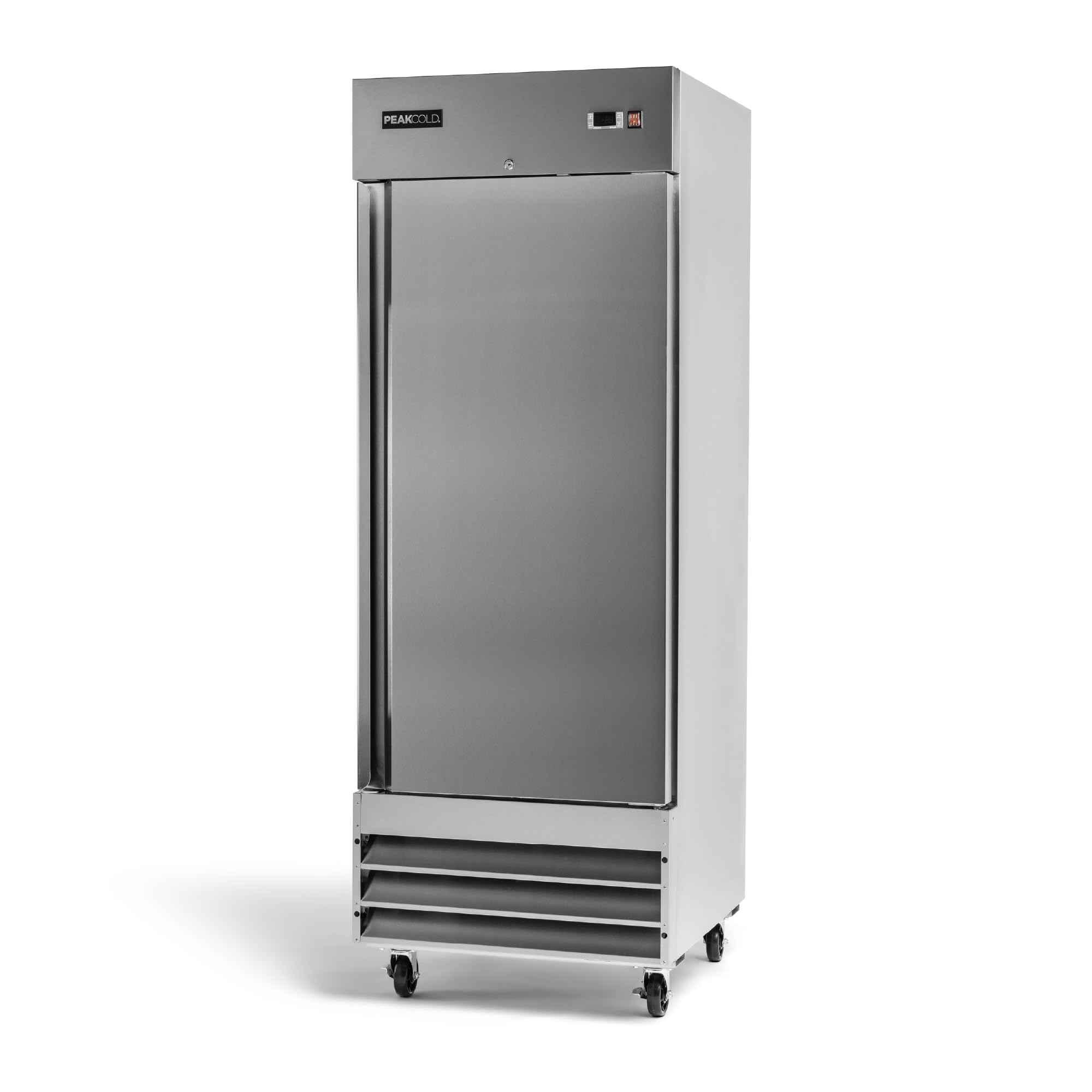
Built around cleaning day — a white aluminium interior and magnetic gaskets that wipe down in minutes.
Hygiene is where this cabinet is strongest. The interior is white aluminium with magnetic gaskets, and that combination is chosen so routine cleaning is fast and sanitary rather than a scrubbing exercise. The stainless exterior wipes straight down to a polished finish. Automatic lighting switches on when the door opens, and 3 adjustable shelves hold 23 cubic feet of high-volume ingredients — same capacity as the ICECASA reach-in above, so this is the cleaner-interior pick of the pair.
Cooling is handled by a commercial-grade 1/5 HP compressor with a dedicated fan, holding a stated 33-41°F with digital controls so you set the number and the system keeps it there. It is engineered to operate within normal commercial-kitchen sound levels, and it runs on R-290 refrigerant. The door is designed around a busy line: it self-closes under 90 degrees to save energy, and stays open past 90 degrees so you can restock without fighting it. Programmable auto defrost, a secure lock, and a stainless exterior come standard — a full set of practical features with no padding.
On reliability, the picture is genuinely mixed rather than one-sided. The quality is the strongest theme in the feedback, with owners describing the packaging as immaculate — styrofoam, cardboard, wood board, and shrink wrap — and one noting the noise level is lower than a dishwasher or a high-efficiency washing machine. The counterpoint is that a unit stopping after a year of use does appear in the feedback. That is a real risk to price in, and it is why the 3-year parts and 5-year compressor warranty matter here. Support is in-house and US-based with 1 year of free on-site maintenance service.
What you are paying for: 430 kilowatt hours per year — the lightest of the two stainless reach-ins here, against the ICECASA 27-inch unit’s 500 kilowatt hours per year.
Suits you if: cleaning turnaround and easy hygiene seals matter more to you than raw horsepower on the label.
Not your pick if: a single cabinet failure would genuinely shut down your service — buy the warranty coverage, not just the fridge.
7. KoolMore 27 cu. ft. Medical Vaccine Refrigerator

Ten shelves of logged, alarmed storage designed for a pharmacy that has to prove what happened overnight.
Stored stock here can be traced, not just chilled. The cabinet logs temperature data and exposes it through a USB port, which turns “I think it stayed in range” into a record you can pull up. The 10 adjustable shelves each carry up to 83.6 pounds, spread across 26.7 cubic feet in a tall two-door format with glass swing doors and a steel finish. A built-in air duct system keeps air moving through a fully loaded cabinet, which is where deep units usually develop a warm corner.
The alarm suite is the reason this sits at the top of the category. Low and high temperature, power failure, sensor issues, door ajar, and ambient temperature changes are all covered, backed by a 15-hour battery for continuous monitoring. Note the 15-hour figure versus the compact KoolMore’s 24-hour backup above — if a long outage is a realistic scenario for your site, that difference matters. Precision is stated at 0.1°C display accuracy, with temperature stability within 2°C, and the dual display shows both temperature and humidity. The unit is UL certified and carries a 1-year manufacturer’s warranty covering parts and labour.
The practical adjustment for anyone moving from a home-style cabinet is the scale of it: the doors swing on a tall unit, so plan the ceiling and door-swing clearance before delivery. As with any cabinet logging data on a USB port, decide your download routine on day one rather than the week an inspection lands. And the Celsius-only temperature and humidity display is worth flagging up front — if your team works in Fahrenheit, build the conversion into the written procedure.
Understand the backup battery clearly: 15 hours of continuous monitoring and alarms, not 15 hours of refrigeration. The compressor stops with the power; the record and the alert keep running.
Built for: a pharmacy, laboratory, or large clinic that must document temperature history and be warned the moment conditions drift.
Know the Specs
Temperature uniformity and stability
Uniformity is how evenly cold is spread through the cabinet; stability is how little the set point drifts over time. A unit can be excellent at one and weak at the other. KoolMore publishes plus or minus one degree Celsius of uniformity on its 4.5 cubic foot countertop cabinet, and stability within 2°C on the 27 cubic foot model. Those two figures describe different jobs — the first is about every shelf sitting in the same band, the second is about the whole cabinet holding steady through the day. When a listing gives you a range like 33 to 41°F, that is the working band, and the fluctuation figure tells you how far inside it the cabinet actually stays.
Alarms, battery backup, and data logging
These three work as a chain. The alarm detects a problem — high or low temperature, power loss, a failed sensor, or a door left ajar. The battery backup keeps that alarm and the monitoring alive when mains power drops, so the outage is recorded rather than silent. Data logging then gives you the history to prove what the cabinet did. Note that the battery in these cabinets powers monitoring and alarms, not the compressor, and the published runtimes differ by model — 24 hours on the compact KoolMore, 15 hours on the 27 cubic foot unit. Match the runtime to how long your site realistically goes without power.
Defrost type and daily workload
Automatic defrost cycles itself, so frost never builds; manual defrost means you schedule the job yourself. In a busy setting, automatic defrost is worth prioritising — the ICECASA reach-in cycles automatically every 4 hours, and the PEAKCOLD offers programmable auto defrost. A manual-defrost cabinet is not a flaw, but it is a recurring task that lands on whoever is on shift.
Footprint, depth, and door swing
Cabinet width is the number people shop on, but depth with the door open is the number that decides whether it fits. The ICECASA under-counter unit needs 55 inches of clearance with its doors open; the 27-inch reach-in needs 56.8 inches; the tall KoolMore needs 47.05 inches. Measure that clearance alongside your aisle width, not just the wall space. Under-counter and worktop units also buy back floor space by giving you a usable surface above.
Common Questions
Do these cabinets hold temperature during a power cut?
Can I use a beverage display fridge for vaccines or medicines?
Why do the medical fridges show temperature in Celsius only?
How much fluctuation is acceptable in a vaccine refrigerator?
Do I need a built-in air duct or fan system?
Can a commercial refrigerator go in a garage or outbuilding?
How does manual defrost compare with automatic defrost?
Will the cabinet fit under my counter or in my prep line?
What warranty and support should I expect on a commercial refrigerator?
Is UL, ETL, or NSF certification important on a medical refrigerator?
The Bottom Line
For most buyers who need dependable cold storage at volume, the winner here is the Tylza Glass Door Beverage Display Refrigerator 350L — 350 liters holding up to 590 cans, a self-closing door hinge that stops cold-air loss, and 250 kilowatt hours per year against the ICECASA under-counter unit’s 400. It earns that spot on quiet running and steady temperature rather than on a marketing claim.
If your stock has to be monitored and logged, change lanes. The KoolMore 4.5 cu ft Countertop Medical Pharmacy Refrigerator pairs 24-hour battery-backed alarms with the tightest published uniformity in this list, and it is the right size for a small practice. If you need that same discipline at pharmacy scale, the KoolMore 27 cu. ft. Medical Vaccine Refrigerator gives you 10 shelves, data logging to a USB port, and 15 hours of backup monitoring.
And if floor space is your real constraint, the ICECASA 48″ W Worktop Undercounter turns a fridge into a stainless prep bench rated for 440 pounds. Work out which of those three problems you actually have — volume, proof, or space — and the choice makes itself.
How we choose
We do not accept paid placement. Every pick is matched to a real buyer and a real use-case; we do not hands-on test units.
Sources
Specifications: manufacturer listings and product documentation. Review insights: verified customer reviews, as of October 2026. Pricing: not shown on this page (it changes often); check the current price via the retailer link.
As an Amazon Associate, Aappliancez earns from qualifying purchases. This does not affect which products we feature.