Disclosure: Some links in this post are affiliate links. As an Amazon Associate I earn from qualifying purchases, at no extra cost to you. Learn more
Specs are compiled from manufacturer listings and verified buyer reviews and can change over time — please confirm the key details on the product page before buying.
You want a machine that still sews a straight line after someone else has already broken it in. And here is the short answer: the Brother XM3700 is the safest place to start, because it pairs 37 built-in stitches with an automatic needle threader and the sort of light weight you can lift with one hand. Modern computerised machines rarely need a rebuild, so most of what you are shopping for is stitch count, feed quality and how easy the machine is to thread.
This guide is built by comparing the manufacturers’ published specifications and the patterns across verified customer reviews, so you get each pick’s real strengths and trade-offs instead of marketing spin.
Below you will find nine machines ranked by what they actually do well, from a starter that mends jeans to a quilting workhorse with 411 stitch applications. Every pick here is a current model you can buy new today, which is the smarter way to shop used sewing machines.
Top Picks


How To Choose The Best Used Sewing Machines
The single biggest mistake buyers make is shopping for a machine that is already worn out. A motor that has been run hard for years loses its torque, and a machine that will not push through denim on day one will not improve. Modern computerised units hold their settings far better than the belt-driven machines of decades past, so a lightly used current model is a safer bet than a vintage unit with unknown hours on it.
Start with stitch count, then stop caring about it
Anything past roughly a dozen stitches covers mending, hemming and basic garment work. The Janome 2212 gives you 12 built-in stitches and a four-step buttonhole, which handles everyday repairs without menus. The machines with 100 or more stitches are for people who want decorative work and quilting detail, not for someone sewing a school uniform hem.
Look hard at the threading system
A needle threader pushes the thread through the eye for you, and it is the feature beginners abandon machines over. The Brother XM3700 includes an automatic needle threader plus a jam-resistant drop-in top bobbin, so you load the thread from above rather than fiddling underneath. If your eyesight or your patience is limited, this one detail matters more than the stitch library.
Check the feed system before you commit
Feed dogs are the little teeth that pull fabric through under the needle. The Janome JW8100 uses a 7-piece feed dog system to move fabric evenly, which is what stops cotton and knits from puckering as you sew. A machine with a weaker feed will shift layered fabric, and you will fight it on every seam.
Decide if you need a free arm
A free arm is the slim section revealed when you slide off the accessory compartment, and it lets you sew around a tube. That is how you hem a sleeve or a pant leg without unpicking the seam. The Brother XM3700 and the SINGER 6700C both offer it, and if you mend clothing regularly it earns its place.
Side-by-Side Comparison
| Model | Best For | Built-In Stitches | Item Weight | Buttonholes | Amazon |
|---|---|---|---|---|---|
| Brother XM3700★ Best Overall | First machine for a home sewer | 37 | 12.5 pounds | One-step auto-size | Amazon |
| Janome JW8100Quilting Ready | Quilting and garment work | 100 | 12 pounds | 7 one-step | Amazon |
| SINGER M1150Best for Small Spaces | Small spaces and classes | 16 | 5 kg | 4-step | Amazon |
| American Home AH600 | Kids and total beginners | 12 | 12.8 pounds | 4-step | Amazon |
| FEIYUE FYe360 | Speed control on a budget | 23 | 13.6 pounds | Included foot | Amazon |
| Janome 2212 | Simple mechanical reliability | 12 | 14.9 pounds | Four-step | Amazon |
| Brother CP100X | Quilting on a wide table | 100 | 10.5 pounds | 8 auto-size | Amazon |
| PooLin EOC02 | Creative decorative stitching | 200 | 7.5 kg | Computerised | Amazon |
| SINGER 6700C | Heavy fabric and monogramming | 411 stitch applications | 14.6 pounds | 7 one-step styles | Amazon |
Detailed Reviews
1. Brother XM3700 Sewing Machine 37 Built-in Stitches
Our pick — 4.5+★ from 950+ verified ratings; the strongest balance of quality and price.
The starter machine that lifts with one hand and threads itself.
The thing you notice first is weight. At 12.5 pounds, this is light enough to carry from a closet to a kitchen table and back again. If you sew on a table that has to be cleared for dinner, that portability is the whole point.
Then there is the threading. Brother fits an automatic needle threader that pushes the thread through the needle for you, plus a jam-resistant drop-in top bobbin that loads from above. You will not be crawling under the machine with a bobbin case on your knees. Twenty feet of accessory pouch, five sewing feet and a three-piece needle set come in the box, so you are not buying a zipper foot as a separate order.
You get the basics done well, and that covers most of what any sewer needs. Buyers report loyalty: “I love this brand!” after a previous Brother gave twenty years of service, and another notes “has perfect power no jamming.” The weak point is durability: the occasional unit is reported to give out early, so register the warranty as part of setup, not an afterthought.
What holds up under daily use
- Automatic needle threader and drop-in bobbin remove the two fiddly steps beginners quit over
- Free arm exposes for cuffs, sleeves and baby clothes
- 37 stitches plus a one-step auto-size buttonhole cover garment and craft work
- Free technical support by chat or phone for the life of the machine
Where it asks for care
- Durability is the recurring gripe — an early failure is reported on a small number of units
- Sold for US use at 120 volts only, which voids the warranty outside the US
- Five feet take practice to swap confidently
Reach for this if: you want one machine that mends jeans, hems curtains and teaches you to sew without a manual fight.
Think twice if: you plan to quilt full-size bed quilts — you will want the wider table on the CP100X instead.
2. Janome JW8100 Computerized Sewing Machine
A metal-bodied machine that arrives already set up for quilting.
Here is the gap that decides it: the JW8100 carries 100 built-in stitches against the 16 on the SINGER M1150, roughly six times the library. Those extra stitches are not decoration for its own sake. Seven one-step buttonholes mean you size a buttonhole by dropping the button in the foot instead of counting turns of a dial, and the LCD screen lets you pick a stitch and adjust length and width without hunting.
Janome builds this around a 7-piece feed dog system, the teeth that pull fabric past the needle. That is what keeps cotton, knits and layered materials moving without shifting or puckering. The quilting kit arrives with the machine: an extra-wide extension table, a hard cover, an even feed foot and a quarter-inch foot for piecing. On denim the results hold up — “flawless, even stitches, no tangles,” as one long test on heavy fabric was summed up. It is also a physically compact machine at 7″D x 16″W x 12″H next to the Brother XM3700 at 15″D x 31″W x 29″H.
The honest catch is light. Several owners want a brighter lamp over the needle, because the LED is serviceable rather than generous when you are working dark fabric at night. The body is metal and the standard 15 bobbins are the common size, so consumables are easy to find. What earns it the spot is the combination of precision feeding and a quilting kit already in the box.
Where the money goes: metal construction, seven feed dogs and a full quilting accessory set, which is why this sits in the mid-range rather than the starter bracket.
The trade-off: the work light is dimmer than the screen suggests, and heavy users will want a clip-on lamp beside it.
Suits you when: you want to quilt blocks and sew garments on one machine without buying feet separately.
Look past it when: you only ever hem and patch — a mechanical dial machine will do the same job for less.
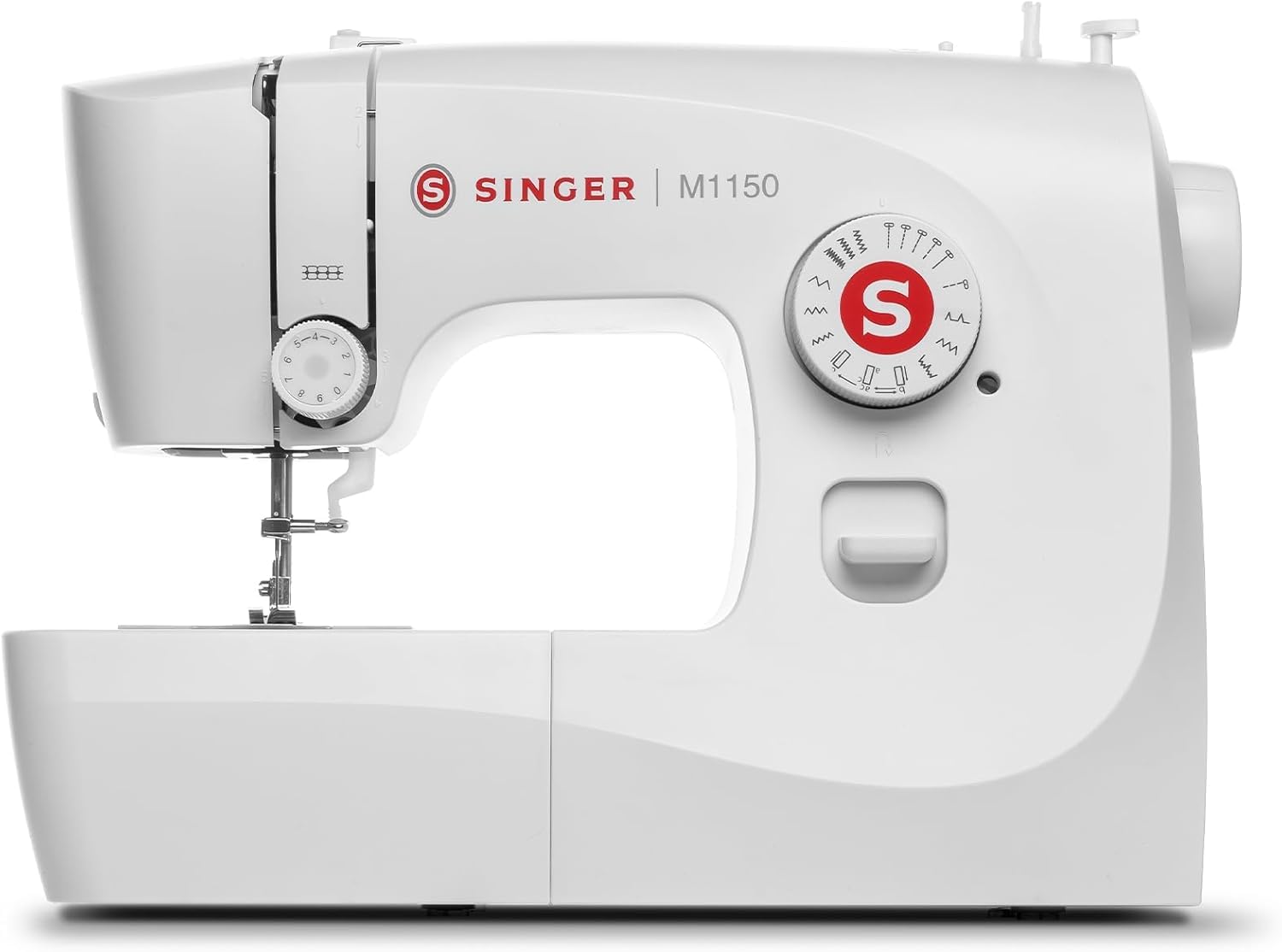
3. SINGER M1150 Portable Sewing Machine
Tuck it in a cupboard, carry it to class, never fight a bobbin case.
The M1150 is a 5 kg machine with a carry-friendly footprint, and that is the entire brief. It suits an apartment where the sewing table is also the dining table, and it suits a beginner walking into a weekly class. Turn the stitch selector dial to a preset and go — no menus, no screen, no settings to learn before your first seam.
Sixteen stitches give you 45 stitch applications, so the same 16 patterns stretch across more jobs than the raw number suggests. A four-step buttonhole handles shirt and dress closures. The top drop-in bobbin loads from above and the threading guides are printed clearly on the machine, which matters when you are learning. The stitches themselves are the part that keeps people happy: “the stitches are perfect, a must for me,” as one buyer put it after moving off an older machine.
One thing to plan around is setup. The printed manual does not walk you through every step, and the buyers who got going fastest did it with a video tutorial open beside them. Needle changes are also a little cramped for larger hands. Neither problem stops you sewing, but both mean your first session takes longer than the box implies.
Go for it if: portability and a short learning curve matter more to you than a large stitch library.
Give it a miss if: you want decorative stitching and lettering — 16 stitches will not stretch that far.
4. American Home Believe Beginner Sewing Machine AH600

Twelve stitches, an automatic stitch control, and a nine-year-old who can run it.
This is the machine to buy when someone in the house is learning from zero. Twelve pre-set stitches and a four-step buttonhole cover mending, hemming and simple projects. The automatic stitch control sets width and length for straight stitch, blind hem, zigzag and decorative stitches, so a beginner cannot pick a combination that will not sew.
Two details help you avoid common frustrations. The automatic bobbin winder (it fills the bobbin, the small spool that holds the lower thread) stops when the bobbin is full, so you avoid the overwinding mess that can stall a first project. The free arm (the narrow part for sewing cuffs and sleeves) is roomy: one reviewer noted, “The free arm has so much room, competitors had nothing in this.” A nine-year-old can realistically learn to thread and wind a bobbin here, because the illustrated booklet walks them through it.
At 12.8 pounds with a carry handle, it stores in a cupboard between sessions. The limitation is the manual, which is ordered oddly around bobbin winding, so plan on a video for that one step. The machine itself keeps its place as the gentlest on-ramp in this group, and a 25-year limited warranty backs the purchase.
What it does best: removes every decision a beginner can get wrong — the stitch control is set for you and the bobbin stops filling itself.
The honest catch: twelve stitches will feel limiting within a year if the hobby grows, and the booklet sequence needs a video beside it for bobbin winding.
The right call for: a child, a teenager, or an adult who wants the machine to decide the settings.
Not the right call if: you already sew and want a machine for garment construction.
5. FEIYUE FYe360 Sewing Machine with LCD Display
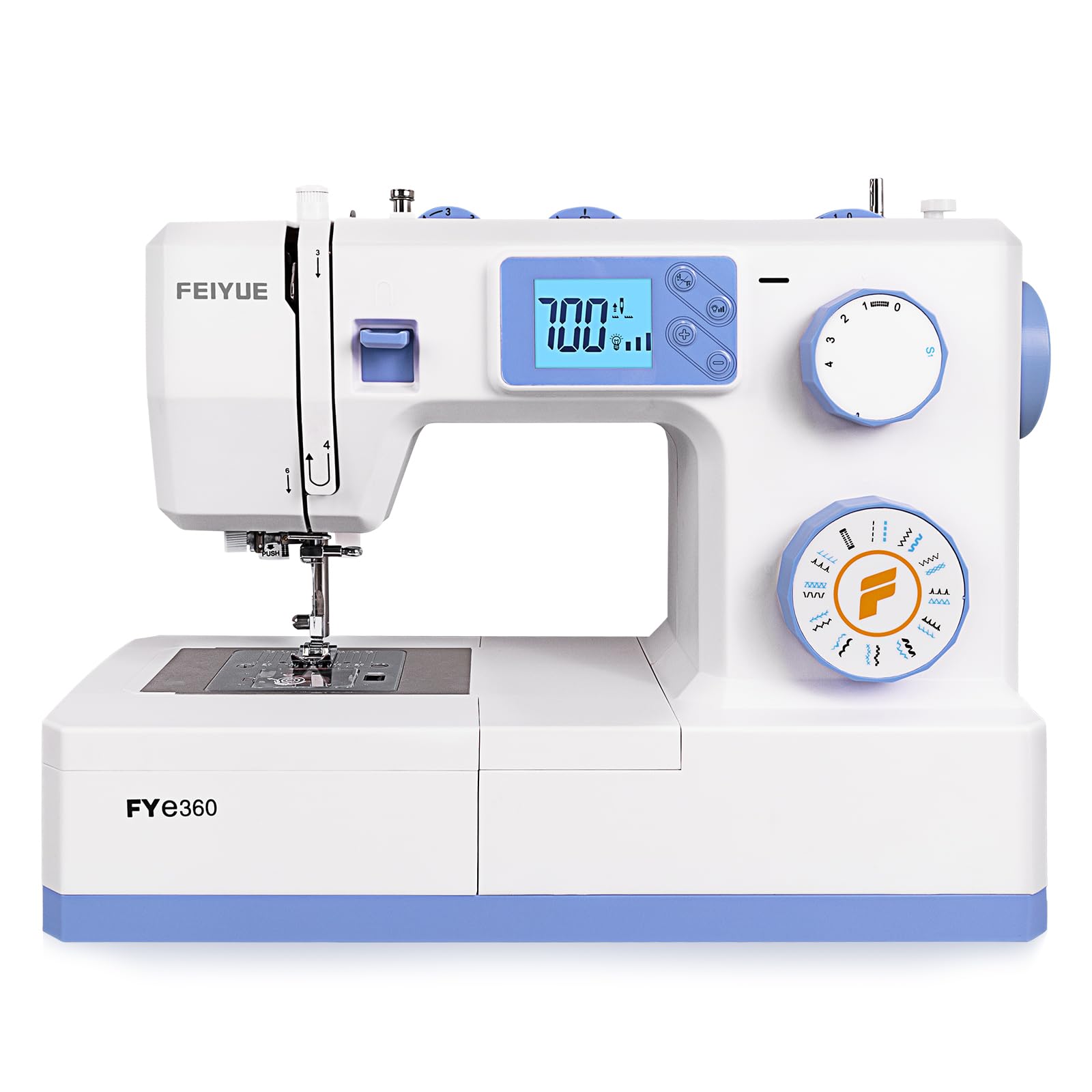
A servo motor and a screen, with the odd early failure in the mix.
Where most machines in this group spin a traditional induction motor, the FYe360 runs an upgraded servo motor — a motor that adjusts its power electronically rather than running flat out. The maker claims 10% higher efficiency and up to 35% energy saving against a standard single-phase motor, which in practice means steadier low-speed control on delicate fabric. The practical result is smooth low-speed control for delicate fabric, and enough torque for multiple layers of denim.
The LCD panel puts needle up/down position, speed and light brightness on buttons rather than dials. There is a protection mode too: if the thread tangles or the machine overloads, it stops and the light blinks, so you clear the jam before the motor takes the strain. Twenty-three stitch patterns cover utility, decorative and buttonhole work, and six bobbins plus five feet and a needle threader come in the kit.
You need to know about the failure reports, because they are the reason this sits lower down the list than its feature set suggests. A share of buyers had the motor seize early or the pedal stick on, and the warranty route did not always resolve it. That is a real risk on a machine of this price, and it is why the older, plainer mechanical models above are the safer purchase for most households.
Worth a look when: needle-position buttons and variable speed control matter to you and you value the servo motor’s slow-speed accuracy.
Look elsewhere when: you want the lowest-risk buy — a simpler mechanical machine has a better reliability record here.
6. Janome 2212 Front-Loading Sewing Machine

No screen, no menus — just metal, dials and a feed that will not quit.
This is the machine you buy if you do not want to think about software. A dial selects the pattern, separate controls set width and length, and a four-step buttonhole handles closures. Twelve stitches is the whole library and it is enough for straight seams, zigzag, blind hems and the odd repair. What owners keep coming back to is build: quality is the trait they single out most, ahead of ease of use and functionality combined in the conversation.
At 14.9 pounds it is the heaviest in this group, and that weight is the reason it stays put instead of walking across the table when you hit the pedal. A 5-piece feed dog system moves fabric through, and the extra-high presser foot lift lets thick seams slide under. It sews multi-fold denim without complaint, and the front-loading vertical bobbin is straightforward to thread once you learn the path. A protective cover is included.
The quirks are mechanical and predictable. The pedal coasts a few stitches after you lift your foot, and the reverse works by holding a lever rather than pressing a button. Bobbin tension is the split topic — some find it spot on, others find it loose. Neither issue is a fault; they are the habits you learn in the first week, exactly as you would on any mechanical machine.
Why it stays on the table
- Heavy at 14.9 pounds so it holds position while you sew
- Dial pattern selection with no screen to fail
- Sews multi-fold denim without strain
- Sliding buttonhole foot and four other feet included
Habits you will learn
- The pedal coasts a few stitches before it stops
- Reverse needs the lever held down
- Bobbin tension divides opinion — check it early on scrap fabric
Buy this one if: you want a machine with no electronic parts that could fail and you mostly sew straight seams.
Pass on it if: you want decorative stitching, lettering or an LCD to guide stitch selection.
7. Brother CP100X Computerized Sewing and Quilting Machine

A hundred stitches, eight buttonholes and a table wide enough for quilt blocks.
Where the Janome 2212 stops at twelve stitches, the CP100X carries 100 built-in stitches and 8 auto-size buttonholes, so utility, decorative and heirloom work all live on one machine. At 10.5 pounds it is the lightest full-size unit here, which is not a small thing if the machine lives in a cupboard and comes out for a few hours on a Sunday.
Brother builds this on a metal frame with a fixed needle bar — the needle stays rigid while you work, which is what produces a clean line rather than a wavering one on long seams. Ten sewing feet come in the box, along with a quilt guide, a wide table and a protective hard case. Owners find it capable on denim, cotton and webbing without tension trouble, and the machine runs quietly enough for an apartment.
Two things are worth knowing before you commit. The LCD screen is not backlit, so a dim room makes the display harder to read than the machine deserves. And the bobbin winder is inconsistent without guidance from your fingers, so wind slowly and check the spool. Neither undoes the value — this is the strongest quilting package in the mid-range bracket.
The quilting case: 100 stitches, an 8-buttonhole set and a wide table plus quilting foot already included, on the lightest full-size body in this group.
The small irritations: an unlit LCD and a bobbin winder that wants manual guidance — both manageable, neither a reason to walk away.
Fits your bench if: quilting and decorative sewing are the plan and you want the accessories supplied rather than purchased later.
Choose something else if: you need to read the screen in low light — the unlit display will frustrate you.
8. PooLin EOC02 Computerized Sewing Machine with 200 Stitches
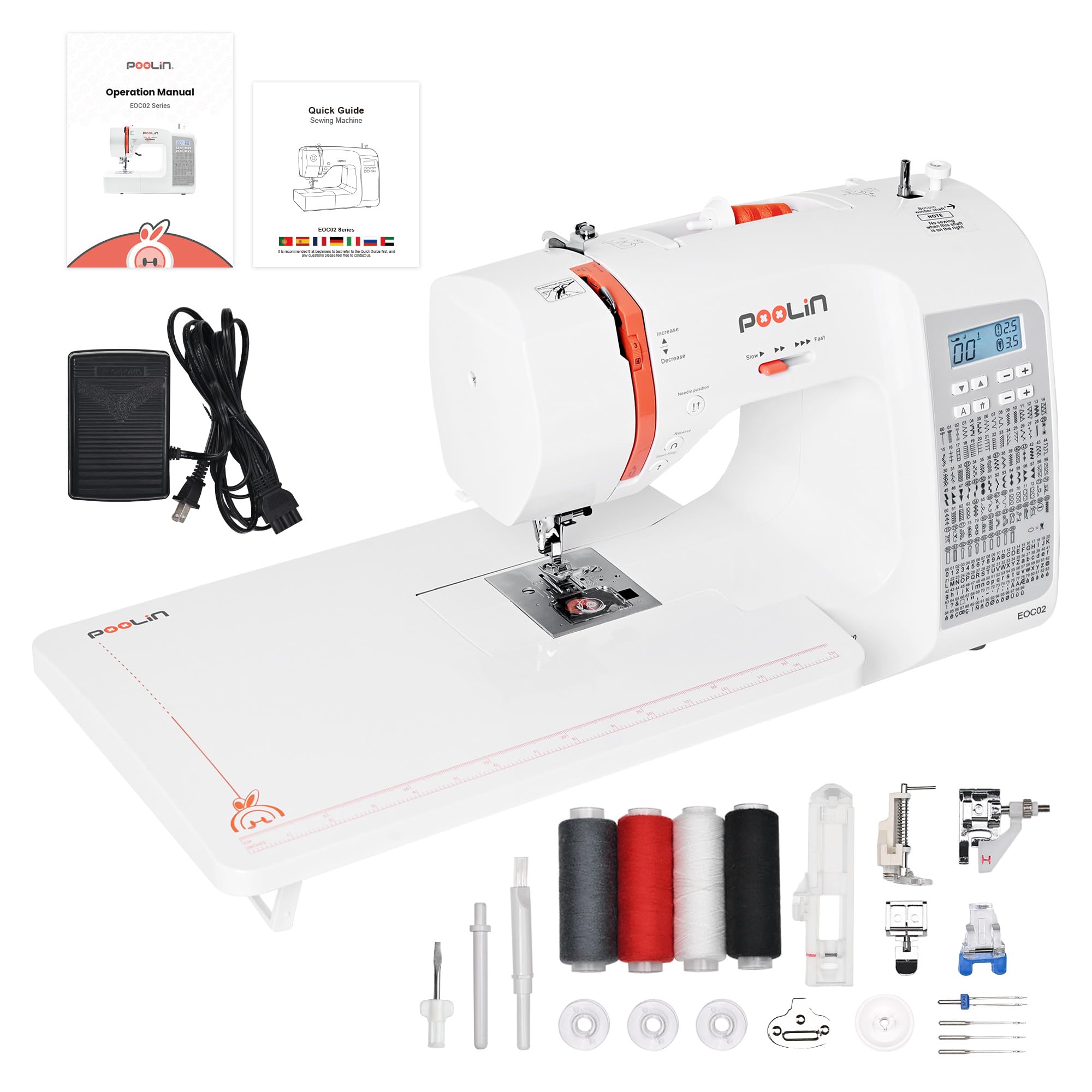
Two hundred stitches on a screen, with an honest limit on heavy fabric.
If decorative and alphanumeric stitching is what you actually want, the EOC02 hands you 200 built-in patterns on an LCD screen. Switching between them is a button press, not a dial turn, and the computerized settings remember what you picked. Seven presser feet cover everything from straight stitching to advanced applications, and the wide table gives quilts and bulky material somewhere to sit.
The everyday experience is reassuring. Owners mention even, consistent stitches, a preset tension that behaves, and noticeably low vibration for a machine of this weight. The start/stop button lets you sew without the pedal at all, and the free arm appears when you lift off the accessory compartment for cuffs and pant legs. The maker lists compatible fabrics up to 6mm of layered or quilted material.
Here is where it is honest with you: this is not a heavy-duty machine. Push three layers plus binding through and it can stop, misfeed a zigzag or break a needle. One owner of a similarly equipped model also found 100% cotton thread fussy, though poly-cotton blends ran fine. Buy it for the stitch library and light-to-medium fabric, and it delivers.
Pick this if: you want a large decorative stitch library, a wide table and computerized selection in one package.
Keep walking if: your work is denim, canvas or upholstery — its feed system is designed for lighter loads.
9. SINGER 6700C Heavy Duty Computerized Machine

The one that goes through canvas, with a metal frame and ten feet in the box.
You get the widest stitch range here: 411 stitch applications, including a lettering font. It sews at 1100 stitches per minute (spm), the fastest top speed on this list, so long garment seams finish sooner. The speed control caps the top end so you can slow down for detail work. Seven one-step buttonhole styles (each makes a finished buttonhole in one step) cover closures from shirts to bags.
The built-in piercing power is the feature that justifies the extra weight. On a desk in a one-bedroom flat it powered through hemmed work pants and a canvas tote — the sort of job that stops a lighter machine. Ten presser feet, four bobbins, a pack of needles and a dust cover come with it, so the walking foot is not an add-on. Stitch selection is by touch buttons on the LCD, and an automatic needle threader saves your eyes.
Quality is the honest caveat here. The machine earns a mixed verdict on that front, and some owners find the plastic parts a step down from older Singers. It is a sound buy for the money and it sews well when set up by the manual, but it is not the machine you hand down to a grandchild. Buy it for capability, not for heirloom build.
What it brings to the table
- 411 stitch applications with a lettering font for monogramming
- 1100 stitches per minute for fast long seams
- Enhanced piercing power for denim, leather and layered quilts
- Ten presser feet including an even feed walking foot
What to weigh honestly
- Build quality draws mixed feedback — plastic parts disappoint long-term owners
- Some units have stopped working unexpectedly
- At 14.6 pounds it is not a machine you put away after each project
The one for you if: you need to sew canvas, denim or leather-like heavy layers and want the widest stitch and buttonhole range available here.
Not the one if: you want a machine with the build quality to last decades — this one is built for capability, not longevity.
Know the Specs
Stitch Count and What It Really Means
A built-in stitch is a pattern the machine can produce, and a stitch application is one of those patterns used for a specific job. The SINGER 6700C lists 411 stitch applications; the Janome 2212 lists 12 built-in stitches. More stitches help if you sew decoratively, quilt or monogram. They do not make a seam straighter — that job belongs to the feed system. For mending, hemming and basic garment work, a dozen patterns is usually enough.
Drop-In Versus Front-Loading Bobbins
The bobbin is the small spool of thread underneath that forms the bottom half of each stitch. A drop-in bobbin sits in a slot under a clear cover on top, so you can see the thread and swap it in seconds. A front-loading bobbin goes into a case that slides out of the side. Drop-in is easier for beginners, which is why the Brother XM3700 uses it. Front-loading gives you a more direct view of the bobbin case when you clear a jam.
Feed Dogs and Fabric Movement
Feed dogs are the metal teeth that rise and pull fabric under the needle. The Janome JW8100 uses a 7-piece feed dog system; the Janome 2212 uses 5 pieces. More teeth spread the grip across a wider area, which keeps layered fabric from drifting. On a machine with a weak feed you will see puckering on knits or shifting on quilts. This is the number that decides whether a machine feels smooth or fights you.
Automatic Needle Threaders
A needle threader is a small hook that pushes the thread through the needle eye for you. The Brother XM3700, Brother CP100X, Janome JW8100 and FEIYUE FYe360 all include some form of it. It is the feature beginners abandon machines over, because re-threading by hand at arm’s length is the most common reason a machine goes back in the cupboard. Check that yours works before you rely on it.
Free Arm and Presser Feet
The presser foot is the metal piece that holds fabric flat against the feed dogs as you sew. A free arm appears when you slide off the accessory compartment, exposing a narrow cylinder for sewing sleeves. Feet snap on and off, and the count varies widely — five with the Brother XM3700, ten with the SINGER 6700C. Buy for the feet you will actually use: a zipper foot, a buttonhole foot and an even feed foot cover most home sewing.
Voltage and Portability
The Brother machines here have stated 120-volt US voltage requirements, and using them on another supply voids the warranty. Weight matters in a different way. A 5 kg machine like the SINGER M1150 is easy to move and store; the 14.9-pound Janome 2212 is heavy because weight is what keeps it planted while you sew. Pick the side of that trade that suits your table and your storage.
Common Questions
Is a used sewing machine worth buying over a new one?
What is the difference between built-in stitches and stitch applications?
Can a small machine like the SINGER M1150 sew denim?
Do I need a quilting table to sew quilts?
How often does a home sewing machine need servicing?
What does a drop-in bobbin change about daily sewing?
Can a sewing machine sew through leather?
What does an automatic needle threader actually do?
Do these machines work on 120-volt US power only?
Which machine is best for a complete beginner who has never threaded a bobbin?
The Bottom Line
For most homes, the used sewing machines winner is the Brother XM3700: 37 stitches, an automatic needle threader (it threads the eye for you) and a jam-resistant drop-in bobbin (the lower thread drops in and resists tangles) let you mend, hem and sew a first garment without a learning curve getting in the way. If quilting is your goal, the Janome JW8100 brings 7 one-step buttonholes, a 7-piece feed system (it grips fabric from several points for even feeding) and a quilting kit in the box. For heavy canvas and the widest buttonhole range here, reach for the SINGER 6700C. The Brother XM3700 suits the widest spread of buyers, from a first hem to years of repairs.
How we choose
We do not accept paid placement. Every pick is matched to a real buyer and a real use-case; we do not hands-on test units.
Sources
Specifications: manufacturer listings and product documentation. Review insights: verified customer reviews, as of October 2026. Pricing: not shown on this page (it changes often); check the current price via the retailer link.
As an Amazon Associate, Aappliancez earns from qualifying purchases. This does not affect which products we feature.