Disclosure: Some links in this post are affiliate links. As an Amazon Associate I earn from qualifying purchases, at no extra cost to you. Learn more
Specs are compiled from manufacturer listings and verified buyer reviews and can change over time — please confirm the key details on the product page before buying.
You already know the feeling: you pull the 3 wood on a par five, swing smooth, and the ball skids along the turf instead of flying. That miss is usually the club, not you — a tight lie is the hardest shot in the bag, and a low, shallow head simply cannot cut through it. The way out is a head with enough size, weight and sole design to launch the ball even when the lie is ugly. The shortlist below covers that fix, from budget-friendly second-hand heads up through premium forged faces.
This guide is built by comparing the manufacturers’ published specifications and the patterns across verified customer reviews, so you get each pick’s real strengths and trade-offs instead of marketing spin.
A used fairway wood is where a serious golfer finds the best balance of a proven head and a forgiving face — every model below has earned its place. If you want the shortest path to hitting fairways again, the used 3 wood at the top of this list is the one to start with.
Top Picks


How To Choose The Best Used 3 Wood
The best used 3 wood is the one whose head shape, loft and shaft match the shot you actually hit. A club that fits your swing lets you repeat the same pass without steering it. A club that fights you turns every fairway shot into a guess about which miss is coming. Four things decide which one you get.
Head size and forgiveness
Head size is measured in cc, or cubic centimetres — a simple volume figure. A bigger head spreads weight further from the centre, so a slightly off-centre strike still travels. The TaylorMade SiM 2 Max uses a 190cc head, which is generous for a fairway wood and sits at the forgiving end of this list. A compact head feels neat on the eye but punishes your thinnest contact.
Loft in degrees
Loft is the angle of the face — more degrees mean an easier, higher launch. A 15 to 16 degree head flies lower and rolls out. A 16 degree head like the Orlimar Escape sits a step higher. Pick lower loft for windy days and more loft when you struggle to get the ball airborne.
Shaft flex and length
Shaft flex is how much the shaft bends under your swing — Regular is the common middle ground. Length matters just as much: a 43 inch club is easy to control, while a longer build gains clubhead speed but costs accuracy. Always match the flex to the head, since a ladies flex head will feel very different from a regular.
What “used” really changes
On a used club the face grooves and the shaft are the two things worth checking. A shiny crown tells you little. Worn grooves cost you spin on the green, and a tired shaft loses the kick that gives you speed.
Side-by-Side Comparison
| Model | Best For | Head Size | Loft | Weight | Amazon |
|---|---|---|---|---|---|
| TaylorMade SiM 2 Max Fairway★ Best Overall | All-round forgiveness off the tee | 190cc | 15.0 degrees | 10.4 ounces | Amazon |
| Intech Behemoth Oversized Fairway WoodMost Forgiving Entry | High handicappers on a budget | — | — | — | Amazon |
| Orlimar Escape Fairway Wood | Point-and-shoot accuracy | — | 16 degrees | — | Amazon |
| Pinemeadow Yukon Fairway Woods | Escaping thick rough | — | — | — | Amazon |
| Cleveland Golf Launcher Halo XL | Clean turf interaction | XL Head | 18 degrees | 1.2 pounds | Amazon |
| Callaway Rogue ST Max Fairway Wood | Ladies-flex players | — | — | — | Amazon |
| Callaway Paradym Ai Smoke Max | Neutral ball flight | — | — | 10.4 ounces | Amazon |
Detailed Reviews
1. TaylorMade SiM 2 Max Fairway
Our pick — 4.5+★ from 400+ verified ratings; the strongest balance of quality and price.
The 190cc head that turns a thin strike into a playable ball flight.
This is the club for the golfer who keeps catching the ball low on the face. The 190cc head gives TaylorMade room to push weight where it helps you, and a bigger head simply misses less badly. For reference, that is a far larger volume than a typical compact fairway wood, and the size is the whole reason the forgiveness feels real.
The Thru-Slot Speed Pocket is a slot cut behind the face — it lets the face flex on contact. That matters most when you catch one low, because the face springs back and keeps ball speed rather than losing it. The C300 steel face is a high-strength steel, and it works with Twist Face, a face curved to straighten your miss-hits. Buyers report: “They have added distance and accuracy to my game.”
Buyers single out how playable it feels from the first round. The V Steel sole redistributes weight and keeps the centre of gravity low, and a depressed heel and toe shrink the sole area so it slides through turf instead of bouncing. The club arrives at 15.0 degrees of loft with a standard Regular flex and a 47 gram Golf Pride Z-Grip. At 10.4 ounces it stays light enough to swing freely on the last hole.
Where it earns its spot
- A 190cc head is the most forgiving size here — off-centre strikes still travel.
- The Thru-Slot Speed Pocket keeps ball speed up on low-face contact.
- Twist Face and C300 steel work together to straighten your misses.
- 15.0 degrees with Regular flex suits most mid handicappers straight away.
What to weigh before buying
- The larger head looks busy behind a tight lie compared with a compact wood.
- The stock Regular flex will feel loose to a faster swing speed.
- 15.0 degrees flies lower than the 16 degree Orlimar, so wind play costs you height.
Buy it for: the golfer who wants one fairway wood that covers tee shots and long approaches without a premium head price.
Think twice if: you already swing stiff flex and hate the look of a deep head behind the ball.
2. Intech Behemoth Golf Fairway Woods
An oversized head aimed squarely at the golfer still learning to get the ball up.
If you shoot in the 20+ handicap range, this is the club built for you — the listing itself sets the recommended level at 20+. The head is supersized and high MOI (moment of inertia — a measure of how much a club resists twisting when you miss the centre), so the balance feels bigger and a toe strike does not dive left. The lofts are chosen to get the ball airborne, which helps players who struggle with launch.
The headcover is included, and the club is fitted with a matching lightweight graphite shaft. An oversized build like this also means the club measures 44 inches in height on the listing and 4 inches across, which is a substantial footprint compared with the Pinemeadow, at 50 inches tall and 5 inches wide.
Durability is the catch that decides this club for you. Owners mention “We literally played 2 rounds and on the 3rd round his head broke off and so did mine!!!” The head finish also draws mixed comments, and some describe the shaft as feeling weak. Treat this as a starter club to learn the swing shape, not a long-term gamer: play it, learn to launch it, then move up.
The beginner brief: a forgiving oversized head at an entry-level tier, and the lowest-cost way on this list to find out whether a fairway wood suits your game at all.
Why it may not last: the head-to-shaft join is the weak point. For a range-season learner that trade-off is fair; for a golfer playing weekly, save for the TaylorMade instead.
Reach for this if: you are brand new, on a tight budget, and want to feel what a large head does for your confidence.
Look elsewhere if: you already play regularly and need a club that survives a full season of practice.
3. Orlimar Escape Fairway Wood Golf Clubs
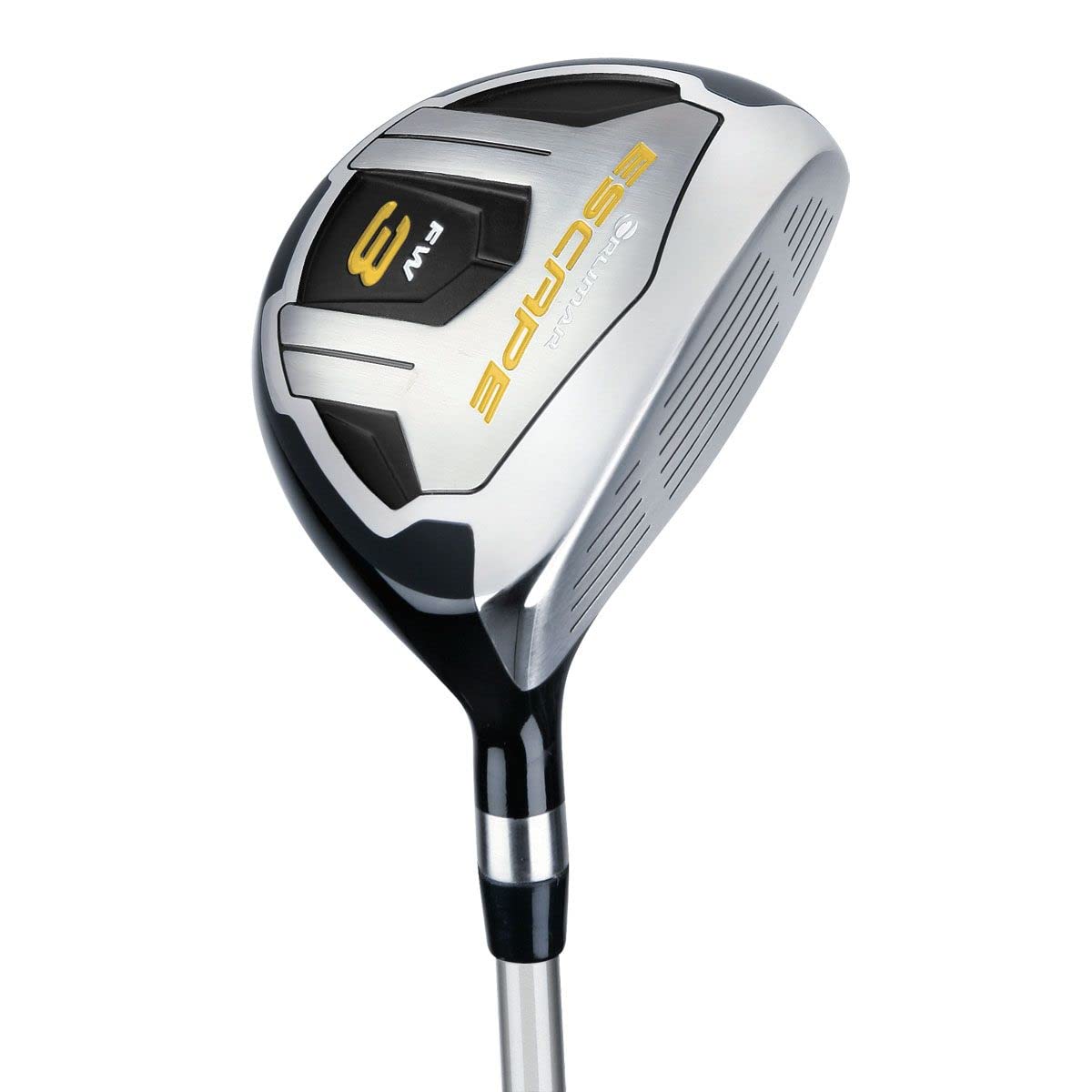
A shallow face that scoops the ball off tight lies and lands it softly.
Sixteen degrees of loft sits at the top of the fairway-wood range, and that is the number to focus on here. Compare it with the TaylorMade at 15.0 degrees and you get a slightly higher launch — the Orlimar flies a touch higher and stops a touch faster on the green. That extra degree is a real help when your swing speed is modest.
The face height is also shallow, and that is the accurate part. A shallow face gets under the ball even from a bare lie in the fairway, so you scoop it rather than chop down on it. The centre of gravity sits low, which sends the ball up and lets it settle softly instead of running out. Appearance is what buyers praise most about this head. One buyer calls it a club that made his game better: “Great 3wood easy to hit its a good buy,made my game better”.
The shaft is an Orlimar Escape Superlite 60 graphite in Regular flex, and the grip is an Orlimar custom velvet. The face angle is a closed 1 degree, which is worth knowing: a closed face is a slightly closed clubhead angle that helps stop the ball fading to the right. It ships with a form-fitting head cover. What this head asks in return is that you trust a controlled swing rather than a fast one — the shallow face punishes a steep, heavy hit.
The accuracy case: shallow face plus low centre of gravity plus 16 degrees equals a club that gets the ball airborne from the fairway and holds the surface when it lands.
The right buyer: a player with moderate swing speed who wants a higher, softer flight and has struggled to stop a 3 wood on the green.
The trade-off: the closed 1 degree face angle will not suit a golfer who already fights a hook.
4. Pinemeadow Yukon Fairway Woods (High Lofts)

Two rails on the sole built to slice through turf instead of bouncing off it.
Twin rails run along the bottom of this head, and their job is straightforward. On a normal flat sole the club can skip off the ground before it reaches the ball; the rails cut a path so the face gets there cleanly. If your course has juicy rough or bare, tight fairways, that difference shows up on the second shot you actually care about.
Pinemeadow fits this head with a low-torque graphite shaft — torque is how much the shaft twists on the downswing, and lower torque means less twist and more control. The build is Regular flex on a synthetic rubber grip, and the club measures 50 inches long and 5 inches wide, so it is the longest head in this lineup compared with the Intech at 44 inches. The maker positions it for any golfer who wants to drop the longer irons from the bag.
The rails are what buyers credit for confidence from bad lies. As buyers put it: “I for one shied away from 3 woods but this club cured me of that.” The club is also fitted with the standard head cover. The trade-off is the finish and weight — the head feels heavier in the hands than a light carbon-crown design, which some players love and others find slow. It asks a smooth tempo rather than a hard grab.
The rough-cut
- Twin rails keep the face moving through thick grass instead of bouncing.
- A low-torque graphite shaft gives a stable, controlled feel.
- Suits golfers who want to drop long irons from the bag entirely.
What you are trading
- The heavier head feel slows down a fast, aggressive swing.
- At 50 inches the length takes some getting used to for compact players.
- Finish quality draws mixed comments, so check the crown on a used head.
Pair it with: a course where rough and tight fairways punish a flat sole, and a swing you would call smooth rather than fast.
Pass if: you want the lightest head in the bag and a fade-friendly face angle.
5. Cleveland Golf Launcher Halo XL Fairway Wood

Two rails and two flex zones working together to keep the face square.
The GlideRail sole is the headline. Two rails run along the bottom, tuned to glide through the turf with less drag, so the face stays square coming into the ball. Compare that with a flat sole and the difference is control — a square face flies straight instead of drifting right. The XL Head packs more MOI than the company’s last generation, and the low-and-deep weighting sends the ball up rather than forward.
Rebound Frame is the second engine: instead of one flex zone, this head has two alternating zones that work together. More of your swing energy goes into the ball, which is why the flight feels lively for a head this forgiving. Build quality is what buyers praise most about this club. Buyers also report it hitting as well as premium heads that cost far more. One golfer put it this way: “Great club! Got this 3W during Prime Days at a great price. Worth every penny.”
Where it asks something from you is the low, shallow head shaping. It takes range time to get used to, and a couple of players find it hard to hit clean in thick rough. It is built with adjustability, and the head arrives at 18 degrees of loft in Regular flex, weighing 1.2 pounds. Give it a session on the range and the square face starts finding fairways.
Where the value lives: GlideRail turf interaction plus a two-zone Rebound Frame at a mid-range sticker — a lot of the premium design language without the premium stamp.
The honest limit: the low head profile can feel odd at address, and consistency in deep rough is the one spot players mention struggling.
Choose it when: you want clean turf interaction and a square face through the ball without paying top-tier prices.
Hold off if: you want a tall face to dig out of heavy rough.
6. Callaway Golf 2024 Rogue ST Max Fairway Wood

A ladies-flex fairway wood built to launch, not to muscle the ball.
The Face Cup is the reason this head feels hot. It is a cup-shaped face welded around the edges, so it flexes more across the whole hitting area than a flat face would. That flex turns your normal swing into a faster ball speed, and it forgives a miss-hit rather than punishing it. The deep, low profile gives you a shallow face that gets the ball airborne easily — which is exactly what a lighter swing needs.
The carbon crown is the quiet helper: it saves weight up top that Callaway moves down low, which lifts MOI for forgiveness on off-centre contact. If you swing with a smooth tempo and want the ball to climb, this head is built for it.
The one thing to check on a used copy is the flex on the shaft. This is a ladies flex, and that needs to be spelled out clearly on the listing. As one golfer put it: “This is a woman shaft just FYI.” The carbon crown and Face Cup handle launch; the ladies-flex shaft is what decides whether this club fits you.
Made for: a golfer with a smooth, moderate tempo who wants maximum launch and a forgiving face without heavy clubhead weight.
Double-check first: the flex printed on the shaft — this listing is ladies flex, and that is the wrong fit for a stiff swing.
7. Callaway Golf Paradym Ai Smoke Max Fairway Wood

A carbon-chassis fairway wood tuned for straight, repeated launch.
The Ai Smart Face is a face shaped by a computer model to keep ball speed up when you miss the centre — a real safety net on long par fives. The lighter, stronger carbon chassis moves weight around the head where it does the most good. And the Tungsten Speed Cartridge — a dense metal weight low in the head — pushes the centre of gravity down so the ball climbs without spinning up. Callaway calls it a neutral ball flight, meaning the club does not bias left or right.
Mid handicappers win here because the club feels good off the face and plays easy. One owner compared it to hunting for a fresh head for an older bag: “I was a little worried ordering this club because I figured there was no way to get a brand new Ai Smoke in 2026, but this was exactly what I was looking for.” You also get adjustability — you can change loft and lie to match your swing.
The trade-off is that it is a premium head with a premium-level ticket. Compared with the TaylorMade SiM 2 Max at 15.0 degrees, this one is speced the same on loft but with a carbon chassis and tungsten cartridge that the SiM 2 does not use. Weigh that against a used copy where the face and grip are already broken in. If you want neutral flight and adjustability, this is the premium answer.
The neutral-flight case: a carbon chassis, tungsten low weight, and an Ai Smart Face built to keep ball speed up even on off-centre strikes.
The trade-off: a premium-tier ticket where a mid-range head like the TaylorMade SiM 2 Max covers most of the same shots, and the adjustability is wasted if you never actually change the settings.
For the player who wants: a neutral ball flight, adjustable loft and lie, and the latest face technology in the bag.
The alternative: the TaylorMade SiM 2 Max covers most of the same fairway shots without the premium ticket.
Know the Specs
Head Size in CC
CC means cubic centimetres — how much space the head takes up. A larger head lets the manufacturer move weight further from the centre, which raises MOI and protects your ball speed when you miss the centre. A 190cc head like the TaylorMade SiM 2 Max gives you more room for error than a compact fairway wood, while a small head keeps the profile neat behind the ball. Neither is better in every case — pick the bigger head if straight shots matter more than a clean look.
Loft in Degrees
Loft is the angle of the clubface sitting back from vertical. More degrees mean an easier, higher launch that lands soft; fewer degrees mean a lower, running shot. On fairway woods the common range runs from about 15 to 18 degrees. Higher loft suits slower swing speeds and firm greens, while lower loft suits a faster swing and windy conditions. Match loft to your launch rather than copying a friend’s setup.
Shaft Flex and Torque
Flex describes how much the shaft bends during your swing — a ladies flex bends most, and a regular flex sits in the middle. Torque is how much the shaft twists, and lower torque means steadier control of the head. A shaft that is too stiff for your swing kills launch height; too soft and the ball sprays. On a used club this matters more than any crown scratch — always read the flex printed on the shaft.
Face Technologies
A Speed Pocket is a slot behind the face that lets the face flex on low contact. A Face Cup wraps the face around the edges to spread flex across the hitting area. Rebound Frame splits the head into alternating flex zones to send more energy into the ball. All three are ways to recover ball speed when your strike is not perfect, and all three reward a squarer strike with better distance.
Common Questions
Is a used 3 wood worth buying instead of a new one?
What does 190cc mean on a fairway wood?
Do I need a Regular or Stiff shaft in my 3 wood?
Will a shallow face 3 wood actually get the ball up off a tight lie?
How do twin rail soles help from the rough?
Is a 16 degree 3 wood better than a 15 degree one?
Can I change the loft on a fairway wood?
How do I check a used 3 wood before buying it?
What weight should a 3 wood be for an average golfer?
Does head size actually change forgiveness or is it marketing?
The Bottom Line
For most golfers, the used 3 wood worth starting with is the TaylorMade SiM 2 Max Fairway because its 190cc head, Thru-Slot Speed Pocket and Twist Face combine to keep a thin or off-centre strike playable. If you want a shallow face that launches higher and lands softer, reach for the Orlimar Escape Fairway Wood at 16 degrees. And for a beginner on a tight budget who wants a first oversized head, the Intech Behemoth is the entry-level way in, so long as you treat it as a learning club rather than a long-term gamer.
How we choose
We do not accept paid placement. Every pick is matched to a real buyer and a real use-case; we do not hands-on test units.
Sources
Specifications: manufacturer listings and product documentation. Review insights: verified customer reviews, as of October 2026. Pricing: not shown on this page (it changes often); check the current price via the retailer link.
As an Amazon Associate, Aappliancez earns from qualifying purchases. This does not affect which products we feature.