Disclosure: Some links in this post are affiliate links. As an Amazon Associate I earn from qualifying purchases, at no extra cost to you. Learn more
Specs are compiled from manufacturer listings and verified buyer reviews and can change over time — please confirm the key details on the product page before buying.
A VPN that gets blocked is just an expensive app that sits there refusing to connect. If you need a tunnel that survives a strict network — a hotel, an office, a campus, a country that filters traffic — the deciding factor is obfuscation: the ability to disguise your VPN traffic as ordinary HTTPS so the network cannot tell it apart from normal browsing. Only a handful of the products below carry that capability on paper, and one of them (the GL.iNet Brume 3) names it outright in its official spec sheet. Start there if blocked connections are your problem.
This guide is built by comparing the manufacturers’ published specifications and the patterns across verified customer reviews, so you get each pick’s real strengths and trade-offs instead of marketing spin.
Some picks here are apps, some are pieces of hardware that push every device in your house through one encrypted pipe — and that distinction matters far more than brand names. The picks below break down what each one actually does about detection, with undetectable vpn tools sorted by how well they hide your traffic.
Top Picks

How To Choose The Best Undetectable VPN
The wrong assumption most people carry is that all VPNs are equally hard to detect. They are not. A standard VPN connection announces itself to a network by the way it behaves — the ports it uses, the way its handshake looks — and a strict firewall can simply refuse it. What gets you through is obfuscation, and only some of the products here have it.
Obfuscation is the feature that actually matters
Obfuscation means wrapping your VPN traffic so it looks like ordinary secure web browsing. One product in this lineup — the GL.iNet Brume 3 — explicitly disguises VPN traffic as regular HTTPS to evade blocking. That kind of masking is what turns a connection from “detected and dropped” into “just another website.”
Split tunneling decides how much you hide
Split tunneling (sending only some apps through the tunnel while others use your normal connection) lets you pick which traffic gets disguised. Mullvad supports it, and its tunnels can be layered through Multihop so your data takes more than one hop before it exits.
No-logs and anonymous accounts are the other half
Being undetectable online and being unidentifiable to your provider are two different problems. Mullvad’s pitch is that it collects no activity logs and asks for no email — you pay and connect without an identity attached. That matters if your real concern is nobody being able to tie traffic back to you.
Speed and device count set the practical limit
Obfuscated traffic and multi-hop tunnels cost you throughput, so check the numbers before you commit. The GL.iNet Brume 3 quotes up to 1100 Mbps VPN throughput with hardware acceleration. The app-based picks cap at a set number of devices — Bitdefender at 10 devices, Mullvad at 5, Malwarebytes at 2.
Side-by-Side Comparison
| Model | Best For | Device Limit | VPN Speed | Obfuscation | Amazon |
|---|---|---|---|---|---|
| Mullvad VPN – 12 Months★ Best Overall | Anonymous, audited no-log privacy | 5 devices | — | Multihop tunnels | Amazon |
| GL.iNet Brume 3 GatewayMost Obfuscation | Obfuscated VPN for a whole wired network | — | 1100 Mbps | Yes — disguises as HTTPS | Amazon |
| Bitdefender Premium VPN | Bundled ad-blocking and device spread | 10 devices | — | Not stated | Amazon |
| Malwarebytes Premium + VPN | Security suite plus VPN in one | 2 devices | — | Not stated | Amazon |
| NordVPN Standard, 2 Years | Long term and a full household | 10 devices | — | Not stated | Amazon |
| GL.iNet Beryl 7 Router | Travel router with built-in VPN client | Up to 120 devices | 1100 Mbps (WireGuard) | Not stated | Amazon |
| NETGEAR Orbi 370 Mesh | Whole-home WiFi with no dead zones | 70 devices | Up to 5 Gbps (WiFi 7) | Not stated | Amazon |
Detailed Reviews
1. Mullvad VPN 12 Months
Our pick — 4.5+★ from 1,500+ verified ratings; the strongest balance of quality and price.
An anonymous, audited no-log tunnel that you can pay for without handing over a credit card.
If your idea of undetectable is “nothing about this connection can be tied back to me,” Mullvad is the pick. It collects no activity logs, asks for no personal information — not even an email address — and replaces your IP with one of its own. You get a numbered account instead of a profile, and the service is based in Sweden, which its own documentation notes has no mandatory data retention laws for VPN providers. Independent security audits back up the no-log claim rather than leaving it as a promise.
The traffic side is just as deliberate. Split tunneling lets you keep one browser hidden while another connects normally, so you decide which activity gets masked. Layered Multihop tunnels route your data through more than one server before it exits, and DAITA traffic-mixing muddies timing patterns that a network might use to spot a tunnel. WireGuard keeps the speed respectable through all of it — owners who have run it for three-plus years report it stays fast in day-to-day use. As buyers put it: “You can pay without a credit card, so no purchase record ties the account to you.”
What wins people over is reliability: owners running it for years report it connects and stays connected without fuss. The honest catch is that this is not a streaming-unblocking specialist. The server list is smaller than the big-name apps, some sites like Reddit need you to switch location, and support runs through email only. A 12-month code for 5 devices means you re-up once a year rather than fighting monthly renewals, and the whole thing stays crowd-favorite territory at 4.5+ stars across 1,700+ ratings.
What It Does Right
- No email, no logs, no identity attached to the account
- Externally audited, and honest about where it is based
- Split tunneling plus Multihop for controlling what gets masked
- WireGuard keeps speeds strong in real use
Where It Holds Back
- Smaller server list than mainstream apps
- Weak at unblocking streaming services
- Email-only support
- Caps at 5 simultaneous devices
Reach for this if: privacy that cannot be traced back to you is the whole point, and you want a mask that holds up over years of use.
Look elsewhere if: you mainly want to stream geo-locked shows — the smaller server list will frustrate you.
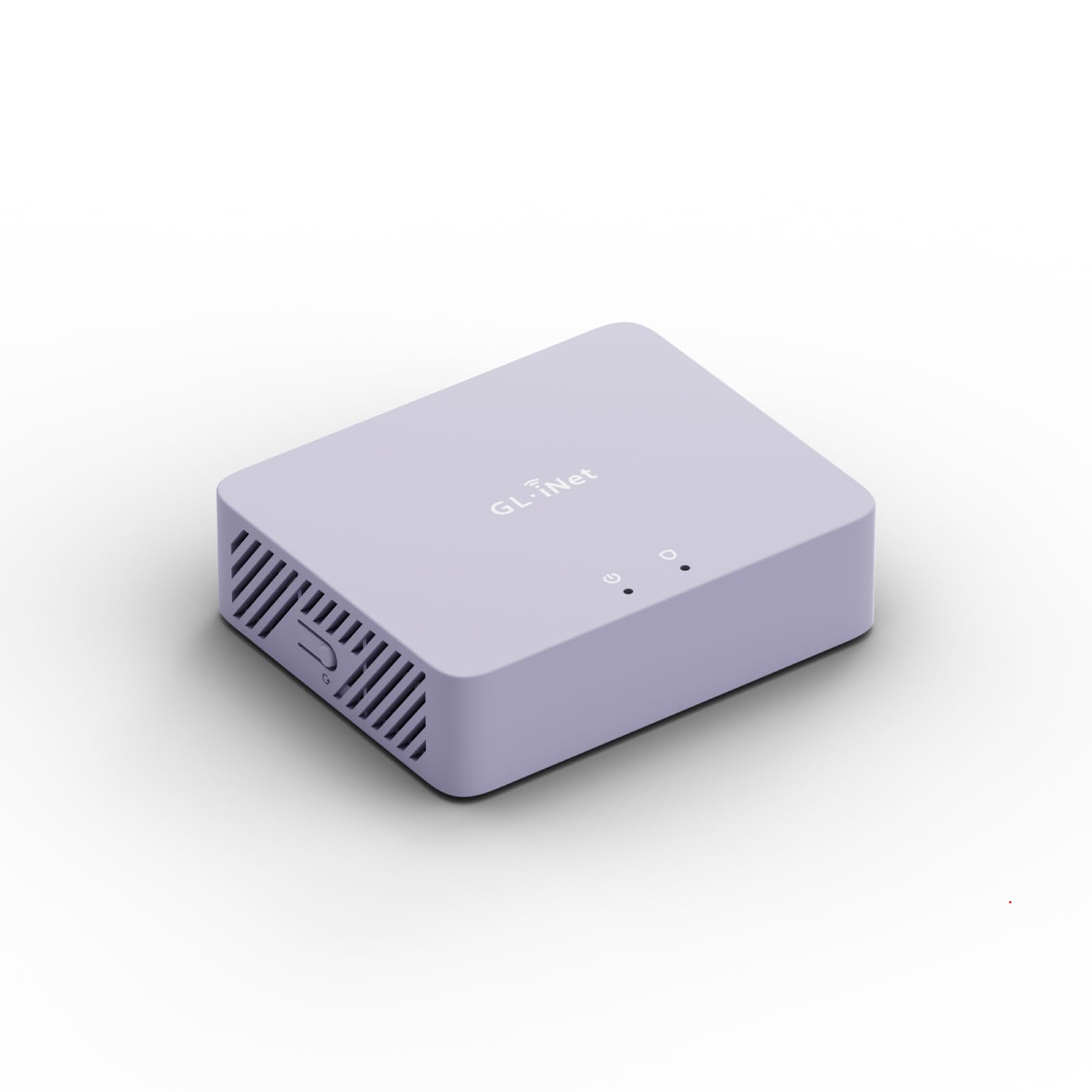
2. GL.iNet GL-MT5000 Brume 3
The one pick here that spells out how it dodges blocking: it dresses VPN traffic up as ordinary HTTPS.
Here is the literal answer to “undetectable.” The Brume 3’s spec sheet states that its VPN obfuscation disguises VPN traffic as regular HTTPS, which is what helps you evade blocking and stay connected on restrictive networks. That is the exact mechanism you are shopping for, written down by the maker rather than guessed at. It pairs that with a hardware-accelerated engine rated at up to 1100 Mbps for WireGuard and OpenVPN-DCO, so the masking does not come at the cost of a crawl.
This is a wired-only box sitting between your modem and your network, so every device behind it inherits the tunnel without a per-app install. Three 2.5GbE ports let you run multi-WAN with failover if one ISP drops. Deep Packet Inspection with dashboards blocks unwanted site categories, and SQM/QoS prioritizes gaming, calls, and video when bandwidth gets tight. OpenWrt with 1GB DDR4 and 8GB eMMC means you can add plugins, ad-blocking, or a NAS, and a USB 3.0 Type-C port handles storage or a 4G/5G dongle. At 148 g it is small enough to relocate without a second thought.
Owners praise throughput most, and travel testing backed it up: tunneling through the Brume 3 cost minimal speed and triggered no streaming travel warnings. The genuine trade-off is that there is no Wi-Fi built in. You need a router or access point behind it, and setup favors a browser in safe mode over a plug-and-play phone flow. USB file sharing is also a weak spot — one disappointed buyer moved to a dedicated NAS after slow transfers. Treat file sharing as a bonus, not a reason to buy.
The obfuscation edge: if a network has actively blocked your app-based VPN, this is the one product here that states a masking method for getting around it.
The moment it clicks: your whole wired home network needs a tunnel that reads as plain web traffic, and you want it configured once.
Know before you buy: it broadcasts nothing over Wi-Fi — plan on a separate router or AP for wireless.
3. GL.iNet GL-MT3600BE Beryl 7 Dual-Band Wi-Fi 7 Travel Router
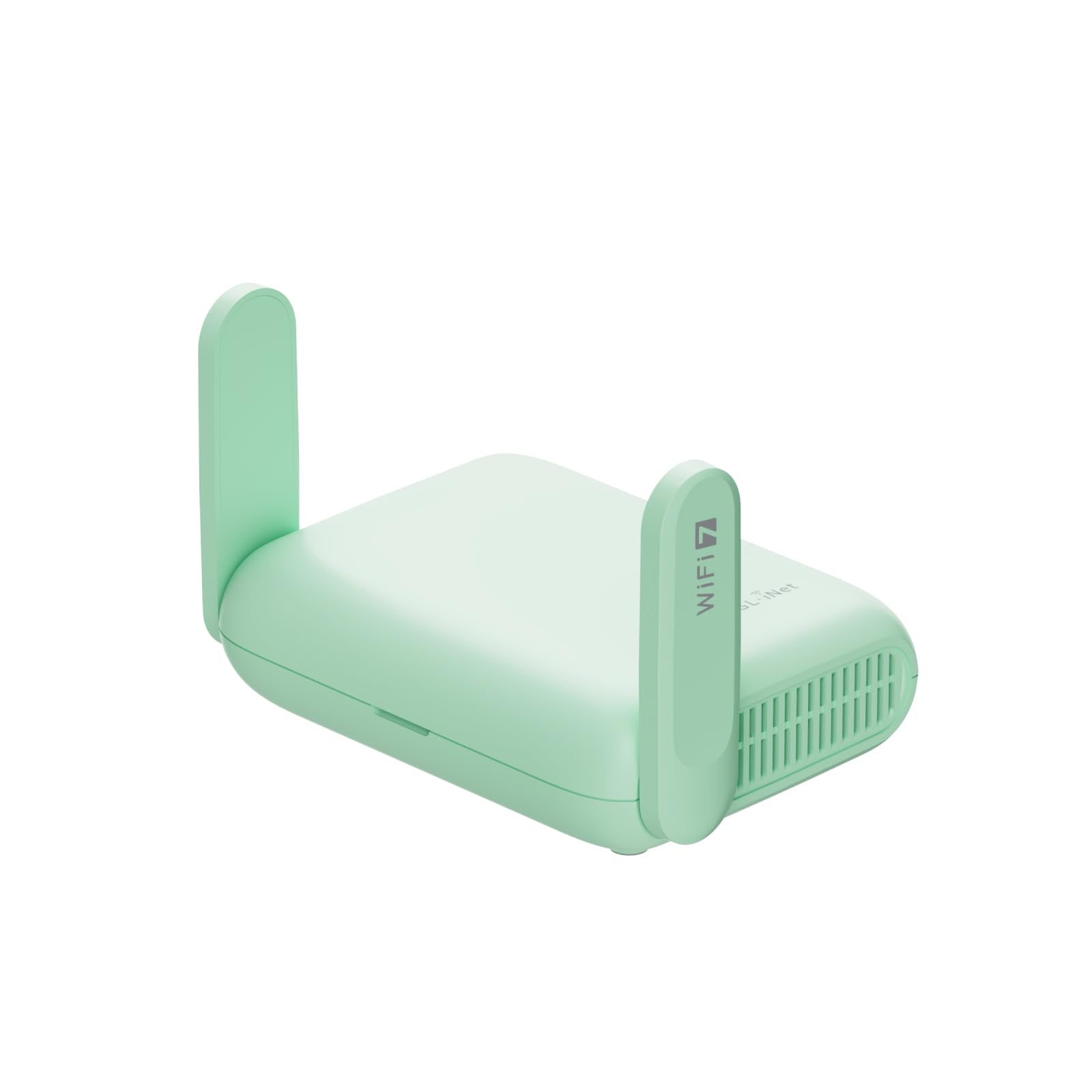
Carry one small router and every gadget you own rides the same encrypted connection through hotel Wi-Fi.
Where a phone app protects one device, the Beryl 7 protects the whole room. It logs into your existing VPN account, then automatically encrypts all traffic on the network it creates — tablets, streaming sticks, laptops, all of it. Its VPN engine is rated at up to 1100 Mbps on WireGuard and 1000 Mbps on OpenVPN-DCO, which is more than enough headroom for a hotel room’s worth of devices. It is rated to handle up to 120 devices at once.
Travel is the whole design brief. It runs on OpenWrt 21.02 with 512MB of storage for customization and plugins, ships with OpenVPN and WireGuard pre-installed, and is compatible with 30+ VPN service providers (you still need an active subscription). It can even host a VPN server and a client at the same time, so you can reach home devices while also routing out through a VPN. A physical toggle switch enables or disables your chosen feature — AdGuard Home or a VPN client — once you set it in the admin panel. On the security side it supports WPA3 against password brute-force attacks, plus DNS over HTTPS and DNS over TLS.
Owners praise the fast setup most and the pocket-sized body second — it configures quickly and disappears into a carry-on. Reviews note solid speed in the field. The repeater and USB-tethering modes also give some buyers trouble, and the web admin UI gives more control than the app if you want to dig in.
Why Travelers Like It
- Covers up to 120 devices through one VPN login
- Runs WireGuard and OpenVPN with pre-installed client software
- Compact enough to live in a carry-on
- Hosts a server and a client at once for remote access
What It Won’t Do
- No obfuscation stated on the spec sheet
- Repeater and USB tethering modes can be finicky
- App is less capable than the web admin interface
- Needs a separate VPN subscription to function
Best for: frequent travelers who want a roomful of devices protected from one pocket-sized box.
Skip if: your goal is beating a firewall that actively blocks VPNs — this model doesn’t advertise that mask.
4. NordVPN Standard 2 Years
Two years of coverage for a full household, with antivirus and a dark-web watch riding along.
NordVPN’s selling point is breadth. One subscription secures up to 10 devices simultaneously across Windows, macOS, iOS, Android, Linux, Amazon Fire TV, and web browsers — vs the Malwarebytes bundle’s 2 devices, a 5.0x gap in how many machines one purchase covers. It connects through thousands of servers in 224+ locations for streaming, gaming, and downloads, and the next-gen antivirus component catches malicious downloads and blocks intrusive ads alongside the tunnel.
For spotting leaks rather than logging them, the Dark Web Monitor Pro component is the standout — it warns you if your email addresses or card details show up on underground hacker sites so you can react. Public Wi-Fi protection is built in for hotels, airports, and cafes. Buyers who entered their codes note activation across multiple devices went smoothly, and several point out the code bought here keeps their subscription running without renewing directly through the provider.
The picture is not perfect, and NordVPN’s own buyer feedback splits on value and on whether it always behaves. Some report the app works beautifully and keeps improving; others hit slowdowns and stalls, and a few find the cost hard to justify for light use. If you run it on a machine that struggles, be prepared to test heavily in the first week. There is a 30-day money-back guarantee noted in reviews, which gives you room to find out whether it suits your setup.
The household math: 10 devices over two years is a lot of coverage from one code, and it is why this sits high on the list.
What to watch: a small number of machines see performance dips — validate early while you still have an easy return path.
A strong fit for: families or power users who want one code, ten devices, and two years before they think about it again.
Think twice if: you run it on an older machine that can ill afford any slowdown.
5. Malwarebytes Standard
If an app-based VPN is your route, this bundles the tunnel with real malware defense in one purchase.
Malwarebytes stacks three tools into a single code: Premium for 24/7 real-time protection, Browser Guard for blocking tracking ads and scam pages, and Privacy, a next-gen no-log VPN with 500+ servers in 40+ countries. The VPN is the piece relevant here — it secures public Wi-Fi and masks your digital footprint with a one-click interface, and the browser extension works on Chrome, Edge, Firefox, and Safari.
Buyers notice the install: it loads cleanly across Windows, Mac, iOS, Android, and Chromebook. Installation is easy across Windows, Mac, iOS, Android, and Chromebook, and the VPN runs without dragging your connection or speed down — several long-term users say it plays nicely alongside other malware tools for wider detection. A few mention the dark-web email and phone monitoring as a welcome extra. The ability to schedule scans and let web protection block dangerous pages quietly in the background round out the package.
The catch is scope and detection. This is not an obfuscation tool — the spec sheet does not claim to disguise your traffic from a strict network, so if a firewall is blocking VPNs, this will not be your fix. It also caps at 2 devices, and installation does not always go smoothly — some systems refuse to load it despite the advertised platform support, so confirm the refund path before you buy.
The Value Here
- VPN, malware protection, and browser guard in one code
- 500+ servers across 40+ countries
- Easy install and smooth VPN performance
- Complements other security tools rather than fighting them
Where It Stops Short
- Only 2 devices per license
- No obfuscation stated for strict-network use
- Some machines fail to load it at all
A natural pick for: one or two devices that need malware defense and an everyday tunnel combined, not just a bare VPN.
Not for: a household of many devices, or a network that blocks VPN traffic outright.
6. Bitdefender Premium VPN 10 Device
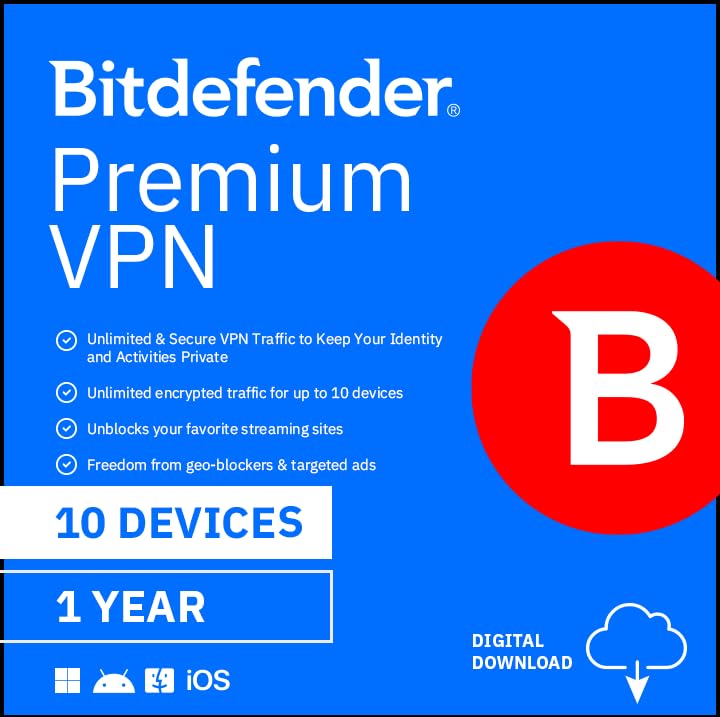
A year of unlimited encrypted traffic across 10 devices, with ad blocking thrown into the deal.
Ten devices on one year of unlimited encrypted traffic is the headline — the same device count as the NordVPN code above, but under a different brand and with no antivirus attached. Two features are worth knowing before you decide. The Ad Blocker and Anti-tracker blocks ads and popups system-wide and stops advertisers collecting data on your habits.
Bitdefender has genuine fans among long-term security-software users. Several long-term users of other security software made the switch and describe the interface as simple and the VPN as reliable, with less resource use than their previous setup. Buyers report the VPN stays on by default, so protection runs without remembering to toggle it. Where others expected a fiddly install, it loaded cleanly on all their devices.
The catch is that this is an everyday consumer VPN, not a stealth tool. Its spec sheet says nothing about obfuscation, and feedback notes that some sites recognize and challenge the connection — so do not count on it to punch through a firewall that is hunting VPNs. Installation is also region-sensitive; a few buyers found it does not work where they live, and since the code is generally non-returnable, that is worth checking in advance.
Worth knowing: 10 devices for a year plus a system-wide ad blocker is the practical draw, especially if you hate pop-ups.
The honest caveat: no obfuscation is claimed, and some sites push back — treat it as a daily-privacy VPN rather than a firewall-evading one.
Right choice if: you want broad multi-device coverage and cleaner browsing, and your usual networks are not actively blocking VPNs.
Pause if: you are counting on it to get past a strict firewall — it does not advertise that ability.
7. NETGEAR Orbi 370 Series 3 Pack

Not a VPN itself, but the mesh backbone you would hang a transparent tunnel on across a whole home.
Slide this into the list with one caveat up front: Orbi’s specs do not mention VPN obfuscation, so it is the home-network layer, not the mask. What it does brilliantly is blanket up to 6,000 sq ft across a router and two satellites, rated for up to 70 devices at once — so every phone, TV, laptop, and camerabox shares one stable connection. WiFi 7 speeds reach up to 5 Gbps, and dual-band technology with enhanced backhaul keeps throughput up as more devices join.
The app-guided setup is what earns this mesh its following. The Orbi app walks you through it step by step, and owners upgrading from an older Orbi report all their devices reconnected on the same SSID and password automatically. One notable detail: coverage extends even into a detached garage with a satellite, with speeds jumping substantially over a prior router. Multi-gig ports (2.5G WAN/LAN) make it fiber-ready, and it works with any internet provider for plans up to 2.5 Gbps.
The honest caveat: dual-band means no 6GHz band, and at extreme range performance drops versus higher-end tri-band models — a trade-off several buyers flag. Satellite speed can also run below the base unit, and there is only one Ethernet port on the base. A few owners note thin-plastic build and a noisy unit, so check yours on arrival. It is also made for use in the US only.
The Case For It
- 6,000 sq ft coverage across a router and two satellites
- Handles up to 70 devices on one network
- App-guided setup that reuses your old network name
- 2.5G ports ready for fiber internet
The Catch
- Dual-band only, with no 6GHz band
- No VPN obfuscation stated on the spec sheet
- Only one Ethernet port on the base unit
- Satellite speeds fall below the base
The exact buyer: you want one signal from the basement to the detached garage and 70 devices running without a stutter.
Not the mask: if hiding the tunnel is the goal, pair this mesh with a VPN that carries obfuscation rather than expecting it from the router.
Know the Specs
Obfuscation (the mask)
Obfuscation is what makes a VPN undetectable in the practical sense — the traffic is dressed up to look like ordinary secure web browsing, often by disguising it as HTTPS. Without it, a strict firewall can identify and drop the connection. When you shop, look for the word obfuscation in the manufacturer’s spec sheet; the GL.iNet Brume 3 is the one pick here that states it explicitly.
No-Log Audits (the proof)
A no-log policy means the provider does not keep records of your activity. The value is only real when an independent audit backs it up — Mullvad’s documentation notes regular independent security audits. Combined with anonymous accounts (Mullvad asks for no email), this is what keeps your activity untraceable even if someone comes looking.
Split Tunneling and Multihop
Split tunneling routes only some apps through the VPN while others use the normal connection, so you choose what gets masked. Multihop routes your data through more than one server before it exits, adding layers. Mullvad supports both. More hops and more splits mean more control, but each adds throughput cost — which is why speed numbers matter.
VPN Throughput and Device Limits
Throughput (how fast the tunnel moves data) decides whether your tunnel feels usable. The GL.iNet Brume 3 quotes up to 1100 Mbps, and the Beryl 7 quotes the same figure on WireGuard. Device limits are the other cap: NordVPN and Bitdefender cover 10 devices, Mullvad 5, Malwarebytes 2, the Beryl 7 up to 120, and the Orbi mesh up to 70.
Common Questions
Will an undetectable VPN get past a strict office or hotel firewall?
Is Mullvad really untraceable if I pay with Amazon?
Does the GL.iNet Brume 3 work without a Wi-Fi router?
Will a hardware VPN slow my internet down?
Can I use one VPN subscription on all the devices in my house?
What is split tunneling and does it help hide traffic?
Does a no-log claim actually mean anything without an audit?
Will these VPNs work with streaming services like Netflix?
Can an Orbi mesh system run a VPN on its own?
What happens if the VPN code does not work in my region?
The Bottom Line
For most people shopping for an undetectable vpn, the winner is the Mullvad VPN because it backs its privacy with audited no-logs, anonymous accounts, split tunneling, and Multihop — the strongest combination of unidentifiability and control here. If what you actually need is to get around a network that blocks VPNs, the GL.iNet Brume 3 is the only pick whose spec sheet states obfuscation, disguising traffic as HTTPS. And for travelers who want a whole room of devices protected from one box, the GL.iNet Beryl 7 covers it. One honest nudge: the crowd favorite here is genuinely the crowd favorite — Mullvad holds 4.5+ stars across 1,700+ ratings, and it earns that with a straightforward no-identity account and tunnels you can actually control.
How we choose
We do not accept paid placement. Every pick is matched to a real buyer and a real use-case; we do not hands-on test units.
Sources
Specifications: manufacturer listings and product documentation. Review insights: verified customer reviews, as of October 2026. Pricing: not shown on this page (it changes often); check the current price via the retailer link.
As an Amazon Associate, Aappliancez earns from qualifying purchases. This does not affect which products we feature.