Disclosure: Some links in this post are affiliate links. As an Amazon Associate I earn from qualifying purchases, at no extra cost to you. Learn more
Specs are compiled from manufacturer listings and verified buyer reviews and can change over time — please confirm the key details on the product page before buying.
If moles, gophers, or stray cats are tearing up your lawn, a solar-powered stake that pulses sound into the soil can help. The 8 green UPGRADE Mole Repellent earns the top spot here: eight solar stakes, each pulsing low-frequency sound through the soil on a repeating cycle. Below are four picks sorted by what they do well, so you can match one to your pest problem instead of guessing.
This guide is built by comparing the manufacturers’ published specifications and the patterns across verified customer reviews, so you get each pick’s real strengths and trade-offs instead of marketing spin.
Some stakes work in sandy soil and fail in clay, while others handle deer but not chipmunks — so the right pick depends on your pest and your ground. The best ultrasonic animal repeller for your yard is the one whose coverage, power source, and target species match your pest and your soil.
Top Picks

How To Choose The Best Ultrasonic Animal Repeller
Most people buy one of these stakes, push it into the ground, and wait. The ones who succeed picked the right tool for their pest and their soil before they ever opened the box. Here is what actually separates a stake that clears your yard from one that just sits there blinking.
Know your pest before you buy
Moles, gophers, and voles spend their lives underground, so a stake that vibrates the soil around their tunnels is the right tool. Chipmunks, squirrels, cats, and deer spend time above ground, so you need a device with a motion sensor and a strobe or siren rather than a buried spike. Buying a soil-vibration stake for a deer problem is the single most common mistake.
Match coverage to your actual yard
Every stake lists an effective range in square feet, and one unit rarely covers a whole property. If your yard is larger than a single stake’s coverage, you will need several placed at regular intervals, or the pests simply walk around the gap. Check the recommended spacing before you buy so you know how many units you actually need.
Solar power and where you plant it
A solar stake only works if its panel sees direct sun. Shade from trees or a north-facing slope means the battery never fills, and the stake goes quiet within a day or two. Look at the charging time in the specs and plan to install in your sunniest open ground. Rain and snow matter too, so a weatherproof or waterproof rating is worth checking if you live somewhere with real winters.
Side-by-Side Comparison
| Model | Best For | Rating | Coverage | Power Source | Amazon |
|---|---|---|---|---|---|
| 8 green UPGRADE Mole Repellent★ Best Overall | Large lawns with mole and gopher tunnels | 3.5+ / 5 | Up to 7500 sq ft per unit | Solar rechargeable battery | Amazon |
| Mole Repellent Solar Powered Outdoor | Simplest setup for mole and vole yards | 3.0+ / 5 | Approx. 5000 sq ft per unit | Solar powered | Amazon |
| 2026 Solar Ultra-Sonic Cat Animal+Deer Repellent Outdoor | Deer and cat deterrence with motion sensing | 3.5+ / 5 | 110° PIR sensor, up to 25 ft | Solar powered | Amazon |
| Solar Animal Repellent Outdoor with PIR Sensor | Flexible placement for cats and dogs | 3.5+ / 5 | 110° PIR sensor | Solar / Type-C charging | Amazon |
Detailed Reviews
1. 8 green UPGRADE Mole Repellent
An eight-stake pack built for whole-lawn mole control, not a single sad corner.
If your lawn is pockmarked with mole hills across a big area, buying one stake is a waste of time — you need enough units to blanket the tunnels. That is exactly what this pack solves. It ships with eight stakes in one box, and each one covers up to 7500 square feet. That is an 8-count versus the 1-count in the Sxaze pack, a 4.0x gap in units for roughly the same money, which is why the value math here is hard to argue with.
The charging math is the part most people miss. Four hours of direct sun gives you roughly four days of running time, and each stake fires a 3-4 second low-frequency pulse every 20 seconds. That rhythm is what pushes moles to relocate their tunnels. The manufacturer notes you should let the stakes charge in full sun for at least two days before you install them, which is a step plenty of buyers skip and then wonder why nothing happened.
Owner results split by pest and soil. In loose, sandy ground the stakes push in with almost no effort and the moles move off — as one five-star buyer describes it, the moles simply relocated to different areas so the stakes had to be moved to follow them. In hard, compacted clay, buyers report the stakes can crack on the way in, and gopher problems in particular tend to shrug them off. The top cover is the weak point, and dropping anything on it is a bad idea.
What earns it the top spot
- Eight stakes cover an enormous lawn in one purchase — far more units than any single-stake pick here
- Huge range at up to 7500 square feet per unit, with a recommended 70-foot spacing for full coverage
- Rainproof and waterproof enough to keep pulsing through wet spells
- Genuinely cheap to replace if a stake dies or breaks
Where it stumbles
- Gophers tend to ignore it — this is a mole and vole tool, not a gopher cure
- The top portion is not sturdy, and a knock can snap it off
- Stakes can crack when pushed into hard clay soil
- The pulse is audible and some owners find the tone nagging
Grab this if: you have mole or vole tunnels spread across a big, sandy-soil lawn and want maximum coverage for the money.
Think twice if: gophers are your problem or your ground is rock-hard clay — a sturdier single unit will serve you better.
2. Mole Repellent Solar Powered Outdoor

The straightforward mole stake — no motion sensor, no modes, just solar pulses in the dirt.
This four-pack is the simplest tool in the group. There is no sensor, no switch, no mode dial — you charge it for a day, push it in until the cap sits about two inches above the surface, and it starts pulsing. For anyone who wants zero learning curve, that is the whole appeal. Each unit covers roughly 5000 square feet, and the box gives you four of them to spread across front and back yards.
The housing is where this one holds its own against pricier picks. It is built from ABS plastic with a hot-pressed waterproof construction that resists corrosion and cold, so it keeps working through rain and snow in a garden, farm, or orchard setting. Say what you like about the plain design — it is the one pick here that is explicitly rated for snowy outdoor conditions, not just a splash of rain.
Where it falls short is the species list. It is designed for moles and snakes, and it does not reliably touch chipmunks despite what the listing name suggests. A buyer who ran it against chipmunks watched them jog right past the ground-level device and keep digging into raised beds. Construction also varies between units — one honest report flagged that of the four stakes in the box, only two actually worked. It is a mole-first tool at a mole-first price, and it pays to set your expectations there.
Best use case: a small to medium yard with an active mole or vole problem, where wireless solar operation and a no-fuss install matter more than the pest list.
Fair warning: the “chipmunk” label oversells it — rated for moles and snakes is the honest read, and a few in-box units have been dead on arrival.
Reach for this if: you want the simplest solar mole stake with a genuinely winter-ready housing.
Look elsewhere if: chipmunks, squirrels, or gophers are what is churning up your beds.
3. 2026 Solar Ultra-Sonic Cat Animal+Deer Repellent
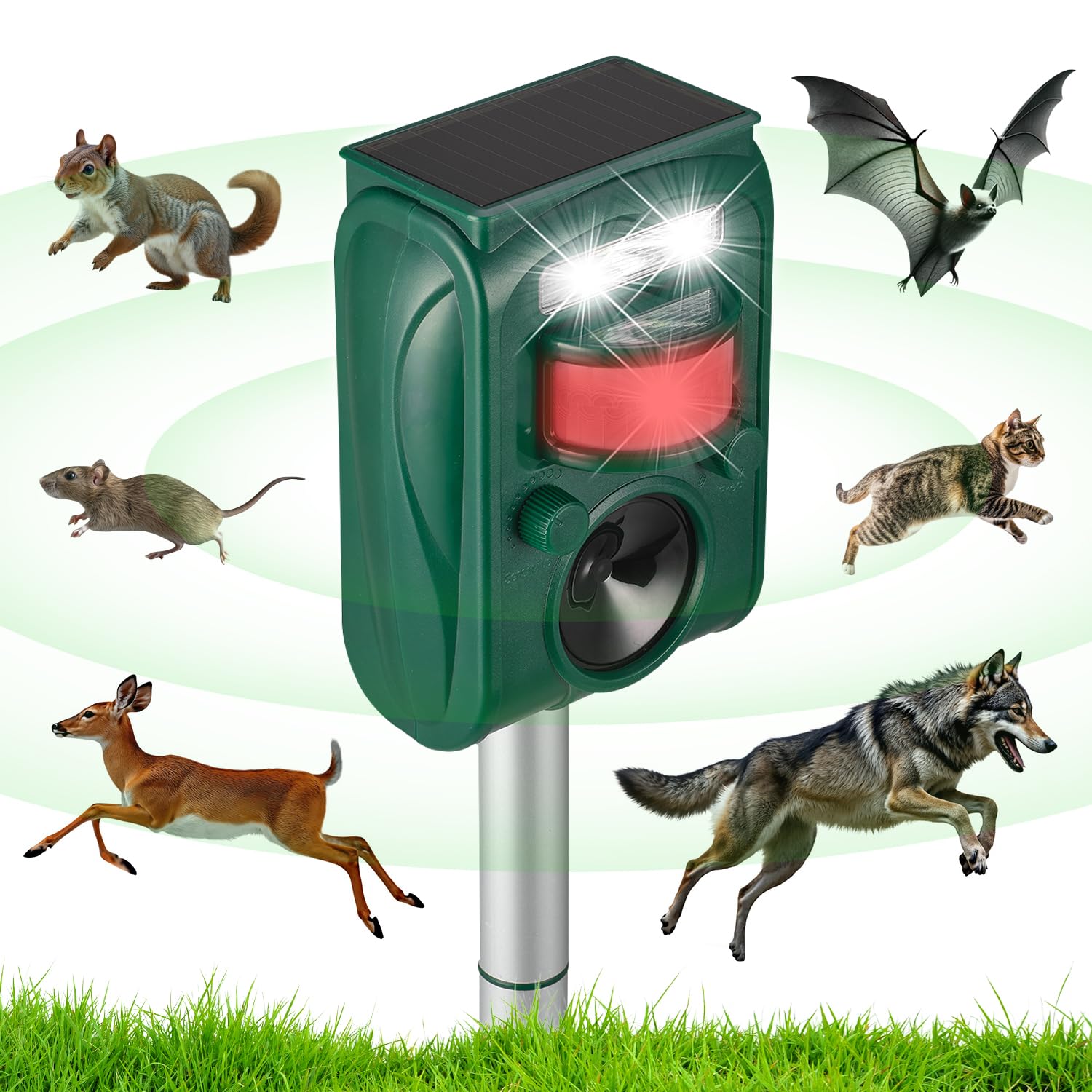
A motion-triggered strobe-and-sound unit for keeping deer and cats off the good plants.
Above-ground pests need a completely different tool than the buried stakes above, and this is the strongest of that type. Instead of pulsing dirt, it fires on approach. The PIR sensor watches a 110° arc and up to 25 feet, then triggers dual ultrasonic frequencies from 13.5 to 45.5 kHz along with LED strobe lights the moment a cat, deer, or squirrel steps into range. No traps, no chemicals, no wiring — the panel handles the power and the casing carries an IP65 weatherproof rating.
Deer are the headline. Where the two soil-stake picks above cannot touch a browsing deer, this unit changes how animals treat a yard. Owners protecting bird feeders, lilacs, and hostas in rural areas report deer slowing, stopping at the back corner, and no longer walking in — with the piles they leave behind dropping from regular counts to none. Flowers go untouched once the units are in place and set to their higher sensitivity modes.
The volume is the honest catch, and it cuts both ways. The siren is loud enough to annoy the person living there, and several owners have resorted to stuffing foam into the housing to soften it. The 10.56-ounce body stands 13.78 inches tall on its stake, which keeps the sensor above low cover but leaves the top of the unit exposed. It runs on solar with the battery carrying it overnight on a full charge, though a stretch of grey days will test it.
The deer equation: it does not stop every single deer, but the ones that keep browsing are the exception rather than the rule — a net win for anyone whose plants were getting stripped.
One more quirk: the 110° sensor means placement angle matters more than you would think — point the coverage cone at the path the animals actually use, not the middle of the lawn.
Best for: rural or suburban yards where deer, stray cats, or squirrels are browsing and burying their way through your beds.
skip it if: your problem is moles under the turf — this one works above the surface, not down in the tunnels.
4. Solar Animal Repellent Outdoor
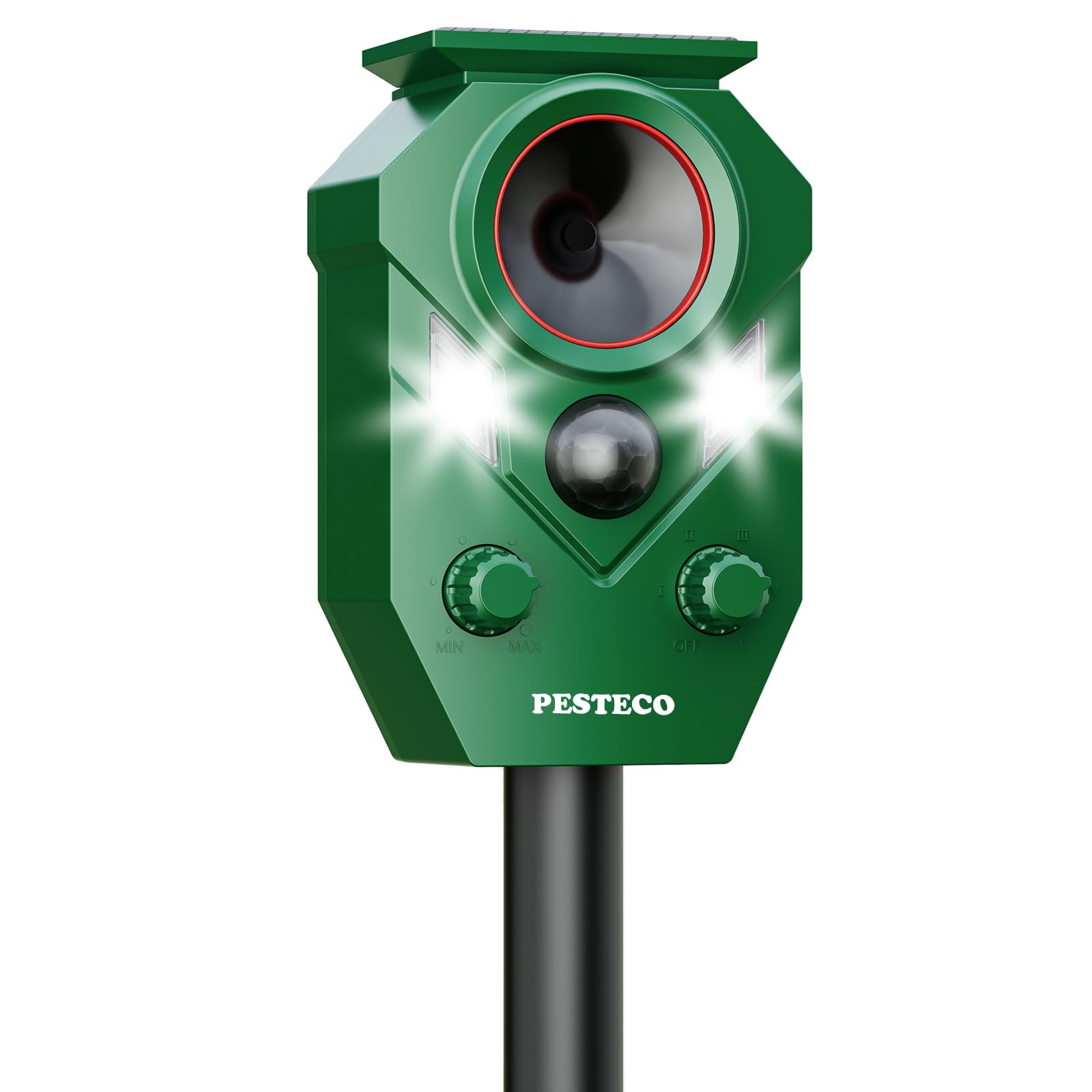
The only pick here that can plug in to charge — and the most adjustable on the wall.
Two things separate this unit from the other motion sensor above. First, it carries the widest feature set in the group: five selectable working modes plus sensitivity control, so you can dial in the frequency and trigger distance for whatever animal is bothering you. Second, and more practically, it charges by USB Type-C as well as solar. That backup charging is real insurance — the one pick here that keeps running continuously even through a run of cloudy days.
The detection side matches its bigger sibling closely. A 110° PIR sensor triggers a 30-second ultrasonic and strobe cycle the moment an animal walks in. The 7.36-ounce plastic body is lighter and shorter than the deer unit above, which makes it easy to mount on a wall with the included screws or spike it into the ground. IP65 waterproofing keeps it running through rain, snow, and heat year-round.
Cats are where owners see the clearest results — this is the pick that keeps stray cats from fouling flower beds, and the reaction is often immediate. The honest limitation is that rodents are more stubborn. Rats and mice can grow used to the ultrasonic pattern, and owners who planted one next to a squirrel burrow watched the squirrel play in the flashing strobe light like it was a nightlight. For cats and dogs it works; for smart burrowers, expect a shorter honeymoon.
what separates it from the pack
- Type-C charging backs up the solar panel — the only unit here with that fallback
- Five working modes and sensitivity control let you tune the trigger to your pest
- Lightweight at 7.36 ounces, with both wall-mount screws and a ground stake in the box
- IP65 waterproof housing handles rain, snow, and summer heat
The honest limits
- Rats, mice, and squirrels can learn to ignore the ultrasonic pulse over time
- Some units arrive with no visible effect on rabbits, skunks, or groundhogs
- Strobe light runs continuously at night and can be visible from indoors
Choose it if: you need flexible placement, want the Type-C charging safety net, and your main target is cats, dogs, or stray animals around the house.
Pass if: you are fighting a rodent problem that has already outsmarted a sound-based repeller before.
Know the Specs
Coverage Area (Square Feet)
The coverage number tells you how much ground a single unit can protect — the buried mole stakes here list up to 7500 square feet and roughly 5000 square feet, while the motion-sensor units list a 110° detection arc up to 25 feet. Coverage is a rating, not a guarantee: real-world performance drops in dense vegetation, uneven ground, or wherever the pest has an established tunnel network. If your yard is bigger than one unit’s coverage, buy several, because moles will simply travel around a single stake.
Solar Charging vs. Battery Backup
Every pick here runs on solar, but they do not all handle grey weather the same way. A solar stake needs direct sun on the panel and charges in hours; a buried unit can go quiet within days of no sun. One pick here adds USB Type-C charging as a fallback so it keeps running through cloudy spells. If your yard gets real shade or you live somewhere with long overcast winters, the Type-C backup is worth prioritizing.
PIR Motion Sensors
A PIR sensor is a passive infrared detector — a motion sensor that spots an animal’s body heat, not just movement. The two motion-activated picks here both use a 110° sensor, which means the unit watches a cone-shaped zone in front of it up to 25 feet out. Angle matters: point that cone at the path the animals actually use, and you get fast triggers. Point it at empty lawn, and it never fires when it matters.
Ultrasonic Frequency and LED Strobes
Ultrasonic means sound above the range of human hearing — usually pitched high enough that people notice only a faint tone or nothing at all. Some units here emit a fixed low-frequency pulse through the soil, while others sweep dual frequencies from 13.5 to 45.5 kHz paired with LED strobes. Buried pests respond to the soil vibration; surface pests respond to the sound-and-light combination. Matching the device type to your pest is the whole game.
Common Questions
Will an ultrasonic animal repeller work for moles AND chipmunks?
How long do solar ultrasonic repellers take to show results?
Do ultrasonic repellers hurt pets or children?
How many units do I need to cover my lawn?
What soil works best for pushing in the stakes?
Can I leave a repeller outside through rain and snow?
Why does the ultrasonic pulse stop working after a while?
Is an ultrasonic repeller better than poison or traps?
Where should I point a motion-activated repeller?
Do I need to remove the stakes before winter?
The Bottom Line
For most yards with a mole or vole problem, the 8 green UPGRADE Mole Repellent is the pick to beat — eight stakes cover a big lawn in one box, and each one pulses low-frequency sound through the soil with no wiring to fuss with. If your pest is deer or stray cats above ground, the 2026 Solar Ultra-Sonic Cat Animal+Deer Repellent is the stronger tool, with its 110° motion sensor and dual-frequency strobe doing work that a buried stake simply cannot. And if flexibility matters most — wall or ground mounting, five modes, and the safety of Type-C backup charging for cloudy stretches — the Solar Animal Repellent Outdoor with PIR Sensor is the one to reach for.
How we choose
We do not accept paid placement. Every pick is matched to a real buyer and a real use-case; we do not hands-on test units.
Sources
Specifications: manufacturer listings and product documentation. Review insights: verified customer reviews, as of October 2026. Pricing: not shown on this page (it changes often); check the current price via the retailer link.
As an Amazon Associate, Aappliancez earns from qualifying purchases. This does not affect which products we feature.