Disclosure: Some links in this post are affiliate links. As an Amazon Associate I earn from qualifying purchases, at no extra cost to you. Learn more
Specs are compiled from manufacturer listings and verified buyer reviews and can change over time — please confirm the key details on the product page before buying.
If you are standing in a store aisle wondering which basketball actually fits your game, the short answer is this: match the ball to where you play first, then worry about the cover material. An indoor-only ball with a soft composite leather cover will feel better in your hands than a rubber street ball, but that same soft cover will shred on rough blacktop.
This guide is built by comparing the manufacturers’ published specifications and the patterns across verified customer reviews, so you get each pick’s real strengths and trade-offs instead of marketing spin.
Most players buy the wrong size or the wrong cover for their court, then blame the ball when shots rattle out. This breakdown covers the type of basketball that suits gym floors, driveways, and everything between.
Top Picks

How To Choose The Best Type of Basketball
The single biggest mistake buyers make is grabbing whatever ball is on sale without checking two things: the diameter and the cover material. That mismatch is why a ball feels great in the store and terrible after a week on concrete.
Size Comes First
Size 7 measures 29.5 inches in diameter and is the regulation ball for adult men’s play and most high school and college games. If you are shopping for a younger player, a smaller ball usually fits their hands better and helps them learn proper shooting form. Several picks on this list come in multiple sizes, so check the size label before you buy.
Match The Cover To Your Court
Rubber covers are the toughest option and handle rough outdoor surfaces without complaint. Composite leather sits in the middle — softer than rubber, more durable than pure leather, and widely used for both indoor and outdoor play. Microfiber composite leather is the softest and grippiest of the three, but it belongs on a clean gym floor where it will not get scraped up.
Panel Count And Channel Depth
Panels are the sections of material stitched together to form the ball. A 12-panel design creates more seams than a standard 8-panel ball, which many players say gives them a better feel for where the ball is in their hands. Deep channel construction works the same way — the grooves between panels give your fingertips something to lock onto when you dribble.
Side-by-Side Comparison
| Model | Best For | Diameter | Cover Material | Construction | Amazon |
|---|---|---|---|---|---|
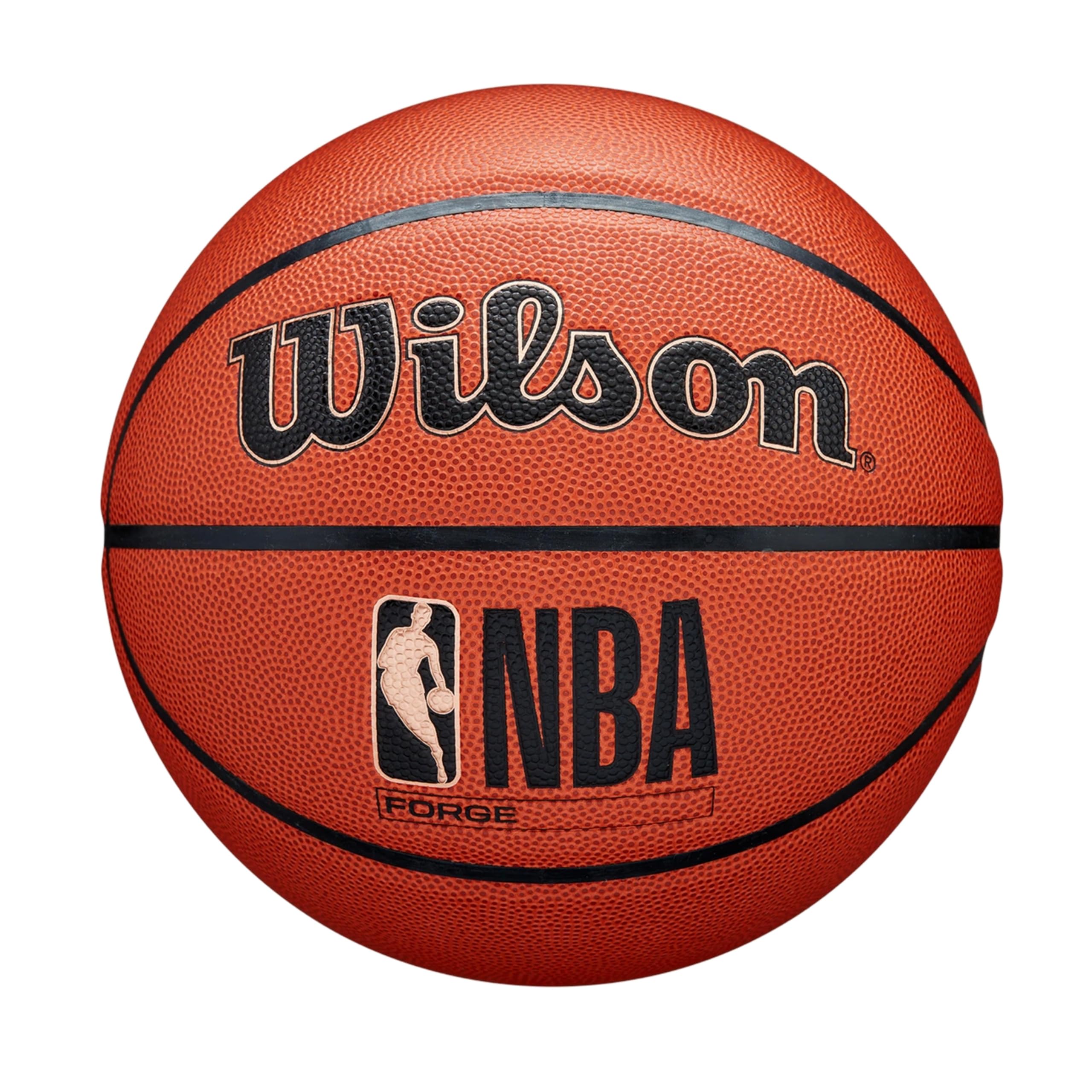
| WILSON NBA Forge Indoor/Outdoor Basketball★ Best Overall | Everyday indoor and outdoor play | 29.5 inches | Pure Feel Cover | Stitched | Amazon |
| AND1 Ultra Grip BasketballBest for Streetball | Streetball and driveway games | 29.5 inches | Rubber | Deep Channel | Amazon |
| Baden Contender Indoor/Outdoor Composite Basketball | Players who want one ball for gym and blacktop | 29.5 inches | Composite | Composite Cover with Symmetrical Panel Construction | Amazon |
| Molten FIBA Approved Basketball | Youth practice and skill building | — | Synthetic | Composite | Amazon |
| Molten BG3800 Basketball | Club players who train and compete all season | — | Leather | Multilayer | Amazon |
| Spalding Legacy TF-1000 NAIA Indoor Game Basketball | Indoor game play at the college level | 29.5 inches | Composite | Composite | Amazon |
| WILSON NCAA Evo NXT Official Indoor Game Basketball | Serious indoor competition and high school play | 29.5 inches | Micro-Touch Cover | Super Soft Core | Amazon |
Detailed Reviews
1. WILSON NBA Forge Basketball
Our pick — 4.5+★ from 1,000+ verified ratings; the strongest balance of quality and price.
The do-it-all ball that handles a driveway in July and a gym in December.
Wilson built this one around an inflation retention lining — a layer inside the ball that helps hold air so you are not digging for the pump every week. The ball carries NBA Pro Seams, a channel construction shaped to how players grip and release, plus official NBA branding and the Wilson script.
At 29.5 inches in diameter and 0.88 kg, this is the regulation adult size. That weight and size make it the right ball for pick-up games, driveway shooting, and league warm-ups. The Pure Feel Cover is the part you notice first — a soft surface that does not feel like plastic under your fingers.
The NBA Forge’s strongest trait against the Spalding Legacy TF-1000 is simply where it can go. The TF-1000 is built for indoor play only, while this Wilson handles indoor and outdoor surfaces. If your court situation changes from week to week, that flexibility matters more than any single spec.
What earns it the top spot
- The Pure Feel Cover draws the most praise by a wide margin, with well over a hundred owners citing overall quality
- Bounce and grip both get consistent positive notes, so the ball feels responsive off the floor
- Works indoors and outdoors, which means one ball covers both your gym nights and your driveway sessions
- Shipped in a brown finish that holds up visually and does not show scuffs as quickly as bright white balls
What to keep in mind
- Air retention is the split issue — some owners find it holds air well while others end up refilling more often than they expected
- Not built for the roughest concrete; the soft cover will wear faster on abrasive surfaces than a pure rubber ball
Best for: the player who wants one quality ball for driveway sessions, gym runs, and everything in between.
Look elsewhere if: you are inflating on a schedule — the air retention is the most inconsistent part of this ball.
2. AND1 Ultra Grip Basketball
A rubber tank for blacktop that arrives with its own pump so you can play the moment it lands.
The deep channel construction on this AND1 carves wider grooves between the panels, which gives your fingertips a clearer hold when you are dribbling through traffic. That is the whole point of a streetball: control on rough ground, not softness in the hand.
Rubber is the right call for outdoor surfaces. Unlike the Wilson NBA Forge above, which uses a softer Pure Feel Cover, this ball is built from high-quality rubber meant to take scrapes from asphalt without shredding. You get the pump in the box too, so a deflated ball is never a problem — you just fill it and go.
At 29.5 inches it matches regulation size 7, and at 16 ounces it sits at the same weight class as the Spalding TF-1000. The colorway leans mint and purple rather than traditional orange, which is worth knowing before you order if you prefer a classic look.
The thing everyone raves about: grip and overall quality come up constantly, and the included pump is cited as genuinely useful. Owners say a fresh ball is tacky and easy to control.
The catch: a few buyers report the ball needs yearly replacement after heavy weather and wear, and the color can look different from the photos. Treat it as a season-by-season street ball, not a decade-long investment.
Reach for this if: your court is concrete and you want a rubber ball that shrugs off the surface.
Think twice if: you play indoors on a clean floor — the deep channels and rubber surface are tuned for outside.
3. Baden Contender Indoor/Outdoor Composite Basketball

The composite ball that plays like a gym ball without falling apart outside.
The Contender’s performance composite cover is the headline — it delivers grip, consistency, and longevity in one surface. A symmetrical panel design keeps the ball balanced, and the wide panel configuration eliminates lumps that cause inconsistent bounces.
At 1.3 pounds and 29.5 inches in diameter, this ball has a little more heft than the AND1 rubber ball. That extra weight is something a few owners notice, but most describe it as feeling solid and balanced rather than heavy. The recessed stealth soft-valve system sits flush with the surface, so the valve does not catch your fingertip mid-dribble.
In head-to-head testing at 8 PSI, owners rated it the best all-around composite of the group, with better balance than the Kuoyotq and more consistent bounce than the Spalding TF-500.
What it delivers: quality, feel, and value are all widely praised, with grip right behind. The soft yet grippy surface is the phrase owners keep circling back to.
Where it falls short: durability is the recurring split — some balls hold up to the elements for seasons while others show wear within a couple of weeks. If you play mostly outdoors, expect to replace it eventually.
Worth it for: the player who wants gym-quality touch but still shoots outside regularly.
skip it if: you need a ball that survives the same concrete court for years — the composite cover trades longevity for feel.
4. Molten FIBA Approved Basketball

A 12-panel youth ball that comes out deflated but turns into the season’s favorite gift.
The 12-panel, two-tone construction is what you notice first — more seams than an 8-panel ball, which many young players find easier to track and grip. This ball is FIBA approved, meaning it meets the international basketball federation’s standard, though buyers should know it is sized smaller than regulation.
Two owners mention a middle-school team used this ball through a championship run, and another calls it a great gift for young players. The synthetic cover suits outdoor courts, and the butyl bladder — a rubber layer inside the ball that resists air loss — helps it hold pressure better than a basic street ball.
This is a completely different animal from the Baden Contender above. The Baden is a full-size 29.5-inch adult ball at 1.3 pounds; this Molten is dimensioned for youth play. Neither is better — they just serve different players, and mixing them up is the most common mistake buyers make here.
The reason it sells: overall quality is the top praise, with value close behind. Owners describe it as a solid practice ball that helps younger players build skills.
Know before you buy: several reviews flag that the ball is smaller than expected, closer to a kid’s size than a regulation ball. Buyers occasionally mistake it for a full-size option, so check the size label carefully.
Made for: young players learning the game, and parents who want a quality ball that fits smaller hands.
Wrong pick if: you need a regulation 29.5-inch ball for adult pick-up games.
5. Molten BG3800 Basketball

The gym-ball built around a 12-panel pattern that keeps its shape through a full season.
The BG3800 was designed for the club player who trains and competes year-round.
Its 12-panel design adds more seams than a standard 8-panel ball, giving club players a clearer feel for the ball in their hands. The butyl bladder inside holds air exceptionally well, so bounce stays consistent from the first game of the season to the last.
At 24.8 centimeters in diameter — roughly a junior size — and 0.59 kg, this is notably lighter than the Baden Contender’s 1.3 pounds and the Spalding TF-1000’s 16 ounces. That lighter weight makes it a smart choice for younger club players stepping into competitive play, not for adults wanting a full regulation ball.
Where it wins: the matt composite leather surface delivers fingertip control without the stickiness that collects dust in a gym. The multilayer construction is built to survive a full season of training.
The trade-off: this ball is on the smaller and lighter side, so if you want a classic adult regulation ball, another pick on this list fits better.
Your ball if: you are a junior or club player who needs one durable ball for constant training and competitive games.
Not your ball if: you want full adult regulation size and weight for your weekly run.
6. Spalding Legacy TF-1000 NAIA Indoor Game Basketball

An indoor-only game ball with a sweat-wicking cover built for hardwood floors.
What makes the TF-1000 different is the wet grip microfiber composite leather cover — a material designed to wick away sweat so the ball stays controllable late in a game. A cushioned carcass underneath gives the bounce a true feel, and deep channel design helps your fingers find the seams instantly.
Inside, a rotationally balanced butyl bladder handles air retention, and nylon windings add structural integrity so the ball keeps its shape. This ball ships inflated at the factory’s recommended 8 PSI, so you can play right from the start.
Unlike the Wilson NBA Forge at the top of this list, the TF-1000 is strictly an indoor ball. Take it to a blacktop court and the soft microfiber cover will scuff quickly. It is the official ball of the NAIA, the National Association of Intercollegiate Athletics, which tells you the level of play it was built for.
Why indoor players choose it
- Value is the most-praised aspect — owners consistently describe it as excellent for the level of play
- Wet grip microfiber handle keeps the ball controllable when your hands get sweaty
- Deep channel design and cushioned carcass deliver a true, predictable bounce
- Ships inflated at 8 PSI, ready for game play
What owners flag
- Grip feedback is split — some owners love the feel while others find it slippery to the touch
- Strictly indoor use; not suitable for outdoor courts at all
- A small portion of customers note receiving a ball that did not hold air, particularly through resale
The one for you if: you play on hardwood and want a dedicated game ball with a sweat-resistant cover.
Leave it on the shelf if: you need a ball that works both inside and out — this one is indoor only.
7. WILSON NCAA Evo NXT Basketball

The March Madness official ball with a soft core that lets your fingers sink in.
NCAA Official tells you exactly what this ball is — the game ball of March Madness, in size 7 at 29.5 inches and 1.3 pounds. Its Extended Range Tech uses a super soft core construction that generates more spin with less effort, and the extra cushioning lets your fingers dig deeper into the surface for better control.
The Micro-Touch composite leather cover adds an extra layer of grip and moisture management on top of that. Composite pebbled channels — pebbled rather than smooth — create a consistent texture across the entire ball surface, so your hands find the same feel no matter where they land.
This ball has a large following among players who grew up shooting with the Wilson Evolution. Owners consistently say its hand feel and air retention beat the Evolution, and many report kids preferring it outright. The updated Electric Orange color is designed for better on-court visibility against dark backgrounds.
The consensus: the soft-core feel is what sells it — quality is mentioned more than any other trait. Owners describe it as tacky yet smooth, holding its air through months of hard use.
The honest limit: value opinions are split, with some owners feeling the price is steep. Durability also takes time to break in — this is not a ball that feels perfect on day one.
For you if: you play competitive indoor basketball and want the same ball college players use in the tournament.
Skip if: you need an outdoor ball — the Micro-Touch composite cover belongs on a gym floor, not on blacktop.
Know the Specs
Diameter and Why It Matters
Pick the wrong ball size and it will feel oversized and hard to control in your hands. Basketball size depends on diameter (the distance straight across the ball), measured in inches or centimeters. A size 7 ball measures 29.5 inches in diameter, which is the regulation standard for adult men’s play, most high school varsity games, and college basketball. Youth balls run smaller, typically with a lower diameter that fits smaller hands. When you see a ball listed with a smaller measurement, that is the ball’s intended size, not a mistake. Match the diameter to the player, or the ball will feel oversized and hard to control.
Cover Material: Rubber vs Composite vs Microfiber
Rubber covers survive blacktop and rough concrete without tearing, but they feel harder and less tacky in the hand. Composite leather is the middle option, offering a softer touch than rubber with better durability than pure leather — it works for both indoor and outdoor play. Microfiber composite leather is the softest and grippiest of the three, and it belongs on a clean hardwood floor. Using a microfiber ball outdoors will scuff it quickly, so match the cover to the surface where you actually play.
Common Questions
What is the difference between a size 6 and size 7 basketball?
Do composite leather basketballs work on outdoor courts?
What does a butyl bladder do for a basketball?
How do I know what PSI to inflate my basketball to?
Is a 12-panel basketball better than an 8-panel ball?
Can a soft composite ball survive being chewed by a dog?
Why does my new basketball feel slippery when my hands sweat?
What does FIBA approved mean on a basketball?
How long should a basketball last before I replace it?
The Bottom Line
For most players, the type of basketball winner is the Wilson NBA Forge because it handles both indoor and outdoor play with a soft Pure Feel Cover and NBA Pro Seams. If you want a dedicated indoor game ball with sweat-wicking grip, grab the Spalding Legacy TF-1000. And for a rubber streetball that comes with its own pump, the AND1 Ultra Grip is the one to reach for.
How we choose
We do not accept paid placement. Every pick is matched to a real buyer and a real use-case; we do not hands-on test units.
Sources
Specifications: manufacturer listings and product documentation. Review insights: verified customer reviews, as of October 2026. Pricing: not shown on this page (it changes often); check the current price via the retailer link.
As an Amazon Associate, Aappliancez earns from qualifying purchases. This does not affect which products we feature.