Disclosure: Some links in this post are affiliate links. As an Amazon Associate I earn from qualifying purchases, at no extra cost to you. Learn more
Specs are compiled from manufacturer listings and verified buyer reviews and can change over time — please confirm the key details on the product page before buying.
A fast break, a slap shot, a serve at match point — a sports TV lives or dies on two specs: motion handling and peak brightness. Get both right and a puck stays a puck instead of a smear, and the pitch stays green at noon on a sunny Sunday.
This guide is built by comparing the manufacturers’ published specifications and the patterns across verified customer reviews, so you get each pick’s real strengths and trade-offs instead of marketing spin.
Below you will find picks for every room and budget, from a sharp entry-level set to a big-screen centerpiece, and the reasoning behind each one. My goal is to help you pick the best TV for watching sports without paying for features you will never use.
Top Picks

How To Choose The Best TV to Watch Sports
For sports, the screen has to do two jobs at once: keep a small fast object (a puck, a tennis ball, a thrown pass) looking like a solid object instead of a trail, and stay bright enough to beat the glare coming through your windows. Refresh rate and brightness matter more than any other spec on the box.
Refresh rate and motion handling
A 120Hz refresh rate (the panel redraws the image 120 times a second) is the practical floor for sports. It gives fast camera pans somewhere to land, so a ball does not break into a dotted line. Some sets go further with a native 144Hz panel, and a few add a motion rate figure in the hundreds, which is a manufacturer measure of how smoothly fast action is presented rather than a literal panel speed. Variable Refresh Rate, or VRR, lets the screen match the frame rate of a game console so the picture does not tear — useful if your sports TV also handles a PS5 or Xbox.
Brightness and local dimming
A bright room eats contrast. That is why a set with local dimming — where groups of LEDs behind the screen can dim or brighten on their own — holds up better during a daytime match. Mini-LED backlights pack in far more of those small LEDs, which tightens the bright highlights around a stadium light without washing out the shadows.
Panel type and viewing angles
OLED panels switch individual pixels on and off, so blacks go truly black. The trade-off is that the brightest OLED still trails the brightest LED sets in a sunlit room. If your sofa is off to one side, note that some LED panels lose color and contrast as you move away from center, while OLED holds its image at wider angles. A big room with a crowd calls for a panel that looks good from the cheap seats.
Size, seating distance and the smart platform
Bigger is usually better for sports if the room can take it — a 77-inch set needs a load-rated wall and two people to hang it. Then look at the software: Roku, Google TV, Fire TV and webOS all surface live sports differently, and the one you find least annoying is the one you will actually use every weekend.
Side-by-Side Comparison
| Model | Best For | Refresh Rate | Backlight | Screen Size | Amazon |
|---|---|---|---|---|---|
| Roku 55-Inch Plus Series★ Best Overall | Best overall value | 120Hz-class motion | Mini-LED / QLED | 55 inches | Amazon |
| Panasonic Z8 Series 77″Big-Screen Cinema | Big-screen cinema | 144Hz | OLED (Master OLED PRO) | 77 inches | Amazon |
| LG B5 Series 55″Bedroom OLED | Bedroom OLED | 120Hz | OLED (self-lit pixels) | 55 inches | Amazon |
| Hisense U6 Series 55″ | Budget mini-LED | Motion Rate 240 | Mini-LED / QLED | 55 inches | Amazon |
| iFFALCON 55U85 | Console + sports hybrid | 144Hz native | Mini-LED | 55 inches | Amazon |
| TCL T7 Series 55″ | Entry-level speed | 120Hz | QLED (direct LED) | 55 inches | Amazon |
| Roku Pro Series 55″ | Bright-room upgrade | 120Hz | Mini-LED / QLED | 55 inches | Amazon |
| Hisense U6 Series 65″ Fire TV | Stadium-scale room | 144Hz native | Mini-LED / QLED | 65 inches | Amazon |
| LG C5 OLED evo 65″ Bundle | All-in bundle | 144Hz | OLED evo | 65 inches | Amazon |
| Samsung S90F 55″ | Premium sports clarity | 144Hz (Motion Xcelerator) | QD-OLED | 55 inches | Amazon |
| Sony BRAVIA 7 85″ | Cinema-wall scale | XR Motion processing | Mini-LED / QLED | 85 inches | Amazon |
Detailed Reviews
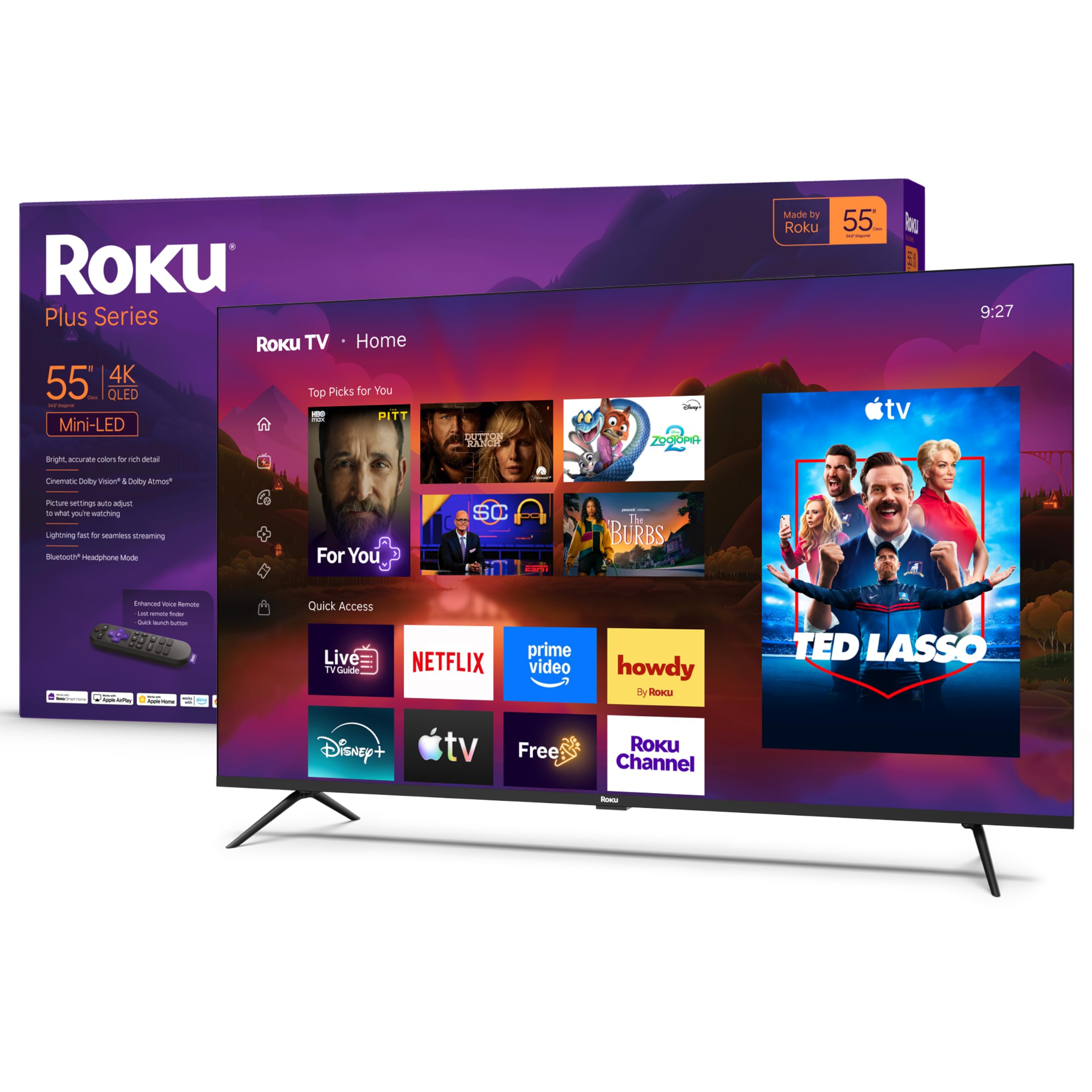
1. Roku 55-Inch Plus Series Smart TV
Our pick — 4.5+★ from 750+ verified ratings; the strongest balance of quality and price.
A 55-inch mini-LED panel that gets the basics of weekend sport right and then some.
Mini-LED backlighting is the headline here. Thousands of tiny LEDs sit behind the screen, and the QLED layer over them widens the color range — so a green pitch reads green and a white jersey does not blend into the crowd. Roku Smart Picture Max, which is a software layer that cleans up the incoming signal, tunes color and sharpness for whatever you are watching, sporting events included.
Sound is often the weak point on a set this size. This one runs Dolby Atmos audio through a built-in subwoofer, so the crowd noise and the commentary have some body without a separate soundbar. Bluetooth Headphone Mode lets you keep the audio on a late game without waking anyone else in the house.
The practical bits are all handled too. You get four HDMI inputs, one of them eARC for a soundbar, plus optical, Ethernet and USB-C. Setup is quick, and the Roku interface puts your most-watched sports apps front and center so you are not scrolling at kickoff.
What earns the top spot
- Mini-LED lighting with QLED color handles bright rooms and fast motion with equal confidence.
- Four HDMI inputs, including eARC, leave room for a console and a soundbar at the same time.
- The built-in subwoofer means crowd noise and commentary carry without extra gear.
- Roku’s home screen keeps your sports apps one click from wake-up.
Where it asks for patience
- No backlit remote, so you may want a universal one for dark-room channel changes.
- As with most LED sets, contrast softens if you sit far off to the side.
The smart buy: A first serious sports TV for a living room with windows, where mini-LED brightness and a quick Roku interface do the heavy lifting.
Think twice: A wide room with seats well off-center will show the LED panel’s off-angle softening sooner than an OLED would.
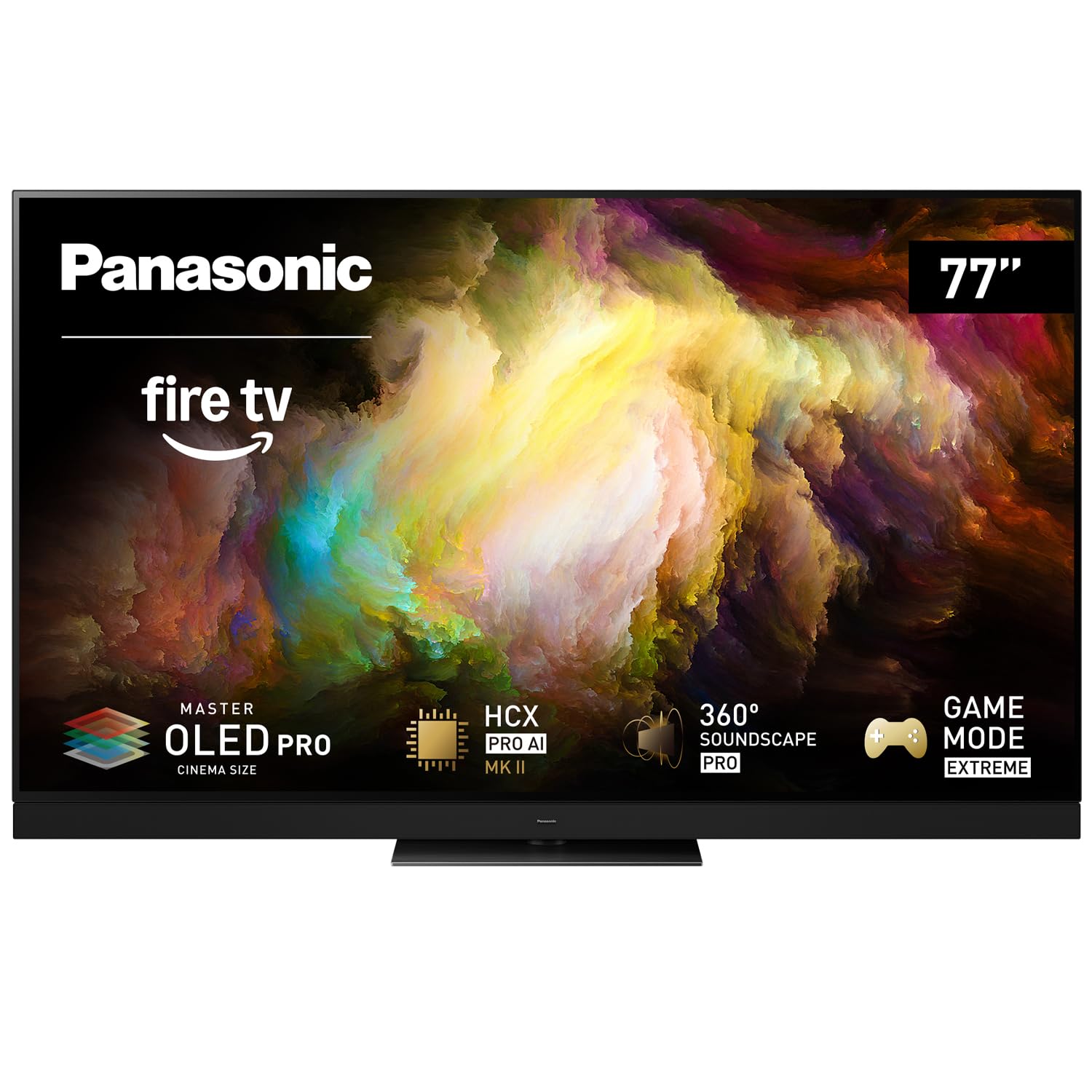
2. Panasonic Z8 Series 77-inch OLED 4K Smart Fire TV 77Z8BAP
A 77-inch OLED built for the recliner crowd who want the game to feel like a stadium.
Its 144Hz refresh rate is the number that matters for sports. A panel that redraws 144 times a second keeps a puck or a tennis ball in a clean shape during a fast pan, and the game-friendly extras — HDMI 2.1, VRR, AMD FreeSync Premium and NVIDIA G-SYNC — mean the same screen will keep a current console happy. HDR10+ Adaptive and Dolby Vision IQ read the room’s light and correct the picture, so a mid-afternoon match does not look washed out.
Then there is sound. The 360 Soundscape Pro speakers, tuned by Technics, fire forward, upward and out the sides to create a Dolby Atmos field — a real advantage for a big room where the crowd noise should come from around you, not from one strip below the screen.
Price is the obvious hurdle: this is a big, heavy premium set — buyers report it weighs around 100 lbs before you add the stand, and the review pages sum it up: “Very heavy: ~100lbs TV +15lb stand, needs 2-3 people.” Plan the wall mount and a helper before it arrives. The one-box cinematic line it belongs to includes the acclaimed Z95A and Z95B models, and the Fire TV platform here is the same one you would find on a smaller set.
what separates it: 77 inches of OLED with a 144Hz panel, plus upward and side-firing Atmos speakers — the biggest, most theatrical option on this list.
The catch: You are buying a two-person job. The stand alone adds weight, and getting the set onto the wall is not a solo evening project.
Built for: A dedicated media room where the screen is the centerpiece and the wall can take the load.
Skip if: You need the set on a shelf or you have nobody to help lift it — the size and weight make a 55-inch pick the easier route.
3. LG 55-Inch B5 Series OLED Smart TV OLED55B5PUA.AUSZ
The OLED that makes a dim room feel like a private box at the stadium.
Over 8.3 million self-lit pixels is the reason the blacks go black. Each pixel switches itself off completely, so a night game, a black uniform or the shadow under a floodlight has real depth instead of a gray wash. The Alpha 8 AI Processor Gen2 adjusts picture and sound on the fly, and the panel refreshes at 120Hz — a smooth enough rate for a fast break, and enough for most console gaming too.
The gaming side is stronger than its price bracket suggests. A 0.1ms response time, up to 120Hz, NVIDIA G-SYNC, AMD FreeSync Premium, VRR and four HDMI 2.1 inputs mean you can plug in a console, a soundbar and a streaming box without unplugging anything.
Sound gets more attention than you might expect. Dolby Atmos and a set of speakers that, in practice, can carry a small room without an amp — several buyers mention keeping it soundbar-free. The downsides are the ones OLED always carries: it is at its best in a room where you can control the lighting, and if your living room is a sun trap, contrast will soften in the daytime. The remote is the other sticking point.
Why owners forgive its quirks: Deep blacks, infinite contrast and wide viewing angles in a 55-inch box — the picture wins people over before they notice the remote.
Plan for it: Some found the remote unintuitive and had no printed manual in the box; a cheap universal remote settles it. The panel also prefers controllable lighting to full midday sun.
Matches best: A bedroom or den where the blinds get closed for the 8 p.m. game — OLED does its best work once the room dims.
Not the fit: A sun-drenched family room with a wall of windows, where a bright LED panel will hold up better during afternoon matches.
4. Hisense 55-Inch U6 Series Mini-LED ULED 4K Google Smart TV 55U6N
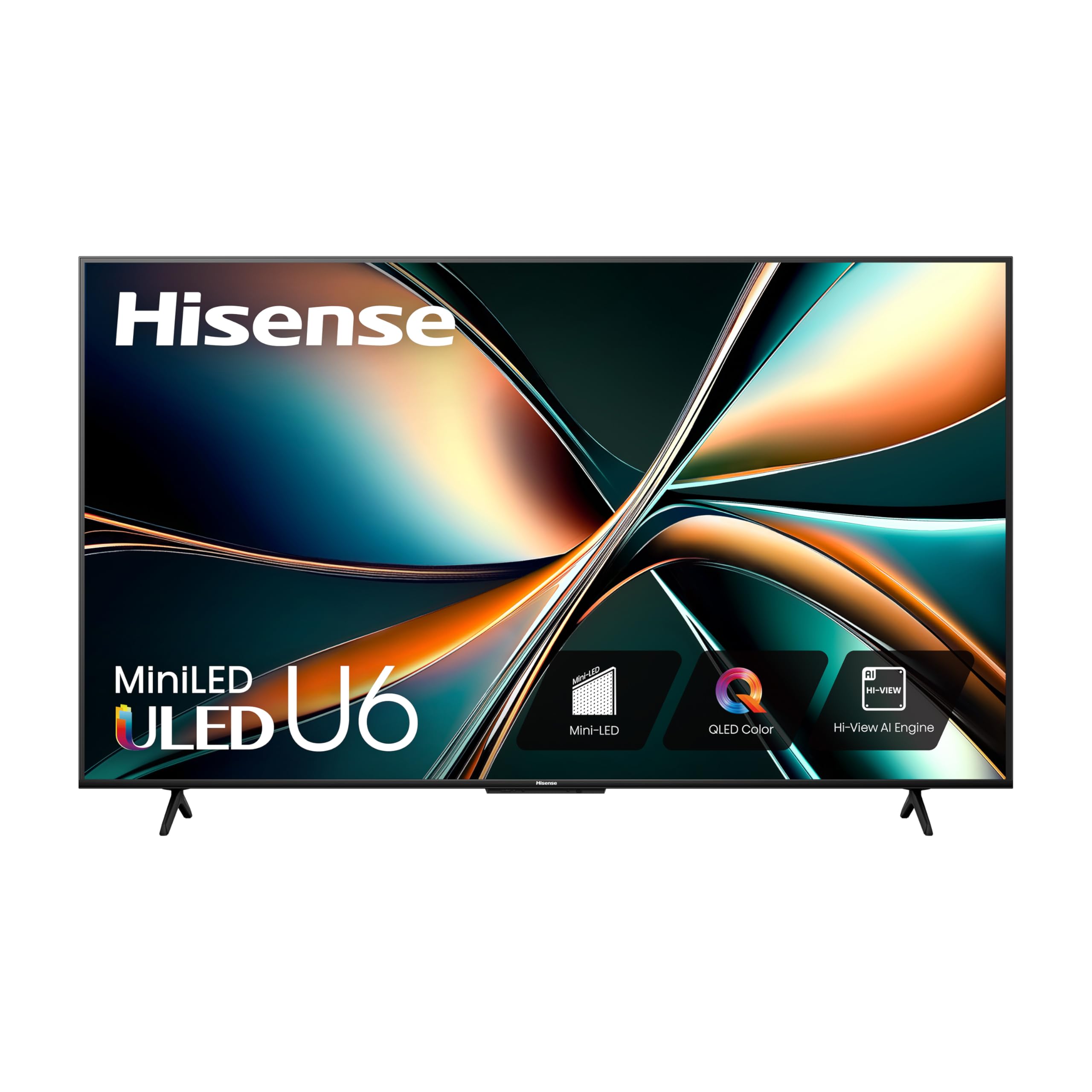
The set that proves a budget can buy a genuinely bright, contrasty sports picture.
Full Array Local Dimming Pro with a mini-LED backlight is why this one punches above its class. The small LEDs dim and brighten in groups, so a bright stadium light and a dark shadow can sit on the same screen without the shadow breaking up into a haze. QLED Quantum Dot color widens the palette, and Motion Rate 240 with MEMC frame insertion is Hisense’s motion smoothing, which is the feature that keeps a fast pass readable instead of smeared.
Game Mode Plus brings VRR, Auto Low Latency Mode (ALLM — the TV drops into low-lag mode as soon as a console wakes) and AMD Freesync, so a sports set does double duty for the consoles. Wi-Fi 6 gives you the newer, less-crowded band for streaming a live feed, and four HDMI inputs with eARC leave room for your gear.
The honest trade-off is internal memory. The Google TV platform can run out of room for apps, and several long-term owners found they could not install everything they wanted. The workaround is to set a USB drive as app storage before you start loading apps. Wi-Fi connectivity is the other thing to watch — a wired Ethernet run is the reliable path if your router is far away.
The value story
- Mini-LED with Full Array Local Dimming Pro delivers contrast that rivals pricier sets.
- Motion Rate 240 plus MEMC handles fast action such as a slap shot or a cross-field pass.
- Four HDMI inputs with eARC, plus Wi-Fi 6 for a modern streaming connection.
Set it up knowing this
- The Google TV platform can fill its internal storage with apps; a USB drive for app storage fixes it.
- If your router is far, run a cable — wireless streaming is where complaints cluster.
Pick this if: You want real mini-LED contrast — a bright daytime picture and deep night-game blacks — without stretching the budget.
Set it up right: Attach a USB drive for app storage on day one, and run Ethernet if the router is out of range; that keeps the Google TV platform from feeling cramped.
5. iFFALCON 55″ 4K MiniLED Smart TV 55U85
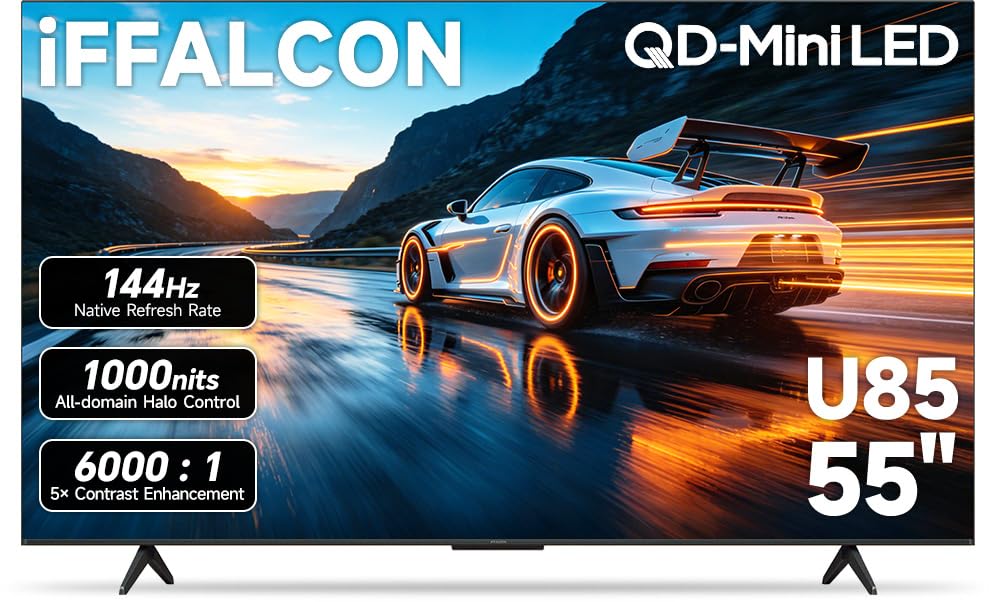
Four HDMI 2.1 ports, a 144Hz panel and a price tag that undercuts the big names.
Start with the panel: it is a native 144Hz screen with Variable Refresh Rate over 4K at 48–144Hz, up to 240Hz, and AMD FreeSync Premium Pro. For sports that means a fast pass stays crisp; for a console it means no tearing. Add up to 1000 nits of HDR brightness, local dimming and a 6,000:1 contrast ratio, and you get bright highlights and deep shadows in the same frame.
The port layout is the reason it is on this list. All four HDMI inputs are 2.1: two will run 4K at 144Hz for a PS5, an Xbox or a gaming PC, and the other two handle 4K at 60Hz for streaming boxes and a Blu-ray player. Auto Low Latency Mode switches to game mode instantly, so you are not menu-diving when the match starts. eARC on HDMI 4 sends lossless audio to a soundbar if you add one.
Sound is a genuine surprise — a 2.1-channel system with two 15W tweeters and a 20W woofer, plus Dolby Atmos passthrough and DTS Virtual:X. There is also hotel mode and IP control, which consumer sets rarely include at this tier and which make it easy to lock inputs in a guest room or an office. The caveat is the brand itself: iFFALCON is a TCL sub-brand, and the software has a growing-pains reputation — a few owners wondered whether it would slow down over time.
The unusual part: Four HDMI 2.1 ports on a 55-inch set is rare; most rivals save that bandwidth for one or two inputs only.
Size up the trade: The Google integration is heavy, and the brand is newer. If you want proven long-term software support, the bigger names are the safer bet.
Right for: A mixed-use room — sports on Saturday, a console or PC on Sunday — where port count matters more than badge prestige.
Look elsewhere if: You want a mature software ecosystem with years of promised updates; this one leans on value and specs over software pedigree.
6. TCL 55 Inch T7 Series 4K QLED Smart Google TV 55T7
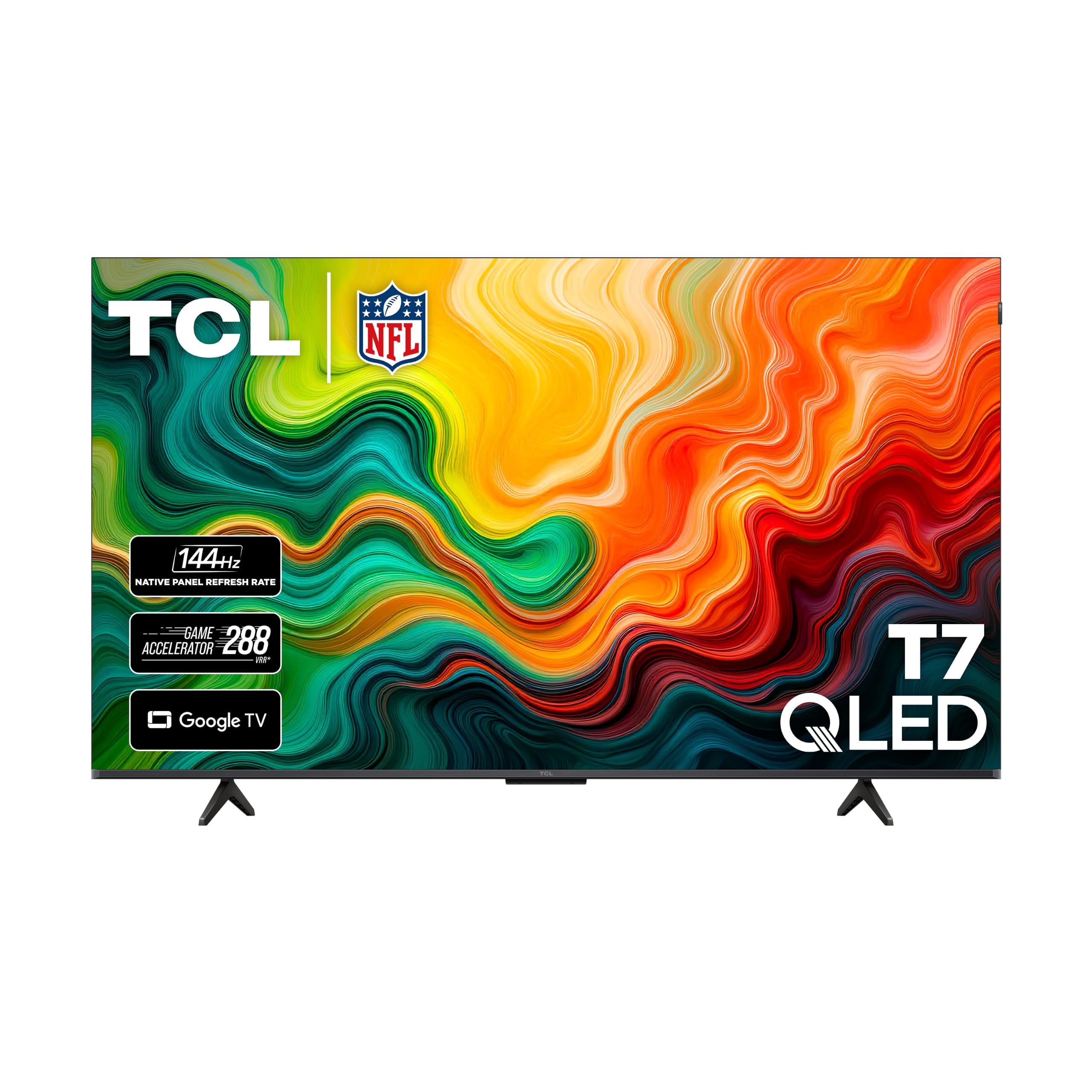
A 120Hz QLED with Motion Rate 480 that takes a fast counterattack seriously.
Motion Rate 480 with MEMC frame insertion is the sports-relevant feature. It combines motion-processing tricks to keep a ball in one piece during a hard camera swing, and the 120Hz panel refresh gives it the frames to work with. QLED Quantum Dot color reaches nearly the full DCI-P3 color space, so the greens of a pitch and the reds of a kit look rich rather than washed. The TCL AIPQ Pro processor tune color, contrast and clarity on the fly.
Connections are plentiful: four HDMI inputs, one with eARC, plus Ethernet, RF, USB and Wi-Fi 5. Google TV brings the apps together in one place, and hands-free voice control means you can search for a game without finding the remote. Dolby Vision, HDR10+, HDR10 and HLG cover the major HDR formats, and Dolby Atmos adds spatial audio to movies and games as well as sport.
Where to be aware: reliability gets mixed reports. Most owners run fine, but the occasional unit has shut off at random times, and one sample arrived with a stuck pixel — the sort of thing that can be a one-off. Build quality is on the lighter side, which is an asset for wall-mounting and a hint that you should treat the panel with care. For casual sports viewing, it does the job with money left over.
A head-to-head worth noting: The TCL’s 120Hz panel and Motion Rate 480 earn its place next to the Roku Plus Series, though the Roku’s mini-LED lighting gives it the contrast edge.
What to expect: Lightweight build makes mounting simple; motion handling on fast action is its real strength.
For the price-minded fan: A 55-inch 120Hz QLED that covers the weekend fixtures without asking for premium money.
One caution: Reports of random shut-offs and an occasional bad panel exist, so buy where returns are simple and check the screen on arrival.
7. Roku 55-Inch Pro Series 4K QLED RokuTV
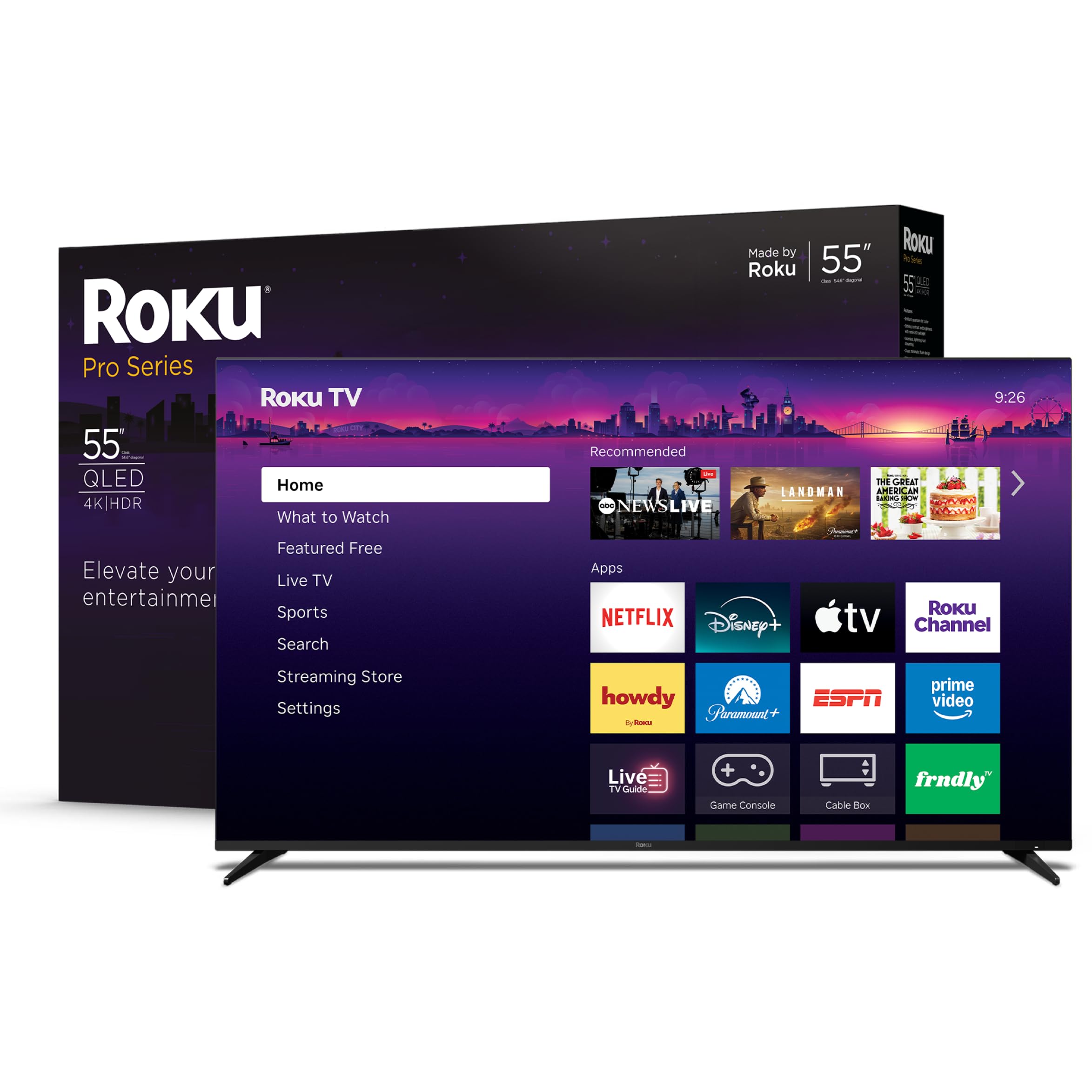
Thousands of mini-LEDs under a Dolby Vision IQ layer, tuned for daylight sports.
The 120Hz refresh rate is the sports number here — Roku calls it “blistering speed” for following live action, and it is what keeps a fast break from breaking into a trail. Thousands of mini-LEDs send light where the frame needs it, and Dolby Vision IQ adapts the picture to the room’s brightness. Side-firing speakers push Dolby Atmos sound out around the set rather than down from a strip.
What wins people over is the remote. It is rechargeable, has backlit buttons you can find in the dark, and does hands-free voice — a genuine upgrade if you are always hunting for a clicker during a fourth quarter. Roku Smart Picture Max cleans up the signal, and the home screen is the simple, low-clutter Roku layout.
The thing to know is that this is a step up in size and brightness than the 55-inch Roku Plus Series below it in the value tier — the mini-LED count is higher and the price climbs with it. The recurring gripe is connectivity: a few buyers had wireless dropouts where a wired connection was fine. And while the picture is strong, the 55-inch Pro’s 120Hz panel sits a step behind the 144Hz panels on some pricier sets. For a bright room with a big window, it earns its place.
Why the remote matters: Backlit, rechargeable and voice-capable — a small thing that changes how a dark-room sports night feels.
The honest limit: A few units hit wireless dropouts; if your router is on another floor, a cable takes the risk out of a live stream.
Choose this when: You watch a lot of daytime sport in a room with control over glare but a lot of light, and you hate hunting for a remote in the dark.
Compare before you buy: The 144Hz sets further down this list will beat it on raw motion smoothness; the Roku’s edge is brightness plus the remote.
8. Hisense 65″ U6 Series Mini-LED 4K Smart Fire TV 65U65QF
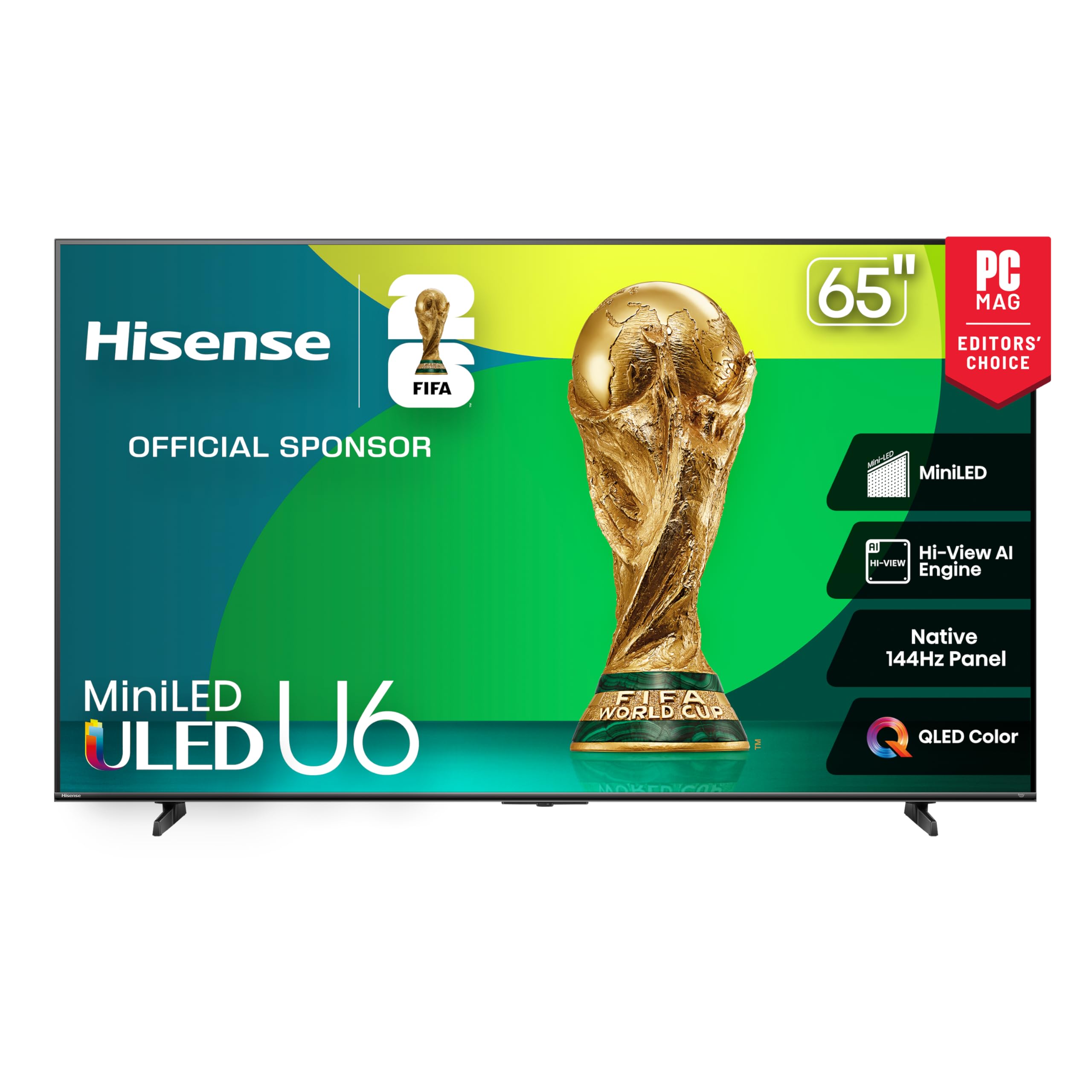
A 65-inch mini-LED with a 144Hz panel that turns a living room into a small stadium.
The panel does native 144Hz with Motion Rate 480 — very simply, it redraws fast enough that a puck or a tennis ball stays in one piece during a hard camera pan, and the high Motion Rate figure keeps the detail through the fastest on-screen action. Mini-LED backlighting peaks at up to 1000 nits with up to 600 local dimming zones, so a floodlit night game has bright highlights without halos around them.
There is plenty for a console too. 144Hz Game Mode Pro runs VRR from 48Hz to 144Hz with AMD FreeSync Premium, and ALLM drops input lag automatically. Dolby Vision IQ and HDR10+ Adaptive adjust to your room, Dolby Atmos handles the audio, and a built-in subwoofer gives the crowd noise some low-end rumble without a soundbar.
The catch is the software. Fire TV is smooth when it works, but sometimes it takes a while to load, has rearranged the home screen to prioritize apps buyers did not want, and occasionally throws a network drop. There is also a durability question — a few long-running units have developed panel faults after around a year of use. Check the warranty terms before you commit.
The case for it: 65 inches, a native 144Hz panel and up to 600 dimming zones in one package — a big-room sports set that does not rely on a soundbar for rumble.
Worth knowing: Fire TV can be pushy with its home screen, and only some of the HDMI inputs run the full 144Hz; check the manual for which port is which when you plug in a console.
Makes sense for: A large living room where you want a 65-inch picture, a native 144Hz panel and a subwoofer built in.
Buy with care: Ask about the warranty terms before purchase — some long-term units developed panel issues just past the first year.
9. LG OLED65C5PUA 65″ C5 OLED evo 4K UHD webOS TV

The C5 OLED evo, sold as a full home-theater starter kit so nothing is missing on day one.
Over 8.3 million self-lit pixels turn off individually, which is why OLED gets the deep blacks and the true-to-life contrast that make a night game feel lit from within. The α9 AI Processor Gen7 tune picture and sound scene by scene, and 4 HDMI 2.1 ports with NVIDIA G-SYNC, AMD FreeSync Premium and VRR cover a current console without splitting the input. It also has Dolby Vision and Dolby Atmos.
The bundle is the reason it is on this list at this spot. You get two 6FT 4K HDMI 2.0 cables, a wall mount bracket sized for 37″-100″ sets, a surge adapter with night light, a beginner’s home-theater guidebook, and CPS’s 26 months of extended protection, which includes accidental and burn-in coverage. That means the piece you would otherwise buy separately — the wall mount and cables — is already in the box.
The honest catch is delivery and out-of-box reliability. Some units have arrived with flashing red light or a bad board — the sort of thing in-bundle protection is designed for, but it still costs time. A few found the included wall-mount hardware short on wall screws. For visual quality, the C5 line is what sets the standard here.
What the bundle buys you: Cables, mount, surge protection and a 26-month accidental and burn-in plan — the extras that a bare OLED purchase leaves you to price separately.
The trade: Occasional out-of-box faults happen on any large OLED; having 26 months of coverage in the box makes the setback a wait rather than a loss.
Ideal for: A first-time big-screen buyer who wants the mount, cables and coverage sorted in one purchase.
Otherwise: A bare C5 paired with a wall mount and a separate warranty lands in the same place, with more flexibility on the brand of accessories.
10. Samsung 55-Inch S90F Smart TV 55S90F

A QD-OLED with a processor built to track a ball and keep it sharp.
Motion Xcelerator 144Hz and the NQ4 AI Gen3 processor are the sports pieces here. The processor is described by Samsung as running 128 neural networks to smooth the motion of fast-moving balls and reduce blur and flickering — the “keep your eye on the ball” feature, in Samsung’s own words. VRR gaming runs up to 4K at 144Hz, so a current console takes full advantage of the same panel.
The QD-OLED screen gives you the OLED strengths — true blacks, deep contrast, a picture that holds up in the dark — with a color range that makes a jersey and a pitch read as separate things. Upscaling Pro brings everything up to 4K, which matters on the lower-resolution feeds some regional sports broadcasts still send.
Where this one earns its premium label is sports clarity specifically. A buyer who compared it directly to other sets on this list put it plainly: “Any tv works for movies and regular shows in my opinion. But for sports, you need absolute clarity and this tv delivers.” The honest frictions are around setup — the solar remote has small buttons some find hard to read, and menus are deep enough to need a second pass.
Best-in-list for motion: Motion Xcelerator 144Hz plus AI motion smoothing is the closest thing here to watching a game with the blur turned off.
Plan for the setup: The menus take a little learning and the solar remote is small; both are fixable in an evening’s fiddling.
It suits: The sports fan who cares about motion clarity above all else and will sit down to tune the picture once.
Not the value pick: If you want a bright LED set for a sunlit room at a lower tier, the Roku Plus Series above does most of the job for less.
11. Sony 85 Inch BRAVIA 7 Mini LED QLED 4K Google TV K-85XR70

85 inches of mini-LED that turns a living room into a stadium wall.
Thousands of Mini LEDs, controlled by XR Backlight Master Drive, are what give this set its authentic contrast — bright highlights from a stadium light sit next to deep shadows without the two bleeding into each other. The XR Processor enhances color, contrast and clarity in real time, and QLED with XR Triluminos Pro brings billions of colors so a patch of turf and a patch of jersey read as the distinct greens and reds they are.
The size is the point. At 85 inches, the pitch feels life-size, and the set supports Dolby Vision and Atmos, IMAX Enhanced and DTS:X for the audio side. It also gets Sony’s PlayStation 5-exclusive features (Auto HDR Tone Mapping and Auto Genre Picture Mode) and Studio Calibrated modes for Netflix and Prime Video, which means the picture modes have been tuned by the studios that made the content.
Two real frictions to plan around. First, the panel has a narrow viewing angle — buyers have noted that off to the side, contrast drops off faster than on an OLED. Second, this is a heavy, 85-inch installation that needs a wall and a helper. The picture is what sells it, and the local-dimming control is genuinely impressive; if you sit centered and watch a lot of big-match sport, it is a cinema wall you will not want to leave.
The case for the wall
- 85 inches is a genuine stadium-scale picture — the size itself changes how you watch a game.
- XR Backlight Master Drive controls thousands of mini-LEDs for deep contrast in bright and dark scenes.
- Studio Calibrated modes for Netflix and Prime Video, plus PS5-specific auto modes.
Site it before you buy
- Narrow viewing angle — plan your seating around a centered view.
- Heavy 85-inch install that needs a wall and a helper.
For: A dedicated viewing room where the sofa faces the screen dead-on and the wall can take an 85-inch panel.
Choose the LG C5 instead if: You have a big group that watches from off to the side — OLED holds contrast at wider angles, while this panel narrows once you move off-center.
Know the Specs
Refresh rate and motion handling
Refresh rate is measured in Hz — how many times per second the panel redraws. A 120Hz set redraws 120 times a second, which is the practical minimum for watching fast sport without a trail following the ball. A native 144Hz panel goes further. A “Motion Rate” or “Motion Xcelerator” figure in the hundreds isthe manufacturer’s own smoothing measure, not a literal panel speed, and pairs with frame insertion to keep fast camera moves readable. VRR, or Variable Refresh Rate, lets the screen match a console’s frame output so the image does not tear; ALLM, or Auto Low Latency Mode, drops the TV into its low-lag setting the moment a console wakes.
Backlight type and local dimming
An LED TV lights its picture from behind the panel. Mini-LED packs far more, far smaller LEDs into that backlight, which is why mini-LED sets can brighten a stadium light and darken the shadow beneath it in the same frame. Local dimming is the control that lets groups of those LEDs dim independently; “Full Array” means the LEDs sit across the whole back panel rather than around the edges. More dimming zones generally means tighter contrast and fewer halos around bright objects on a dark field. OLED takes a different route entirely — each pixel makes its own light and can switch fully off, which is why OLED blacks go truly black.
Brightness, HDR and room light
HDR, or High Dynamic Range, is the format that carries a wider range of brightness and color than a standard signal. Dolby Vision, HDR10+, HDR10 and HLG are the main versions, and a set that supports all of them will not be caught out by a particular streaming app. Dolby Vision IQ and HDR10+ Adaptive go a step further: a light sensor in the TV reads the room and adjusts the picture so a midday match does not look blown out. Peak brightness figures in nits tell you how hard the set can push a highlight; contrast ratio tells you how far apart its brightest and darkest points sit.
Panel type, viewing angle and glare
OLED holds its color and contrast as you move off-center, because each pixel fires straight at you. Many LED panels soften as you move to the side, which matters in a room with a wide seating arc. Screen finish matters too: a glossy panel gives deeper blacks but shows reflections from a window or a lamp, while an anti-reflective coating trades a little punch for fewer distractions. In a bright room, the honest answer is often to control the light rather than expect the panel to beat it.
Common Questions
Is 60Hz good enough for watching live sports?
Will a mini-LED TV look better than OLED for a daytime game?
What does Dolby Vision IQ actually do during a match?
Do I need HDMI 2.1 if I also play console games on my sports TV?
How far should I sit from a 55-inch or 65-inch sports TV?
Does motion smoothing help or hurt a sports broadcast?
Is OLED a risk for burn-in if I leave a sports ticker on all day?
Can I wall-mount a 77-inch or 85-inch TV myself?
Which smart platform is best for finding live sports quickly?
Do I still need a soundbar for watching sport?
The Bottom Line
The best sports picture for most people lands on the Roku 55-Inch Plus Series, because mini-LED brightness, QLED color and a quick Roku interface do the two things a match demands — hold contrast in a lit room and keep fast action clean — without asking for a premium budget. If motion is the one thing you refuse to compromise on, the Samsung S90F with its Motion Xcelerator 144Hz panel is the sharper tool for a fast ball.
For a room where the lights stay low and the blacks matter, the LG B5 OLED is the set that makes a night game look three-dimensional. And if the wall can take it, the Panasonic Z8 at 77 inches turns a big match into an event — just bring a helper for the lift.
Match the panel to your room’s light and your seating, then buy the biggest screen that fits.
How we choose
We do not accept paid placement. Every pick is matched to a real buyer and a real use-case; we do not hands-on test units.
Sources
Specifications: manufacturer listings and product documentation. Review insights: verified customer reviews, as of October 2026. Pricing: not shown on this page (it changes often); check the current price via the retailer link.
As an Amazon Associate, Aappliancez earns from qualifying purchases. This does not affect which products we feature.