Disclosure: Some links in this post are affiliate links. As an Amazon Associate I earn from qualifying purchases, at no extra cost to you. Learn more
Specs are compiled from manufacturer listings and verified buyer reviews and can change over time — please confirm the key details on the product page before buying.
You can watch your local channels for free — if you pick an antenna that reaches your towers. The wrong one leaves you staring at a “no signal” screen. The fix is matching the antenna’s pickup pattern and range to your actual distance from the broadcast towers. That distance can be a city apartment or 80 miles out in the country. Below are six picks, so you can aim once and stop paying for local channels.
This guide is built by comparing the manufacturers’ published specifications and the patterns across verified customer reviews, so you get each pick’s real strengths and trade-offs instead of marketing spin.
Whether you are cutting the cord or hunting for one stubborn network channel, the key is matching an antenna’s gain and directionality to your tower distance. Here is how to pick the best TV Antennas for your rooftop.
Top Picks
How To Choose The Best TV Antennas
An antenna is not a magic box that grabs TV out of the sky at any distance. It is a directional collector that works best when its reach, its aiming, and its amplification line up with the towers near you. Match all three and the picture locks in.
Match the range to your real tower distance
A stated range like 60 miles or 200 miles is the manufacturer’s best-case number, measured across flat, open ground with nothing in the way. Trees, hills, and even the brick in your own walls cut that down. Check your distance to the nearest broadcast towers first, then pick an antenna with headroom above that number.
Directional or multi-directional
A directional antenna focuses its pulling power toward one cluster of towers, so it grabs distant stations from a single angle. A multi-directional model catches signals from several directions at once, which suits you if your local channels are spread across more than one compass point.
Amplification and interference filtering
An amplifier (a booster that strengthens a weak incoming signal) helps most when you are far from the towers or using a long cable run. Just as important is filtering that blocks cell-phone and FM radio signals, which can smear a picture into pixelated squares even when the station is close.
Side-by-Side Comparison
| Model | Best For | Max Range | Channels | Powered | Amazon |
|---|---|---|---|---|---|
| Televes DAT BOSS Mix LR 149884★ Best Overall | Deep fringe rural reception | 80 miles | 29 | Yes (dual mode) | Amazon |
| PBD Amplified Outdoor TV Antenna 360°Best Value | Budget cord cutters wanting remote aiming | 150 miles | 100 | Yes | Amazon |
| Five Star Yagi FSA-5812 | Attic or roof install with 4-TV split | 200 miles | 200 | No | Amazon |
| PIBIDI Outdoor TV Antenna UHD-8903 | No-motor install in windy areas | 200 miles | 100 | No (booster optional) | Amazon |
| Five Star Amplified HDTV Antenna | Five-TV households on a single mast | 200 miles | 100 | Yes (rotator powered) | Amazon |
| Antennas Direct ClearStream 2V | Attic, indoor, or suburban roof mounting | 60+ miles | 8 | No | Amazon |
Detailed Reviews
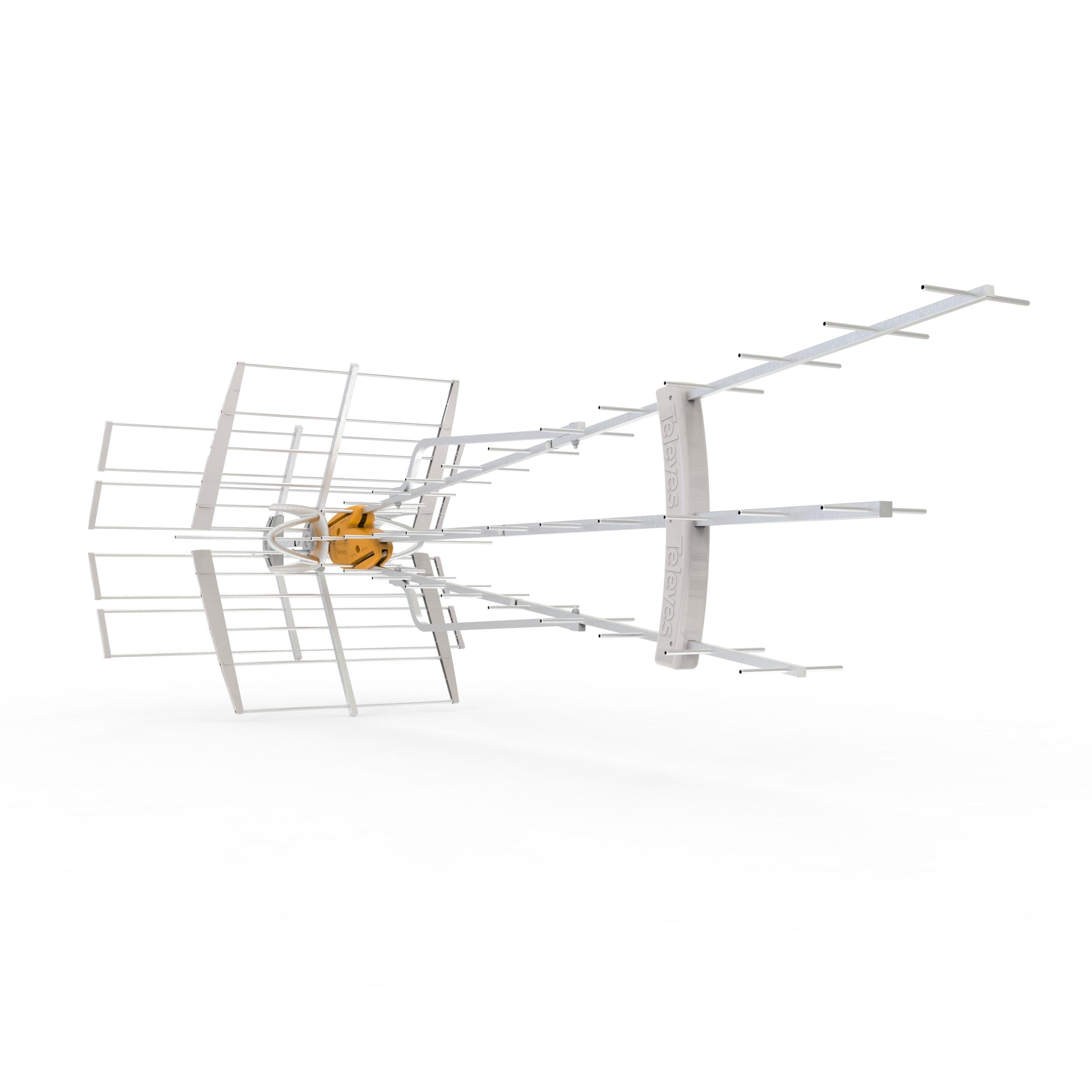
1. Televes DAT BOSS Mix LR 149884 HDTV Antenna
Our pick — 4.5+★ from 450+ verified ratings; the strongest balance of quality and price.
The directional long-range pick that holds a lock where weaker antennas drop out.
If your nearest broadcast towers sit far enough away that every cheap antenna gave you a blank screen, this is the one built for exactly that problem. It is a directional antenna, which means it points toward one cluster of towers to pull in stations from a long way off — and it reaches up to 100 miles from transmitters. The selling point is its TForce preamp, a booster that strengthens the incoming signal before it ever reaches your cable. Televes tunes that amplification separately for two broadcast bands, at 38 dBi on High VHF and 46 dBi on UHF, so it stays stable even when conditions shift.
That stability is why the pick leads the list. The build is aluminum elements with stainless hardware and ABS plastics, meant to shrug off rain, humidity, UV, and the kind of exposure that ruins a cheap antenna in a season or two. It also filters out nearby cell-phone and FM signals, a real rescue when your picture keeps breaking into squares. And there is a clever fallback: if the power ever fails, the antenna keeps passing signal in passive mode instead of going dark entirely. Buyers report the payoff plainly — as the review pages put it, “Installed: went from 4 to 88 channels.”
The catch is the price and the aiming. At the top of this group, you are paying for the amplification and filtering you actually get, and the directional design rewards careful pointing — swing it a few degrees off and a distant station can vanish. The assembled unit is also large, so it wants real roof or attic space rather than a windowsill. And oddly for an antenna at this level, no coax cable is included, so budget for your own run. Buyers also occasionally flag that assembly takes patience, so plan an afternoon.
Why This Wins The Top Spot
- Boosts two broadcast bands independently at 38 dBi High VHF and 46 dBi UHF to hold a lock in fringe conditions.
- Filtering cuts cell-phone and FM interference that causes pixelation on weak stations.
- Weatherproof build with aluminum, stainless hardware, and ABS plastics rated for harsh outdoor exposure.
- Keeps passing signal in passive mode when power is lost.
What To Weigh Before Buying
- Sits at the premium end of this group.
- Directional design demands careful aiming; distant stations fade if it drifts off target.
- No coax cable in the box.
- Large assembled footprint needs real roof or attic space.
Best For: Rural and fringe homes 60 to 100 miles from the towers who want a set-and-forget signal through rough weather.
Look Elsewhere If: You want a single unit to catch channels spread across a wide spread of directions — its focus is its strength, but also its limit.
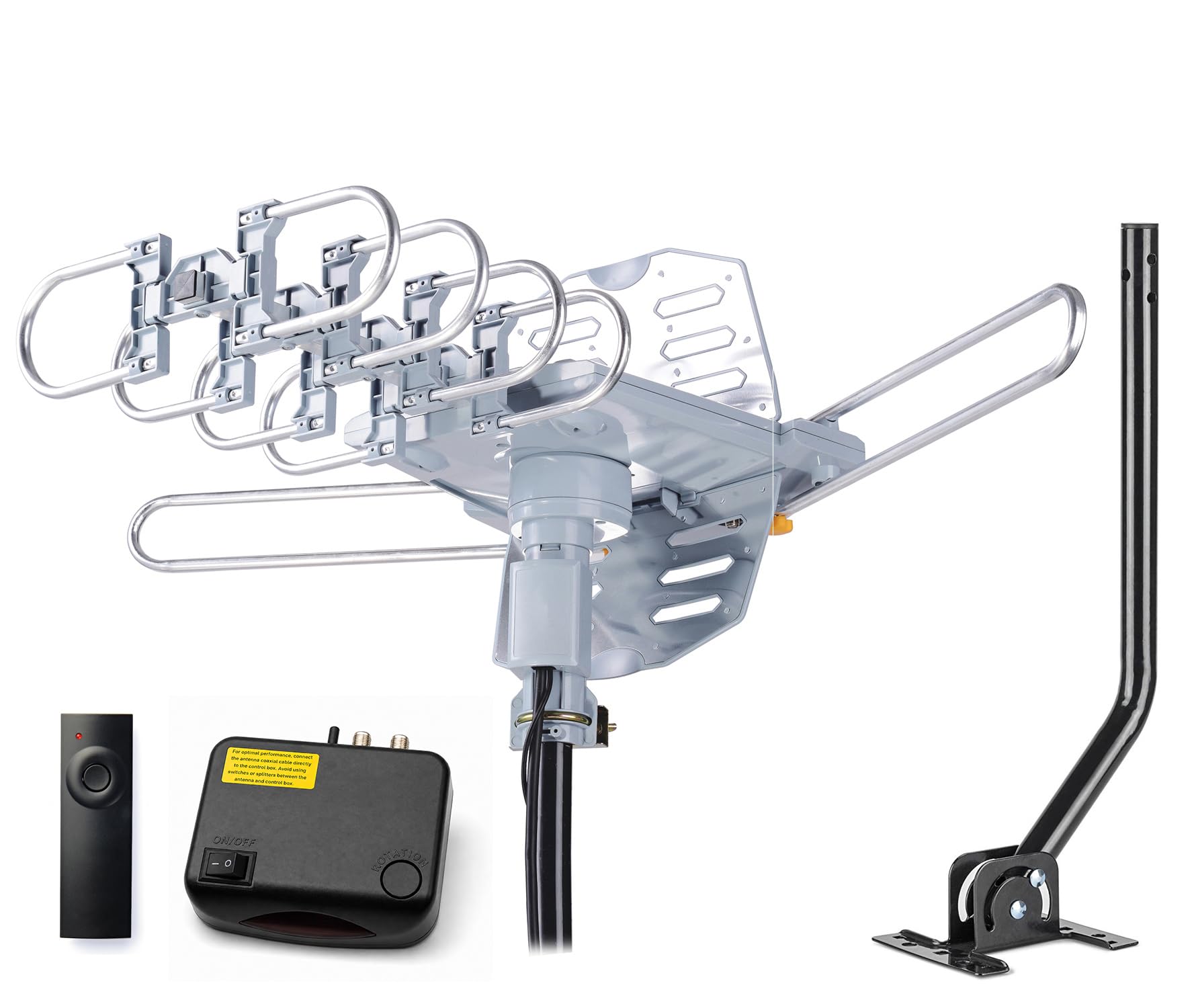
2. PBD Amplified Outdoor TV Antenna
A 360° rotor you steer by remote, so you re-aim without climbing the roof.
The PBD earns its spot because one box does the whole job: it aims itself and reaches far. For an entry-level setup you get a built-in high-gain, low-noise amplifier (a powered booster that pulls in weak signals) rated for signals up to 150 miles out, a motorized rotor (a motor that turns the antenna) you steer with a wireless remote, and a kit that already includes 40 feet of RG6 coaxial cable (the standard TV cable) plus the mounting hardware. That remote aiming is the real-world win — if your local channels sit in different directions, you sweep the antenna without climbing back on the roof.
Owners talk most about how many channels they pull in. One buyer writes, “After simple install, scan got 135 channels.” Two TV outputs let you feed two sets at once without buying a splitter (a box that divides one signal to two TVs) — handy when the kitchen TV and the living-room TV both want the game. And despite the low entry point, it ships NEXTGEN TV (ATSC 3.0) ready, the newer over-the-air broadcast standard, so it is set for the next generation of channels.
Two honest notes, both sized properly. The motor is the recurring topic on the review pages — most find the 360° rotation helpful, but a minority report the rotor sticking or not turning cleanly. And several owners describe the metal as lightweight, so treat it as a fair-weather build that wants a sturdy mounting point, not something to bang around.
Where It Shines: Cheap to buy, ready to mount once set up, and it hands you remote control of the aim — rare at this price.
Reach For This If… You want the least hassle and the lowest commitment for a first cord-cutting setup in town or the suburbs.
Think Twice If… You are 80-plus miles out or need a rotor that never misses — a sturdier build and stronger amp serve that distance better.
3. Five Star Yagi Satellite HD TV Antenna FSA-5812

A Yagi kit with a 4-way splitter that feeds four TVs from one mast.
Most antennas in this group come ready to feed one screen. This Yagi-style model comes ready to feed four, thanks to a 4-way splitter bundled into a kit that also includes 40 feet of coax cable, cable clips, and a 20-inch mounting pole. That single detail is why it makes the shortlist for bigger households — you mount once and cover several rooms. It is billed for reception up to 200 miles and catches both VHF and UHF stations, so it is built for people replacing a flaky indoor model with a real outdoor performer.
Buyers who switched from a cheap indoor unit say the picture stops dropping out. One buyer’s short take says it all: “Picked up 67 channels.” It is a passive antenna (no powered booster inside), so it runs on raw gain and can even work with no power outlet at the mast — some installers prefer that. The build is made to handle wind and rain with lightning protection, and the pole is included, so you are not hunting for extra parts.
Know the honest limit: the 200-mile figure is more optimistic than the real-world reach for most installs. That is the one number owners push back on hardest — plenty get strong reception within 70 miles, but the full claim is a stretch. The kit’s instructions are also the weak link, thin on specifics for the bracket and mount, so expect to figure a few steps out yourself. If you add an amp for a very long cable run, the picture quality per station can still vary with distance.
One Catch Worth Knowing: The range the box promises runs ahead of what the reviews confirm, so measure your true tower distance before you commit to it for a far-flung location.
Best Fit: A multi-TV home inside a reasonable tower radius that wants one antenna, one mount, and four screens fed.
skip it if: You are chasing fringe stations 100-plus miles out and need a boosted directional antenna for that reach.
4. PIBIDI Outdoor TV Antenna UHD-8903

A fixed directional design with no rotor to jam or drift in high wind.
If you hate climbing back on the roof to re-aim after a storm, this PIBIDI is built for you. It has no motor and no rotor, so there is nothing to jam or drift when the wind picks up. It is a fixed directional design (it points one way and stays there) with extended UHF and VHF elements (the rods that catch the two main TV bands). It also arrives mostly preassembled, and the maker says no tools are needed for the final steps. If you have watched a motorized antenna get knocked out of alignment, that simplicity is the whole point.
On paper it reaches as far as the pricier long-range picks, billed for reception up to 200 miles. It is tuned to pull UHF signals across the 470 to 790 MHz band and VHF across 170 to 230 MHz (the two frequency ranges local TV uses). The reception design is lightning protected with grounding, so it is built to live outdoors through rough weather. One tip the reviews make clear: if you are pushing toward the far end of its rated range, plan on adding an optional signal booster rather than trusting the base setup alone — several buyers pair it with an amp for exactly that reason. The sharpest praise comes from tough areas, with receivers well past the mainland pulling every local channel free and clear in places like Puerto Rico.
The honest note is the aiming. Because there is no rotor, you set the direction once and live with it — so if your local stations are spread across several directions, you will compromise on the weakest one. The picture-quality reports also split: some owners describe outstanding pickup and others a weaker result, which usually traces back to how their tower distance and obstructions line up rather than the antenna itself. That makes it a strong fixed install, not a magic wand for impossible locations.
Choose This If: You want a set-once, no-moving-parts antenna that shrugs off wind and rarely needs attention.
Go A Different Route If: Your channels sit in different directions and you want the flexibility to re-aim without a trip up the ladder.
5. Five Star Outdoor Digital Amplified HDTV Antenna
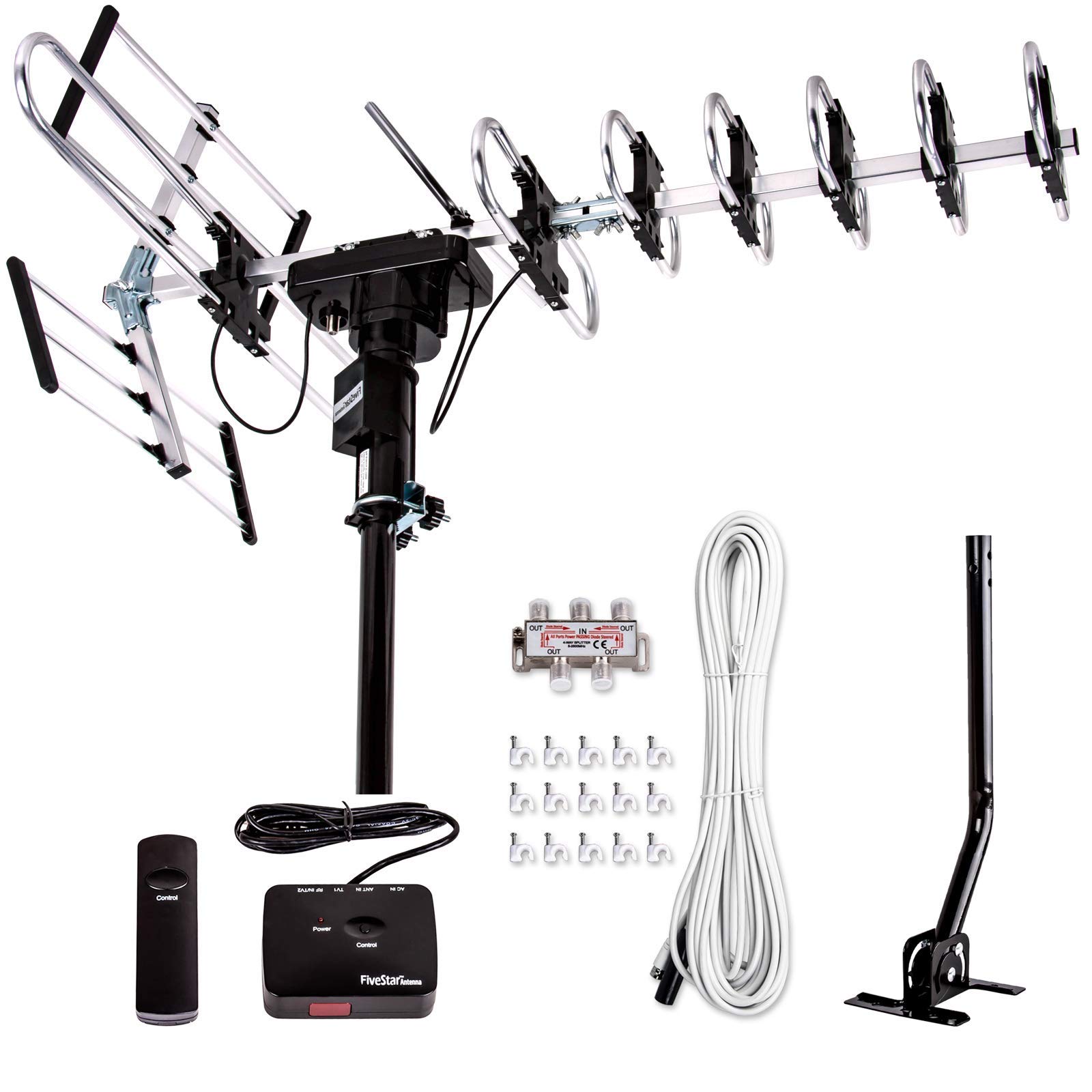
A 360° amplified antenna with a kit built to feed five TVs at once.
If you are wiring a whole house at once, the numbers here are the reason to look. This amplified model is rated to reach up to 200 miles and comes with a kit designed to supply five televisions simultaneously, plus FM radio support. The antenna spins a full 360 degrees so you can point it toward the towers from a button indoors. Five Star also fits it with a gain booster and an auto gain control chip, which the maker describes as holding gain within the 15 to 35 db range. In short: more reach, more outputs, more amplification than the value options.
The channel pickup is the part that wins owners over. Buyers installing on a roof within a normal radius of the towers describe locking onto every major network with a clean picture and a pile of extra stations beyond the main ones. The reflector count is also higher on this model, six elements versus four, which the brand ties to a sharper UHF picture and a steadier signal that resists wind damage. If your goal is coverage and you have a mast to spare, it handles the load.
Two caveats are worth the read before you buy. The rotor is the recurring gripe — some find it jerky, and some find it lacks a direction indicator so you have to be outside to see where it lands. And while the top of its range is generous on paper, plenty of owners mention strong reception only out to 50 to 90 miles, so treat the headline number as best-case. The reflective body is light metal, which means extra care bolting it down where gusts are common.
The Trade-Off: You accept a fussy rotor for the flexibility of aiming by remote and feeding a whole floor full of TVs.
Made For: A family with several screens who wants to run one antenna, one splitter, and one wire run.
Not Ideal For: Someone who wants precise, repeatable aiming — the rotor’s lack of a position indicator makes it fiddly.
6. Antennas Direct ClearStream 2V
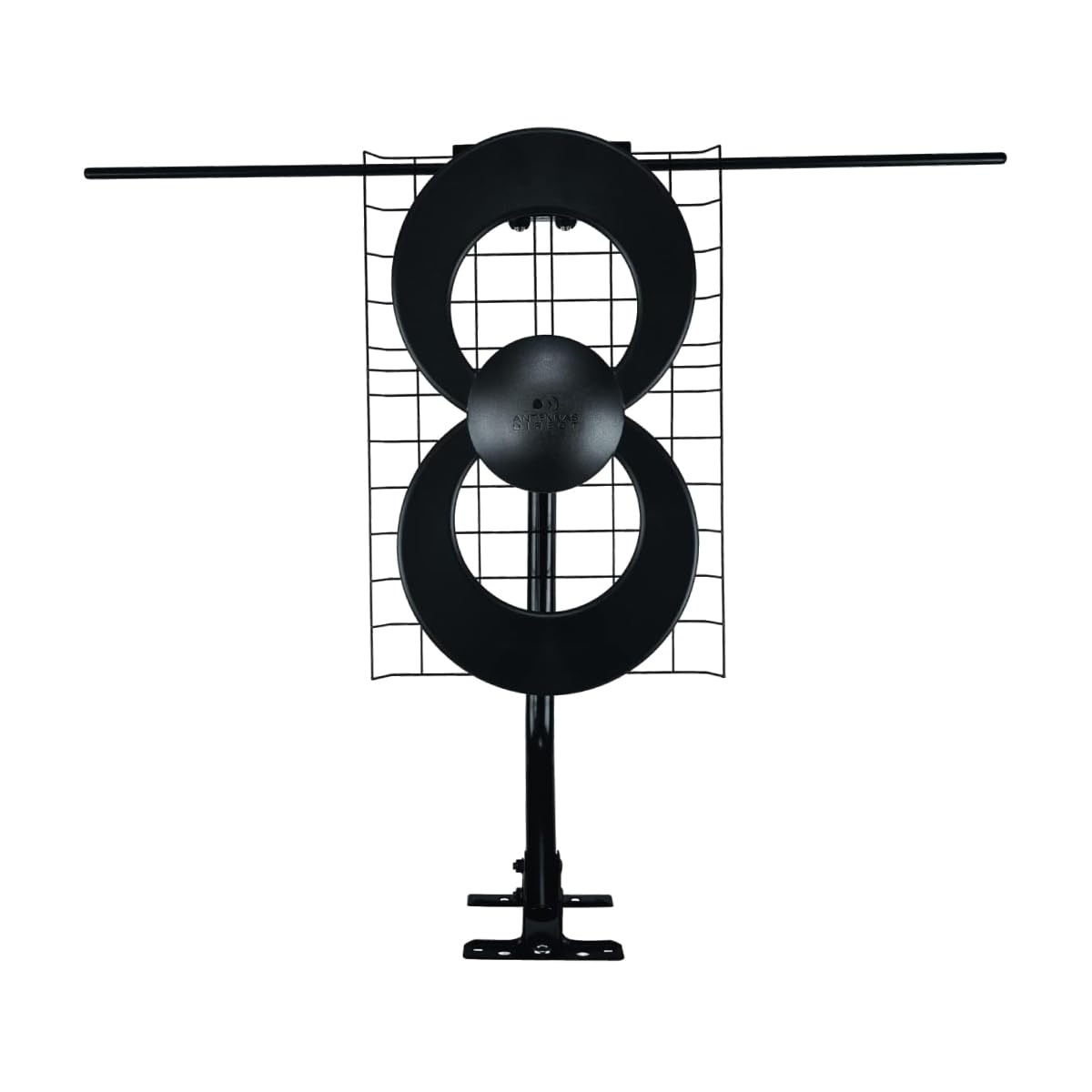
A 2-lb multi-directional antenna that mounts indoors, in an attic, or on a roof.
This one skips the roof and the aiming that the big directional picks demand. It is a multi-directional antenna, meaning it catches signals from more than one direction at once instead of locking onto a single tower cluster. At 2 lbs, it is the lightest unit in this group, so it can sit indoors, go in an attic, or mount outside — its 20-inch mast has a pivoting base that stands on a vertical or horizontal surface. If you rent, live in a brick apartment, or simply do not want to climb a roof, this is your shortcut.
What the design brings to weak areas is a reflector, a piece that adds forward gain and shields the antenna from the rear interference that causes pixelation and total dropout. Rounding it out at up to a 60-plus mile range, it covers the standard suburban and rural distance well. It is also generous on future-proofing — ready for NEXTGEN TV, 4K, 8K UHD, and 1080p over the air without an internet connection. The brand backs the antenna itself with a lifetime manufacturer warranty, unusual for a category full of one-year coverage.
The snags buyers hit are real. The most recurring complaint is assembly instructions that are unclear, and the pivoting J-mount can feel unstable if you do not anchor it well. Buyers also report the strongest results when the towers are within a reasonable distance and roughly visible — from a wooded valley, for example, it needed a raise up the mast and a separate amplifier before far-flung stations came in cleanly. So the honest read is: great for flexible mounting and standard distances, less so for a deep-fringe rooftop job.
Standout Reasons To Choose It
- Weighs 2 lbs and mounts indoors, in an attic, or on a roof via a pivoting 20-inch mast.
- Multi-directional pickup grabs stations from more than one compass direction.
- Reflector adds forward gain and blocks rear interference that causes pixelation.
- NEXTGEN TV, 4K, and 8K UHD ready, backed by a lifetime antenna warranty.
Where It Falls Short
- Instructions can be hard to follow and the pivoting mount needs careful anchoring.
- Reception is best within a standard tower radius; deep fringe may need a boost.
- Only rated for a 60-plus mile range, lower than the long-range picks here.
The Standout Spec: Flexible, multi-directional, and the lightest of the group at 2 lbs — the one to pick when mounting options are limited.
Only Overlook If: You need to snag the weakest stations 80-plus miles out, where a directional amplified model wins.
Know the Specs
Range and Reception Distance
The advertised range is a best-case figure — often measured over flat, open ground with a clear line to the towers. Trees, hills, and the building materials in your own house all cut that number down. As a rule, the more directional and amplified an antenna is, the more of its stated range it can actually deliver in real conditions.
Impedance and Cable Match
Every antenna here runs at 75 ohm, which is the standard TV impedance and the rating of a typical coaxial cable. Matching impedance keeps the signal from losing strength between the antenna and your TV. That is one reason the length and quality of your coax run matters — a short, good cable keeps more of the signal than a long, worn one.
Common Questions
Will a 200-mile TV antenna really reach 200 miles?
Do I need an amplifier, and can it ever make reception worse?
Directional or multi-directional — which do I need?
Where should I mount an outdoor TV antenna for the best signal?
What cable and connectors do the antennas use?
Can one antenna feed more than one TV?
Will a TV antenna work with NEXTGEN TV?
How do I keep a picture from breaking into squares?
What does a motorized rotor add, and is it worth it?
Do these antennas pick up FM radio too?
The Bottom Line
For the majority of shoppers, the tv antennas winner is the Televes DAT BOSS Mix LR 149884 because its dual-band amplification and interference filtering hold a stable signal in the tough long-range conditions where cheaper antennas fail. If you want remote aiming and a lower entry point, grab the PBD Amplified Outdoor TV Antenna. And for flexible mounting indoors or in an attic, the Antennas Direct ClearStream 2V is the one to reach for. Whichever you choose, the crowd favorite here is a 4.5+ star performer that keeps earning its keep — so if long-range pickup is your priority, start at the top of this list.
How we choose
We do not accept paid placement. Every pick is matched to a real buyer and a real use-case; we do not hands-on test units.
Sources
Specifications: manufacturer listings and product documentation. Review insights: verified customer reviews, as of October 2026. Pricing: not shown on this page (it changes often); check the current price via the retailer link.
As an Amazon Associate, Aappliancez earns from qualifying purchases. This does not affect which products we feature.