Disclosure: Some links in this post are affiliate links. As an Amazon Associate I earn from qualifying purchases, at no extra cost to you. Learn more
Specs are compiled from manufacturer listings and verified buyer reviews and can change over time — please confirm the key details on the product page before buying.
Plugging a US phone charger into a European wall socket without stepping the voltage down is how trips end with a dead device — a travel voltage converter takes that 220–250V wall current and drops it to the 110–125V your gear was built for. The short answer for most travelers: the APzek 220V to 110V Voltage Converter covers the widest set of European destinations at a genuinely portable size, while the DOACE C15 is the one to grab if a hair dryer is coming along. Everything below is sorted by what you actually plug in.
This guide is built by comparing the manufacturers’ published specifications and the patterns across verified customer reviews, so you get each pick’s real strengths and trade-offs instead of marketing spin.
Voltage is only half the puzzle — plug shape is the other half, and wattage limits decide what you can safely run. This breakdown covers both, so you can match a converter to your exact devices before you leave. A 220V to 110V converter steps foreign wall voltage down to the 110–125V your US devices expect.
Top Picks

How To Choose The Best Travel Voltage Converter 220V to 110V
The mistake almost every first-time traveler makes is buying a plug adapter and assuming the job is done. An adapter only reshapes the metal prongs so they fit the hole in the wall — it passes the foreign 220–250V straight through to your device. A converter is the part that actually lowers the voltage to a US-friendly 110–125V. You need both, and on most of these units they arrive as one combo.
Check the wattage ceiling before anything else
Every converter has a maximum wattage, and it is the single number that decides what you can run. The APzek handles devices from 30W to 1400W. The ISELECTOR and BESTEK top out around 250W. The DOACE C15 and TESSAN reach 2000W on their high-power outlets. A phone charger draws very little; a hair dryer can pull well past 1000W. Match the device’s rated wattage to the converter’s ceiling and you avoid the most common failure.
Low-wattage devices can be the tricky ones
Counterintuitively, some of the smallest gadgets are the ones converters handle worst. The TESSAN notes its 2000W outlets are built for simple mechanical motors and are not suitable for low-wattage devices in the 0–5W range, such as electric shavers or toothbrushes. The APzek states devices below 30W are not recommended. If a razor or brush is your main concern, read that spec line carefully rather than assuming small equals safe.
Match the plug type to the country, not the continent
Europe is not one plug. Type C is the common two-round-pin used across much of the continent, Type G is the UK and Ireland, Type I is Australia and China, and Italy adds Type L. The APzek is explicit that it does not support the UK, Ireland, or Scotland — its plug is Type C. The Ceptics bundles Type A, B, C, E/F, G, and I outputs. Confirm your destination’s plug type against the included adapters before you rely on one unit for a multi-country trip.
Side-by-Side Comparison
| Model | Best For | Max Wattage | Outlets / USB | Plug Types | Amazon |
|---|---|---|---|---|---|
| APzek 220V to 110V Converter★ Best Overall | Broad Europe coverage, multi-device charging | 30W–1400W | 6 outlets (2 AC + 2 USB-A 2 USB-C) | Type C | Amazon |
| DOACE C15 2000W ConverterHigh-Power Pick | Hair dryers and high-power appliances | Up to 2000W | 6 (2 AC + 4 USB) | A/I, C, F, G | Amazon |
| ISELECTOR 220V to 110V Converter | Multi-device charging on a fixed base | Up to 250W | 8 outlets (4 AC + 4 USB) | A, C, G, I | Amazon |
| BESTEK Universal Travel Adapter | Long trips across many countries | Up to 250W | 7 (3 AC + 4 USB) | UK/US/AU/EU/India | Amazon |
| TESSAN 220 to 110 Converter | Europe and South Africa with 2000W outlet | 2000W AC / 200W adapter | 7 (3 AC + 4 USB) | C, G, I, L, D, M | Amazon |
| Ceptics LX-C2000 | Hair dryer plus curling iron on separate outlets | 2000W + 200W | 6 (3 AC + 3 USB-A 1 USB-C) | A, B, C, E/F, G, I | Amazon |
| HYTED 1600W Pure Sine Wave | Sensitive and motor loads with clean power | 0–1600W | 1 unit | C, G, I, E/F | Amazon |
Detailed Reviews
1. APzek 220V to 110V Voltage Converter US to Europe
Our pick — 4.5+★ from 700+ verified ratings; the strongest balance of quality and price.
The 6-in-1 combo that fits a carry-on and a whole family’s chargers at once.
The APzek is a 6-in-1 combo — two US sockets, two USB-A ports, and two USB-C ports in a single unit that weighs 4.8 ounces. That is light enough that you will not think twice about tossing it in a day bag. It steps 220–250V down to 110–125V and lists compatibility with more than 80 countries, including Spain, Italy, Germany, France, Greece, Hungary, Portugal, the Netherlands, Poland, and Austria. The plug type is Type C, and the maker is direct: this one does not support the UK, Ireland, or Scotland.
Where it earns its spot is the spread of ports. A single 20W PD USB-C port fast-charges a compatible phone while the second USB-C and the two USB-A ports pick up a watch, a tablet, or a Kindle. The 20W PD spec means newer phones fast-charge instead of trickling. Factor in the two US sockets and six devices can be topped up from one wall outlet — the exact problem a hotel room with one spare socket creates. Buyers report the connectors “slide out and pop back in easily,” and the practical upshot is that plug-swapping between countries stops being a fiddly job.
Functionality is what wins people over most, and travel-friendly design is a close second — the size and the all-in-one build are what keep showing up in the feedback. The recurring gripe is the fuse cap: at least one long-term owner had the cap break and needed a rubber band to hold the fuse in place. It is a small mechanical part, not a failure of the electronics, but it is worth treating the cap gently. There is also a real device-limit wall here — the converter works with electronics rated 30W to 1400W, and devices below 30W are not recommended.
What earns it first place
- Six outputs from one 4.8-ounce unit — 2 AC, 2 USB-A, 2 USB-C
- 20W PD USB-C fast charging for modern phones
- Covered in 80+ countries including Greece, Italy, Croatia, and Turkey
- Safety suite: over-voltage, short-circuit prevention, and temperature control
Where it draws the line
- Will not work in the UK, Ireland, or Scotland — Type C only
- 30W–1400W window leaves out hair dryers, straighteners, and razors
- Fuse cap is the fragile point over years of travel
Grab this one if: your trip runs through continental Europe and you are carrying phones, tablets, watches, and a Kindle rather than appliances.
Look elsewhere if: your destination is the UK or Ireland, or a hair dryer needs to come along — this one is a Type C unit capped at 1400W.
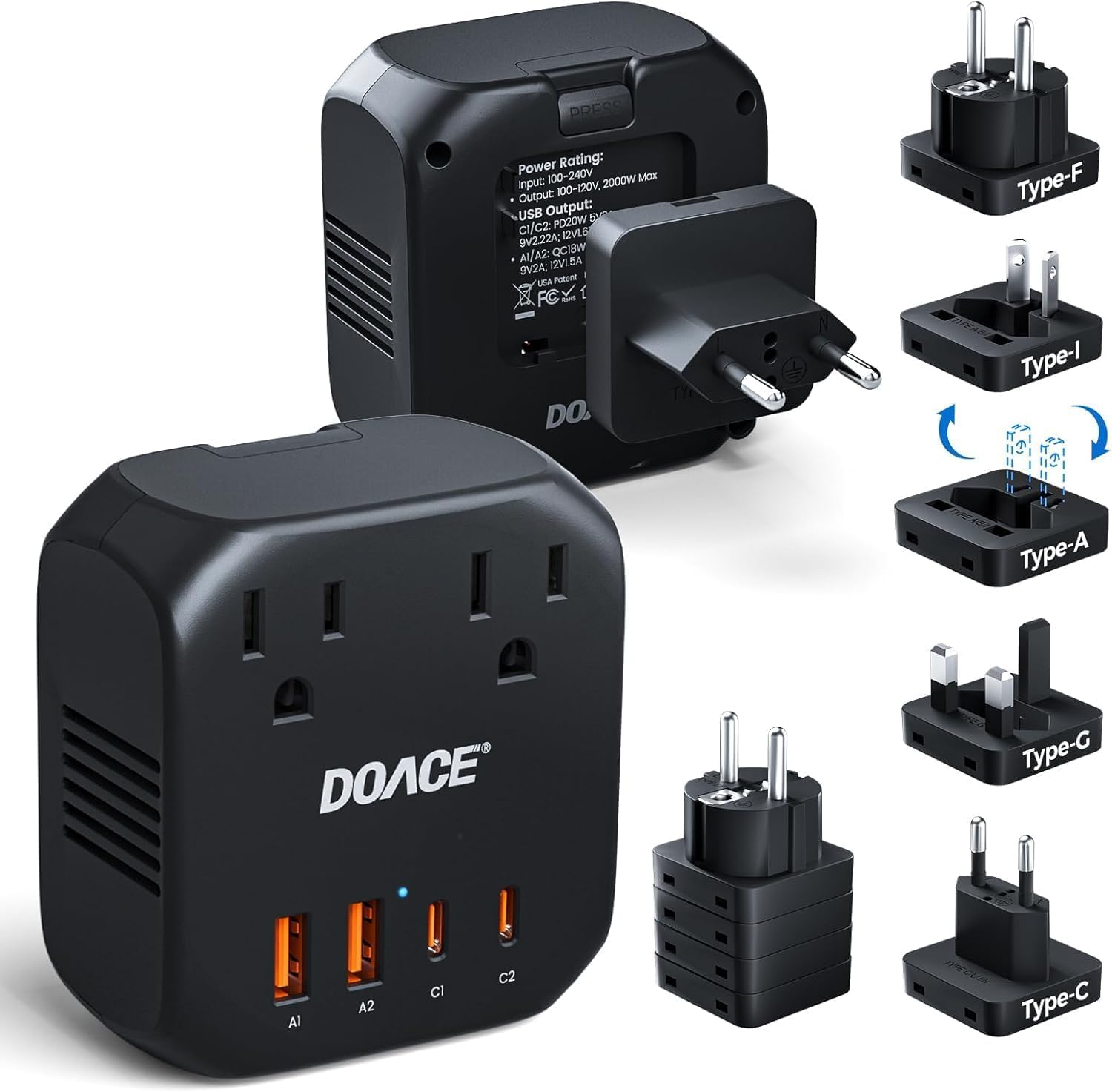
2. DOACE C15 Upgraded 2000W Voltage Converter
A 2000W ceiling built specifically for travelers who insist on packing the hair dryer.
Hair dryers are the reason most people buy a converter in the first place, and they are also the reason most converters fail. The DOACE C15 solves that with a 2000W rating — well above the 1000W ceiling the maker points to as the competitor norm. It steps 220–240V down to 110V, so a US hair dryer, electric kettle, or waffle maker can actually run on a European socket. The catch written right on the box: it is not for Dyson hair tools, and nothing over 2000W.
Four interchangeable plugs — EU, UK, DE, and AU/US — are bundled, and the Type A and Type I mini plugs swap by rotating the two pins. That covers Europe, the UK, Australia, Asia, and the Middle East across 200+ countries. The 2000W unit measures 3.33 x 2.99 x 1.97 inches, which is slightly larger than the APzek’s 3.1 x 2.1 x 2.1 inches — the extra volume is the price of the heavier-duty transformer inside.
For charging duty, there are 2 US standard transformer sockets plus 4 USB ports, with 2 PD ports and 2 QC USB-A ports among them. Six devices can run at once. Safety is covered by overcurrent, overload, overheating, and short-circuit protection, NRTL tested. Owners mention it “worked great for our trip to Italy” — a short record, but a clean one.
The honest read: this is a specialist tool, not an everyday charger. If your bag is phones and laptops only, its 2000W muscle is wasted weight. If a hair dryer or kettle is non-negotiable, it is the difference between a working trip and a fried appliance.
Built for: travelers who will not leave the blow dryer behind and are heading to Europe, the UK, or Australia.
Think twice if: you own Dyson hair tools — the maker explicitly excludes them.
3. ISELECTOR Voltage Converter 220V to 110V
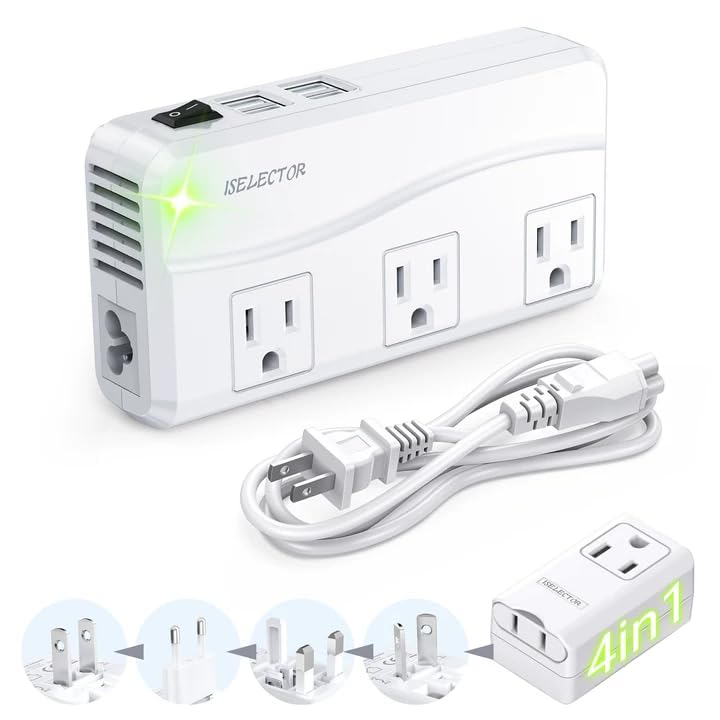
Eight devices off one wall socket — the hotel-room power strip that steps voltage down.
Its 8 ports beat the APzek’s 6 and the DOACE’s 2 AC sockets. The ISELECTOR packs 4 AC outlets and 4 USB ports into a unit that charges 8 devices at once. USB ports use smart IC technology that identifies each device and delivers 2.4A per port. The 4-in-1 plug combo covers JP(A), EU(C), UK(G), and AU(I), and the plug adapter can be used on its own — giving you 9 charging ports in Type A countries.
This is a base-station design rather than a pocket unit. It comes with a 5-foot detachable power cable and a storage pouch, and the maker lists dimensions of 6x3x1.57 inches. Set it on a hotel desk and every device in the family recharges overnight without a tangle of adapters. The ceiling is 250W, which is fine for phones, laptops, cameras, shavers, and game consoles — but the maker is blunt that this should not power a hair dryer, straightener, curling iron, or coffee machine regardless of wattage.
Functionality and versatility are the two qualities that carry this unit in owner feedback. A recurring note is the absence of a USB-C port, so you will need your own USB-C blocks. Noise gets a mixed reception — some find the cooling fan silent, others can hear the buzzing. The cooling fan is built to reduce heat, and the maker claims it runs quietly enough not to disturb sleep.
Best used as: a fixed charging hub on a longer stay, where you unpack once and leave it on the desk.
Reach for it when: you are traveling with a family’s worth of gadgets and want every port filled from one outlet.
Not the one for: a one-bag carry-on traveler, or anyone who needs USB-C built in.
4. BESTEK Universal Travel Adapter

The long-selling workhorse with a 24-month warranty and a pouch that keeps every piece together.
BESTEK holds a patent on this design — Patent No. US RE48,368 E — and it has clearly earned its long shelf life, sitting at 4.0+ stars across thousands of owners. The unit supplies 250 watts through 3 standard US plugs and 4 USB ports capable of 5V / 2.4A each, charging 7 devices simultaneously. Input is 220V, converted to 110V output. One US power cable and 4 international adapters (UK/US/AU/India) cover 150+ countries, and the unit packs down with a 5-foot detachable power cable.
The crowd consensus is that it simply keeps working — it handles Africa, India, and Europe without drama and comes with a travel pouch that keeps the pieces together and passes airport security. One owner sums up the fan in a single line: “The fan I never heard.” Other owners describe only a faint hum, audible mainly when the unit sits near your head.
Where it falls short of the premium picks is the ceiling. 250W will not touch a hair dryer, iron, or coffee machine, which the maker states plainly in the product notes, and the body is a bulky 1.2 pounds when you want everything in a daypack. It is the sensible anchor for a multi-country trip — just not the one that runs high-power appliances.
The case for making it your base
- 7 devices at once — 3 AC plus 4 USB at 2.4A each
- Adapters for UK, US, AU, EU, India across 150+ countries
- 24-month warranty and NRTL safety testing
- On/off switch, power light, and a travel pouch that keeps it all together
What the specs leave out
- 250W ceiling rules out hair dryers and kettles
- 1.2 pounds is heavy for a carry-on-only traveler
- The faint hum becomes noticeable if it sits near your pillow
Pick this for: a multi-country itinerary where you want one proven unit with every plug already in the bag.
Move on if: a hair dryer or high-wattage appliance is on your list.
5. TESSAN Voltage Converter US to Europe

One converter that covers Europe, the UK, Italy, Australia, India, and South Africa without a second adapter.
TESSAN ships 6 international adapters — Type C, G, I, L, D, and M — in one box, plus a DE plug. That is more plug types than any other unit here, and it means the same converter works in Germany, the UK, Italy, Australia, India, South Africa, Dubai, Greece, and New Zealand. For a trip that bounces between continents, that breadth is the whole argument.
The unit splits its work between two channels, and this is the detail that matters. A 2000W AC outlet converts 220–240V (50/60Hz) down to 110V (60Hz) for household appliances like kettles. A separate 200W adapter accepts 100–240V for laptops and phones. Alongside them sit 3 AC outlets and 4 USB ports with one USB-C at 3A and the USB-A ports at 2.4A — 7 devices charging at once. Its fan is designed to run quietly enough for overnight use.
What the unit will not do is the thing to read carefully. The 2000W outlets are designed for simple mechanical motors and are not suitable for very low-wattage devices in the 0–5W range, such as electric shavers or toothbrushes. Customers note it working well in Rwanda, Pune, and across Europe, though feedback splits on size — some call it compact, others too big — and durability draws the most criticism.
A quirk you should know: the on/off button and the extra adapters are most useful when a hotel outlet does not fit the converter’s own plug on the first try.
The trade-off: the widest plug set in the group comes with occasional reports of the unit switching off with just two phones charging — not a failure pattern, but worth watching.
Best for: itineraries that cross Europe, the UK, and South Africa in one trip, with a kettle or appliance in the mix.
Skip if: you need to charge a razor or electric toothbrush — the 0–5W range is off-limits here.
6. Ceptics Voltage Converter 200W + 2000W
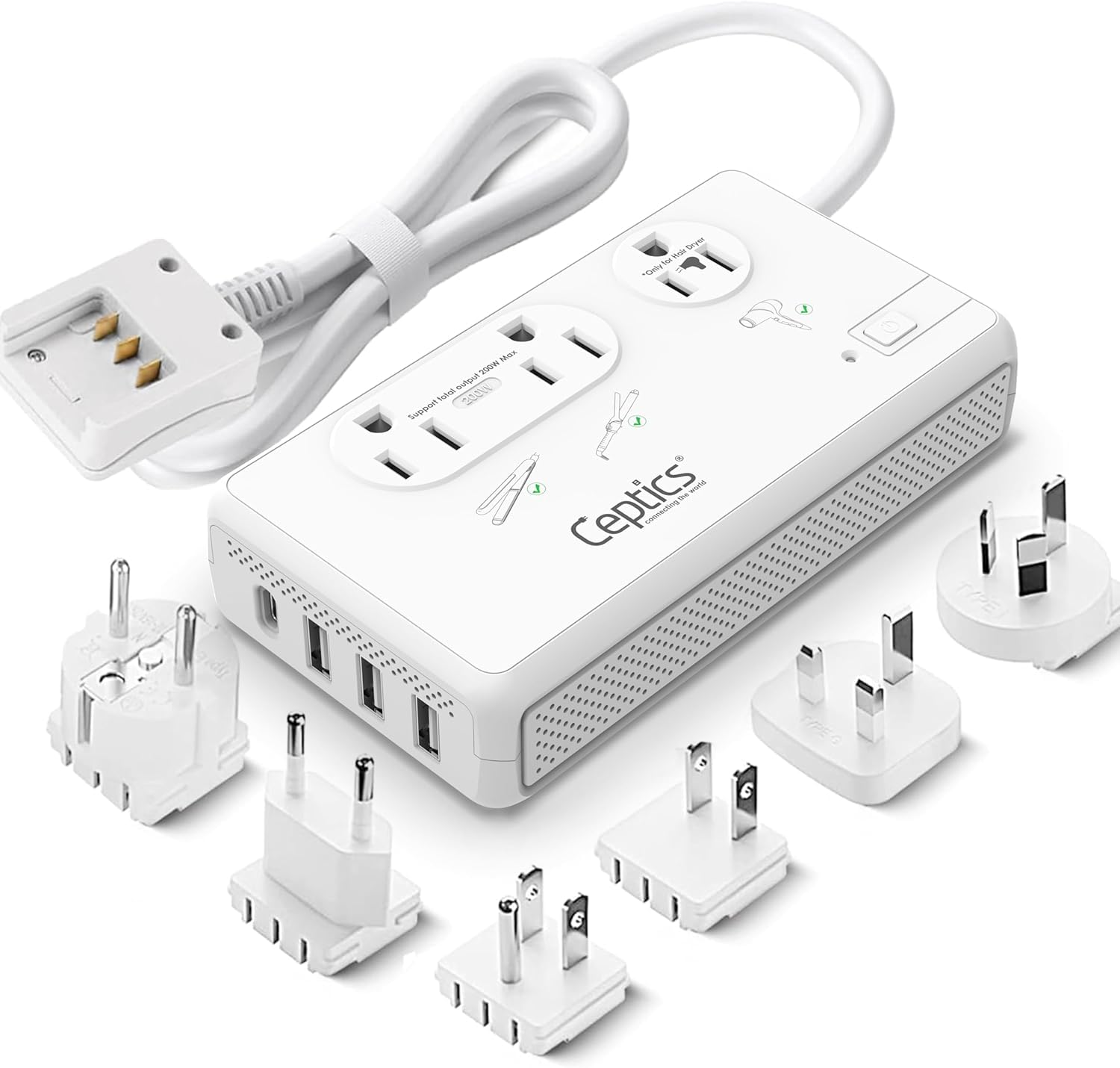
Two separate outlets dedicated to the two things that actually need converting — a hair dryer and a straightener.
Ceptics splits power into two distinct outlets, and that is the clever part. One US input handles a non-electronic hair dryer up to 2000W. Two more US inputs handle curling irons and straighteners up to 200W. Both run in 220V countries on separate outlets, so you are not unplugging one appliance to use the other. Charging duty is handled by 3 USB-A and 1 USB-C with QC 3.0, and the unit can output 6.4A total, matching each device’s maximum draw.
SWadAPt technology covers Type C, G, and E/F outputs for Europe, South America, Asia, and the Middle East, plus Type A, B, and I for China, Australia, New Zealand, Africa, and Israel. The body is listed at 5.9 x 3.3 x 1.37 inches at 1.5 pounds with a 5-foot cable. A 24-month warranty backs it, and safety features include a silent fan to prevent overheating, auto shut-down surge protection, and over-current, over-temperature, and short-circuit protection. It will not work with Dyson or other electronics hair dryers.
What owners keep coming back to is the multi-device charging and the solid build — one reviewer noted it “worked well on our trip to Asia. Got two for the family and had no problems.” The most consistent nit is the carry case: it is slightly too small to hold the unit and its three adapters together, so a fair number end up leaving the case at home and packing the parts loose. The downward-hanging design is also a tight fit in outlets set low or close to a counter.
The verdict: if a hair dryer and a straightener both travel with you, the two-outlet layout is worth the extra size — no other pick here separates them so cleanly.
Pick it for: packing two high-power grooming appliances that need separate converted outlets.
Caveat: the carry case barely fits the unit and adapters, so plan on a small ziplock instead.
7. HYTED 1600W 220V to 110V Converter

Pure sine wave output for the devices where dirty power is not worth the risk.
Pure sine wave is the technical heart of the HYTED, and it is what separates it from cheaper converters in real use. Rather than a choppy stepped-down waveform, the unit outputs a smooth 120V sine wave, which is the same shape of power your wall socket at home provides. That matters for devices with sensitive electronics and motor-driven appliances alike — the maker states there are no load-type restrictions across heating, motor, electronic, sensitive, and mixed loads. The output is stable from 0 to 1600 watts.
The unit also handles startup surges, which is where converters often trip. It limits inrush current to roughly 35A at 120V, because motor appliances can briefly draw 2–3 times their normal current when switched on. Protection covers overheating, overload, over-current, surge, and short-circuit, with an indicator light that flashes when it cuts power so you know why. It is CE certified and UL safety tested. Plug options are Type E/F for France, Germany, and Spain; Type C for Italy and Europe; Type G for the UK and Ireland; and Type I for Australia and China — over 160 countries.
Quality is what owners praise most, with compatibility a close second — the consensus is that it works flawlessly in Italy for steaming clothes, charging, curling hair, and running fans. The honest caveats: at 1.6 pounds it is bulky for packing, the cooling fan noise is measured rather than silent, and durability draws a mixed note. And as with every converter here, it is unnecessary if your hotel supplies a hair dryer.
Why the clean-power crowd picks it
- Stable 120V pure sine wave output from 0–1600W
- 35A startup inrush control for motor appliances
- Plug options covering 160+ countries
- Auto shut-off with a flashing indicator so you know why
The trade-offs to weigh
- 1.6 pounds is heavy for a daypack
- The cooling fan is audible during heavy use
- Overkill if your devices are simple phone chargers
Worth it for: sensitive or motor-driven appliances where dirty power could do damage, and travelers who want the cleanest output available here.
Pass if: your whole bag is USB chargers and you want the lightest possible load.
Know the Specs
Wattage ceiling and what fits under it
Wattage is the hard limit on any converter. Low-wattage units in the 250W range handle phones, laptops, cameras, and game consoles comfortably, but are explicitly not for hair dryers, straighteners, kettles, or coffee machines regardless of their rated wattage. High-power units at 1600W or 2000W open up the appliance list — hair dryers, curling irons, even kettles. Check the number printed on your device before you assume any converter will run it.
Pure sine wave versus modified output
A pure sine wave converter outputs a smooth, evenly shaped 120V current that mirrors a US wall socket, which is what sensitive electronics and motor-driven appliances are built for. Cheaper converters may output a stepped or modified wave, which some devices tolerate and others do not. If your gear has motors or delicate circuitry, the pure sine wave spec is the one worth paying attention to. For a phone or laptop charger, either type usually does the job.
Plug types (C, G, I, E/F, L, D, M) explained
Plug type is the shape of the metal pins, not the voltage. Type C is the two-round-pin plug used across much of continental Europe. Type G is the three-rectangular-pin UK and Ireland plug. Type I is the slanted two-pin used in Australia and China. Italy adds Type L, and Type D and M appear in parts of Africa and the Middle East. A converter’s plug type tells you which countries it works in — the APzek’s Type C means it will not work in the UK, Ireland, or Scotland.
USB-C and PD charging in a converter
USB-C is the newer, smaller connector, and PD (Power Delivery) is the fast-charging standard that lets it push more power to a compatible phone or tablet. A converter with 20W PD USB-C can fast-charge a modern phone; one with QC 3.0 USB-A can speed-charge older compatible phones. Standard 2.4A USB-A ports top up a device at a slower, more universal pace. If fast-charging your phone matters on the road, look for the PD or QC spec on the port, not just the port count.
Common Questions
Will a travel voltage converter 220V to 110V work with my hair dryer?
Can I just use a plug adapter instead of a converter?
Why do some converters say not to use them with electric shavers or toothbrushes?
Will the APzek converter work in the UK and Ireland?
What does pure sine wave mean and do I need it?
Can a converter run a USB-C laptop and a phone at the same time?
Does a converter work in Italy where the plugs are different?
Is a heavier converter better for high-power appliances?
How do I know which plug type a country uses?
Can a converter damage my devices if the foreign power is unstable?
The Bottom Line
For most travelers, the travel voltage converter 220v to 110v winner is the APzek 220V to 110V Voltage Converter because its 6-in-1 combo, 4.8-ounce body, and 80+ country coverage solve the everyday charging problem without any extra adapters — and it is the crowd favorite at 4.5+ stars across 700+ owners. If a hair dryer travels with you, grab the DOACE C15 and its 2000W ceiling. And for sensitive electronics and motor appliances where clean power matters most, the HYTED 1600W pure sine wave unit is the one to reach for.
How we choose
We do not accept paid placement. Every pick is matched to a real buyer and a real use-case; we do not hands-on test units.
Sources
Specifications: manufacturer listings and product documentation. Review insights: verified customer reviews, as of October 2026. Pricing: not shown on this page (it changes often); check the current price via the retailer link.
As an Amazon Associate, Aappliancez earns from qualifying purchases. This does not affect which products we feature.