Disclosure: Some links in this post are affiliate links. As an Amazon Associate I earn from qualifying purchases, at no extra cost to you. Learn more
Specs are compiled from manufacturer listings and verified buyer reviews and can change over time — please confirm the key details on the product page before buying.
The plug problem hits you in a hotel room at 11 p.m., when three devices are at 4% and the wall has one usable socket. The fix is a single travel charger that splits one outlet into several — and the ones below do it without turning your carry-on into a brick bag. Pick the Anker GaNPrime 615 if you want the strongest all-round balance of ports, travel size and price; it leads this list for a reason.
This guide is built by comparing the manufacturers’ published specifications and the patterns across verified customer reviews, so you get each pick’s real strengths and trade-offs instead of marketing spin.
Some picks here convert plug shapes only, some add USB fast charging, and a few can genuinely power a laptop. Below you get each one’s honest fit, plus the one spec that decides whether it earns space in your bag — starting with the best travel charger for multiple devices.
Top Picks


How To Choose The Best Travel Charger for Multiple Devices
The mistake most people make is buying for the number of ports first. What actually decides whether a charger is useful on the road is how much power it can hand out, and whether it changes the shape of your plug or the voltage coming out of the wall.
Total watts beat port count
A charger with five ports is only as good as its shared output. Read the total wattage and the per-port maximum, because a 20W budget is fine for phones but leaves a laptop crawling. The Anker Nano Travel Adapter, for example, supports up to 20W total across its USB ports — great for a phone and earbuds, not for a 14-inch laptop.
Adapter versus converter — the distinction that saves your devices
A travel adapter changes the pin shape so your plug fits a foreign socket. It does not change voltage. Anything with a motor or a heating element — hair dryers, straighteners, some toothbrush bases — needs a separate voltage transformer if it only accepts 110V/125V input.
Which plug types you actually need
Type A covers the US, Canada, Japan and China; Type C covers most of the EU; Type G covers the UK, Ireland and Singapore; Type I covers Australia and New Zealand. A charger that carries all four inserts handles almost any itinerary, which is why the universal models here are worth the slight extra bulk.
Size, weight and foldable pins
Pins that retract or fold stop snagging on clothes and let a charger slide into a side pocket. Weight matters too: a 320 g power strip is fine in a carry-on, while something half that size disappears into a jacket pocket. If you fly often, look for a footprint close to a credit card and a body under an inch thick.
Side-by-Side Comparison
| Model | Best For | Max Output | Ports / Outlets | Plug Coverage | Amazon |
|---|---|---|---|---|---|
| Anker GaNPrime 615★ Best Overall | Everyday all-rounder | 65W USB-C | 2 USB-C, 1 USB-A, 2 AC | — | Amazon |
| NEWVANGA Travel Adapter Fast ChargeBest Value | Worldwide plug changing | 20W USB-C PD | 1 USB-C, 1 USB-A, 5 outlets | Type A/C/G/I | Amazon |
| LanLuk 7-Port Universal AdapterMost Ports | Charging seven things at once | 15W USB-C per port | 2 USB-C, 2 USB-A, 3 AC | Type A/C/G/I | Amazon |
| HICOBER 3-in-1 Wireless Station | Apple-only travel kit | Wireless charging | 3 wireless pads | — | Amazon |
| Anker Nano Travel Adapter | Pocket-sized plug changer | 20W USB-C | 2 USB-C, 2 USB-A, 1 AC | Type A/C/G/I | Amazon |
| VEGER Portable Charger | Battery power on the move | 10000mAh battery | Built-in iOS + USB-C cables, USB-A/C | US plug, 110–220V | Amazon |
| Anker MagGo UFO 3-in-1 | Wireless travel charging | 15W Qi2 | 3 wireless pads | — | Amazon |
| Anker Prime 6-in-1 140W | Laptop-heavy trips | 140W USB-C | 2 USB-C, 2 USB-A, 2 AC | — | Amazon |
| THREEKEY 4-in-1 Qi2 Station | Apple household hub | 15W Qi2 | 3 wireless pads + retractable cable | — | Amazon |
Detailed Reviews
1. Anker GaNPrime 65W Charging Station
Our pick — 4.5+★ from 1,000+ verified ratings; the strongest balance of quality and price.
A three-foot cord and five ports turn one wall socket into a whole charging desk.
This one earns its spot on layout, not a single big number. You get two USB-C ports, one USB-A port and two AC outlets in a body that measures 4.69 inches long by 2.32 inches wide — so two people can charge phones while a laptop and a camera battery top up on the same strip. The 65W USB-C output (65 watts of power over a USB-C cable) is enough to take a MacBook Pro 14″ to 50% in 37 minutes, which is the difference between a usable work trip and a paperweight laptop.
Portability is what wins people over here. The 3ft (0.9m) cord winds back into the body so nothing tangles in your bag, and the whole thing is 320 g, light enough to live in a carry-on permanently. Two AC sockets also mean the strip handles hotel rooms, airport lounges and coffee shops where the wall is contested. Buyers report running it on 240V abroad and charging six devices, including a CPAP machine and a baby monitor, without strain; one buyer in South Africa had the unit die after a load-shedding surge, and Anker replaced it free.
Compare it to the Anker Prime 6-in-1 further down and the gap is real: the Prime’s single USB-C port delivers 140W against this one’s 65W, and the Prime offers 6 charging points versus 5. If you travel with a large laptop that insists on more power, the Prime earns its place. For phones, tablets, a 13-inch laptop and a pair of earbuds, 65W covers the whole trip comfortably. ActiveShield 2.0 temperature monitoring and next-gen GaN circuitry keep it from cooking your bag, and the unit ships with a 24-month warranty.
Where it pulls ahead
- The built-in 3ft cord reaches awkward hotel sockets and wraps away clean
- Two AC outlets plus three USB ports cover a couple’s entire kit at once
- 65W USB-C fast-charges a 14-inch laptop and a phone together
The trade-off to weigh
- 65W is the ceiling, so a power-hungry 16-inch laptop will want more
- It is a small strip rather than a pocket adapter, so it takes more room than a plug-only unit
Reach for this if: you travel with a laptop, two phones and a tablet and want one plug-in point for the lot.
Look further if: you pack only a phone and earbuds — a smaller wall adapter will save you space.
2. Travel Adapter Fast Charge, GaN Worldwide All in One, White
Five detachable plug heads turn one white block into a charger that works in over 200 countries.
The headline here is coverage. Five different input plugs click tightly into one adapter, covering US, EU, UK and AU sockets plus the plug families within them — Thailand, Israel, Italy, Russia, China, Australia, India, Hong Kong and more. At 3.2 ounces it disappears into a wash bag. The Type-C port delivers 20W of Power Delivery, and a second QC USB-A port adds fast charging for older cables.
What makes it a joy day to day is how the prongs behave: they slide smoothly and lock tight without sagging in worn sockets. One owner used it for a month in the UK with no complaints. It replaces three separate wall bricks, runs cool and consolidates a family’s charging into one white block.
The honest catch is physical. The adapter body is bulky enough to block the socket next to it, and the plugs are not the sturdiest — with more than two cords plugged in, the unit can slip out of a loose overseas outlet and stop charging. The other thing to lock in your head: this converts plug shape only, never voltage. Anything rated solely 110V/125V (110 or 125 volts, the US wall voltage) needs a separate transformer.
What you gain: one 3.2 oz block and four extra plug heads replacing a whole pouch of singletons, with the confidence of 8A dual fuse shut-off (an 8-amp fuse that cuts power if something goes wrong) and built-in safety shutters.
What to plan around: if you routinely run three or four cords at once, choose a charger with a longer body or a corded strip instead.
Solid buy for: multi-country itineraries where you need one adapter that fits any wall.
Think twice if: you need to charge more than two devices from a single loose socket.
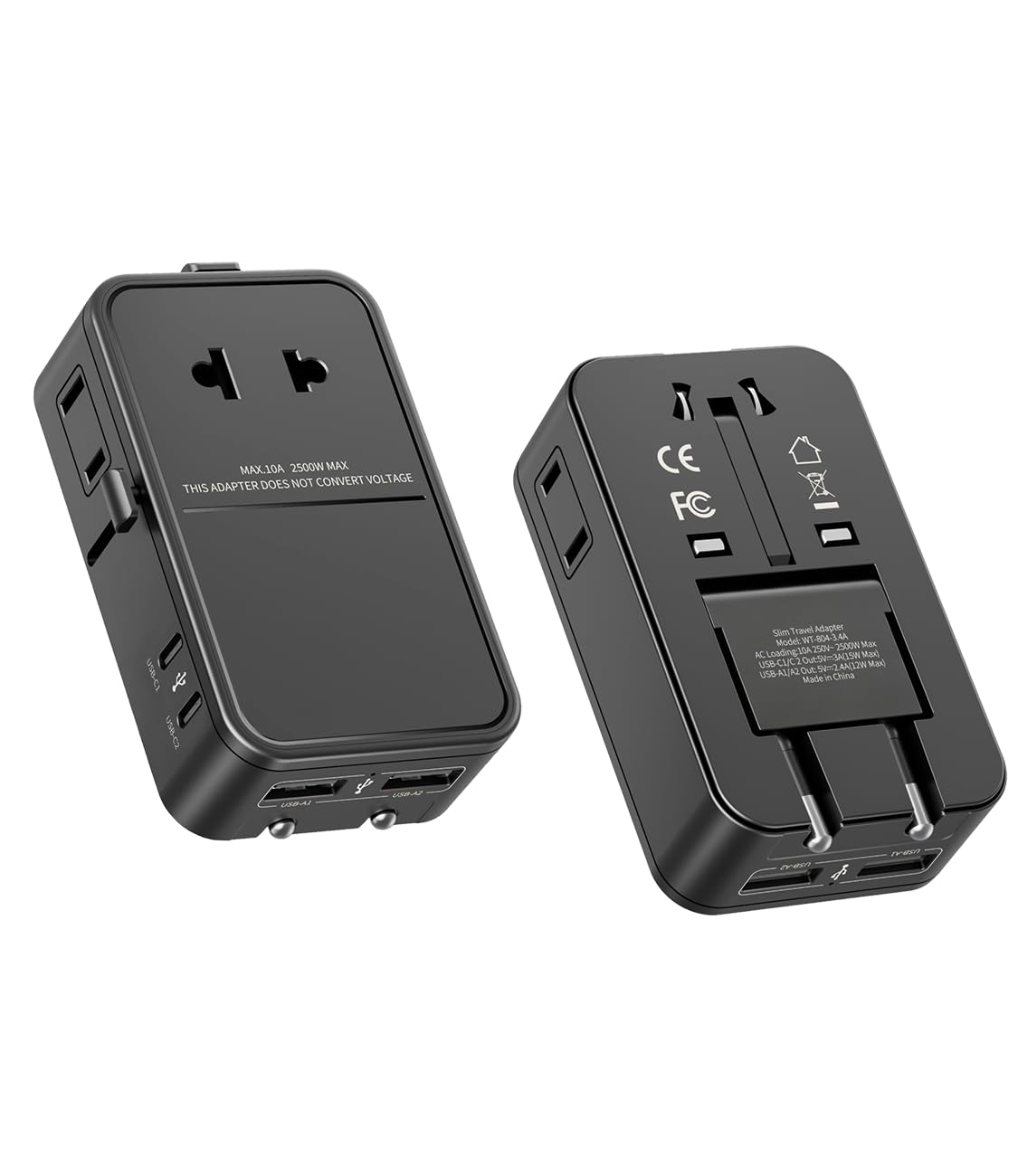
3. Universal Travel Plug Adapter 7-Port
Seven charging points inside a body that measures 3.39 inches across.
This adapter runs 3 AC outlets at a maximum of 2500W (2500 watts, enough for most travel electronics), plus 2 USB-C ports at 15W each and 2 USB-A ports at 12W each — seven electronics at once from one wall. It refuels an iPhone 17 to 50% in 30 minutes, which easily covers laptops, cameras, power banks and tablets.
The physical trick is the slimness. Foldable retractable pins shrink the body to 3.39 × 2.02 × 1.01 in (86 × 51.3 × 25.7 mm) and 43% smaller than ordinary travel adapters. In your luggage the effect is real. Owners say it works on a plane, stays out of the way in a carry-on and remains surprisingly lightweight.
Four interchangeable inserts cover Type A, C, G and I, putting more than 200 countries in reach. Build quality is fire-resistant PC shell with overvoltage, overcurrent, short-circuit and overheat protection, compliant with US UL and FCC standards. The one reminder that matters: this is a plug adapter, not a voltage converter, and it works with dual-voltage devices rated 100V-250V only. A single-voltage hair dryer will still need a transformer.
The value read: you get the highest port count here and the thinnest body — a rare combination in travel adapters.
Bear in mind: USB-C tops out at 15W per port, so a full-size laptop will charge slowly compared with a 65W strip.
Built for: families or gadget-heavy travellers who want every device on one plug.
Not the pick if: your laptop needs fast charging from USB-C rather than a slow trickle.
4. HICOBER 3-in-1 Wireless Charging Station

An iPhone, Apple Watch and AirPods all charging from one folded pad, no cables required.
If your travel bag is an Apple kit, this replaces three separate chargers with one. The foldable body drops into a backpack, handbag or carry-on, and the angled stand supports StandBy and Nightstand Mode so the phone screen stays readable for alarms and time checks. Most phone cases can stay on while it charges. Compatibility runs the full current range: iPhone 17 down through 12 series, Apple Watch Ultra 3/2/1 and Series 11 through SE, and AirPods 4/3/2/1 plus AirPods Pro 3/2/1.
What buyers praise most is how it consolidates. The strong magnet snaps the phone into place, the watch charger tilts so you can lay a band flat or hang it upright, and small LED lights confirm each device is actually charging. Over-current, over-voltage and temperature protection handle the overnight charging job, and non-slip silicone pads stop everything slithering.
The honest catch is grip. The phone can charge inconsistently and the earbud case is easy to knock off the pad, so the magnets on the smaller devices are not as secure as the iPhone’s. For travel and camping it is a clean solution; as an everyday bedside dock, it is a little looser than wired charging.
Reasons it travels well
- One cord charges iPhone, Apple Watch and AirPods together
- Folds compactly enough for a carry-on or a rucksack side pocket
- StandBy Mode keeps the phone screen visible on a hotel nightstand
Where it falls short
- The AirPods pad holds weakly — a nudge can break contact
- Only useful if every device you carry is from Apple
Grab this if: you carry an iPhone, watch and AirPods and want zero cables in your hotel room.
Skip past it if: you travel with Android phones or a laptop that needs USB-C charging.
5. Anker Nano Travel Adapter 20W

A credit-card footprint that fits four different wall sockets and five devices.
Anker squeezed Type A, Type C, Type G and Type I compatibility (the plug shapes used in the US, Europe, UK and Australia) into a body of 3.39 × 1.97 × 0.98 in (86 × 50 × 25 mm) — the brand claims a 43% smaller footprint than similar models, with foldable retractable pins. Plug it into a European, UK, Australian or US socket and you get one AC outlet plus 2 USB-C and 2 USB-A ports.
The single USB-C port delivers up to 20W, enough to take an iPhone 16 to 50% in 28 minutes. The total budget across all USB ports is 20W, or 15W maximum when shared — which is the spec that decides whether this suits you. For a phone, earbuds and a watch it is comfortably enough. The 2-pin design reduces shock risk, but that also means it will not accept grounded 3-prong plugs, including EU Schuko, UK 3-pin or grounded laptop chargers.
Where it earns its place is packing. Owners call it deck-of-cards sized at about 107 g, and one carried it on a cruise where it performed exactly as advertised. One owner reports it outlasted a rival adapter that failed on the same trip. The trade-off, stated plainly: if you plug in several devices at once, the shared 20W makes everything charge slowly — noticeably so with more than one device drawing power.
Fast verdict: the best plug-shape changer for minimal packers, with a genuinely tiny 86 × 50 mm body.
The limit: 20W total is a phone budget, not a laptop budget — set expectations accordingly.
Pick it for: one-bag travellers who need a phone charger that works on any continent.
Pass if: you need grounded plugs or laptop-grade speed.
6. VEGER Portable Charger

The charger that fills itself from a wall socket and already has the cables attached.
This one solves a different problem from the adapters above: there is no wall at all. The 10000mAh battery packs an AC plug and two built-in cables — one iOS, one USB-C/Micro USB — so you recharge the bank itself by plugging it into any outlet, no extra cord needed. The clear LED display reads out the exact remaining percentage rather than guessing at four dots.
It charges up to four devices at once: a phone, tablet, earbuds and smartwatch all draw at the same time. At 0.72 inches thick and 8 oz it fits a pocket, and the micro-grooved surface gives a grip that survives a music festival or a long hike. The capacity numbers are concrete — roughly 1.8 charges for an iPhone 17/16 series phone and 1.6 for a Samsung S25.
The travel detail that matters most is airline compliance. At 38.5Wh it sits safely under the 100Wh cabin limit, and the built-in US plug (110–220V) works directly in North America, Japan, Australia and Asia — you only add a socket adapter for Europe. A mesh pouch comes in the box alongside a 36-month warranty. The trade-off is the one every power bank carries: it must be recharged from a wall overnight, so on a multi-day trip it is a companion to a travel adapter, not a replacement.
Why it belongs in your bag
- Built-in AC plug recharges the battery with no extra cable
- Four devices charge at once from a pocket-sized body
- 38.5Wh is under the airline cabin limit
What to watch
- Still needs a wall to top itself up, so it does not replace a charger
- The 8 oz weight is more than a bare adapter
Made for: long travel days with no socket in sight — theme parks, hikes, festivals, airport delays.
Not a substitute for: a wall charger, which you still need to refill it.
7. Anker MagGo UFO 3-in-1 Charging Station

A baseball-sized disc that folds out into three wireless charging pads.
Anker’s Qi2 certification buys you 15W of wireless charging for an iPhone 15 Pro to reach 20% in 15 minutes, and an Apple Watch Series 9 to reach 30% in 22 minutes. Qi2 is the faster wireless standard — the same magnetic alignment idea as MagSafe, but certified so the phone actually receives the higher wattage. It folds flat into a bundle about 3 inches across and 1.4 inches thick.
What makes it a stand-out travel piece is what comes in the box: a 40W adapter and a 5 ft USB-C to USB-C cable are included, so you do not hunt for a spare wall brick. That 40W adapter can even charge a MacBook Air 15″. Owners call it a genuine minimal-travel solution: two phones plus a watch on the pads at once, it stays cool, and it folds back into a tidy bundle.
Unlike the HICOBER above, this one is designed as a travel charger first and a nightstand dock second — the fold-out form factor is sleeker and the build quality is notably higher. The catch is honest and simple: there is no pouch in the box, and this is a top-tier price for a wireless-only station that cannot charge your laptop from the pads themselves. It earns its place only if Apple wireless is the whole point.
Standout strength: 15W Qi2 through a disc that folds to 1.4 inches thick — wireless charging that actually packs.
The honest catch: no travel pouch and a wireless-only approach, so a USB-C laptop is left out.
Right for: Apple users who want cable-free charging in a hotel with no fuss.
Wrong for: anyone travelling with a USB-C laptop that needs ports, not pads.
8. Anker Prime Charging Station 140W

One USB-C port with 140W — a laptop charger that also handles everything else.
Charging six devices from one slim strip requires headroom, and this one has it. A single USB-C port delivers up to 140W, enough to take a MacBook Pro 16″ to 100% in 1 hour and 15 minutes (based on Anker’s own lab testing). Two AC outlets plus two USB-A ports at 12W each fill out the six-in-one layout, and the USB inputs accept 100–240V at 50/60 Hz.
The feature that surprises people is the smart display. It shows real-time power draw for each USB port, so you can spot a bad cable in seconds by watching the number stay low. ActiveShield 2.0 adds up to 3 million daily temperature checks. The body is only 0.7 inches thick and the pop-up outlet keeps it desk-slim, while the 5 ft detachable cord reaches awkward hotel sockets without dragging the strip with it. Owners run a Dell laptop, a phone and a tablet on it at the same time and call the live power display genuinely useful rather than a gimmick.
The trade-off worth knowing: the display screen scratches easily if it rides in a bag unprotected, and if you plug into a laptop that uses its own proprietary charging standard, the strip may not deliver the full 140W (140 watts) — one traveller drew up to 85W from a Dell XPS 15 9530, which is enough to recharge but not the full figure. USB ports also re-negotiate momentarily when you plug or unplug something.
Why heavy travellers love it
- 140W on one USB-C port charges a 16-inch laptop at full speed
- Live power meter turns cable hunting into a five-second check
- Six charging points inside a 0.7-inch body
Where it asks you to care
- The display is prone to scratching in transit
- Some laptops with proprietary charging standards will not reach 140W
Choose it when: your laptop is the biggest device and everything else comes second.
Overkill if: you never travel with a power-hungry laptop.
9. THREEKEY 4 in 1 Qi2 Charging Station
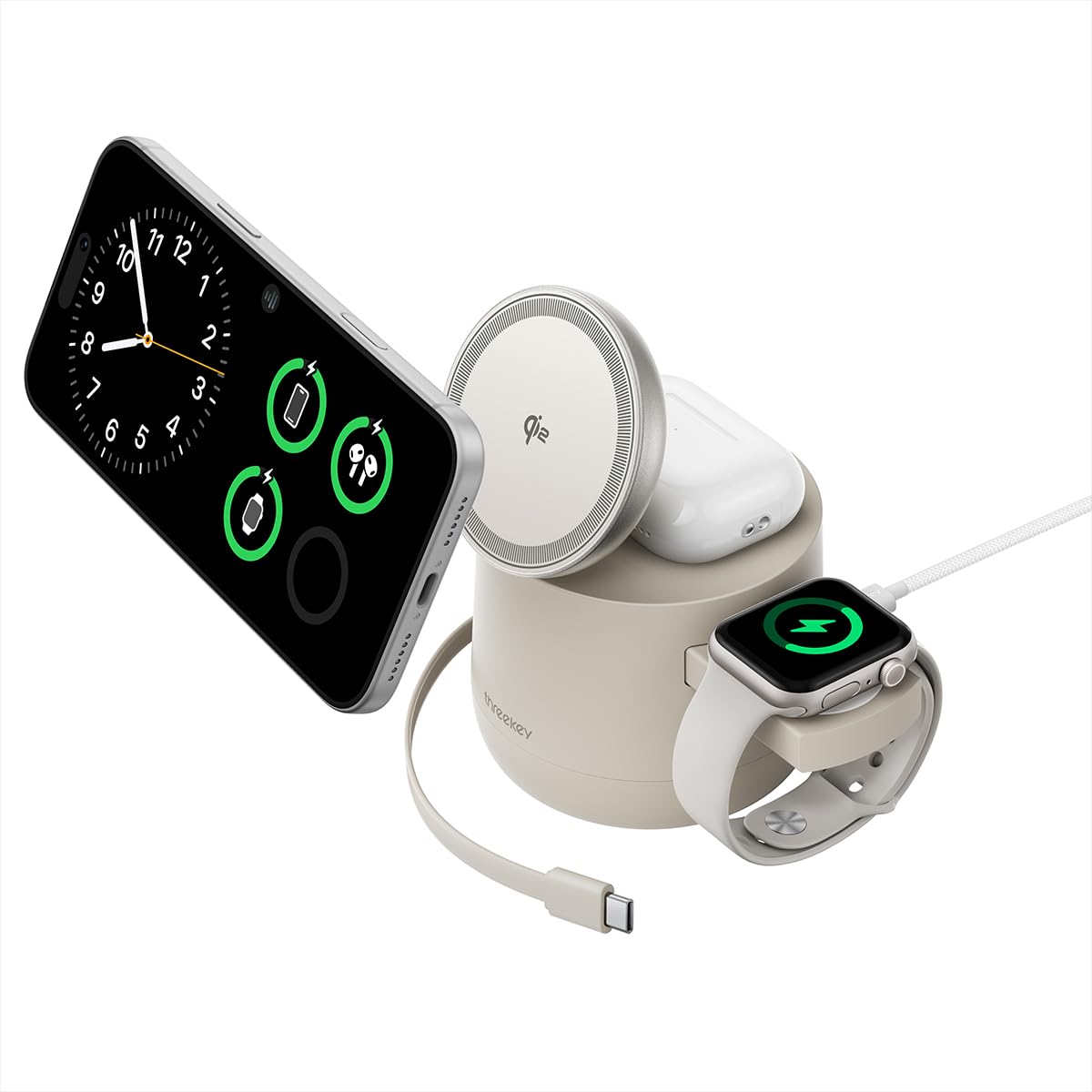
Three wireless pads plus a retractable fourth cable in a single cube.
Apple’s MFi stamp is the reason this one exists: the watch module is officially authorised, so it works through iOS updates without the “unsupported accessory” warning that cheaper wireless docks often trigger. Qi2 certification lifts iPhone charging from 7.5W to 15W, taking an iPhone 16 from 0 to 50% in 30 minutes. The cube handles iPhone, Apple Watch, AirPods and, through a built-in 3ft retractable cable, a fourth device like an iPad or an Android phone.
That retractable cable is the clever bit — you can use it as input to feed the cube power, or as output to charge one more thing. A 65W PD adapter and a 5ft braided cord come in the box, so there is nothing else to buy. The top has a warm-white ambient light with four brightness levels (0%, 25%, 50% and 100%) that is genuinely useful on a dark nightstand — though some owners find the light more fiddly than helpful.
The honest caveat lives in the durability record. The retraction mechanism can eventually stop pulling the cord fully home, and the unit is more delicate than its price suggests — long-term reliability is the question mark here rather than speed or convenience. If wireless-only Apple charging in a compact cube is what you want, it delivers; if you need gear that survives years of hotel-bag abuse, this one wants careful handling.
What it gets right: MFi-authorised Apple Watch charging, 15W Qi2 for iPhone, and a fourth device covered by a retractable cable.
The fair warning: the retraction mechanism and general build are not built for rough treatment.
A good fit for: Apple households that want everything on one cube with no warning pop-ups.
Less suited to: travellers who toss gear loose into bags and expect years of service.
Know the Specs
Total wattage and shared output
Wattage is the measure of how much charging power a charger can hand out. A 140W charger has plenty of headroom, while a 20W one is enough for phones but not laptops. The key trap is sharing: when several devices plug into one charger, the total is divided between them — so five ports at 20W total means slow charging the moment you add a second device. Read both the total and the per-port maximum before you commit.
Adapter versus voltage converter
A travel adapter changes the shape of the pins so your plug fits a socket. It does not change the electrical voltage. Dual-voltage devices rated 100V-250V are fine; anything rated solely 110V/125V — a hair dryer, a straightener, some toothbrush chargers — needs a separate voltage transformer. Never plug a single-voltage appliance into a foreign socket through an adapter alone.
Plug types A, C, G and I explained
Type A is the two flat pins used in the US, Canada, Japan and China. Type C is the two-round-pin European plug. Type G is the three-pin UK and Singapore plug. Type I is the angled two-pin used in Australia, New Zealand and Argentina. A charger that ships with inserts for all four covers the vast majority of international itineraries in one accessory.
GaN and Qi2 in plain words
GaN (gallium nitride) is a semiconductor material that lets a charger handle power with less heat and less bulk than older silicon designs — that is why a 65W charger can fit in a pocket. Qi2 is the newer wireless charging standard with magnetic alignment, offering up to 15W to a compatible iPhone versus 7.5W on older Qi pads.
Common Questions
Can a travel adapter convert 220V to 110V for my hair dryer?
Will a 65W charger power my laptop and phone at the same time?
What does “43% smaller than similar models” actually mean for packing?
Can I take a travel charger in hand luggage on a plane?
Does a universal adapter work in every country?
Why does my phone charge slowly when I plug several devices into one charger?
Is a wireless charging station better than a plug-in strip for travel?
Do foldable or retractable pins actually matter for packing?
Can I use a US plug adapter in Europe without a converter?
What is the difference between Qi and Qi2 wireless charging?
The Bottom Line
The strongest all-round answer to a multi-device travel charger is the Anker GaNPrime 615: five ports, 65W of USB-C power, a 3ft wrappable cord and 320 g of body that slides into any carry-on. It balances speed, size and price better than anything else on this list, and it is the pick most travellers should reach for first.
If you need wireless and Apple-only, the Anker MagGo UFO folds to 1.4 inches thick with 15W Qi2 and a 40W adapter included — a top-tier wireless solution. If you carry a 16-inch laptop, the Anker Prime 6-in-1 is the only pick here that charges it to full in 1 hour and 15 minutes.
And for the international traveller who just wants a plug that fits anywhere, the NEWVANGA Universal Adapter packs 200+ country coverage into 3.2 ounces. Whichever way you go, match the charger to your heaviest device — then everything lighter just follows.
How we choose
We do not accept paid placement. Every pick is matched to a real buyer and a real use-case; we do not hands-on test units.
Sources
Specifications: manufacturer listings and product documentation. Review insights: verified customer reviews, as of October 2026. Pricing: not shown on this page (it changes often); check the current price via the retailer link.
As an Amazon Associate, Aappliancez earns from qualifying purchases. This does not affect which products we feature.