Disclosure: Some links in this post are affiliate links. As an Amazon Associate I earn from qualifying purchases, at no extra cost to you. Learn more
Specs are compiled from manufacturer listings and verified buyer reviews and can change over time — please confirm the key details on the product page before buying.
If you rely on a BiPAP machine to breathe through the night, a dead outlet is not an inconvenience — it is a medical problem. The good news: a battery built for PAP therapy can keep your machine running on a plane, in a tent, or through a multi-day blackout. The catch is that these packs vary wildly in real runtime, and the honest numbers only show up once the humidifier is switched off.
This guide is built by comparing the manufacturers’ published specifications and the patterns across verified customer reviews, so you get each pick’s real strengths and trade-offs instead of marketing spin.
Every pack below lists its tested machine-by-machine runtimes and cable kit, so you know before you buy whether it will carry your therapy through the dark. This is the shortlist that matters for anyone hunting a travel bipap machine battery before their next trip.
Top Picks
How To Choose The Best Travel BiPAP Machine Battery
A PAP battery is really two decisions in one: how many nights it holds, and whether the airline will let it on the plane. Get one of those wrong and the pack becomes a paperweight. Here is what actually separates the winners from the letdowns.
Watt-hours and the airline limit first
The capacity figure that matters is watt-hours (Wh) — the pack’s total energy, like the size of the fuel tank. Anything at 160Wh or below is within standard FAA carry-on limits, so a 95Wh or 160Wh pack flies. Larger packs, like the 297.6Wh reserve, are meant for car camping and home backup instead of the cabin.
Match your machine’s voltage before the cable
Machines run on different voltages — some on 24V (like many ResMed models) and some on 12V (like Philips DreamStation). Buying a 12V pack for a 24V machine, or vice versa, means it simply will not power your therapy. The best packs sidestep this with automatic multi-voltage output.
The humidifier trade-off
Turn on heated humidification and a heated tube (a tube that warms the air so it does not feel cold) and your overnight runtime can drop to a fraction of the published figure. Every runtime number in this guide assumes the humidifier and heated tube are switched off unless the listing says otherwise, so plan your nights accordingly.
Side-by-Side Comparison
| Model | Best For | Capacity | Weight | Best Documented Runtime | Amazon |
|---|---|---|---|---|---|
| EASYLONGER ES960 PRO★ Best Overall | Multi-night camping & home backup | 297.6Wh | 6.6 lb | 2+ nights | Amazon |
| Pilot-24 Lite (24V)Best for Flying | Flying with a 24V machine | 95Wh | 1.3 lb | 8 hrs (humidifier off) | Amazon |
| Pilot-12 Lite (12V)Best For Blackouts | DreamStation owners in a blackout | 95Wh | 1.3 lb | 15.5 hrs over two nights | Amazon |
| Pilot-24 Lite + Wipes | AirMini flyers who want wipes bundled | 95Wh | 1.3 lb | 2-3 nights on a travel CPAP | Amazon |
| Pilot-24 Lite + S9 Cable | S9 and AirSense 10 owners | 95Wh | 2.33 lb | ~2 nights (7 hrs each) | Amazon |
| Zopec Explore Mini | Lightest carry-on option | 99.9Wh | 1.1 lb | Up to 2 nights | Amazon |
| Freedom CPAP Battery | Widest tested machine list | 160Wh | 3.59 lb | Up to 35 hrs (DreamStation 2) | Amazon |
| Pilot Flex Navy | Dual 12V & 24V travelers | 98Wh | 1.92 lb | 8 hrs (AirSense 11, humidifier off) | Amazon |
| Zopec Explore 5700 | No-adapter universal travel | 5700mAh | 1134 g | 16-24 hrs (humidifier off) | Amazon |
Detailed Reviews
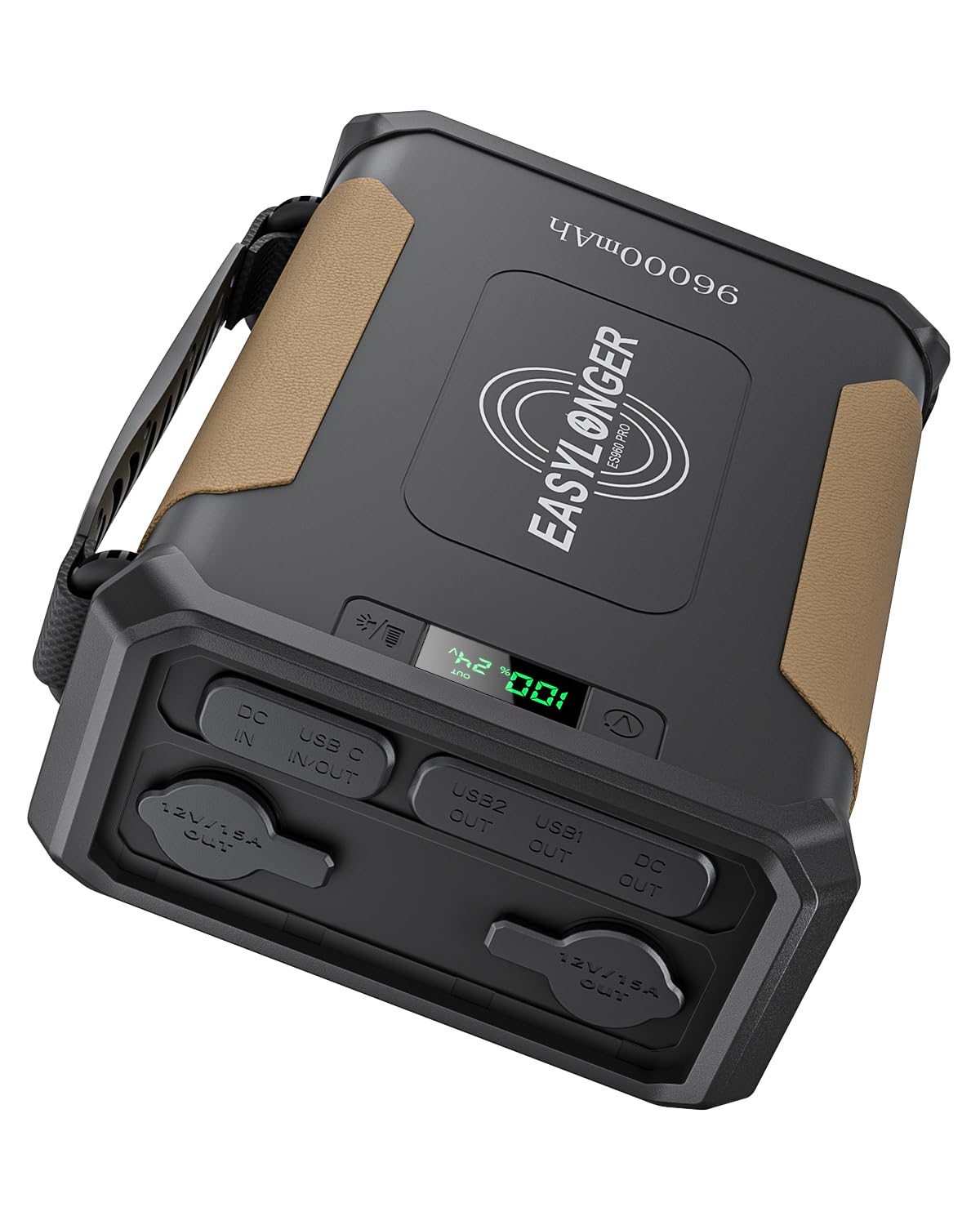
1. EASYLONGER CPAP Battery Backup ES960 PRO
Our pick — 4.5+★ from 100+ verified ratings; the strongest balance of quality and price.
The 297.6Wh LiFePO4 pack that runs a BiPAP four nights off-grid with the humidifier off.
This is the pack for the traveler who is not flying. At 297.6Wh, the ES960 PRO holds more than three times the capacity of the Pilot-24 Lite’s 95Wh — 297.6 versus 95 — so it laughs off the two- to three-night camping trip that would drain the smaller packs. Its 297.6Wh sits above the 160Wh FAA cabin limit, so it stays in the trunk, not the overhead bin, and it weighs 6.6 pounds against the Pilot-24 Lite’s 1.3 pounds. You are buying nights, not ounces.
The real-world numbers back up the spec sheet. Owners running an AirSense 11 with the humidifier off report sitting on roughly half a tank after three nights and clearing a full week on one charge. A common report from the air-travel set is that a direct DC connection at 24V skips the AC conversion step, cutting energy losses that would otherwise eat roughly half the usable capacity. The pack ships with four cables and covers 12V, 19V, and 24V output, so a wide spread of ResMed, Philips, and Luna machines plugs straight in.
It is a LiFePO4 (lithium iron phosphate) cell pack, a chemistry that can handle more charge cycles than the lithium-ion cells in the compact Pilot packs — 3000+ cycles here. That durability, plus 100W USB-C output for a laptop or tablet, is what makes it double as a home blackout station. The catch: at 6.6 pounds it is the single heaviest pick on this list, and the 12V car charging cable is not included, so charging on the road needs a separate adapter.
Why owners keep it plugged in at home
- 297.6Wh delivers 2+ nights of BiPAP use with the humidifier off — the biggest tank here
- LiFePO4 cells rated for 3000+ charge cycles, so it outlasts standard lithium-ion packs
- Runs from wall (5 hrs), a ≥100W solar panel, or 12–24V car output (6 hrs)
- 100W USB-C plus six ports charge laptops, phones, and drones between therapies
Honest limits before you buy
- 297.6Wh exceeds the 160Wh TSA cabin limit — it is not a fly-with-you pack
- At 6.6 pounds it is the heaviest option on this page
- 12V car charging cable sold separately
Reach for this if: you camp, road-trip, or want a home blackout reserve that runs your BiPAP for four nights.
Look elsewhere if: you fly with your machine — the 297.6Wh capacity sits over the airline 160Wh limit.
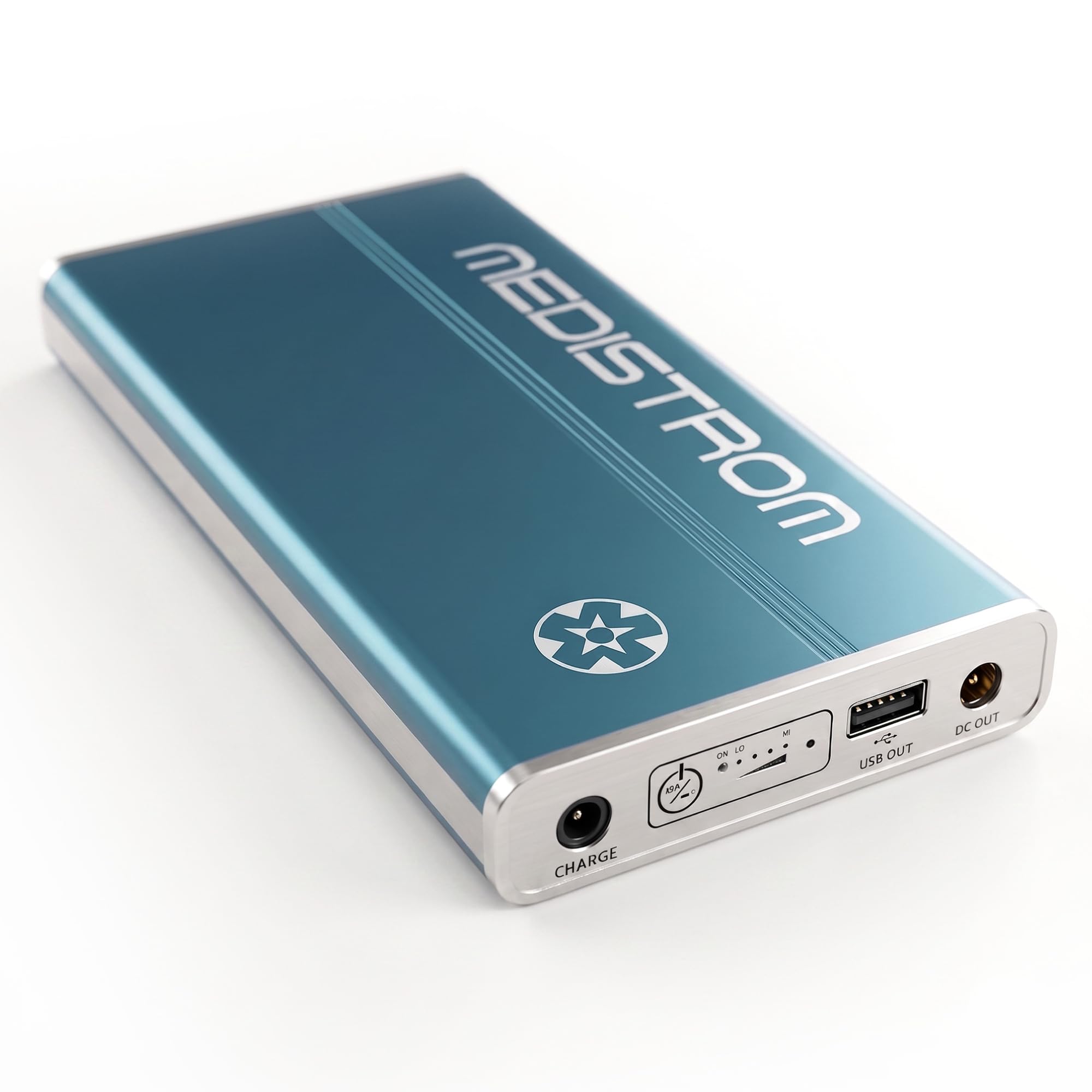
2. Pilot-24 Lite CPAP Battery Backup
The 95Wh, 1.3-pound pack that clears TSA carry-on and runs a 24V ResMed eight hours with the humidifier off.
At 95Wh the Pilot-24 Lite ducks comfortably under the 100Wh TSA threshold, so it is cleared for carry-on, and it does that while powering a 24V ResMed AirMini or AirSense 10. Recharge time is fast — the aluminum shell and lithium-ion cells bring it back to full in two to three hours. Next to the ES960 PRO’s 297.6Wh tank, this is a daypack versus a jerrycan, but it clears the cabin door and the 6.6-pounder does not.
What buyers keep coming back to is that it simply works in-flight. There is broad agreement that the pack delivers roughly eight hours on a machine with the humidifier and hose heat switched off, which covers a long-haul overnight with room to spare. It also auto-switches to backup mode at home, so a power cut does not wake you. The cables for both AirMini and AirSense 10 are in the box, though additional machines like the AirSense 11 or S9 need a separately sold cable.
The honest trade-off is cable quality. Buyers report a recurring problem: an included cord can arrive faulty, and one reviewer noted an overnight charge that failed. Medistrom’s support says older batches have since been sorted, and most of the thousands of owners here report no trouble — but test every cable the day the box lands, and pack a spare for a trip you cannot afford to miss.
Where it separates from the ES960 PRO: you are trading capacity for cabin legality. The Pilot-24 Lite gives you 8 hours and 1.3 pounds; the EASYLONGER gives you multi-night runtime and 6.6 pounds that never leaves the ground. If a plane is in your future, only one of those numbers matters.
Best matched to: frequent flyers on a 24V ResMed who need a TSA-legal pack for overnight flights.
Watch for: test the included cables the day they arrive — a faulty cord can strand a trip.
3. Pilot-12 Lite CPAP Battery Backup
The 12V pack that auto-switches to battery during an outage and runs a DreamStation about 15.5 hours across two nights.
Philips DreamStation machines run on 12V, not 24V, and the Pilot-12 Lite is built exactly for that voltage — the 24V Pilot packs simply will not power them. The 95Wh capacity, 1.3-pound body, and two- to three-hour recharge mirror its 24V sibling, and it ships with DreamStation 1, 2, and System One S60 cables in the box. If your machine’s label says 12V, this is the one to check first.
What wins owners over is the way it turns a blackout into a non-event: plug it in at home, and it automatically takes over when the grid drops. Real user reports put it at about 15.5 hours across two nights with the humidifier off, and around 2.5 hours when you run the humidifier. That solar-panel and car-charger-friendly 12V input makes it a quiet favorite for road trips and off-grid nights, and the easy setup is what owners bring up most.
The genuine caveat here is support outside the United States. One long-haul traveler ran it through a South African trip mostly fine, then hit a failure out of warranty and found email support hard to reach from overseas. For a domestic buyer this is a footnote; if you are taking it abroad for months at a time, treat it as a pack to test thoroughly at home first.
What makes it a blackout fixture
- 12V output matches DreamStation 1, 2, and S60 with cables included
- Bridges a power outage automatically — no waking up to rewire
- ~15.5 hours over two nights with the humidifier off
What to know before you travel far
- Humidifier use cuts runtime to about 2.5 hours
- Out-of-country warranty and support can be slow to reach
Buy it if: you run a 12V DreamStation and want the pack to catch a blackout on its own.
Think twice if: you plan months abroad — verified support outside the country is the weak link here.
4. Pilot-24 Lite CPAP Battery Backup 3 Wipe Pack
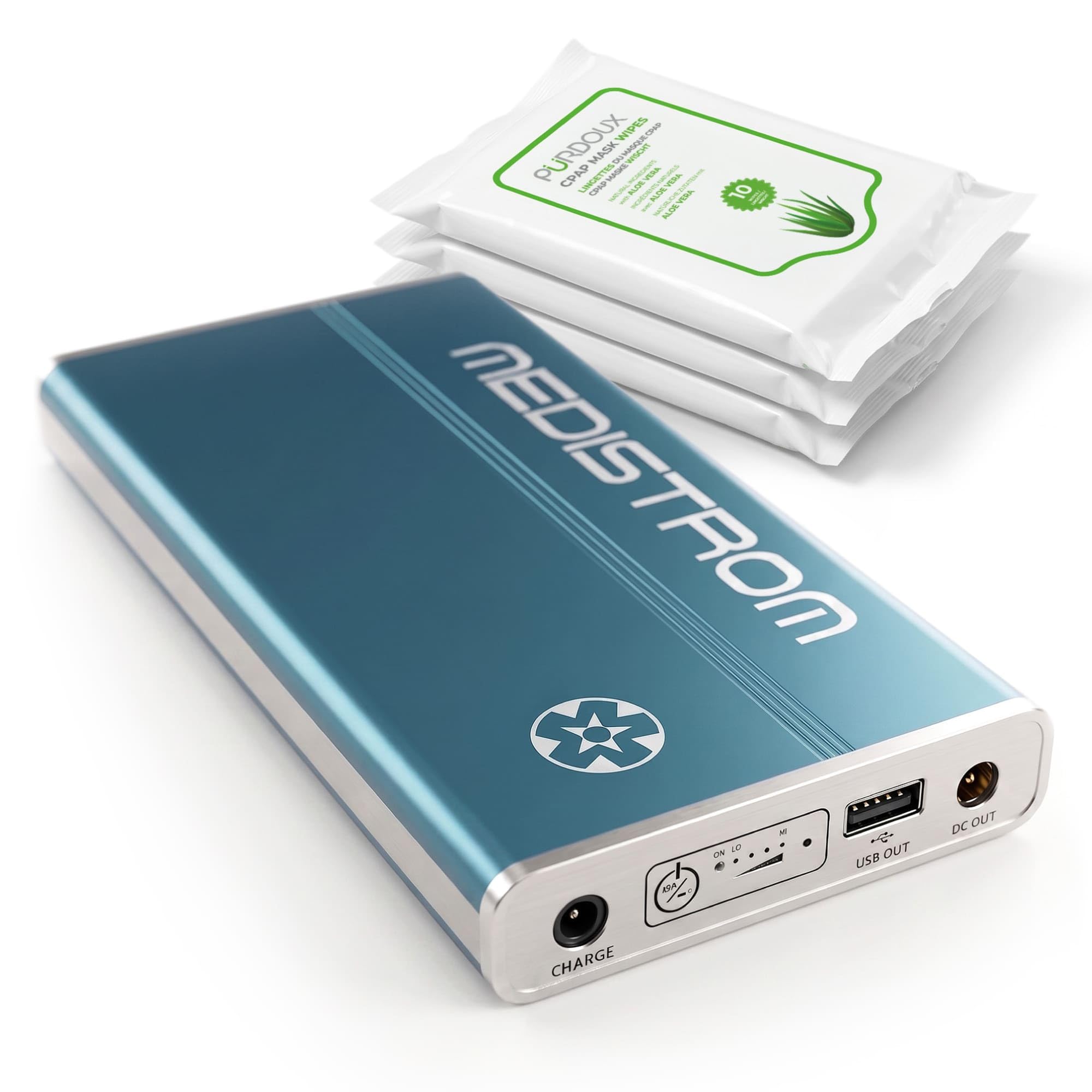
The same 95Wh, 1.3-pound 24V Pilot-24 Lite, bundled with three packs of travel wipes.
Strip away the wipes and this is the identical 95Wh, 1.3-pound, 24V Pilot-24 Lite reviewed above — same aluminum casing, same two- to three-hour recharge, same TSA-legal under-100Wh rating. The only difference is the sold-as-bundle extras: three packs of travel wipes and cables for ResMed AirMini and AirSense 10. It is a clean pick for a cruiser who wants the mask-cleaning basics sorted in one order.
For a ten-day run through Italy with an AirMini, owners describe charging the pack during the day through the AirSense 10 cable and running it at night where outlets were scarce, without a single missed session. Off-grid camping clients report two to three nights on a travel CPAP, or a full seven-plus hours with humidification and hose heat running. It also doubles as a phone and tablet charger between uses.
Two things to know. First, the pack does not solve the high-power side: run a humidifier and runtime can fall to a couple of hours, which is the same trade-off every compact pack on this list shares. Second, for newer AirSense 11 users the correct cable is not in the box and has to be bought separately, so confirm your machine’s model before ordering. Test the included cords the day they arrive, exactly as you would with the sibling pack above.
Where it fits the lineup: if you want wipes, travel sachets, and a 24V backup for the road bundled into one cart, take this. If you already own your cleaning supplies, the plain Pilot-24 Lite does the same job for the same money — a genuine either-or choice.
A tidy fit for: cruisers with an AirMini or AirSense 10 who want the cleaning kit thrown in.
Only snag: the AirSense 11 cable is not included, so newer machines need one bought separately.
5. Pilot-24 Lite CPAP Battery Backup S9 Cable

The 95Wh 24V pack that ships with S9, AirMini, and AirSense 10 cables in the box.
For anyone still running a ResMed S9, this is the Pilot-24 Lite variant to pick: the S9, AirMini, and AirSense 10 cables all ship in the box. The 95Wh capacity, TSA-legal sizing, and 24V output are the same across the family, but this kit saves you the separate-cable hunt. Its 2.33-pound listed weight is heavier than the 1.3-pound siblings — that is the packaged box, not the bare pack.
The reviews split cleanly, and honesty matters here. On the rougher side, AirSense 10 users have seen a full charge supply barely three and a half hours with heat on, and a small number flag a faulty output cable that needed swapping. Treat the runtime figure as machine- and settings-dependent, and test the cable early.
There is also a small quirk worth knowing: with the cable seated, the AirMini sometimes needs a quick unplug-and-replug to wake up, but it then runs fine. Between those two honest grumbles and the strong majority of happy owners, this is a solid cabin-and-campsite pack — just budget time to verify the cable before the trip that matters.
What lands with this bundle
- S9, AirMini, and AirSense 10 cables all included — no separate buy
- Over 10 hours per charge reported on an AirMini
- Doubles as a home blackout backup with automatic switchover
The flip side
- Runtime collapses sharply with humidifier and heated tube running
- A small number of included output cables have arrived faulty
Made for: ResMed S9 or AirSense 10 owners who want every needed cable in the box.
Set expectations for: runtime that drops hard the moment the humidifier runs, so plan nights around it.
6. Zopec Explore Mini CPAP Battery UPS Backup

At 1.1 pounds and 99.9Wh, the lightest TSA-legal pack here, with automatic 24V, 12V, and 19V output.
If every ounce in your carry-on counts, the Zopec Explore Mini is the extreme end of the travel scale: 1.1 pounds, six and a half inches by three by one, with 99.9Wh of capacity that keeps it TSA-compliant. Its patented multi-voltage output adapts automatically to 24V, 12V, and 19V machines without a manual switch. It also tops up fast — 1.5 hours on a USB-C charger rated for high wattage, and it can be chained with additional Zopec-Mini batteries for a longer trip.
What genuinely separates it is the real travel experience owners describe: running an AirMini for the better part of three nights per charge, with all the adapters and proprietary cables in the box and no extras to buy. It recharges in under two hours on the included charger, and close to 1.5 hours with a high-wattage USB-C block (a fast-charging wall plug). For a redeye flight, the pack handles the whole cabin leg without a hitch.
The honest concern is consistency. There are reports of a full charge delivering well under six hours on a stubborn unit, and a few cases of a pack that underperformed from day one or ran warm during charging. For a BiPAP user, weekend-length backup you can genuinely depend on means sizing your expectation to a single reliable night and taking a charger with you. If you need multi-night assured runtime, the EASYLONGER or Freedom packs are the safer fits.
Where it shines: the lightest, smallest pack that still clears the 100Wh TSA line, with automatic voltage matching that removes cable guesswork. For a one-night flight or hotel trip, the ounces you save are worth it.
Grab it if: carry-on weight is your first concern and you fly on a 24V machine.
Don’t count on: runtime consistency — some units report falling short of two nights, so keep the charger handy.
7. Freedom CPAP Battery 160Wh
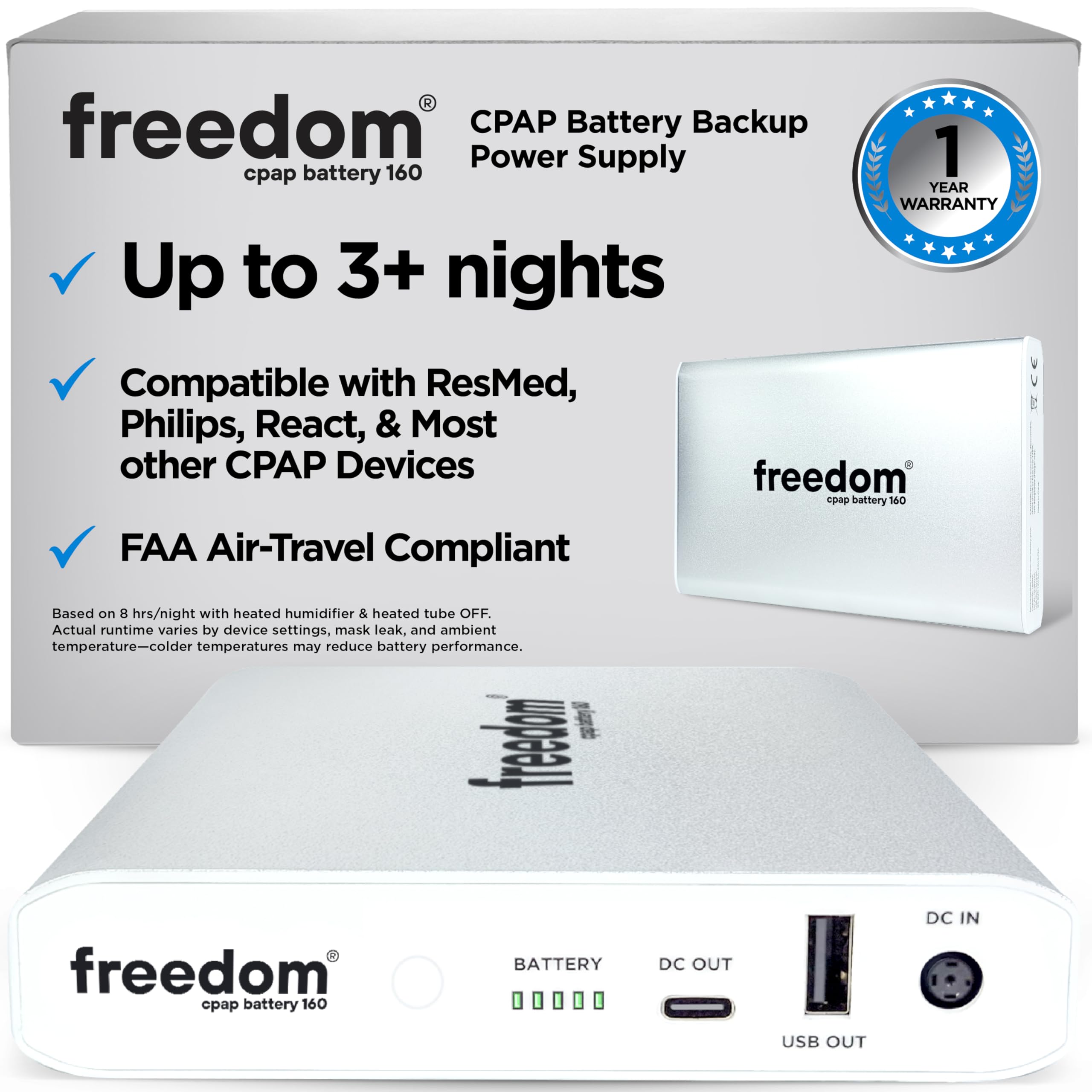
The 160Wh pack that publishes per-machine runtimes — up to 35 hours on a DreamStation 2 — and stays within the FAA carry-on limit.
Where most packs leave you guessing, the Freedom 160Wh prints the answer: up to 24 hours on an AirSense 11, up to 30 on an AirMini, up to 19 on an AirSense 10, up to 31 on a DreamStation 1, up to 35 on a DreamStation 2, and up to 20 on an AirCurve 10 ASV — all at a pressure setting of 10 with no heated humidifier or tubing. At 160Wh (watt-hours, the pack’s energy capacity) it also sits right at the FAA carry-on ceiling, which the heavier 297.6Wh EASYLONGER cannot claim. That machine-by-machine transparency alone makes it the easiest pick to buy for a specific unit.
Owners sticking to the listed conditions — humidifier off — report the documented multi-night results holding up, with a full week of sessions from a single charge being the point of the pack. It keeps output steady right through the discharge curve, so your therapy does not sag as the tank empties, and it can sit charged at the bedside as an instant backup.
The chemistry here is rated for over 500 recharge cycles, so the pack is built to be used rather than stored. The recurring caveat is the same one every humidifier-loving owner will hit: switch the humidity on and runtime drops dramatically, with a minority of users reporting only four to five hours. Keep your BiPAP’s heated settings off on the nights you rely on battery, and the Freedom lives up to its table.
The case for the Freedom
- Published per-machine runtimes — 35 hrs on DreamStation 2, 30 on AirMini
- 160Wh sits within FAA carry-on limits, unlike larger backup packs
- 500+ recharge cycles rated for long-term reliability
What limits it
- Runtime falls fast with heated humidification on
- 3.59 pounds is heavier than the compact 1-pound class
Unbeatable for: buyers who want the printed runtime for their exact machine before they commit.
Bring a plan if: you sleep with humidification — the 35-hour figure assumes it is switched off.
8. Pilot Flex Navy CPAP Battery Backup
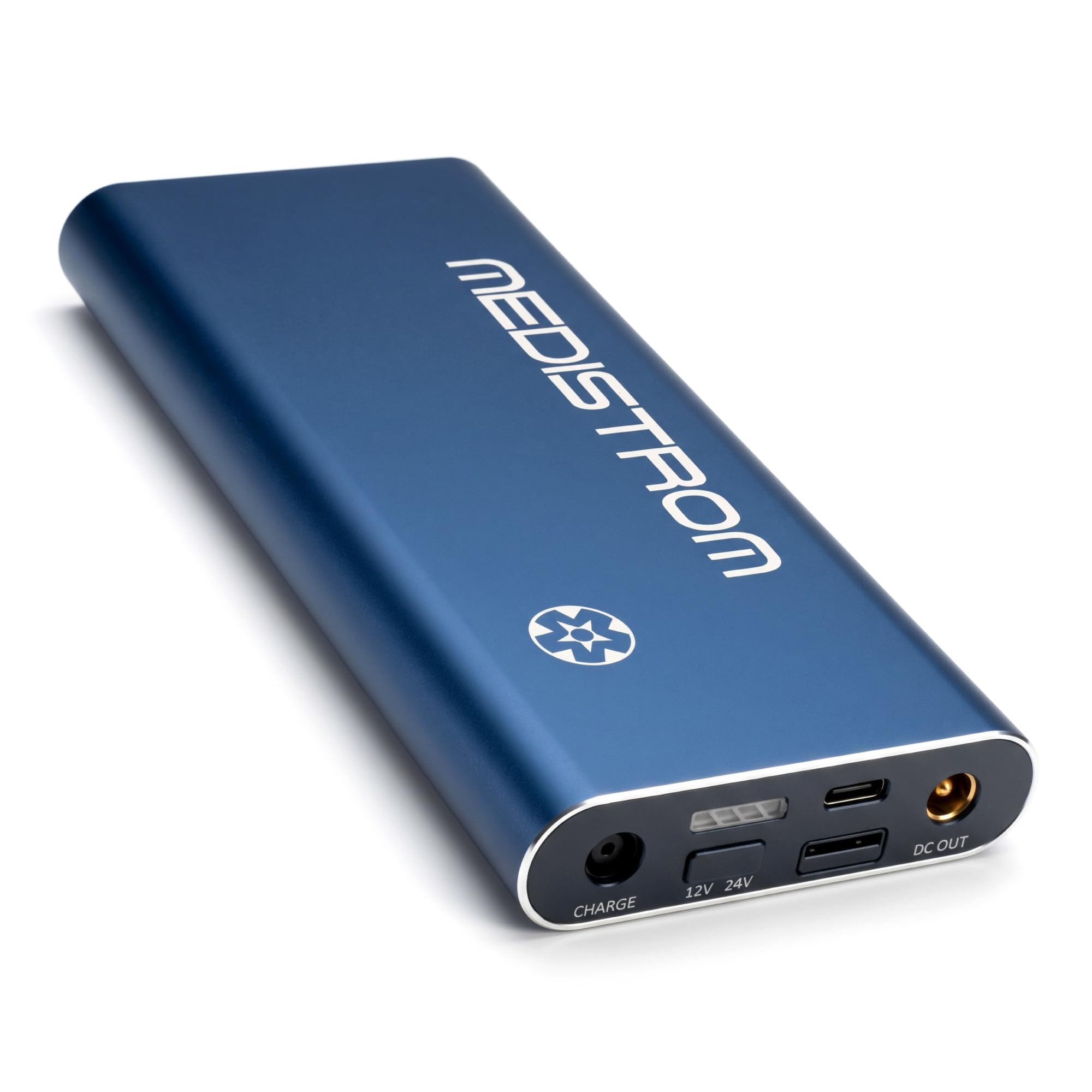
The 98Wh pack with dual 12V and 24V output, so one battery covers a ResMed and a DreamStation.
The Pitch: for a two-machine household or a frequent swap between a 24V ResMed and a 12V DreamStation, the Pilot Flex’s dual 12V and 24V output saves you from buying a second battery. At 98Wh, 1.2 pounds, and TSA-legal sizing, it matches the compact class on paper and recharges in two to three hours. The AirMini and AirSense 11 cables are in the box, with more available separately.
Where it wins is convenience. Buyers point to the included adapters for the AirSense 11 and AirMini as the strong suit of the package, along with a USB-C charging input that tops it up quickly. For a traveler lucky enough to fly with a machine that runs either voltage, that single-pack flexibility is the reason to choose the Flex over a fixed-voltage Pilot.
Honesty is important on this one, because the results genuinely split. With the humidifier and hose heat off, owners mention about eight hours on an AirSense 11 with a bar still showing, but only one and a half nights on an AirMini where two is claimed, and the adapters can feel finicky in the socket. A smaller number of units have shut down or stopped charging entirely. If your trip cannot tolerate a soft night, treat this as a one-night pack rather than a multi-night one.
Choose the Flex when: dual 12V and 24V support is worth the trade-off, and one night per charge comfortably covers your use.
Best for: two-machine owners who want one pack that handles both voltages.
Heads up on: runtime and reliability — some units fall short of the two-night claim, so test yours before a critical trip.
9. Zopec Explore 5700 Universal Travel CPAP Battery

The one-battery-for-every-brand pick that skips the adapter hunt entirely.
This is the wide-net choice: the Explore 5700 advertises compatibility with most popular CPAP and BiPAP machines — ResMed, Philips Respironics, and DeVilbiss included — and adapts across a wide range of input voltages from 110 to 240V (volts, the outlet power level) for international travel, all without buying separate adapters. That universal fit is what makes it the pack to reach for if you change machines or travel to countries with different outlet voltages. It is sized at 5700mAh (milliamp-hours, the battery’s capacity) with a lithium-ion cell, around 1134 grams, and it is FAA-compliant for carry-on.
Owners lean on its independence in the field. One American traveler ran three nights — seven to eight hours apiece — without a humidifier on an Iceland hiking trip, and a camper got three nights of use in Africa through rolling blackouts and tent camping, recharging in about two hours from twenty percent and keeping a charged reserve at the bedside for a mid-night outage. USB charging is available but eats into that three-night budget, so the practical advice is to leave the phone off the pack on a critical night.
The genuine risk is unit-to-unit consistency — a small number have stopped working after a couple of uses, which is the hardest kind of failure when everything depends on reliable overnight power. Treat it as a pack whose long-run reliability needs a home test before you stake a trip on it, and keep the humidifier off to actually reach those three nights.
The trade-off, stated plainly: a pack that works with nearly any machine and any country’s outlets, bought against a longer shadow of reliability doubt than the EASYLONGER or Freedom carry. For an adaptable, travel-first pick, it fits; for absolute overnight certainty, test it first.
Take it if: you want a universal, adapter-free pack that travels across machine brands and countries.
Verify first: reliability varies unit to unit — a home shakedown night is the honest way to know yours.
Know the Specs
Capacity in watt-hours (Wh)
Watt-hours measure how much energy a battery can store — like the size of a fuel tank. A compact 95Wh pack like the Pilot-24 Lite runs roughly one night on a travel CPAP, while the 297.6Wh EASYLONGER stretches to multiple nights. Match the figure to your trip length and whether you are flying: the 160Wh FAA carry-on limit is the ceiling for cabin travel.
Voltage matching (12V vs 24V)
Your machine runs on a set input voltage, and buying the wrong one means the pack simply will not power it. Many ResMed models run on 24V and most Philips DreamStations run on 12V, which is why packs like the Pilot-24 and Pilot-12 come in separate versions. An automatic multi-voltage pack, such as the Zopec Mini, adapts to both so you cannot get it wrong.
Humidifier vs runtime
Heated humidification and a heated tube draw a lot of extra power, so they cut overnight runtime sharply. Published numbers like the Freedom’s up to 35 hours assume no heated humidifier. If comfort with humidity matters to you, plan to charge mid-trip or step up to a higher-capacity pack. The most reliable figure to read is the no-humidifier runtime.
DC output and energy loss
A pack that feeds your machine through a direct DC cable — the same voltage the machine wants — skips the conversion step and wastes less energy than running through a standard AC wall plug. That is why one reviewer’s notes on the EASYLONGER cite roughly half the energy loss versus an AC-style battery. Fewer conversions equal more real nights per charge.
Common Questions
Will a 24V battery power a 12V CPAP machine?
Can I take a CPAP battery on a plane under TSA rules?
How many nights will a 95Wh pack actually give me?
Does using the humidifier really drain the CPAP battery?
Do I need a separate cable kit for my machine?
What is the difference between a CPAP battery and a UPS?
How long does a CPAP battery take to recharge?
Which battery is easiest for someone changing machines often?
Is a bigger battery always the better choice?
Can these batteries charge my phone as well as my machine?
The Bottom Line
For most people shopping a travel bipap machine battery, the winner is the EASYLONGER ES960 PRO because its 297.6Wh LiFePO4 tank delivers multiple nights of therapy with the charge-holding endurance to outlast standard cells. If you fly and need a TSA-legal pack with quick recharge, grab the Pilot-24 Lite. And for a DreamStation owner who wants blackout protection that switches over on its own, the Pilot-12 Lite is the one to reach for. Whichever you choose, test your cables and your runtime at home before you stake a trip — or a night’s sleep — on battery power.
How we choose
We do not accept paid placement. Every pick is matched to a real buyer and a real use-case; we do not hands-on test units.
Sources
Specifications: manufacturer listings and product documentation. Review insights: verified customer reviews, as of October 2026. Pricing: not shown on this page (it changes often); check the current price via the retailer link.
As an Amazon Associate, Aappliancez earns from qualifying purchases. This does not affect which products we feature.