Disclosure: Some links in this post are affiliate links. As an Amazon Associate I earn from qualifying purchases, at no extra cost to you. Learn more
Specs are compiled from manufacturer listings and verified buyer reviews and can change over time — please confirm the key details on the product page before buying.
If you run a school, the hardest translation problem is not the words — it is getting one voice clearly into thirty pairs of ears across a noisy hall. A teacher lecturing a mixed-language class, a front office welcoming a new family, a parent evening with three interpreters working at once: all of it falls apart the moment the audio crackles or the channel mixes. This guide sorts the wireless headsets, handheld translators, and FM systems that hold up in a classroom from the ones that make daily use harder.
This guide is built by comparing the manufacturers’ published specifications and the patterns across verified customer reviews, so you get each pick’s real strengths and trade-offs instead of marketing spin.
If you need to translate a lesson for a whole class or help a parent at the front desk, the right device depends on your room and your setup. This page covers eight systems for schools and explains the specs that matter in real classrooms with concrete walls and busy hallways: channels (how many separate audio streams can run at once), range (how far the signal reaches), battery (how long it runs before charging), and offline capability (whether it works without internet). You will find one-way headsets for large classes and handhelds for front-office talks, covering the full range of translation devices for schools.
Top Picks


How To Choose The Best Translation Devices for Schools
The right system depends on where the translation happens. Assembly-hall lectures, small bilingual classes, and front-office conversations each demand something different. Getting the category right keeps you from buying a handheld translator for a room that needs whisper headsets, or the reverse.
Whisper headsets versus handheld translators
Whisper headsets are one-way systems where a teacher speaks into a transmitter microphone and listeners wear earpieces set to the same channel. They shine when you have ten, twenty, or fifty people who all need to hear one voice at the same time. Handheld translators are two-way devices that convert speech between languages for a single conversation — better for parent meetings or front-desk questions than for lecturing a full class.
Channels, groups, and crosstalk
If your school runs more than one translated session at once — Spanish in room A, Mandarin in room B — the channel count matters. A transmitter paired to receivers on the same frequency channel will cross into another group using that channel. Check the channel count and how easily it can be changed mid-session. Lock switches that prevent accidental frequency changes are a real convenience in a classroom where students handle the receivers.
Battery, charging, and daily routine
A system that dies mid-lecture stops the lesson. Look at the transmitter’s rated working hours, the receiver’s runtime, and whether a charging case or dock is included. A 32-slot charging case means every headset goes back on the rack at the end of the day; loose AAA batteries mean someone is always swapping them.
Side-by-Side Comparison
| Model | Best For | Channels | Transmitter Battery | Working Range | Amazon |
|---|---|---|---|---|---|
| Retekess T130 (1TX 15RX)★ Best Overall | Large lecture translation | 99 | 900 mAh / 12 h | ~60 m | Amazon |
| EXMAX ATG-100T (1TX 6RX)Biggest Bundle | Multi-group simultaneous sessions | 99 | 1200 mAh / 20 h | 50–100 m | Amazon |
| Retekess TR503 (1 TX 10 RX)Best Value Pick | Budget church-style listening | 5 station presets | 450 mAh / 8 h | 30 m | Amazon |
| Pocketalk Plus | Two-way travel and reception desk | — | — | — | Amazon |
| Jarvisen Translator 2 | Offline two-way conversations | — | 2000 mAh / 6 h | — | Amazon |
| Timekettle W4 Pro | Meeting-style bilingual sessions | — | 6 h earbud / 18 h case | — | Amazon |
| Vasco Translator Q1 | Heavy photo and text translation | — | — | — | Amazon |
| AI Translator Traductores (TAGRY) | — | — | — | — | Amazon |
Detailed Reviews
1. Retekess T130 Wireless Tour Guide System (1TX 15RX)
Our pick — 4.0+★ from 100+ verified ratings; the strongest balance of quality and price.
One transmitter into fifteen headsets, from the start, in under five minutes.
For a school running a single translated lecture — one ESL class, one bilingual assembly, one workshop where fifteen students each need their own earpiece — the T130 is the one that gets it right the first time. Its transmitter carries a 900mAh rechargeable battery rated for 12 hours of work, and the receivers run 18 hours on their own charge. Compare that to the Retekess TR503 below, whose transmitter battery sits at 450mAh and 8 hours: the T130 has roughly double the transmitter capacity and half again the working time. On a full school day that is the difference between a system that finishes the last period and one that does not.
Teachers care most about setup speed. One-click pairing syncs all receivers to the transmitter channel in five seconds, so you can start the lesson without keeping thirty students waiting. The PLL circuitry (a tuning method that keeps the signal locked to your channel instead of drifting into others) handles interference automatically. The transmitter and receiver clip together on a small body: the transmitter weighs 56 grams and the receiver only 46 grams, light enough that students forget they are wearing them. Wireless range is about 60 meters, which covers a standard assembly hall with room to spare.
Functionality is the top positive in Amazon’s review data, cited by 19 buyers ahead of sound quality. The recipient earbuds use a 3.5mm single-sided design, so a listener can hear the interpreter and the room at the same time, and the 10-level volume lets you tune it to the room.
Where the T130 wins
- Transmitter works 12 hours on a 900mAh battery, receiver 18 hours — a full school day without a charge
- One-click pairing syncs 15 receivers in 5 seconds
- 99 channels allows multiple groups to run at once without crosstalk
- Transmitter at 56g and receiver at 46g keeps wear comfortable for all-day listening
What to think about
- It assists a human translator — it does not translate automatically on its own
- One buyer hit a set they could not change channels on, blocking second-language use in that session
- At the highest end of the mid-range standing, the value question is real for a small program
Built for: the school running one translated lecture to a fifteen-person class or a live tour group that needs everyone hearing the same voice at once.
Look elsewhere if: you need automatic translation without a live interpreter, or you want to run several simultaneous language groups and cannot risk one locked channel.
2. EXMAX ATG-100T 195MHz Wireless Tour Guide System (1TX 6RX)
A rechargeable suitcase that keeps six earpieces topped up and ready for the next class.
Six receivers, one transmitter, and a 32-slot charging case: if your school runs simultaneous sessions and hates hunting for AAAs, this is the shape of system to buy. The transmitter battery is 1200mAh rated for 20 hours, and the receivers carry 900mAh batteries rated 25 hours — long enough that a full day of classes never touches the charger. The one-click channel synchronization pairs all receivers to the transmitter in one move, and the MUTE function silences background noise when the guide pauses. Range is 50–100 meters (164–328 ft) depending on line-of-sight, which comfortably clears a large classroom block.
The channel count is where this system earns its keep for a multi-language school. 99 frequency channels on 195MHz–230MHz means 99 selected IDs, allowing at least 40 groups to work simultaneously, so Room A on Channel 05 and Room B on Channel 12 never bleed into each other. That is the exact classroom problem that flummoxes cheaper systems. The single-sided ear-hook receivers keep one ear open to the room — the hygienic design with sponge pads matters when students share headsets across a term.
Functionality and build quality both draw the strongest praise from owners, and the pattern is remarkably clean. In one buyer’s own words, from the review pages: “Works amazing! We bought 1 transmitter and 6 receivers. There’s no breaks or extra sounds. They’re perfect!” That level of satisfaction is rare in a category where cheap transmitters hiss and drop out. FCC certification and a 2-year replacement warranty add real reassurance for a school purchase that has to survive three years of student handling.
The honest catch: the receivers are right-ear only by default. Buyers who wanted left-ear flexibility report buying an inexpensive third-party headset that plugged into the 3.5mm jack and worked fine — so this is a fit-note, not a flaw. One charging cradle in one unit arrived dead; the seller replaced it under the 2-year warranty.
Who this fits: a school with two or more language groups running in parallel, or a department that wants the full kit in a case rather than loose components.
Reach for this if you run simultaneous sessions and want the channels and charging case to make it a non-event.
Skip if you only ever translate one class at a time — the channel headroom is wasted on a single-group program.
3. Retekess TR503 Church Translation System (1 TX 10 RX)
A ten-receiver FM kit that hands a listener room to roam without losing the broadcast.
Where the T130 above is a closed whisper system tuned for lectures, the TR503 is an FM broadcast kit — a transmitter sends on a frequency, and ten PR13 receivers tune in like pocket radios. The transmitter battery is 450mAh and rated for about 8 hours after a 2–3 hour recharge, and the receivers run on 2 x AAA batteries (not included). Range is 30 meters in the open air. That is shorter than the T130’s 60 meters and much shorter than the EXMAX’s 50–100 meter line-of-sight, but for a church-style sanctuary or a single classroom, 30 meters is more than enough.
Operation is refreshingly manual: dial the transmitter and receiver to the same frequency and you are listening. Each PR13 receiver holds 5 station presets, includes a 24-hour digital clock, and locks with a switch so a student cannot bump the frequency by accident. The 15-level transmit volume lets the speaker shape the level to the room, and the small size (7.87 x 5.91 x 1.18 inches) makes the whole kit easy to pack away between sessions.
Where it shines: reliability is what buyers keep coming back to — the kit simply works the way a church hearing-assistance system is supposed to, and the value for the price is the second thing they mention. A real buyer review sums it up: “Retekess Church Translation System: transmitter charges in 20 min; receivers last ~6 hrs per battery set.”
The frequency conversation: the FM band is shared, so hissing and static are the recurring complaint when the venue’s local FM stations sit near your channel. Switching stereo to mono and finding a quiet spot on the dial are the standard fixes, and default 107.5 is often the worst choice — drop to a lower frequency range and the sound usually cleans right up. This is a setup quirk, not a defect, but it means someone at your school has to own the frequency plan.
Best fit: a single sanctuary-style room where one translated speaking voice needs to reach ten listeners seated at a distance.
Not the one if your school runs several translated sessions at once or sits next to a crowded FM dial you cannot tune around.
4. Pocketalk Plus Real-Time Two-Way Voice & Camera Translator

Handheld two-way translation for the front office, where a whispered headset will not do.
A whisper headset gets one speaker into many ears. A handheld translator does the opposite job — it lets two people in a face-to-face conversation trade sentences back and forth in real time. For a school office taking a new family’s enrolment call, translating medical forms, or handling a teacher-parent-conference with no shared language, the Pocketalk Plus is the shape of device you actually want. It covers over 84 languages and dialects, includes a camera and large touchscreen for translating signs, menus, and printed text, and supports real-time currency, length, weight, and temperature conversion.
The privacy angle is where Pocketalk earns its place on a school shortlist. It is HIPAA compliant, includes PIN locks, and lets you set timed automatic history deletion — the ability to have conversations deleted on schedule matters when a student’s medical information crosses a translation device. A two-year LTE data plan for over 130 countries is included, so the device works from the start without a SIM or an account setup. Note that translation needs an internet connection; the device does not work offline.
On the accuracy question, the reviews genuinely split. Some buyers report the Pocketalk Plus works fast and accurately — “basically instant” is how one describes the button-press-to-translation loop, and it held up through conversational Spanish, English, and Japanese. Others report that it fails to recognize native English input altogether and returns no translation. The consistency that emerges: strong in a well-lit, quiet room between two motivated speakers; less reliable in an echoing corridor with background noise. For a front office desk, that reliability is enough — for a hallway conversation, plan on the noise problem.
Go with the Pocketalk Plus when your translation moment is one conversation, not a room, and privacy handling matters.
Think twice if you need offline use in a rural or signal-dead building — the device is internet-dependent.
5. Jarvisen Language Translator Device

Voice, photo, and offline pairs — the translator that keeps working when the Wi-Fi drops.
A school with patchy Wi-Fi is a real thing. The Jarvisen Translator 2 answers that directly with 18 pairs of offline language packs, so even with no internet you can still translate between the core pairs. Online, it supports 108 languages for voice translation and 50 languages for photo translation — enough to cover the enrolment desk, the science classroom, and the outdoors field-trip briefing in one device. It pairs leading online engines with the iFLYTEK offline engine, claiming up to 96% accuracy and a 0.5-second response time.
The battery is where the Jarvisen earns its keep for a full school day. A 2000mAh cell drives up to 6 hours of continuous translation and 10-day standby, and it recharges fully in 90 minutes — long enough for the whole teaching day plus a top-up over lunch. The device is 4.6 ounces and sized to slip into a bag or pocket, and it comes with two years of built-in global mobile data, so it works from the start without a SIM card or subscription. A Type-C cable, protective case, SIM pin, and 12-month warranty complete the kit.
The functionality record here is genuinely split. Some owners mention it works exactly as advertised; others report the device will not function at all. The translation quality itself draws the same mixed picture — accurate enough for everyday requests up to a point, then failing on harder material. For a school using it consistently for routine front-office and classroom questions, the offline packs are the real differentiator: the Pocketalk Plus above cannot translate without internet; the Jarvisen can. Route non-critical conversations through offline mode and let it lean on data when the Wi-Fi is good.
Strongest card: the 18 offline pairs plus 2000mAh battery make it the least network-dependent pick on this list.
The trade-off: the mixed-functionality reports mean you should plan for a learning curve and lean on offline mode when the connection is rough.
Right for: schools with unstable Wi-Fi or classrooms that move between buildings and outdoor spaces.
Wrong for: a program that expects fully accurate two-way translation of complex academic content without practicing with the device first.
6. Timekettle W4 Pro AI Interpreter Earbuds

Conversation-shaped earbuds that handle a back-and-forth in two languages at once.
Most translator devices make one speaker wait while the other finishes. The W4 Pro takes a different approach: dual-channel design lets both parties speak and be translated simultaneously across 52 languages and 106 accents. That is the format a parent-teacher conference or a small department meeting wants — two people in a conversation, both with an earbud, neither waiting. Three microphones with vector-based noise reduction filter out surrounding voices, which is the whole reason this can work in a crowded staffroom where two other meetings are happening at the same table.
Listen & Play mode covers the lecture side: switch between listening and speaking in a meeting, with AI Semantic Segmentation pulling out the key content and AI Memo capturing auto-recorded sessions for follow-up. Offline translation works in 13 key language pairs across 8 major languages, so English-Spanish, English-Chinese, English-French, English-German, and English-Japanese keep going without internet. Battery is 6 hours of continuous translation per charge, extended to 18 hours by the charging case, with up to one year of standby. Bluetooth 5.3 and a 56-metre Bluetooth range mean the earbuds can wander from the connected phone without dropping.
What makes the W4 Pro stand out is the conversation itself — the dual-channel design and open-ear fit are the highest-praised features in the customer data. What makes it a considered purchase is the translation consistency: the mixed reports on accuracy over 50% of the time, real delays in the translation loop, and value-for-money complaints sit alongside the praise. This is a device for the meeting format that needs it, not a substitute for a trained interpreter on a formal school assessment or a legal notice home to parents.
The standout: dual-channel simultaneous translation is a genuinely different category from every other device here — the closest thing to natural back-and-forth between two people who do not share a language.
The caution: the accuracy variance is real. Run it on routine conversations and short meetings, and have a human interpreter step in when a message has to be exact.
Picture it as a tool for parent meetings and one-on-one conversations where a slow, computer-mediated back-and-forth would be worse than a small accuracy trade.
Better elsewhere if you need to broadcast one voice to a full classroom — that is the whisper-headset job, not the earbud job.
7. Vasco Translator Q1
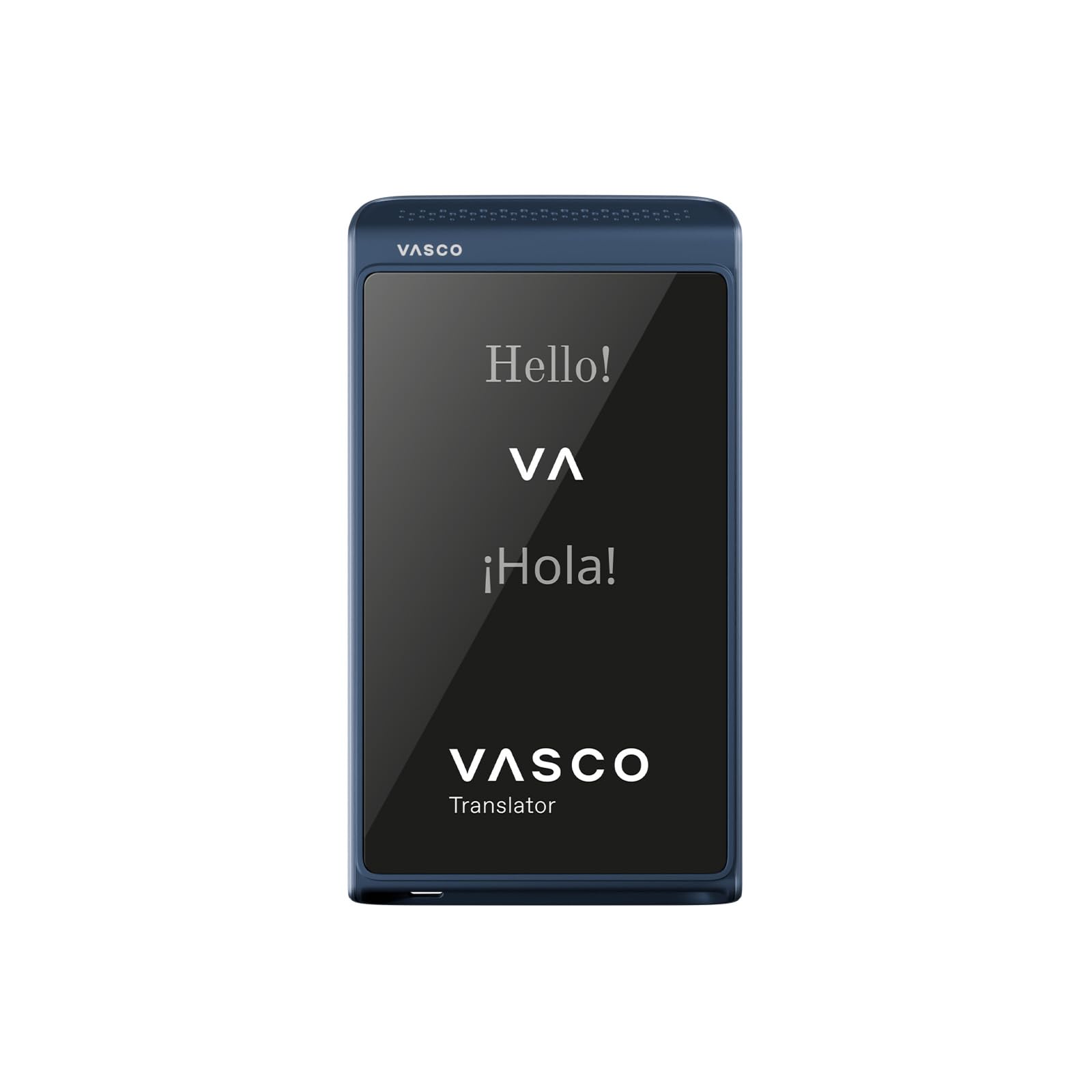
Photo-focused translation with a lifetime SIM, built to handle print-heavy school paperwork.
The core use-case for the Vasco Q1 in a school is printed material: permission slips, enrolment forms, signage, notices home to families. It supports 121 languages for photo translation, 116 for text translation, and 95 for voice translation, and it auto-detects the language and starts translating. A built-in SIM card provides free internet in nearly 200 countries, and 10+ translation engines combine for context-aware translation. The device also works offline when needed, so a Wi-Fi shutoff does not stop the translation.
For phone calls, the Q1 translates worldwide calls in 53 languages. That matters for a school office handling a parent call across time zones. You get 10 free minutes of call translation included, then buy more through manufacturer customer support. An AI assistant highlights and explains cultural concepts, symbols, and local customs in the translation — helpful when the message matters as much as the words — and voice cloning makes the conversation sound more like the speaker.
Owners praise photo translation most, and their experiences match the marketing: a Greek street sign translated quickly and clearly, setup done on-screen, no charging block needed (though one is not included). The trade-offs are consistent: slow boot-up, occasional mis-timed conversation mode, and pronoun handling for some language pairs — one owner notes a mis-translation in the male-to-female pronoun of “I love you,” a fair caution for languages with gendered grammar. None of these breaks the device, but each is a reason to test with the specific languages your school needs before relying on it for high-stakes communication.
Suits: a school office that handles a lot of printed paperwork in multiple languages and wants photo translation done well.
Might not suit: a program that needs fast voice conversation in gendered languages where pronoun accuracy is critical — test first.
8. AI Translator Traductores (TAGRY)

An entry-tier translator that needs a phone and a strong signal before it does anything.
The AI Translator Traductores is the entry-level option on this list, and the design has one hard requirement built in: it relies entirely on an internet connection through your phone. No connection, no translation — and on a slow or weak signal, a single phrase can take a minute or two to convert. Schools with reliable Wi-Fi and a steady cellular signal can work within that, but schools with patchy coverage will find the device non-functional at exactly the moments they need it most.
The headphone-based design is the other part of the experience to think through. Using the translator means wearing the included headphones, plugging into a phone, and managing that pairing throughout a conversation. That works well for a single face-to-face session, but it is the wrong format for lecturing a class, running a small-group activity, or handling a queue of parents at the office desk. Owner reports point to the headphone design being difficult to use for some, and a few report failures even after the setup is complete.
Where it fits: a single personal conversation in a location with strong Wi-Fi or cellular signal where the speaker does not want to pass their phone across the table. A pilot buyer who tried it summed up the trade-off: “They do work fairly well but totally rely on internet connection on your phone.”
The honest read: the ratings here land well below the rest of this list, and the design trade-offs — internet dependence, headphone format, and mixed reliability — are the reasons. Treat it as a backup or a starter device, not the primary tool for a school program.
Consider it if you need one entry-level voice translator for occasional individual use and you have reliable connectivity.
Better served by the Jarvisen or the Vasco if your program needs offline capability or reliable output under real classroom conditions.
Know the Specs
Channel Count and Frequency Range
Channels and frequency range decide whether two translated sessions can run side by side without bleeding into each other. A 99-channel system running on a UHF band like 195MHz–230MHz gives each group its own ID so Room A never hears Room B. FM transmitter systems work differently — they share the public FM band, so a crowded local dial can intrude on your channel unless you pick a quiet frequency. The rule of thumb: UHF for multi-group schools, FM for a single-room kit where one translated voice reaches many listeners.
Battery Capacity and Working Hours
Battery is the spec that quietly decides whether a system survives a full school day. Transmitter batteries in this category range from 450mAh up to 1200mAh, and rated working time ranges from about 8 hours at the smaller end to 25 hours at the larger. Receivers often run longer than the transmitter because they are doing less work — the EXMAX receivers, for example, are rated 25 hours against a 20-hour transmitter. Pair the rating with the way your school actually runs: a half-day program needs less headroom than a full day of back-to-back sessions.
Common Questions
Can a whisper headset system translate automatically without an interpreter?
How many receivers can one transmitter support for a school class?
Will two translated classes running at the same time interfere with each other?
How long does the transmitter battery last on a whisper headset?
Do any of these translation devices work without internet?
Can teachers use the EXMAX ATG-100T with their own headphones?
Is the Pocketalk Plus safe for handling student information?
How is the Timekettle W4 Pro different from the other translators?
What is the working range of the Retekess T130 and the EXMAX together?
Will the Vasco Translator Q1 handle both printed notices and spoken conversations?
The Bottom Line
For most schools, the translation devices for schools winner is the Retekess T130 because its 12-hour transmitter, five-second pairing, and 15-receiver bundle cover the exact scenario a classroom lecture needs — one voice into many ears, for a full day, without a charge. If your school runs more than one translated session in parallel, the EXMAX ATG-100T brings 99 channels, a 32-slot charging case, and the longest battery life here. For a budget single-room setup with a trained interpreter, the Retekess TR503 does the job. And for front-office conversations, the Jarvisen Translator 2 is the offline-friendly handheld to reach for. Start by deciding whether your translation happens in one room or across many — that choice settles the rest.
How we choose
We do not accept paid placement. Every pick is matched to a real buyer and a real use-case; we do not hands-on test units.
Sources
Specifications: manufacturer listings and product documentation. Review insights: verified customer reviews, as of October 2026. Pricing: not shown on this page (it changes often); check the current price via the retailer link.
As an Amazon Associate, Aappliancez earns from qualifying purchases. This does not affect which products we feature.