Disclosure: Some links in this post are affiliate links. As an Amazon Associate I earn from qualifying purchases, at no extra cost to you. Learn more
Specs are compiled from manufacturer listings and verified buyer reviews and can change over time — please confirm the key details on the product page before buying.
Short answer first: if you want one pump that covers most household water-moving jobs, buy a cordless stick pump with a long submersible barrel and speed control — it reaches into a barrel, drains a hot tub, and clears a flooded yard without a power cord. If your problem is a flooded basement floor, an automatic sump pump with a low-water sensor earns its place. Everything below is sorted by that real job, not by brand hype.
This guide is built by comparing the manufacturers’ published specifications and the patterns across verified customer reviews, so you get each pick’s real strengths and trade-offs instead of marketing spin.
You will see the flow rate in gallons per minute (how fast water actually moves), the maximum lifting height (how high the pump can push water up a hose), and the discharge size (which hose fits) for every pick. The cordless stick pump carries 4.0+ stars across 800+ owners, and that tells you more than any spec sheet. Here is the honest breakdown of the best transfer pumps.
Top Picks

How To Choose The Best Transfer Pumps
Start with where the water sits, not with the pump. A pump that lives inside the water (a submersible design) solves a different problem than a pump that sits on dry ground and sucks water through a hose. Get that one decision right and the flow rate, head, and hose size narrow down fast.
Match the pump type to where the water is
Submersible pumps drop straight into a barrel, pool, or flooded basement and push water out from inside. They drain a flat floor down to almost nothing because the intake sits on the base. Shallow-well and lawn pumps sit outside the water and pull it up through a suction hose, which is what you want for sprinklers, garden irrigation, and moving water from a pond to a lawn.
Read the flow rate before the horsepower label
Flow rate tells you how fast water actually moves, and it is the number that decides whether a job takes ten minutes or an hour. A 1 HP submersible unit rated at 72.4 gpm moves water far quicker than a 1/10 HP transfer pump rated at 5.5 gpm. Horsepower only tells you how hard the motor works, so compare gpm across models to see the real difference.
Understand head height and why flow drops
Maximum lifting height is how high the pump can push water before the flow stops. Every foot of rise and every foot of hose steals some volume, so a pump rated high at the source delivers far less at the far end of a long run. If you are watering a lawn up a slope or filling a tank overhead, buy more head than you think you need.
Check the discharge size against your hose
A 3/4-inch outlet threads onto a standard garden hose with no extra fittings, which makes setup quick. Pumps built around 1-inch or 1-1/2-inch NPT threads move more water but usually need an adapter to reach a garden hose. Look at what comes in the box, because a missing adapter turns a five-minute job into a hardware store trip.
Side-by-Side Comparison
| Model | Best For | Flow Rate | Max Lift | Power / Type | Amazon |
|---|---|---|---|---|---|
| Brushless Stick Water Transfer Pump (Milwaukee 18V)★ Best Overall | Cordless barrel and hot tub draining | 12 gpm (720 GPH) | 26 ft | Cordless, 18V battery (not included) | Amazon |
| Green Expert 1/3HP Submersible Sump PumpBasement Drainer | Flooded basement and last-inch floor drainage | 33 gpm (2000 GPH) | 23 ft | Corded, 1/3 HP | Amazon |
| Acquaer 1HP Sump Pump | Fast pool, hot tub, and basement emptying | 72.4 gpm (4345 GPH) | 30 ft | Corded, 1 HP | Amazon |
| FIDISP Water Transfer Pump | Camper, aquarium, and small tank moves | 5.5 gpm (330 GPH) | 42 ft | Corded, 1/10 HP, 115V | Amazon |
| BLACKHORSE-RACING Oil Transfer Pump | Diesel, kerosene, and waste oil movement | 5.25–15.75 gpm (20–60 L/min) | — | Corded, 110V, 550W | Amazon |
| Aquastrong 115V Shallow Well Garden Pump | Sprinkler and irrigation systems | 22 gpm (1320 GPH) | 164 ft | Corded, 1.6 HP | Amazon |
| WAYNE PLS100 1 HP Lawn Pump | Long-run lawn watering and stock tanks | 14.17 gpm (850 GPH) | 20 ft | Corded, 1 HP, 120V | Amazon |
Detailed Reviews
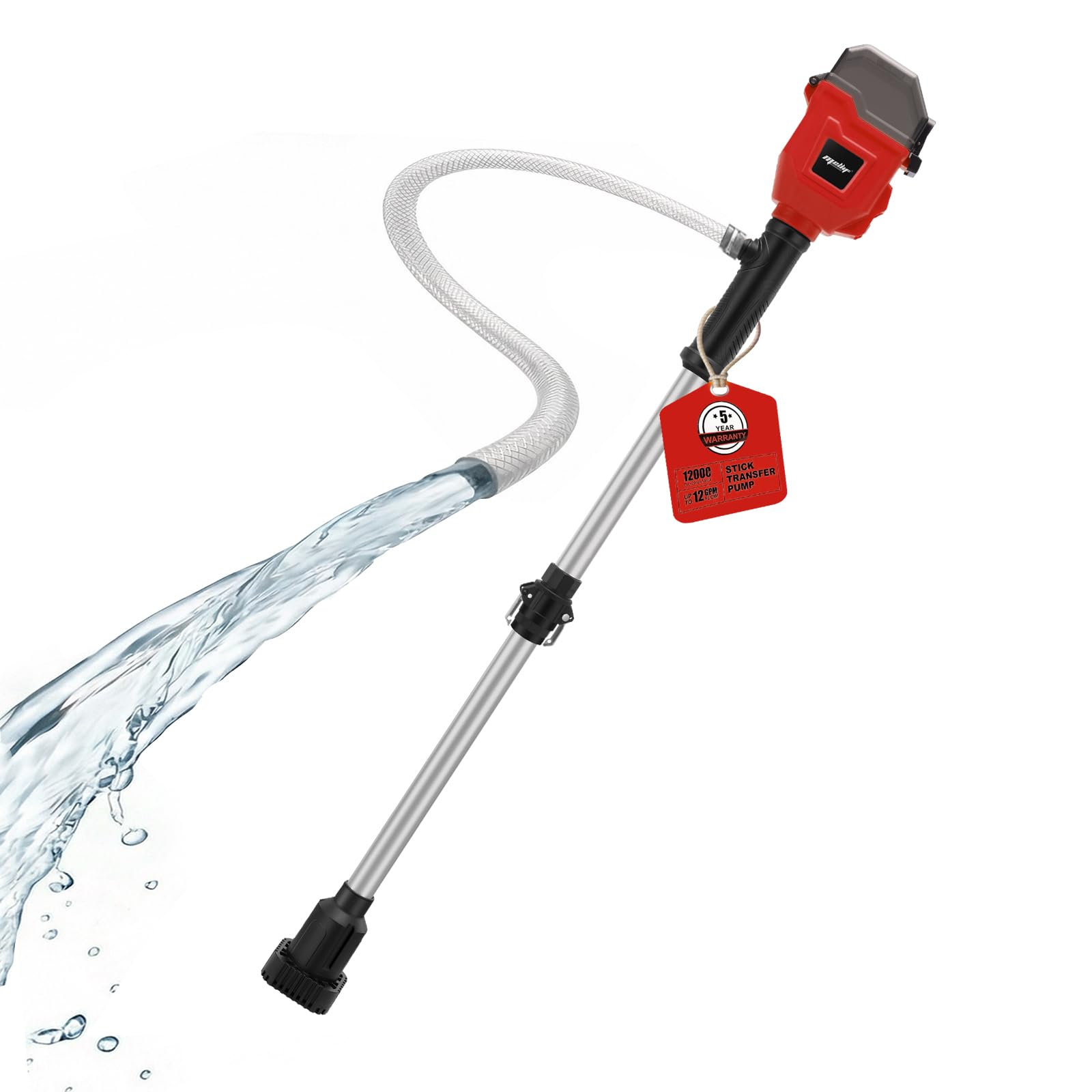
1. Brushless Stick Water Transfer Pump
Our pick — 4.0+★ from 850+ verified ratings; the strongest balance of quality and price.
A cordless stick pump that reaches 36 inches into a barrel and still folds down for the shelf.
The thing you notice first is what is missing: a cord. This pump runs off a Milwaukee 18V battery you already own, so you can carry it to a rain barrel at the far end of the yard with no outlet in sight. That cordless freedom is the whole pitch, and owners praise the fit of the pieces and the feel of the plastic more than any other trait.
Numbers back up the convenience. It pushes up to 720 gallons per hour, which works out to the 12 gpm listed in the specs, and it lifts water 26 feet. Compare that lifting height to the Green Expert sump pump below at 23 feet, and this cordless pump actually climbs higher — 26 feet to 23. It also folds down and weighs 5.6 pounds, light enough to hang in a shed.
Speed control is the feature that keeps it useful across jobs. You get three settings at 720, 600, and 480 GPH, so you can blast a flooded yard or slow the flow to a controlled trickle into a tank. The 3/4-inch outlet threads onto a standard garden hose, and the detachable filter keeps sediment out of the pump. Five built-in protections guard against dry running, low voltage, overload, over-current, and overheating, and a 5-year warranty backs the whole thing.
As owners put it: “It usually takes half a day for the hottub to manually drain from the drain plug but using this – done in an hour – with battery power left to spare!” That is the real case for it — a tiring manual chore turned into a short job.
cordless Milwaukee battery fit
- Cordless design runs off a Milwaukee 18V battery, so no outlet or extension cord is needed
- 36-inch aluminum barrel reaches the bottom of deep barrels and drums without bending
- Three flow settings at 720, 600, and 480 GPH for both fast and gentle jobs
- 26-foot lifting height and a 3/4-inch outlet that fits a standard garden hose
- 5-year warranty plus dry-run, overload, and overheat protection
needs battery and charger
- Battery and charger are not included, so you need a Milwaukee 18V pack on hand
- The 36-inch barrel needs a widened opening to fit some drums — one owner had to drill a 4-inch hole
buy it if: you already own Milwaukee 18V batteries and want one pump for hot tubs, barrels, RVs, and flooded yards.
hold off if: you have no compatible battery — the pump alone will not run without one.
2. Green Expert 1/3HP Submersible Sump Pump
The floor-drainer that goes down to the last inch, with a sensor that stops the pump for you.
If your problem is standing water on a basement or garage floor, this is the pick built for it. It pulls 33 gpm and a maximum flow of 2000 gallons per hour, which clears a lot of water quickly. It also drains down to a suction level of 1/25 inch, so it gets the last film of water off a flat floor instead of leaving a puddle behind.
The design is small and light: it weighs 3.65 kg and measures 9.5 by 6.7 by 10.6 inches, compact next to the 28-inch stick pump above. That low, wide shape is why it can sit on a floor and still pull water from the shallowest point. It works two ways — automatic mode uses the water sensor to fire on and off, and manual mode runs continuously. A non-return valve stops backflow when the pump shuts off.
The honest catch is the sensor. The low-water sensor is the most-discussed feature in the reviews, and feedback is genuinely split — it performs beautifully on a flat, rigid surface, but several buyers report it acting up outdoors when water rises from the side rather than from below. The manufacturer even notes it works best on rigid, flat surfaces and that soft pool covers can block the low base. Auto-off carries the same mixed feedback. Treat the sensor as a helper on a flat indoor floor and run manual mode for outdoor puddles.
high flow volume: a 1/3HP PSC motor with thermal overload protection moves up to 2000 gallons per hour at zero feet, and the 23-foot lifting height covers a basement floor or window well.
sensor needs watching: automatic shutoff stops about 15 seconds after the sensor reads no water, which is brilliant indoors and less dependable outdoors — have manual mode ready.
right for: flooded basements, garages, and rain barrels where you want automatic on/off and a near-dry floor.
think again for: outdoor pond or waterfall duty where you cannot rely on the water sensor to trigger.
3. Acquaer 1HP Sump Pump, 4345GPH Submersible Water Pump

When the water needs to be gone now, this 1 HP unit does the heavy lifting.
Raw emptying power is the reason to pick this one. It moves 4345 gallons per hour, which is the 72.4 gpm in the specs, and lifts water 30 feet. Put that beside the Green Expert sump pump above at 33 gpm and the gap is real: the Acquaer moves more than double the volume per minute. For a pool, a hot tub, or a deep flooded cellar, that is the difference between a long afternoon and a short morning.
It handles a little grit too — the pump can pass solids up to 1/5 inch, so dirty water does not jam it. The low suction base drains down to 1/5 inch from the surface, and the 9.8-foot UL power cord gives you reach with a maximum immersion depth of 7 feet. A mechanical seal keeps water inside the housing, and a built-in thermal overload protector stops the motor from burning out if it runs dry.
Owners keep coming back to the solid construction and the strong water movement. The multi-size outlet is a quiet bonus: a 1-1/2-inch discharge comes with elbow and snap-coupling adapters for 3/4, 1, and 1-1/4-inch hoses. One recurring gripe is the float switch — it is the least-loved part, and at least one owner had to rig the on/off gauge to work when the pump sits at an angle, so keep it upright and it behaves.
strong 1HP lift: a 1 HP capacitor motor at 4345 GPH with a 30-foot head clears big volumes fast, and the reinforced thermoplastic casing resists corrosion and abrasion.
install space tight: the supplied adapters cover several hose sizes, but you must tighten a garden hose hard or it will spray at the joint.
best for: draining pool spas, hot tubs, flooded basements, and pond water where speed matters most.
skip it if: you need a float switch to run unattended and cannot keep the pump standing upright.
4. FIDISP Water Transfer Pump 115V

A palm-sized metal pump that lifts water 42 feet and comes with both hoses in the box.
Do not be fooled by the size. This pump measures just 6.1 by 3.15 by 3.15 inches, yet it reaches a maximum lifting height of 42 feet — higher than any other pump on this list, including the 26-foot stick pump and the 20-foot WAYNE. That head height is what makes it handy for pushing water up and out of a camper, a water heater, or an aquarium on a shelf.
Speed is modest by comparison: 330 gallons per hour, which is the 5.5 gpm in the specs. But the kit is what sells it. You get two 6-foot suction hoses, a replaceable impeller, and a suction strainer that pulls water down to 1/8 inch from the surface. The metal housing is heavier-duty than plastic, the motor uses copper wire for steady power, and the corrosion-resistant zinc alloy volute helps it last. A waterproof built-in switch and 6.4-foot cords make on/off simple.
Owners find it earns its spot on camper and occasional jobs — a two-year camper user reports it moving 7 gallons in 2-3 minutes, and it runs fine on a generator. Just prime it first by adding water to the inlet and outlet, and it is not built for heavy-duty or commercial work. One owner notes the triangular inlet filter needs holding down to stay at the bottom, and running it dry risks speeding the motor.
reach for this if: you move small volumes — camper tanks, aquariums, pool topping, water heater flushes — and want the hoses included.
look elsewhere if: you are draining a whole flooded basement, where the low 5.5 gpm will test your patience.
5. BLACKHORSE-RACING Self Priming 110V Oil Transfer Pump

Built to move fuel and waste oil, not water — read that line twice before buying.
This is a different animal from the rest of the list. It is an oil and fuel pump, meant for diesel, kerosene, biodiesel, and light oils on a car, truck, farm, or construction site. The 110V AC 550-watt self-priming motor runs at 2800 r/m and flows between 20 and 60 liters per minute, which is the 5.25 to 15.75 gpm in the specs. The cast iron body and 1-inch hose barb inlet take a reinforced hose, and it uses an anti-drainback valve to hold prime.
For moving used oil, it is a strong worker. Owners moving waste oil report strong suction through a 1-inch reinforced hose, and it clears mixed waste oil faster than a twin-diaphragm pump. It comes with a cleanable steel-mesh suction filter and uses replaceable generic switch and capacitor parts, so repairs are not locked to one source. One farm user filling a tractor reports the fast flow turns the job into about a minute and a half.
Two honest cautions. First, it is loud — several owners say so plainly, and the noise is the price of the strong flow. Second, it is for light oils only: it is not suitable for highly flammable fuel like gasoline, liquefied petroleum gas, or alcohol, and it needs 1-inch reinforced hose with BSP threads, since NPT fittings will not fit. Also check the wiring before trusting it in a wet or outdoor spot, as one owner found the ground wire missing inside despite a three-prong plug.
self priming oil moves: strong self-priming suction on diesel and waste oil, with fast 20-60 L/min flow and a cast iron body that runs cool thanks to a high-airflow internal fan.
fittings run odd: it wants 1-inch reinforced hose and BSP threads, so budget for the right connectors and treat it as a loud, fuel-only tool.
it suits: garages, farms, and workshops moving diesel, kerosene, or waste oil between tanks and equipment.
not for you if: you need to pump water — this one is fuel-only and loud by design.
6. Aquastrong 115V Shallow Well Garden Pump, 1320 GPH

A 164-foot head and 1.6 HP motor built to feed a whole sprinkler system from a well or pond.
The number that matters here is the lift. This pump pushes water up to 164 feet, which dwarfs the 20-foot lift of the WAYNE lawn pump below — an 8x difference on paper. It flows 1320 gallons per hour at 5 feet of head (the 22 gpm in the specs) and pulls from a well up to 26 feet deep. For a lawn, garden, or farm running sprinklers off a lake, pond, or rain barrel, that head and depth give you the reach to cover a long run.
The build is aimed at outdoor life. A stainless steel casing and aluminum motor housing resist corrosion, a waterproof on/off switch keeps it simple, and the iron carry handle lets you move it around the yard. A carbon ceramic mechanical seal helps stop leaks. When the water inside runs dry, it shuts off automatically to protect the motor, and built-in thermal overload protection guards against overheating. It also works with a pressure regulator as a booster pump.
What owners rate most is how easy it sets up and how it performs on long runs — it has handled 300 feet of hose and pulled water 50 feet out of a drain tile. The honest trade-off is priming and motor life. This is not a self-priming pump, so you must fill it before use, and one owner found priming tougher than the instructions suggest, having to remove the inlet hose and fill the pump upright to clear an air lock. A few owners mention motors seizing or humming after a few months, though the company has sent prompt replacements in those cases. It carries a two-year warranty.
pick this for: sprinkler zones, garden irrigation, and drawing from shallow wells or ponds where high head height matters.
look elsewhere if: you want a pump that primes itself — this one needs filling before every start.
7. WAYNE PLS100 1 HP Portable Stainless Steel Lawn Pump

A stainless steel lawn pump that holds 60 PSI and keeps sprinklers running season after season.
This is the pump for a lawn that needs steady pressure, not a quick drain. It holds pressure up to 60 PSI and delivers a 140-foot total dynamic head (how high and how far it can push water while still keeping pressure). It flows 14.17 gpm, which is 850 gallons per hour, and draws water up to 20 feet. The 1-inch NPT suction and discharge threads come with a 3/4-inch garden hose adapter, so you can hook a standard hose without hunting for parts.
Durability is where it earns long-term owners. The stainless steel exterior resists corrosion and the 120-volt fan-cooled motor is built for continuous duty. There is a safe on/off switch and an easy carry handle, and it weighs 20.6 pounds. Long-term customers note it still holding 70 psi with no decline, and one long-run test measured 78 psi at the outlet, 76 psi at 75 feet, and 63 psi at 150 feet with a 22-foot rise.
Owners most often cite the steady pressure — it has boosted weak city spigots enough to run two impact sprinklers at once. The honest limits are priming and heat. Priming is more work than a self-priming pump, and owners suggest shutoff valves at both ends to prime solo, plus draining it before winter. It also runs hot — one owner describes the casing as hot to the touch after 20 minutes, though the built-in fan handles normal running heat. The cord is on the short side.
worth it for: underground sprinkler systems, well or lake irrigation, pool filling, and stock tanks where steady pressure over long runs is the goal.
pass on it if: you want grab-and-go simplicity — the priming routine takes a few minutes and some patience.
Know the Specs
Flow Rate (GPM and GPH)
Flow rate tells you how fast water moves, measured in gallons per minute (gpm) or gallons per hour (GPH). A high number empties a tub or flooded floor quickly; a low number is fine for topping off a tank. Watch how the rating is stated — pumps often quote their best-case figure at zero lift, and real-world flow drops once you add hose length and height.
Maximum Lifting Height (Head)
This is how high a pump can push water before the flow stops, measured in feet. Every foot of rise and every foot of hose eats into the volume you actually get at the end. A pump with a big head number can feed a sprinkler up a slope or fill an overhead tank; a modest head number is fine for moving water along the ground.
Discharge Size and Hose Fit
The discharge is the outlet where water leaves the pump, sized in inches. A 3/4-inch outlet mates to a standard garden hose; 1-inch and 1-1/2-inch NPT threads move more water but usually need an adapter. Check the box for adapters before you buy, because the wrong fitting stalls a job on day one.
Submersible vs. Self-Priming
A submersible pump goes into the water and pushes it out, which lets it drain a flat floor to almost nothing. A self-priming pump sits outside and pulls water up through a suction hose, but many lawn pumps are not self-priming and need filling with water before each start. Match the type to where your water actually sits.
Common Questions
Will a transfer pump drain a hot tub faster than the drain plug?
Do I need to prime the pump before every use?
What is the difference between a submersible pump and a shallow well pump?
Can I connect a transfer pump to a standard garden hose?
Why does my pump move less water than the rating says?
Can a transfer pump run dry without breaking?
Is an oil transfer pump safe for water?
What size hose do I need for a 1-inch discharge pump?
How high can these pumps lift water?
Can I leave an automatic sump pump running unattended?
The Bottom Line
For most people, the best pick among these transfer pumps is the Brushless Stick Water Transfer Pump, because it covers the widest range of jobs — a hot tub, a rain barrel, a flooded yard — on a battery you already own, with three speeds and a 5-year warranty. If your water sits on a basement floor and you want it gone automatically, choose the Green Expert 1/3HP Submersible Sump Pump for its last-inch drainage. And when raw emptying speed is the whole point, the 1 HP Acquaer Sump Pump at 72.4 gpm clears the biggest volumes fastest. Pick by where your water sits and how much head you need, and any of these will do the job.
How we choose
We do not accept paid placement. Every pick is matched to a real buyer and a real use-case; we do not hands-on test units.
Sources
Specifications: manufacturer listings and product documentation. Review insights: verified customer reviews, as of October 2026. Pricing: not shown on this page (it changes often); check the current price via the retailer link.
As an Amazon Associate, Aappliancez earns from qualifying purchases. This does not affect which products we feature.