Disclosure: Some links in this post are affiliate links. As an Amazon Associate I earn from qualifying purchases, at no extra cost to you. Learn more
Specs are compiled from manufacturer listings and verified buyer reviews and can change over time — please confirm the key details on the product page before buying.
If ceramic or thinset is stuck to your slab and a hand scraper has you on your knees getting three tiles an hour, you need power and you need the right blade. This guide covers both halves of the job: a demolition hammer to break the bond, and a floor scraper to get the mortar off clean. The Berserker 45HM is the pick most buyers land on for the heavy lifting — 4.5+ stars across 500+ owners, and its 4,100 BPM breaks a foyer of tile loose in minutes.
This guide is built by comparing the manufacturers’ published specifications and the patterns across verified customer reviews, so you get each pick’s real strengths and trade-offs instead of marketing spin.
Getting the old floor out is half demolition and half tool choice, and the picks below cover both the breaker and the scraper. Read on for the tool to remove tile that actually fits your floor.
Top Picks


How To Choose The Best Tool to Remove Tile
The first decision is not brand — it is whether you are breaking the tile bond with a machine or lifting it by hand. A powered demolition hammer does the heavy chipping; a long-handled floor scraper does the cleanup and the jobs a machine cannot reach. Most full tile removals use both.
Match the shank to your hammer before anything else
The shank is the slotted end of the chisel that slides into the hammer. SDS-Plus and SDS-Max are two different shank sizes, and a bit made for one will not lock into the other. Check the collar of your rotary hammer first, then buy chisels that fit it. Buying the wrong shank is the most common wasted return in this category.
Read impact energy and beats per minute as a pair
Impact energy is the force of each blow, measured in joules. Beats per minute (BPM) is how often those blows land. A tile set in thinset on a concrete slab breaks loose from a mix of both — enough force per hit to crack the bond, and enough speed to make progress across a room. A hammer-only machine will not drill, so if you also need holes in masonry, that is a separate tool.
Choose blade width by what you are scraping
A wide flat blade covers more floor per pass and is the fastest way to strip thinset after the tile is up. A narrower chisel gets into corners, along baseboards, and between floor planks without chewing up the boards you are keeping. Red Devil’s 4-inch blade and Firecore’s 5-inch blade sit at the two ends of that trade-off in this list.
Decide if you want the tool to outlive this one floor
A weekend demolition hammer rental runs close to the price of some models here. If you have more than one floor, a bathroom, or a patio in your future, buying shifts the math. If this is genuinely a one-room job, a manual scraper and a helper may be all you need.
Side-by-Side Comparison
| Model | Best For | Type | Shank / Fit | Weight | Amazon |
|---|---|---|---|---|---|
| Berserker 45HM SDS-Max Demolition Hammer★ Best Overall | Whole-room tile demolition | Powered demolition hammer | SDS-Max | 12 lb (5.4 kg) | Amazon |
| Warner 591 5″ Heavy Duty ScraperBest for Adhesive | Scraping glue and adhesive standing up | Manual long-handle scraper | Replacement blades 595 / 599 | 16 oz | Amazon |
| Makita 3-Piece SDS-Plus Chisel Set | Adding chisels to a hammer you own | Chisel bits | SDS-Plus | — | Amazon |
| MAXPOWER 3-Piece Masonry Chisel Set | Cutting through brick, block and tile by hand | Hand masonry chisels | Hand struck | — | Amazon |
| Firecore 5″ x 11″ SDS Plus Floor Scraper | Stripping thinset after the tile is gone | Powered scraper attachment | SDS-Plus | 1.26 lb | Amazon |
| VEVOR 1400W Demolition Jack Hammer | Large slab and tile jobs with budget headroom | Powered demolition hammer | 5/8 in. hex | 16.9 lb | Amazon |
| Red Devil 2108 Long Handle Floor Scraper | Corners, baseboards and vinyl tile by hand | Manual long-handle scraper | 4 in. double-edge blade | 2.8 lb | Amazon |
Detailed Reviews
1. Berserker 1300W 12-Pound SDS-Max Demolition Jack Hammer 45HM
Our pick — 4.5+★ from 500+ verified ratings; the strongest balance of quality and price.
Twelve pounds of SDS-Max hammer that breaks a hand-scraped foyer loose in minutes, not hours.
The number to start with is 12 pounds. That is light enough to hold in both hands for a full afternoon, which is exactly why this machine wins the category — most demolition hammers this capable sit far heavier and need a second body to move around a bathroom. Underneath that weight sits a 1,300-watt, 11-amp motor that delivers 4,100 beats per minute and 11.1 ft-lbs of impact energy, measured in the manufacturer’s spec as 15 joules. In plain terms, each blow lands hard enough to shear the thinset bond and fast enough that you cover floor quickly.
The chisel system does a lot of the work for you. The SDS-Max shank (a slotted bit holder that locks the chisel with no tools) lets you swap a flat chisel for a point chisel in seconds, and the lock-on button keeps the trigger down so you are not squeezing through an entire room. The vario-lock positioning rotates and locks the chisel into 12 different positions, which matters when you are working on your side under a cabinet toe-kick or in a corner where a straight-on angle will not reach. Triple vibration control — an air cushion in the hammer mechanism plus a spring-loaded rear handle — is why your hands are not buzzing an hour in.
What wins people over across the review pages is how disproportionate the output feels to the size, and the tile stories back it: as owners put it, “was slow going with the long stick tile scraper… the pic is what the berserker did in less than 10 minutes.and these ceramic tiles were on there solid.” Setups like a 2 ft by 2 ft poured concrete column come apart without a fight, and one buyer drove an 8 ft grounding rod through shale “like a hot knife through butter.” The honest catch is the function set — this is hammer-only with no drilling mode, and it takes SDS-Max chisels only, so if you already own an SDS-Plus rotary hammer you need the Makita set below instead. Several owners also swapped out the included bits for better ones.
Where this hammer earns its place
- 4,100 BPM and 15 joules of impact energy from a 12 lb body — real power without the usual heft
- 12 locked chisel positions and 360° adjustable handle for corners and toe-kicks
- Lock-on trigger plus triple vibration control for long stretches of work
- Ships as a kit: flat chisel, point chisel, grease, wrench, spare carbon brush and a carrying case
- Backed by a 24-month warranty from the maker
What to know before you commit
- Hammer-only — there is no drilling function, so it will not bore holes
- SDS-Max shank only; it will not accept the more common SDS-Plus bits
- The included chisels are the weak link for some buyers
Pick it for: a whole foyer, bathroom or patio of tile on a slab, where you want the bond broken in minutes rather than hours.
Think twice if: your existing rotary hammer is SDS-Plus — this machine will not take those bits.
2. Warner Manufacturing Warner 591 5″ Heavy Duty Scraper
A four-foot lever you push standing up, so your back survives the glue layer.
Once the tile is gone you are left with the sticky part — dried adhesive, glue, tar, paint — and that is the job this scraper was built for. The 47-1/4 inch steel handle puts you upright instead of kneeling, and the angled head gives you real leverage when you lean into a dried adhesive patch. The blade is 5 inches wide in alloy steel with a straight edge, and it takes Warner replacement blades 595 and 599 when it eventually dulls. It weighs 16 ounces, so fatigue comes from the pushing, not from hauling the tool around a bakery floor.
Sturdiness is the theme that runs through the owner feedback. The shaft is a solid piece rather than a telescoping pole, so it does not flex when you load it, and the vice-style blade holder grips with two large Phillips screws for better torque on thick adhesive. Reviewers compare it directly to thinner competitors and find the thicker blade resists chipping on concrete. It is American-made and the all-metal unpainted body cleans up without fuss.
Where it gets fiddly is at the blade. Some buyers find the blades break sooner than they would like, and the replacement blades are one-sided only, so plan on buying several for a large floor. There is also a real technique limit: the blade edge is what contacts the glue, so on uneven concrete only part of the cutting edge sits flat. One owner who bought it for rug adhesive found “it takes a lot of elbow grease and time to get it up.” If the tile itself is still down, this is not the tool — go to the Berserker above. This one is for what is underneath.
Standing-room only: the 47-1/4 inch handle and angled head are the whole point — you scrape glue off concrete without kneeling, and the 5-inch alloy blade covers a plank or a strip of adhesive per pass.
The blade is the consumable: it takes 595 and 599 replacements, and one-sided blades mean you should order spares before starting a whole floor rather than mid-job.
Reach for it when: the tile is already up and dried adhesive, paint or tar is what is holding you to the floor.
Look elsewhere if: the ceramic is still bonded — this is a scraper, not a breaker.
3. Makita 3 Piece SDS-Plus Chisel & Point Bit Set

The upgrade your existing SDS-Plus hammer needs to start eating tile.
If there is already a rotary hammer in your garage, you do not need a new machine — you need chisels that will survive tile. This is three of them: a 10-inch point chisel, a 10-inch by 0.8-inch flat chisel, and a 10-inch by 1.57-inch scaling chisel, all in hardened cold-forged steel with a 45-degree cutting angle. Each has its own protective sleeve for storage. The whole set packs into 7.25 by 1 by 3 inches, which is roughly the footprint of a paperback — nothing to store.
Here is the direct comparison against the Berserker: that machine is 17.13 inches long and 3.54 inches wide, while this cased set measures 7.25 inches long and 1 inch wide. The gap is the difference between a tool you dedicate a shelf to and a set you keep in a drawer until the next floor. It will not out-chop a purpose-built demolition hammer, but it turns a rotary hammer you already paid for into a tile tool.
The field report on duration is genuinely encouraging. Across the reviews, the flat chisel and the scaling chisel are the two that get worked hardest for floors, and the tips hold their edge — one buyer stripping flooring tile noted “the tips have not lost their edge at all. In fact, the edges are still sharp.” Function and build quality are what the reviews dwell on, which for a consumable bit set is the right thing to care about. Check your hammer’s collar before you order: these are SDS-Plus, and they will not lock into an SDS-Max machine like the Berserker.
Buy these if: your SDS-Plus rotary hammer is sitting in the garage and you want to put it to work on a tile floor.
Pass if: you own an SDS-Max hammer — the shanks are different sizes and these will not fit.
4. MAXPOWER Masonry Chisels

Three struck chisels that do the job when there is no outlet in sight.
Not every tile job has a cord. These are hand-struck chisels — you hit the end with a hammer — forged in heat-treated chromium-vanadium steel with thick wide hand guards that keep your grip from sliding up the shaft and absorb some of the shock. The set covers three distinct jobs: an 11-inch point chisel with a narrow tip that concentrates force for starting holes and chipping high spots, an 11-inch flat chisel with a 3 cm precision-ground edge for scoring and surface cleaning, and an 8-inch brick chisel with a wide 10 cm blade for cutting and breaking brick, masonry, tile and concrete.
The build quality is what the reviews keep returning to — forged Cr-V steel that holds an edge through repeated strikes. A hobbyist carving rock went from chisels that bent and dulled to these and reported more progress in one month than with previous tools over a year and a half. Another cut a 3-inch retaining wall cap in half and carved a clean square hole out of a basement floor to pour a footing. An outdoor fireplace came apart with them without drama. For a set of hand tools, that is a serious record.
The caveat worth naming is rust. Durability splits down the middle across the feedback — some buyers find them indestructible, and at least one watched them rust within a month of use. Wipe them down and store them dry. Also be realistic about pace: hand chisels cut a floor slowly compared to the Berserker, so treat this set as the right answer for a small patch, a brick surround, or the slab you cannot get a cord to.
- Cutting coverage: 11″ point, 11″ flat with a 3 cm edge, and an 8″ chisel with a 10 cm blade — three geometries in one case
- Forged Cr-V steel: heat-treated to take repeated heavy strikes, with thick guards against slip and vibration
- No power needed: works in a basement, an attic or a back garden where a cord will not reach
- Rust watch: dry them after use and store them indoors
The right tool when: the job is a patch of tile, a brick surround, or a slab with no nearby outlet.
Not your pick if: you are stripping a whole floor — you want a powered hammer for that pace.
5. Firecore SDS Plus Floor Scraper

A wide blade that slides into a hammer you already own and eats the mortar layer.
The spec that does the work here is the blade width: 5 inches of 65# manganese steel, heat-treated, cut with an upgraded sharp edge. The maker claims it removes 25% more material than standard blades, and on a floor covered in thinset that width is why — you clear a 5-inch strip per pass instead of chasing a narrow lane with a chisel. The whole thing weighs 1.26 pounds, so your arms are not the limiting factor.
It fits any SDS-Plus rotary hammer through a standard 10mm slotted shank, which lets you swap it in without extra tools. Firecore includes three spare alloy steel bolts and locknuts, and the blade itself is replaceable.
The floor stories are the reason this one earns a place. An 8 by 8 foot bathroom floor came up and scraped down to bare concrete “in no time at all.” A 600 sq ft thinset job after tile removal took about six hours and left the floor smooth enough for hardwood. The blade is where the honest limits sit — one buyer’s blade broke, and another found it better for scraping after the tile is up than for lifting the tile itself. Pair it with a wide-blade scraper for the mortar, and let a demolition hammer handle the tile.
Wide blade, fast floor: 5 inches of manganese steel per pass covers ground quickly, and the 10mm SDS-Plus shank drops into a rotary hammer you already own.
Order the spares: three spare bolts and locknuts ship in the box, and the blade is replaceable — plan on a spare blade for a large floor.
Best used for: the thinset and mortar layer, once the tile itself is off.
Weaker at: breaking the original tile bond — that is a demolition hammer’s job, not a scraper’s.
6. VEVOR Demolition Jack Hammer, MAX 1400W, 2900 BPM
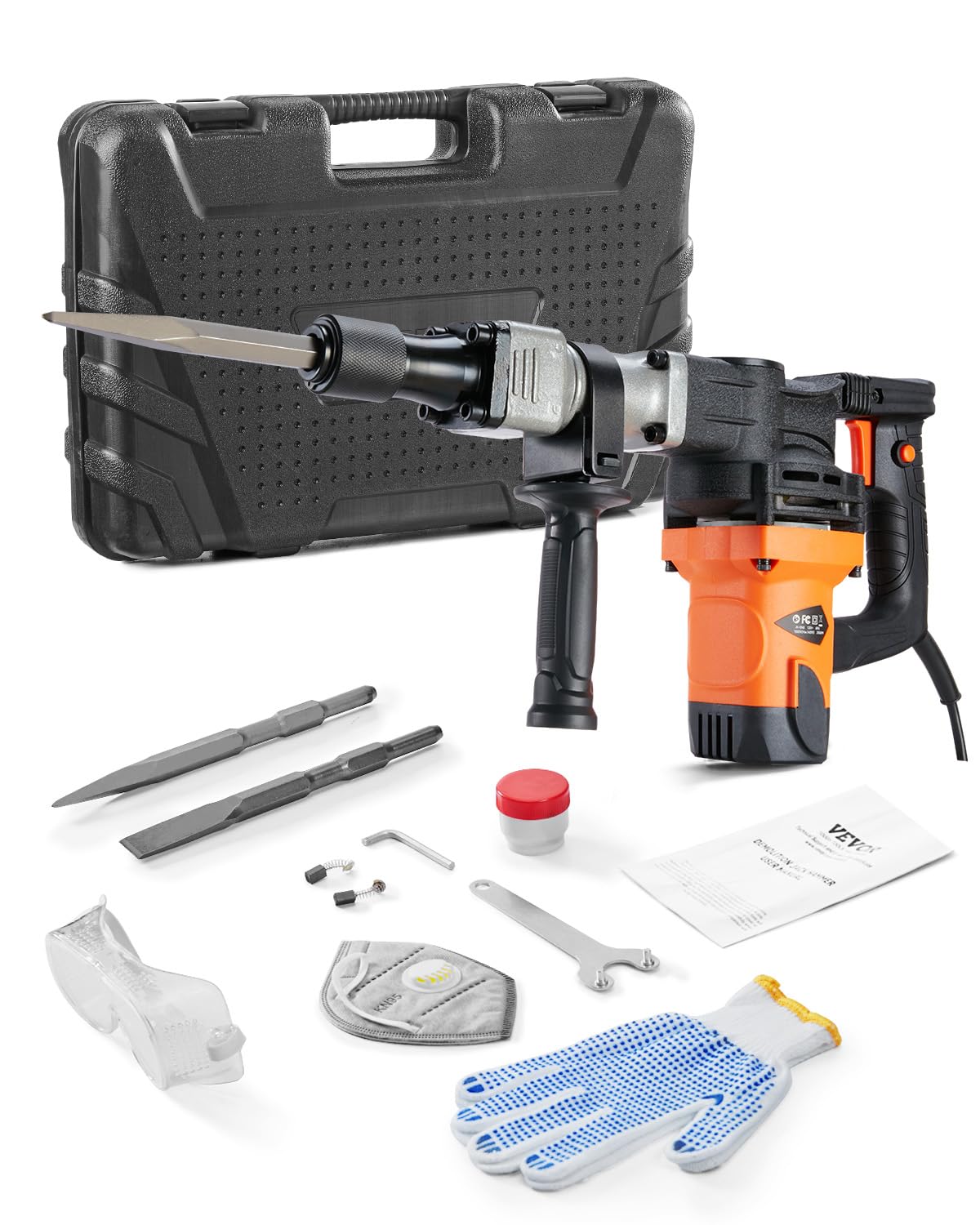
The heavier, higher-impact option for slabs, curbs and stumps as well as tile.
This one is about raw numbers against the Berserker. The VEVOR runs a MAX 1400-watt motor at 2900 beats per minute with 19 joules of impact energy, on a 16.9 pound body — the Berserker’s 1,300 watts, 4,100 BPM and 15 joules sit in a 12 pound frame. Read that together: the Berserker lands more blows per minute in a lighter machine, while the VEVOR hits harder per blow. For a stubborn concrete slab or a thick tile bed, per-blow force is what cracks it; for a long afternoon of chipping, the lighter machine saves your arms.
The comfort features are aimed at long jobs. A shock-absorbing structure with additional springs takes the sting out of the trigger hand, the 360° rotary handle lets you change your grip angle for narrow spots, and a cooling system keeps the motor temperature down through a full day of breaking. It ships with two chisel bits — a flat and a point — a carrying case, and gloves. It is a hammer-only machine, so do not expect to drill with it.
Owners get real value out of it on demolition work, and the tile and concrete jobs are where it shines. One buyer cut through a concrete curb “like butter” for a paver project; another broke a 5 by 3 foot slab eight inches thick without strain. The notes worth hearing: the manual gives no maintenance or greasing guidance, so you will be learning from videos, and the chisels use a 5/8 inch hex shank that takes some hunting to replace. A few buyers mention oil leakage and a handle that loosens if you do not secure it.
Why it competes on big pours
- 19 joules per blow from a MAX 1400-watt motor — hard-hitting force for slabs and thick beds
- 360° rotary handle and shock-absorbing springs for long breaking sessions
- Ships with flat and point chisels, a case and gloves
- Runs grease rather than oil in the gearbox, and weighs less than the 40 lb oil-based hammers some buyers compare it to
The fine print
- 5/8 inch hex shank is less common than SDS — finding replacement bits takes effort
- The manual skips maintenance and greasing guidance
- Some buyers report oil leakage and a handle that needs securing
- At 16.9 pounds it is heavier than the Berserker, so long chipping sessions cost more effort
Choose it for: thick slabs, curbs and heavy demolition alongside your tile, where per-blow force matters more than weight.
skip it if: you want the lightest machine that will still strip a tile floor — the Berserker above is easier on the arms.
7. Red Devil 2108 Long Handle Heavy Duty Floor Scraper

For corners and baseboards where a rotary sander cannot reach, with a blade that flips.
The blade on this one is a 4-inch double-edge steel — one sharp side for tough material, one blunt side for cleanup without gouging the surface underneath. That flip is the feature to buy for: when you are lifting glued vinyl off a ceramic tile you want to keep, the blunt edge is what stops you from scarring it. The 4-foot steel handle with a cushioned grip keeps you standing and off your back during a long project, and the whole scraper weighs 2.8 pounds.
Compared with the 5-inch Warner above, this gives up an inch of blade width in exchange for tighter access. That inch is the trade: 5 inches covers more floor per pass, 4 inches gets along baseboards and into corners where a sander head will not fit. If your floor has a lot of perimeter and cabinet toe-kicks, the narrower blade earns its place. The steel build is heavy-duty and takes commercial-grade use.
The jobs owners put it through run from the obvious to the odd — adhesive vinyl tile lifted off ceramic without the blade wearing out, carpet pad staples cut with little effort, glued linoleum pulled up, and dried food waste scrubbed off a floor. Durability and build quality are what the reviews return to again and again. The note worth passing on is that the edge is sharp enough to bite: keep the correct angle on a wood floor or it will slice the surface you are protecting. Some buyers also find it priced toward the upper end for a hand scraper.
Made for: edges, corners and sticky linoleum where a machine cannot get its head in.
Check your angle if: you are working over wood — this edge will cut where you point it.
Know the Specs
Impact energy and beats per minute
Impact energy is the force of a single blow, measured in joules (often also listed in ft-lbs). Beats per minute, or BPM, is how often those blows land. A higher joule rating cracks thick, stubborn material; a higher BPM count covers floor faster. The Berserker’s 15 joules at 4,100 BPM and the VEVOR’s 19 joules at 2900 BPM illustrate the split — one favors speed across the floor, the other favors force per hit on heavy pours.
SDS-Plus vs SDS-Max shanks
The shank is the slotted end of the chisel that locks into the hammer. SDS-Plus and SDS-Max are different sizes, and a bit made for one will not seat in the other. The Makita and Firecore tools here fit SDS-Plus hammers; the Berserker needs SDS-Max. Check your hammer’s collar before buying a bit set, or you will be returning it. The VEVOR sidesteps the naming entirely with a 5/8 inch hex shank, which is replaceable but less common on a shelf.
Blade width on a scraper
A wide blade clears more floor per pass and is faster on open concrete. A narrow blade gets into corners and along baseboards. Firecore’s 5-inch blade and Red Devil’s 4-inch blade are the two ends of that on this list — pick by whether your job is mostly open floor or mostly edges.
Manual leverage vs powered chipping
A long-handled scraper turns your body weight into a lever, which is why a 47-1/4 inch or 4-foot handle lets you work standing. That leverage is enough for adhesive, paint and tar. It is not enough for a well-bonded ceramic tile on a slab — that needs impact energy, which is what the demolition hammers supply.
Common Questions
Will SDS-Plus chisels fit my SDS-Max demolition hammer?
Do I need a demolition hammer to remove ceramic tile?
Can a floor scraper remove the tile itself, or just the thinset?
Is the Berserker 45HM a drill as well as a hammer?
How do I stop my scraper blade from loosening mid-job?
Will a hand masonry chisel cut through tile on a slab?
How heavy are these hammers to hold overhead or on my side?
Can I use these tools to remove vinyl, linoleum or carpet too?
Does the VEVOR jack hammer come with chisels and a case?
The Bottom Line
For most people pulling up a floor, the tool to remove tile that carries the day is the Berserker 45HM — 15 joules of impact at 4,100 BPM in a 12-pound body, with 12 locked chisel positions for the corners a straight chisel cannot reach. It is the one tool here that breaks bonded ceramic on a slab in minutes rather than a long weekend.
If your tile is already up and thinset is what is in the way, add the Firecore 5-inch scraper to your existing SDS-Plus hammer and let the wide manganese blade do the passing. Working by hand on a patch or a brick surround, the MAXPOWER chisel set gives you three forged blades that will take a strike without bending.
One thing worth saying plainly: buying beats renting if you have more than one floor ahead of you — a weekend rental costs about what some of these hammers do, and the hammer stays in your garage. Start with the machine that matches your floor’s bond, then add the scraper for what is underneath.
How we choose
We do not accept paid placement. Every pick is matched to a real buyer and a real use-case; we do not hands-on test units.
Sources
Specifications: manufacturer listings and product documentation. Review insights: verified customer reviews, as of October 2026. Pricing: not shown on this page (it changes often); check the current price via the retailer link.
As an Amazon Associate, Aappliancez earns from qualifying purchases. This does not affect which products we feature.