Disclosure: Some links in this post are affiliate links. As an Amazon Associate I earn from qualifying purchases, at no extra cost to you. Learn more
Specs are compiled from manufacturer listings and verified buyer reviews and can change over time — please confirm the key details on the product page before buying.
Arizona pavement turns into a griddle every summer, and that heat quietly ages your tires faster than any other climate in the country. The right set needs a compound that resists heat aging, holds grip on 150°F-plus asphalt, and stays quiet on long desert highway runs. This guide separates the tires that survive that punishment from the ones that only look capable.
This guide is built by comparing the manufacturers’ published specifications and the patterns across verified customer reviews, so you get each pick’s real strengths and trade-offs instead of marketing spin.
Heat is the enemy here, so I focused on compounds, load ratings, and real-world owner feedback from hot-climate driving. Here are the tires that hold up best in Arizona heat, with each trade-off spelled out before you buy.
Top Picks


How To Choose The Best Tires for Arizona Heat
Buying tires in Arizona is a different game: sustained heat breaks down rubber compounds faster than in mild climates. Sustained heat breaks down rubber compounds faster, so the tire you’d pick for a mild climate may not be the one that lasts here.
Compound heat and tread life
A tire’s compound — the rubber blend itself — is what fights heat. Softer compounds grip better but wear faster under hot pavement. Harder compounds last longer but can feel stiffer on rough roads. Look for tires with published treadwear warranties and read how owners describe wear over time.
Load index and what it means for you
Pick a tire that can carry your loaded SUV or truck, and it will usually handle Arizona heat better too. The load index is a number that tells you how much weight one tire can safely carry. A higher index means the tire is built for heavier loads, which usually means a more sturdy construction that resists heat under a loaded SUV or truck. Match the index to your vehicle’s actual weight needs.
Summer versus all-season rubber
Summer tires are compounded to stay grippy in high temperatures, making them a strong match for desert driving as long as you never see ice or snow. All-season tires trade a bit of that heat tolerance for year-round flexibility. In Arizona, a good summer or all-season tire both work, but choose based on whether your car ever leaves the valley.
Side-by-Side Comparison
| Model | Best For | Load Index | Load Capacity | Tire Type | Amazon |
|---|---|---|---|---|---|
| MICHELIN Road 5 Touring 180/55ZR-17 73W★ Best Overall | Motorcycles | 73 | 890 pounds | Radial | Amazon |
| Fullway HP108 215/45ZR17 91W XLBest Value | Budget passenger cars | 91 | 1356 pounds | All Season | Amazon |
| Yokohama Avid Ascend LX 225/65R17 102HSUV Pick | SUVs and crossovers | 102 | 1874 pounds | All Season | Amazon |
| Pirelli Scorpion All Season Plus 3 245/60R18 105H | All-season SUV and truck use | 105 | 2039 pounds | All Season | Amazon |
| Firestone Firehawk Indy 500 225/40R18 92W XL | Summer performance cars | 92 | 1389 pounds | Ultra-High Summer | Amazon |
| Continental Conti Motion 120/70ZR17 + 180/55ZR17 Set | Sport touring motorcycles | — | — | Sport Touring | Amazon |
| Goodyear Eagle Touring 285/45R22 114H XL | Trucks and SUVs | 114 | 1700 pounds | All Season | Amazon |
| Forceum Octa 205/55ZR16 94W XL (4-Pack) | Passenger cars on a budget | 94 | 1477 pounds | All Season | Amazon |
| MICHELIN Defender2 245/60R18 109H XL | Long-wear daily driving | 109 | 2271 pounds | All Season | Amazon |
Detailed Reviews
1. MICHELIN Road 5 Touring Radial Tire-180/55ZR-17 73W
Our pick — 4.5+★ from 550+ verified ratings; the strongest balance of quality and price.
For riders who want a motorcycle tire that keeps its cool when the pavement is scorching.
If you ride a motorcycle in Arizona, the Road 5 is the tire the riding community keeps coming back to. Patented Michelin XST Evo siping — small cuts molded into the tread that open and grip as the rubber flexes — keeps water channeled away even after 3,500 miles of wear. Michelin backs that with 2CT and 2CT+ tread compounds, two different rubber blends across the tire so the center wears longer while the edges stay soft for cornering.
The heat side of the equation is the ACT+ casing — an internal structure that Michelin designed to keep the tire stable and consistent as it warms up. Owners describe it gripping from the first mile and letting them lean hard with confidence. In Michelin’s internal wet lap testing against six rival sport-touring tires, the brand rates the Road 5 #1 for wet grip.
How long the tread lasts is the honest follow-up question. Michelin doesn’t promise a figure, and while many riders stretch their sets for thousands of miles, longevity varies with how hard you ride. This tire carries 890 pounds, and its 73 load index — a code that rates how much weight one tire carries — puts it in the touring class, not the heavy-cruiser class. If you ride two-up on a loaded touring rig, look elsewhere for extra capacity.
What Earns Its Keep
- XST Evo siping keeps wet grip alive even after miles of wear
- 2CT and 2CT+ dual compounds balance center wear against edge grip
- 890-pound load capacity suits sport-touring bikes
- Michelin rates it #1 for wet grip against six rivals in its own lap testing
Where It Asks Patience
- Tread life is not spelled out, and it varies by rider
- Load index 73 is on the lighter side for a fully loaded touring setup
Reach for this if: you ride a sport-touring or standard bike and want a tire that holds grip on hot, slick desert roads and monsoon-wet pavement alike.
Look elsewhere if: you run a heavily loaded cruiser and need the extra capacity a higher load index brings.
2. Fullway HP108 215/45ZR17 Two Tires
The tire that surprises everyone who assumed cheap rubber couldn’t survive Arizona summers.
For a driver who wants a full set of all-season tires without spending premium money, the HP108 delivers. Each tire carries a 91 load index and supports up to 1356 pounds, which covers most sedans and sporty compacts. The UTQG 380AA rating — a wear-and-traction grade stamped on the sidewall — signals a mid-range wear life and top-tier traction for the category. The W speed rating certifies the tire to 168 mph, far more than any daily commute needs.
For Arizona heat, the interesting piece is the 4-ply rated construction. More plies means a more sturdy sidewall and tread structure that resists cooking under sustained heat, so the tire holds up on long hot highway runs. Owners repeatedly call these tires quiet and smooth, and one long-term driver kept a set nearly three years of extensive driving with minimal road noise. They weigh 40 pounds per pair against the Yokohama Ascend’s 27.7 pounds, so this is a heavier tire — you feel that in a slightly firmer ride.
The catch is fitment quirkiness. A Civic Si owner noticed vibrations above 60 mph when the tires went on the front, then found rotating them to the rear cured it entirely. That’s a real pattern worth knowing: this tire behaves better on the rear axle of front-heavy sport compacts. Durability is genuinely mixed — many owners get years out of them, a handful report shorter tread life, and the honest read is that results vary by alignment and driving style.
Why It Earns Its Slot: 1356 pounds of load capacity per tire, a 168-mph W rating, and an all-season compound that owners describe as quiet and grippy — all at a budget-friendly tier.
Pros
- 1356-pound load capacity per tire covers sedans and compacts
- 4-ply rated construction handles sustained heat well
- Quiet, smooth ride that owners consistently praise
Cons
- Heavier than some rivals, so the ride feels firmer
- Front-axle vibration at highway speed on some cars
Best fit: budget-conscious sedan owners who drive mostly highway and want a quiet, heat-tolerant all-season set.
Think twice if: you drive a high-horsepower front-wheel-drive car where highway-speed balance has been an issue with past sets.
3. Yokohama Avid Ascend LX 225/65R17 102H
An SUV tire with the highest load capacity in this lineup and rubber that refuses to crack.
The Avid Ascend LX lives in a different weight class than the motorcycle tires above. Its 102 load index translates to 1874 pounds of capacity per tire — roughly double what the Michelin Road 5 carries. It measures 28.6 inches in diameter versus the Road 5’s 17 inches, so it fills a much larger wheel well on SUVs and crossovers. The 27.7-pound weight keeps it manageable at the mount.
For Arizona heat, Yokohama’s L-2 compound is the important part. It’s formulated for longer tread life, and the 85,000-mile limited treadwear warranty backs that claim. The 3D sipes and shoulder notches add bite in cold and wet, while the wide circumferential grooves channel water off the footprint. The multi-pitch tread pattern also knocks down road noise — an area where owners split. Some love how quiet it rides; a handful find it louder than expected in the cabin.
A Harley-Davidson Limited rider gives this tire real credibility. That rider uses the Avid Ascend LX as a rear “Darkside” tire — a car tire fitted to a motorcycle — and reports it “holds up well and sticks tonthe road great even leaning hard on it” through the WV mountains while riding two-up. That’s abuse most passenger tires never see. The honest catch is noise: a few drivers find it louder than the stereotype of a quiet touring tire suggests.
The Real Draw: an 85,000-mile treadwear warranty and an L-2 heat-resistant compound make this a genuine long-haul SUV tire for desert commuters.
What To Know: at 1874 pounds per tire, this is one of the highest-capacity picks in this list, so it carries a loaded crossover without complaint.
Suits you when: you drive a crossover or SUV and want a tire with a massive treadwear warranty that can handle load and heat together.
Not your tire if: cabin quietness is your top priority and you’re sensitive to road hum on the highway.
4. Pirelli Scorpion All Season Plus 3 245/60R18 Tire

Pirelli builds an all-season SUV tire that actually seems to enjoy 90-degree pavement.
What wins people over on the Scorpion All Season Plus 3 is the heat performance. One minivan driver logged seven months on a 2017 Dodge Grand Caravan through 90°F summers and heavy August rain with no hydroplaning, and noted that handling got noticeably sharper below 70°F. That’s the profile of a tire whose compound stays stable when temperatures swing from 100°F to 60°F in the same week — exactly the Arizona shoulder-season reality.
The engineering behind it: full-depth tread sipes that work from the first mile to the last, plus 3D sipe technology that interlocks to keep the tread blocks stiff under cornering loads. The 105 load index carries 2039 pounds per tire — enough for a loaded F-150 or GMC Yukon. At 29.57 inches in diameter and 30.7 pounds, it’s sized for mainstream SUV wheel wells.
The honest caveat is tread life and fuel economy. A Grand Caravan owner reported combined MPG dropping from 23 to 18 after switching, and a truck owner noted the tires began slipping in rain around 35,000 miles. Both are real patterns — the softer compound that gives this tire its grip can cost some efficiency, and long-term wear habits should be watched with regular rotations. If you do a lot of snowy mountain driving, this is an all-season tire, not a winter one.
Standout Strengths
- 2039-pound load capacity handles full-size SUVs and light trucks
- 3D sipes keep tread blocks stiff for confident cornering
- Quiet, smooth ride that owners keep highlighting
- Handles 90°F summers and heavy rain without drama
Worth Knowing
- Fuel economy can drop noticeably after install
- Tread life is mixed, with some trucks slipping in rain around 35,000 miles
Made for you: SUV and light-truck owners who drive in year-round desert heat and want a quiet, confident all-season tire with serious load capacity.
Skip if: you track your fuel economy closely or need true winter-weather traction in the mountains.
5. Firestone Firehawk Indy 500 225/40R18 Tire

This is the tire built to grin at 100-degree asphalt and devour corners while it does.
Ultra-high summer performance tires are made for exactly the conditions Arizona serves up most of the year — hot, dry pavement that would cook a softer all-season compound. The Indy 500’s wide shoulder blocks stiffen the tire’s structure under load, so cornering feels planted instead of squirmy. Firestone’s own testing claims a 20% shorter wet stopping distance than the prior-generation Firehawk Wide Oval Indy 500.
The Pulse Groove channel is the other piece worth understanding. It’s a proprietary groove design that moves water out from under the tread faster, cutting the risk of hydroplaning during monsoon storms. In the dry, owners describe the rubber as “soft and sticky” — grippy enough that a modified Hyundai Elantra Sport pushing roughly 250 hp to the ground keeps it planted. At 23 pounds and 1389 pounds of load capacity with a 92 load index, it’s a light, responsive tire for sport compact cars.
The limitation is honest and important: this is a summer tire and it behaves like one. One GTI owner found it fine in ordinary rain but hard to trust in heavy downpours, and the same owner noted the tire gets loud as it wears. If you drive through standing water often or your car sees occasional snow in the high country, this tire is not the answer. For a year-round Phoenix driver on a sport sedan or hot hatch, though, it delivers.
The Case For It: summer-only rubber, a Pulse Groove hydroplane-resisting channel, and a 20% shorter wet stopping distance versus the prior generation make this the most heat-focused performance pick here.
The right buy for: sport compact and hot-hatch drivers in the Phoenix valley who want maximum dry grip through summer and accept the summer-tire trade-offs.
Avoid if: your car sees heavy rain regularly, occasionally visits snow country, or you hate the way performance tires get loud as they wear.
6. Continental Conti Motion 120/70ZR17 180/55ZR17 Tires 2 Pack
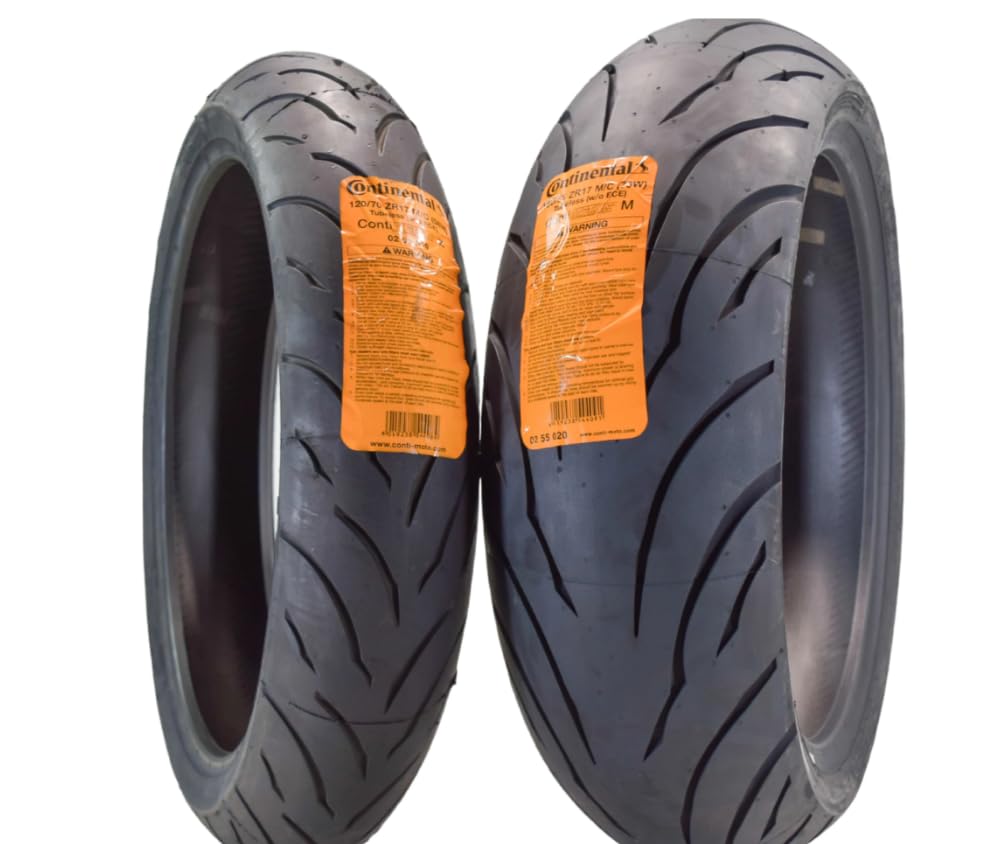
A matched front-and-rear set that lets entry-level riders get serious grip without the serious bill.
Buying both tires in one box is the appeal here — a 120/70ZR17 front and 180/55ZR17 rear, paired by Continental for sport-touring bikes. The compound uses formulated polymers that the brand says deliver a strong cost-per-mileage ratio, which is exactly what you want in a hot climate where rubber ages quickly. Steel-belted construction and a 42 psi maximum pressure round out the spec sheet.
What makes the Conti Motion relevant for Arizona is how it handles heat and grip together. Owners describe it gripping predictably on dry, wet, and high-40s°F roads, with confident turn-in and controllable slides. One rider leaned a 2007 GSXR 600 nearly to the tire’s edge with a secure feel and reported a previous Conti Motion rear lasting 7,000+ miles at about 33 psi. That’s excellent mileage for a sport-touring tire.
The honest follow-up: wear rate depends heavily on how you ride. One rider on a 600-pound bike found the rear wore out sooner than expected, admitting the weight and a heavy throttle hand were factors. The takeaway is plain — a heavier bike or aggressive riding shortens tire life, so budget accordingly if you carry a passenger or ride hard in the mountains.
Where It Shines
- Front and rear matched in one purchase
- Polymer compound aimed at cost per mile
- Confident cornering and predictable turn-in
- Strong reported mileage on sport-touring bikes
Where To Be Careful
- Heavier bikes and hard riding shorten rear life
- Bumps feel harsher than some rival tires
Great purchase for: entry-level to intermediate sport-touring riders who want a matched pair that grips predictably in heat and rain.
Consider something else if: you ride a heavyweight cruiser or a 600-pound-plus bike and want a rear tire that stretches its mileage.
7. GOODYEAR EAGLE TOURING 285/45R22 114H XL VSB

Built for the big wheel wells on full-size SUVs that see a lot of highway and a lot of sun.
The 285/45R22 size is the headline — this is a wide, large-diameter tire for modern full-size SUVs and pickups running bigger factory wheels. The 114 load index and 1700-pound load capacity per tire mean it can carry the weight of a loaded Tahoe or Escalade without straining. The 32.1-inch diameter fills the wheel arch on a large truck exactly the way it should.
What the Goodyear does well is daily-driving comfort. Owners describe it as very quiet, smooth, and easy to balance with good dry and wet traction. The 114H speed rating is rated to handle sustained interstate driving, which suits the typical commute-and-road-trip pattern of an SUV household. The tread pattern is designed for low road noise, and the all-season compound handles hot Arizona pavement without complaint.
The honest trade-off is tread life under heavy use. One truck owner running three sets noticed that around 35,000 miles they started slipping in rain and felt scary on highway curves — a real concern that shows how much tire wear matters when you’re carrying significant weight. Regular rotations and alignment checks help extend life. If you haul loads regularly, plan on a shorter cycle than the SUV tire you may be replacing.
What It’s Built For: 1700-pound load capacity and a 32.1-inch diameter make this a natural fit for full-size SUVs on larger factory wheels.
Matches you when: you drive a big SUV or truck on 22-inch wheels and want a quiet, smooth all-season tire for years of highway use.
Look at alternatives if: you tow heavy loads often and need a tire with a longer wear pattern under constant weight.
8. Forceum Octa 205/55ZR16 Tires 4

Four tires in one box for drivers who want a fresh set without a painful invoice.
Buying a full set of four tires as a single package is the smart move for a commuter car, and the Forceum Octa delivers exactly that. The 94 load index carries 1477 pounds per tire with a 4-ply rated XL construction, and the UTQG 400AA grade points to long-wear traction. The W speed rating certifies to 168 mph, so interstate driving is well within bounds. A 44 psi maximum pressure keeps the footprint firm.
Owners describe these tires as smooth, quiet, and surprisingly grippy for the category. One driver called it a great choice for a daily beater and noted the ride was noticeably smooth. The 4-ply XL construction means more material in the sidewall and tread, which is exactly what you want when Arizona sun is baking the rubber day after day. The all-season compound is rated for a wide temperature range.
The honest caveat is long-term durability. Some buyers report the tires not lasting past 20,000 miles. That’s a real consideration if you’re a high-mileage driver, but for a low-mileage commuter or a second car, the value math changes dramatically. The look of the tire is also a point in its favor for anyone tired of plain black sidewalls.
Nice Touches
- Full 4-tire set in one purchase
- 1477-pound load capacity per tire
- 4-ply XL construction resists heat aging
- Quiet, smooth ride for the category
- W speed rating for highway confidence
Weigh First
- Some owners mention wear short of 20,000 miles
- Ride sits a notch below premium smoothness
Worth grabbing if: you need a full set of four for a commuter or second car and want quiet, grippy tires without spending a lot.
Dial it back if: you rack up serious highway miles each year and want the longest tread life available.
9. MICHELIN Defender2 All-Season Tire 245/60R18/XL 109H

Michelin built this one specifically to chew through miles without chewing through your budget.
The Defender2 comes with an 80,000-mile manufacturer’s treadwear limited warranty, which is the biggest wear promise in this lineup. Michelin’s treadwear test claims up to 25,000 more miles than three leading competitors. For anyone driving the long desert freeway stretches between Phoenix and Tucson or out to California, that warranty alone is a real argument.
The 109 load index carries 2271 pounds per tire — the highest capacity here — and it’s an XL load range tire, so it’s overbuilt for heavier vehicles. Locking 3-D sipes provide hundreds of biting edges for grip, and Michelin’s own testing claims shorter wet and dry stopping distances than three competitive tires. Owners describe it as quiet, smooth, and durable, with several saying it lasts longer than other tires they’ve owned.
The trade-off is ride firmness. One owner who drove only two months noted the tires feel harder than the OEM set they replaced. That’s the cost of a long-wear compound — harder rubber resists wear but transmits more road feel. If you prioritize a plush ride over longevity, this may not be your tire. If you want a set you can forget about for years, it’s the one.
What Makes It Stand Out: an 80,000-mile treadwear warranty, 2271-pound load capacity, and Locking 3-D sipes combine for a tire built around going the distance.
Pulls you in when: you drive high annual miles and want the longest wearing tire on this list with the strongest treadwear promise.
Second-guess it if: a plush, cushioned ride matters more to you than stretching 80,000 miles out of a set.
Know the Specs
Load Index
The load index is a number stamped on the sidewall that tells you how much weight one tire can safely carry. A 73 supports 890 pounds; a 109 supports 2271 pounds. For Arizona heat, a higher index usually means a sturdier construction that handles load and heat together without flexing to death. Match this number to the heaviest load your vehicle will actually carry.
Treadwear Grade and Speed Rating
UTQG treadwear grades like 380AA and 400AA are the manufacturer’s own comparison of how long the tread should last, with AA being the top traction grade. Speed ratings (W, H, ZR) tell you the maximum sustained speed the tire was built for — W is certified to 168 mph. In desert heat, a tire rated for high speed has internal structures designed to resist heat build-up, which matters even if you never approach that speed.
Common Questions
Will a summer tire survive Arizona heat better than an all-season?
How often should I rotate tires in Arizona heat?
What does the load index number actually mean on a tire?
Do higher load index tires wear faster in the heat?
Is the Michelin Defender2 worth it over a cheaper tire?
Can I use a motorcycle tire on a standard car wheel?
Does a UTQG 380AA rating hold up in desert heat?
What tread depth should I replace tires at in Arizona?
How do I know if my tires are heat-damaged?
Are wider tires better for Arizona highway driving?
The Bottom Line
For most Arizona drivers, the standout pick is the Yokohama Avid Ascend LX — an 85,000-mile warranty, 1874 pounds of load capacity, and a heat-focused L-2 compound that stands up to abuse most tires never see. If you drive a sport compact and want the sharpest dry grip, the Firestone Firehawk Indy 500 is the summer-focused pick that leans into the heat instead of fighting it. And for high-mileage daily driving where durability is the only thing that matters, the Michelin Defender2 with its 80,000-mile treadwear warranty is the one to reach for.
How we choose
We do not accept paid placement. Every pick is matched to a real buyer and a real use-case; we do not hands-on test units.
Sources
Specifications: manufacturer listings and product documentation. Review insights: verified customer reviews, as of October 2026. Pricing: not shown on this page (it changes often); check the current price via the retailer link.
As an Amazon Associate, Aappliancez earns from qualifying purchases. This does not affect which products we feature.