Disclosure: Some links in this post are affiliate links. As an Amazon Associate I earn from qualifying purchases, at no extra cost to you. Learn more
Specs are compiled from manufacturer listings and verified buyer reviews and can change over time — please confirm the key details on the product page before buying.
Timing a prebiotic is simpler than the internet makes it sound: your gut bacteria feed around the clock, so the best window is the one you will actually repeat every single day. Consistency beats clock-watching. This guide breaks down five real prebiotic and prebiotic-blend supplements, explains what each one actually contains, and helps you match a format — chewable, capsule, caplet, or powder — to the way you already live.
This guide is built by comparing the manufacturers’ published specifications and the patterns across verified customer reviews, so you get each pick’s real strengths and trade-offs instead of marketing spin.
Below is a practical, plain-English walkthrough of the time to take prebiotic supplements that real buyers keep coming back to.
Top Picks

How To Choose The Best Time to Take Prebiotic
The honest answer about timing is that there is no magic minute. Your gut bacteria are active day and night, so what matters far more is whether you can take the same supplement at roughly the same point in your day, every day. The rest of this section is about picking the format and dose that make that possible.
Match the format to your morning
A chewable tablet takes seconds and needs no water, which suits people who already take something with their morning coffee. A capsule or caplet is easier to swallow with a drink and travels well. A powder dissolves into whatever you are already drinking, so it disappears into a routine you already have. Pick the format you will not skip, because a prebiotic only works if it actually gets taken.
Know your dose before you buy
Prebiotic fiber feeds the good bacteria already living in your gut, and how much you take matters. Some formulas use relatively low doses on purpose to avoid the bloating that large commercial doses can trigger. Others lean on oligofructose-enriched inulin, a fiber type that works through the whole colon. Whatever you choose, the smart move is to start smaller than the label suggests and build up over a week or two.
Read the serving size, not just the front label
A bottle advertised as a 30-day supply is only a 30-day supply if you take exactly the serving listed. Some caplets are dosed at two per day. Check whether the fiber comes as inulin, oligofructose, or a plant-based blend, and check whether the product is shelf-stable or needs refrigeration. Those details decide whether it fits your shelf and your schedule.
Side-by-Side Comparison
| Model | Best For | Format | Strength | Supply / Count | Amazon |
|---|---|---|---|---|---|
| Physician’s CHOICE Probiotics 60 Billion CFU★ Best Overall | All-in-one daily gut support | Capsule | 60 Billion CFU, 10 strains | 30 count | Amazon |
| Life Extension FLORASSIST Prebiotic ChewablePrebiotic-Only Pick | Prebiotic-only, no pills to swallow | Chewable tablet | Low-dose prebiotic blend | 60 tablets | Amazon |
| Garden of Life Dr Formulated Once Daily 3-in-1 | Pre, pro and postbiotics in one capsule | Capsule | 30 Billion CFU, 16 strains | 30 count | Amazon |
| Benefiber Prebiotic Fiber Supplement Caplets | Travel-friendly fiber on the go | Caplet | Plant-based prebiotic fiber | 84 count | Amazon |
| Prebiotin Prebiotic Fiber Supplement Powder | Mixing into coffee, water, or food | Powder | Oligofructose-Enriched Inulin | 8.68 oz | Amazon |
Detailed Reviews
1. Physician’s CHOICE Probiotics 60 Billion CFU
Our pick — 4.5+★ from 145,000+ verified ratings; the strongest balance of quality and price.
The one-bottle answer for people who want prebiotics and probiotics handled together, in a single morning capsule.
The headline here is 60 Billion CFU (colony-forming units — the count of live bacteria in the capsule) drawn from 10 diverse strains, paired with organic prebiotics that feed the bacteria already in your gut. That double duty is exactly why this bottle is easy to time: you take one capsule a day and you have covered both sides of the equation. No second container, no separate powder scoop.
What wins people over is how the gut settles. Buyers report less bloating and more regular bowel movements within the first week. The formula is built for uncomfortable days too — constipation, diarrhea, gas and bloating. Capsules swallow easily, and plenty of buyers take theirs with morning coffee rather than on an empty stomach.
The catch is that it is a general-purpose blend rather than a targeted dose, so a person chasing a specific fiber number may want something more focused. Compare it against the Garden of Life 3-in-1: at 60 Billion CFU this one leads on strength, while that one counters with 16 strains and postbiotics added. If you want the simplest possible daily habit — one capsule, no refrigeration, shelf-stable bottle — this is the one to build your routine around.
What earns its place
- 60 Billion CFU across 10 strains, plus organic prebiotics, in one daily capsule
- Shelf-stable bottle with acid-resistant capsules — no fridge space needed
- Third-party tested for purity and potency, made in the USA
- One month supply per bottle keeps the habit simple
Where it asks something of you
- Targeted at general gut support, not a dedicated prebiotic fiber count
- Some buyers find the price slightly steep for a month
The cleanest daily habit: reach for this if you want prebiotics and probiotics in one swallow and nothing else to think about.
Look elsewhere if: you specifically want a prebiotic-only formula and no live bacteria at all.
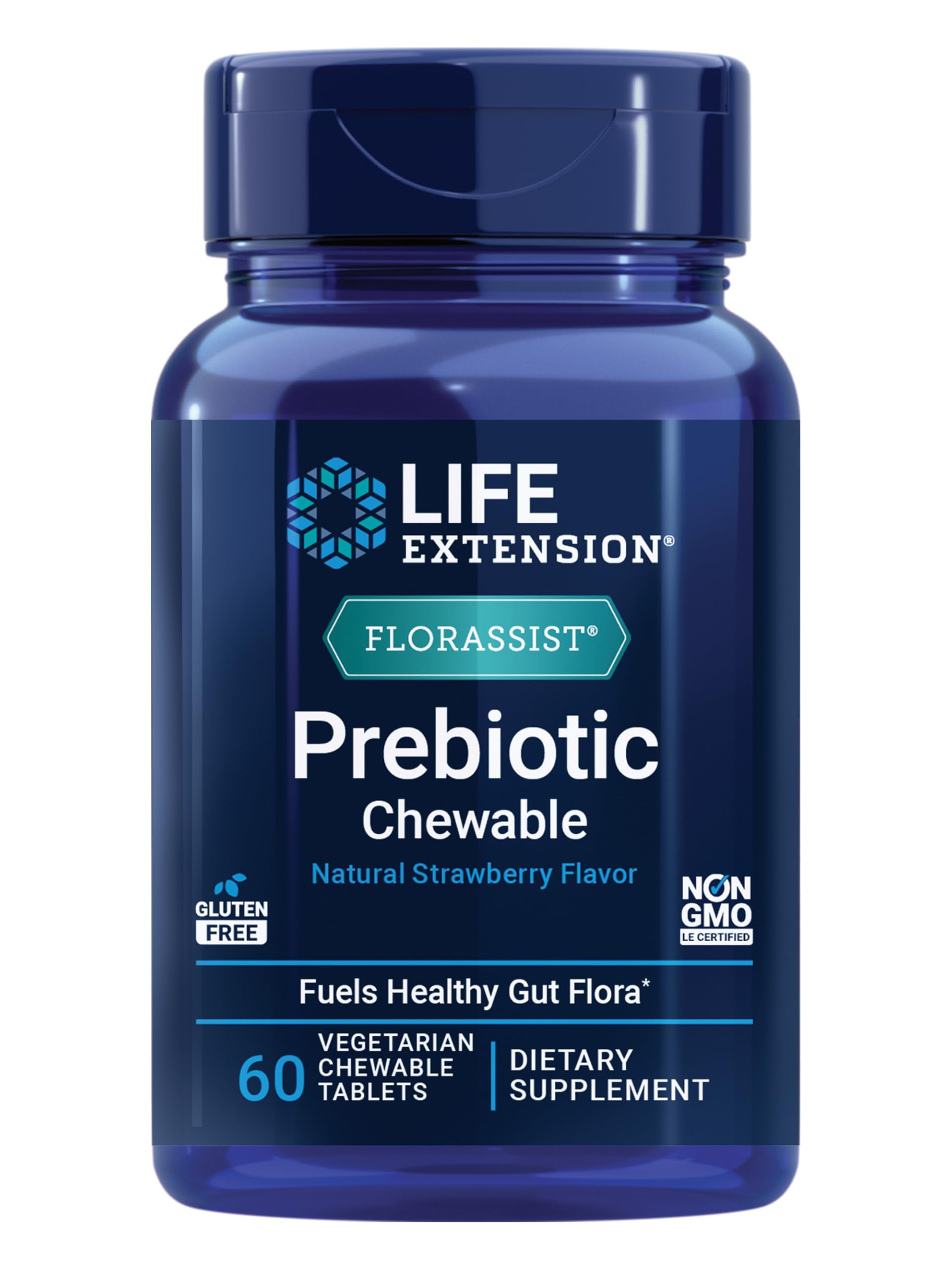
2. Life Extension FLORASSIST Prebiotic Chewable
A strawberry chewable for anyone who cannot face another capsule — feed the gut, skip the swallow.
This is a prebiotic and nothing else, which is the whole point of the formula. Instead of live bacteria, it delivers ingredients that support the bifidobacteria already in your gut, and it does so at deliberately low doses. That matters, because many commercial prebiotics arrive in large amounts that can leave you bloated and uncomfortable. Life Extension’s own note is that their special ingredients support healthy bifidobacteria using relatively low doses. Two minutes with this bottle and your part is done — chew one in the morning.
Effectiveness is what sells it, and digestive relief is close behind. Owners mention relief from long-standing constipation and less bloating. One amusing note that keeps coming up — some people order this expecting a soft gummy and get a hard, round chalky tablet instead. It does not taste bad in strawberry, it is just not the texture they pictured.
Taste is the split vote here, and honest buyers land on both sides of it. Some call the strawberry pleasant; others find the chalky texture a turn-off, and a flavor drift between batches has been noticed by long-time buyers. At 6.24 ounces for the bottle, it is also the heaviest pick on this list — versus the Garden of Life 3-in-1 at just 2.12 ounces, you are carrying real heft, though that is a bottle you keep at home rather than in a bag. Chew it in the morning and it slots neatly into a coffee-and-breakfast routine.
Where it shines: a genuinely prebiotic-only option that skips live bacteria entirely, taken as a quick chew.
Set expectations on texture: plan for a firm, chalky tablet rather than a soft gummy, and flavor can shift batch to batch.
Made for chewers: ideal if you want a prebiotic with no capsule and no probiotics in the mix.
Pause if texture matters: the chalky feel and drifting flavor are the recurring trade-off here.
3. Garden of Life Dr Formulated Once Daily 3-in-1 Complete Probiotics
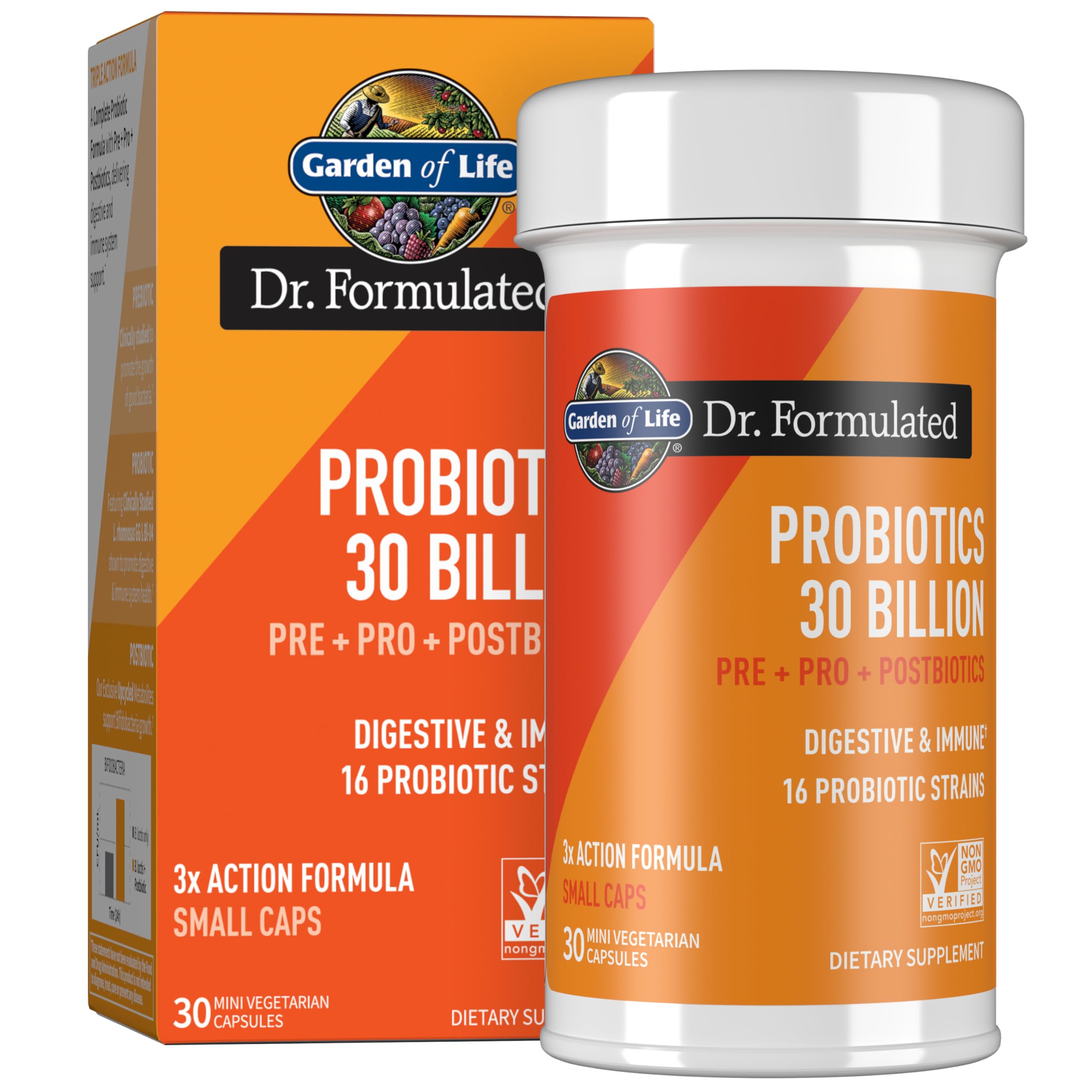
Three jobs in one small capsule: the bacteria, the food for them, and the byproducts they leave behind.
Garden of Life’s formula goes a step further than the standard pre-plus-pro pairing by adding postbiotics — the compounds bacteria produce after they feed. That gives you a 3x-action setup with 30 Billion CFU spread across 16 strains, all in a capsule small enough to take with water and forget about. For timing, this is a once-daily product, which means the routine question answers itself.
The multi-strain count is what makes this one different from the Physician’s CHOICE 60 Billion CFU bottle: that one leads on raw strength, this one leads on strain diversity at 16. In the hand, it is also the lightest formula on this list at 2.12 ounces, measuring 4.75 x 2.4 x 2.35 inches — easy to stack in a cabinet or slip into a travel pouch. Customers note easy digestion, and many reorder month after month.
The honest caveat is that results are a mixed bag. Some buyers describe real improvements in bloating and digestion over months of use; others say it simply did not move the needle for them, and a few ran into stomach aches. Anyone on a specific medical protocol should check with their own doctor first, since supplements like this are not right for every situation. If you want a whole-household, once-daily capsule with the widest strain spread, this is the pick.
Why it is here: a rare pre, pro and postbiotic combination with 16 probiotic strains, dosed once daily in a small capsule.
Best for strain variety: choose this if you want three-in-one coverage and the widest strain spread on the list.
Consider who it suits: effectiveness lands differently for everyone, and some users notice nothing at all.
4. Benefiber Prebiotic Fiber Supplement Caplets, 84 count

No scoop, no shaker bottle — fiber that lives in your pocket and never touches a glass of water.
Benefiber solves the one problem powders cannot: portability. These caplets are built for a fiber gap you need to close away from home, with plant-based prebiotic fiber that nourishes the good bacteria in your gut. The 84-count bottle fits a desk drawer or a carry-on, and the label notes it carries twice the fiber of the leading fiber capsule. If your schedule is the reason fiber keeps slipping, this is the format that fixes it.
Being eligible for HSA and FSA reimbursement is a genuine convenience for anyone with those accounts, and the fiber itself is quietly effective. Buyers on GLP-1 medications take two caplets daily to close the fiber gap that comes with eating less. That said, the shape is the talking point: four-faced caplets with sharp corners can stick on the way down, and reviewers with swallowing difficulties flag it as a bad fit.
There is a real split here between people who find the caplets easy and those who dread them, so if you already know large pills give you trouble, a powder may serve you better than this bottle. For everyone else, this is the most unobtrusive way on the list to keep prebiotic fiber going while you travel.
Reasons it travels well
- 84 caplets in a small bottle — easy to take on the go
- Plant-based prebiotic fiber that supports gut bacteria
- HSA and FSA eligible, per the listing
- Twice the fiber of the leading fiber capsule, per the label
What to know before you buy
- Large, four-faced caplets with sharp corners can stick for some people
- Not the easiest option if you have trouble swallowing pills
Suits the commuter: pick this if you want prebiotic fiber without mixing anything and you handle pills without issue.
Skip the leap of faith: if large caplets are a known struggle, the powder pick below is the kinder route.
5. Prebiotin Prebiotic Fiber Supplement Powder, 8.68 oz

The invisible option — dissolves clear into your morning coffee and works through the whole colon.
Prebiotin takes the powder route with Oligofructose-Enriched Inulin, which the label says nourishes beneficial bacteria throughout the entire colon rather than just the early stretch. There are no added flavors, so it mixes clear into water, beverages, or food without announcing itself. It is gluten-free, low in carbohydrate, and free of fat and sodium, which makes it an easy fit for a low-carb or vegetarian routine. For timing, this is the most flexible product on the list — whatever you already drink in the morning becomes your delivery vehicle.
Dissolving is where this one mostly behaves: it mixes well into liquids and is described as only slightly sweet, like a powdered creamer. Tastes like sweet creamer, in fact, though it can clump if you dump the whole scoop in at once — stir it in gradually and it disappears.
The genuine caution is that starting at a full scoop can be rough. Reviewers point out severe bloating and gas when they start at a full scoop, especially those already prone to constipation — start with a quarter teaspoon and build up over weeks. Interestingly, some buyers found prebiotics alone worked better for them when they cut back on probiotics entirely. Note it is made in the USA following GMP standards, which is a real manufacturing distinction rather than a marketing word.
The reason buyers stay: dissolves clean with no added flavor, and the fiber is one that reaches the whole colon.
Do this on day one: start at a very small scoop and ramp slowly — high first doses are what trigger the bloating complaints.
Best for mixers: go with this if you would rather stir fiber into coffee than swallow anything.
Plan the ramp: begin below the suggested scoop, since jumping straight in is where the gas reports come from.
Know the Specs
Prebiotic vs Probiotic vs Postbiotic
These three words describe different parts of the same job. A probiotic is the live bacteria itself. A prebiotic is the food that feeds bacteria already living in your gut — it is what supports their growth. A postbiotic is the byproduct those bacteria leave behind after they feed. A “3-in-1” formula, like the Garden of Life bottle here, puts all three in one capsule, while a dedicated prebiotic like FLORASSIST contains only the feeding part.
What CFU Means on a Label
CFU stands for colony-forming units — the count of live bacteria in a dose. The numbers here range from 30 Billion CFU in the Garden of Life formula to 60 Billion CFU in the Physician’s CHOICE bottle. A higher CFU is not automatically better for every person; it is simply the strength of the dose. What matters more is choosing a formula that suits your gut and then taking it consistently, because a daily habit matters more than chasing the biggest number.
Fiber Types Explained
Prebiotic fiber comes in different forms. Oligofructose-enriched inulin, used in the Prebiotin powder, is a fiber type the label says works through the entire colon. Other formulas lean on plant-based fiber, as the Benefiber caplets do, or on low-dose blends like the FLORASSIST chewable, which avoids the bloating that large commercial doses can trigger. The fiber type affects both where it works in your gut and how your body handles it in the first week.
Postbiotics and Timing
Postbiotics are the compounds bacteria produce after feeding on prebiotic fiber. Including them in a formula, as the 3-in-1 bottle does, means you are supplementing the end product as well as the food. On timing, none of these need to be taken at a specific hour to function — the point is repetition. Pick a slot you already keep, morning or evening, and take it there daily so the habit holds.
Common Questions
Morning or night — does the time of day actually matter for a prebiotic?
Can I take a prebiotic and a probiotic at the same time?
Should I take a prebiotic with food or on an empty stomach?
How long before I notice a difference from a prebiotic?
Which is better for me — a caplet, a chewable, or a powder?
Do prebiotic supplements cause gas and bloating at first?
Is a higher CFU count always better?
Can I take these prebiotics while on a GLP-1 medication?
Do these prebiotic supplements need refrigeration?
How do I start a prebiotic without a rough first week?
The Bottom Line
For most people, the time to take prebiotic question resolves to whichever format you will actually remember, and the Physician’s CHOICE Probiotics 60 Billion CFU makes that easiest — 60 Billion CFU and 10 strains with organic prebiotics in one shelf-stable capsule, taken with your morning coffee. If you want a prebiotic only, with no live bacteria and nothing to swallow, the Life Extension FLORASSIST Chewable is the one to reach for, one strawberry chew and done. And for anyone who would rather stir their fiber than take a pill, the Prebiotin Powder disappears into coffee with no flavor at all. Any of the three will serve you well — just start at a smaller dose than the label suggests and give it a few consistent weeks before you judge the results.
How we choose
We do not accept paid placement. Every pick is matched to a real buyer and a real use-case; we do not hands-on test units.
Sources
Specifications: manufacturer listings and product documentation. Review insights: verified customer reviews, as of October 2026. Pricing: not shown on this page (it changes often); check the current price via the retailer link.
As an Amazon Associate, Aappliancez earns from qualifying purchases. This does not affect which products we feature.