Disclosure: Some links in this post are affiliate links. As an Amazon Associate I earn from qualifying purchases, at no extra cost to you. Learn more
Specs are compiled from manufacturer listings and verified buyer reviews and can change over time — please confirm the key details on the product page before buying.
A thin wallet is about sitting down without a lump digging into your hip. The picks below solve that in different ways: some drop your cards into a metal frame that never sags, others keep a leather bifold that still folds flat after years of use. You will see exactly how many cards each one holds, how heavy it sits in a pocket, and what owners genuinely like and dislike after real daily carry.
This guide is built by comparing the manufacturers’ published specifications and the patterns across verified customer reviews, so you get each pick’s real strengths and trade-offs instead of marketing spin.
Below you will find a full comparison table, seven in-depth reviews, and a plain-English spec guide to card capacity, RFID shielding, and pocket bulk. Every pick was checked against what owners actually say after months of use, so you can choose the right one for your thin wallets.
Top Picks


How To Choose The Best Thin Wallets
Most people start with the wrong question. They ask “how thin is it?” when the real question is “how thin does it stay once I fill it?” A wallet that starts slim and sags by month three is worse than one with a bit more structure. Start there, then work down this list of four things that actually decide whether a thin wallet works for you.
Card capacity: match the number to your real daily load
Count the cards you actually reach for in a week. Most people carry six to ten, but the number a wallet claims it holds usually assumes nothing else is inside. Leather slots stretch, so a wallet rated for seven cards often ends up loose at five. Metal frames hold their shape but fit fewer cards per slot because there is no give. Pick a capacity that leaves a little headroom rather than one that maxes out on day one.
RFID blocking: what it protects and what it does not
RFID blocking (a layer or solid plate that stops short-range radio signals) protects contactless payment cards from being read through your pocket. If your cards have the tap-to-pay symbol, this matters. What it does not do is protect anything you keep outside the shielded area — cash, a card tucked in an outer slot, or your ID if the slot is not covered. Check whether the shield wraps the whole wallet or one compartment.
Structure and how it ages
A thin wallet has to fight the natural tendency of leather to soften and spread. Hand-stitched leather over a metal frame holds its shape longer than a soft bifold alone. A rubbery coating on the inside of pockets stops cards from sliding out as the leather relaxes. An elastic band or cash strap will wear faster than a rivet or a tuck flap. Decide early which part of the wallet you are willing to replace or live with.
Pocket bulk and carry style
Front-pocket carry demands a wallet under about four inches wide when closed, otherwise it digs in when you sit. Back-pocket carry tolerates more width but punishes anything with hard edges or a protruding rivet. If you travel, a pull tab or thumb hole lets you get a card out one-handed without emptying the whole wallet.
Side-by-Side Comparison
| Model | Best For | Stated Card Capacity | Weight | RFID Blocking | Amazon |
|---|---|---|---|---|---|
| Trayvax Ascent★ Best Overall | Heirloom build | 4–7 cards | 3.04 oz | Stainless steel plate | Amazon |
| Bellroy Hide & SeekClassic Slim | Traditional look | 5–12+ cards | 1.45 oz | Yes | Amazon |
| BESSIO Pop Up | Quick-draw access | Up to 7 PVC cards | 6.56 oz | Aluminum body | Amazon |
| Big Skinny Curve | Front pocket comfort | Up to 20 cards | 1.44 oz | — | Amazon |
| Stealth Mode Bifold | Everyday leather | 8+ cards | — | Yes | Amazon |
| Ridge Wallet | Absolute minimum bulk | 1–12 cards | 1.5 oz | Aluminum body | Amazon |
| Coach Slim Billfold | Brand and finish | Six slots | 1.6 oz | — | Amazon |
Detailed Reviews
1. Trayvax Ascent Wallet
Our pick — 4.5+★ from 600+ verified ratings; the strongest balance of quality and price.
A leather-and-steel brick that never loses its shape, and it weighs 3.04 ounces doing it.
If you have ever watched a slim leather wallet turn into a floppy flap inside a month, the Ascent is the correction. It pairs hand-stitched top-grain leather with a slim stainless steel frame, so the body stays rigid while the leather softens around it. That frame sits on both sides of your cards, which is also how the wallet blocks RFID readers — the metal surrounds the cards rather than a fabric liner hoping to do the job.
Capacity is honest rather than generous: the manufacturer states 4–7 cards plus up to 5 bills or receipts, and the strap-and-slide layout means your most-used card sits on top. The pull tab is the part that wins people over — it fans cards out without you clawing at them, and it is the single detail owners bring up again and again. A few mention the leather starts tight enough that you cannot fit your full load on day one. Soaking the leather in warm water with your cards inserted, then letting it dry, is the fix owners use to break it in.
Here is the catch worth knowing before you buy. This is a front-pocket wallet with a rigid metal spine, and that rigidity is exactly why it costs you a little depth and a little patience. It also weighs more than most leather picks here — the Bellroy Hide & Seek comes in at 1.45 ounces against the Ascent’s 3.04 ounces, so if featherweight carry is your priority, the Ascent is the heavier of the two by a wide margin. What you get for that weight is a wallet backed by a 65-year heirloom warranty and built in the USA, with black oxide coated brass rivets and a melonite finish (a hard, dark surface treatment) that shrug off daily abuse.
What earns its place
- Stainless steel frame keeps cards flat and stops them bending, even after years of use.
- RFID blocking comes from the steel plate itself, not a separate liner that can wear through.
- Hand-stitched top-grain leather develops a patina instead of fraying.
- MIL-SPEC pull tab gives one-handed card access without dumping the whole stack.
- 65-year heirloom warranty and USA manufacturing.
Where it pushes back
- Starts very tight — you will need the warm-water break-in before it holds your full load comfortably.
- The cash slot is shallow; heavy bill carriers will find it cramped.
- At 3.04 ounces it is the heaviest wallet on this list.
- Anyone carrying more than about seven cards needs a different design.
Built for: anyone who has ruined a soft wallet and wants a leather front-pocket carry that still looks and feels solid in year five.
Think twice: if you hoard eleven cards or prefer your wallet to be weightless in a shirt pocket, the leather bifolds below suit you better.
2. Bellroy Hide & Seek Slim Leather Wallet
A wallet that looks like the one you already own, then quietly hides half its contents.
This is the pick for anyone who refuses to carry a metal plate but still wants the bulk gone. Bellroy calls it a landing point for people moving to slimmer wallets, and the design backs that up: four quick-access card slots, a hidden flap that folds large bills out of sight, and a tucked-away card section for the ones you rarely touch. The stated capacity stretches from 5 to 12+ cards, so it adapts to how much you actually carry rather than locking you in.
What owners describe after a month of carry is the part that matters. The leather is soft from the start, cards come out easily but stay put, and the whole thing sits noticeably slimmer in a pocket than a standard bifold holding the identical contents. At 1.45 ounces it is one of the lightest wallets here, and it measures 0.51 x 4.61 x 3.74 inches — compact enough for front-pocket use, though it is built to two different heights so international bill sizes fit without folding. It also comes in an RFID version (a version that blocks wireless card scanning) if you want the shield.
The trade-off is not durability but the hidden section itself. The flap that keeps big bills private can be fussy to tuck back, and if you overstuff the wallet it will not sit flat — a recurring gripe worth taking seriously rather than dismissing. There is also a small riveted owl logo that creates a slight bump on the outer face. Neither ruins the wallet. They are the price you pay for a design that hides your cash and still looks respectable in a jacket pocket.
What wins people over: the leather softens without the wallet collapsing, so cards stay secure yet slide out without a fight, and cash is genuinely out of sight rather than stuffed in a fold.
The honest limit: the hidden flap demands a bit of care to close cleanly, and a stuffed wallet loses the flat profile that makes this design worth it.
Reach for this if: you want a leather wallet that looks completely normal to everyone else while holding more than it appears to.
Look elsewhere if: you need rigid protection for cards or you want zero fuss when closing your wallet.
3. BESSIO Pop Up RFID Wallet
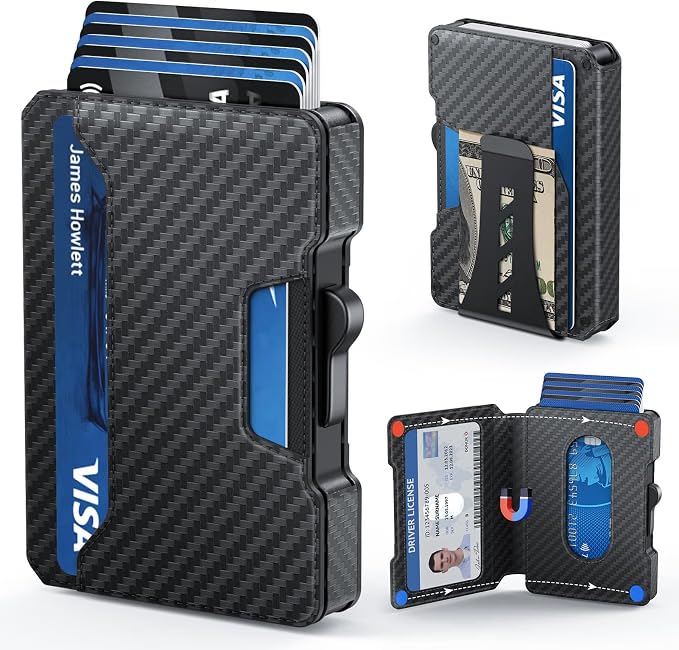
One touch triggers the card stack — the wallet for people who are always paying first.
BESSIO’s whole pitch is speed. The aluminum pop-up slot is a smooth slide structure that pushes your cards into a staggered stack with one motion, so you grab the right card without pulling the whole set out. A magnetic flip closure keeps everything shut between uses, and the carbon fiber body is scratch-resistant. At 6.56 ounces and 0.62 x 2.79 x 4.33 inches, it is the heaviest wallet in this group by a noticeable margin — the Ridge, for comparison, weighs 1.5 oz — so this is not a featherweight pick. It is a wallet that trades lightness for a one-touch pop-up mechanism.
What owners like most is the build and the price-to-feel ratio: the thing looks and feels like it belongs on a shelf well above its tier, and the pop-up trigger gets used every single day. A few buyers report the card slots loosen over time so cards start creeping out, and some find the mechanism does not always eject perfectly smoothly. Others point out the middle slot realistically fits seven PVC cards, with room for an ID and a couple of outer cards on top of that. It is a fair summary: the wallet delivers the quick-draw experience, with a mechanism that rewards a lighter load.
The real draw: the pop-up action turns a two-handed fumble into a single flick, which is why it suits anyone paying at a counter several times a day.
Size vs. speed: the aluminum mechanism adds bulk and weight — 6.56 ounces against the Ridge’s 1.5 oz — so front-pocket comfort is a trade you make for the trigger.
One caveat: the card holder can loosen with heavy use, so do not max out the stack if you want it to stay tight.
Suits: commuters and daily tappers who want the right card out in one motion with RFID shielding around it.
Not for: anyone who wants a nearly weightless wallet or who carries a dozen cards at once.
4. Big Skinny Men’s Curve Leather Bi-Fold

A 20-card wallet that still fits a front pocket — because the shape is curved, not because the leather is magic.
The curve is the entire idea. A straight bifold holding a lot of cards pushes outward and digs into your thigh when you sit. This one is cut to follow the contour of a front pocket, with three card pockets, two extra-large hidden pockets, a full-sized billfold area, and an ID pocket — up to 20 cards in total from top-grain cowhide with a nylon microfiber interior.
The detail that keeps cards from escaping is the rubbery coating lining the pockets. Leather slots that loosen over time are the usual failure point in a thin wallet, and this liner gives the cards something to grip. Owners who have carried Big Skinny for years point to that combination of slim build and high capacity as the reason they keep coming back, and at under five years of daily use the slots do eventually lose grip — a normal lifespan for soft leather rather than a defect. The leather itself holds its appearance well, and several buyers compare the texture to something far more expensive.
The limitation is that it is a true bifold with no RFID shield, so tap-to-pay cards sit unprotected and the fold adds a little width compared with a card-only sleeve. If you want the maximum number of cards in a wallet that still respects a front pocket, this is the design that does it. If you want a hard shield or a rigid frame, look above.
Pick this one: if you carry a full card collection, want a proper billfold, and refuse to give up front-pocket comfort.
Consider the alternative: if RFID shielding matters to you or if you want a single-piece card carrier that never folds.
5. Stealth Mode Men’s Slim Front Pocket Wallet

A proper leather bifold that stays under three inches closed, with RFID built in.
Stealth Mode keeps the familiar bifold shape and then shrinks it. Closed, the wallet measures 3 by 4 inches, opening to 4 by 6 inches, which is small enough to disappear into a front pocket. Inside you get five card slots, a cash pocket, and an ID window with a thumb hole so you can push your license out without wrestling it. RFID blocking is built into the lining, so contactless cards stay shielded whether you are at home or travelling.
The leather is the part owners keep returning to. It breaks in quickly, and because it becomes pliable over time the slots expand to hold two cards each rather than one — which is how the stated 8+ card capacity works in practice. Long-term reports describe the leather staying supple and keeping its colour after a year of daily use, and the tight stitching is what holds it together. The packaging is unusually careful for this price tier, with the wallet arriving wrapped and in a carrying pouch.
One thing the design does not solve: folded bills can extend past the edge of the closed wallet on some notes. It is a small mismatch between the wallet’s width and certain bill sizes, and it only shows when you carry cash. If you rarely fold bills, it never comes up. If you do, it is the one detail to check before committing.
Why it holds up
- RFID blocking lining sits inside a genuine leather bifold, so you get security without a metal shell.
- Small closed footprint — 3 by 4 inches — slips into a front pocket without a bulge.
- Leather softens and its slots stretch to hold two cards each.
- Thumb-hole ID window saves digging for your license.
- Careful packaging and tight stitching give it a much higher feel than its tier suggests.
The other side of the seam
- Folded bills can extend beyond the wallet’s edge depending on the note size.
- You need to break it in before the slots reach their full two-card capacity.
- As a genuine leather bifold it will soften and stretch over time, so it will not stay as stiff as a metal wallet.
Best match for: someone who wants a normal-looking leather wallet, just much smaller, with RFID protection already inside.
The skip case: heavy cash carriers should look at a money clip or a wallet with a deeper bill pocket instead.
6. Ridge Wallet with Cash Strap

Two aluminum plates and an elastic band — the lightest way to carry twelve cards.
Nothing on this list removes bulk more ruthlessly. The Ridge squeezes your cards between two anodized gunmetal aluminum plates, held by interchangeable elastic, with an outside notch so you can push cards out sideways. It holds 1–12 cards and weighs 1.5 oz in an 86 x 54 x 6 mm frame, and the aluminum body is what does the RFID blocking — no liner to fray. The cash strap sits on the outside for folded bills, and you can swap it for the money-clip version if that suits you better.
Owners describe the size change as the whole reason to switch: people who carried a trifold for years report the Ridge holding every card they need in something small enough for a shirt pocket. The build quality is what gets brought up most — the plates, the screws, the anodized finish — and the fact that Ridge will replace parts like the elastic, screws, or cash strap under its lifetime guarantee. It also converts skeptics of the plate-and-band format, which is a good sign for a design this unusual.
The honest trade-offs are mechanical rather than structural. Fanned cards are harder to separate than a stacked wallet, so if you have several cards that look alike you will want them in a deliberate order. The elastic cash strap is the part most likely to age fastest, so keeping it lightly loaded is sensible. And the two metal plates do bulk up slightly as you near the top of that card range. Those are the realities of a plate-and-elastic format, not defects.
Where it leads: nothing else here gets twelve cards down to a 1.5 oz frame, and the aluminum plates make the RFID shield structural rather than sewn in.
Fair warning: the elastic band and the card-fanning motion both take getting used to, so this is a wallet to adapt to rather than settle into.
The right buyer: someone who wants the smallest possible pocket footprint and is comfortable with a mechanized card stack.
Wrong pick if: you want cash handling to feel like a normal bifold, or you dislike separating cards that sit flush together.
7. Coach Men’s Slim Billfold in Signature Canvas
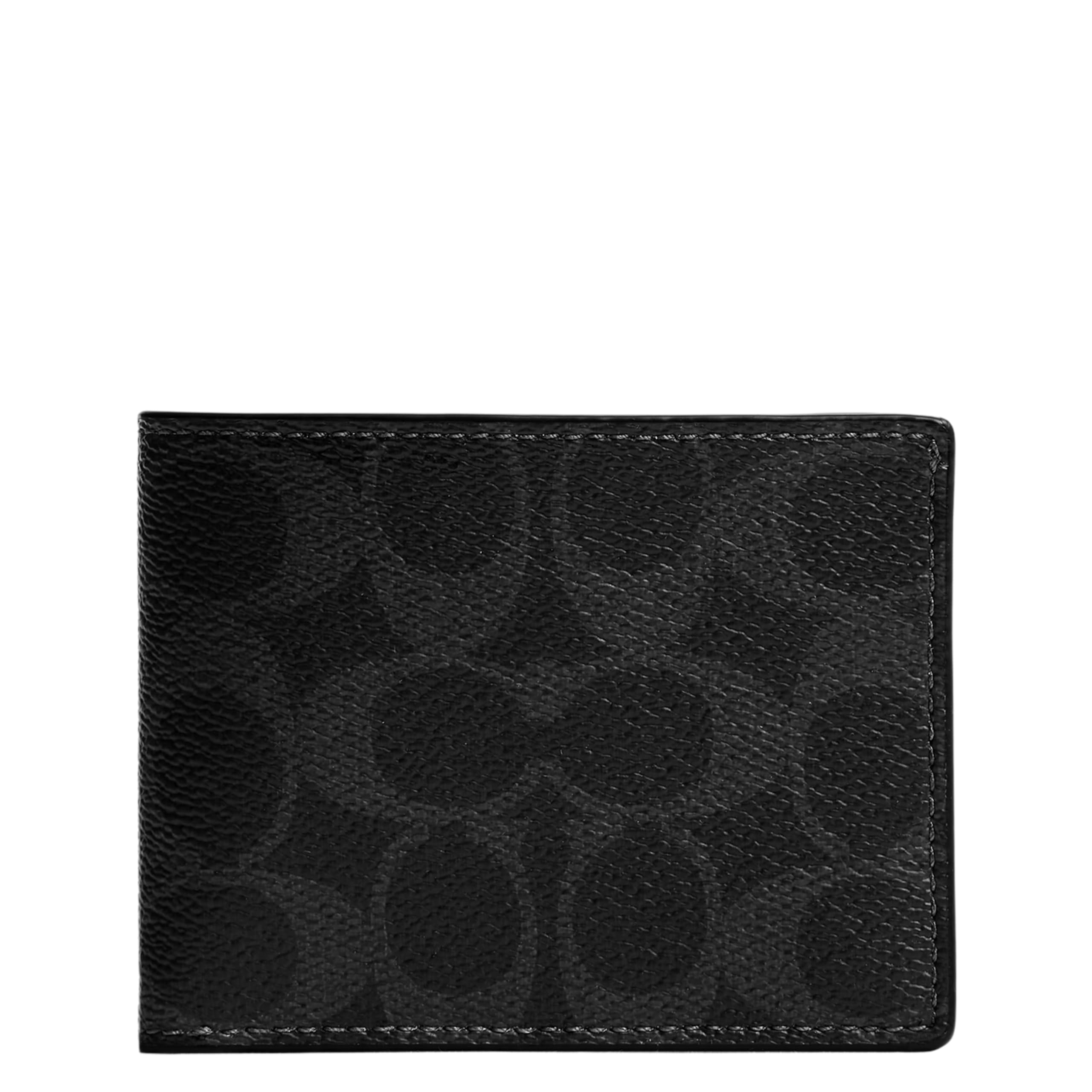
A brand-name billfold that stays genuinely thin, with six slots and a full bill compartment.
For some buyers the whole point of a thin wallet is that it still looks like a wallet. Coach’s slimmest billfold mixes polished calf leather with the signature coated canvas, keeps a neat bifold shape, and offers six card slots plus a full-length bill compartment. Closed it measures 4 inches long, 3 inches high, and half an inch wide, and it weighs 1.6 ounces — light enough that you will not notice it, but with the finish and hardware of a dress wallet rather than a utility one.
The finish is what buyers describe first: the mixed leather-and-canvas face draws compliments, and the construction is built to survive daily use in a pocket. The bill compartment is full-length, so notes lie flat rather than folded, which is a real advantage over the slim card holders above. It is also a popular gift — the kind of wallet you buy for someone who would not buy it for themselves.
There is a caveat about buying this brand from a marketplace rather than a boutique. A few buyers have run into card-slot finish peeling within the first month, and some have found the after-sales support more complicated when purchased here rather than directly. Those cases are rare against the overall picture, but worth knowing if long-term service matters to you. The upshot: this is a wallet chosen for its calf-leather-and-canvas finish and how it feels in hand, and on that measure it delivers.
Choose it for: the dressy finish, the flat-folding bill compartment, and a brand a gift recipient will recognise.
Weigh first: if you want official servicing down the line, buying direct from the brand is the safer route than a marketplace listing.
Know the Specs
Card Capacity (and why the number disappoints)
Card capacity is the count of cards a wallet is built to hold comfortably. The number is usually a range because leather slots stretch and metal frames do not — a leather wallet rated for seven cards may feel loose at five once the leather relaxes, while a rigid metal frame holds its shape but fits fewer per slot. The practical rule: pick a wallet whose stated capacity leaves one or two cards of headroom, and expect the loosest leather wallets to lose grip on cards after a few years of use.
RFID Blocking
RFID blocking is a shield that stops short-range radio signals reaching the contactless chip in your payment card. It comes in two forms: a metal plate or solid body that surrounds the cards, or a blocking liner sewn into the wallet’s fabric. A solid metal body gives the most complete coverage because it wraps the cards on both sides. A liner protects only the pocket it lines, so a card stored in an outer slot may sit outside the shield. Neither form has any effect on cash or magnetic stripes.
Common Questions
How many cards can a thin wallet realistically hold?
Does RFID blocking stop contactless payments being stolen from my pocket?
Which thin wallet is best for front pocket carry?
How long does a leather thin wallet last?
Is a metal wallet better than a leather wallet?
Will a thin wallet hold foreign currency notes?
Can I carry coins in a thin wallet?
Do thin wallets set off airport security?
What is the lightest wallet on this list?
Should I choose a pull tab or an elastic strap?
The Bottom Line
For most people buying a wallet that stays genuinely thin, the thin wallets winner is the Trayvax Ascent because it pairs a stainless steel frame with hand-stitched top-grain leather, so the shape holds and the RFID shield (a built-in block against wireless card scanning) sits in the metal rather than a sewn-in liner. If you want to keep your leather wallet habit but lose the bulk, the Bellroy Hide & Seek hides your bills and fits international note sizes. And for the smallest possible pocket footprint with a heavy card load, the Ridge Wallet strips the whole thing down to two aluminum plates and a strap at 1.5 oz.
If you carry a full card collection and refuse to give up front-pocket comfort, the Big Skinny Curve is the one that still fits. Pick the closure you will actually live with every day — cash strap, pull tab, or bifold — and your hip will notice the difference within a week.
How we choose
We do not accept paid placement. Every pick is matched to a real buyer and a real use-case; we do not hands-on test units.
Sources
Specifications: manufacturer listings and product documentation. Review insights: verified customer reviews, as of October 2026. Pricing: not shown on this page (it changes often); check the current price via the retailer link.
As an Amazon Associate, Aappliancez earns from qualifying purchases. This does not affect which products we feature.