Disclosure: Some links in this post are affiliate links. As an Amazon Associate I earn from qualifying purchases, at no extra cost to you. Learn more
Specs are compiled from manufacturer listings and verified buyer reviews and can change over time — please confirm the key details on the product page before buying.
Here is the short answer: the right table for a 3D printer is the one that stays dead flat while the machine throws its head around at speed. A wobbly desk turns every fast print into a lottery of shifted layers and stringy corners. The pick that gets this right is the CAMMOO 48″ Adjustable Workbench — rubberwood top, 2000-pound load capacity, and a build that holds steady even with two printers running. Below are nine stands and benches, each matched to a different buyer and a different room.
This guide is built by comparing the manufacturers’ published specifications and the patterns across verified customer reviews, so you get each pick’s real strengths and trade-offs instead of marketing spin.
Your printer only prints as well as the surface it sits on, so the specs that matter here are load capacity, frame material, and how the feet meet your floor. That is exactly how these nine were sorted to find the best table for 3D printer setups at every budget.
Top Picks

How To Choose The Best Table for 3D Printer
A 3D printer is a machine that moves fast and pushes back. Every rapid travel move sends a little kick through the frame and into whatever it stands on. If that surface flexes, the nozzle lands a hair off, and the print shows it. So pick the table by how rigid it is first, and how big it looks second.
Load capacity is not just about the printer’s weight
The load number tells you how much weight the shelf can hold without bowing. But a printer that weighs a fraction of the rated load can still shake a flimsy table. A higher ceiling means the frame is built heavier, and heavier frames absorb vibration. You want a wide gap between the printer’s actual weight and what the shelf is rated for.
Frame material and bracing decide whether it shakes
Look for a metal frame with crossbars that tie the two sides together. Steel legs with upper and lower rails resist side-to-side rocking far better than thin tubular legs. Wooden tops absorb a little vibration, while metal tops transmit it. A solid wood or thick particle board deck with a steel support bar underneath is the combination most printing setups want.
Feet, wheels, and your floor
Adjustable leveling feet let you dial out a sloping garage floor or a slightly warped concrete pad. Locking casters let you roll the whole station out for maintenance and then pin it down. Four locking wheels beat two, and adjustable feet beat both on carpet. Check that the stand includes both options or you may end up shimming with cardboard.
Height adjustment and clearances
A taller printer needs vertical room for its lid to swing open and its filament to feed. Measure your printer’s height with the lid raised, then check the stand’s shelf spacing. Adjustable middle shelves and a long outer frame give you that flexibility. Pegboards and side racks add tool storage but can crowd the space around the machine.
Side-by-Side Comparison
| Model | Best For | Load Capacity | Top Size | Height | Amazon |
|---|---|---|---|---|---|
| CAMMOO 48″ Adjustable Workbench★ Best Overall | Best Overall | 2000 lb | 47.64″ wide | 28.5″–39″ | Amazon |
| AHOWPD 3D Printer Stand with Filament StorageFilament Hoarder’s Pick | Filament Hoarders | 300 lb | 29.2″ wide | 59″ | Amazon |
| AHOWPD 3D Printer Table with Storage Rack & DrawerBest Built-In Power | Compact Rooms | — | 39.4″ wide | 28.4″ | Amazon |
| YAOHUOO 3 Tier Large Printer Stand | Mobile Cart | 120 lb per shelf | 23.6″ wide | 33.3″ | Amazon |
| METYERRY 24″x23.6″ Large Printer Stand | Big Build Plates | 200 lb per shelf | 24″ wide | 28.3″ | Amazon |
| Fannova 23.6″x23.6″ Large Printer Stand | Damped Rigidity | 200 lb per shelf | 23.62″ wide | 30.12″ | Amazon |
| ARTINRACK TR22 Printer Stand | Towering Storage | 140 lb | 24″ wide | 69″ | Amazon |
| Poweruck PRT22 Stand with Power Hub | Tall Printers | 140 lb | 24″ wide | 34″ top shelf | Amazon |
| CAMMOO 48×24 Garage Work Bench | Workshop Hub | 2000 lb | 48″ wide | 36.5″–38.7″ | Amazon |
Detailed Reviews
1. CAMMOO 48″ Adjustable Workbench
Our pick — 4.5+★ from 700+ verified ratings; the strongest balance of quality and price.
The rubberwood slab and 2000-pound frame that swallow a printer’s shake without a shiver.
Start with the number that changes everything: this bench is rated for 2000 pounds. That is a 6.7x gap over the AHOWPD filament stand below, which tops out at 300 pounds. A printer weighing a small fraction of that ceiling barely registers on the frame, so the mass sits inert while the head flies around. The rubberwood top soaks up high-frequency vibration that a metal deck would pass straight into the print.
Its 47.64-inch width is the widest surface among the narrower stands here, which means two separate printers can share one deck without touching. It is also 52.7 pounds of bench, so it stays put. Six height settings run from 28.5 to 39 inches, adjusted with 360° tool-free knobs, so you can set it at standing height for a quick check or drop it to sitting height for a long print. Adjustable glides let you level it on a sloped garage floor.
The built-in ETL-certified power strip carries 4 AC outlets, 2 USB ports, and a 6.5 ft cord, so the printer, a filament dryer, and a lamp all plug into the bench itself. Both sides have pegboards, and six hooks come included for clamps and scrapers. Buyers single out the build quality first, and the workbench rigidity carries straight into a printing station. As buyers put it: “Super solid workbench. Use it for my 3D printing setup and it is fantastic.”
Where it earns its keep
- 2000-pound load rating holds a printer, tools, and then some without flexing.
- Rubberwood top absorbs vibration that steel decks transmit.
- Six height positions from 28.5 to 39 inches, no tools required.
- ETL-certified strip with 4 outlets, 2 USB ports, and a 6.5 ft cord.
What to plan around
- At 52.7 pounds it moves only with effort, so set its spot before assembly.
- The pre-drilled wood screws strip easily if you drive them with a power drill.
- A few buyers would have liked an extra lower crossbeam for even more rigidity.
Set it and print: if you want one flat, heavy, wide surface that ends the wobble question for good, this is the bench.
Think twice if: you need to roll the station between rooms — 52.7 pounds of wood and steel does not travel casually.
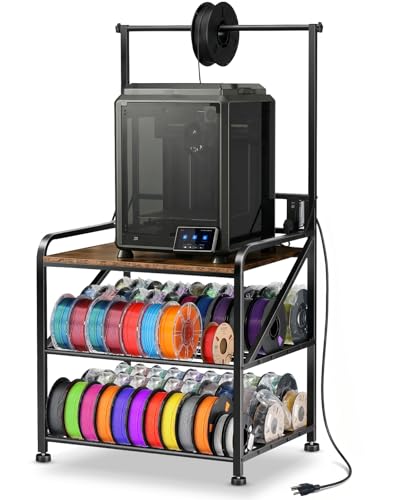
2. AHOWPD 3D Printer Stand
A 59-inch tower that turns a sprawl of spools into one tidy, upright column.
If filament is taking over your shelves, this is the stand that solves it. The rack holds up to 60 spools of filament — the top fits 10, and the two bottom layers take 500g and 1kg spools. It stands 59 inches tall, more than double the 28.4-inch height of the AHOWPD drawer model below, and the top detaches for spool holding too. The solid wood top measures 27.5″ x 23″, wide enough for an enclosed, open-frame, or resin printer.
The frame uses 0.78-inch thick metal with a powder-coated wood surface, and it locks together with screws for up to 300 pounds of support. Assembly runs under 15 minutes with a video guide. Instead of wheels, it sits on heavy-duty adjustable leveling feet, which is the right call for a printing stand — a flat, non-wobbling base is the whole point.
Buyers praise the build quality first and the 60-spool storage layout second. The honest note is stability: a tall, open frame on a hard floor can pick up a bit of movement under fast printing, so set it on the most solid surface you have and load the lower shelves first. The top reel holder also sits proud enough that the stand needs a little wall clearance while a spool is in use.
Room to breathe: the 59-inch frame gives filament and a printer their own vertical zones, so nothing crowds the deck.
Assembly reality: a short screwdriver session and a video to follow, then it stands ready — no wheels to fuss with.
Reach for this if: your spool collection has outgrown your shelves and you want it standing in one column.
Look elsewhere if: your printer is tall enough that you need the wide, low bench footprint instead of a vertical rack.
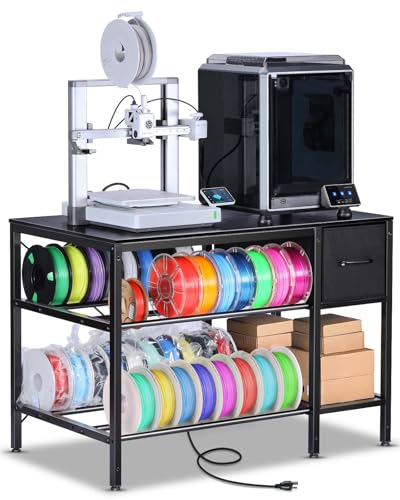
3. AHOWPD 3D Printer Table
Short, wide, and wired for power — a printing table that keeps tools in drawers instead of on the floor.
The dimensions here are the story: 39.4 inches long, 23.7 inches deep, 28.4 inches tall. That low profile fits under a window or into a corner where a 59-inch tower would not, and it is 23.7 inches deep against the 23.2 inches of the tall AHOWPD model above. The top takes a printer, with filament storage on two levels below via a metal tube rack on the middle and bottom shelves.
An embedded power strip adds 2 AC outlets and 2 USB ports, and the 140 cm cord gives you some reach to the nearest wall socket. Fabric drawers swallow screws, wrenches, and nozzles so the deck stays clear. The metal frame is built to hold up over long prints, and the whole stand weighs 37 pounds — enough to feel planted without being a two-person lift.
Owners describe the storage as the draw: the shelves organize filament and supplies and clean up a messy work area fast, and the clean black finish reads well in a home office. The recurring note is assembly hardware — the included Allen wrench has a habit of rounding off, so bring your own driver and the build goes smoother. Slight movement shows up under very fast printing, about what a normal desk does.
Best fit: small studios and home offices that need storage, power, and a printer all in one low footprint.
Second thought: if you need the lid of a tall enclosed printer to open freely under a shelf, check your clearances before committing.
4. YAOHUOO 3 Tier Printer Stand
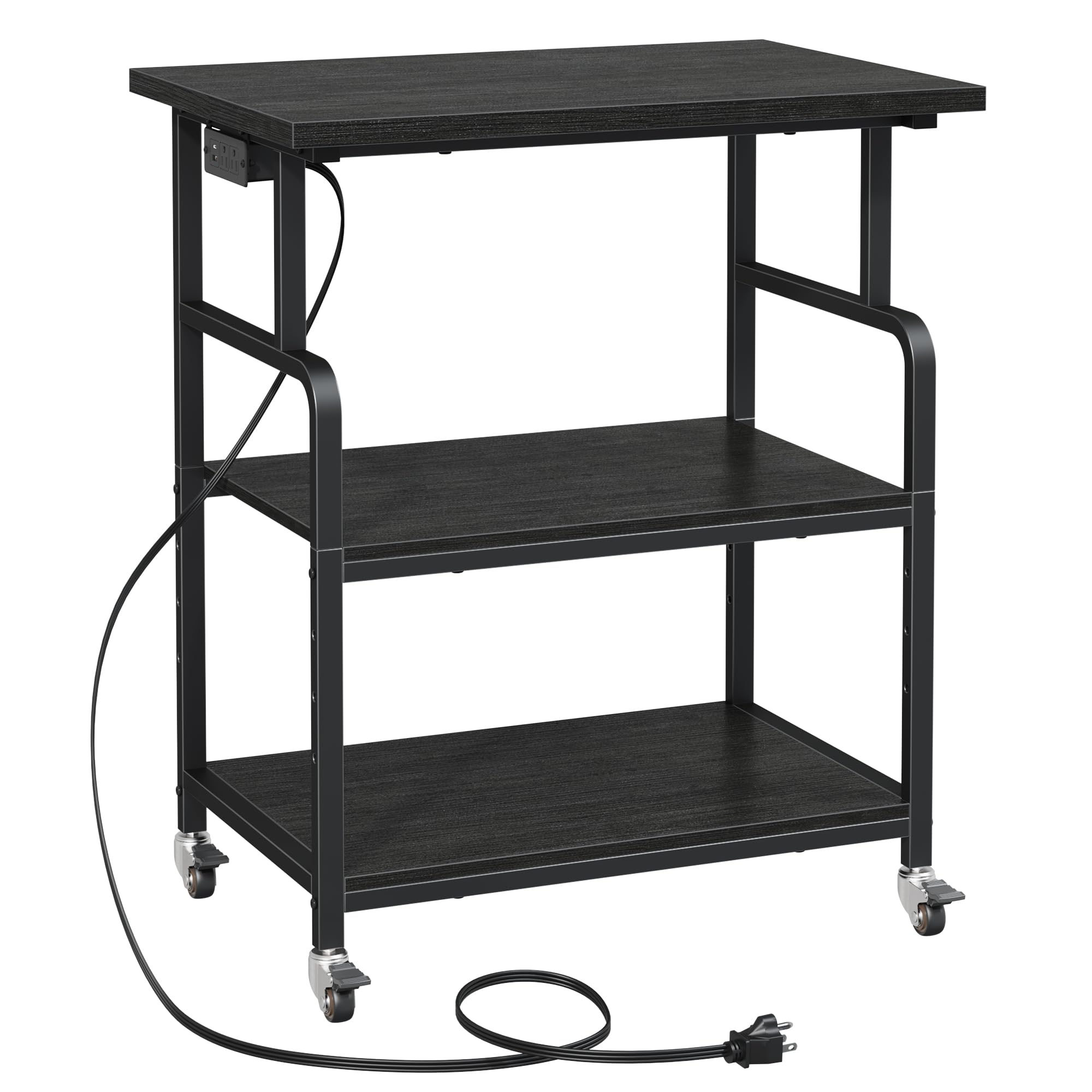
A three-tier cart on four lockable wheels that rolls a printer to the job and pins it down to print.
Some workshops need the machine to travel — to the workbench for assembly, back to the corner for printing. This cart runs on four 360° locking casters, with four adjustable feet in the box as a fixed alternative. Each shelf supports up to 120 pounds, and the waterproof board wipes clean when resin or dust lands on it. The three tiers let 2 to 3 printers, a fax machine, or a heat press live in one footprint of 23.6″W x 19.7″D x 33.3″H.
Power sits onboard: 2 AC outlets plus 1 USB and 1 Type-C port keep a printer and a phone charging from one spot. The middle shelf adjusts across 4 levels, 2 inches per level, so a taller machine gets the room it needs. A heavy-duty metal frame with high-quality board carries the load, and all the install tools come in the box.
Once the four casters are locked, the frame does not wobble while the printer runs. Buyers who move their gear around between jobs single out the mobility, and it rolls a heat press around the studio as happily as a printer. The honest catch is assembly time and the multi-piece shelf design: each shelf and support bar ships in two joined halves, which feels sturdy once bolted up but adds a few minutes to the build.
Mobility wins: four lockable casters plus spare adjustable feet cover both the rolling and the permanent setup without buying anything extra.
The catch: shelves arrive in split halves for shipping, so set aside a proper half hour with the included tools.
Worth it for: anyone who shares one printer across jobs and needs it to roll between rooms.
Pass on this if: your printer stays put forever and you would rather have a single rigid bench under it.
5. METYERRY 24″x23.6″ Printer Stand
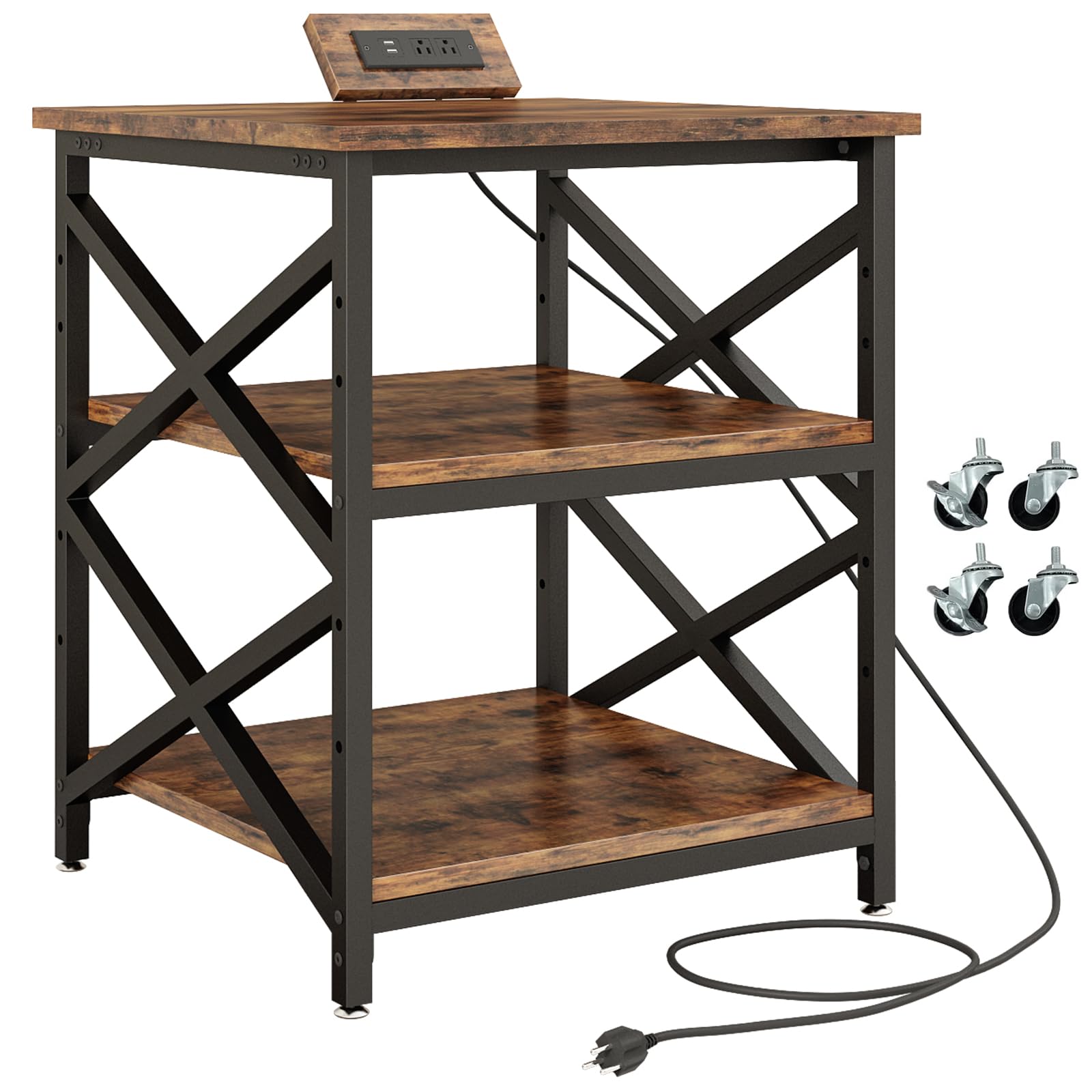
A 24-inch-square deck rated for 200 pounds a shelf, built to sit under a wide-frame machine.
When the printer has a big build plate, the tabletop is the first thing to check. This stand gives you 24″ x 23.6″ on top with a 200-pound rating, and two 20.5″ x 20.5″ lower shelves that each carry up to 200 pounds. Each shelf deck is reinforced with a steel support tube underneath, so the load does not bow the board over long prints.
The middle shelf lifts out and drops into 5 height positions, so you can stack a filament dryer or a taller spool holder underneath. The power strip has 2 AC outlets and 2 USB ports, and it mounts in either of two positions so the cords land where you want them. When you pull the middle shelf, the included metal support bars bolt onto the back to keep the frame rigid.
The mobility hardware is a step up too: industrial-grade casters roll the whole station, two of them lock, and adjustable foot pads cover uneven floors. Assembly is the part buyers keep bringing up as easy — clear picture instructions and holes that line up. A fair warning on the heavy vibrations of very fast printing: the frame is rigid front to back and slightly less so side to side, so keep it off deep carpet if you can.
Why it suits large printers
- 24″ x 23.6″ top deck takes a wide-frame enclosed printer.
- 200-pound rating on each of the three shelves, steel-reinforced.
- Five middle-shelf positions adapt to tall dryers and spool stacks.
- Power strip mounts left or right, with 2 AC and 2 USB ports.
Where it gives a little
- Side-to-side rigidity trails the front-to-back bracing.
- Fast printing on carpet can show slight movement.
- The included tools get the job done but a real screwdriver feels better.
Pick it when: your printer’s footprint is large and you want storage shelves that hold real weight.
Consider the floor: put it on a hard surface for the steadiest fast-speed prints.
6. Fannova 23.6″x23.6″x30.1″ Printer Stand
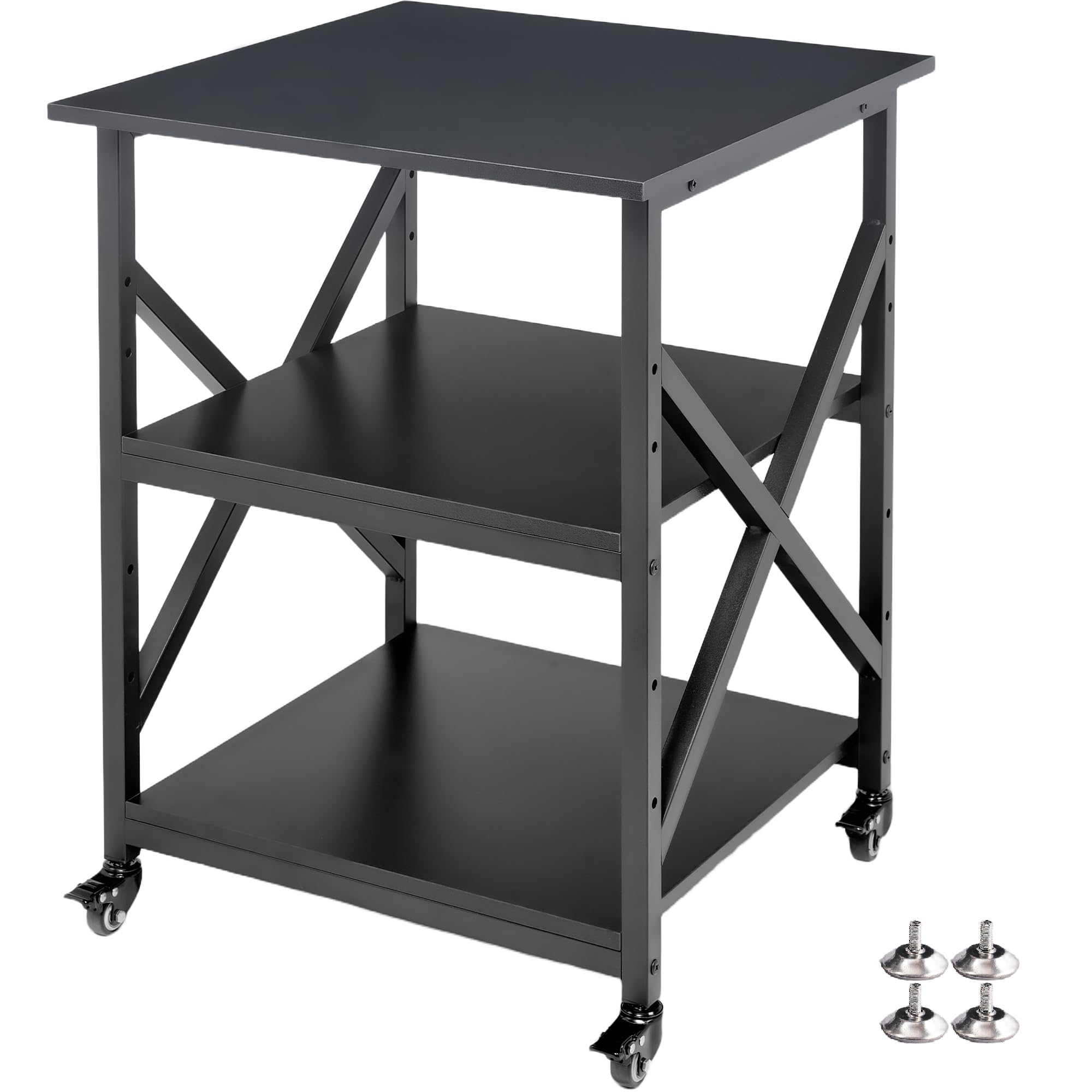
Oversized steel tubes and six crossbars — the frame that fights vibration instead of passing it on.
The build numbers set this one apart. It uses 0.98-inch (25mm) heavy-gauge square steel tubes, thicker than the 0.78-inch (20mm) tubes many racks run, and six horizontal crossbars tie the side frames into a rigid box. That box is what absorbs the constant vibration of a fast printer. Each shelf deck is 15mm particle board with a full-length steel support bar underneath, rated for 200 pounds per shelf.
The top shelf measures 23.6″ x 23.6″, with two lower shelves at 20″ x 20″ each for filament, resin bottles, and tools. All four casters lock independently — an upgrade over the two-lock setup most stands use — and adjustable foot pads come in the box for anyone who would rather bolt it down permanently. Assembly is threaded rather than nut-and-bolt, with a full-size screwdriver included instead of a finger-pinching mini wrench.
Buyers praise the sturdiness: it holds heavy printers with no wobble on the feet, though casters on an uneven floor show a little shimmy. One practical tip from the assembly process — fit the frame together before you install the casters or feet, since those hinder the sides while you square it up. The black finish matches the rest of a hardware rack, and buyers report it still looks like new after six months.
Rigidity payoff: the thicker tubes plus six crossbars are the reason this one holds a printer without bending, even under a leaning load.
Small note: on an uneven floor, the adjustable feet beat the casters for dead-flat stability.
Choose this if: wobble is your main enemy and you would rather have the heaviest, stiffest frame in the room.
skip it if: you want a full-height filament tower — this one keeps everything within 30.12 inches.
7. ARTINRACK TR22 3D Printer Stand

A 69-inch column with a printer up top and a spool wall below — storage on two levels.
The 24″W x 24″D tabletop takes a large printer, and the bottom holder — internal size 24″H x 24″W x 25″D — can fit most 3D printers or even a paper shredder. That lifts the machine off your main desk and frees the workspace. The top storage shelf keeps filament spools within arm’s reach instead of buried in bins. The whole structure tops out at 140 pounds of capacity.
The frame is thick wood board over a metal structure, corrosion-resistant, with four 360° swivel wheels that all lock. At 42 pounds it can be moved solo when the wheels are free, then pinned down for printing by snapping all four locks. Assembly is a four-step job with the hardware and Allen wrench included.
Owners mention the 140-pound frame holds up with two printers running at once, and the prints come out clean. Two honest notes come up: the side spool holder can crowd against a wall on enclosed printers, so give it some clearance and use the top shelf instead; and a caster’s thread quality has been uneven on the odd unit, which is worth checking when you unpack. That said, the towers earn their keep — buyers fit large enclosed machines on the shelf and still have room for the spools.
Right for: a studio or garage with vertical room to spare and a filament collection to park in one place.
Different need: if your printer lid needs full clearance on all sides, plan the wall gap before assembly.
8. Poweruck PRT22 3D Printer Stand
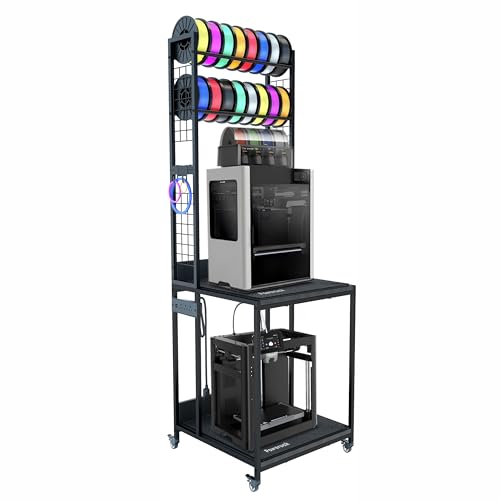
A 34-inch top shelf built for taller enclosed printers, with vibration pads under the machine.
Height-extended designs solve a specific problem: a tall enclosed printer needs headroom for its lid to open and its filament to feed. This stand sets its top shelf at 34 inches, a jump over the 28.4-inch tops on the shorter carts, and the 24″W x 24″D deck takes heavy printers and filament dryer boxes. The lower shelf fits most 3D printers or a paper shredder.
The power hub brings 3 AC outlets and 2 USB ports, so the printer, a dryer, and a phone all plug in at the stand rather than across the room. Specialized vibration damping mats sit under the machine to soak up movement, and four 360° casters with two locking wheels let you roll it out and pin it down. The frame is reinforced steel over thick high-density wood boards, rated for up to 140 pounds.
Buyers like the 24″W x 24″D size most — it fits an enclosed printer and keeps the workspace clean. The genuine caveat is stability: this is a taller, narrower frame than the wide benches, and reports split on how planted it feels, so use the vibration mats and lock the wheels every time. Assembly directions are the other rough edge, and checking the screw-in casters for fit when the box lands saves a headache later.
Height advantage: the 34-inch top shelf is the feature that tall-printer owners come for, and it earns its place.
Set it up right: lock the wheels, use the damping pads, and give the frame a solid floor for the steadiest job.
Best for: taller enclosed printers that need a higher top shelf and onboard power.
Not for: anyone who wants a low, wide, immovable bench as the printing base.
9. CAMMOO 48×24 Inch Garage Work Bench

The heavy garage bench that doubles as a printing and soldering station with light and power onboard.
When the printer shares space with real workshop tools, the bench has to carry both. This one is rated for 2000 pounds on a rubberwood top, with an H-shaped frame and upper and lower crossbar supports, plus a metal shelf spanning four 1.5mm-thick steel legs. At 76.7 pounds it is the heaviest pick here, and that mass is exactly what keeps a printing deck still. A long metal storage shelf mounts at any hole on the legs with 13.4 inches of adjustable space underneath.
The platform adjusts across 10 height levels from 36.5 to 38.7 inches with 360° tool-free knobs, each step a 1.34-inch lift, and adjustable metal feet tune out an uneven floor. A pegboard mounts without drilling and can travel with the bench when you roll it away from the wall. The ETL-certified power strip brings 4 AC outlets and 2 USB-A ports on a 6.5 ft cord, and an LED light fixed on the pegboard lights the work area.
Buyers praise the overall quality first and the 2000-pound sturdiness second. Owners bolt a shop vac underneath on the adjustable shelf and hang tools on the pegboard. Two honest notes: only a few pegs ship in the box, so buy your own hooks, and the higher you raise the bench the more it can shake, so set the height and leave it. One unit arrived with a dead LED, which is worth a quick check on delivery.
Made for: a garage or workshop where printing, soldering, and assembly all happen on one rock-solid surface.
Weigh the trade: at 76.7 pounds this bench is a permanent fixture, not something you move on a whim.
Know the Specs
Load capacity: why the number is bigger than it looks
Load capacity is the most weight a shelf holds before it starts to bow. A printer rarely comes close to the ceiling. The value is the built-in margin: a high rating means a heavier frame, and a heavier frame absorbs the kick of a fast print head. A stand rated well above your printer’s weight is the safer base.
Frame material and bracing: the anti-wobble engine
The frame decides whether the table fights vibration or passes it up into the machine. Steel legs with crossbars tie the sides into a rigid box, and thicker square tubes do it better than thin ones. A rubberwood or thick particle board deck with a steel support bar underneath adds a little give that damps high-frequency shake.
Feet and casters: keeping it still on your floor
Adjustable feet let you screw out one corner to level a sloped garage floor. Locking casters let you roll the station out for maintenance and pin it back down. All four locking wheels hold tighter than two, and adjustable feet beat casters on carpet. If your stand ships with both, try the feet for the steadiest print, and keep the wheels for a station you move often.
Top size and height: fitting your printer, not just the room
Measure the printer’s footprint and its height with the lid open. A larger top deck supports a wide enclosed printer without its feet near the edge. A taller stand gives headroom for the lid and filament feed but trades away some lower-body stability compared with a wide, heavy bench. Check shelf spacing before you buy, so a filament dryer and spool holder fit underneath.
Common Questions
Will my enclosed printer’s lid open fully under a stand shelf?
A workbench or a dedicated printer stand — which is better for a 3D printer?
How much weight should a table hold for a 3D printer?
Do wheels make a printer table less stable?
Can one stand hold two 3D printers at once?
What does a built-in power strip add to a printer stand?
Will a table for a 3D printer fit in a small apartment room?
How do I level a printer table on an uneven garage floor?
Do I need to anchor a printer stand to the wall?
How long does assembly take on these printer tables?
The Bottom Line
For most printing setups, the table for 3d printer winner is the CAMMOO 48″ Adjustable Workbench because its 2000-pound rubberwood deck and six height settings give you the heaviest, widest, steadiest base of the group. If your collection of spools is the real problem, grab the AHOWPD 3D Printer Stand with Filament Storage, which holds up to 60 spools on a 59-inch tower. And for a tall enclosed printer that needs a higher shelf and onboard power, the Poweruck PRT22 is the one to reach for. Reviewers keep returning to the same point about the CAMMOO bench: a solid, flat surface a printer can trust.
How we choose
We do not accept paid placement. Every pick is matched to a real buyer and a real use-case; we do not hands-on test units.
Sources
Specifications: manufacturer listings and product documentation. Review insights: verified customer reviews, as of October 2026. Pricing: not shown on this page (it changes often); check the current price via the retailer link.
As an Amazon Associate, Aappliancez earns from qualifying purchases. This does not affect which products we feature.