Disclosure: Some links in this post are affiliate links. As an Amazon Associate I earn from qualifying purchases, at no extra cost to you. Learn more
Specs are compiled from manufacturer listings and verified buyer reviews and can change over time — please confirm the key details on the product page before buying.
A synbiotic needs both halves — live bacteria and the prebiotic fiber that feeds them — and every pick below pairs the two. You want a formula with a real strain list, a stated CFU count (colony-forming units, the number of live bacteria per dose), and a fiber source doing the feeding. Everything else is packaging.
This guide is built by comparing the manufacturers’ published specifications and the patterns across verified customer reviews, so you get each pick’s real strengths and trade-offs instead of marketing spin.
The right synbiotic depends on how your gut handles the strains and the fiber. Below you’ll find one capsule-a-day formulas, stick packs that melt on your tongue, and spore-based options that never need the fridge. Each pick earns its place for a different reason, and the right synbiotic supplement for you depends on how your gut reacts to the strains and fiber.
Top Picks
How To Choose The Best Synbiotic Supplement
A synbiotic works when you hand it both the workers and the food supply — live bacteria plus a prebiotic fiber they can ferment. Without the fiber, the bacteria arrive with nothing to eat.
Read the fiber before you read the bacteria
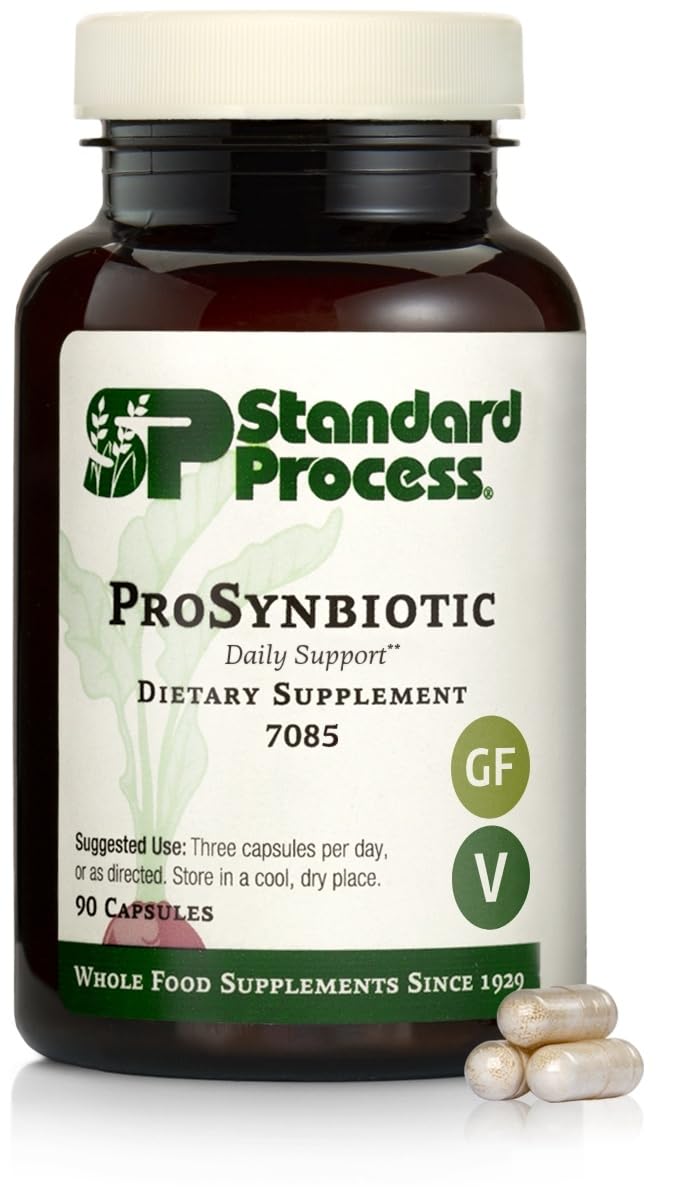
Prebiotic fiber is the half most people ignore. Inulin, chicory root, acacia fiber, and Sunfiber are all fermentable fibers that feed the bacteria already living in you. A formula built on inulin, like the Standard Process ProSynbiotic, is feeding bacteria that a plain probiotic capsule leaves hungry.
CFU counts are a floor, not a scoreboard
CFU stands for colony-forming units — the live bacteria count at the time of manufacture. The Klaire Labs option lists 50 billion CFU, while the Codeage capsule uses a different unit entirely: 500 million AFU of Akkermansia muciniphila. AFU means active fluorescent units, a count specific to that strain. You cannot line those two numbers up against each other, so do not try.
Format decides whether you actually stick with it
Capsules are the default, but not your only option. The THORNE Complete Biotic comes as a frosted orange-flavored powder in single-serving stick packs. If pills are the reason you quit a supplement, format is the first spec to check.
Side-by-Side Comparison
| Model | Best For | Format | Live Count | Prebiotic Fiber | Amazon |
|---|---|---|---|---|---|
| Standard Process ProSynbiotic★ Best Overall | Gut regularity and immune support | 90 capsules | — | Inulin | Amazon |
| Physician’s CHOICE Probiotics 60 Billion CFUBest Value | Everyday bloating and regularity | 60 capsules | 60 Billion CFU | Organic prebiotics | Amazon |
| Garden of Life Dr Formulated 3-in-1 | Gas and bloating in one daily capsule | 30 day supply | 50 Billion CFU | Organic Potato, Acacia fiber, PreforPro | Amazon |
| Codeage Akkermansia Muciniphila | Post-antibiotic gut rebuilding | 90 capsules | 500M AFU | Chicory Inulin | Amazon |
| THORNE Complete Biotic | Kids and pill-avoiders | 30 stick packs | — | Prebiotic blend | Amazon |
| Terraflora Daily Care Synbiotic | Shelf-stable spore-based daily use | 60 capsules | — | Nordic Chaga & Bladderwrack | Amazon |
| Klaire Labs Ther-Biotic Synbiotic | Sensitive stomachs needing low FODMAP | 30 capsules | 50 billion CFU | Sunfiber | Amazon |
Detailed Reviews
1. Standard Process ProSynbiotic 90 Capsules
Our pick — 4.5+★ from 300+ verified ratings; the strongest balance of quality and price.
Inulin feeds the bacteria; the capsule delivers them. That pairing is why this one holds the top spot.
The formula is built around inulin, a prebiotic fiber that probiotic bacteria ferment as food. That means the bacteria you swallow are not arriving to an empty table. The label states it supports a healthy gut microbial environment, normal bowel regularity, and the body’s natural immune system response function — three jobs that usually need three separate bottles.
For comparison, the Physician’s CHOICE bottle weighs 2.82 ounces — the Standard Process is the bulkier of the two to pack in a carry-on, though neither is a burden on a bathroom shelf.
The buyers who stick with it describe a slow, steady settling rather than a dramatic jolt. One group worth noting: a long-time user who had been dealing with chronic UTIs, saw specialists with no relief, and was put on this by a chiropractor — she reports she has not needed UTI medication since. That is one person’s story, not a clinical claim, but it is the kind of review that explains why this bottle sells out.
What carries this pick
- Inulin prebiotic included, so the fiber half of the synbiotic is already handled
- Capsules are easy to swallow and carry no bitter vitamin aftertaste
- 90-capsule bottle designed around a month of daily use
- Third-party-style quality reputation that repeat buyers mention by name
Where it costs you
- Premium-tier pricing for a single bottle
- The 3.52-ounce bottle is chunkier to travel with than the smaller Physician’s CHOICE
- No specific strain list or CFU number printed on the label
Reach for this if: you want prebiotic and probiotic handled in one daily capsule and you value a formula people stay on for years.
Think twice if: you want to see an exact strain list and CFU count on the label before you buy.
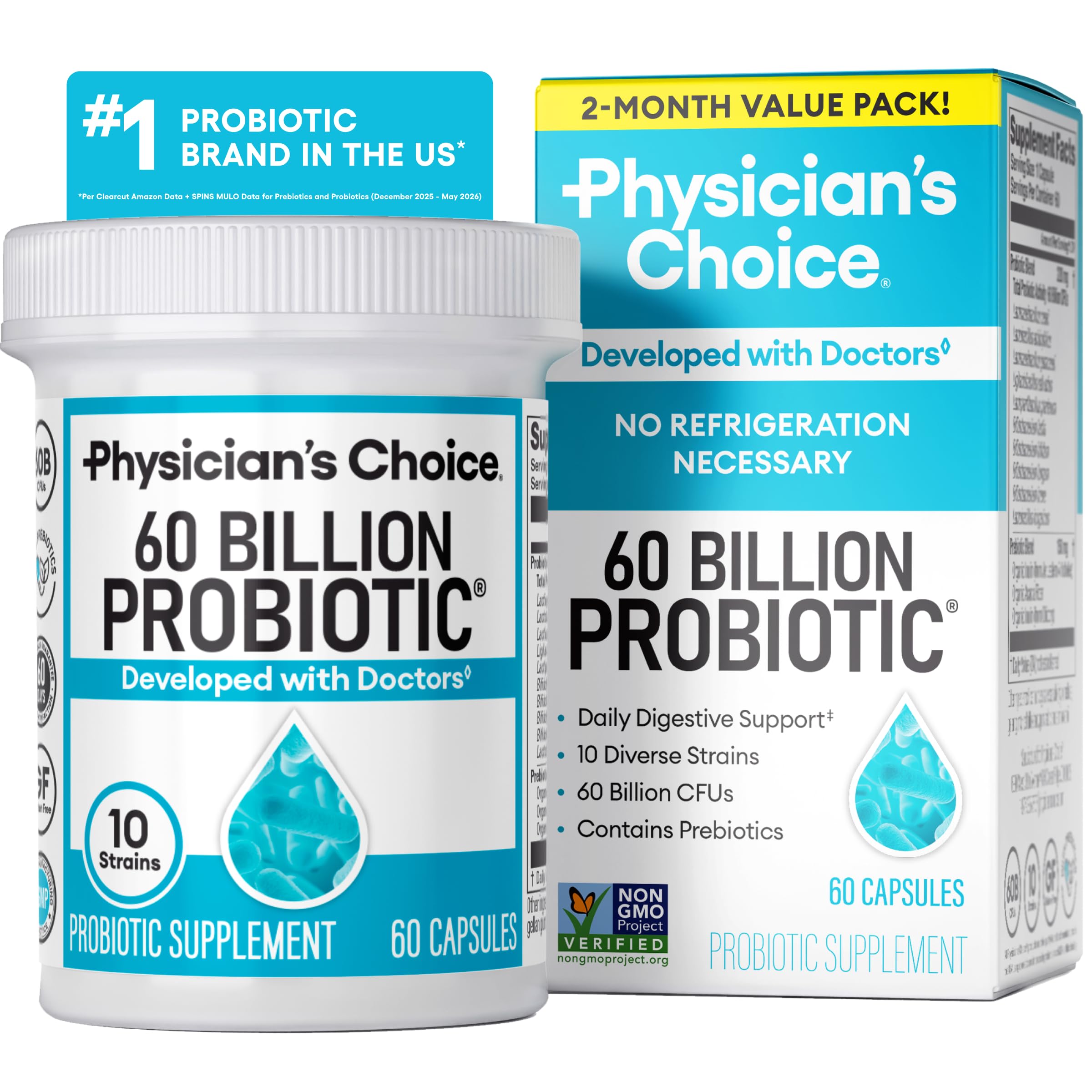
2. Physician’s CHOICE Probiotics 60 Billion CFU
Ten strains and 60 billion CFU at a mid-range price, with acid-resistant capsules doing the hard part.
The numbers that matter here are written on the front: 60 billion CFU across 10 diverse strains, plus organic prebiotics that work alongside them. The capsules are acid-resistant, which is the spec that decides whether the bacteria actually reach your gut instead of dissolving in your stomach. The bottle is shelf-stable, so no refrigerator shelf gets sacrificed — and the 60-count size is built as a two-month supply.
Owners describe it as the formula that fixed regularity when nothing else did. Bloating and gas come up as the most-relieved complaints, and it is repeatedly described as easy to swallow with no aftertaste and no upset on an empty stomach. One father of a dairy-sensitive household describes reduced cramping and nausea along with better regularity — the kind of steady report that explains a fan base this size.
Where the Garden of Life 3-in-1 leans on a postbiotic layer, this one skips that third tier and leans on raw strain variety instead. That is the trade: 10 strains and 60 billion CFU versus a 15-strain formula built around clinically studied HN019. Both approaches have followers, and neither is wrong.
The strength in plain terms: a 60-count bottle that runs about two months, acid-resistant capsules to survive the stomach, and third-party testing for purity and potency. Few formulas at this tier publish all three.
One honest note: it swaps the postbiotic tier for strain variety. If you specifically want a pre + pro + post formula, look at the Garden of Life pick instead.
The straight answer: the right bottle if you want a big strain list and a long supply without stepping into premium pricing.
Not the pick for: anyone who specifically wants a postbiotic included in the same capsule.
3. Garden of Life Dr Formulated Once Daily 3-in-1
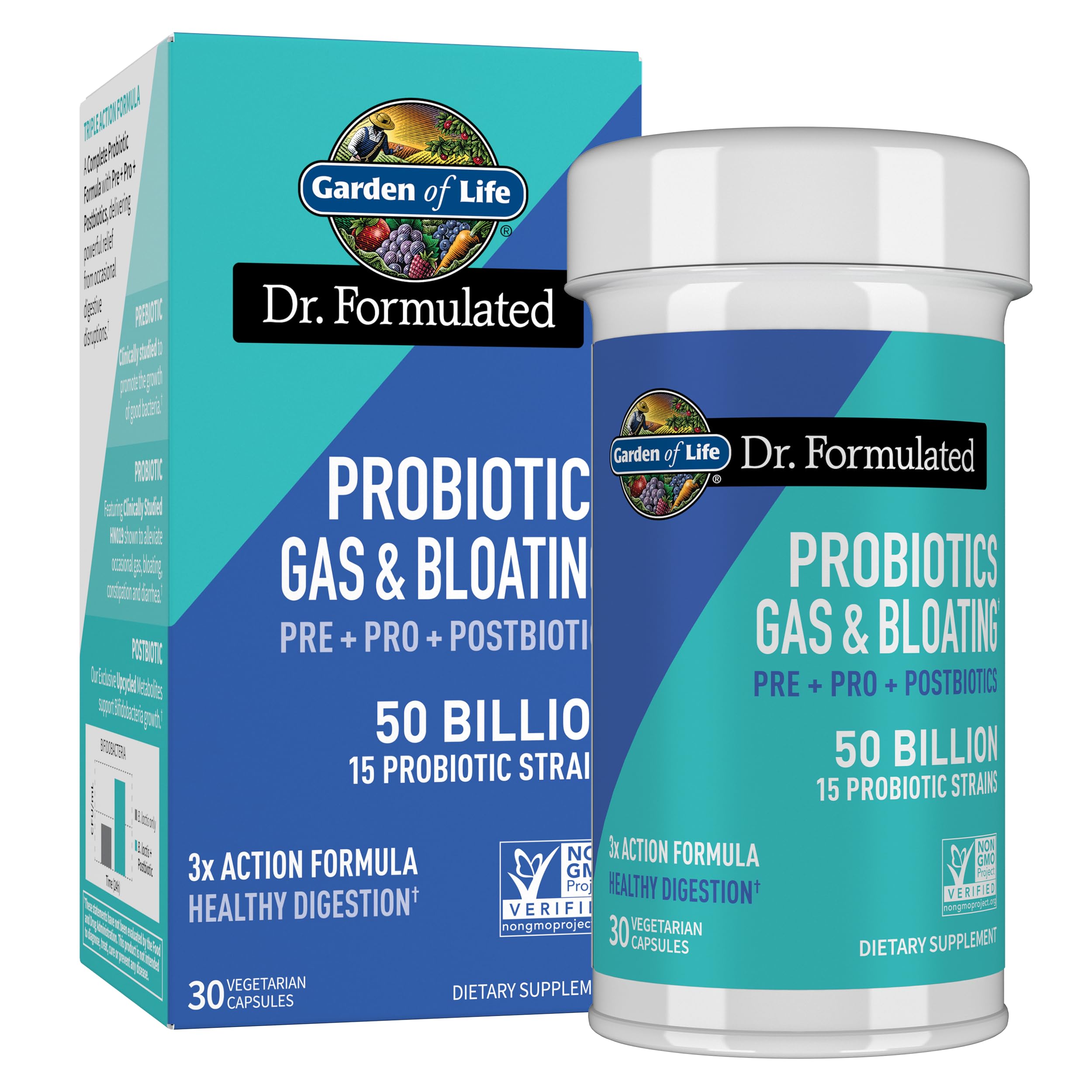
Three layers in one capsule: prebiotics, 15 strains of probiotics, and a postbiotic tier most competitors skip.
Fifty billion CFU, 15 probiotic strains, and a prebiotic blend of Organic Potato, Acacia fiber, and PreforPro make up the base. On top of that sits the postbiotic layer — upcycled metabolites that support Bifidobacteria growth. Fifteen strains is the widest count in this lineup, which is the main reason this one earns its spot.
This bottle saves shelf space: at 4.75 x 2.4 x 2.35 inches, it is noticeably more compact than the 2.5 x 2.5 x 3 inch Codeage bottle, so it slots into a smaller cabinet shelf or a dopp kit without a fight. It is also Non-GMO and Gluten Free, and the capsule is vegetarian with no refrigeration required.
The honest picture from owners is a split. Plenty report bloating easing within days — one describes the effect kicking in on day one, with less gas and less bloat already noticeable. Others report the opposite at first, with more gas before things settle, and some find the price steep for a 30-day supply. The recurring theme in the less enthusiastic reviews is that a body with existing gut trouble may need to adjust before judging it.
Why it stays in the running
- 15 probiotic strains — the widest spread in this lineup
- Pre, pro, and postbiotic tiers in one daily capsule
- Compact 4.75 x 2.4 x 2.35 inch bottle travels well
- Shelf-stable vegetarian capsules, Non-GMO, Gluten Free
The adjustment period
- Some owners see more gas before the bloat eases, not less
- 30-day supply at a mid-to-premium price, so a trial month is a real commitment
- No second bottle size for anyone who wants a longer run before deciding
Strongest match for: someone who wants pre, pro, and post in one capsule and is willing to give a body a few weeks to adjust.
Probably a mismatch if: you have active digestive trouble and want zero adjustment period.
4. Codeage Akkermansia Muciniphila 90 Capsules

A single named strain at 500 million AFU, paired with chicory inulin — narrow where others go wide.
Most formulas here throw a dozen strains at the wall. This one bets everything on Akkermansia muciniphila at 500 million AFU, plus chicory root inulin as the prebiotic half. AFU (active fluorescent units) is a different unit from CFU (colony-forming units) — it counts active fluorescent units and is specific to how this strain is measured — so the 500 million figure cannot be lined up against a 50 or 60 billion CFU label. Judge it on the strain, not the number.
The 90-capsule bottle is a three-month supply at one capsule a day, which is the longest run in this group. It is vegan, non-GMO, dairy-free, soy-free, and gluten-free, and made in a cGMP-certified (current Good Manufacturing Practice, the FDA’s manufacturing standards) facility in the USA. At 2.5 x 2.5 x 3 inches it is also one of the more compact bottles in the lineup.
Owners with a specific history seem to find it: several describe gut trouble that started after a course of antibiotics and did not budge through other supplements or diet changes, then improving within a week of starting this. Some find the price high for a specialty strain; others call three months of supply a fair deal. Both views show up, and the split is real.
What the strain focus buys you: one targeted organism at a stated 500M AFU, three months of capsules, and a clean allergen profile for dairy, soy, gluten, and animal ingredients.
The catch: if you want a broad multi-strain formula rather than a single-organism bet, the Garden of Life 15-strain option covers more ground.
Pick this one if: you have a specific gut-rebuilding goal after antibiotics and want a three-month run of a targeted strain.
Look elsewhere if: broad strain coverage matters more to you than one organism taken deep.
5. THORNE Complete Biotic 30 Stick Packs
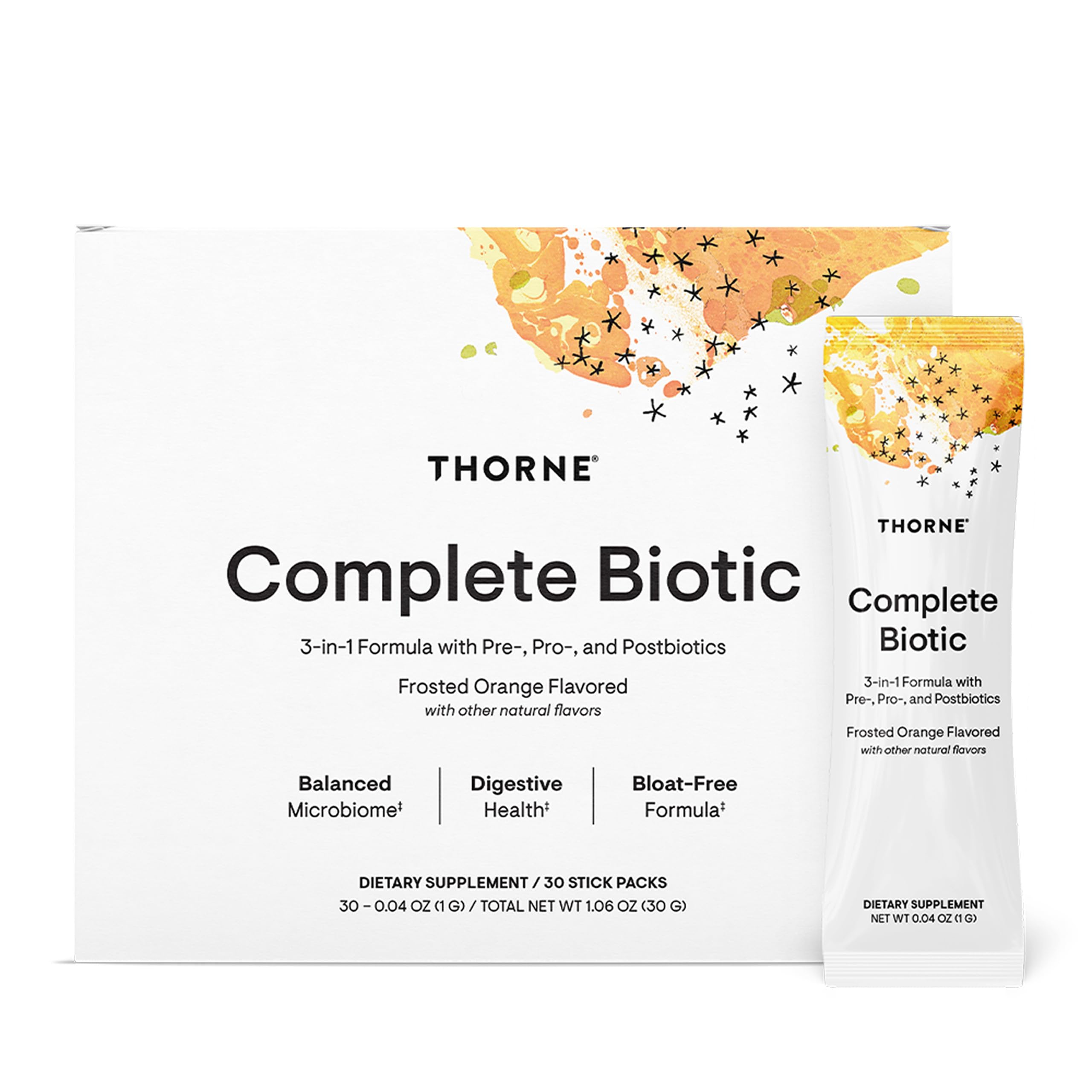
Frosted orange powder that melts on your tongue — the pick for anyone who is done with pills.
This is the only powder in the lineup, and it changes who the product is for. Each single-serving stick pack holds a prebiotic, a probiotic, and a postbiotic together, and the powder melts quickly in the mouth before you swallow. Thorne states it is designed for adults and children as young as 4, and that it addresses occasional diarrhea, constipation, gas, and bloating. Third-party testing verifies the contents match the label and that contaminant levels fall within safe limits.
The ingredient list and the orange flavor are what owners bring up most, and dissolving on the tongue without grit is a repeated point. Kids who resist swallowing capsules take to it — one parent describes a son who prefers the powder to “another pill” and reports no reflux or aftertaste. Worth knowing before you buy: those foil stick packs can be stubborn, and scissors are the usual solution.
Compared with the Codeage bottle’s three-month run, this is a 30-pack — one month of daily use. That shorter runway is the honest trade for having a format your whole household, including a 4-year-old, can actually take.
What the format wins
- Frosted orange powder dissolves on the tongue, no water and no swallowing required
- 3-in-1 prebiotic, probiotic, and postbiotic in every stick pack
- Third-party tested and certified for label accuracy and contaminant limits
- Stated as suitable for adults and children as young as 4
The practical snags
- Only 30 packs, so a single month of daily use
- The stick packs can be hard to tear — a pair of scissors lives nearby
- Inhaling the loose powder is a real risk if you dump it in carelessly
The best fit for: households with kids, or anyone who genuinely hates capsules and wants a taste they will actually look forward to.
Not for: someone who wants a multi-month supply per purchase.
6. Terraflora Daily Care Synbiotic 60 Ct

Spore-based bacteria in a seed-like shell, with wild-harvested prebiotics — no fridge, no refrigeration anxiety.
Spore-based organisms are the defining feature. Instead of naked live bacteria that degrade, these are seed-like spores with a protective shell that stays stable on the shelf. That is why Terraflora needs no refrigeration and travels in a gym bag or a carry-on without a second thought. The prebiotic side uses Nordic Chaga and Nova Scotian Bladderwrack, responsibly sourced, to bring polyphenols and polysaccharides to the party.
Owners describe the formula as gentler on the stomach than standard capsules — the phrase that keeps recurring is “no digestive issues,” with several saying it is better tolerated than other types of probiotics they have tried. Those who ease into it, per the instructions, tend to be the happiest; going too hard out of the gate is the one mistake mentioned.
Where the Physician’s CHOICE pick lives in the fridge-free zone using acid-resistant capsules, this one leans on spore biology itself. Two different strategies, both shelf-stable, both worth understanding before you commit.
Why spore-based is a real choice: seed-like shells survive shelf time and travel, so this is the bottle for someone who would otherwise leave their supplement at home.
The caveat to respect: it is strong enough that easing in at half-speed the first week is the safer path — jumping in at full dose is the one complaint that shows up.
Made for: frequent travelers and anyone who wants a synbiotic that never needs a refrigerator.
Better to start elsewhere if: you want a gentler entry point and are not willing to taper your dose at the start.
7. Klaire Labs SFI Health Ther-Biotic Synbiotic, 30 Count
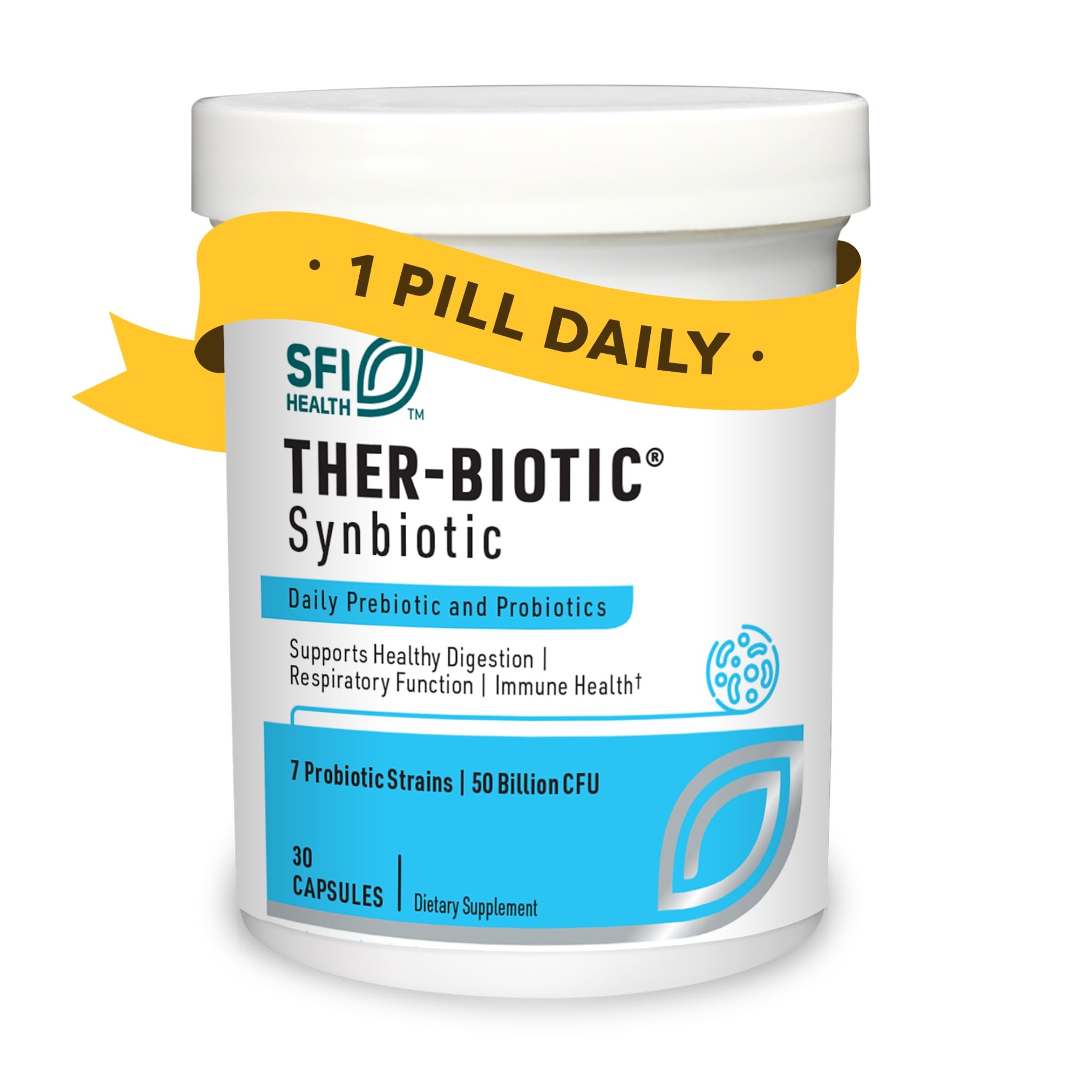
Fifty billion CFU across seven strains, built low FODMAP for guts that react to everything.
FODMAPs are fermentable carbs that can trigger gas and cramping in sensitive digestive systems. This formula is blended specifically to keep them low, across seven strains at 50 billion CFU, with Sunfiber as the prebiotic partner. Combined with one capsule daily, that gives a high-potency dose without the fermentable load that usually makes sensitive users bail. The brand is now part of SFI Health and the formulation is unchanged — the same capsules that long-time buyers know, in a new-looking bottle.
The bottle is the lightest thing here, at 1.76 ounces with package dimensions of 2.91 x 2.01 x 2.01 inches. That is slimmer than the 3.94 x 2 x 3.86 inch THORNE carton, so it packs into a toiletry bag almost invisibly.
Where it stands out: seven strains selected for low FODMAP content, 50 billion CFU, and a prebiotic blend built with Sunfiber — a package aimed squarely at reactive guts.
Know before you buy: a 30-count bottle at a premium price, so there is no cheap way to test whether the formulation suits you first.
The right answer if: your stomach reacts to standard probiotics and you specifically need a low FODMAP formula.
A harder sell if: you want the lowest cost per day rather than a formula tuned for sensitive digestion.
Know the Specs
CFU vs AFU: two different ways to count bacteria
CFU — colony-forming units — is the standard measure of live bacteria in a probiotic, and it appears as 60 Billion on the Physician’s CHOICE label and 50 Billion on the Garden of Life and Klaire Labs bottles. AFU — active fluorescent units — counts a specific organism by a different method, and the Codeage bottle lists 500M AFU for Akkermansia muciniphila. Because the methods differ, a CFU number and an AFU number are not comparable. Ignore the brand that suggests otherwise and read the strain list instead.
Prebiotic fiber: what actually feeds the bacteria
A probiotic without a prebiotic is bacteria with no food supply. The prebiotic is the fermentable fiber that feeds what you swallowed: inulin in the Standard Process bottle, the Organic Potato, Acacia fiber, and PreforPro blend in the Garden of Life bottle, chicory root inulin in the Codeage bottle, Sunfiber in the Klaire Labs bottle, and Nordic Chaga and Nova Scotian Bladderwrack in the Terraflora formula. Some bacteria handle certain fibers better than others, so the fiber choice matters as much as the CFU count.
Common Questions
How long before a synbiotic starts working?
What is the difference between a synbiotic and a plain probiotic?
Do synbiotic supplements need refrigeration?
Can I take a synbiotic at the same time as an antibiotic?
What is a low FODMAP synbiotic and who needs one?
How many CFU should a synbiotic have?
Are synbiotic capsules safe for children?
Why do some people feel more bloated the first week?
Should I take a synbiotic with food or on an empty stomach?
What does 500M AFU mean on the Codeage bottle?
The Bottom Line
For most people, the synbiotic supplement winner is the Standard Process ProSynbiotic because it pairs live bacteria with inulin in one easy capsule, and it holds the top rating in this lineup. If the format is the reason you quit supplements in the past, grab the THORNE Complete Biotic stick packs — the powder dissolves on the tongue, and kids as young as 4 can take them. And if your stomach reacts to standard probiotics, the Klaire Labs Ther-Biotic Synbiotic is the low FODMAP one to reach for.
The single most useful move you can make: pick the format you will actually take every day for a month, and start there.
How we choose
We do not accept paid placement. Every pick is matched to a real buyer and a real use-case; we do not hands-on test units.
Sources
Specifications: manufacturer listings and product documentation. Review insights: verified customer reviews, as of October 2026. Pricing: not shown on this page (it changes often); check the current price via the retailer link.
As an Amazon Associate, Aappliancez earns from qualifying purchases. This does not affect which products we feature.