Disclosure: Some links in this post are affiliate links. As an Amazon Associate I earn from qualifying purchases, at no extra cost to you. Learn more
Specs are compiled from manufacturer listings and verified buyer reviews and can change over time — please confirm the key details on the product page before buying.
Low ferritin is rarely the problem — the problem is keeping iron down long enough to move the number. Ferrous sulfate is cheap and common, and it is also why a lot of people quit after a week of cramps and constipation. Every pick below is a chelated (iron bonded to an amino acid) or plant-based iron, chosen for tolerability, and they run from a 5 mg capsule you can split across the day to an 18 mg women’s formula with vitamin C already built in. Short answer: Pink Stork Iron Supplement for Women is the strongest all-round pick for most women, Kirkman Low Dose Iron is the one if you have ever had to stop iron because of diarrhea, and MaryRuth’s Iron Gummies are for anyone who genuinely cannot swallow a capsule.
This guide is built by comparing the manufacturers’ published specifications and the patterns across verified customer reviews, so you get each pick’s real strengths and trade-offs instead of marketing spin.
Ferritin is the storage protein your body parks spare iron in, so a low ferritin reading means your reserves are running thin before your hemoglobin ever drops. Below, each pick depends on three things: the dose per capsule, the iron form, and whether it carries an absorption helper when you are shopping for supplements for ferritin.
Top Picks

How To Choose The Best Supplements for Ferritin
Ferritin is your body’s spare-iron tank, so a low blood reading means slow, tolerable topping up for months — not one big hit. Three label details decide the rest: how much iron sits in one capsule, what form that iron takes, and whether the formula carries anything to help you absorb it.
Start with the dose per capsule, not the bottle size
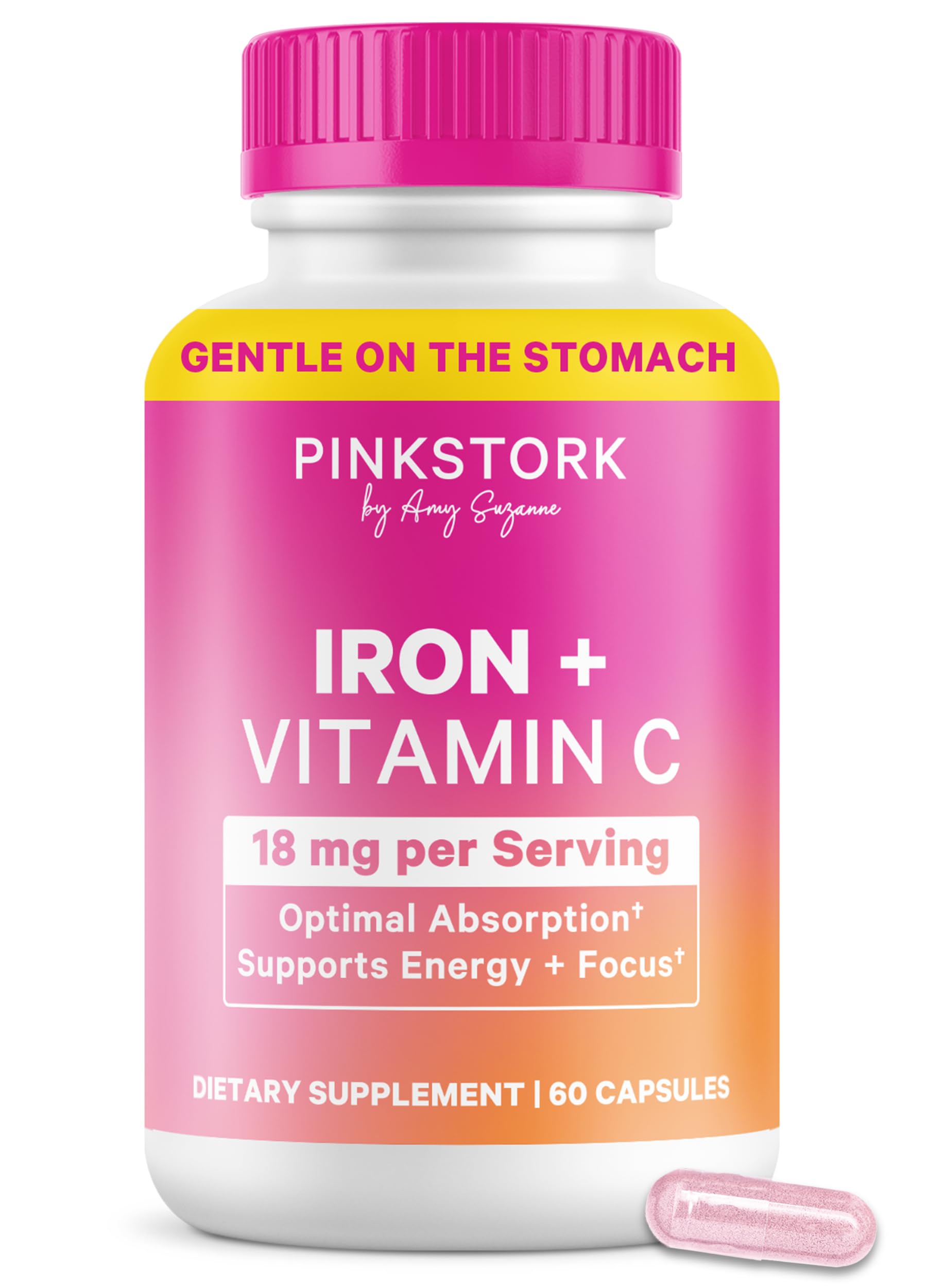
A 60-capsule bottle sounds generous until the serving turns out to be two or three capsules a day. What counts is the milligrams of iron in one capsule and how many capsules make up your daily serving. The Kirkman option delivers 5 mg of iron per capsule from ferrous bisglycinate chelate in a low dose you can split across the day. Pink Stork delivers 18 mg per capsule, listed as 100% of the Daily Value on that label. Cardiovascular Research also lists 5 mg per capsule. Same shelf, very different daily math — check the serving line first.
Look at the iron form, because it decides whether you stick with it
Chelated iron is bonded to an amino acid, and that bond is why bisglycinate and Ferrochel tend to sit easier in your stomach than ferrous sulfate.
Check whether vitamin C is already inside the capsule
Vitamin C helps your body pull iron out of your gut and into your bloodstream, which is why so many people buy it separately. Pink Stork packs 50 mg of vitamin C from acerola fruit extract into the same capsule as the iron, listed as 56% of the Daily Value. MaryRuth’s puts vitamin C in its gummy too. Pick a formula without it and you supply your own source — the Kirkman label suggests pairing with Kirkman Vitamin C to support absorption.
Side-by-Side Comparison
| Model | Best For | Iron Per Capsule | Form | Count | Amazon |
|---|---|---|---|---|---|
| Pink Stork Iron Supplement for Women★ Best Overall | Most women, especially pregnancy and postpartum | 18 mg (100% DV) | Iron bisglycinate + vitamin C | 60 capsules | Amazon |
| Cardiovascular Research Ferritin Maximum AbsorptionBest Value | Budget-friendly daily store maintenance | 5 mg | Bioavailable iron | 60 capsules | Amazon |
| Kirkman Low Dose Iron Ferrochel | Sensitive stomachs and anyone who failed higher doses | 5 mg | Ferrous bisglycinate chelate (Ferrochel) | 120 veg capsules | Amazon |
| MaryRuth’s Iron Gummies for 14+ | Anyone who dreads swallowing capsules | 100% DV per serving | Vegan gummy + vitamin C | 60 gummies | Amazon |
| FloraHealth Ferritin+ | Slow, steady plant-based support | — | Plant-based ferritin, delayed-release | 30 veg capsules | Amazon |
Detailed Reviews
1. Pink Stork Iron Supplement 60 Capsules
Our pick — 4.5+★ from 900+ verified ratings; the strongest balance of quality and price.
The one-capsule-a-day iron that already has its vitamin C packed inside
One capsule, 18 mg of iron, once a day — that is the entire routine, and it is why this is the pick for most women reading this. The iron arrives as chelated iron bisglycinate (iron bonded to the amino acid glycine, the form commonly chosen for stomach comfort over ferrous sulfate salts). The label lists that 18 mg as 100% of the Daily Value. That is roughly three and a half times the 5 mg in the Kirkman capsule — 18 mg versus 5 mg — so if your ferritin sits well below range and your doctor has cleared a full-strength daily dose, this is the faster-moving bottle of the two.
The vitamin C is the quiet win here. Each capsule carries 50 mg of vitamin C from acerola fruit extract, listed as 56% of the Daily Value, and vitamin C is what helps your gut pull iron into your bloodstream. Buying that as a separate bottle is the usual alternative, so having it in the same capsule removes one step from your morning. Women’s iron needs also shift across monthly cycles, pregnancy, postpartum and perimenopause, and the formula was built around that, with a 60-capsule bottle working out to a stated 2-month supply. The capsule itself is made without gluten, dairy, peanuts, tree nuts or animal products, and the formula is third-party tested and produced in cGMP-certified facilities in the USA.
What wins people over is that it works without the misery — effectiveness is the most-praised thing about this bottle, with digestive comfort a close second. Buyers report hemoglobin rising, energy coming back and no cramps, including buyers who report hemoglobin levels increased after two weeks of taking it and that the pills are easy to swallow. One recurring note is worth knowing before you buy: a few women find it slows their normal bathroom routine and simply skip a day or two between capsules. That is a fit issue, not a flaw — but if you already run slow, the Kirkman below takes the gentler route. Worth adding too: if you are already taking a multivitamin or prenatal that contains iron, the label advises checking your total iron intake with your healthcare provider rather than stacking both.
What Earns It First Place
- 18 mg of chelated iron bisglycinate per capsule, one capsule daily
- 50 mg of vitamin C from acerola fruit extract in the same capsule, so no second bottle
- 60 capsules, stated as a 2-month supply
- Free of gluten, dairy, peanuts, tree nuts and animal products; third-party tested and made in cGMP-certified US facilities
Before You Commit
- 18 mg is a full-strength daily dose, so it is not the right starting point if you have ever had to stop iron
- If you already take a prenatal or multivitamin with iron, you may be doubling up
- Some women need to space the capsules out rather than take one every single day
Made for: non-pregnant and pregnant women who want a full daily iron dose, vitamin C included, in a single easy-to-swallow capsule.
Think twice if: you are already supplementing iron elsewhere — check your total intake with your healthcare provider first.
2. Cardiovascular Research Ferritin Iron Supplement 60 Capsules
The no-frills ferritin capsule for building stores slowly and cheaply
Nothing on this bottle is dressed up: ferritin from Cardiovascular Research Ltd., sold as a bioavailable iron supplement, at 5 mg per capsule across 60 capsules. If your ferritin is low but not alarming and your plan is simply to top up steadily for months, that 5 mg dose is a sensible, low-commitment place to sit — and it matches the Kirkman capsule milligram for milligram, so the two make a genuine like-for-like comparison on dose.
Where it separates from the Kirkman is packaging volume, not potency. The Kirkman gives you 120 capsules at the same 5 mg; this one gives you 60. The most-discussed shortcoming here is exactly that math — owners mention the bottle runs out fast at several capsules a day, and the recurring wish is for a larger size. The honest read is that this is a starter bottle: it lets you test how a low, bioavailable ferritin capsule treats your digestion before you commit to a bigger jar.
On the experience itself, the feedback is quiet and consistent. No nasty iron aftertaste, and customers note it is the easiest on the stomach of the iron options tried. Results come gradually rather than dramatically, and the people who stick with it tend to confirm the change through blood work rather than by feel — the realistic expectation for any low-dose ferritin routine. If you want vitamin C already inside or a chelated bisglycinate label, look at the Pink Stork or Kirkman picks instead; this one is the stripped-back option for someone who just wants the mineral and nothing else riding along.
Plain And Predictable: a 5 mg ferritin capsule with 60 in the bottle and no extras — a clean, low-dose entry point if your ferritin just needs steady topping up.
The Trade You Are Making: half the capsule count of the Kirkman at the same dose, so buy the bigger bottle if you already know low-dose iron suits you.
Worth grabbing if: you want the lowest-commitment daily ferritin dose and prefer a formula with nothing added.
Step up instead if: you want vitamin C in the same capsule, or a chelated iron label you can read at a glance.
3. Kirkman Low Dose Iron Ferrochel 5 mg 120 Veg Capsules

For anyone who has already been beaten by full-strength iron once
Here is the scenario this capsule was built for: you tried standard iron, it wrecked your gut, and you stopped. Each capsule holds just 5 mg of ferrous bisglycinate chelate — the chelated iron form sold under the Ferrochel name from Albion Laboratories, tested for safety and absorbability in animals, adults and kids. Kirkman built the capsule to be hypoallergenic, free of milk, eggs, fish, shellfish, tree nuts, peanuts, wheat, soy, sesame, artificial colors and flavors, and it suits adults and children 4 years or older. At 5 mg per capsule, the 120-capsule bottle is the value play of this group — twice the capsule count of the Cardiovascular Research bottle at the same strength, so it lasts roughly twice as long at one capsule a day.
Quality is what this bottle is known for above all else, and digestibility follows right behind it. Kirkman manufactures under its Ultra Tested protocol, running raw ingredients and finished product through testing that includes 9 heavy metals plus checks for total aerobic microbial count, yeast, mold, Enterobacteriaceae, E. coli, Pseudomonas aeruginosa, Salmonella, Staphylococcus aureus and coliforms. If a sensitive gut or a restricted diet is why your ferritin is low, that level of disclosure is the reason to pick this over a cheaper bottle. Reviewers point out borderline anemia resolving across several months on the low dose, and shoppers say the flip side well documented too: higher iron doses in the 27-35 mg range caused severe diarrhea for the same people, which is exactly why the low-dose route exists.
Practical notes worth having before it arrives. It pairs with vitamin C to support absorption — the label suggests Kirkman Vitamin C for that — and taking it with dinner is the pattern buyers report keeps stomach pain away. The one caveat on this listing comes from the buyers themselves: iron needs vary from person to person, iron can be harmful for some people, and the recommendation is to confirm with blood tests rather than guessing at your dose. At 5 mg per capsule the ceiling is low, but the principle still applies — run this past your healthcare provider, and do not stack it on top of other iron.
Why The Sensitive Crowd Lands Here: a 5 mg Ferrochel chelate in a capsule that leaves out milk, eggs, fish, shellfish, tree nuts, peanuts, wheat, soy and sesame — and 120 of them in the bottle.
The Catch: 5 mg is a genuinely small dose, so if your ferritin is significantly low you will be moving slowly by design.
Right answer for: the person who has already had to abandon iron once and needs the lowest-tolerability-risk dose they can get.
Not your bottle if: your provider has told you that you need a full-strength daily dose rather than a top-up.
4. MaryRuth’s Iron Gummies 60 Count

The iron you chew instead of swallow, for anyone 14 and up
If swallowing capsules is why you have never managed a steady iron routine, here is the workaround: a grape-flavored vegan gummy carrying 100% of the Daily Value of iron per serving, with vitamin C in the same gummy to help your body take it in. The formula is sugar free and built to fit most lifestyles — Non-GMO, Vegan, Dairy Free, Nut Free, Gluten Free, Soy Free, made in a GMP facility, Clean Label Project Certified and B Corp Certified. The gummies are labeled for ages 14 and up, so a teenager can take this one without dealing with a pill — something the Pink Stork and Kirkman capsules cannot offer.
The results owners mention are measurable, which is what keeps this bottle selling despite everything below. Reviewers report iron levels rising from 54 to 90 and ferritin climbing after several bottles, after other expensive brands failed across a decade of low iron. Taste is the honest battleground, and it splits people cleanly. Some find them perfectly acceptable and even get an 8-year-old to take them without complaint. Others hit a metallic, medicinal, chalky note and a texture that is hard to chew through. It is worth knowing that MaryRuth’s customer service reaching out to unhappy buyers is itself a theme on this listing — so if the flavor does not work for you, say something.
Before you buy, factor in the serving math. The gummies are labeled as a 60 count, and if you take two daily as some buyers do, that is a shorter run than you might assume from the bottle size. The way to think about it is this: buy it for someone whose alternative is taking nothing at all, not for someone comparing it against a 120-capsule bottle on cost per dose. And if you want a form with no flavor to argue with at all, the FloraHealth Ferritin+ below sidesteps the taste question entirely.
Why People Switch To It
- 100% of the Daily Value of iron per serving, with vitamin C included for absorption
- Sugar-free grape gummy — no capsule to swallow, and labeled for ages 14 and up
- Vegan, Non-GMO, gluten free, dairy free, nut free, soy free, Clean Label Project Certified and B Corp Certified
- Measurable iron and ferritin gains described across months of use
The Honest Trade-Off
- Taste divides the room — some taste a clean grape, others taste metal and chalk
- A chalky, grainy texture that a few find genuinely hard to chew
- 60 gummies goes quickly if you take two a day
Reach for this if: you or a teen in the house will not swallow a capsule and a gummy is the only format that sticks.
Look elsewhere if: you are sensitive to metallic or chalky flavors — the capsule options here avoid that entirely.
5. FloraHealth Ferritin+ 30 Veg Capsules
Delayed-release plant ferritin, built to move the number without the backup
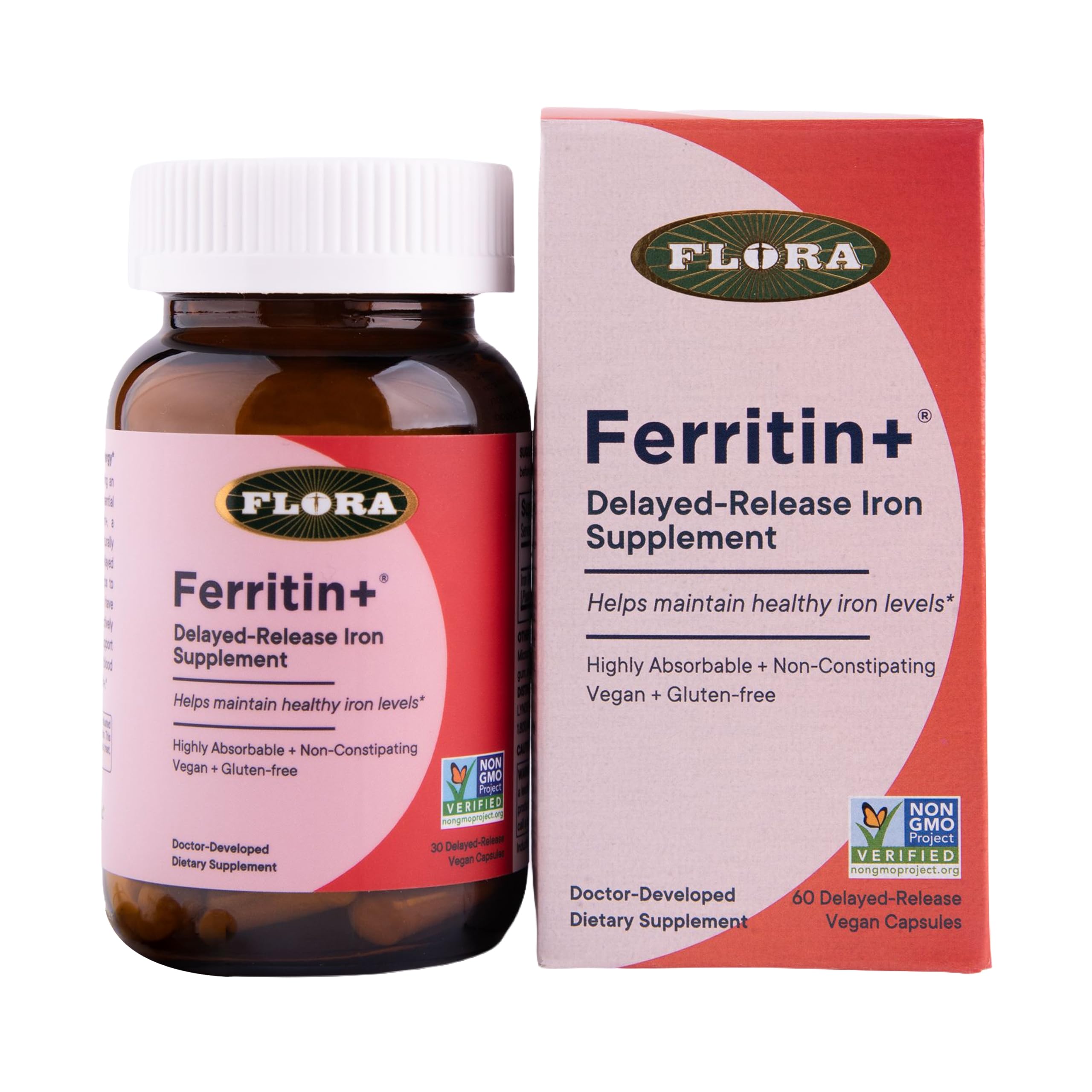
Flora’s Ferritin+ is the plant-based route: a vegan, gluten-free ferritin formula in delayed-release capsules, designed so the iron releases further down your digestive tract instead of all at once. That design is the whole point — it is a non-constipating formula built to answer the specific complaint that iron backs you up, and customers note “no constipation like with every other iron tablet.” In a group where every other pick is a capsule of iron salt, this 30-capsule bottle is the one a plant-first buyer reaches for.
Reviewers describe ferritin and hemoglobin gains within weeks, unusually fast for a low-dose iron. One reviewer reports a 71-year-old no longer anemic after one month. Another with third-trimester anemia saw ferritin rise from 5 to 21 in a week, hemoglobin stabilize and dizziness disappear. A third with fibroids credits better absorption than straight iron, plus hair regrowth at the edges. What ties those stories together is that the formula leans on natural ferritin rather than a heavy synthetic salt — and note that it contains no added vitamins, so add your own vitamin C if you want it in the same capsule.
Two things to weigh before ordering. First, the bottle holds 30 veg capsules, the smallest count on this page — the shortest run here, so buy with the daily serving in mind. Second, the packaging draws complaints: reviewers point out the blister pack is extremely thick paper over foil, the capsules can break, and getting one out means cutting with scissors every single day. The pills themselves are easy to swallow, odorless and, by all accounts, worth the effort. Plan for that daily ritual, and treat the 30-count as a trial size rather than your supply.
The Case In One Line: a delayed-release, vegan, gluten-free ferritin formula where the most-praised quality is effectiveness and the runner-up is how kind it is to your digestion.
Budget For This: the blister packaging is awkward enough that people cut capsules out with scissors daily, and 30 capsules will not carry you far.
Built for: anyone who wants a plant-based, non-constipating iron and is willing to pay for a gentle delayed-release formula.
One thing to plan around: 30 capsules per bottle means this is a starter supply — the packaging format makes it a daily scissors job.
Know the Specs
Elemental Iron vs. Iron Compound
The milligram number on the front of a bottle usually means elemental iron — the actual usable metal your body gets. So 18 mg on Pink Stork and 5 mg on Kirkman are genuinely different daily doses, even though both are “one capsule of iron.” When you compare supplements for ferritin bottle to bottle, line up the elemental milligrams first.
Chelated Iron and Delayed Release
“Chelated” (bonded to an amino acid) covers iron bisglycinate and Ferrochel, and that bond is commonly chosen for stomach comfort compared with standard iron salts like ferrous sulfate. Delayed release (the capsule holds the iron until it reaches lower down your gut) is a second approach to the same problem, and Flora’s Ferritin+ uses it. Neither term guarantees anything for you personally — the labels themselves say individual responses vary — so start low and watch how your own system reacts.
Common Questions
How much iron should I take for low ferritin?
Is ferritin the same thing as iron?
What is the difference between iron bisglycinate and ferrous sulfate?
Why do these iron supplements include vitamin C?
Can I take iron on an empty stomach?
How long does a bottle of iron capsules last?
Should I take iron every day or every other day?
Are iron gummies as effective as iron capsules?
Can I take iron with my prenatal or multivitamin?
Is plant-based ferritin different from regular iron supplements?
The Bottom Line
If you want one bottle and no second-guessing, the Pink Stork Iron Supplement for Women is the one to take — 18 mg of chelated iron bisglycinate with 50 mg of vitamin C already inside the same capsule, one a day, 60 capsules to the bottle, and a track record of women raising their hemoglobin without the stomach trouble they expected. If you have already had to stop iron once, go the gentler way with the Kirkman Low Dose Iron Ferrochel — 5 mg per capsule, 120 in the bottle, and a hypoallergenic formula built for sensitive systems. And if the capsule itself is the obstacle, the MaryRuth’s Iron Gummies get 100% of the Daily Value of iron, plus vitamin C, into a grape gummy labeled for ages 14 and up.
How we choose
We do not accept paid placement. Every pick is matched to a real buyer and a real use-case; we do not hands-on test units.
Sources
Specifications: manufacturer listings and product documentation. Review insights: verified customer reviews, as of October 2026. Pricing: not shown on this page (it changes often); check the current price via the retailer link.
As an Amazon Associate, Aappliancez earns from qualifying purchases. This does not affect which products we feature.