Disclosure: Some links in this post are affiliate links. As an Amazon Associate I earn from qualifying purchases, at no extra cost to you. Learn more
Specs are compiled from manufacturer listings and verified buyer reviews and can change over time — please confirm the key details on the product page before buying.
If you have a scar, the sun is the one thing that can darken it faster than anything else — so the sunscreen you choose needs to sit still, spread evenly over raised or uneven skin, and not sting when you sweat. The short answer: a mineral formula built on zinc oxide is what you want, because it blocks UVA and UVB right at the surface instead of soaking in, and the picks below cover the full range from a roll-on for squirmy kids to a tinted fluid that blends over redness.
This guide is built by comparing the manufacturers’ published specifications and the patterns across verified customer reviews, so you get each pick’s real strengths and trade-offs instead of marketing spin.
You’ll see how each formula handles texture, white cast, and water resistance on scarred or sensitive skin. Read on for the honest breakdown of the best sunscreen for scars.
Top Picks

How To Choose The Best Sunscreen for Scars
A scar doesn’t behave like normal skin. It’s often smoother, thinner, or raised, which means a lotion that glides over your cheekbone can skip right over the mark or bunch into the edges of it. That’s why the format — stick, roll-on, or fluid — matters as much as the SPF number on the tube.
Mineral versus chemical filters
A mineral sunscreen uses zinc oxide or titanium dioxide to bounce UV rays away at the skin’s surface. A chemical sunscreen uses filters that absorb into the skin before they block rays. On scarred or healing skin, many buyers prefer the mineral route because the barrier stays on top and the ingredient list stays short. Every pick here is mineral-based.
Match the format to the scar’s location
A scar on your shoulder or the back of a hand is easy — any lotion works. A scar on your lip, ear, or nose needs a stick you can aim precisely. A scar on your face that you cover with makeup needs something that layers without pilling. Choose the format that reaches the scar first, then compare SPF.
White cast is the trade-off you’re signing up for
Zinc oxide is a white powder at heart, so a mineral formula either leaves visible white residue or adds tint to hide it. A pure white zinc stick shows up boldly. A tinted moisturizer blends the same protection into skin-tone pigments. Decide whether you can live with visible white or need tint before you buy.
Check the reapplication window
Most mineral formulas here ask for a fresh layer at least every 2 hours, and sooner after swimming or heavy sweating. A scar that gets daily sun exposure needs you to actually keep that schedule, not just apply once in the morning.
Side-by-Side Comparison
| Model | Best For | SPF | Format | Water Resistance | Amazon |
|---|---|---|---|---|---|
| Sun Bum Baby Bum Mineral Roll-On★ Best Overall | Kids and large scar areas | SPF 50 | Roll-on lotion | — | Amazon |
| Sun Zapper Extreme Zinc StickSpot Coverage | Lips, ears, and spot coverage | SPF 50+ | Solid stick | 4+ hours | Amazon |
| Beauty by Earth Mineral Face Sunscreen | Daily face wear under makeup | SPF 50 | Fluid tube | — | Amazon |
| DRMTLGY Physical Tinted Moisturizer | Blending over redness | SPF 44 | Tinted cream | 80 minutes | Amazon |
| Avène Mineral Multi-Defense Fluid | Sensitive and acne-prone faces | SPF 50+ | Fluid tube | — | Amazon |
Detailed Reviews
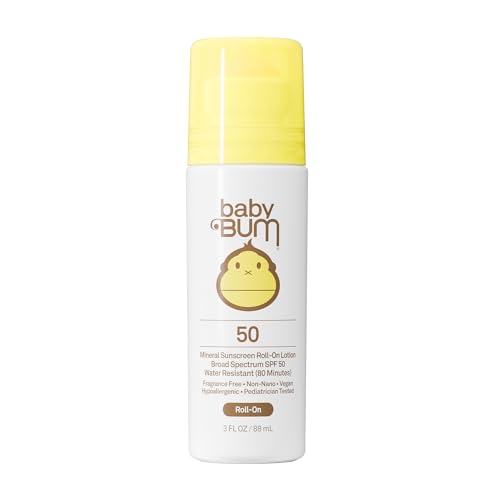
1. Sun Bum Baby Bum Mineral SPF 50 Roll-On Sunscreen
Our pick — 4.5+★ from 850+ verified ratings; the strongest balance of quality and price.
A roll-on tube that spreads SPF 50 over a scar without needing a second hand to squeeze.
Getting sunscreen onto a scar on a wriggling toddler — or onto the back of your own shoulder — is half the battle. This 3 oz roll-on solves that by turning application into a glide: you press the roller and it lays down a mineral SPF 50 film, which the maker builds on zinc oxide plus titanium dioxide with coconut oil, shea butter, and cocoa butter to keep the skin underneath conditioned. The easy-apply win is the thing people talk about most, and it’s easy to see why when you’re chasing a two-year-old.
What makes this the pick for scars is the texture. It’s a lightweight, moisturizing base that spreads by hand after you roll it on, so you can work it into the edges of a scar rather than leaving a stripe. The formula is also vegan, cruelty-free, gluten-free, and dye-free, with no oxybenzone or octinoxate — which suits delicate or sensitive skin. The maker asks you to reapply after 80 minutes of swimming or sweating, after toweling off, and at least every 2 hours, so it keeps a realistic schedule for a day in the sun.
The catch is the one mineral sunscreens always carry: some white residue stays behind even after you rub it in. It’s less ghostly than many zinc formulas, and buyers report it blends into a soft layer rather than a paste, but on a dark skin tone you will see it. The 3.1-ounce tube is also on the small side for daily full-body use. Sized against the Sun Zapper Extreme stick’s 0.53 ounces, this carries a 3.1-ounce fill, so a scar on a small area will last you a long time while a full back-and-shoulders job will go through it faster.
Where the roll-on wins
- Roller head spreads SPF 50 one-handed over squirmy kids and hard-to-reach scars
- Zinc oxide and titanium dioxide only — no oxybenzone or octinoxate
- Coconut oil, shea and cocoa butter keep delicate skin from drying out
- Unscented and dye-free, which suits reactive skin around a scar
What to expect before you buy
- Some white residue remains even after rubbing in, especially on deeper skin tones
- 3 oz tube empties quickly with full-body daily use
- Reapply after 80 minutes of swimming or sweating — not a set-and-go formula
Grab this one for: kids, wriggling toddlers, or any scar on a body part you can’t easily reach and rub yourself.
Rather not: if you need an invisible finish on your face every morning — the tinted creams below hide the white cast better.
2. Sun Zapper Extreme SPF 50+ Zinc Stick White 15g
A pocket-sized white zinc stick built to survive surf, sweat, and a hot car.
A scar on your lip, your ear, or the tip of your nose is impossible to protect with a runny lotion — it slides right off. That’s where a solid stick earns its place. The Sun Zapper Extreme lays down a dense shell-white zinc oxide layer you can see, so you know exactly where you’ve covered. Its defining feature is 4+ hours of water resistance: the wax-and-mineral base physically grips the skin instead of sitting in a film that rinses off after one swim.
At 0.53 ounces it’s tiny — a full 5.8x smaller than the Sun Bum roll-on’s 3.1 ounces — but that’s the point. It vanishes into a pocket, a surf bag, or a glovebox, and the maker says it won’t melt or leak in a hot car, which is the failure most sunscreen sticks have. There’s no oxybenzone in it, and it’s enriched with aloe vera to settle skin after salt-water exposure. Australian-made, it’s been sold to surfers and outdoor athletes in over 40 countries since 1995, and the white coverage is bold on purpose.
That boldness cuts both ways. This is the classic lifeguard look, not a subtle finish, so a scar on your face will read as a white patch. Owners mention it holds up through real sun — one Florida buyer used it on lips and ears and came away without the usual blisters. Pairing it with a tinted SPF over the top is a common trick if you want coverage without the ghost-white. The other honest note: the dense formula takes a bit more blending than a lotion, and a few buyers found it wasn’t quite what they pictured on first use.
The 5.8x factor: You’re trading volume for portability and staying power. The 0.53-ounce stick is barely wider than a thumb, so it lives in a pocket without a thought, and the wax base holds through repeated wave impacts where regular sunscreen gives out after one set.
The honest catch: That chunky white finish is the trade-off for the water resistance. If you want your scar to disappear under makeup, this isn’t that product.
Made for: surfers, swimmers, hikers, and anyone with a scar on a spot that needs precise, stay-put coverage like lips, ears, or nose.
Look elsewhere for: an invisible everyday face finish — the tinted picks below are built for that.
3. Mineral Face Sunscreen SPF 50 – Non-Nano Zinc Oxide
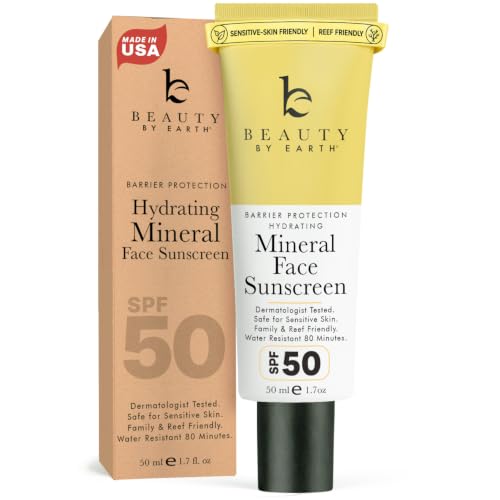
A face-first fluid that is designed to keep the white cast down while still going fully mineral.
For a scar on your face that you have to look at in the mirror every morning, the goal is protection that disappears. This fluid runs on non-nano zinc oxide — the particles aren’t ground fine enough to absorb into skin, so the barrier stays where you need it — with no chemical filters at all. It’s SPF 50 broad spectrum, so it covers both UVA and UVB rays, which are the two that darken a scar in the first place.
What wins people over here is the finish. The maker builds it to smooth on without a heavy or greasy feel, and buyers back that up: it layers under makeup without pilling, evens out tone and post-sun damage, and suits skin that breaks out easily. It’s made in the USA with organic, natural ingredients and none of the reef-harming UV filters, and the maker lists it as fitting acne-prone skin. That matters if your scar sits next to active breakouts and you can’t afford to clog anything.
The maker calls it dermatologist-recommended and markets it for discoloration, the same darkening concern a scar raises. The tube is small and portable. Weighing it against the Sun Zapper stick: both are mineral, but this fluid is 0.63 ounces against that stick’s 0.53 ounces, so it has slightly more product while still being a face-sized carry.
Why faces like it: It spreads easily, reads soft and natural rather than shiny, and handles the sun-block job without a chemical filter load — good if your scar sits on skin that reacts to fragrance or heavy creams.
The honest trade: No white cast is the goal, but “no white cast” in a mineral formula is never a hard guarantee on every skin tone. Also, SPF 50 daily-face use means that small tube gets used up.
Right for you if: you want a mineral SPF 50 for the face that plays nicely under foundation and won’t clog acne-prone skin around a scar.
Skip if: you need the 4-hour water resistance of a stick for ocean days — this is a daily-wear fluid, not a surf formula.
4. DRMTLGY Physical Tinted Moisturizer SPF 44

A tinted mineral cream that covers redness while it blocks the sun.
Scars and redness go together, and a white mineral layer only makes a mark stand out more. This tinted moisturizer takes the opposite approach: it’s a mineral SPF 44 built with iron oxides, which give it actual skin-tone color instead of a ghost layer. You get sun protection and a bit of coverage in one step, and the iron oxides also help guard against pollution and free radicals, per the maker’s description.
The filter set is physical, guarding against UVA/UVB, infrared, and blue light, and the formula is water-resistant for up to 80 minutes. It carries hyaluronic acid and vitamin E for hydration, and buyers on the drier side of the spectrum describe it as genuinely moisturizing, blending over rosacea redness and settling into a natural look. It wears alone or under foundation without the foundation sliding around. If your scar sits on a cheek or near the nose where you’re already using a base, this saves you a step.
One thing to know about tinted formulas: the color has to match, and the trade is coverage. This adds slight color rather than full camouflage, so a very dark or very raised scar won’t vanish — it softens. A few users find it leaves a shine depending on how much you use, and the package being 1.7 ounces means a daily face commitment drains it over time. Measured against the Sun Zapper’s 3.66 inches, this DRMTLGY package runs 6.18 inches, so it’s the larger of the two to store, though it’s still a slim tube for a bathroom shelf.
What it fixes
- Iron oxides add skin-tone color that blurs redness instead of broadcasting white
- Water-resistant for up to 80 minutes for humid or sweaty days
- Non-chemical filters that don’t sting the eyes when you sweat
- Moisturizing base — hyaluronic acid and vitamin E keep skin from drying
Where it stops
- Light coverage, not full concealment — prominent scars still show
- Can read shiny on oily skin if you apply heavily
- Shade match matters; the single tint won’t suit every tone
Best matched to: anyone who wants their scar’s redness softened and their face protected in a single tinted step, especially dry or mature skin.
Pass if: you need full-coverage concealing over a dark scar, or a pure white-free mineral layer in a color that matches your exact tone.
5. Avène Mineral Sunscreen Multi-Defense Fluid SPF 50+

A 100% mineral fluid from a French pharmacy name, aimed straight at reactive skin.
When a scar sits on skin that reacts to everything, the ingredient list becomes the deciding factor. Avène’s formula is 100% mineral filters with broad-spectrum SPF 50+, free of oxybenzone and octinoxate, and it’s fragrance-free. The maker states it carries National Eczema Association and Skin Cancer Foundation approvals — a signal it’s aimed at eczema-prone, sensitive skin. It’s also built as a multi-defense shield against pollution and blue light, and the maker says it helps improve visible redness and skin tone.
The quality of the formula is what earns the most praise — it’s a watery physical fluid with a short additive list, described as pure and effective. One buyer’s review points out the filter set (including niacinamide, allantoin, vitamin E, and bisabolol) alongside the fragrance-free, alcohol-free build. Apply it to the face and neck 15 minutes before sun exposure, then reapply every 2 hours and after swimming or sweating.
Here’s what to know before you commit. Customers note a slight white cast on facial hair, some find the watery texture tricky to apply without over-dosing, and a few say it stings their eyes — so keep it off the lids. The smell draws the harshest notes, and price is a recurring complaint, though the formula is described as going a long way. At 900+ ratings on a 4.3 it’s a well-tried formula, but if you’re scent-sensitive, sample first.
The sensitive-skin argument: Short, fragrance-free, alcohol-free, 100% mineral, and aimed at eczema-prone skin per the maker’s statement — a lot of barriers cleared for reactive skin.
What it asks of you: A watery texture rewards a light hand, the scent isn’t for everyone, and it runs on the expensive side for daily use.
For the sensitive set: eczema-prone, acne-prone, or reactive skin where a fragrance-free 100% mineral fluid is the whole point.
Think twice if: you’re sensitive to scent or need a formula you can slather without rationing.
Know the Specs
SPF rating
SPF measures how well a formula blocks UVB rays, which are the ones that burn you. A higher number means a longer margin before burning shows up. On a scar, the goal isn’t just avoiding a sunburn — it’s keeping UVA and UVB rays off the mark so it doesn’t darken over the summer. All five picks here run from SPF 44 to SPF 50+, and “broad spectrum” means it covers UVA as well as UVB.
Mineral filters
Zinc oxide and titanium dioxide are the two mineral filters. They sit on the skin’s surface as a physical barrier rather than absorbing in like chemical filters. That surface barrier is why mineral formulas can leave white cast, and it’s also why they’re often chosen for sensitive or reactive skin near a scar. “Non-nano” means the particles are large enough that they don’t absorb into the skin.
Water resistance
Water resistance is measured in how long the protection holds up while swimming or sweating. The Sun Zapper stick lists 4+ hours, and the DRMTLGY tinted cream lists up to 80 minutes. Formulas without a stated water-resistance window still ask you to reapply after swimming or heavy sweating — treat the 2-hour rule as the ceiling, not the goal.
Iron oxides and tint
Iron oxides are the mineral pigments that give a tinted sunscreen its color. They match it to skin tone so the white cast of zinc is hidden, and they also add a layer of visible-light protection. A tinted pick is the answer when a scar’s redness needs softening, while an untinted one is the answer when you want the purest mineral barrier without color-matching concerns.
Common Questions
Does sunscreen really help a scar fade?
Should I use mineral or chemical sunscreen on a scar?
Can I put sunscreen over a fresh scar?
How often should I reapply sunscreen on a scar?
Will a tinted sunscreen hide my scar?
Is SPF 50 better than SPF 44 for scars?
Which sunscreen is best for a scar on my lip?
Does mineral sunscreen leave a white cast on scars?
Can kids use sunscreen on scars?
How long will one tube of sunscreen last on a single scar?
The Bottom Line
For most scar areas, the sunscreen for scars winner is the Sun Bum Baby Bum Mineral Roll-On because its SPF 50 mineral formula spreads one-handed over any scar, kid or adult, without needing a second pass. If you want protection that stays put through water and sweat on a lip, ear, or nose, reach for the Sun Zapper Extreme Zinc Stick and its 4+ hours of water resistance. And for a face scar where redness needs softening under makeup, the DRMTLGY Physical Tinted Moisturizer does the sun block and the color in one step. My one nudge: if your skin reacts to everything, the fragrance-free Avène formula is worth the extra spend — its review pages back that with more than a thousand ratings behind it.
How we choose
We do not accept paid placement. Every pick is matched to a real buyer and a real use-case; we do not hands-on test units.
Sources
Specifications: manufacturer listings and product documentation. Review insights: verified customer reviews, as of October 2026. Pricing: not shown on this page (it changes often); check the current price via the retailer link.
As an Amazon Associate, Aappliancez earns from qualifying purchases. This does not affect which products we feature.