Disclosure: Some links in this post are affiliate links. As an Amazon Associate I earn from qualifying purchases, at no extra cost to you. Learn more
Specs are compiled from manufacturer listings and verified buyer reviews and can change over time — please confirm the key details on the product page before buying.
The walls buzz, the pictures rattle, and the downstairs neighbor starts knocking during movie night — and your subwoofer is not actually too loud. The real problem is that it is bolted to your floor by vibration. A subwoofer isolation pad puts a dense, decoupling layer between the cabinet and the room surface. That way the bass energy goes into the air where you want it, not into the building structure where you do not.
This guide is built by comparing the manufacturers’ published specifications and the patterns across verified customer reviews, so you get each pick’s real strengths and trade-offs instead of marketing spin.
Some platforms are sized for 8-inch boxes. Some are puck-style feet that suit huge cabinets. Others are weight-rated mounts that need a little math before you buy. Each pick below is matched to a real room and a real subwoofer. Here is the honest shortlist of the best subwoofer isolation pad options for tighter bass and quieter floors.
Top Picks


How To Choose The Best Subwoofer Isolation Pad
Most people buy a pad that is too small or too soft for their cabinet. A subwoofer heavier than the pad’s rating squashes the foam flat. A flattened pad stops isolating and passes vibration straight through. Match the load rating and the footprint first, then worry about the finish.
Start With The Footprint, Not The Foam
A platform works best when your subwoofer’s feet sit fully inside the top plate with a little margin to spare. Measure the width and depth of the cabinet base before you order. A down-firing sub (a sub whose driver fires downward) is the fussiest case, because the driver fires straight at the platform surface and needs clear breathing room around it.
Then Check The Load Rating Against Your Cabinet
Every platform and puck in this list carries a published weight capacity. A foam platform rated to a hundred pounds or more suits typical home-theater boxes. Individual pucks are rated per unit (each one on its own), so you multiply by how many you use. Three pucks rated at six pounds each carry eighteen pounds together — so heavy cabinets need either more pucks or a higher-rated puck.
Platform Versus Feet: Pick By Room, Not By Hype
A full platform spreads the load across a wide panel and lifts the cabinet a couple of inches off the floor. Feet and pucks replace or sit under the existing feet and barely change the cabinet’s height. If your subwoofer already has threaded inserts (screw holes built into the base), screw-in feet are the tidier route. If it does not, a platform or adhesive-backed puck is the practical answer.
Think About What The Pad Cannot Fix
Isolation tames the vibration that travels through the structure. It does not silence bass that passes through the air and straight into your neighbor’s wall. Expect the boom to tighten, the rattles to quiet down, and the deep room shake to ease — not to disappear entirely at wall-shaking volume.
Side-by-Side Comparison
| Model | Best For | Type | Footprint / Size | Load Capacity | Amazon |
|---|---|---|---|---|---|
| Sound Addicted VibeBoss P10★ Best Overall | Most people with an 8–10 inch sub | Foam + MDF platform | 13.7″ x 15.7″ x 2.5″ | 165 pounds | Amazon |
| Auralex SubDude-IIApartment Saver | Apartment dwellers fighting floor transfer | Platform | 15″ x 15″ x 1.75″ | — | Amazon |
| Pyle PSI21 | Wide cabinets and studio monitors | Foam + steel top plate | 22.3″ x 15″ x 3″ | 100 pounds | Amazon |
| Sound Addicted VibeBoss P12 | 12–15 inch large subwoofers | Foam + MDF platform | 20″ x 17″ x 3″ | — | Amazon |
| SVS SoundPath Isolation System | Subs with screw-in feet | Elastomer feet, 6-pack | 40 mm height | — | Amazon |
| IsoAcoustics Orea Bordeaux | Components and cabinets needing exact load math | Isolator, single unit | 2.6″ x 1.4″ | 32 pounds per unit | Amazon |
| IsoAcoustics Iso-Puck Mini | Bookshelf speakers and light gear | Isolator puck, 8-pack | 1.7″ x 0.9″ | 6 pounds per unit | Amazon |
Detailed Reviews
1. Sound Addicted VibeBoss P10
Our pick — 4.5+★ from 400+ verified ratings; the strongest balance of quality and price.
The platform that fits most living rooms and actually quiets a walking subwoofer.
The 165-pound load rating is why this takes top spot — it keeps the foam working instead of squashing flat under a heavy cabinet. If you run a normal 8, 9, or 10-inch sub in a living room or home office, start here. The Sound Addicted VibeBoss P10 is a sandwich build: high-density foam, an EVA layer (a firm plastic-like sheet), and a rigid MDF board on top. It measures 13.7 by 15.7 inches across and 2.5 inches tall. That MDF top plate is the part that matters. It gives the cabinet something flat and stiff to sit on, while the foam underneath flexes and eats the vibration headed for your floor.
The headline spec is the load rating: 165 pounds. That is enough headroom for a heavy cabinet, so the foam does not collapse into a flat brick. Buyers report a dual-12-inch down-firing sub sitting in a non-rigid server cabinet stopped rattling and stopped its slow “walking” across the floor once it sat on this platform. Down-firing drivers are the hardest case, so that is a genuine win. A Yamaha HS8S owner found the platform restored the gain knob to 12 o’clock, with cleaner, crisper bass and less boom, after dialing it back to 9 o’clock on a bare floor. As that buyer put it, the isolation brought back the clarity they were missing.
What wins people over beyond the numbers is how decisively it stops physical movement. Cabinets stop creeping, shelves stop buzzing, and the bass tightens up because the energy no longer leaks into the joists (the floor beams under your room). The catch is honest and simple. It is a fair bit larger and pricier than a basic foam slab, and it lifts your cabinet 2.5 inches off the ground, which you will notice if your sub tucks into a tight media niche. Also, once the floor rattle is gone, you may suddenly hear furniture rattling that the floor noise used to mask. That is the room talking, not the platform failing.
What Earns Its Place
- 165-pound load capacity keeps the foam working instead of squashing flat under heavy subs
- Rigid MDF top plate spreads the cabinet weight evenly across the foam
- Non-slip base keeps the platform anchored on hardwood and carpet alike
- Fits the universal 8-to-10-inch size bracket that most home setups fall into
Where It Gives Ground
- 2.5 inches of added height can crowd a tight cabinet niche
- Full decoupling means once the floor noise drops, other room rattles become more noticeable
- Substantial footprint rewards a quick tape-measure check before ordering
The straightforward buy: if your sub is 8 to 10 inches and you want the vibration gone without fussing over screw threads or weight math, this earns top spot.
Check the tape first: confirm 13.7 by 15.7 inches of clear floor space and 2.5 inches of vertical clearance before you commit.
2. Auralex Acoustics SubDude-II
The thin platform that turned a landlord complaint into a movie night.
At just 1.75 inches tall, this is the pad that slides under a cabinet without changing how your room looks — and that low profile is why it earns its spot. The Auralex SubDude-II is the pick when your problem is not the bass itself but the person on the other side of the wall. It is a 15 by 15-inch platform using an inert structural layer with a velour top surface (a soft, fabric-like grip) to hold the sub and break the path to the floor.
Where this one earns its reputation is real-world peacekeeping. Owners mention an owner running a Shockwafe 9.2.4 system with dual 10-inch woofers could finally push the bass settings up to 3 at volume 34 without trouble, after being capped at 1 for fear of the downstairs complaint. That is the whole value of this pad: you get your bass back. The construction is a mixed bag, though. The base is a packing-grade foam, and there are fair questions about how well it holds up long term. The velour top grips a cabinet well but collects dust. One buyer also put it under a turntable and found it “tightened up the sound,” which tells you how broadly it decouples.
Compare it to the VibeBoss P10 and the trade-off is clear. The Auralex sits lower at 1.75 inches against 2.5 inches, which suits a shallow niche better. It also uses a velour grip surface instead of an MDF plate. You are not getting the same load-rated stiffness the Sound Addicted pad advertises. So if you own a genuinely heavy cabinet, check your sub’s weight against what this foam can take before relying on it.
Why it wins fans: the low 1.75-inch profile decouples a sub without turning your media corner into a riser display, and the apartment results speak for themselves.
The honest trade: its base foam is closer to packing grade than the rigid sandwich builds, so a very heavy sub may want a stiffer platform instead.
Reach for it if: your sub lives on a shared floor and you want the neighbor complaints to stop more than you want a showpiece.
Look elsewhere if: your cabinet is unusually heavy — this thin foam suits lighter boxes best.
3. Pyle PSI21
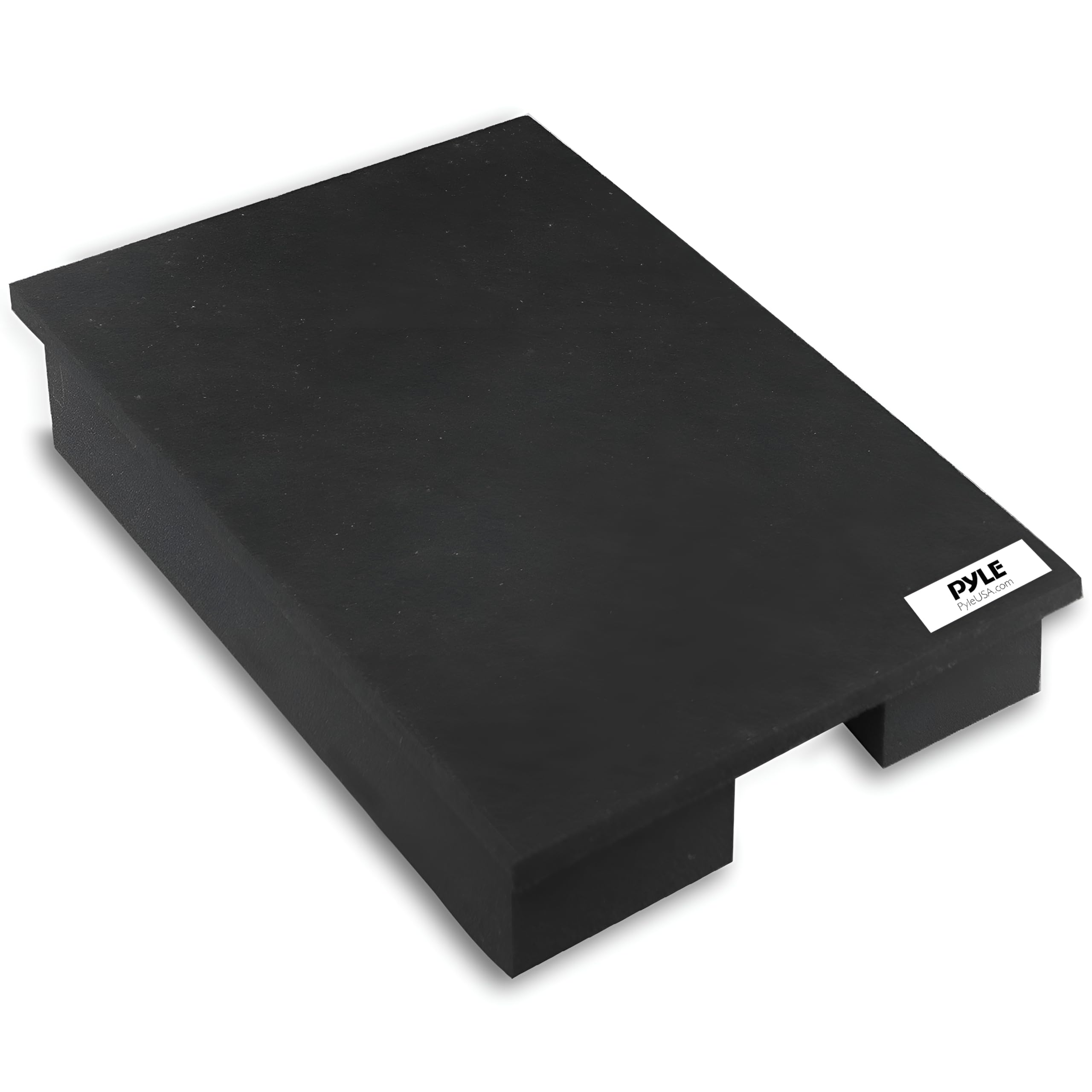
Twice the width, so a stereo speaker or wide sub gets room to breathe.
Twenty-two point three inches of width is what puts this platform here — it is a full 22.3 inches of surface against the 13.7 inches of the VibeBoss P10 above. That is a lot more floor real estate for a wide sub or a pair of studio monitors. The Pyle PSI21 measures 22.3 inches wide by 15 inches deep by 3 inches tall. Under all that sits high-density engineered foam, topped with an anti-slip rubber base and a machined thick steel top plate. That plate gives speakers a sturdy, flat launch pad.
The load rating is 100 pounds, which covers plenty of home cabinets without overpromising. Buyers using it under a Polk PSW 10 subwoofer described it as lightweight but sturdy, holding the weight well and staying easy to move and angle — that rubber base really does keep it put. What earns the most praise is the sound result. Customers note it improves clarity and dramatically reduces vibration in apartments, which is the whole reason you buy one. One owner decoupled a Klipsch R-120sw from a hardwood floor in a second-floor townhome and got less rattle and punchier bass. That same owner noted it reduces vibration rather than eliminating it entirely.
The fair caveat here is the finish and construction feel. Treat it gently and it holds up. Do not expect it to cure a rattling sofa all on its own. It decouples the sub, which is the job, and the rest is room acoustics.
The spread-out advantage: 22.3 inches of width and a steel top plate make this the right call for wide cabinets that would overhang a compact pad.
Be honest about the build: the value and material quality read as mixed, so this is a platform you buy for function and floor coverage, not for a premium feel.
Suits your setup if: a wide sub or a stereo pair needs a broad, stable base and you value floor coverage over plush materials.
Skip the width if: your cabinet is compact — the extra footprint is wasted on a small box.
4. Sound Addicted VibeBoss P12

The wide-shouldered sibling built for the big 12-to-15-inch cabinet in the corner.
If a 10-inch pad would leave your sub’s feet hanging off the edge, the P12’s 20-by-17-inch surface is the reason it made the list. It stretches to 20 inches by 17 inches by 3 inches — clearly larger than the 13.7-by-15.7 footprint of its P10 sibling above — and it is aimed squarely at 12, 13, and 14-to-15-inch subwoofers. It uses the same proven recipe: high-density foam, an EVA material layer, and a sturdy MDF board on top for a flat, stable surface with a non-slip base underneath.
The big box is the whole reason it exists, and buyers confirm it delivers. A 7.4 home-theater owner running a pair of SVS 10 and 14-inch subs on platforms gained better control over sound dispersion and could dial back the mid-bass so more detail passed through the main speakers. Under a KEF KC92 over a carpeted wood floor with a crawlspace, the P12 stripped out the low-frequency resonance traveling through the joists and made the bass tighter and more defined. When the driver fires down at 3 inches of foam and MDF, that physical separation is what stops the floor acting like a drum skin.
The catch to weigh up is footprint and price positioning. At 20 by 17 inches it is a substantial slab, so measure the nook under your cabinet before ordering — a tight media alcove may not have the clearance. Pair it with a lighter cabinet and you are paying for floor space you will not fully use.
Room It Commands
- 20 by 17 inches of surface suited to large 12-to-15-inch cabinets
- MDF top board keeps the foam from deforming under a heavy box
- Non-slip base holds position on carpet and hard floors
- Dense foam plus EVA layer tightens bass and cuts structural resonance
Space It Demands
- Full 20-by-17 footprint needs clearance most compact nooks do not have
- Bigger slab earns its keep only if you actually run a large sub
- 3 inches of lift changes how a cabinet sits in a shallow stand
Built for the big box: this is the platform for a 12-to-15-inch subwoofer that would overflow a smaller pad.
Be sure of your space: if your cabinet alcove is tight, the wide footprint will not fit — measure before you order.
5. SVS SoundPath Isolation System, 6-Pack

Six steel-shell feet that screw straight in and keep your cabinet looking stock.
Six feet that screw into your sub’s existing threaded inserts — and keep your cabinet looking stock — are why this makes the cut when a platform will not do. Each elastomer foot (elastomer is a rubbery material that flexes under load) sits in a durable anodized steel shell and stands 40 millimeters tall. The whole set weighs just 2.7 pounds. You get six ¼-20 by 20 mm screws in the box. If your sub has no threaded holes, you can fall back to double-sided tape or non-abrasive adhesive pads.
The install is where you need to think ahead. A Monolith 15 sub weighing around 130 pounds is a two-person job. You want help tipping it, and you should avoid pressing on the feet or dragging the cabinet across the floor once they are in. Do it right and the payoff is the one buyers keep coming back to. A hobbyist with a sub that used to rattle the whole house found that after adding these, “I still get the powerful bass, but without the rattle.” Another described the bass focus improving and the build quality being obvious — “you can feel the quality in your hand.” The elastomer is what does the work, flexing under load to intercept vibration before it reaches the floor.
Against a full platform like the Auralex or the VibeBoss above, the SoundPath keeps your cabinet’s height and silhouette nearly unchanged, which is its special appeal. The trade is that it leans entirely on existing screw threads. If your sub is a front-firing box with fixed rubber feet and no inserts, this system’s cleanest install is closed off to you, and you are back to adhesive or a platform.
The stealth fix: screw-in elastomer feet deliver isolation without a riser changing how your media corner looks.
Know your cabinet: it works best with subs that accept screw-in feet — anything fixed needs the tape workaround.
Pick this if: your sub has threaded feet and you want the rattle gone with the cabinet looking exactly as it does now.
Pass if: your subwoofer has no screw-in inserts and you would rather not fuss with adhesive.
6. IsoAcoustics Orea Bordeaux

The one you buy by the piece, because the load math decides how many you need.
Each Orea Bordeaux is a single stainless-steel isolator rated at 32 pounds per unit — and because you buy it one at a time, that rating is the reason it earns a spot. You build your own set: three units under a component carry up to 96 pounds together, and four units carry up to 128 pounds. That weight rating is not a gimmick. It lets the isolator compress properly under the exact load it is meant to support, which is how you get genuine isolation instead of a half-squashed pad.
Under a turntable and audio rack, an owner placed one under the cabinet legs and found the vibration cut “to a minimum,” with the music heard cleaner and more open. Another tightened up the bass and stopped tone-arm feedback. The honest footnote is that these are essentially a carefully tuned foam core in a stainless casing, and the price reflects the engineering rather than exotic materials. For anyone happy building their own damping with pool noodles and padding, that value is a real question. But if you want the stiffness-to-weight math already solved for you, this is that solution in one small package.
Compare it with the SVS feet above and the split is clear. Those six feet give you an all-in set, while the Orea makes you count units and match capacity to the component you are isolating. That extra step is the whole point. A correctly weight-matched isolator behaves very differently from a generic rubber foot on a heavy amplifier.
The reward for doing the math: a 32-pound per-unit rating lets you build a set matched to your component’s actual weight for true compression-based isolation.
The fair pushback: value for money divides opinion here, and the core is a foam material in a casing — you are paying for precise tuning, not rarity.
Made for the precise owner: pick it if you are isolating a specific component and want the load rating to govern the setup.
Not for the casual buyer: one unit is not enough on its own — factor in at least three or four before deciding.
7. IsoAcoustics Iso-Puck Mini, 8-Pack

Tiny rubber discs that lift a monitor or a small sub off the desk surface.
At 1.7 inches wide by 0.9 inches tall, these pucks lift a desk speaker without a slab — and the 6-pound per-unit rating is the number to plan around. Three pucks together carry 18 pounds, four carry 24 pounds. You get an 8-pack, so you have enough to spread under multiple pieces of gear. IsoAcoustics tests the design at the National Research Council of Canada, and the goal is to stop the speaker notable the desk or shelf, so the bass stays clean instead of turning the furniture into a second speaker.
Put them under 7-inch studio monitors in a home office and reviewers report the mids and low mids image noticeably better — the kind of clarity improvement that makes you wonder why you waited. Under a KEF LS50 Meta on a desktop, the tone and resonance in the bass and guitar regions sounded more natural. What keeps it grounded is the honest note that the pucks are fussy to reposition, because they tend to fall when you slide a speaker. They can also make bass sound slightly flat, so you may want to nudge placement afterward. And even fans admit cheaper alternatives might get close, which is the fair caveat on the value side.
Set it next to a full platform and the difference is simply scale. A platform spreads a heavy cabinet’s load over a big panel. These pucks are for lighter speakers and sensitive desktop gear, where you want isolation without a slab under everything. Check your speaker’s weight before you load all four on — the 6-pound per-unit rating is firm, not optimistic. This set suits a small desk or a bookshelf rig, and anyone with a floor-standing sub should budget for a rated platform instead.
Where The Mini Shines
- 6-pound per-unit rating suits bookshelf speakers and desktop gear
- Compact 1.7-inch footprint tucks under almost anything
- 8-pack gives you spares for multiple components
- Directional rubber design anchors the speaker and isolates the surface
Fiddly Bits To Know
- Pucks can slip out when you move the speaker, so repositioning takes care
- Bass can sound slightly flat until you re-tune placement
- Value divides opinion — some find cheaper damping gets close
The desktop answer: reach for the mini pucks when a monitor or small bookshelf speaker needs to come off a desk or shelf surface.
Not a floor-sub fix: with a 6-pound per-unit rating, a heavy subwoofer will overwhelm these — use a rated platform instead.
Know the Specs
Load Capacity (Pounds)
The load capacity is the maximum weight a pad or puck can hold while still doing its isolating job. A foam platform rated for 165 pounds will squash and stiffen if you overload it, which stops the flex that absorbs vibration. Pucks are rated per unit, so the total is the per-puck rating times how many you use — three 6-pound pucks carry 18 pounds. Match this figure to your cabinet’s real weight, not a guess.
Platform Footprint And Height
The footprint is the width and depth of the top surface, and it must be at least as big as your subwoofer’s base so the feet stay fully supported. Height matters just as much: a 1.75-inch platform slips into tight niches, while a 3-inch riser lifts the cabinet noticeably. Before ordering, measure both the clear floor space under your sub and the vertical gap above it.
Foam Versus Elastomer Feet
Foam platforms spread load across a wide panel and give you a big surface, so they suit heavier cabinets sitting on carpet or hardwood. Elastomer feet — the screw-in type — are small, flex under load, and keep the cabinet’s look and height nearly unchanged. If your sub has threaded inserts, feet are the tidier route; if it does not, a platform or an adhesive-backed puck is the practical choice.
Decoupling Versus Room Acoustics
Decoupling breaks the physical path for vibration traveling from the cabinet into the floor and walls. That is what a pad can do. It cannot stop bass that travels through the air and shakes your neighbor’s shared wall, and it will not fix a rattling shelf on its own. Expect the floor rumble and cabinet creep to ease, with the bass tightening up as the energy stops leaking into the building.
Common Questions
Will a subwoofer isolation pad actually stop my neighbor hearing the bass?
How do I choose between a platform and screw-in isolation feet?
What weight capacity do I need for my subwoofer?
Will an isolation pad work under a down-firing subwoofer?
Can I put an isolation pad under a front-firing subwoofer instead?
How many IsoAcoustics pucks do I need under one speaker?
Does a foam or velour top surface damage the bottom of my subwoofer?
If the pad does not eliminate the vibration completely, is it still worth it?
Can I use a subwoofer isolation pad under other audio gear?
The Bottom Line
The subwoofer isolation pad that solves the most rooms is the Sound Addicted VibeBoss P10 — a 165-pound load rating, a rigid MDF top plate, and a surface that fits most 8-to-10-inch subs without a tape-measure headache. If you are in an apartment and the complaint is structural rumble, the low-profile Auralex SubDude-II stays only 1.75 inches tall and quietly hands your bass back. And if your sub has screw-in threads, the SVS SoundPath feet hide the fix entirely.
Whichever you pick, measure the footprint, check the weight rating, and set expectations honestly. The floor noise will drop and the bass will tighten, and that is the difference between a home theater and a noise dispute.
How we choose
We do not accept paid placement. Every pick is matched to a real buyer and a real use-case; we do not hands-on test units.
Sources
Specifications: manufacturer listings and product documentation. Review insights: verified customer reviews, as of October 2026. Pricing: not shown on this page (it changes often); check the current price via the retailer link.
As an Amazon Associate, Aappliancez earns from qualifying purchases. This does not affect which products we feature.