Disclosure: Some links in this post are affiliate links. As an Amazon Associate I earn from qualifying purchases, at no extra cost to you. Learn more
Specs are compiled from manufacturer listings and verified buyer reviews and can change over time — please confirm the key details on the product page before buying.
The screw that decides whether your deck, shed or beam frame stays put is not the cheap one in the bargain bin — it is the one whose shank survives the impact driver and whose head refuses to strip halfway through. If a fastener snaps or cams out, you are left with a half-driven stump in expensive lumber and a joint you cannot trust. This guide covers the structural screws that hold their clamping force, resist splitting in treated wood and survive weather, so you can match the right fastener to the job instead of guessing at the hardware aisle.
This guide is built by comparing the manufacturers’ published specifications and the patterns across verified customer reviews, so you get each pick’s real strengths and trade-offs instead of marketing spin.
You will see which screws earn their keep for framing, decking and timber work, and where a budget box is genuinely good enough. Our shortlist of the structural screws worth driving into load-bearing lumber is built on code approvals, drive design and real owner experience.
Top Picks
How To Choose The Best Structural Screws
A structural screw is a fastener built to carry load, not just to hold trim in place. That single distinction drives every choice below — the drive recess, the coating, the shank and the paperwork behind it all matter more here than in ordinary woodworking screws. Buying on length alone is how people end up with snapped heads and joints that creep.
Start with the drive recess, not the price
A star or Torx recess grips the bit at six points instead of the four shallow slots of a Phillips head. That extra contact is what stops the bit from camming out when an impact driver pours on torque. Look for a stated bit size — T30 and T40 recur throughout this category — and confirm the matching bit is either included or easy to source, because a stripped recess turns a good screw into scrap.
Check whether the screw carries a code evaluation
An evaluation report number means an independent body has reviewed the fastener for structural connections. On a permitted deck or a load-bearing beam repair, an inspector may ask for exactly that documentation. If your project is a garden bench or shelving, you can skip this step; if it holds up a roof, you cannot.
Match the coating to the lumber and the weather
Pressure-treated lumber and coastal air both eat fasteners. Manufacturers quote salt-spray test hours to describe corrosion resistance, and a higher number points to a coating built for harsher exposure. Rust stains on a finished deck are the visible symptom of getting this wrong; a weakened connection is the expensive one.
Size the shank to the wood you are joining
Thicker shanks carry more load but demand more driving torque and can split dense hardwood without a proper thread design. Length should reach through the material you are fastening into without poking out the far side. A screw that is overkill in length is just wasted torque, and one that is too short fails to clamp.
Side-by-Side Comparison
| Model | Best For | Size | Drive | Pack Count | Amazon |
|---|---|---|---|---|---|
| GRK Fasteners RSS 5/16 x 4★ Best Overall | Code-approved framing and beam work | 5/16 in. x 4 in. | Torx (star) | 25 PCS | Amazon |
| SG TZH #14 x 4 Lag ScrewsBest Bulk Value | Bulk outdoor builds on a budget | #14 x 4 in. | Torx (T30) | 140 Pcs | Amazon |
| B1jounie YA Structural Lag Screws | Deck and fencing replacements for lags | 1/4 in. x 4 in. | Star (T30) | 100 PCS | Amazon |
| Simpson Strong-Tie SDWS22312DBB-R50 | Visible decorative hardware connections | .220 in. x 3-1/2 in. | 6-lobe T40 | 50-Qty | Amazon |
| Chocikick 300Pcs #14 x 2-7/8 | Big-count decking and fencing kits | #14 x 2-7/8 in. | Star (T30) | 300 Count | Amazon |
| FMhotu #14 x 5 Wood Structural Lag Screws | Long-reach framing through thick members | #14 x 5 in. | Pin-in-Star (T30) | 108Pcs | Amazon |
| LIONMAX #14 x 2-7/8 | High-volume crews and repeat projects | #14 x 2-7/8 in. | Star (T30) | 500PCS | Amazon |
Detailed Reviews
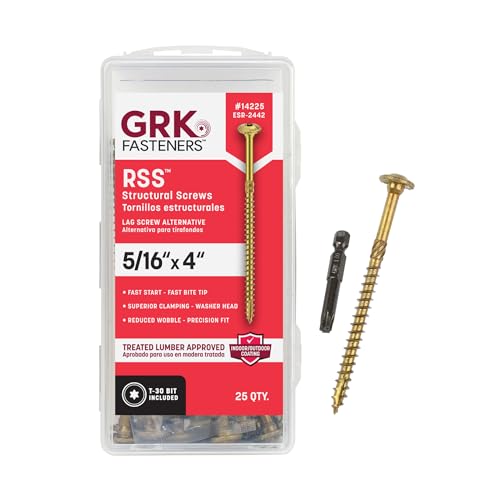
1. GRK Fasteners RSS 5/16 x 4 Framing Screws, 25 PCS
Our pick — 4.5+★ from 950+ verified ratings; the strongest balance of quality and price.
The code-approved framing screw that pulls a multi-ply beam into a zero-gap joint.
It takes the top spot because of its ESR-2442 evaluation as much as its steel. It carries an ESR-2442 evaluation, which means an independent body has reviewed it for structural connections in heavy-duty framing, multi-ply beams and timber framing. On a permitted deck or a load-bearing repair, that report is the difference between passing inspection and tearing a joint apart.
Then there is the driving experience. The W-cut thread is designed to cut installation torque by roughly 40%, and the washer head clamps multi-ply beams into a zero-gap joint. The star drive recess grips at six points, which keeps the bit from wobbling loose mid-drive. Owners describe these as quicker and easier than predrilled lag bolts — one report sums up a near-thousand-screw run where none broke, with only a handful of heads that would not accept the bit cleanly.
Understand the trade-off before you buy: these are not stainless, and GRK sells a separate stainless version for that job. The 5/16-inch shank also asks a lot of a small drill, so use low torque or both hands rather than fighting a spinning tool. And while 25 pieces does the job on a targeted repair, it is a small count next to the 140-screw box further down — the GRK gives you 25 screws against that box’s 140, so you pay for certification and precision rather than volume. At 0.31 inches in diameter, it is also thicker than the 0.16-inch shank on the SG TZH, which is exactly where the extra load capacity comes from.
Where it earns the crown
- ESR-2442 evaluation backs it for structural framing and multi-ply beams.
- W-cut thread trims installation torque by around 40% for smoother driving.
- Washer head clamps hard for zero-gap joints in LVL and engineered lumber.
- Six-point star recess resists stripping and bit wobble.
What to weigh first
- Not stainless — a separate GRK stainless line exists for that need.
- The 5/16-inch shank needs controlled torque; a high-power drill can spin.
- 25 screws per box is a small count for large projects.
Reach for this if: your connection has to satisfy an inspector or carry real structural load in treated lumber.
Think twice if: you are fastening a garden bench and want maximum count per box rather than a certification.
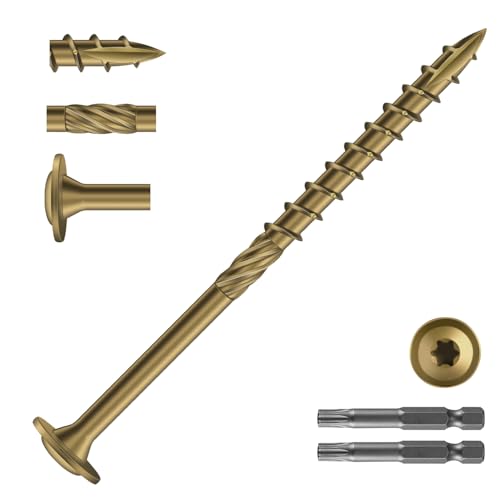
2. #14 x 4 Inch Lag Screws (140Pcs)
One hundred and forty coated lag screws with two bits in the box — the volume play.
If your project is a swingset, a shed wall or a run of deck boards, the math here is simple. You get 140 pieces against the GRK’s 25, with two T30 star bits included so you are not hunting for the right driver. The 4-layer anti-corrosion coating is rated through a 1000-hour salt spray test, enough for treated-lumber swingsets and deck boards.
The shank is thinner than the GRK at 0.16 inches versus 0.31 inches, so this is not the fastener to specify for a multi-ply beam. Where it shines is everyday outdoor assembly on pressure-treated lumber, where the knurled mid-section and the QA2 thread design are aimed at cutting the risk of cracking hardboard. What wins people over is straightforward quality — the top thing buyers talk about — with durability close behind, and the recurring scene is a full swingset assembled on treated lumber without a single stripped head.
The honest caveat is diameter. That slimmer 0.16-inch shank carries less load than the thicker GRK or the 0.22-inch Simpson, so treat this as your general outdoor builder, not your engineered-connection screw. It is also worth verifying your bit fit on the first few drivers, since a worn T30 head is the usual complaint in this price range. As owners put it about a full run: “Ran these through wet and dry logs and lumber, not one snapped or stripped.”
The value read: 140 coated screws plus two T30 bits makes this the box that finishes a weekend project without a second hardware trip, and the 1000-hour salt spray rating covers real outdoor exposure.
Best fit for: the DIY builder joining treated lumber on a swingset, shed or deck who wants count over certification.
Look elsewhere if: the connection is load-bearing and needs a wider shank or a code report.
3. Structural Lag Screws 1/4″ x 4″ 100PCS

The 100-count box built to retire your old lag bolts and carriage bolts.
The design brief here is replacement: heat-treated Grade 5 alloy steel, a modified truss washer head that clamps without a separate washer, and a sharp point meant to start fast. One hundred screws arrive in a reusable plastic box, which sounds minor until you are carrying fasteners up a ladder. Durability is the attribute that carries the most weight with owners, followed by the stability of the joint once seated.
Against the SG TZH above, you trade 40 screws for a stronger claim on break resistance and pull-out strength, and the washer head design is the reason it holds without pulling through the wood. Real projects here run from bed frames and outdoor benches to shed bracing. A fair note from the field: the point does not always bite immediately into hard wood, and a few heads are not stamped cleanly enough for the T30 bit — check your bit seating on the first handful.
One thing to plan around is length. At 4 inches this is overkill for thinner stock, and going down to a 3-inch version is the smarter call for shallow joins. It is also worth confirming your local code on screw versus nail schedules before you commit a whole structure to them. The value comparison is stark — as buyers report, a rival listing charges the same for a 50 count, while this box hands you 100.
What it replaces: traditional lag screws and carriage bolts in decks, fencing, stairs and playsets, with the truss washer head supplying clamping force without an extra washer.
Choose this when: you are upgrading an old lag-bolt build and want a washer head plus a reusable storage box.
Size down first if: your lumber is thin — the 4-inch length is more reach than many joints need.
4. Simpson Strong-Tie SDWS22312DBB-R50 Structural Wood Screw

Black powder-coated structural screws that finish a pergola as neatly as they hold it.
Most structural screws assume they will be buried. This one assumes you will see it. The black DB coating and washer head are made to pair with Outdoor Accents decorative hardware, and it works just as well without the washer as a straight wood-to-wood fastener. If the joint sits in view on a pergola, a run-in shed or a cabin frame, appearance is a real part of the job.
The engineering is not decorative, though. The patented SawTooth point is designed for fast starts and to reduce installation torque, so predrilling is unnecessary in most applications. Under-head nibs give you control as the head seats, and the deep six-lobe T40 recess takes a lot of torque without slipping — the bit comes in the box. Durability leads in owner feedback, and the recurring scene is a run-in shed built from horizontal 2×6 and 2×8 fastened to 4×6 posts without a split.
Where it differs from the GRK at the top: at 0.22 inches in diameter it sits between the slim SG TZH and the heavier GRK, and at 3-1/2 inches it is shorter than the 4-inch options here — so it is a control-and-finish screw rather than a long-reach one. The decorative washer is sold separately, so budget for that if the look depends on it. A large-torque cordless drill can snap an occasional head, so ease off the trigger as it seats.
Why it stands apart
- Black coating and washer head pair with Outdoor Accents hardware for visible joints.
- SawTooth point starts fast and cuts installation torque without predrilling in most woods.
- Under-head nibs control the seat and the T40 recess resists slipping.
The fine print
- The decorative washer is sold separately.
- 3-1/2-inch length is shorter than the 4-inch, 5-inch and 2-7/8-inch picks here for reach.
- Maximum torque on a cordless drill can occasionally snap a head.
Ideal for: the builder who wants the connection to look finished, not just hold — pergolas, sheds and visible framing.
Not the pick if: you need long reach through thick members or do not want to buy the washer separately.
5. 300Pcs #14 x 2-7/8″ Lag Screws
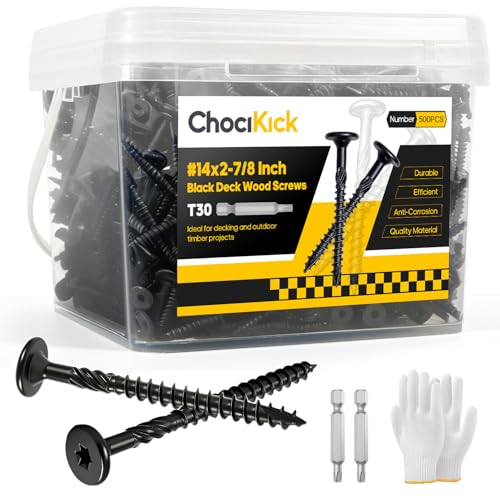
Three hundred black star-drive screws, a bit and a pair of gloves in one heavy box.
This is the package that gets a beginner through a whole decking or fencing run without a mid-project store trip. Three hundred screws, a free T30 star driver bit and a pair of protective gloves arrive together. The coating is built to handle ACQ-treated lumber, the wood where rust stains show up first.
The build is aimed at stubborn boards: a thicker shank and deep aggressive threads are designed to draw warped material flat and keep the joint from working loose. Owners describe exactly that — joints pulled tight and warping removed from the boards. A self-drilling tip means no predrilling on most of this work, and the star drive keeps the bit from slipping out under load.
Two practical points stand out. First, 2-7/8 inches is a decking and fencing length, not a beam-reach length — the FMhotu at 5 inches and the GRK at 4 inches reach far deeper. Second, the box is heavy at 8.6 pounds and the plastic container has been known to arrive split when the packaging lacks padding, so inspect it on delivery. This is also a newer listing with a smaller review base than the established names, which is worth knowing if you value a long track record.
Inside the box: 300 carbon steel screws, a T30 bit and gloves — a complete starter setup for decking, fencing and framing, with a coating rated for ACQ-treated lumber.
Pick it up when: you are outfitting a first deck or fence run and want screws, bit and gloves in one order.
Hold off if: your job needs long reach through thick beams or a longer proven track record.
6. #14 x 5 Wood Structural Lag Screws

Five inches of reach for the 2×8-to-6×6 connections nothing shorter will make.
When the joint is a 2×8 against a 6×6 post, length is the whole story, and 5 inches is the longest here. The 4-layer coating has been through a 1500-hour salt spray test, the most demanding exposure rating in this group, which suits pole barns and coastal timber. A modified truss washer head finishes the joint cleanly and the T30 star drive holds under load.
Driving these is easier than the length suggests. A knurled shank cuts the torque needed, and the sharp threads with a type 17 notched point bite without tearing the wood. Owners describe driving into treated stock and 6×6 posts with no pilot holes, steady pressure, and no stripping or bending. Quality is the attribute praised most, with functionality right behind it, and the recurring scene is driving these 5-inchers through 2×8 into a 6×6 with the joint holding tight.
One design note: the head is smaller than the Simpson structural screw, which is an advantage if you use decorative nuts, since it fits inside them where the larger head does not. That same smaller head is the thing to check if you are matching hardware to a big Simpson washer. The 108-piece count sits in the middle of this group — comfortably above the GRK’s 25 and well below the LIONMAX’s 500.
The reach case: 5-inch length plus a knurled shank that eases torque, in a coating tested to 1500 salt spray hours — the combination for a pressure-treated or coastal timber build.
Best for: framing where 4 inches will not reach, especially 2×8 into 6×6 post work.
Check first if: you are pairing with decorative washers sized for a larger head.
7. LIONMAX Structural Wood Lag Screws #14 x 2-7/8 Inch, 500PCS
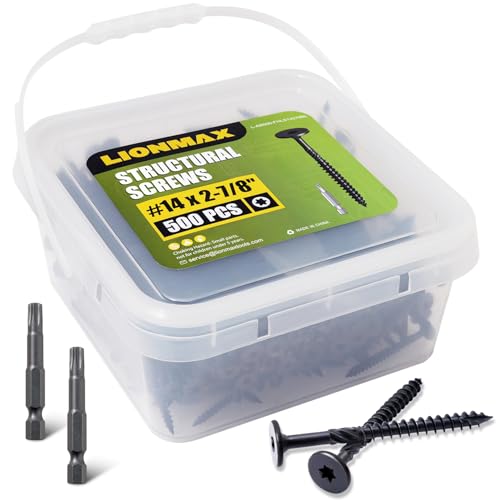
Five hundred screws in a labelled canister — the number that ends mid-job supply runs.
For anyone building a long fence, a porch or a run of shelving, the count is the selling point. Five hundred #14 x 2-7/8-inch carbon steel screws come in a labelled container with two T30 bits, organized so you can see what is left. That canister is itself a small upgrade — owners describe it beating the flimsy card and flat-pack packaging that other brands ship in.
The coating passed a 1000-hour salt spray test, enough for humid-climate fences and porch builds. The flat countersunk head sits flush for flooring and trim work, and the star drive holds its grip. Quality is what people bring up most, and pulling power is the concrete win — 2x4s drawn tight against a surface, 4x4s driven cleanly into a 2×4 side. Owners mention zero stripped heads across the first thirty screws, with the included T30 bit still like new.
What to weigh: a flat head means no washer-face clamping on this one, so for a joint that needs the pull of a washer head, the SG TZH or the Simpson is the better shape. And not everyone should push it into a critical connection — as customers note, one owner would not trust it on “an improve deck” but rates it highly for shelves and wheeled pallets. That is a fit guide, not a warning: for general framing and utility builds, this bulk box is the efficient choice.
The bulk math: 500 screws and two T30 bits in a reusable labelled canister, coated through 1000 salt spray hours — the box that covers a whole multi-week project without resupply.
Go with it if: high volume, flush-finish trim and repeat projects define your work.
Not the one if: you need washer-head clamping or a certified critical-load connection.
Know the Specs
Drive Recess and Bit Size
The recess is the shaped socket in the head where your driver bit sits. A star or Torx recess contacts the bit at six points, while a Phillips head contacts at four shallow slots — which is why a star drive resists camming out when an impact driver pours on torque. Sizes like T30 and the deeper T40 recur in this category because heavier screws need a bigger bit to transfer the load. Always confirm the matching bit is included or easy to find; a stripped recess turns a good screw into scrap.
Salt Spray Hours and Coating
Salt spray testing sprays a fastener with a corrosive mist for a set number of hours to approximate how long a coating survives tough exposure. A 1000-hour rating and a 1500-hour rating both describe corrosion resistance, with the higher number pointing to a finish built for harsher conditions. This matters most with pressure-treated lumber and coastal air, where a weak coating shows up as rust stains or a loosened joint. Match the rating to your exposure rather than paying for more than the project needs.
Shank Diameter and Load
The shank is the main body of the screw below the head. A thicker shank, like 0.31 inches on the GRK, carries more load and resists shearing better than a slimmer 0.16-inch body. That added strength comes with a cost: more torque is required to drive it, and dense hardwood can split without a thread design built to ream. Match the shank to the load your connection actually carries — heavy framing wants the thicker body, general decking is often fine with the slimmer one.
Code Evaluation and Inspection
A code evaluation report, such as the ESR designation on the GRK, means an independent body has reviewed the fastener for structural connections. On permitted framing, an inspector may ask for that documentation before signing off. For a garden bench or a shelf, the report is irrelevant. Know whether your project is permitted before you buy, because choosing a screw without the right paperwork can force a redo the inspector will not pass.
Common Questions
Do structural screws need pilot holes?
Can I use structural screws instead of nails for framing?
What is the difference between a structural screw and a regular lag bolt?
Which screw is best for pressure-treated lumber?
What size screw do I need for a 2×8 into a 6×6 post?
Will a T30 bit fit every screw on this list?
How many screws come in a box for a deck project?
Do these screws rust on an outdoor deck?
Is a thicker or thinner shank better?
Can I use structural screws for a visible pergola joint?
The Bottom Line
For most projects, the pick that earns its position is the GRK Fasteners RSS 5/16 x 4, because its ESR-2442 evaluation, 40% torque reduction and washer-head clamping cover both the paperwork and the driving experience of a real structural connection. If count and budget drive your build, the SG TZH 140-piece box gives you far more screws per job with a 1000-hour coating and two bits included. And where the joint will be seen, the Simpson Strong-Tie Outdoor Accents finishes the work as neatly as it holds it. One honest note to guide the choice: the top pick’s precision and certification are why it takes first place, even though the bulk boxes carry the higher counts.
How we choose
We do not accept paid placement. Every pick is matched to a real buyer and a real use-case; we do not hands-on test units.
Sources
Specifications: manufacturer listings and product documentation. Review insights: verified customer reviews, as of October 2026. Pricing: not shown on this page (it changes often); check the current price via the retailer link.
As an Amazon Associate, Aappliancez earns from qualifying purchases. This does not affect which products we feature.