Disclosure: Some links in this post are affiliate links. As an Amazon Associate I earn from qualifying purchases, at no extra cost to you. Learn more
Specs are compiled from manufacturer listings and verified buyer reviews and can change over time — please confirm the key details on the product page before buying.
If you want one answer fast: the Bialetti Moka Express is the safest bet for most kitchens, because it has been made in Italy the same way since 1933 and still outsells everything else in this shelf. But a stovetop pot is not a plug-in machine. You control the heat, so you control the taste. Get the grind and the flame right and a cheap pot on a gas ring can beat a countertop espresso machine on both flavour and cleanup. Get them wrong and you get a bitter, watery cup with grinds floating in it.
This guide is built by comparing the manufacturers’ published specifications and the patterns across verified customer reviews, so you get each pick’s real strengths and trade-offs instead of marketing spin.
Below you will find the two families that dominate this shelf (pressurised moka pots and circulating percolators), the sizes that actually fill a mug, and where the weak spots are.
Top Picks


How To Choose The Best Stove Coffee Maker
The first decision is not brand, it is style. A moka pot forces hot water up through packed grounds under pressure, which gives you a short, syrupy, espresso-strength shot. A percolator pumps water up a tube and rains it back over the grounds again and again, which gives you a bigger, softer pot of diner-style coffee. Pick the wrong one and no amount of technique will fix it.
Decode the cup number before you order
These pots were never measured in American mugs. A 6-cup moka pot produces six small espresso-style servings, which lands near two generous mugs once you add milk. The COLETTI Bozeman spells its own math out: 9 cups equals 45 fluid ounces, which it calls about four 12 oz mugs. If you drink one large mug each morning, a 6-cup moka pot or a 6-cup stainless percolator is the honest starting point.
Match the metal to your stovetop
Bare aluminum heats fast and is the traditional Italian choice, but it discolours and should be rinsed rather than scrubbed with detergent. Stainless steel costs more and shrugs off dishwasher cycles. Then check your hob, because it decides more than the metal does — the COLETTI Bozeman states plainly that it does not work on induction, and the Bialetti reaches induction only with the maker’s separate adapter plate.
The heat setting nobody warns you about
Most complaints about grinds in the cup trace back to a flame that was too high. Hot water forced through too violently lifts the fine particles past the filter. Medium to low heat, a pot taken off the burner the moment it starts to gurgle, and a grind that sits between espresso and drip will solve it.
Side-by-Side Comparison
| Model | Best For | Style | Stated Capacity | Material | Amazon |
|---|---|---|---|---|---|
| Bialetti Moka Express★ Best Overall | The classic Italian shot | Moka pot | 6 espresso cups | Aluminum | Amazon |
| Primula Classic StovetopBudget Champion | Cuban café at a low spend | Moka pot | 6 espresso cups | Cast aluminum | Amazon |
| Bellemain Stovetop EspressoCompact Pick | One or two drinkers | Moka pot | 6 demitasse cups | Aluminum | Amazon |
| IMUSA 9 Cup Cast Aluminum | Big batches on a budget | Moka pot | 9 cups | Cast aluminum | Amazon |
| Café Brew Glass Percolator | Watching the brew happen | Percolator | 8 cups (40 oz) | Borosilicate glass | Amazon |
| Coffee Gator Moka Pot | Induction hobs | Moka pot | 6 x 60ml cups | Aluminum | Amazon |
| GSI Outdoors Percolator | Campfire mornings | Percolator | 8 cups | Enameled steel | Amazon |
| Farberware Yosemite 12-Cup | Big pots of hot coffee | Percolator | 12 cups | Stainless steel | Amazon |
| COLETTI Bozeman | No aluminum, no plastic | Percolator | 9 cups (45 fl oz) | Stainless steel | Amazon |
| GROSCHE Milano | Handle that stays cool | Moka pot | 9 espresso cups | Anodized aluminum | Amazon |
| Coleman Stainless Percolator | Crowds and power cuts | Percolator | 12 cups | Stainless steel | Amazon |
Detailed Reviews
1. Bialetti Moka Express 6 Cups
Our pick — 4.5+★ from 120,500+ verified ratings; the strongest balance of quality and price.
The pot that invented the category, and still the one to copy.
This is the moka pot every other pot on this page is measured against. Alfonso Bialetti invented it in 1933, and the eight-sided body with the little moustached gentleman on the side has not changed since. It comes in at 4.5+ stars with 100,000+ owners, which for a device that demands you watch a flame is a remarkable showing.
What wins people over is the cleanup, which feels almost wrong for something producing coffee this strong — rinse it out, wipe it down, done. The brew itself takes about ten minutes from cold water, and the result lands smooth rather than bitter. The patented safety valve lifts out easily for cleaning, and the ergonomic handle stays usable while the body heats. It fits gas and electric hobs from the start; induction needs the maker’s separate adapter plate.
Here is the catch. Bare aluminum is a commitment — no dishwasher, no detergent, just water, or the finish dulls and the taste will pick it up. The size also splits opinion: plenty of buyers call six cups perfect for one or two people, and plenty find it small once they start adding milk. And nothing about this pot forgives neglect; leave it on a high flame and you will scorch the base.
What earns the top spot
- About ten minutes from cold water to a full pot
- Smooth, non-bitter extraction without fancy gear
- Three parts that rinse clean in under a minute
- The safety valve lifts out for a proper scrub
What you take on
- No dishwasher and no detergent — water only
- Induction hobs need the adapter plate sold separately
- Six espresso cups reads small once milk goes in
Buy this if: you want the reference Italian shot and you are happy to rinse a pot by hand each morning.
Think twice if: your hob is induction, because this one needs a separate adapter plate to work there.
2. Primula Classic Stovetop Espresso and Coffee Maker (6 Cups)
Six demitasse servings of Cuban-style coffee for the price of two café orders.
The neat trick here is the burner list. This pot runs on electric, ceramic and gas hobs, propane included, which is why it keeps turning up in camping boxes as often as kitchen cupboards. Cast aluminum spreads heat evenly across the base, so the extraction stays consistent from the first cup to the sixth.
What buyers bring up most often is the build — it feels better made than the money suggests, and the quality of the cup backs that up. Preheating the water in the lower chamber cuts the brew to minutes, which is the single fastest fix if you find moka coffee slow. The flip-top lid with its heat-resistant knob and handle makes pouring six cups a one-hand job.
The honest limitation is heat discipline. As owners put it: “Very nice but you MUST boil on medium to low fire or else it does not filter the coffee grinds well so that fine coffee grinds come up and sit on the bottom.” Keep the handle away from the centre of the flame too, because it will melt there. And ignore the dishwasher — hand washing is what keeps this one going.
The burner list is the selling point: gas, electric, ceramic and propane all work, which is more coverage than most moka pots offer at any tier.
The trade-off is technique: a high flame pushes fine grinds straight into your cup, so this rewards a patient cook more than a rushed one.
Reach for this if: you want a proper Cuban or Italian brew at the entry level and you brew on more than one kind of hob.
Look elsewhere if: you refuse to hand-wash, since this pot discolours and rusts in the dishwasher.
3. Bellemain Stovetop Espresso Maker (6-Cup Silver)
A six-cup pot that pours two demitasse cups and asks almost nothing of you.
Bellemain made this one for the small household. It is rated to make up to six demitasse cups of 2 oz each, which is roughly one large serving or two small ones, so it suits a single drinker or a couple rather than a family. The footprint tells the same story — at 4.25 inches deep and 6 inches wide it sits on a small burner without hogging the hob.
Coffee quality is what carries it, and it holds up across roast levels, including light roasts that cheaper pots tend to flatten. The heavy base heats evenly, the handle is generous enough for a full hand, and the threads screw on and off without a fight. A safety valve regulates internal pressure during the brew, and the stay-cool handle and lid knob protect early-morning fingers.
Two things to know before you commit. Brewing runs ten to fifteen minutes, which is the slow end of the moka range. The filter basket also gets fiddly to lift out while it is still wet, so let it cool a moment first. Plan for roughly one big mug per session rather than a round of coffees.
Where it shines: even heat across the base plus an easy screw thread means a consistent cup with very little fuss, and the light-roast crowd rates it specifically.
The honest limit: six demitasse cups is not a party pot, and ten to fifteen minutes per brew is slower than the fastest moka pots here.
Best matched to: one or two drinkers who want a small, tidy pot that handles any roast.
Not the one for: anyone brewing for four, because the capacity tops out around two demitasse servings.
4. IMUSA 9 Cup Cast Aluminum Stovetop Coffee Maker

Nine cups of strong coffee from a pot that costs less than a round of lattes.
If the guest count is the thing that keeps ruining your coffee plans, this is the pot that answers it. Nine cups of brew from a cast aluminum body, with a flip-top lid and an easy-pour spout so you can serve a table without dripping down the side. The polished exterior looks good enough to leave on the hob.
Brew quality is what the happy half of the reviews talk about, and it earns that. The pot pulls a strong, full-flavoured cup while using less ground coffee than you would expect, and it handles Cuban coffee and Italian-style moka with equal ease. The cool-touch handle and even heat distribution do their job on a standard gas or electric burner.
The caution here is durability, and it is the loudest theme in the feedback. Handles have snapped early and seals have come loose after a couple of months for some buyers, and one long-time user describes a clear slide in build quality against older IMUSA pots. Treat it gently, avoid wrenching the handle to tighten the two halves, and it does its job. The honest framing is that this is a big-batch pot at an entry-level spend, not a lifetime heirloom.
Why the big-batch crowd likes it
- Nine cups in one brew, enough to serve a table
- Strong extraction while using less ground coffee
- Cool-touch handle and a spout that pours cleanly
The reputation to weigh up
- Durability is the most-discussed concern, with handles and seals failing early for some
- Value for money and size both split opinion among buyers
The case for it: you need nine cups at once and you want to spend entry-level money doing it.
The case against: you want a pot to last a decade, because the build record here is the shakiest on this list.
5. Café Brew Glass Coffee Percolator, Stovetop, 8 Cup

Clear glass, so you can watch the coffee climb and pull it off at the right second.
The whole point of this one is visibility. The body is SCHOTT DURAN borosilicate glass sourced from Germany, a heat-resistant glass built for stovetop duty, and it brews eight cups by the traditional percolation method. Because nothing is hidden, you can watch the colour darken in the top chamber and lift the pot off exactly when you want to.
Glass asks for care in return. It is a pound and a half of pot, and it will not forgive a careless knock on a hard counter or a sudden temperature change. Give it the diffuser plate every time and store it somewhere it will not get banged, and this is a lovely thing to own.
The reason to pick glass: you get the clearest possible read on brew strength, plus a dishwasher-safe body and a BPA-free basket assembly.
The deal you make: heat-resistant is not unbreakable, so this one wants a diffuser and gentle handling.
Worth it for: brewers who want to see the percolation and who value dishwasher cleanup above ruggedness.
Skip the glass if: the pot lives in a busy kitchen with kids or gets knocked about.
6. Coffee Gator Moka Pot Aluminum, 6 Cup

An aluminum moka pot that actually works on an induction hob.
Induction owners usually get left out of the moka party, and this pot fixes that — it runs on gas or an induction hob without an adapter plate. The matte grey body holds six 60ml cups, which is 12 oz of finished espresso-style coffee, and the traditional design pushes water up through the grounds to leave a genuine crema on top.
Premium aluminum with a steam safety valve and a cool-touch handle covers the basics properly, and the quality of the build is the thing that reads best across the feedback. Cleaning is a rinse, nothing more. The bonus pair of stainless-steel cups is a genuinely useful extra — they are double-walled with a vacuum layer that keeps your coffee warmer for longer, so the pot arrives ready to serve.
Size is where opinions diverge. Six 60ml cups is a modest pour, and while some buyers find it sensible for a single drinker, others call it very small once milk is involved. Buy with that in mind rather than expecting a family pot.
The standout: induction compatibility in an aluminum moka pot, which is rarer than it should be and saves you buying an adapter.
The maths to do first: six 60ml cups is 12 oz total, so a household of two milk-drinkers will want a bigger pot.
The obvious match: anyone cooking on induction who wants a real moka brew without buying extra hardware.
Look at a larger size if: you’re serving two people who both take milk.
7. GSI Outdoors Percolator Coffee Pot, 8 Cup Enamelware
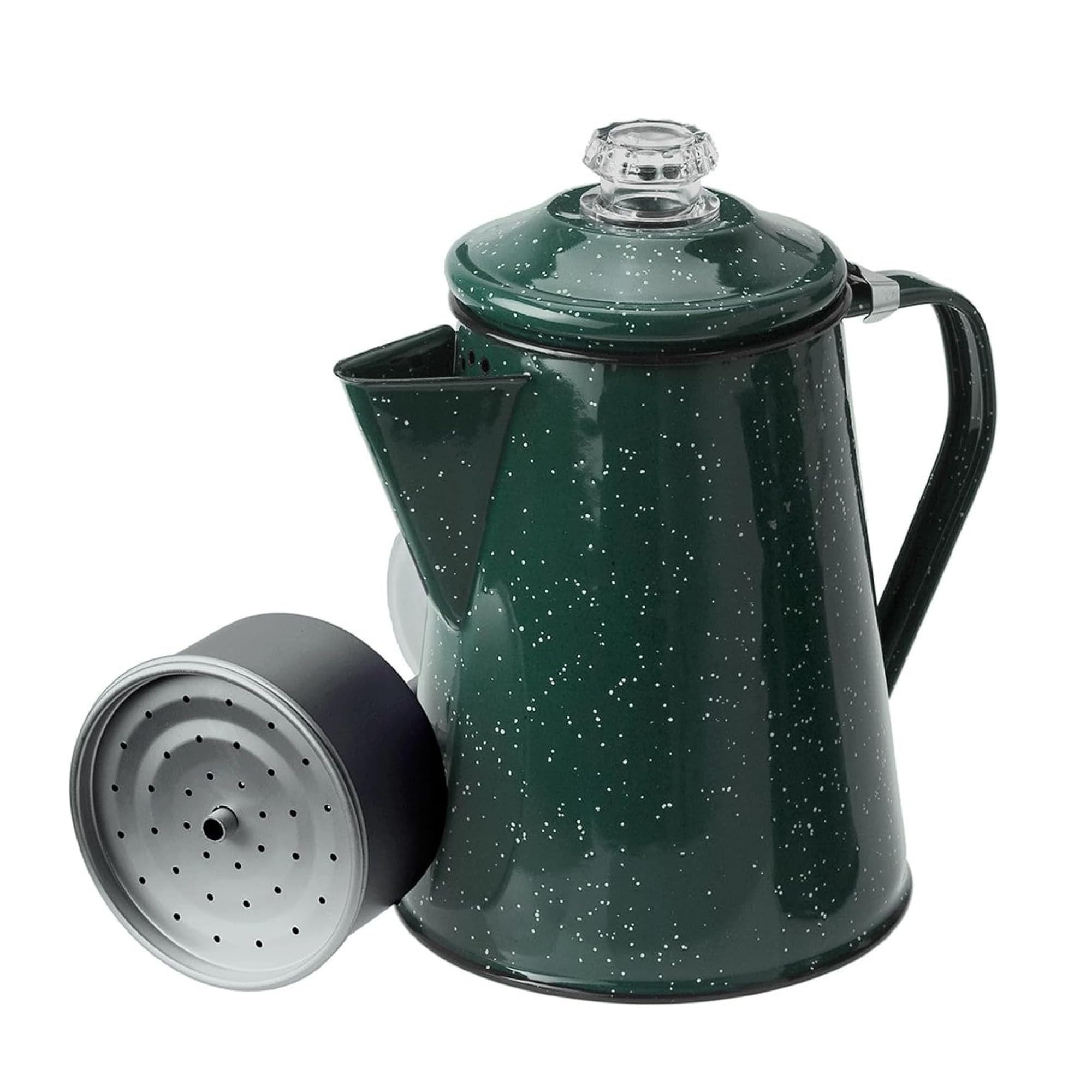
Built for a campfire, with a glass knob so you can watch the percolation.
This one is honest about its home. It is an eight-cup percolator in enameled steel, made to sit over a campfire, a grill or a stove, and it weighs 1.3 pounds so it earns its place in a pack. The heat-resistant silicone handle lets you pour without a glove on, and the clear PercView knob shows the brew cycle so you can cut the heat at the right moment.
Seven minutes of percolating is the number the happy owners land on, and the coffee stays hot longer than you would expect from a thin-walled pot. No paper filters are needed, the parts come apart without tools, and GSI backs it with a lifetime warranty against material and workmanship defects. Its looks are a big part of the appeal — the enamel finish is the kind of thing people leave on display.
Fair warning on the internals. The basket lid does not seal tightly, so a hard boil can push grounds up into the pot, and the lid clip has broken on some units. The enamel coating can chip and rust with rough handling. The “8 cups” reads as eight 6 oz measures, which is nearer four good mugs. Treat the fittings kindly and it serves you for years of campsite mornings.
What campers keep coming back for
- Seven-minute percolation and coffee that stays hot
- 1.3 pounds, easy to pack and easy to pour
- Lifetime warranty against material and workmanship defects
Where the corners are cut
- Basket lid does not seal, so a hard boil lifts grounds into the pot
- Enamel can chip and rust with rough handling
- Eight cups equals eight 6 oz measures, roughly four mugs
Made for: campers and cabin owners who want a rugged pot with a lifetime warranty behind it.
Not made for: rough packing and a roaring boil, which is where the enamel and the basket lid give out.
8. Farberware Classic Yosemite 12-Cup Percolator

Twelve cups of coffee that comes out genuinely hot, not merely warm.
Temperature is the thing that gets people started on percolators, and this is the pot that converts them. It makes twelve cups at six ounces each — roughly three mugs — and holds that heat for hours on the hob. The body is heavy-duty stainless steel polished to a mirror finish, with a clear glass knob so you can see when the perk starts.
The permanent metal filter basket means no paper filters to buy and nothing to bin after the brew. Everything is fully immersible and dishwasher safe, which puts it well ahead of the aluminum moka pots for upkeep. The stem is wide enough that hard-water minerals struggle to clog it. Coffee quality is the clear headline in the feedback here, with the taste and the easy cleanup running close behind — even cheap grounds come out smooth and bitter-free.
Two adjustments catch people out. It needs more coffee per pot than a drip machine, and a 12-cup brew runs around twenty minutes on a mid-range burner. The plastic perk knob is the wearing part, so treat it as a consumable and plan on a glass replacement down the line.
The headline: twelve cups at six ounces each, piping hot and still hot hours later, from a stainless body you can put straight in the dishwasher.
The adjustment: budget twenty minutes and a heavier scoop of grounds than your old drip machine took.
Pick this one for: a house that drinks several cups a morning and wants them hot at the end of the pot.
Pass if: you want coffee in five minutes, since a full pot here needs about twenty.
9. COLETTI Bozeman Percolator Coffee Pot, 9 Cup Stainless Steel
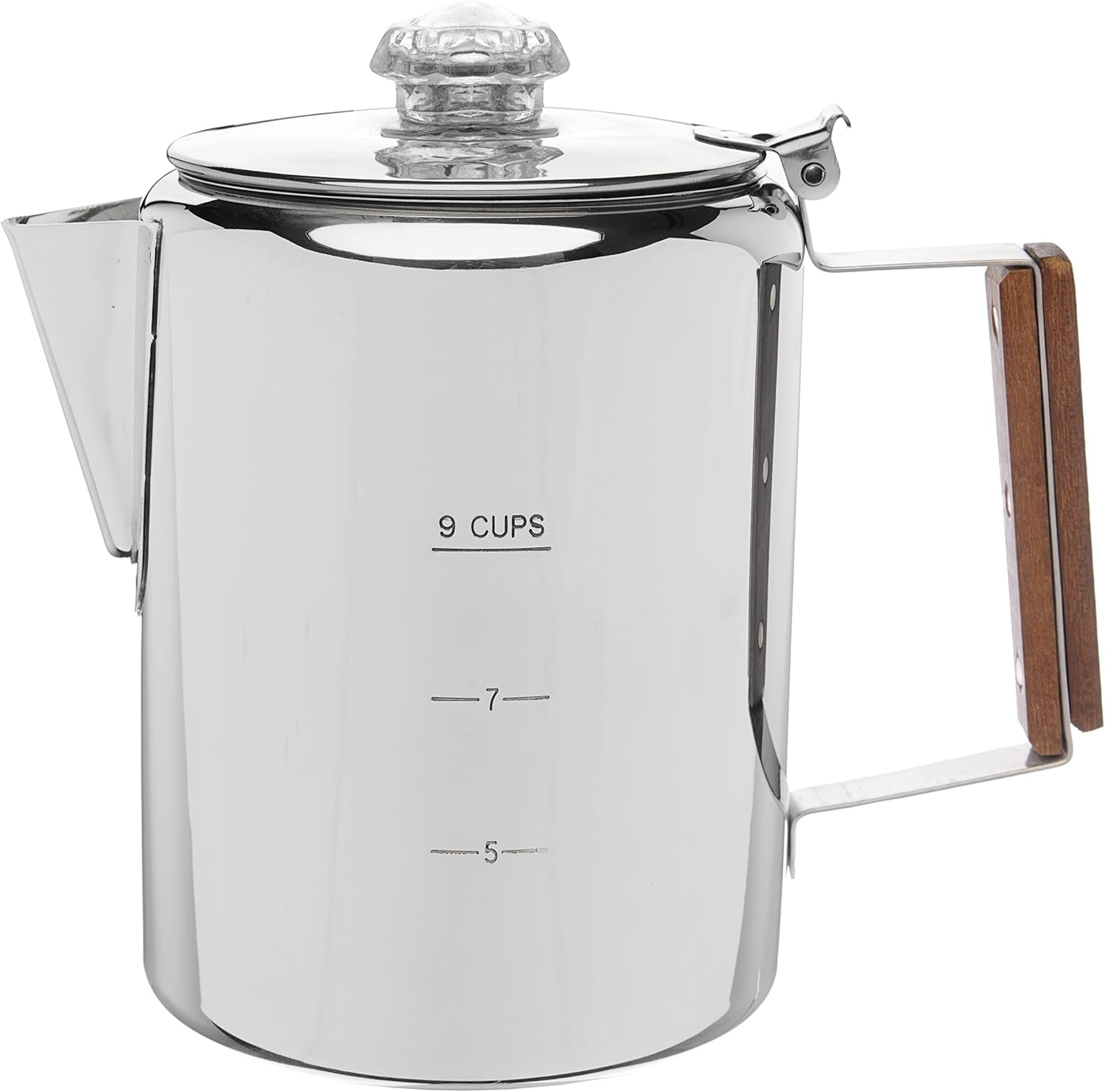
A nine-cup pot where hot water touches steel and glass, nothing else.
This is the pot for anyone who has started thinking about what their coffee brews through. The Bozeman uses stainless steel components and a glass view top throughout, so no plastic or aluminum sits between the water and your grounds. It brews 45 fluid ounces, which the maker is upfront about translating into about four 12 oz mugs.
Coffee quality is what the crowd talks about, and the percolating cycle that draws out deep, full-bodied flavour is why. The glass top lets you watch the brew and decide when to pull it, and the all-metal basket and tube set it apart from the aluminum and plastic rivals at this size. It needs no electricity — water, coffee and heat are the whole recipe — so it works on a camp stove, a grill or over a fire, and it is dishwasher safe once you get home.
The hard limit is induction. COLETTI states plainly that this pot does not work on induction hobs and points buyers to a separate induction model, so check your hob first. The glass view top is the other fragile point, and it is worth knowing that a replacement is what keeps these pots running rather than a whole new unit.
What makes it different: an all-stainless and glass build with no aluminum or plastic in the brew path, plus a 45 fl oz capacity that equals roughly four mugs.
Check before you buy: it does not work on induction, and the glass top is the part to handle with care.
This suits you if: you want a plastic-free, aluminum-free brew path and you brew on gas, electric or a campfire.
Keep looking if: your kitchen runs on an induction hob.
10. GROSCHE Milano Stovetop Espresso Maker, 9 Espresso Cup

A big moka pot with the one fix most pots still lack — a handle that will not burn you.
Nine espresso cups in food-grade anodized aluminum, finished in blue, and the size is the point. If the small six-cup pots on this list leave you wanting, this one pours a proper round. It runs on gas, electric and propane camp stoves, and it will make coffee on a glass-top induction hob but will heat very slowly because the aluminum is not magnetic.
The detail that earns it attention is the handle. GROSCHE added a larger soft-touch grip with a burn guard after studying the burnt-finger complaints that follow this whole category around, and it is backed by an Italian safety valve that vents high-pressure build-up. A premium silicone gasket seals the join, and the filter screen lifts out for washing. Quality leads the feedback by a wide margin, and the flavour it pulls runs bold and unbitten.
Two things to square away. It is not induction-friendly in any practical sense, so induction owners should look at the Coffee Gator instead. Handle durability is also the mixed note in the feedback, with a share of buyers reporting the handle giving up after a few months, so lift by the body where you can.
The case for the Milano
- Burn-guard soft-touch handle designed against the usual scald
- Italian safety valve and premium silicone gasket
- Nine espresso cups for a proper round
What to watch
- Does not work practically on induction hobs
- Handle durability is the recurring mixed note in feedback
Go for it when: you want a bigger moka pour and you are tired of burning your fingers on the grip.
Go elsewhere if: you cook on induction, where the Coffee Gator is the better fit.
11. Coleman Stainless Steel Coffee Percolator, 12-Cup

Twelve cups over a camp stove or a fire, with no moving parts to fail.
Coleman built this for volume and for outages. Twelve cups of coffee on a camping stove, a grill or a fire, from a stainless body that resists corrosion and wipes down in seconds. It weighs 2.2 pounds and it has no mechanical parts, so there is nothing to break in the field — the base, tube, basket and basket lid are the whole assembly, and no paper filters are needed.
It works on propane stoves and on induction cooktops, which puts it further up the hob-compatibility ladder than the moka pots here. Because the water keeps circulating over the grounds, it uses about half the grounds of a drip machine, and the coffee stays hot down to the last cup. The wide opening fits a hand inside for proper cleaning, and it goes in the dishwasher at home.
Two known snags. The filter basket drains slowly, so a hard boil can push grounds over into the pot — keep the heat moderate and the problem mostly disappears. The glass knob on top is the part that cracks, and a replacement screw-on top keeps the pot going. The internals also sit a little loose in the body, so it feels less premium than a tighter-fitting pot.
The volume play: twelve cups, 2.2 pounds, no moving parts, and about half the grounds a drip machine would use.
The known snags: a slow-draining basket can let grounds through on a hard boil, and the glass top knob is the part that cracks first.
The right call for: groups, campsites and power cuts, where a big pot with nothing to break is what you want.
Probably not for: a single drinker, since twelve cups is a lot of coffee to get through.
Know the Specs
Moka pot versus percolator
A moka pot seals its two halves and uses steam pressure to force water up through the grounds once, which is why it lands strong and syrupy. A percolator pumps water up a central tube and lets it fall back over the grounds repeatedly, which builds a bigger, softer pot that stays hot. Choose moka for espresso-style shots and milk drinks; choose percolator for a mug you sip slowly.
What the cup number really means
A cup here is a small measure, not a mug. Moka pots count demitasse or espresso cups, so six cups lands near two generous mugs. Percolators often count 5 oz or 6 oz cups, which is why a 12-cup pot pours about three large mugs. COLETTI lays its own maths out: 9 cups equals 45 fluid ounces, roughly four 12 oz mugs.
Aluminum, stainless or glass
Aluminum heats fastest and is the traditional choice, but it dulls with detergent and needs a water rinse only. Stainless steel costs more and takes dishwasher cycles without complaint. Borosilicate glass lets you watch the brew and keeps the oils intact, but it demands gentle handling. None of these is superior across the board — each trades upkeep against durability.
Hob compatibility
Check this before anything else. Aluminum moka pots mostly need an adapter plate for induction. The COLETTI Bozeman states plainly that it does not work on induction. The Coffee Gator works on induction without an adapter. Gas, electric and ceramic hobs accept all of these pots.
Common Questions
How many cups does a 6-cup moka pot actually make?
Why are there grinds in the bottom of my cup?
Can I use a stovetop moka pot on an induction hob?
Do I need paper filters in a percolator?
Why does my aluminum moka pot look dull or stained?
Is percolator coffee stronger or weaker than drip?
Can I brew coffee with a glass percolator on a gas flame?
How long does a pot of percolator coffee take?
Will a stainless percolator go in the dishwasher?
How do I stop grounds from boiling over into the pot?
The Bottom Line
The strongest stove coffee maker here is still the Bialetti Moka Express, because it has been made the same way since 1933 and beats the field on the thing that matters — smooth, quick extraction from a three-part pot that rinses clean in under a minute. If you drink big pots rather than shots, the Farberware Yosemite 12-Cup is the better call — twelve cups at six ounces each, still hot hours after the perk. And if you want the brew path free of aluminum and plastic, the COLETTI Bozeman gives you stainless and glass all the way through at 45 fluid ounces.
One last nudge worth acting on: the Farberware carries one of the deepest crowds on this shelf, and its coffee quality is the single thing people rave about most — which is about as clean a signal as you get in a category full of technique-dependent pots.
How we choose
We do not accept paid placement. Every pick is matched to a real buyer and a real use-case; we do not hands-on test units.
Sources
Specifications: manufacturer listings and product documentation. Review insights: verified customer reviews, as of October 2026. Pricing: not shown on this page (it changes often); check the current price via the retailer link.
As an Amazon Associate, Aappliancez earns from qualifying purchases. This does not affect which products we feature.