Disclosure: Some links in this post are affiliate links. As an Amazon Associate I earn from qualifying purchases, at no extra cost to you. Learn more
Specs are compiled from manufacturer listings and verified buyer reviews and can change over time — please confirm the key details on the product page before buying.
If your phone stays in a bag all day, it is a poor step counter. You want a small device that counts your steps on its own, needs no app, and does not need charging every night. The five picks below all do exactly that, mostly with a simple button battery and a screen you can read at a glance. I have weighed each one’s real strengths and honest trade-offs so you can pick the right one for your wrist or your pocket.
This guide is built by comparing the manufacturers’ published specifications and the patterns across verified customer reviews, so you get each pick’s real strengths and trade-offs instead of marketing spin.
Some people want a watch look, others want a tiny clip for a pocket. What follows is a plain walk through accuracy, battery life, and fit so you know what actually matters when you shop for a step counter device.
Top Picks

How To Choose The Best Step Counter Device
The first choice is where the device lives. A watch band sits on your wrist and shows the time, steps, and calories in one glance. A clip or lanyard goes on a waistband, pocket, or keychain and stays out of the way. Neither is wrong, but where you carry it decides how accurate it will be for you.
Where you wear it changes the count
Step sensors read motion to decide that you have taken a step. A device bouncing loose in a pocket can overcount small shifts. A device pressed against your body or swinging free on a lanyard can undercount. Keep it steady in one spot and check it once against a known route, so you learn its quirks before you trust the count.
The ten-second rule and what it does
Many quality devices ignore short bursts of movement. They wait for continuous motion before recording a step, then add the earlier steps back automatically. That filter cuts out hand wiggles and car rides but can also miss very slow, shuffling walking. If you take brisk, steady walks, the filter serves you well.
Battery, water, and fit
Button-battery devices typically last months, so you are not charging anything. A rechargeable smart watch gives more data but asks for a cable. Water resistance matters if you wash dishes or walk in rain — look for an explicit rating like 30M or 5 ATM, not just a vague “waterproof” claim. Finally, check the band fit: a snug strap on a small wrist reads steps more reliably.
Side-by-Side Comparison
| Model | Best For | Display | Power | Water Rating | Amazon |
|---|---|---|---|---|---|
| TIMEURE Men’s Pedometer Watch★ Best Overall | Everyday wrist tracking | 42 mm case | CR2032, up to 12 months | 30M | Amazon |
| U-Trak 3D PedometerBest Value Clip | Clipping to a pocket or bag | 1 inch | Included battery | — | Amazon |
| GOMMIN 3D Pedometer | Pocket and bag carry | 1.5 inches | Button battery, months | — | Amazon |
| Zeacool Fitness Tracker | All-day health data | 1.10 inch AMOLED | Rechargeable, 10 days | 5 ATM | Amazon |
| Hearkent Pedometer Watch | Large, readable numbers | 36 mm dial | Battery, 12 months | 30M | Amazon |
Detailed Reviews
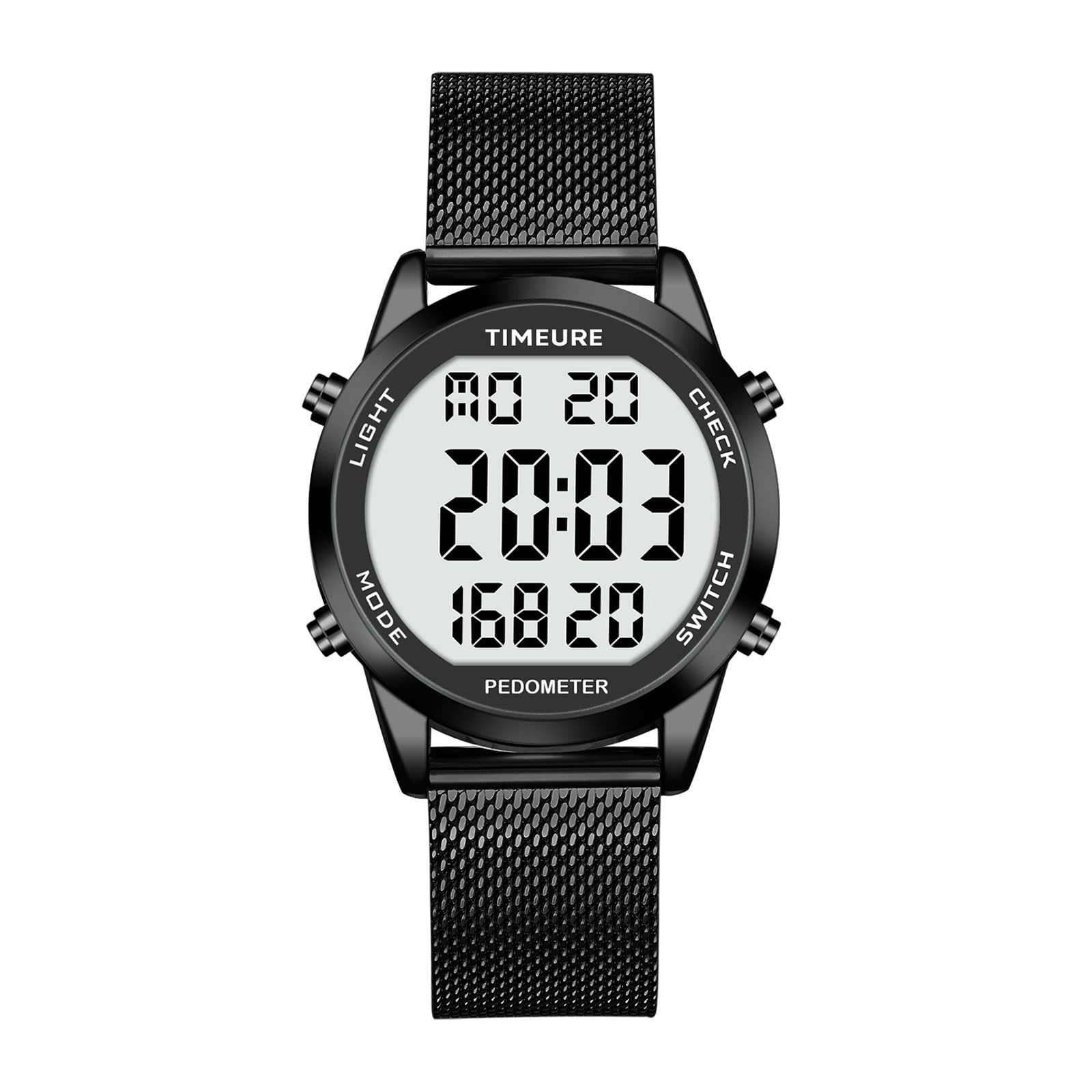
1. TIMEURE Men’s Pedometer Watch TU-2306B
Our pick — 4.0+★ from 200+ verified ratings; the strongest balance of quality and price.
A metal-case watch that tracks your steps and never asks for an app.
The number that matters here is 12 months of run time from one CR2032 button battery. That is the whole point: you wear it, you walk, and you do not think about charging. The case is a 42 mm glossy metal body with an adjustable stainless steel mesh bracelet that fits wrists from 6.29 to 9.44 inches. If you want a metal watch that counts steps without an app, start here.
The ten-second filter is the accuracy story. The watch ignores continuous movement under 10 seconds, then adds those earlier steps back once you pass the threshold, which keeps brief hand jiggles out of your count. Owners praise the no-fuss setup: no pairing, no app, just a watch that counts steps. Many like that it stays readable and works without pairing to a phone. The most discussed area is accuracy itself, and that is where honest shopping matters.
Where it can stumble: this is a rough estimator, not a lab instrument. A steady walk reads fine, but arm movement that mimics walking can nudge the number. On the wrist, it handles handwashing and rain thanks to 30M water resistance, though you should keep the buttons dry and out of the water. Owners also note the manual is thin and there is no screen protector made for this model. Set it once and it runs on its own.
What works in its favor
- Up to 12 months on a single CR2032, no charging
- Stainless steel mesh bracelet fits 160 to 240 mm wrists
- 30M water resistance for handwashing and rain
- Step, calorie, and distance tracking without a phone
Where you should think twice
- Step count leans on rough motion, so it can drift
- Sparse directions for battery swaps
- No phone connection means no sync or history
Wear it if: You want a watch that counts steps, looks sharp, and runs a year on a coin cell.
Skip if: You need app sync or spot-on step data for medical tracking.
2. U-Trak 3D Pedometer for Walking
A pocket-sized clip that counts steps from any angle.
The 3D tri-axis sensor here is the draw. It reads steps whether you walk up, down, or sideways, and it records from any orientation you carry it. A screen at 1 inch keeps the whole thing small enough to clip on a waistband, slip in a pocket, or hang from the spring carabiner. The whole device weighs 0.03 kg, so you forget it is there until you check the count.
Attaching to a keychain is the biggest win for many owners, and the clip lets you hang it from a purse or bag. The included battery runs the device, and a one-minute auto-sleep shuts the display down when you are still to save power. For a quick daily read without a bulky smartwatch or a Bluetooth setup, it does the job.
The catch is where you put it. Carried loose, the ten-step error prevention needs steady motion to start the count, and unsteady carry or very light steps can throw it off. Accuracy reads mixed, and one reviewer noted very low counts when clipped near the neckline or in a shorts pocket. The carabiner also makes it easy to misplace if it snags free. Fit it snugly and it works best.
The short version: A light, cheap clip-on that counts from any angle, with the carabiner doing the keeping-safe work and the pocket spot mattering most.
Reach for it if: You want a tiny clip to hook on a bag or waistband and skip the phone.
Look elsewhere if: You need pinpoint accuracy and always wear it the same way.
3. GOMMIN 3D Pedometer for Walking

A clear 1.5 inch screen makes this the easiest count to read.
That 1.5 inch display is the standout spec on this one — a 50% larger screen than the 1 inch U-Trak, which makes a real difference when you glance down to check a number mid-walk. It also wakes up when you pick it up, so no hunting for buttons in the dark. Hold the single reset button for 3 seconds and the count drops back to zero.
The ten-step calibration is the same accuracy idea seen across this category. It waits for 10 steady steps before it starts recording, then adds the earlier steps once you hit the threshold. Bouncing around in a pocket or held in your hand is where the count can skew, and the lift-to-light feature on one unit did not work for a buyer. Keep it steady and the numbers hold fairly well from day to day.
The smart sleep mode keeps the display dark but keeps tracking in the background, and an ultra low-power design runs for months on a tiny battery without the constant-charge pressure. For a pocket pedometer with the biggest readout here, it is a fair, lightweight pick. The honest limit is the count itself — it can overestimate, so treat it as a rough gauge.
Choose it if: You want the biggest, clearest readout in this group and a one-button reset.
Pass if: You need tight step accuracy and wear it loose in a pocket.
4. Zeacool Fitness Tracker

A full smart watch that also happens to count your steps.
It tracks heart rate, blood oxygen, sleep, and steps all day, and runs up to 10 days of regular use on a charge, standing by for 30 days. That means a cable and some babysitting, unlike the coin-cell picks above. If you want a health dashboard on your wrist and don’t mind a weekly charge, the trade is worth it.
The 1.10 inch AMOLED touch screen is the part most people love — you can customize faces and read everything at a glance. Functionality is the strongest thing about it, and the step tracking has a good track record for checking your daily count without pulling out your phone. The 5 ATM rating covers handwashing, showers, and swims, so you can leave it on through a workout.
Where it asks more: it leans on an app for real depth, and the accuracy reads mixed when pushed. You also get one charging cable in the box, so a spare makes life easier. It packs heart rate, blood oxygen, sleep, and steps into one wrist device, more data than any clip here.
Why it earns a spot
- Up to 10 days regular use, 30 days standby
- 5 ATM waterproof for showers and swims
- Step, heart rate, and sleep in one place
- 1.10 inch AMOLED color touch screen
The honest friction
- Needs a cable, not a coin cell
- Accuracy reads mixed when pushed
- Heavier on app setup than the clips
Go with it if: You want a real smart watch that tracks vitals and steps in one device.
Think twice if: You want zero charging and the simplest possible step count.
5. Hearkent Pedometer Watch
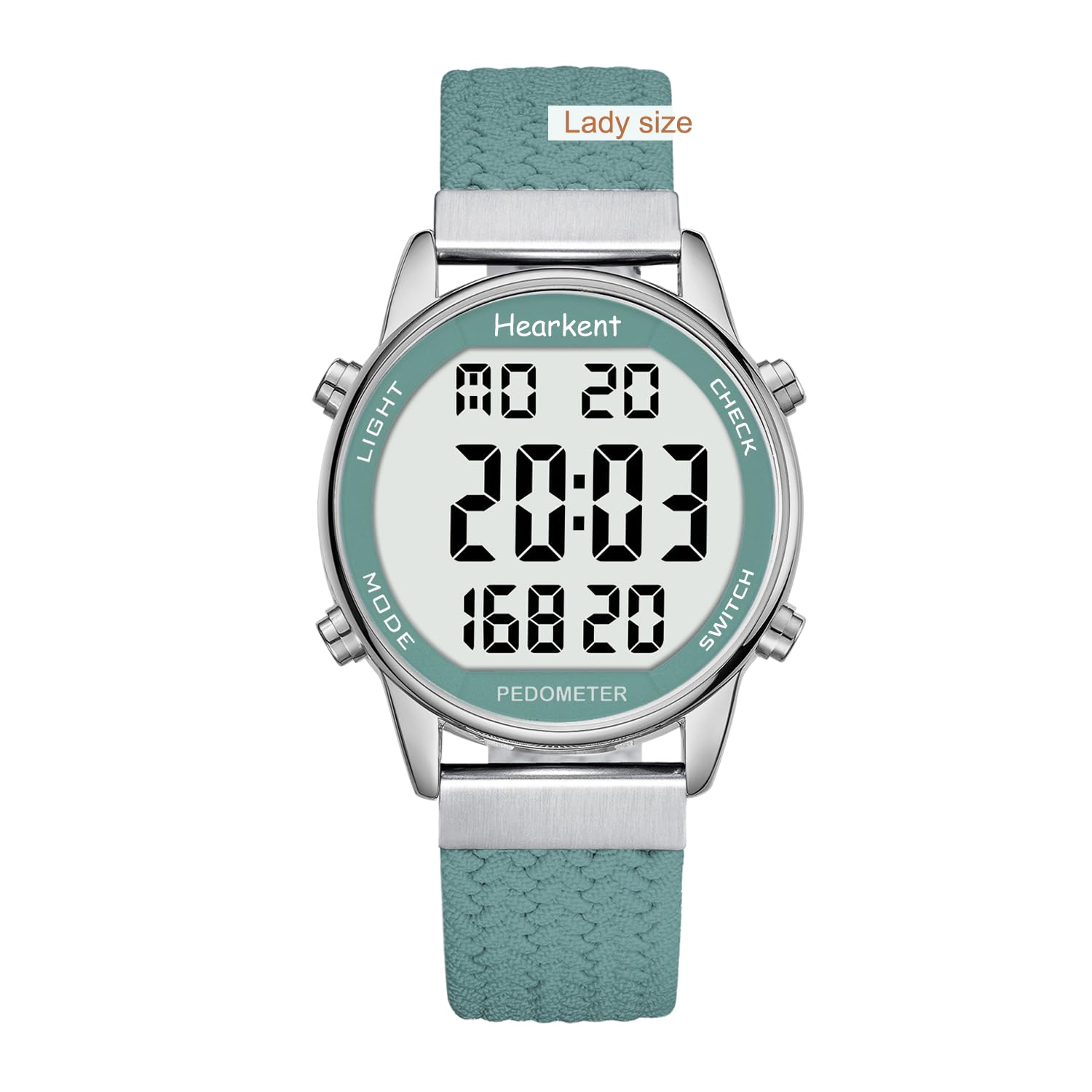
Large digits on a 36mm dial, and a battery that lasts a year.
The 36mm dial is packed with big numbers for time, week, and date, and a 5-second EL backlight makes it readable in the dark. The band is a breathable nylon strap that fits wrists from 4.1 to 7.6 inches and is easy to adjust. If you have struggled with tiny screens, this is the friendliest layout here. A button battery keeps it running for 12 months.
The heart of it is a no-app step counter that tracks steps, calories, and miles without a phone or Bluetooth. Owners like the privacy of that — no data off to an app, no charging, no sync. The nylon strap is comfortable and breathable, and the watch can be worn for sport or the office. Owners pick it for the look: a tidy watch face instead of a clip on the waistband.
The ten-second rule applies here too: continuous movement under 10 seconds is ignored, then earlier steps are added once you pass it. That can miss slow, shuffling walking. Step count reads mixed, and one buyer found it weak on stair machines and shopping-cart walks. On hikes it reads well. The honest limit is that it is a rough step counter, not a precise pedometer, so treat it as a guide.
What you actually get: A big, legible watch face that counts steps on its own and runs a year on a battery, with step accuracy that is fair on steady walks and loose elsewhere.
Wear it if: You want large digits, no app, and a one-year battery in a tidy watch.
skip it if: Stair or cart walking is the bulk of your steps.
Know the Specs
Power: Coin Cell vs Rechargeable
A button battery like the CR2032 runs a watch for up to 12 months without a cable, which means no nightly charging and no forgotten-watch dead mornings. A rechargeable device like the Zeacool gives up to 10 days of regular use, so it asks for a short charge every week or two. Pick the coin-cell route for the least maintenance, and the rechargeable route for more data.
Water Resistance: 30M and 5 ATM
Water ratings are a promise, not a guarantee. A 30M rating like the TIMEURE and Hearkent is for everyday splashes, handwashing, and rain — not for pressing buttons underwater. A 5 ATM rating like the Zeacool covers a shower or a swim. Always keep the buttons dry on a 30M watch and never dive with it.
Step Filter: The Ten-Second Rule
Many pedometers ignore movement shorter than 10 seconds, then add those steps back once you pass the threshold. This stops hand jiggles and car rides from registering as steps. The trade-off is that very slow, shuffling walks may drop steps. Quick, steady walking is where this filter works best.
Display Size and Readability
A larger screen makes a single number easier to read at a glance. The GOMMIN’s 1.5 inch display is a full 50% larger than the U-Trak’s 1 inch screen, which matters mid-walk. Watch faces like the Hearkent’s big digits serve the same purpose — quick checking without squinting.
Common Questions
Do I need a phone to use any of these step counters?
How long does the battery last on a coin-cell pedometer?
Why does my step counter ignore the first ten seconds of walking?
Can I wear a 30M waterproof watch in the shower?
Is a clip-on pedometer more accurate than a wrist watch?
Can the Hearkent or GOMMIN connect to an app?
How do I reset the step count each day?
Which step counter is best for a small wrist?
Do these pedometers track calories and distance too?
What happens if I get my pedometer wet or drop it?
The Bottom Line
For most people hunting a step counter device, the TIMEURE Men’s Pedometer Watch is the safest bet. It pairs a watch look with a year of coin-cell life and no app, so you just wear it. If a tiny clip fits your day better, the U-Trak 3D Pedometer is the value pick with a carabiner that keeps it attached. And for someone who wants the clearest readout, the GOMMIN offers the 1.5 inch screen that is bigger than the U-Trak’s 1 inch display. Whichever you choose, give it a snug carry and a week of walking to learn its habits, then trust the trend more than any single day.
How we choose
We do not accept paid placement. Every pick is matched to a real buyer and a real use-case; we do not hands-on test units.
Sources
Specifications: manufacturer listings and product documentation. Review insights: verified customer reviews, as of October 2026. Pricing: not shown on this page (it changes often); check the current price via the retailer link.
As an Amazon Associate, Aappliancez earns from qualifying purchases. This does not affect which products we feature.