Disclosure: Some links in this post are affiliate links. As an Amazon Associate I earn from qualifying purchases, at no extra cost to you. Learn more
Specs are compiled from manufacturer listings and verified buyer reviews and can change over time — please confirm the key details on the product page before buying.
Most STEM kits for kids look impressive in the box and then sit untouched after one weekend. Three things separate a kit that gets played with for months from one that collects dust: how clearly the instructions guide a child, whether the materials survive actual kid handling, and whether the experiments produce a result notable enough to repeat. This guide sorts the current standouts by those exact measures.
This guide is built by comparing the manufacturers’ published specifications and the patterns across verified customer reviews, so you get each pick’s real strengths and trade-offs instead of marketing spin.
For a curious four-year-old or a ten-year-old who already calls themselves a scientist, the picks below cover every age and learning style. Each one earns its spot by doing something genuinely well — not just by filling a box with colorful plastic. That is the standard behind every pick in this guide to the best stem toys.
Top Picks

How To Choose The Best STEM Toys
The biggest mistake buyers make with STEM toys is chasing the biggest experiment number on the box. A kit advertising 250 experiments sounds like more value than one with 50, but your child’s patience runs out long before experiment number 200. What actually determines whether a kit gets used is whether the first three experiments work smoothly and produce something worth showing off.
Match the age range to your child, not the gift occasion
Every kit lists a manufacturer recommended age, and that range is not marketing filler — it reflects the fine motor control and reading level the experiments demand. A kit rated 8 years and up assumes your child can follow multi-step written instructions independently. A kit rated 4 years and up is built around pouring, mixing, and observing with heavy adult help. Buying above your child’s level produces frustration and a kit that gets abandoned after two sessions. Buying below produces boredom.
Check what tools are actually included
A kit’s real value lives in its included components. Test tubes, pipettes, measuring spoons, goggles, and molds are the reusable hardware you keep long after the consumable chemicals run out. Kits that include real lab tools like a conical flask or a test tube stand let a child feel like an actual scientist, which drives repeat play. Kits that include only powders and a booklet leave you buying the tools separately. Look at the included component list before you look at anything else.
Consider the cleanup and storage reality
No parent regrets buying an educational toy — they regret the mess it makes. Kits that come with a storage box or tray spare you the nightly scavenger hunt for missing pipettes. Chemistry kits produce spills and stains by design, so plan for a dedicated work surface you can wipe down. Building sets generate hundreds of small pieces, and a container is the difference between a toy that survives and one that vanishes into the carpet.
Side-by-Side Comparison
| Model | Best For | Age Range | Experiments | Included Tools | Amazon |
|---|---|---|---|---|---|
| National Geographic Junior Chemistry Set★ Best Overall | First chemistry lab for ages 4-6 | 4 years and up | 50 | 20+ lab tools | Amazon |
| UNGLINGA 250+ Science Experiments KitMost Experiments | Maximum experiment count for ages 8+ | 8 years and up | 250+ | Pipettes, test tubes | Amazon |
| Doctor Jupiter Ultimate Science Kit | Structured science journey for ages 8-12 | 8 Years and above | 135+ | Flask, cylinder, stand | Amazon |
| Qirptey Kids STEM Building Toys | Screen-free building for ages 3-8 | 3 years and up | — | 125 building pieces | Amazon |
| Butterfly EduFields 150+ Science Kit | Gift-ready girls science kit for ages 8-12 | 8 years & up | 150+ | Test tube, beaker, funnel | Amazon |
Detailed Reviews
1. National Geographic Junior Chemistry Set
Our pick — 4.5+★ from 900+ verified ratings; the strongest balance of quality and price.
The starter lab that turns baking soda into a first real science habit.
If your child is four to six and has never touched a test tube, this is the kit to buy. The Junior Chemistry Set packs 50 hands-on experiments and over 20 durable, child-safe lab tools — test tubes, goggles, flasks, beakers, and funnels — into one box designed specifically for that age. The activities run on common household items like baking soda and vinegar, so you can start the first experiment the day it arrives without a shopping trip. At 11 x 4.22 x 9.64 inches, the whole set stores on a shelf, and no battery is required at any point.
What wins people over here is pure engagement. Kids mix colored solutions and playdough with the droppers and beakers, following the illustrated steps with light supervision. The set also has an unusually broad age spread for a chemistry kit: the manufacturer rates it for 4 years and up, while the Doctor Jupiter kit above starts at 8 years and above — a full 2.0x gap in the starting age. That means this is often the kit a family buys first, then hands down to a younger sibling when the older one outgrows it. Blue Marble developed it exclusively for Amazon, and the brand has won the Toy Association’s Toy of the Year Award for its educational products.
The catch is that “complete” refers to the tools, not everything you’ll want. The chemicals and lab equipment beyond the included set — stands, clamps, extra tubes, beakers, a scale — are add-ons you buy as your junior chemist goes deeper, and a 25-month-old tester’s family found the setup needs a dedicated work zone with a sink, towels, and easy-to-wipe surfaces, since the dyes can stain. Kids on the younger end also hit the ceiling fast; several experiments are a stretch for a five-year-old and call for steady adult hands. Buy this as a first kit for a 4-to-6-year-old who loves pouring and mixing, and size up if your child is already comfortable reading multi-step instructions alone.
What earns its keep
- Over 20 child-safe lab tools including goggles, test tubes, and beakers built for small hands
- 50 experiments using household staples like baking soda and vinegar, so play starts on day one
- Illustrated step-by-step instructions clear enough for a young child to follow with a little help
- Starts at 4 years and up — two years earlier than the Doctor Jupiter kit’s 8-and-above floor
Before you commit
- Dyes can stain hands and clothing — set up on a wipeable surface with old clothes on
- Deeper experiments need extra gear you buy separately as your child advances
- Five-year-olds will need steady adult help on the harder experiments
Reach for this if: you want a first chemistry kit for a 4-to-6-year-old and value sturdy tools over a huge experiment count.
Step up instead if: your child already reads instructions solo — the Doctor Jupiter kit’s 135+ experiments will stretch them further.
2. UNGLINGA 250+ Science Experiments Kits
Enough experiments to fill a school year, not just a birthday afternoon.
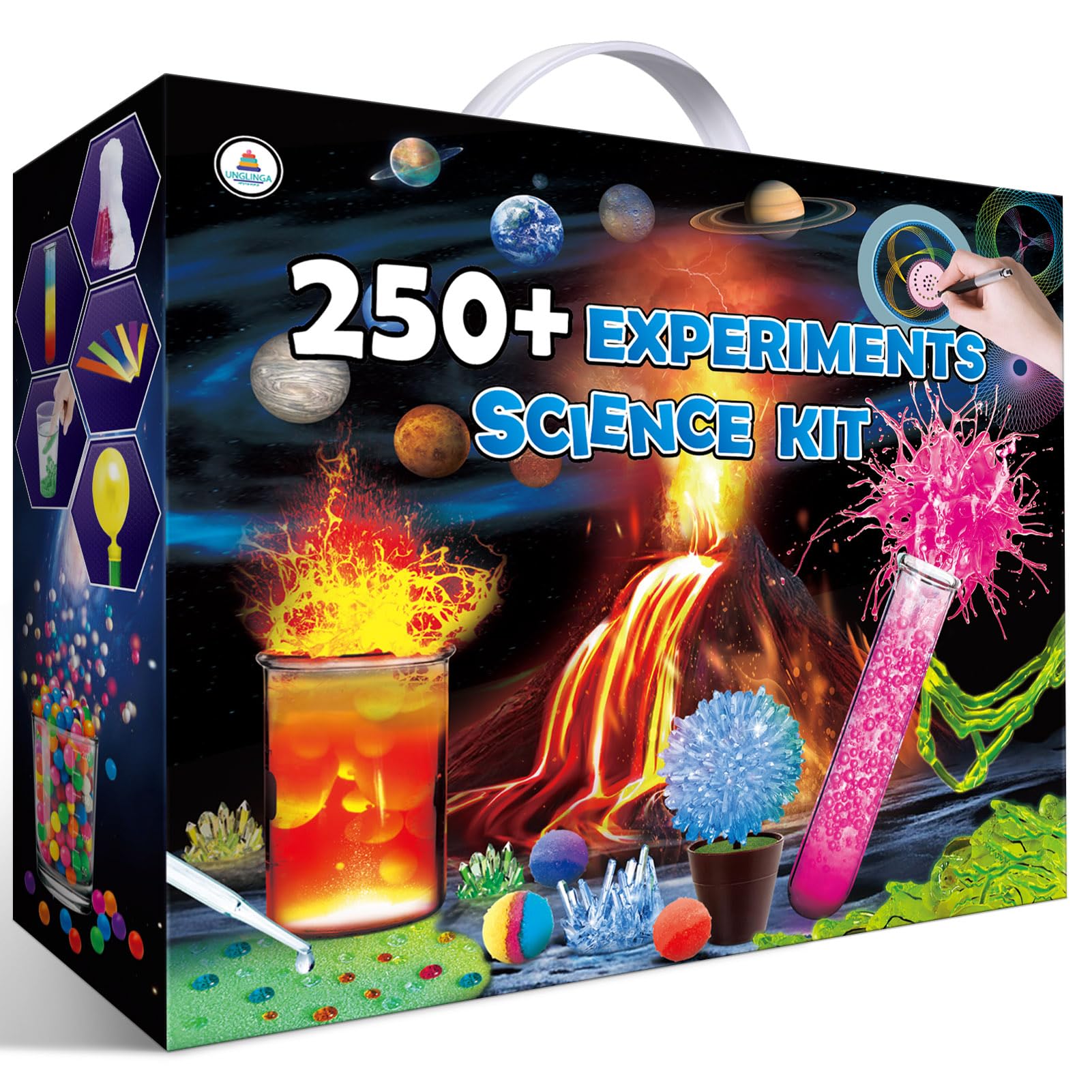
Sheer volume is the pitch here, and it is not exaggerated. This kit carries 250+ experiments packed into one set — the Doctor Jupiter kit in this list tops out at 135+, which is 85% more experiments in the UNGLINGA box. The activities cross chemistry, earth science, and physics, so the same kit covers a lava lamp, a volcano build, and surface-tension reactions without you buying three separate sets. Real chemistry tools like pipettes and test tubes are included, and the detailed full-color manual walks a child through each step with instructions simple enough to follow independently.
Kids respond to the variety. Rated for ages 8 and up, it suits a child who can read the manual and run an experiment start to finish alone. Parents describe it as a kit that keeps paying off across a winter weekend, a rainy day, or a school break, not a one-time event. It measures 12 x 10.8 x 3.9 inches, which gives it a slightly bigger footprint than the National Geographic set at 11 x 4.22 x 9.64 inches, but it still slides onto a shelf or into a tote. You will need common household items alongside the included supplies, so check the manual before each session.
Where the value sits: 250+ experiments across three science themes from a single purchase — the highest count in this guide and the strongest pick if longevity matters more than a polished first-experiment experience.
The honest trade-off: the household-supplies requirement means a few experiments need you to check the cupboard first, and some parents prefer a kit where every material ships in the box.
Settle on this one: for an 8-to-12-year-old who will actually work through experiments over weeks and months.
Think smaller if: you want zero prep before each session — the National Geographic set is more self-contained.
3. Doctor Jupiter Ultimate Science Experiments Kit
A real flask and test tube stand make this feel like actual lab work.
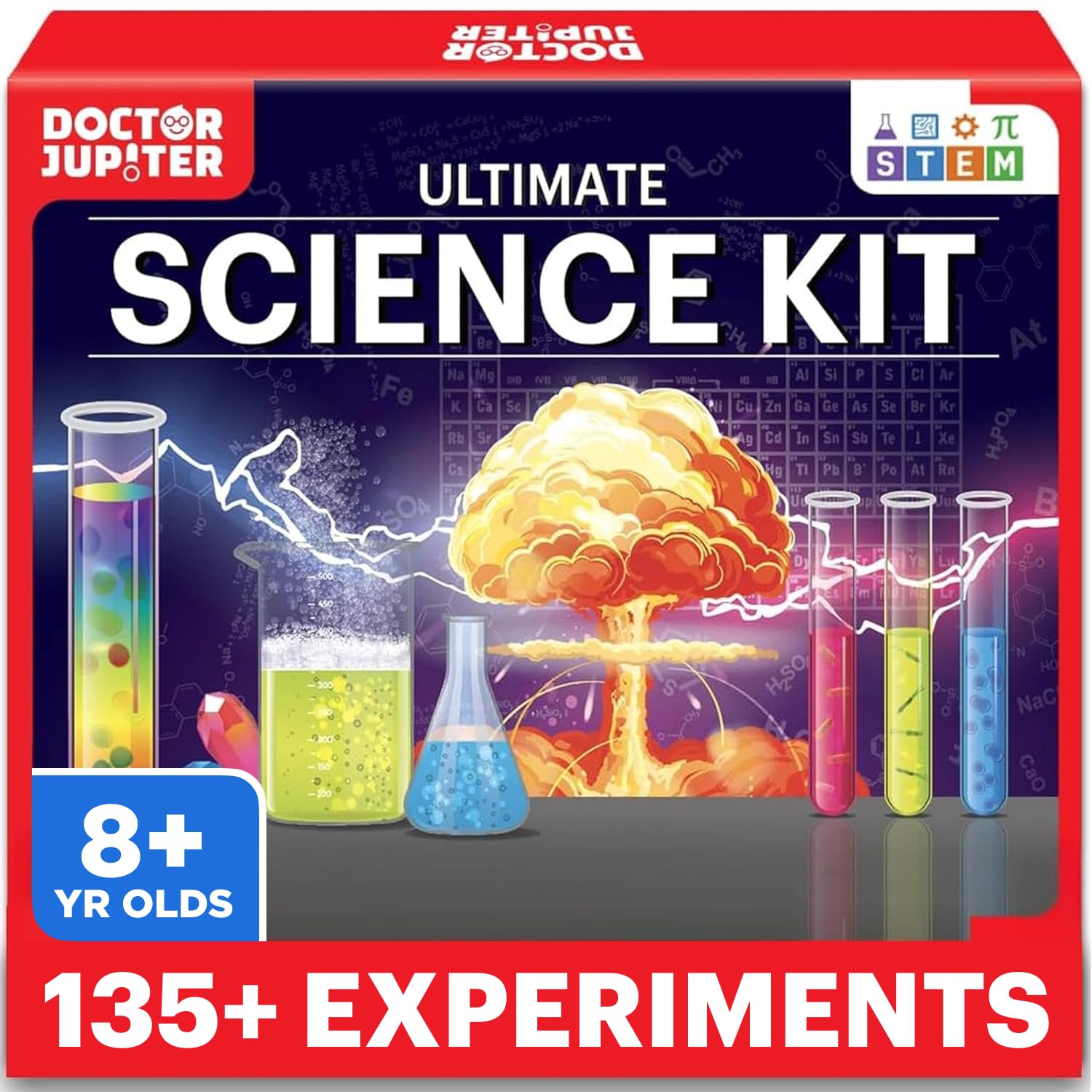
What separates this kit from the rest is hardware. Alongside 135+ experiments you get a measuring cylinder, a conical flask, a spatula, stirring sticks, a test tube stand, a funnel, a tray, soap molds, and six ingredients including glow powder and citric acid. That is a genuinely capable starter lab, and it is the reason the kit skews one to two years older in how it plays. It also ships with free access to 90+ bonus experiments that use everyday household items, so the box keeps giving after the included materials are done.
The instructions are where this kit’s reputation lives. The guide uses clear step-by-step directions with illustrations for every experiment, and the chemical materials arrive in separate leak-proof bottles so kids can run the same experiment more than once without a mess. Parents describe easy setup and kid-friendly explanations with helpful time estimates that let you pick an experiment that fits the afternoon you have. The kit is modest in weight at 650 g, so a child can carry it to the table themselves.
Do budget for the mess — the recurring theme in reviews is a tablecloth that may never fully recover, and a seven-year-old can work through most experiments with a little adult help. A small number of buyers report the supplied quantities run light for some activities and that a few experiments need extra items beyond the box. The upside is a pass-along set: everything stores back in the tray, and the format holds up across siblings. For a child who wants to feel like a real scientist rather than a color-mixer, this is the sharper pick.
True science feel: for ages 8-12 who want a flask, stand, and gloves-on lab experience rather than pastel play.
Might disappoint: if you expect all 135 experiments to run with zero extra shopping — a handful need top-ups.
4. Qirptey Kids STEM Building Toys

125 pieces, zero screens, and a carry case that actually survives cleanup day.
If your goal is fewer hours in front of a screen, this is the box that does it. The set hands a child 125 pieces across different colors and shapes, plus an idea booklet showing how to build models like a race car, a robot, a truck, or a dinosaur — and then encourages them to invent their own. There is no battery and no power source; every model builds by hand. It holds attention in classrooms, waiting rooms, and living rooms, and the included carry case turns cleanup into a thirty-second job instead of a floor search.
Quality is the standout. Parents of 4- and 5-year-olds report the pieces connect easily and stay connected through play, and the rounded edges and non-toxic, odourless plastic mean you are not hovering. The parts are generous enough that several families pick up a second set to expand what one child can build. Children as young as three use the larger shapes while seven- and eight-year-olds follow the booklet for the more involved models, so the same box genuinely spans a wide age band. At 1 x 1 x 1 inches per listing, the pieces stack into the storage box and store on any shelf.
Two things to know before buying. First, the instructions occasionally leave steps unclear — the models go together, but expect to help your child puzzle through a page or two. Second, the durability of the pieces is the most-mentioned trade-off; they hold up to normal play, but a very young or very determined builder can test them. Treat it as a great gift for a builder who enjoys following a picture to a result, and pair it with a quiet shelf for the finished models.
The builder’s verdict: 125 colorful, easy-to-connect pieces plus an idea booklet earn this the strongest classroom-tested reputation in the guide, and the storage case seals the deal for parents tired of loose parts under the couch.
Perfect for: ages 3-8 who prefer making things with their hands and for parents who want a screen-free afternoon every time.
Keep in mind: the idea booklet is a starting point, not a full instruction manual — the fun is in improvising.
5. Butterfly EduFields 150+ Experiments Girls Science Kit

Built as a first science kit a girl can call her own — 150+ experiments in one box.
This kit is designed for girls 8-12, and the thought shows in the contents. Alongside 150+ experiments you get a 50ml test tube, a measuring spoon, a stirring stick, three measuring cups, a tray, a volcano mold, three food colors, four face masks, a soap base, and two food essences in mango and strawberry. The kit meets ASTM F963-17 safety standards, weighs 700 g, and uses safe chemicals with a full-color illustrated manual that lets a child work through experiments step by step on her own. It is a gift-shaped product from the first unboxing.
The reason it earns a spot on this list is the gift factor. Parents buying it for a daughter, niece, or granddaughter report the recipient diving into the experiments the day she opened it and staying absorbed for hours. Slime and volcano projects are the crowd-pleasers — the ones kids show off and want to repeat. The illustrated manual is clear enough that an 8-to-12-year-old can follow along, and the kit includes everything needed for its headline experiments, so the first session does not need a store run.
One honest note: the value-for-money aspect is mixed. Some buyers feel the included material quantities run short for the price and a few report an experiment failing even when following instructions or a solution bottle arriving dried out. The best approach is to treat the 150+ experiments as a menu to work through over time, sticking to the slime and chemistry projects first, and checking the manual for any ingredient that needs topping up before a session. For a girl who loves creative, hands-on projects and has outgrown toddler science sets, this is a fitting next step.
Why it works as a gift
- 150+ experiments from an 8-12 range kit designed specifically for girls, with molds, masks, and soap-making included
- Full-color illustrated manual lets a child work independently at her own pace
- ASTM F963-17 safety certification and safe chemicals put parents at ease
- Slime and volcano projects are the repeat hits kids ask for again
Worth knowing
- Some buyers feel the included quantity is light relative to the price
- An occasional bottle can arrive dried up — check contents on arrival
- A few experiments fail even when instructions are followed closely
Buy this for: an 8-to-12-year-old girl who wants her own science kit with experiments she can run solo.
Look elsewhere if: you want a multi-child kit — the National Geographic set stretches further across two siblings.
Know the Specs
Age Range and Reading Level
The manufacturer recommended age reflects the reading level the manual assumes and the fine motor control the experiments demand. A kit rated 4 years and up relies on an adult reading the steps aloud and controlling the pours, while an 8-years-and-up kit expects a child to follow multi-step written instructions alone. Buying above your child’s level is the most common reason a STEM kit gets abandoned after two sessions.
Experiment Count and Variety
A count like 50 or 250 is the total activities the manual covers, not what your child finishes in one sitting. A higher count usually signals more variety across chemistry, physics, and earth science, which keeps a kit interesting for longer. A lower count often means the included tools are the focus — a real flask or test tube stand can be worth more than fifty extra experiments that need supplies you don’t have.
Included Tools and Storage
Check the included component list first. Test tubes, pipettes, goggles, measuring cups, molds, and trays are the reusable hardware your child keeps after the chemicals are gone. A kit with a storage box or tray means fewer missing pieces and quicker cleanup, which decides whether the toy gets pulled out again next weekend.
Safety Certification and Materials
Kits that carry an ASTM safety certification have been tested against a recognized toy-safety standard, which matters more for chemistry kits than for building sets. Material matters too: non-toxic, odourless plastic with rounded edges is friendlier for young builders, while chemistry kits need goggles and child-safe dyes. Check the included components list to see how much protective gear comes in the box.
Common Questions
What age is the National Geographic Junior Chemistry Set actually good for?
How many experiments do the top STEM kits include?
Do these kits come with everything needed or do I have to buy extra supplies?
Are the chemicals in these science kits safe for kids?
Which STEM kit is best for a child who gets bored quickly?
What is the difference between a chemistry kit and a STEM building toy?
Can two children share one science kit without fighting over supplies?
How long does it take to work through a 250-experiment kit?
Do any of these STEM toys need batteries or a power source?
Which kit is the better gift for a girl turning 9?
The Bottom Line
For most families, the stem toys winner is the National Geographic Junior Chemistry Set because it puts over 20 real lab tools into a 4-and-up kit, includes 50 experiments that run on household staples, and holds a 4.5+ star rating across 900+ ratings — the strongest all-around package for a first chemistry lab. If your child is 8 or older and will actually work through experiments over months, the UNGLINGA 250+ kit delivers the highest experiment count in this guide. For a hands-on builder who wants zero screens, grab the Qirptey 125-piece building set, and for a gift designed for a girl 8-12 with a real passion for experiments, the Butterfly EduFields 150+ kit is the one to reach for.
How we choose
We do not accept paid placement. Every pick is matched to a real buyer and a real use-case; we do not hands-on test units.
Sources
Specifications: manufacturer listings and product documentation. Review insights: verified customer reviews, as of October 2026. Pricing: not shown on this page (it changes often); check the current price via the retailer link.
As an Amazon Associate, Aappliancez earns from qualifying purchases. This does not affect which products we feature.