Disclosure: Some links in this post are affiliate links. As an Amazon Associate I earn from qualifying purchases, at no extra cost to you. Learn more
Specs are compiled from manufacturer listings and verified buyer reviews and can change over time — please confirm the key details on the product page before buying.
You want one knife that chops an onion without fighting back, and you do not want to spend a fortune finding out you picked wrong. The short answer: an 8-inch chef’s knife with a comfortable non-slip handle, a blade that arrives sharp, and steel that holds its edge is all a new cook actually needs. Everything past that is preference. So this guide sorts the field by what each knife genuinely does well — and where it asks you to compromise.
This guide is built by comparing the manufacturers’ published specifications and the patterns across verified customer reviews, so you get each pick’s real strengths and trade-offs instead of marketing spin.
A stamped blade is lighter and cheaper, a forged blade is heavier and stiffer, and either one can serve you brilliantly for years. Below you will find the real differences that separate a starter knife you keep from one you quietly stop reaching for. The picks below are the starter chef knife options worth your first real investment.
Top Picks

How To Choose The Best Starter Chef Knife
Your first serious chef’s knife depends on three things: how the handle feels in your wet hand, whether the blade is thin enough to glide through an onion, and whether you will wash it by hand every time. Get those three right and the brand on the blade barely matters. Get them wrong and the knife sits in the block.
Blade length: why 8 inches is the default
An 8-inch blade gives you enough length to rock through a pile of herbs and enough control to trim a single strawberry. Shorter blades feel nimble in a cramped kitchen but run out of room on a head of cabbage. Longer blades cover more board but add weight at the tip. Nearly every pick here lands at 8 inches for that reason, and the one set that breaks the pattern uses a 6.7-inch santoku to do the heavy chopping.
Stamped versus forged: what your hand notices
A stamped knife (cut from a flat sheet of steel) tends to be thinner and lighter, so your wrist tires less during long prep — the Victorinox Fibrox lists roughly 22.68 g of item weight versus the forged Mercer Genesis at 8.48 ounces. A forged knife is shaped from a single heated block, which gives you a heavier spine and a bolster (the thick collar where blade meets handle). Neither is “better.” Forged knives feel planted and resist flexing when you press down.
The handle decides whether you keep reaching for it
Your hand is wet half the time you cook. A textured rubberized handle — Fibrox, Santoprene, Pakkawood, or dimpled stainless — keeps your grip steady when a slick plastic handle would let the blade rotate. If you have large hands, look for a handle with visible finger points rather than a smooth barrel.
Edge angle and steel hardness in plain terms
A sharper angle cuts with less effort but dulls or chips sooner. A 15-degree-per-side edge like the one on the SHAN ZU and the MAC set slices tomatoes beautifully but wants care around bone and frozen food. A harder steel (measured in HRC, a hardness scale) holds its edge longer but is more brittle. Softer steel sharpens up fast on a simple pull-through sharpener but needs honing more often.
Where beginners overspend
The common mistake is buying a big block set before you know which blade you actually reach for. Start with one chef’s knife you love, then add a paring knife when you notice yourself reaching for one. A knife you sharpen twice a year beats five knives you never touch.
Side-by-Side Comparison
| Model | Best For | Blade Length | Construction | Blade Material | Amazon |
|---|---|---|---|---|---|
| Victorinox Fibrox Pro 8 Inch★ Best Overall | First serious knife, no fuss | 8 inches | Stamped | Stainless Steel | Amazon |
| Amazon Basics Classic 8-inch Full TangBudget Champion | Tightest budget, forged feel | 8 inches | Forged | High Carbon Stainless Steel | Amazon |
| Mercer Culinary M22608 MillenniaTop Performer | Restaurant-style daily beater | 8 inches | Stamped | High Carbon Steel | Amazon |
| Babish 8-Inch Chef Knife | German steel on a budget | 8 inches | Forged | High Carbon German 1.4116 Steel | Amazon |
| Mercer Culinary M21078 Genesis | Forged weight and short bolster | 8 inches | Forged | High Carbon German Steel | Amazon |
| MOSFiATA 8″ Professional | Gift box with sharpener included | 8 inches | Forged | EN1.4116 German High Carbon Stainless | Amazon |
| SHAN ZU 8 Inch Damascus | Damascus looks without the price | 8 inches | Forged | 10Cr15Mov Damascus Steel | Amazon |
| Wüsthof 8″ Gourmet | Big-brand starter, lighter feel | 8 inches | Stamped | High Carbon Stainless Steel | Amazon |
| HENCKELS Classic 8-Inch | Forged all-rounder for long sessions | 8 inches | Forged | Stainless Steel | Amazon |
| Wakoli EDIB 3-Piece Damascus Set | Gift-ready three-knife set | 6.7 inches (santoku) | Forged | 67-Layer Damascus with VG-10 Core | Amazon |
| WÜSTHOF Classic 8″ | Lifetime forged upgrade | 8 inches | Forged | High Carbon Stainless Steel | Amazon |
| MAC Chef Series 2-Piece Set | Chef plus paring, handcrafted | 8 inches | Stamped | Molybdenum Alloy Steel | Amazon |
| Global 3 Piece Starter Set | All-metal Japanese starter kit | 8 inches | Stamped | CROMOVA Stainless Steel | Amazon |
Detailed Reviews
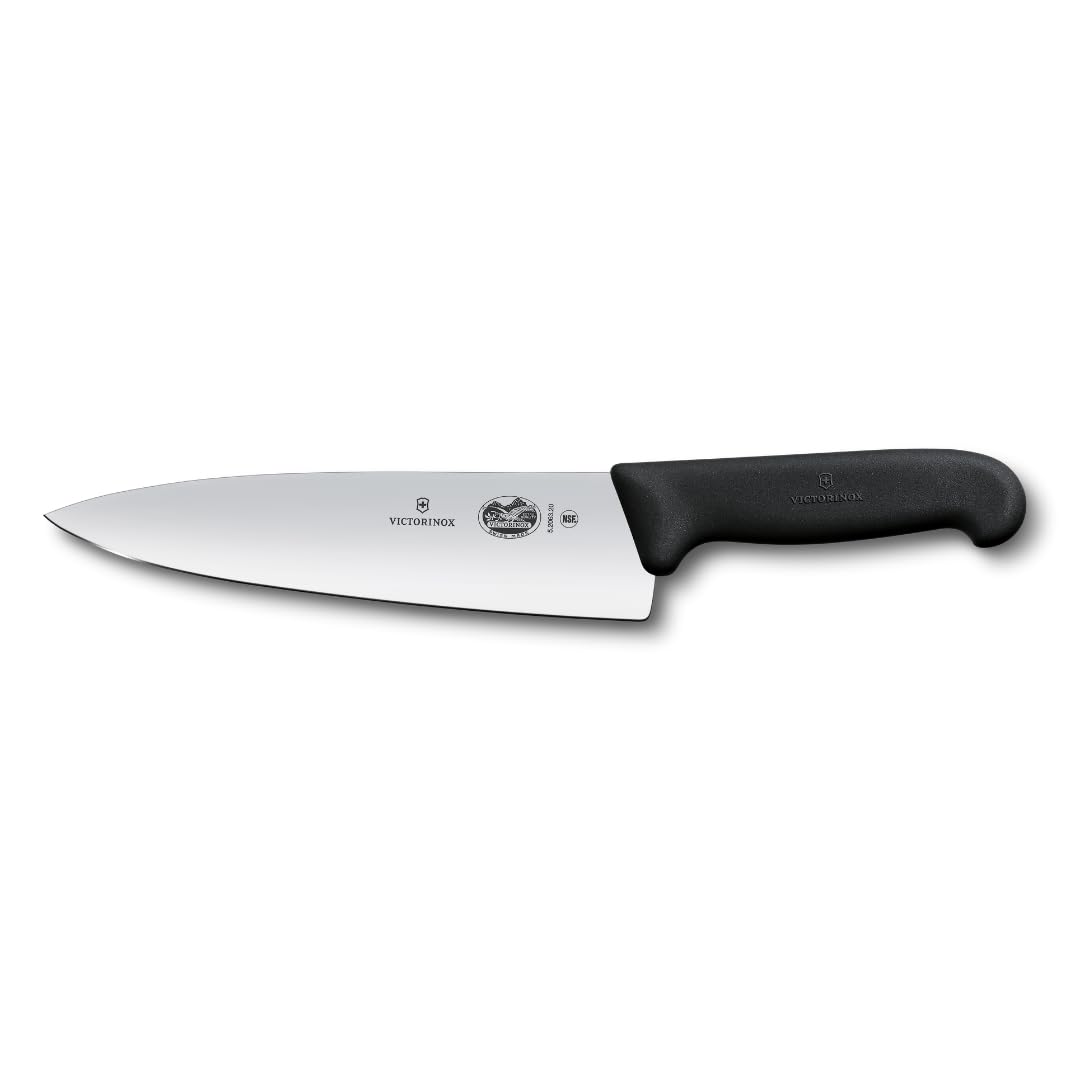
1. Victorinox Fibrox Pro 8 Inch Chef’s Knife
Our pick — 4.5+★ from 15,000+ verified ratings; the strongest balance of quality and price.
The stamped stainless blade and grippy TPE handle make it the rare knife a first-timer can use safely and a line cook can lean on daily.
The defining fact here is the construction: this is a stamped stainless steel blade, which keeps it light in the hand and lets the makers put the money into the edge instead of a heavy forged blank. The blade is 7.9 inches long with a plain edge, and the whole knife runs 13.4 inches end to end. Compared with the Mercer Culinary M22608 Millennia at 8 inches overall, this one carries 5.4 more inches of listed item length, which is the clearest signal that the measure counts the handle too.
The handle is the story. Victorinox molds it from thermoplastic elastomer (TPE), a rubbery plastic that stays grippy when your hands are wet — the exact moment a smooth handle gets dangerous. Reviewers overwhelmingly single out quality, and sharpness follows close behind, so the consensus lines up with the spec sheet. A happy owner of this particular knife called it an “Absolute workhorse of a knife. Takes a beating and doesn’t care. Sharp. Versitile. Machine washable.” That dishwasher-safe material is genuinely rare in this category, where most brands insist on hand washing.
Two things to know before you commit. The blade arrives sharp but there is no sleeve or cover in the box, so plan a drawer guard or a magnetic strip. And while the lifetime warranty against material and workmanship defects is real, it is a defect guarantee, not a promise that Swiss steel never dulls. It does, like everything else.
What a beginner gets right away
- TPE handle holds its grip with wet hands, which matters most in the first year of learning proper cuts
- Stamped stainless blade at 7.9 inches keeps the weight low for new cooks building knife confidence
- Dishwasher safe materials — the rare exception in this category, where almost everything else is hand wash only
Where it asks patience
- No protective sleeve in the box, so you will want a blade guard for storage
- The grip is textured and utilitarian rather than elegant — function over presentation
Best for: a first real chef’s knife for a home cook who wants to toss it in the dishwasher and move on.
Think twice if: you want a knife that looks handsome on the counter — this one prioritizes grip over glamour.
2. Amazon Basics Classic 8-inch Chef’s Knife
A forged, full-tang high-carbon blade with three rivets at an entry-tier price, and it holds an edge through regular use.
Most starter knives in this price band are stamped and thin. This one is forged from high carbon stainless steel with a full tang — the metal runs all the way through the handle — and three rivets holding the grip in place. That forged construction is the exact same class as the Babish at a similar tier, and both give you a knife that feels planted rather than flexible. The semi-bolster leaves the full blade accessible for chopping and for sharpening, which is the design choice that keeps this knife usable for years instead of fighting your sharpener.
The blade is 8 inches, the handle steel is a satin finish that resists stains, rust and pitting, and the listed item weight comes in at 0.23 kg. Owners say it cuts meat and vegetables without effort and feels balanced in the hand. The maker’s own instructions are clear on care: hand wash only. That is the honest trade-off for steel this inexpensive and this sharp.
One nuance to plan around. Some buyers find it sharpens up easily, others say the edge wants more frequent attention than a premium blade — a perfectly normal split for budget high-carbon steel. Buyers report it “arrived well sharpened and has kept its edge through many uses.” Think of it as a knife that rewards a quick honing every couple of weeks.
Where your money goes: a forged full-tang build at the entry tier, with a satin stainless blade that resists staining and pitting, and a three-rivet handle that feels more solid than the price suggests.
Reach for this if: you want forged weight and a riveted handle without spending like a pro.
Look elsewhere if: you refuse to hand wash — this one will not survive the rack.
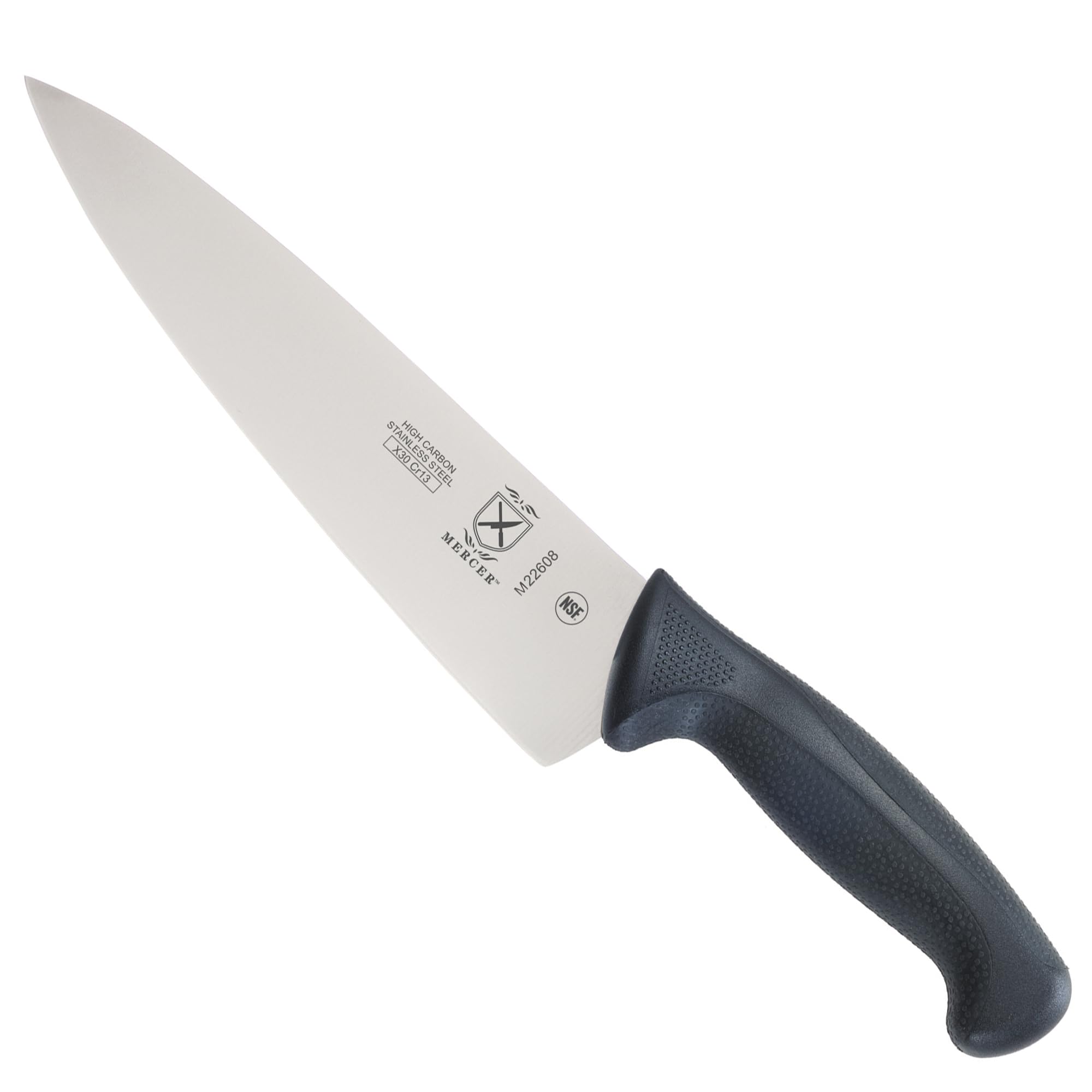
3. Mercer Culinary M22608 Millennia Chef’s Knife
The 6.7-ounce Santoprene-handled knife restaurants hand to new cooks on day one.
Here is the number that tells the story: 6.7 ounces. The blade is 8 inches with a Santoprene handle — a soft, rubbery synthetic — and textured finger points give you a non-slip grip even when your hand is wet. The absence of a bolster at the heel means you can sharpen the full edge evenly over the years, which is a real advantage for a knife you plan to keep sharp yourself.
Owners who cook daily for years report the edge keeps up and sharpens back fast on a simple drag-through sharpener. That longevity is the core reason this knife has such a loyal following — it does not need babying. The steel is thin, Japanese-style, so it glides through onions and herbs with less wedging than a thick German blade.
The catch is the flip side of thin, hard steel: it can dull faster than a heavier German blade, and Mercer explicitly says hand wash only — no dishwasher, no long soaking. Treat it well and it rewards you for years. Toss it in the rack and you will be sharpening more often.
The real draw
- 6.7 ounces keeps wrist fatigue down through a full dinner prep
- Bolster-free heel lets you sharpen the whole edge uniformly over time
- Santoprene handle with textured finger points stays grippy wet
Terms of the deal
- Hand wash only — the maker is explicit about keeping it out of the dishwasher
- Thin Japanese-style edge dulls faster than heavier German steel
The honest verdict: a professional-grade beater priced for home cooks, best for anyone cooking several nights a week.
One caveat: if you know you will never hand wash a knife, pick a dishwasher-safe option instead.
4. Babish 8-Inch Chef Knife – High-Carbon German 1.4116 Steel

Forged 1.4116 German high-carbon steel at a price that leaves room for a decent cutting board.
The spec that separates this from the pack is the steel: 1.4116 German high-carbon stainless, forged from a single piece, then tempered, taper-ground and polished. That is the same steel family serious German makers build on, which is why owners describe the edge as ready to use right from the start. The blade is 8 inches, the full-tang ABS handle runs the length of the knife for balance, and the listed item weight is 320 g — noticeably more substantial than a stamped blade like the Mercer Millennia.
What buyers keep coming back to is the cut itself: onions, potatoes, carrots, even frozen meat go down with minimal effort. Owners note the factory grind is a touch rough on arrival but takes a superb edge once you hone it yourself. One owner praised this one’s “razor-sharp edge” holding through weeks of use and found it easy to re-sharpen. A no-bolster design means your hand cannot slide onto the edge, which some see as a safety feature rather than a compromise.
One honest wrinkle: a thin, hard-tempered blade does not enjoy the dishwasher. The heat and detergent wreck edge retention fast. Hand wash this, dry it, and it will reward you for years. Treat it like a utensil and it will dull quickly.
Standout spec: genuine German 1.4116 high-carbon steel, forged in one piece and hardened for everyday use.
The real trade-off: you get pro-level steel but not pro-level care instructions — hand washing is non-negotiable here.
Choose this: if you want German steel feel and a real edge improvement over generic budget blades.
skip it if: you want a knife you can toss in the rack without thinking twice.
5. Mercer Culinary M21078 Genesis Chef’s Knife

The short bolster is the small design decision that makes this forged blade genuinely beginner-friendly.
Where most forged knives grip you with a thick bolster at the heel, this Genesis model trims it — the “short bolster” in the name. That means the full blade, toe to heel, sits on the cutting board when you sharpen, so you never end up with a permanent dull spot. The blade is precision-forged high-carbon German steel, taper-ground for an easier cut, and the 8-inch length is paired with a Santoprene handle built to hold when your hands are wet. The 8.48-ounce listed weight is where the forged feel lives.
Owners describe it as a superb all-around tool that rocks cleanly for chopping and dicing. The balanced design keeps the tip where you point it, and the edge takes sharp and holds it. There is a real range of opinion on arrival sharpness — a few knives land needing a touch-up on the honing steel, most arrive ready to cut. What buyers consistently agree on is the grip and the balance in the hand.
Two practical notes. This is hand wash only; warm water, mild soap, dry completely with a soft towel. And the packaging it ships in is hard plastic clamshell — a nuisance some buyers mention, though nothing about the blade itself changes. Keep it dry and honed and it behaves like a knife costing far more.
Why cooks like it
- Short bolster gives you back the heal of the blade for clean, full-edge sharpening
- Santoprene handle grips firmly even wet, and the balance feels right on the board
- Forged German high-carbon steel with taper-ground edge
Worth knowing
- Hand wash only, so plan the routine
- Edge sharpness on arrival varies — some need a quick hone first
Best for: cooks who want a forged blade without the thick-bolster sharpening headaches.
Not ideal for: anyone hoping for a dishwasher-safe knife.
6. MOSFiATA 8″ Chef’s Knife
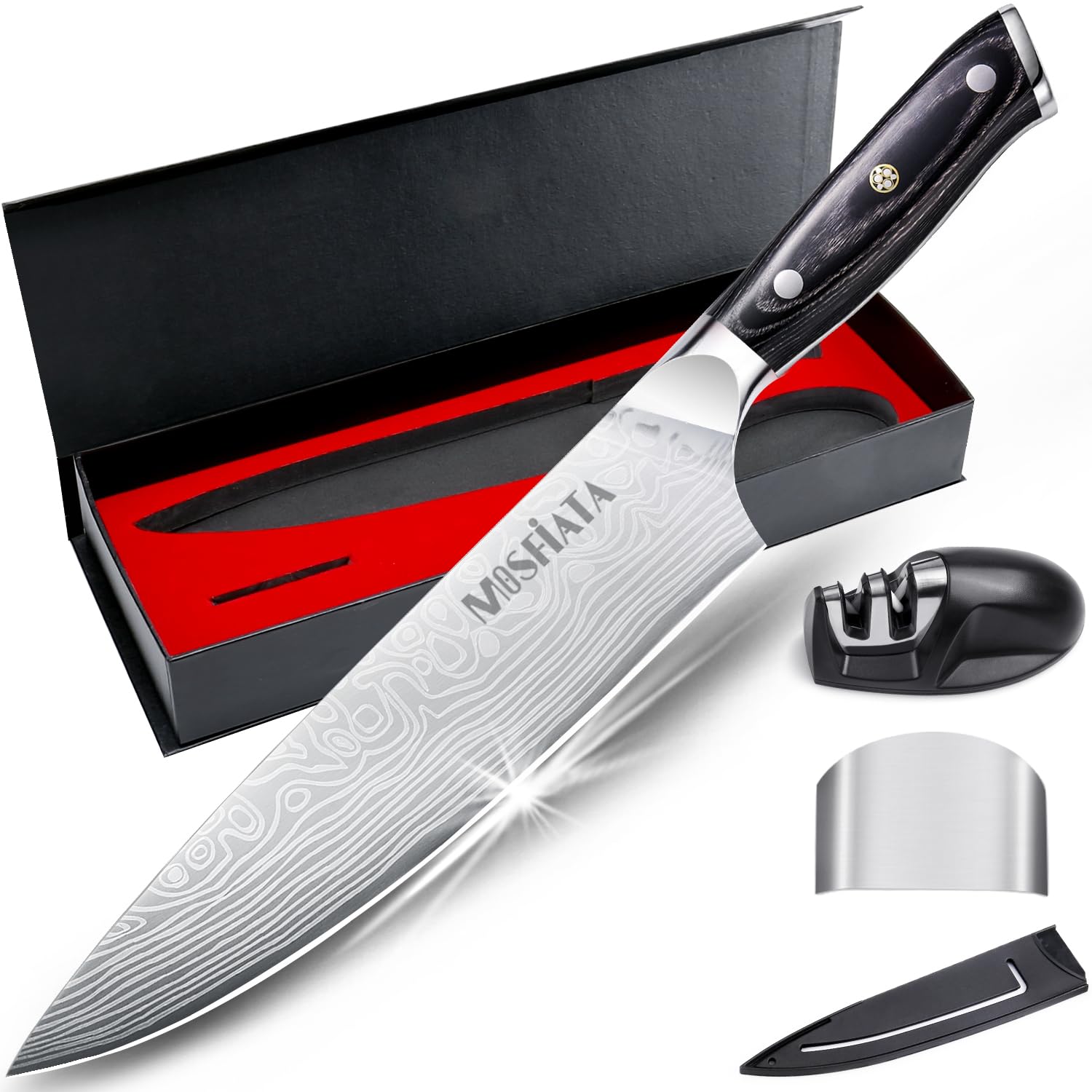
It shows up in a presentation box with a sharpener, a finger guard and a blade cover, which is why so many get bought as gifts.
Straight to the spec that matters: this is a forged EN1.4116 German high-carbon stainless blade with hand-sharpened 16-degree-per-side angles, and the maker claims 0.45–0.55% carbon content for extra hardness. That hand-sharpened edge is what makes it arrive razor-sharp, and that is what owners mention again and again. The Micarta handle (a dense layered composite) is triple-riveted to a full tang, so it feels solid in the hand. The listed weight is 7.84 ounces.
The kit is the differentiator — the sharpener, guard and blade protector mean you can start with one purchase instead of hunting for accessories. Owners describe the balance as spot on and say it handles proteins and vegetables with precision, and it stays sharp through regular use. There is a look to it that pleases too; the laser-engraved pattern on the blade is decorative and anti-sticking, and the maker is clear that it is not a Damascus pattern.
Honest limitation: a small subset of customers note it always seems to want a fresh sharpen, so budget for that rhythm with the included sharpener. Treat it as a knife that wants regular touch-ups, not a knife you leave alone for a year.
The gift math: a forged Micarta-handled German-steel blade plus a sharpener, blade guard and finger guard in one box — that combination is exactly why so many are bought as presents.
The catch: it wants regular sharpening attention, so the included sharpener earns its place fast.
The verdict: a smart starter kit for gifting or for one-purchase setup, especially if the person you are buying for is new to good knives.
pass on it if: you want a knife with a low-maintenance edge that barely needs attention.
7. SHAN ZU Chef Knife 8 Inch

A 62 HRC 10Cr15Mov core folded across 67 real layers of Damascus steel — not a laser-etched imitation.
The core spec is the 10Cr15Mov Japanese steel core hardened to 62 HRC, folded across 67 layers of steel. That hardness is what gives this knife its excellent edge retention, and 62 HRC is a noticeable step up from most German blades in this range. The blade is 8 inches with a 2.2 mm thickness, a 2.5-inch width, a 15-degree cutting angle, and the whole knife weighs 260 g. It is a heavier knife than the Mercer Millennia, and the balance point sits right where your thumb and forefinger meet — a detail buyers describe as excellent in the hand.
The G10 glass fiber handle (a dense, textured composite that stays solid) gives it a comfortable non-slip grip. Owners praise its performance on tomatoes, onions and even frozen meat, and they note the Damascus pattern gets more visible after polishing. It is a knife that looks and feels well above its price point.
The catch is that a hard core steel — 62 HRC — is more prone to chipping than softer German steel. Avoid bone and frozen items, keep it out of the dishwasher, and wipe it dry after use. Do that and its edge holds for a long time.
What earns this its spot
- 62 HRC core holds an edge noticeably longer than typical German stainless
- G10 glass fiber handle stays grippy and solid, with a balance point at the pinch grip
- 67 real folded layers of Damascus steel
The honest limit
- The hard core is more chip-prone, so keep it away from bone and frozen food
- Hand wash and dry after use — no dishwasher for this one
Best fit: cooks who appreciate real Damascus steel and will handle the knife with a little respect.
Pass if: you plan to use it on frozen food or through chicken bones.
8. Wüsthof 8″ Gourmet Chef’s Knife

A Wüsthof you can start with — stamped rather than forged, and lighter for it.
This knife is your entry into among the most respected names in cutlery, and the build explains the price tier: a precisely laser-cut stamped blade in high-carbon stainless steel, with a synthetic polypropylene handle (POM, a stiff molded plastic that resists fading and heat). The blade is 8 inches, the listed item weight is 240 g, and the whole knife runs 13.23 inches. Because it is stamped rather than forged, it feels lighter in the hand than the WÜSTHOF Classic, which comes in at 8 ounces.
Owners say it holds an edge longer than the knives they replaced and handles heavy work well — one buyer talks about trimming a 20-pound beef brisket with it, another about prepping a butternut squash without wrist fatigue. The polypropylene handle is comfortable dry, but the design is smooth, so a wet hand has less to grip than a textured handle would offer.
Honest caveat: this is not forged, and it is not dishwasher safe. The brand’s own guidance leans toward hand washing. The limited lifetime warranty is reassuring. If you want the Solingen name on your first knife without a forged price, this earns its slot.
The value proposition: a laser-cut Wüsthof blade at the lowest tier the brand offers, and the light 240 g weight makes it easy on your wrist during chopping.
What to weigh: you get the brand’s engineering but not its forged construction — the Classic below is a different animal.
Reach for this: if the Wüsthof name and light handling matter more to you than forged weight.
Consider the Classic instead: if you want a forged blade with a full bolster.
9. HENCKELS Classic 8-Inch Chef Knife
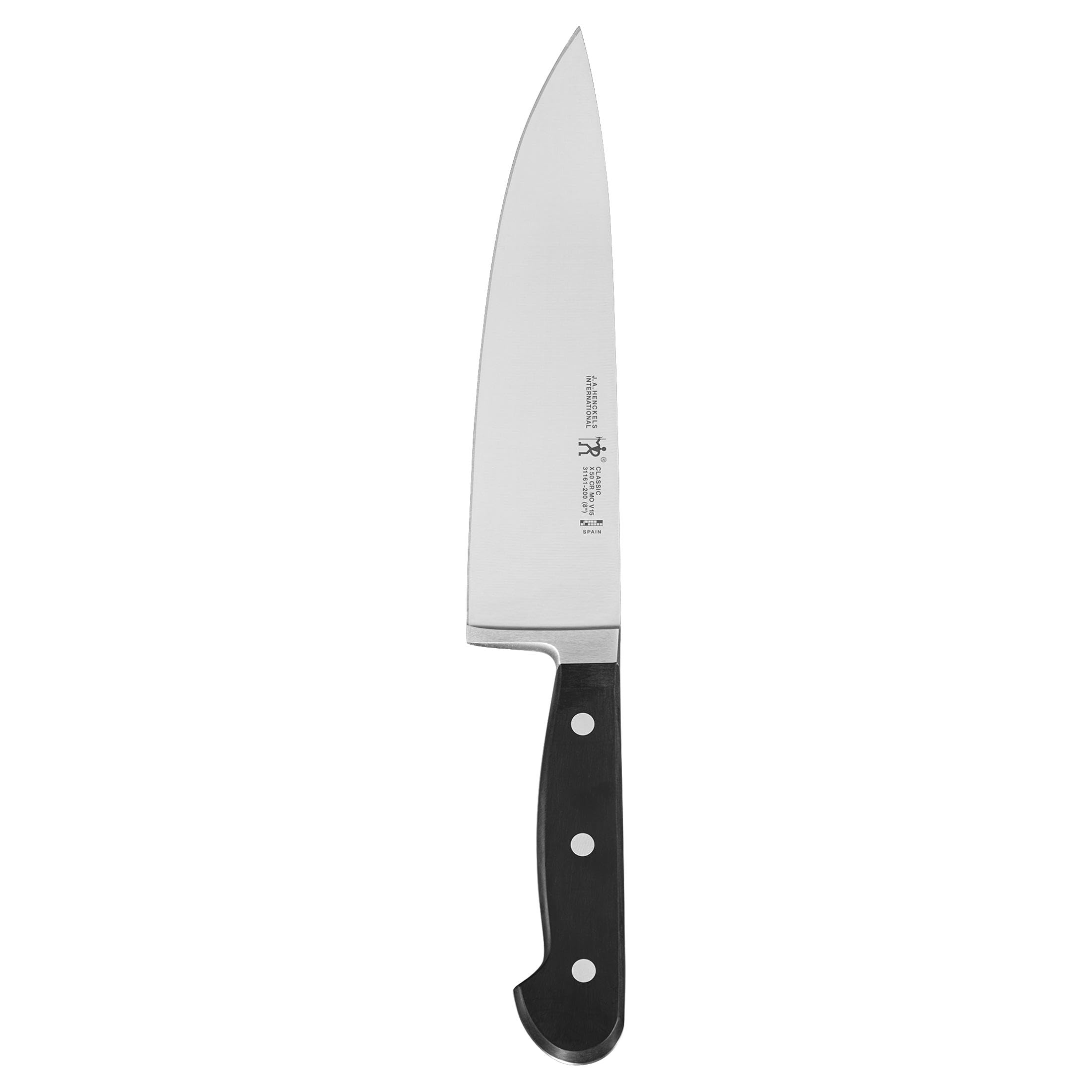
The forged German blade that keeps its edge through months of nightly cooking.
You get fully forged construction here, which brings a smooth transition from blade to handle and a traditional triple-rivet grip. The blade is 8 inches, satin finished, and the whole knife is built for slicing, chopping and mincing through everything from herbs to large cuts of meat. The listed weight is 4.48 ounces, lighter than you might expect from a forged knife — a design choice that makes long sessions easier on the wrist.
Reviewers point out it keeps its edge for months of regular cooking, which is the single biggest reason to spend at this tier. The balance and the traditional handle shape get consistent praise. One comparison worth flagging: buyers who tried both this and the Victorinox note the HENCKELS feels heavier and more ergonomic over long sessions, while the Victorinox blade is sharper from the start but its handle is lighter and less comfortable. Which of those two matters more is a genuinely personal call.
Dishwasher safe, stain and rust free blades — that is a real convenience in this category. A few knives arrive with minor cosmetic surprises in the handle resin, so inspect on arrival. Otherwise this is the forged knife a beginner can genuinely grow into.
Why this earns a place
- Fully forged German stainless with a smooth blade-to-handle transition
- Triple-rivet handle is comfortable for long sessions
- Dishwasher safe blades — unusual for a forged knife at this tier
Worth factoring in
- Some knives arrive with minor cosmetic imperfections in the handle
- Blade edge near the heel can be slightly less sharp than the tip
The call: a forged all-rounder for the cook who wants one good German blade that handles everything and tolerates the occasional dishwasher cycle.
Who should look elsewhere: buyers who prioritize the sharpest possible out-of-box edge over long-session comfort.
10. Wakoli EDIB 3-Piece Damascus Kitchen Knife Set

Three Damascus knives in a wooden box — the starter kit that doubles as a wedding present.
This set covers the whole board, so you stop reaching for a paring blade mid-recipe: a 6.7-inch santoku for chopping and slicing boneless meat, a 4.7-inch small santoku for smaller produce, and a 3.4-inch paring knife for peeling and trimming. Each blade is genuine 67-layer Damascus steel (folded and layered steel with a visible wavy pattern) with a VG10 cutting core (a hard Japanese steel) hardened to 60 ± 2 HRC (a hardness scale where higher holds an edge longer), manually honed on waterstones to a 12–14° angle per side. That sharp angle is why the blades slice a ripe tomato with barely any pressure.
The contoured Pakkawood handles (a resin-treated wood composite) suit both right- and left-handed cooks, and the balance point helps the knife feel steady when you change direction mid-chop. Owners describe the blades as extra sharp and long on edge retention, and they praise the craftsmanship. Packaging in a wooden gift box pushes the set into present territory — it is the pick here for a wedding, housewarming or a serious home cook’s birthday.
The honest limit: this is a premium set, and the santoku profile is not the same as a chef’s knife. If what you really want is one all-purpose blade, this is more than you need. If you want three that work together, it is a strong buy.
Why the set works: three distinct blade shapes with a 60 ± 2 HRC VG10 core and a 12–14° edge, all in a wooden presentation box — not a single tool dressed up as a collection.
The trade-off: you pay for three knives, and a santoku is not a chef’s knife — the profile takes a little learning if you are used to a Western blade.
The verdict: a genuine gift-ready set that also functions as a real three-knife starter kit for a household that cooks together.
Not for you if: you only need one blade and would rather put the money into a single chef’s knife.
11. WÜSTHOF Classic 8″ Chef’s Knife, Black

A precision-forged Wüsthof at 58 HRC with a full bolster and finger guard, built to outlast the drawer you keep it in.
Two numbers sit at the heart of this knife. The blade is precision forged from a single block of high-carbon stainless steel, tempered to 58-degree HRC (a hardness scale where higher holds an edge longer), and the maker’s Precision Edge Technology (PEtec) is claimed to yield a blade that is 20% sharper with twice the edge retention than previous models — those are the manufacturer’s own claims, and the feel on the board backs up the sharper part. The blade runs 7.87 inches, the handle runs 5 inches, and the full bolster with finger guard gives you a natural pinch point. The listed weight lands at 8 ounces.
Wüsthof’s Classic line is their best-selling series for a reason: full tang, triple-riveted handles, and a synthetic grip that resists fading and discoloration. Owners say it stays sharp between honings and cuts vegetables and even butternut squash cleanly, and the all-purpose nature means it never leaves the counter. The brand’s seven-generation family history and the Solingen name come with a limited lifetime warranty.
The honest downside is care. Hand wash and dry it immediately to avoid rust or discoloring, and hone it occasionally with a steel or ceramic rod. The value conversation around this knife is the only one that splits opinion — some buyers feel it is worth the premium, others feel the price is high for a stamped-feeling weight. Almost no one complains about the cut.
Why this is the long-haul choice
- Forged from a single block of high-carbon stainless steel at 58 HRC
- Full bolster and finger guard support a confident pinch grip
- Limited lifetime warranty from a seven-generation family maker
Where the money gets tested
- Hand wash only and dry immediately — no dishwasher
- Premium tier pricing splits opinion, even though the cut quality rarely does
Buy it once: a forged German blade meant to last a lifetime for a cook who enjoys the ritual of hand washing and honing.
Look elsewhere if: your cooking routine leaves no room for hand care — the care demands are real.
12. MAC Knife Chef Series 2-Piece Starter Knife Set TH-201

An 8-inch chef’s knife and a 5-inch paring knife, handcrafted in Japan, with dimples that stop potatoes from clinging to the steel.
The spec to know is the dimpled edge. Both knives — the 8-inch chef’s knife with dimples and the 5-inch paring knife withdimples — have dimples on the blade sides that break the vacuum seal when you slice starchy or sticky food. Potatoes and apples slide off instead of gripping the steel. The steel itself is a stain-resistant molybdenum alloy, stamped from thin stock (2.5 mm for the chef, 2.0 mm for the paring) and then fully tapered spine to edge. That thinness is why it wedges less going into a carrot. Both blades carry a 15-degree-per-side double bevel. The Pakkawood handles are contoured with an upswept shape that lifts your knuckles clear of the board, and the maker puts a 25-year warranty on manufacturing defects.
Owners describe the pair as balanced, sleek and genuinely sharp — sharp enough that one reviewer noted they cut paper cleanly straight from the box. The paring knife earns its place fast; peeling and trimming with a 5-inch blade becomes the job you stop dreading. Keep both dry after washing and the stain-resistant steel stays looking new, though a single rust spot has been reported on a large blade that would not wipe away — dry them promptly and that risk stays low.
What the dimples actually do: they release the suction that makes potatoes and apples stick to a flat blade, so slices fall away instead of clinging.
The catch: handcrafted steel this thin rewards prompt drying — leave it wet and a spot can set.
Pick this pair: if you want a chef’s knife and a paring knife that were made together, in Japan, by hand, with a 25-year warranty behind them.
Think twice if: you only have room for one knife — the chef’s blade alone will do most of the work.
13. Global 3 Piece Starter Knife Set G 2338

A one-piece CROMOVA stainless knife with no rivets and no wood — nothing for bacteria or dishwater to creep into.
Global’s signature is the construction: each knife is stamped from a single piece of CROMOVA stainless steel, so the blade and handle are one continuous piece of metal with no seam, no rivet and no wooden scale. The chef’s knife runs 8 inches and the set ships with a utility and a paring knife as well. The blade is face-ground with a long taper, and that taper is why the edge stays sharp longer — there is less material dragging through the cut. The convex edge is a Global hallmark, and it slices with very little resistance. The listed weight is 1.1 pounds for the set.
The handle deserves a plain explanation. The dimples you see are colored metal indentations, not rubber pads — they add grip without a soft surface. Owners say the knife feels light and well weighted, and describe it cutting through frozen chicken bones with ease, which tells you the steel is hard. The thin Japanese-style profile cuts with less effort than a thick German blade.
The honest wrinkle: hard steel that cuts brilliantly can also chip under abuse. A handful of shoppers say chipping after a few months, and the fix is technique — no twisting, no hacking through bone with force, no dishwasher. Store it on a magnetic rack or in a block, hand wash and dry it, and use a ceramic whetstone rather than a steel honing rod for the sharpest results.
What makes Global distinct
- One-piece CROMOVA stainless construction with no seam, rivet or wood to trap moisture
- Long face-ground taper keeps the edge effective longer than a short bevel
- Light, well-weighted feel that reduces hand fatigue
What to respect
- Hard steel can chip if you twist or force it through bone
- Hand wash and dry, no dishwasher, and a ceramic whetstone is the sharpening tool of choice
The verdict: a lifetime-grade all-metal starter set for a cook who wants three knives, no rivets, and a hygienic smooth handle.
Not the one if: you want a knife you can be rough with — this steel rewards a careful hand.
Know the Specs
Blade Length and Shape
Eight inches is the default for a reason: it covers enough board to rock through herbs but stays short enough to trim a single strawberry. The santoku in the Wakoli set at 6.7 inches and the MAC paring knife at 5 inches show how a shorter blade becomes a precision tool, not a smaller version of the same job. Match the blade to the motion — a long chef’s knife for the rocking chop, a paring blade for in-hand work.
Stamped vs Forged Construction
A stamped blade is cut from a sheet, so it is thinner and lighter — the Victorinox Fibrox and Global set both use it. A forged blade is shaped from a heated block, giving a heavier spine and a bolster. Neither is better; stamped blades tire your wrist less, forged blades feel more planted. For a first knife, stamped is often the easier introduction because it is lighter in the hand.
Steel Hardness (HRC)
HRC is a hardness scale for steel. A higher number holds an edge longer; a lower number sharpens up faster but dulls quicker. The SHAN ZU at 62 HRC and the Wakoli at 60 ± 2 HRC sit high on this scale, which is why their edges last — but hard steel is also more prone to chipping. A softer German blade at a lower HRC will shrug off more abuse and take a fresh edge with less effort.
Handle Material and Grip
Your hand is wet half the time you cook, so grip is not a small detail. TPE, Santoprene and Pakkawood (textured rubber and layered-wood handle materials) stay secure when wet. Smooth polypropylene or plain plastic handles feel fine dry but can get slick. An all-metal handle like Global’s is smooth and hygienic but has no give. Picture the grip with damp hands before you buy.
Edge Angle
A sharper angle cuts with less force but dulls or chips sooner. A 12–14° per side edge (Wakoli) or 15° per side (SHAN ZU, MAC) slices tomatoes beautifully but wants care around bone and frozen food. A wider German-style angle holds up to more abuse and honing. If you cook a lot of squash and frozen meat, a wider angle is the safer call.
Care Requirements
Most knives in this category are hand wash only; a few, like the Victorinox Fibrox and HENCKELS Classic, are dishwasher safe. Heat and detergent wreck edge retention on thin, hard blades. A quick hand wash and towel dry after every use is the single habit that decides whether a good knife stays good for years.
Common Questions
Is an 8-inch chef’s knife the right first knife for a beginner?
What is the difference between a stamped and a forged chef’s knife?
Can I put a chef’s knife in the dishwasher?
How often will I need to sharpen a starter chef’s knife?
What does HRC mean on a knife spec sheet?
Is a Damascus chef’s knife better than a plain stainless one?
Will a hard Japanese steel knife chip if I cut through bone?
Should I buy a chef’s knife alone or a starter set?
How do I keep a new chef’s knife sharp between sharpenings?
Is a wooden or Pakkawood handle better than plastic?
The Bottom Line
For most first-time buyers, the starter chef knife winner is the Victorinox Fibrox Pro 8 Inch because it pairs a grippy TPE handle that stays secure wet with a stamped stainless blade that stays light in your hand, and it is one of the few in this category you can wash in the dishwasher. If you want a forged blade with real German steel and a full tang (the steel running through the handle) at the entry tier, the Amazon Basics Classic 8-inch gives you that construction on a beginner budget. And for anyone who wants the sharpest edge retention in this lineup, the SHAN ZU 8 Inch Damascus at 62 HRC is the blade to reach for — provided you keep it off bone and out of the dishwasher.
Here is the nudge: none of these knives is a gamble. Each one earns its slot because owners who cook every night keep reaching for it, and the only real mistake a beginner makes is buying too many blades before knowing which one they love. Pick the handle that fits your wet hand, then commit.
How we choose
We do not accept paid placement. Every pick is matched to a real buyer and a real use-case; we do not hands-on test units.
Sources
Specifications: manufacturer listings and product documentation. Review insights: verified customer reviews, as of October 2026. Pricing: not shown on this page (it changes often); check the current price via the retailer link.
As an Amazon Associate, Aappliancez earns from qualifying purchases. This does not affect which products we feature.