Disclosure: Some links in this post are affiliate links. As an Amazon Associate I earn from qualifying purchases, at no extra cost to you. Learn more
Specs are compiled from manufacturer listings and verified buyer reviews and can change over time — please confirm the key details on the product page before buying.
The whole point of a springless trampoline is the part you will never have to replace: there are no metal springs to stretch, squeak, or rust through. Instead, elastic bungee cords or flexible composite rods hold the jumping mat, which changes almost everything about how the trampoline feels, sounds, and survives winter. This guide covers nine real springless models, from compact indoor rebounders to full backyard giants, so you can match the right one to your family.
This guide is built by comparing the manufacturers’ published specifications and the patterns across verified customer reviews, so you get each pick’s real strengths and trade-offs instead of marketing spin.
You do not need to be an engineer to pick one of these. What matters is the sizing, the bounce material, and the weight rating — three numbers that decide whether a trampoline fits your yard and your jumpers. That is exactly what this breakdown of the best springless trampoline walks through, pick by pick, with the real trade-offs left in.
Top Picks


How To Choose The Best Springless Trampoline
A springless trampoline trades metal springs for either elastic bungee cords or flexible composite rods. That single swap is why the category exists: no coils means no pinch points between the mat and the frame, no rust cycle, and none of the metallic squeak you hear from a traditional bouncer. The trade-off is that these bungees and rods still wear over time, so the frame and the pad around them are the parts you want to be honest about.
Match the weight rating to your heaviest jumper
Every trampoline lists a weight figure, and it is the fastest way to rule one in or out. A 220-pound rating handles small children and lighter teens; a 285- or 450-pound rating opens the mat to adults. If two people jump at once, you want the higher ceiling. Check the rating before the size — an oversized mat with a low weight limit is the wrong buy for a grown-up family.
Bungee cords versus composite rods
Bungee-cord trampolines use elastic straps that stretch and recoil, which gives a springy, quiet bounce and makes the mat relatively simple to set up. Composite-rod models move the suspension below the mat so nothing pokes into the jump zone at all. Rods give a flatter, more controlled bounce and a wider mat edge to land on; cords are usually lighter and cheaper to ship. Neither is “better” — they just feel different underfoot.
Round, square, or rectangular
Round mats pull a jumper back toward the center, which is why they suit casual play and multiple kids at once. Rectangular and square frames spread the bounce evenly across a longer run, so they are the shape gymnasts and tumblers prefer for flips and tumbles. If your kids mostly want to jump and laugh, a round or square model is plenty; if someone is practicing tumbling skills, a rectangle earns its footprint.
Side-by-Side Comparison
| Model | Best For | Frame Size | Weight Rating | Shape | Amazon |
|---|---|---|---|---|---|
| Zupapa Rectangular Trampoline★ Best Overall | Gymnastics and family tumbling | 2.88 feet | 450 pounds | Rectangular | Amazon |
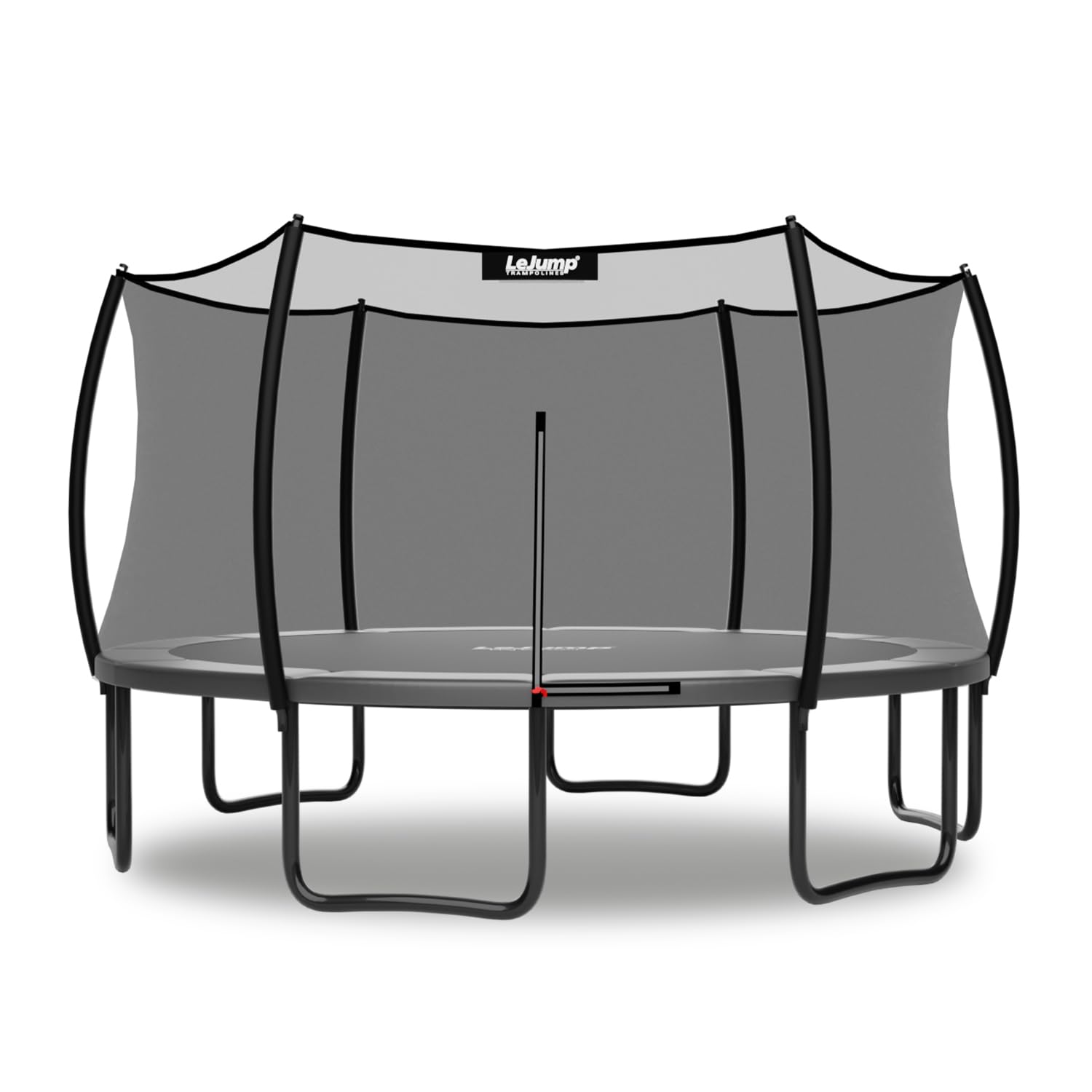
| LeJump 14FT SpringlessWind-Ready Pick | Windy yards and easy setup | 14 feet | 400 pounds | Round | Amazon |
| SkyBound 6FT SpringlessBest for Small Spaces | Small indoor or patio spaces | 6 feet | 220 pounds | Round | Amazon |
| SkyBound 6FT Springless (Black) | Playrooms and tight corners | 6 feet | 220 pounds | Round | Amazon |
| Sunny Health & Fitness Rebounder | Indoor cardio and jogging | 1.25 inches | 285 pounds | Square | Amazon |
| Gigu 10FT-16FT Springless | Active kids and families | 14 feet | 450 pounds | Round | Amazon |
| SkyBound 8FT Springless | Rooms with a bit more space | 8 feet | 265 pounds | Round | Amazon |
| Jumpflex Hero | Big families and long-term yards | 14 feet | 550 pounds | Round | Amazon |
| Springfree Trampoline | Premium springless bounce | 11 feet | 220 pounds | 11ft Large Square | Amazon |
Detailed Reviews
1. Zupapa Rectangular Trampoline 10x17FT 9x15FT 8x14FT
Our pick — 4.5+★ from 650+ verified ratings; the strongest balance of quality and price.
A 450-pound dynamic rating and a gap-free mat make this the family mat that takes real stunts.
If your kids want to flip, tumble, and throw gymnastic moves, the rectangular frame here is the reason this pick takes the top slot. The long-sided mat spreads the bounce from end to end instead of pulling everyone toward the middle, which is exactly what tumblers need for a run of backflips. Building it out of Q195 steel gives the frame a 51mm diameter and a 2.5mm wall thickness, both above the standard 42mm frames common in this tier — a real difference when flippers land off-center. Frame and mat together carry a static load capacity of 1800LBS and a dynamic load rating of 450LBS, so your heaviest jumper can bounce hard without you watching the legs.
You skip the half hour of rope-tying that most trampolines demand, because Zupapa’s patented No-Gap Design (Patent No. 2022230865778) joins the net straight to the jumping mat. The four-leg support system replaces the usual four-corner layout and adds mid-span support on the long sides, so the mat does not sag between the legs. For a family with teenagers, this is not the cheapest way into a springless trampoline, but the mat size, weight ceiling, and 10-year frame durability guarantee (2 years on mats, pads, nets, and springs) add up to the best all-round backyard gymnastics setup in this lineup.
What wins families over is straightforward: quality leads everything else owners talk about, and bounce and size come right after. The material you’re paying for is hot-dip galvanized steel with a PVC+PE+foam pad over the frame edge, deliberate choices meant to survive UV exposure and winter. The one honest caveat is stability — owners rate it positively but note the frame wants to be properly anchored to stay planted in a strong wind. Staking the legs solves it, but do not skip that step.
Why It Wins The Slot
- Rectangular shape spreads bounce for real gymnastic moves
- Q195 steel frame with 51mm diameter, above the standard 42mm tier
- 1800LBS static and 450LBS dynamic load ratings
- Patented No-Gap Design skips rope-tying setup
Where It Asks For Your Help
- Needs staking down to stay planted in strong wind
- Large footprint — the 204″L x 120″W mat eats real yard
- At 310 pounds shipped, this is not a one-person assembly job
Grab this if: you have a family of mixed ages who want one trampoline for both play and practice.
skip it if: your yard is small enough that a 204-inch rectangle would not leave a landing zone around the mat.
2. LeJump 14FT Outdoor Springless Trampoline
Owners say it will not budge, and that calm starts with a no-spring frame that never rusts in place.
Fourteen feet round, 400-pound weight rating, and a frame of carbon steel with powder-coated legs — the LeJump is the middle-of-the-road size that fits a typical backyard without dominating it. The genuine selling point here is the no-spring design, which the maker measures as 20% more bouncing space than a coil-spring frame. If you have ever spent a spring maintenance weekend oiling rust off metal coils, you feel that 20% as a whole weekend handed back. The galvanized legs and powder coating are deliberate for standing up to weather; the 14-foot frame dimensions sit at 168″L x 144″W x 35″H, so measure your corner before committing.
Wind resistance is the strongest thing owners talk about. Buyers report it stays put in a 40mph gust — that is unusual for a trampoline this size, and it means you are not always chasing it across the yard after a storm. Setup is also treated kindly: buyers describe “sectioned-off marks” on the poles that help you put it together without a manual-consulting marathon, and the net and mat snap on with plastic hooks rather than tied rope. Grandparents in particular like that the net and mat are separate enough to install without tools in hand all day.
Where this one gets real is durability. Some owners mention it holding up well past two years; a few others have flagged wear sooner than expected. That is not a reason to skip the LeJump — it is a reason to treat the mat and net as the wear parts they are, and to keep the frame clean of standing moisture. The bounce itself is solid for the 400-pound rating, and 132.8 pounds of shipping weight means two adults can manage the build comfortably. For a family that wants a round, wind-stable, easy-assembly trampoline without premium-tier pricing, this is a sensible middle.
Best for windy yards: the LeJump is the pick for buyers who have seen a cheaper trampoline roll across the lawn, and want something the wind leaves alone.
The honest caveat: durability on the soft parts is mixed across the long-term owner reports, so plan on inspecting the net and mat seasonally rather than assuming they will look new at year five.
Reach for this if: your yard is exposed to weather and you value quiet, rope-free assembly.
Look elsewhere if: you need a longer service window on mat and net than the standard trampoline, or a rectangular shape for gymnastics.
3. SkyBound 6FT Springless Trampoline for Kids and Adults
Six feet across, 56 pounds, and bungee cords instead of springs for the smallest installed footprint here.
This SkyBound takes the entry-level slot for good reason: at 6 feet across and 72″L x 72″W x 20″H, it tucks into a playroom, a covered patio, or the corner of a small yard. That footprint sits at a fraction of the size of the Zupapa rectangular above — you’re trading mat length for floor plan, and for a family with limited space that is the whole point. The frame is stainless steel with fiberglass rods used in place of metal poles, which is the reason this one does not corrode the way a traditional steel-pole enclosure does. The mat carries a 220-pound weight rating, so it fits one child or a lighter teen at a time comfortably.
Your kids’ feet and hands never meet a pinch point, because flexible bungee cords replace the coil springs that squeeze at the mat edge — the maker says the cord edge removes the pinch points where small feet and hands get caught. The no-gap zipper system joins the net to the mat with no seam to slip through. The pad around the frame is high-strength polypropylene sewn with straps underneath the frame, and the maker rates the polypropylene pad at 6-8 times the lifespan of a foam pad; that number is their own claim, but the water-permeable, UV-resistant construction makes it a believable one. Kids consistently report this bounces higher than a similarly sized spring model, which is the benefit of stored energy in the bungee versus steel coils.
Assembly on this smaller frame takes longer than a comparable spring type, and the instructions rely on translations that some owners find harder to parse than they’d like. Customers note a well-made unit for heavy teen use once it’s up, and note the bungee tool that ships with the kit helps. The honest limits: this is a 220-pound, 6-foot frame, so it is meant for children and lighter adults. If you want a bigger installed footprint for a growing family, step up to the 8-foot version or another round in this list.
Where it shines: the fiberglass rods and stainless frame mean the vertical parts of the enclosure last without the rust patina that steel poles pick up over a season or two.
What to know before you buy: budget a couple of hours for setup; the translation on the manual is the most common friction point owners mention, and the smaller 6-foot mat means one jumper at a time in practice.
Pick this if: your priority is a properly small, no-spring bouncer for one young child with safe bungee energy.
Look past it if: you have more than one child who wants to jump together, or need more than a 220-pound mat.
4. SkyBound 6FT Springless Trampoline (Black)

The same 6-foot bungee build as the green one, finished in black to disappear against darker walls.
Same frame, same bungee setup, same 220-pound weight rating and 6-foot span as the green version above — the difference here is the finish. If the trampoline is living indoors in a playroom or against a dark fence, the black colorway reads less like a toy and more like furniture. The 5-year warranty applies to all components, which is a longer coverage window than you find on most entry-level trampolines in this size. The high-strength polypropylene pad is water-permeable and UV-resistant, and the straps sewn underneath hold it snug to the frame instead of loosening with use.
The no-gap zipper system is the second reason to consider this compact pick. Where a traditional enclosure net leaves a gap between the netting and the jumping mat, the zipper design makes a continuous surface so there is no pinch or fall-through point around the perimeter. The fiberglass rods used in the vertical support do not rust the way steel poles do, which is worth calling out for anyone putting this on a screened porch or a covered patio where humidity is a factor. Reviewers point out the bounce exceeds what they expected from a 6-foot model, and that the enclosed netting is a genuine comfort for parents watching kids use it unsupervised.
The trade-offs are the same trade-offs that come with the 6-foot size, not this colorway. Assembly is on the longer side because there are more bungee connections than a coil model, and the manual’s translation takes some patience. Some owners note the bungee mat can develop rings that flip out of alignment and need repositioning — cosmetic, easy to fix, and not affecting bounce. Treat it as the pick for one young jumper who needs a properly small, quiet, no-rust bungee setup, not the family workhorse.
What Earns Its Place
- Compact 6-foot frame fits indoor and patio spots
- 5-year warranty on all components
- Fiberglass rods will not rust like steel poles
- Zipper no-gap system joins net to mat smoothly
What To Plan Around
- 220-pound mat rating caps it at one lighter jumper
- Longer setup than a spring-type equivalent
- Instructions rely on translations that take patience
Choose this if: you want the small bungee SkyBound in a color that blends into a darker indoor space.
pass on it if: you need the visual pop of a bright frame to keep an eye on kids from a distance.
5. Sunny Health & Fitness Square Fitness Trampoline

A 40-inch square rebounder with 32 elastic bands — built for jogging indoors, not backyard flips.
This one belongs in a different conversation than the others. It is a fitness rebounder, not a kids’ bouncer: 42.5″L x 42.5″W x 13.4″H, 26.4 pounds, rated for 285 pounds, and supported by 32 elastic bands instead of cords or rods. The square shape is deliberate — it gives more usable mat area than a round of the same diameter, which is why inner-thigh workouts and jogging feel less cramped here. The side mat that protects the bungees adds a layer over the frame edge that keeps ankles from catching the connections.
You can rebound next to a TV without a metallic ring, because the low-noise bungee design replaces the steel spring that gets old by week two. Jogging in place, jumping jacks, and low-impact cardio are the balance; the mat handles the force of sustained use from an adult but it is not built for high-flying tricks. Stability is good — owners who run on it report the curved outward legs help with off-center movement and the frame stays planted without squeaks. A 65-year-old owner reports using it comfortably with a stable handle and hexagon-shape advantage for space that the square design provides.
Assembly is easy for most — legs bolt on with an Allen key in minutes and the bungees ship pre-installed. Not every unit arrives complete: a few buyers have reported missing hardware in the box, which is a frustrating first-day experience but does not reflect the design. The mat itself does not last forever under heavy daily cardio; at least one long-term owner of over five years has now replaced the bungees one by one as they degrade. For a rebounder, that is the wear cycle to expect — the bungee is your replaceable part, so check the tension and re-tie knots to firm the bounce if it feels soft.
The one feature that defines it: 32 elastic bands under a 40-inch square mat turn a small piece of floor into a quiet, joint-friendly cardio station.
The honest limit: this is not a children’s bouncer — its 285-pound adult rating and 26.4-pound total weight assume indoor fitness use, not outdoor play.
Reach for this if: you want a quiet indoor cardio tool that takes up a 40-inch corner of a room.
Look elsewhere if: you want a family trampoline for multiple kids, or need something that tolerates standing water outdoors.
6. Gigu 10FT-16FT Outdoor Springless Trampoline
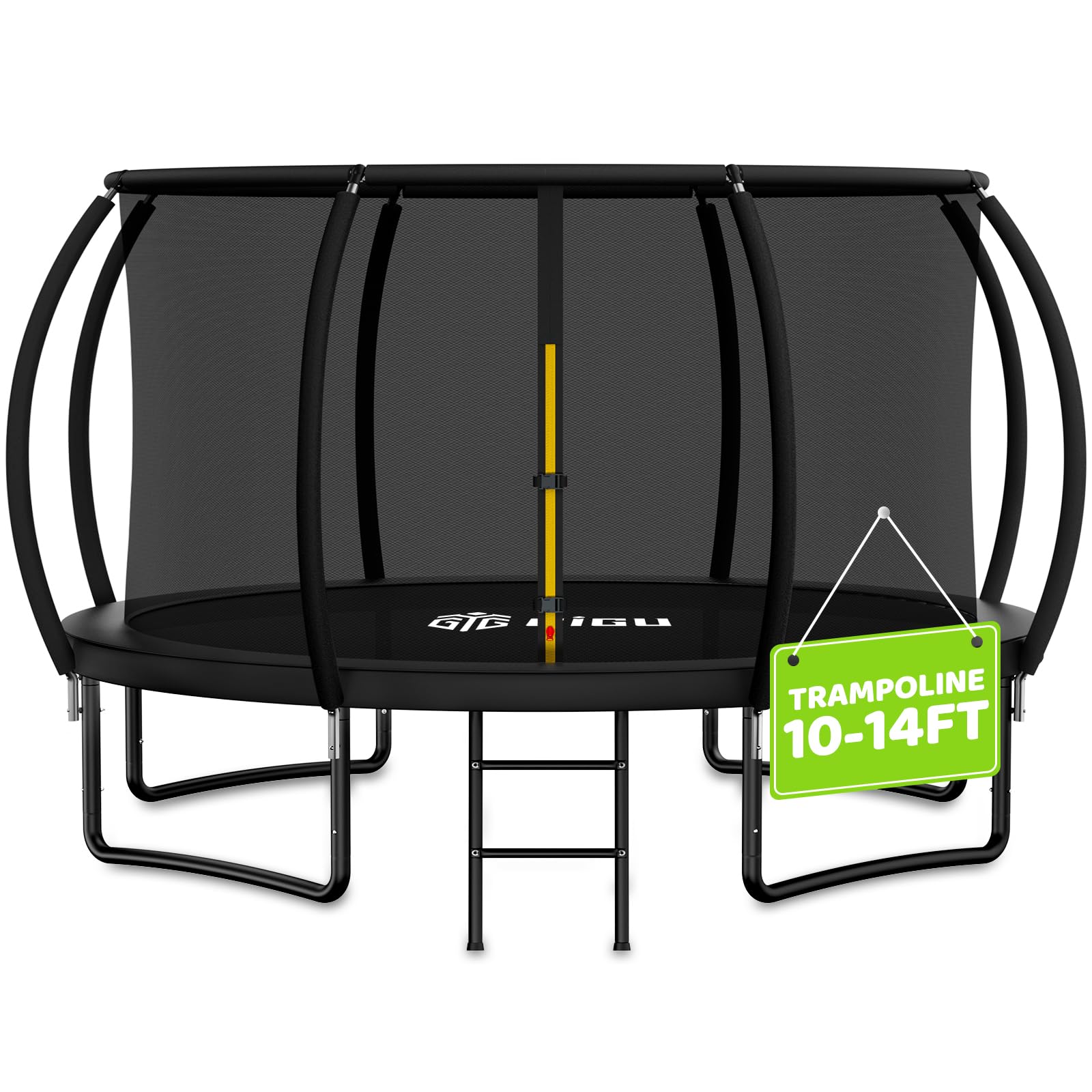
A 450-pound frame, 80 springs, and a curved-pole safety build that keeps kids busy all afternoon.
The Gigu covers the mid-size round trampoline slot nicely — a 14-footer with a 450-pound weight rating, a stainless and hot-dip galvanized steel frame, and an upgraded anti-skid ladder included. Two safety certifications matter here. The CPSIA test confirms materials are free from harmful heavy metals like lead and phthalates. The ASTM F381-16 standard covers structural integrity, component quality, labeling, and assembly. Together those are the two certifications worth checking in this category, and having both is why this makes the list. The 14-foot frame tops out at 168″L x 168″W x 30″H, and with 80 springs holding the mat, its bounce will feel closer to a traditional bouncer than the deeper, longer-recoil feel of a springless bungee model.
Assembly is where this one shines. Owners describe the instructions as clear and the parts as fully present, and note that with two adults working together, it goes up in a reasonable afternoon. The curved safety poles wrapped in high-density foam reduce the chance of an unintended collision with a pole; the anti-skid ladder gives smaller kids a safe way up. The jumping mat is reinforced with heavy-duty stitching and finished UV-resistant, waterproof, and fade-resistant — three properties that matter if this is living outside in the sun year after year.
The honest gap between the marketing and owner experience: some long-term shoppers say the poles loosening and the net tearing at the bottom inside the first year in harsh-sun climates. That is one report among many, note rather than worrying about, but it does mean you should check pole connections and net straps after each season. For families who want a straightforward round family trampoline with the certifications to prove materials safety, and one that kids genuinely bring their friends over to use, the Gigu is a solid middle-ground investment.
What Makes It Worth It
- Both CPSIA and ASTM F381-16 safety certifications
- 450-pound weight rating suits adults and multiple kids
- 80 springs and galvanized steel frame for classic bounce feel
- Curved foam-wrapped poles and anti-skid ladder included
Where It Could Be Better
- Not fully springless — 80 metal springs need periodic inspection for rust
- Harsh-sun climates may wear the net and pole connections faster
- Two-package shipping means delivery days may not match
Best for: a family with two to three active kids who want a mid-size round trampoline that feels like a classic bouncer.
Worth noting: unlike the bungee and rod picks above, this one still uses metal springs, so a rust-check routine belongs in your season maintenance.
7. SkyBound 8FT Springless Trampoline

The 8-foot balance for families who have outgrown a small bungee bouncer but not the yard.
Two kids can jump at once on this 8-foot SkyBound, which is the right move when you have outgrown a 6-foot bouncer. The frame measures 96″L x 96″W x 24″H and upholds a 265-pound weight rating — enough for two younger kids or one heavier teenager. The build repeats the SkyBound springless formula: patented bungee cords instead of metal springs, a no-gap zipper that joins the net to the mat, and fiberglass rods for the support posts rather than the steel poles most brands use. That fiberglass choice matters in humid climates where steel would pick up rust over time, and it is why buyers report these hold up through several seasons without the pole fading that shows on cheaper models.
Your kids get a higher, more responsive bounce than a spring-type equivalent, and the bungee system means no spring-noise while they jump — a real quality-of-life difference if your trampoline lives close to a window or a patio where you sit. The frame pad is polypropylene, which the maker rates at 6-8 times the lifespan of traditional foam, and the straps sewn under the pad hold it against the frame rather than loosening as it ages. At 72 pounds shipped, the 8-foot version is heavier than the 6-foot but still manageable for two adults to assemble in an afternoon.
Assembly time is longer than a comparable spring model — an honest trade for the bungee build, and one buyers accept once the mat is up because the ride is worth it. The instructions use translations that owners find harder to follow than a US-made equivalent, so watch a build video rather than relying purely on the manual. Anchor the legs before you let the kids on it; without stakes, wind can move this size more than you expect.
Why this earns its spot: the 8-foot mat plus 265-pound rating opens the bungee bounce to two jumpers or a bigger kid, and the fiberglass rods mean the frame keeps its color season after season.
What to know: setup takes real time, the manual is not the easiest read, and you’ll want to anchor the legs before first use — plan a full afternoon.
Great match for: families with two kids who want a calm, quiet, springless bounce and enough room to share it.
Better skip if: you need a rectangle shape for gymnastics, or a weight rating above what two lighter kids and one teen will push against.
8. Jumpflex Hero Trampoline 10FT-15FT

A 550-pound capacity and a 14-foot round mat turn the Jumpflex Hero into a true family-size bouncer.
The headline number on the Jumpflex Hero is the 550-pound maximum user weight — nearly double what most mid-range trampolines in this size will take. Ideal for jumpers between 40 and 200 pounds, the Hero is built for households where adults and bigger teenagers want on the mat without worrying about the frame giving out. The dual-ring steel frame uses a 42mm high-tensile upper ring and a 38mm lower ring, with 96 springs and a 6-layer process over the construction — all specific structural choices made for a mat that takes real weight. At 14 feet and 15.1 feet in diameter at the widest point, it wants a yard with a minimum 16.4-foot clearance so you have space to step off and land around the frame.
Assembly is where this one surprises people — 0 bolts and no welds means the frame fits together as designed quick snaps rather than hardware. You will still spend around two hours on the build, which is normal for a 14-footer, but owners mention it is a clean assembly that does not require specialized tools. The safety enclosure uses a 360-degree net that clips to the mat, and a SafeSeal design that closes the door with no gaps or holes. The zipperless entry is a change some older owners find harder to use than a zipper, especially if they have short reach.
The durability record on the Hero is genuinely strong. Owners who have had theirs a few years report it outlasting every trampoline on their street, and one family confirms two-plus years of use with no replacements while strapped into the ground through Midwest winters. The 10-year frame warranty reflects that confidence. The trade-off is honest: it is a premium-priced pick, and it ships in three boxes, so if one is delayed, contact the seller rather than assembling a partial frame. The mat remains the wear part — the frame endures, but plan on eventually replacing the mat and net when they fade.
What Justifies The Pick
- 550-pound max user weight — the highest in the mid-range here
- 42mm upper and 38mm lower high-tensile steel dual-ring frame
- 0-bolt, no-weld assembly with included ladder
- 10-year warranty on the frame
What To Expect
- Needs a 16.4-foot minimum foot-print of clear yard space
- Zipperless entry takes longer to get used to than a zipped net
- Setup is ~2 hours, closer to a real project than a quick pop-up
Built for: larger or heavier families who want one sturdy trampoline that adults can genuinely use.
Look past it if: your yard is tighter than 16-plus feet at the widest point, or you need a springless mat rather than this spring-based bouncer.
9. Springfree Trampoline Springless Round Backyard Trampoline
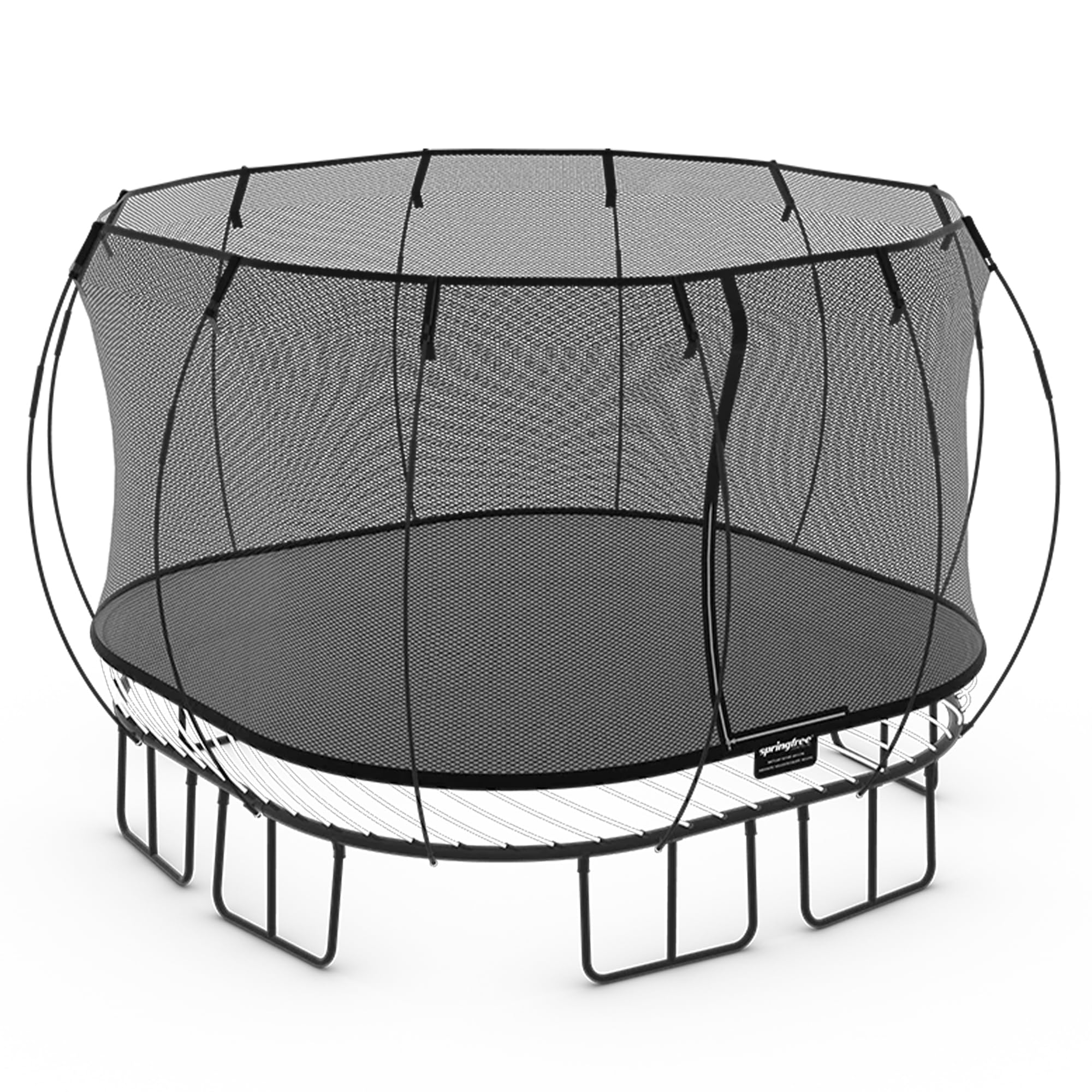
Composite rods instead of springs and cords — the springless design taken to its logical end.
Springfree is the pick for the buyer who wants the springless concept pushed farthest. Where most bungee models still hang cords or rods at the frame edge, Springfree moves the entire suspension below the jumping mat, using composite rods so there is nothing to pinch against in the jump zone at all. The 11-foot frame paired with a “11ft Large Square” shape opens 113 square feet of jump surface — a substantial mat with the corners cut to give more usable space than a round of comparable diameter. The 220-pound weight rating suits a family with kids and one or two lighter adults, and the 10-year spare-part availability signals the brand expects this to live outside for a decade.
The bounce itself is where owners notice the difference. It is a flatter, more stable ride than a metal-spring bouncer, and the FlexiNet enclosure absorbs impact rather than bouncing the jumper back hard; the intent is to guide you toward the center of the mat. The pads under the enclosure are foam, and the frame is alloy steel — solid construction, but the feel is closer to a gymnastics platform than the “give” of a bungee cord. During daily use owners describe it as quiet and confidence-inspiring, which is what this tier is paying for.
Assembly is the sticking point. Multiple customers note it requiring two adults, several hours, and real muscle — one buyer who skipped the paid install option and did it in over three hours with a wrong-attempt net setup reported it was a chore. The manual and the online assembly app are essential; skipping a step makes the next step impossible. Value-wise, owners split cleanly between those who say it is worth every dollar for the safety design and those who feel the price stings. Both are fair. The upside is that the mat and net are the same wear parts you would replace on any trampoline, and the frame underneath is the piece that lasts.
what separates it: the composite rods, fully below the mat, mean there is literally no spring or cord to catch a foot in the jump zone — the safest geometry in this lineup.
What it asks of you: budget a full day for setup, ideally with a helper, and know that the price is where springless design gets its premium.
Bring this home if: maximum springless safety geometry and a long-life frame are worth the premium to you.
Steer clear if: you want one-person assembly or a bounce that feels closer to a traditional coil trampoline.
Know the Specs
Bungee Cords versus Composite Rods
A bungee cord is an elastic strap that stretches and springs back under the mat, the same stretch-and-recoil action as a bungee cord on a duffel bag. A composite rod is a flexible fiberglass or polymer bar that bends and returns, usually mounted below the mat rather than at its edge. Both replace metal coils and both eliminate the pinch point where kids can catch a foot. Bungee models tend to feel a touch springier and sound quieter during play; rod-based designs like the Springfree generate a flatter, more controlled bounce with no cord visible at the mat perimeter. Neither approach rusts the way a coil spring does, and either one can be replaced when it finally stretches out. The bungee or rod is the wear part on a springless trampoline; the frame is not.
Weight Rating: Static versus Dynamic
A trampoline weight rating comes in two flavors, and they are not the same number. Static load is how much weight the frame can hold without anyone bouncing — for one Zupapa model that figure is 1800LBS sitting still. Dynamic load is the realistic number for an actual jumper, since landing force multiplies body weight: the same trampoline’s dynamic rating is 450LBS. When you compare models, use the dynamic figure, because that is what a real bounce applies. A trampoline rated for 220 pounds handles a child or a lighter teen; 285 pounds suits one adult exercising; 400 to 550 pounds opens the mat to bigger adults or two lighter jumpers at once. Match the dynamic rating to your heaviest jumper plus a margin, not your total family weight.
Common Questions
What makes a trampoline springless and why would I want one?
How long do bungee cords last on a springless trampoline?
Can adults use a springless trampoline?
How much space does a springless trampoline need?
Are springless trampolines safer than spring-based ones?
How long does assembly take on a springless trampoline?
Do springless trampolines bounce higher than traditional spring ones?
Can I replace the bungee cords or rods on my springless trampoline?
Is a square trampoline better than a round one for springless bounce?
The Bottom Line
For most families replacing a spring trampoline or buying the first one, the springless trampoline winner is the Zupapa Rectangular Trampoline — its 450-pound dynamic rating, patented gap-free mat, and 10-year frame durability add up to the most gymnastics-ready bounce in the lineup. If you want a round trampoline that holds its ground in wind and sets up without a manual tussle, the LeJump 14FT is the one that owners say stays put. And for the family that wants a huge capacity and a frame that lasts through Midwest winters, the Jumpflex Hero with its 550-pound rating earns the step up. Whichever you pick, anchor the legs before the first jump — that one step does more for the lifespan of these than anything else on the maintenance list.
How we choose
We do not accept paid placement. Every pick is matched to a real buyer and a real use-case; we do not hands-on test units.
Sources
Specifications: manufacturer listings and product documentation. Review insights: verified customer reviews, as of October 2026. Pricing: not shown on this page (it changes often); check the current price via the retailer link.
As an Amazon Associate, Aappliancez earns from qualifying purchases. This does not affect which products we feature.