Disclosure: Some links in this post are affiliate links. As an Amazon Associate I earn from qualifying purchases, at no extra cost to you. Learn more
Specs are compiled from manufacturer listings and verified buyer reviews and can change over time — please confirm the key details on the product page before buying.
Stink bugs do not bite, but they make up for it by crashing into lamps, landing in the sink and releasing that sharp smell when you squash them. The right spray is not the one that kills fastest — it is the one that leaves a dried barrier on your siding and window frames so the next wave dies before it gets inside. That is the whole job, and it is what separates the picks below.
This guide is built by comparing the manufacturers’ published specifications and the patterns across verified customer reviews, so you get each pick’s real strengths and trade-offs instead of marketing spin.
Below you will find concentrate jugs you mix yourself, ready-to-use aerosols, botanical options for households with pets, and long-reach wand sprayers for two-storey walls. I lay out the active ingredients, the barrier duration, and the honest catches side by side so you can pick the best spray for stink bugs for your own house.
Top Picks


How To Choose The Best Spray for Stink Bugs
Stink bugs arrive in waves. They cluster on the sunny side of a house in autumn, squeeze through window seals and door sweeps, and then sit in the attic or behind curtains until spring. Killing the ones you can see solves nothing — you need something drying on the surfaces they walk across. That single fact reshapes how you should read every label in this category.
Residual versus contact-only formulas
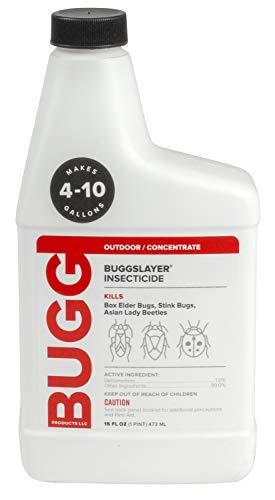
A contact spray kills the bug you hit today and leaves nothing behind. A residual spray dries into a film on the surface and kills whatever walks over it for weeks or months afterwards. The Bugg concentrate is explicit that it is “not a quick-kill knock-down product” and has “no repellent effect” — the bug has to touch treated surface for it to work. For stink bugs pressing against a window frame, that is exactly the behaviour you want to exploit.
Concentrate or ready-to-use
A concentrate arrives as a small bottle you dilute in water and pour into your own pump or backpack sprayer. You get far more mixed liquid per bottle, but you must own a sprayer and measure carefully. Ready-to-use formulas come premixed in a spray bottle or aerosol — shake, point, spray. If you are treating four windows and one door, ready-to-use is simpler. If you are doing a whole foundation, a concentrate goes much further.
Where stink bugs actually get in
Treat the outside face of window frames, the gap under door sweeps, the foundation line where siding meets concrete, dryer and utility vents, and any gap around an air conditioner line. Indoors, hit the window tracks and the corner where two walls meet. A fine mist beats a soaking stream here — you want an even film, not puddles running down the siding.
Households with pets and children
Plant-oil formulas built on peppermint, clove, geraniol or citronella change the smell and the surface feel, and several here are labelled for use around pets and family when used as directed. Read the label wording carefully — most of these products specify non-porous surfaces and drying time before pets or kids return to the area.
Side-by-Side Comparison
| Model | Best For | Form | Volume | Stated Barrier | Amazon |
|---|---|---|---|---|---|
| Bugg Insecticide Concentrate★ Best Overall | Whole-house perimeter on a budget | Concentrate | 16 fl oz | Months (no fixed figure stated) | Amazon |
| BioAdvanced Complete Insect KillerBest Barrier Length | Indoor spot treatment plus perimeter | Ready-to-use spray | 1 gallon | Up to 12 months indoors | Amazon |
| Raid MAX Perimeter ProtectionLongest Label Claim | Fast knockdown on contact | Liquid spray | 30 fl oz | Up to 18 months on non-porous surfaces | Amazon |
| FortaGrow Peppermint & Clove Spray | Botanical indoor control | Ready-to-use spray | 16 oz | Reapply at least twice weekly | Amazon |
| BugMD Pet Safe Multi-Insect Killer | Homes with dogs and cats | Ready-to-use spray | — | Reapply every three to five days | Amazon |
| JT Eaton Water-Based Spray | Fabric, gear and mattress treatment | Liquid spray | 128 fl oz | Multiple washings | Amazon |
| Nature’s Dome Pest Control Spray | Plant-based all-rounder | Ready-to-use spray | 16 fl oz | Reapply regularly | Amazon |
| Wondercide Ant & Roach Aerosol | Kitchen and baseboard control | Aerosol (2-pack) | 10 oz each | Spray as often as needed | Amazon |
| Ortho Home Defense MAX | Odour-free indoor barrier | Spray (2-pack) | 24 fl oz each | Up to 12 months indoors | Amazon |
| Trifecta Outdoor Pest Control | Yard and patio treatment | Ready-to-use spray | 32 oz | Reapply every couple of weeks | Amazon |
| Ortho Home Defense Indoor & Perimeter2 | Large properties with wand sprayers | Ready-to-use spray (2-pack) | Two 1.1 gal. containers | Up to 12 months indoors | Amazon |
Detailed Reviews
1. Bugg Insecticide Concentrate 16 oz
Our pick — 4.5+★ from 950+ verified ratings; the strongest balance of quality and price.
A small bottle of deltamethrin you dilute yourself — and it outlasts rain.
The point of a stink bug spray is not to kill the one on your curtain. It is to make every window frame and door sill hostile to the next forty. This Bugg concentrate does that job better than almost anything its size, because you mix it with water and stretch 16 fluid ounces across the whole exterior. Deltamethrin is the active ingredient — a synthetic pyrethroid, which is a man-made version of the compounds found in chrysanthemum flowers that insects cannot break down fast enough.
The manufacturer is unusually honest about how it works. Their own copy says this is “not a quick-kill knock-down product” and that it has “no repellent effect” — bugs must come in contact with treated surfaces for it to work. That matters for stink bugs specifically, because they land on and crawl over surfaces constantly. The formula is water-based, so it does not stain siding, and it is described as odourless, which solves the usual problem of a chemical smell drifting through the window you were trying to seal.
Buyers report results that match the label. One buyer who treated the exterior in autumn had no stink bugs inside the following spring — a first after years of fall invasions. Another found box elder bugs dead the morning after one application, with numbers near zero for months after just two treatments. The honest caveat is volume: 16 fluid ounces of concentrate (a small bottle you mix with water) does not go as far as it sounds once you have a full foundation to cover. Reviewers agree the bottle is small for the coverage and the price involved.
What makes it the one to beat
- Deltamethrin in a water-based mix that will not stain the siding you just paid for.
- Odourless formula, so treating around open windows does not stink out the room.
- Described as weather-resistant — owners mention it still holding after heavy rain.
- 16 fluid ounces of concentrate, diluted per the label, covers more surface than a ready-to-use bottle.
Where it will frustrate you
- You need your own pump or backpack sprayer and must measure the dilution yourself.
- It works by contact with treated surface, so bug numbers fall over days, not seconds — no instant knockdown.
- 16 fluid ounces is a narrow bottle for a full perimeter job.
- You will want a second bottle on hand before a seasonal treatment.
Reach for this if: you are treating an entire house exterior and want a barrier that stays put through rain.
Look elsewhere if: you want to see bugs die in front of you — this one works slowly and deliberately.
2. BioAdvanced Complete Insect Killer, Ready-to-Use, 1 Gal
One gallon, no mixing, and a barrier the label says holds twelve months indoors.
If the idea of measuring concentrate into a sprayer makes you put the job off another season, this is the shortcut. BioAdvanced ships the spray already mixed in a one-gallon container, and the label states up to 12 months of indoor insect protection. For a stink bug problem that returns every autumn, that window covers a full cycle — treat once in late summer and you are covered until the following summer.
The product kills 72 listed insects, including ants, spiders, fleas, bed bugs and roaches. Ants and roaches are listed as dying in seconds, which tells you the formula has a fast-acting component on top of the residual. You can use it as a spot treatment on a single window frame or as a perimeter barrier around the foundation. Against the Bugg concentrate above, this is the easier option but the costlier one per mixed gallon — the trade is convenience for volume.
A buyer on a third bottle, spraying every spring through late summer for centipedes, advises a mask because the scent runs strong. That is the recurring note worth flagging: it is not a smell-free spray. What buyers agree on is that it works across a wide range — spiders, centipedes, roaches and ants all come up. One caution the label implies but is worth spelling out: a ready-to-use gallon is heavy and armour-plated once full, so plan where you will store it.
Plain-speak read: the 12-month indoor claim is the reason to pick this over a cheaper aerosol — you treat once, not monthly.
The honest trade: a gallon jug is heavy to carry up a ladder and the scent is strong enough that a mask is sensible.
The case for it: a first-time stink bug treatment where you want maximum coverage with zero measuring.
The one caveat: strong scent during application — ventilate and plan the timing.
3. Raid MAX Perimeter Protection 30 fl oz
An 18-month residual claim and a trigger spray — the longest barrier figure here.
Raid’s number is the boldest on this list: the label says it keeps killing for up to 18 months. That figure comes with a very specific footnote — American cockroaches and Argentine ants on non-porous surfaces. Read it as a guide to how stubborn the residue is, not a guarantee about stink bugs on rough cedar siding. Even factored down, it is the longest stated barrier here, well beyond the 12-month indoor figure BioAdvanced and Ortho both quote.
You get 30 fluid ounces of liquid in a trigger bottle, so there is nothing to mix and no sprayer to buy. The formula is clear and described as leaving no stain and no lingering odour, and it covers roaches, ants, mosquitoes, fruit flies and spiders in one bottle. Against the BioAdvanced gallon, you are trading total volume for a squirt bottle you can hold one-handed while aiming at a window track.
Owners describe it as killing on contact and then continuing to work on the treated surface for months — One treatment around windows and doors ended a prior waterbug invasion for months. The clear warning is the trigger itself: plastic spray heads on this type of bottle have a habit of quitting mid-job, and the kill-on-contact part still works fine when they do. Buy it as a complete bottle you intend to use up on one big treatment rather than a bottle you open and close across seasons.
Why it earns its spot: it carries the longest label claim here at up to 18 months of protection, so you spray once and forget it for a year and a half. The no-stain, no-odour finish means you can spray window tracks indoors without a smell.
The catch worth knowing: if the trigger stops spraying mid-treatment, you are left with a half-full bottle and dead bugs on the outside only.
Reach for this if: you want one bottle, no mixing, and the longest stated barrier.
Look elsewhere if: you plan to spread one bottle across several weekends — a big single treatment uses it better.
4. FortaGrow Insect & Pest Control Spray
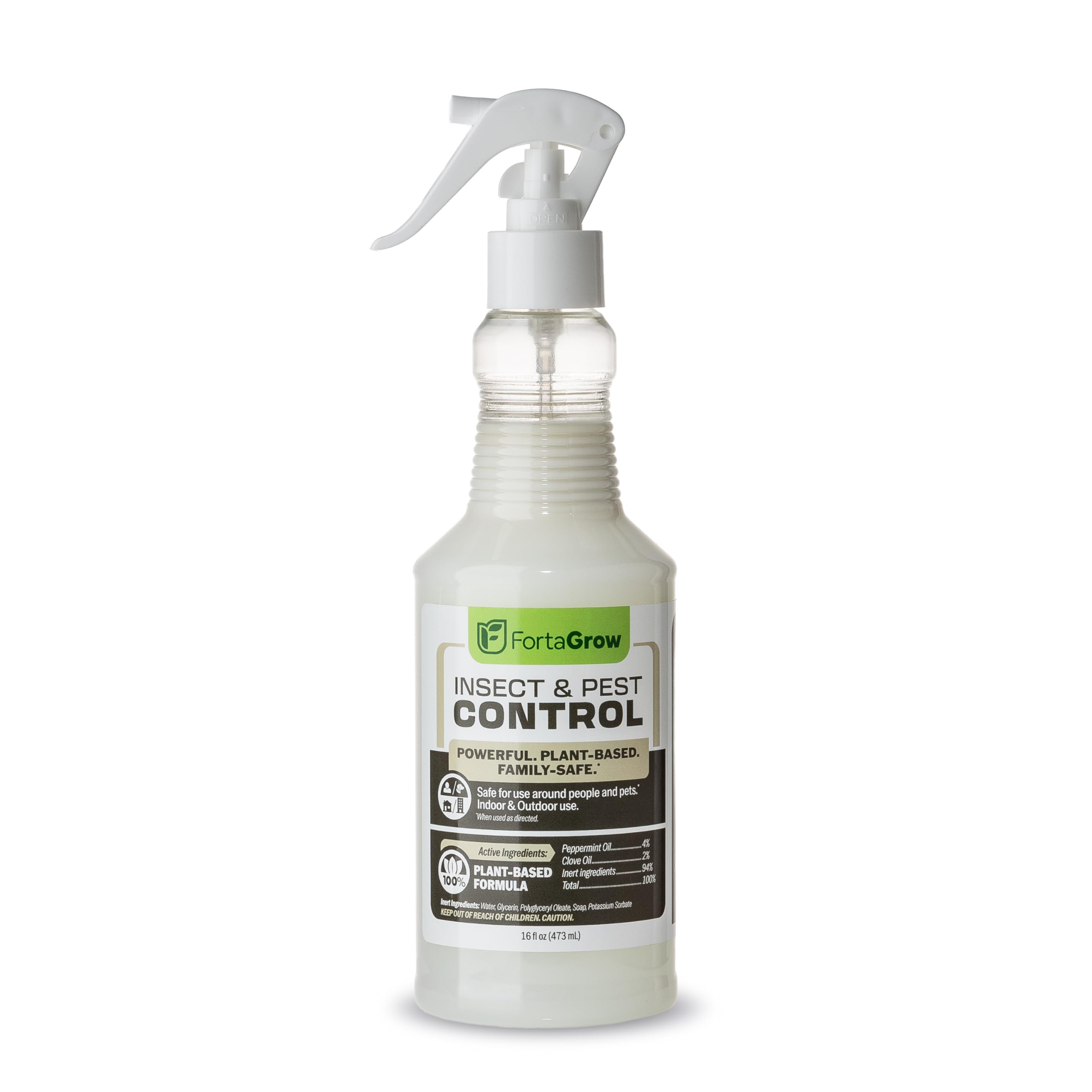
Two to four times the active oil load of most natural sprays, in one ready-mixed bottle.
This one leads with concentration. FortaGrow lists 4% peppermint oil and 2% clove oil as its active load, and the manufacturer says that is 2–4X more active ingredients than most natural sprays. Peppermint oil is the compound that overwhelms the scent receptors insects use to navigate — which is why a plant-based spray both kills and repels. No mixing, no sprayer to buy: shake and go.
The label targets spiders, ants, flies, gnats, roaches and beetles, and directs you to baseboards, entryways, kitchens and storage areas. It also sets your schedule for you: apply at least twice a week for maximum control. That is a much shorter interval than the residual sprays above, and it tells you plainly that this is a repeated-application routine rather than a treat-once barrier.
What wins people over is the smell — a clean peppermint scent that fades over roughly an hour and does not carry the harsh chemical bite of a conventional spray. A household with a severe roach problem cleared it with this fine mist after powders, pellets and baits failed, because it reached cracks ordinary sprays missed. The honest trade is the bottle itself. The recurring gripe is the packaging — customers note the nozzle snapping or the bottle leaking when shaken as instructed. Effectiveness is genuinely mixed rather than a clean sweep: crickets and beetles pushing through a door crack were reported as unaffected. Treat this as a strong indoor scent-friendly option, not a full perimeter answer.
What it does well
- 4% peppermint and 2% clove oil give it a far heavier active load than typical botanical sprays.
- Peppermint scent fades in about an hour and stays pleasant while it lingers.
- Fine mist reaches cracks and crevices that a stream spray simply skips past.
- Ready to use with no mixing or measuring.
The part nobody mentions in the ad
- Twice-weekly application is required — this is a routine, not a one-off treatment.
- Nozzle and bottle construction has let people down, with leaks and breakages reported.
- Hit-and-miss on larger or harder-shelled insects like beetles.
Best fit: kitchens and entryways where you want a peppermint-fresh spray and are willing to reapply twice a week.
Not the pick for: one-and-done perimeter work on a large house.
5. BugMD Pet Safe Multi-Insect Killer and Repellent Spray
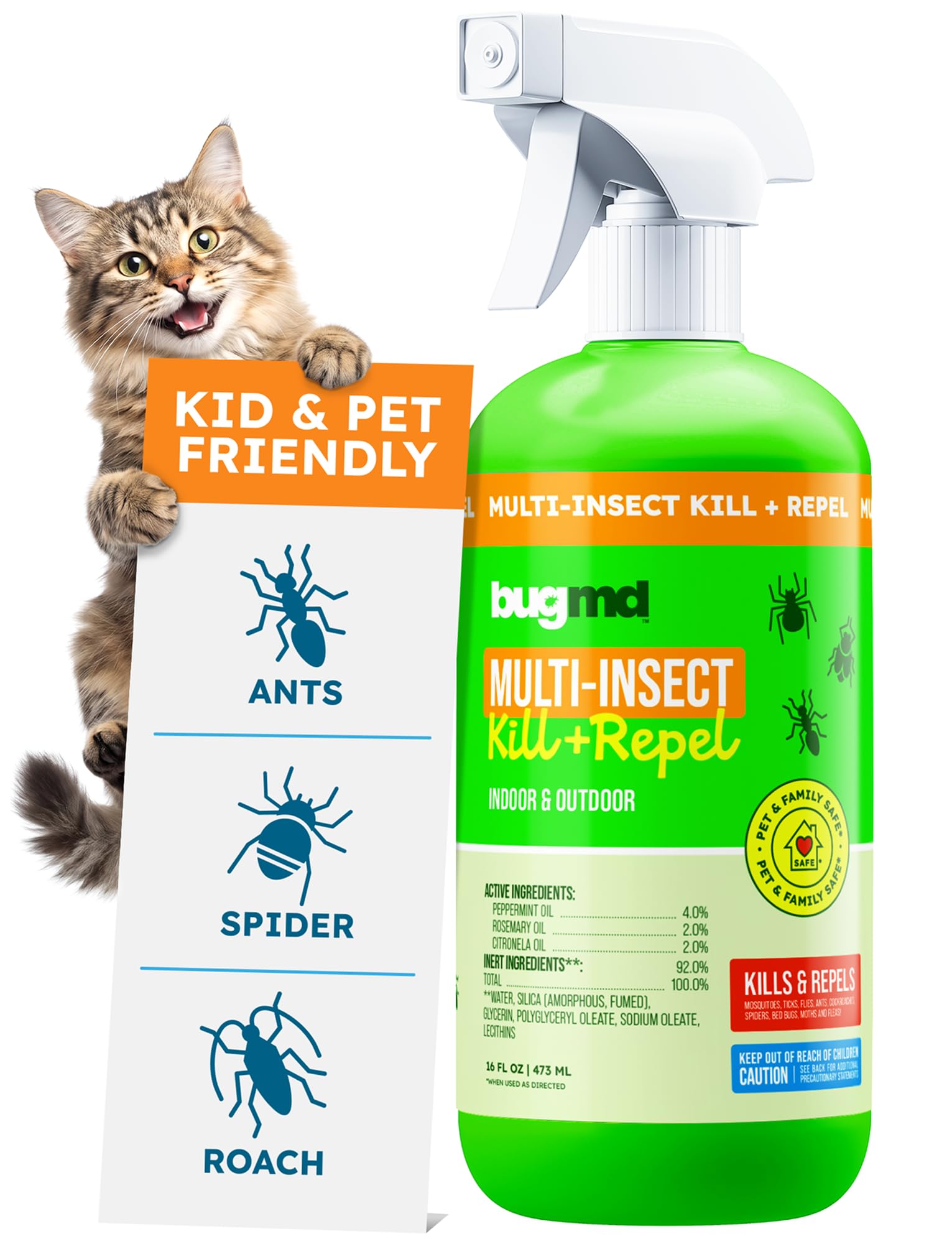
Built for households where a dog or cat shares the floor you are spraying.
Essential oils (plant-based concentrates) do two jobs at once here: peppermint, rosemary and citronella knock down ants, spiders and roaches on contact, and the mint scent is described as a natural deterrent to the next arrivals. The label states it is formulated for use around children and pets when used as directed. That phrase matters, because it is conditional on the product being dry and applied per the directions, not on it being harmless at all times.
You will be reapplying more often than you would with a synthetic residual (a chemical spray that keeps working for months). The instructions say every three to five days to maintain a repellent barrier, which puts it in a different class from the 12- and 18-month claims elsewhere in this guide. In return you get an all-in-one bottle that also handles mice in a garage or basement, and it is safe on non-porous surfaces (sealed surfaces that do not absorb liquid) like baseboards, windowsills and kitchen counters.
What reviewers point out most is speed — ants going down within about ten seconds on contact — and the convenience of keeping a bottle in the bathroom, one in the kitchen and one in the basement. The scent divides people cleanly: pleasant mint to some, too strong to others. Practically, spray sparingly, one room at a time, and open a window. And keep it away from eyes and noses — the manufacturer’s own advice, and a sensible rule with any essential-oil formula.
Its strongest card: a single bottle that handles insects and rodents while being labelled for use around pets and children.
Where it asks more of you: reapplying every three to five days is real maintenance, and the mint scent is strong in a closed room.
Consider this one: in a pet household where you want a plant-oil spray you can use indoors every few days.
Keep looking if: you want to spray once and forget it until next season.
6. JT Eaton Bed Bug, Tick & Mosquito Killer Gallon
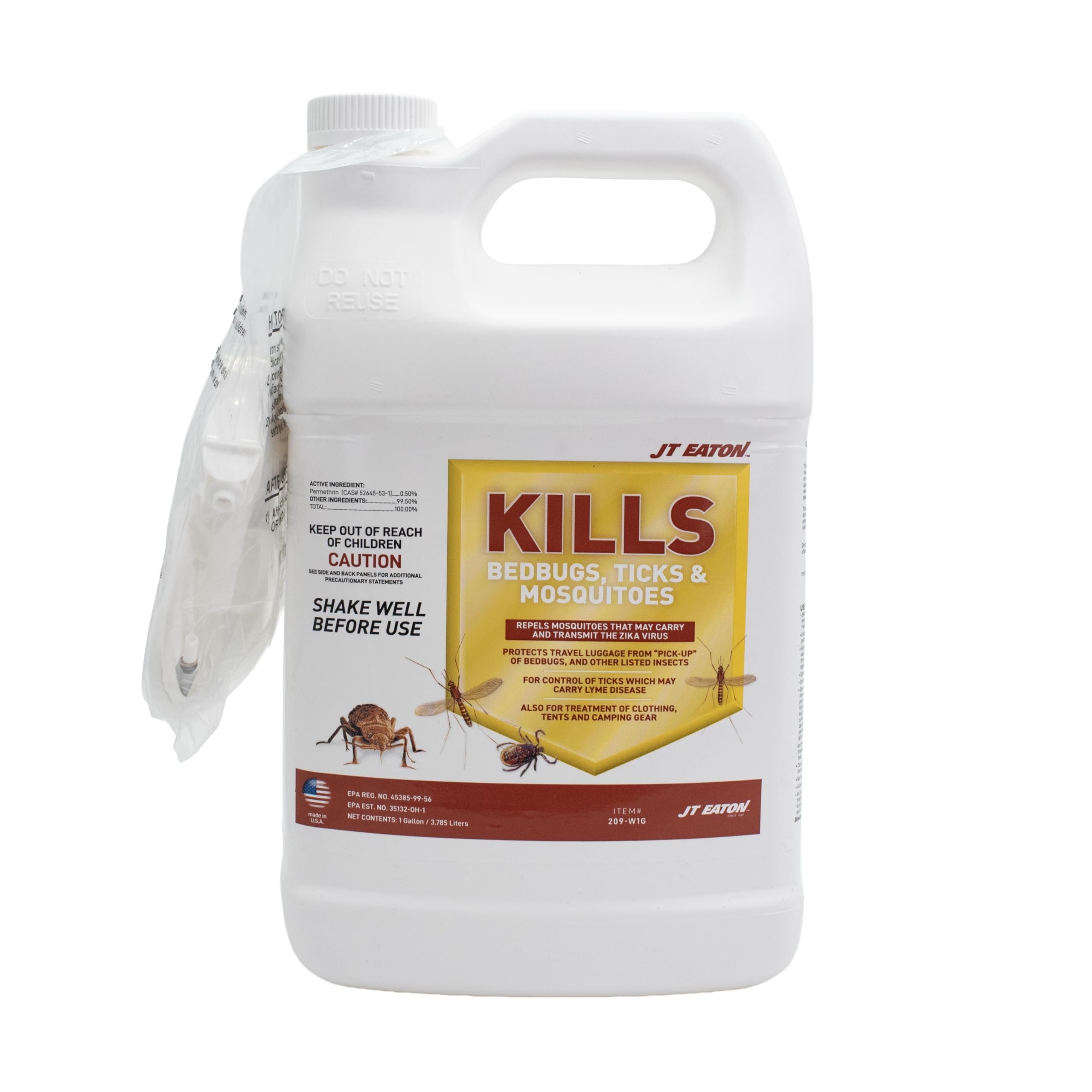
A full gallon that treats the things stink bugs crawl into — curtains, screens and stored clothes.
Stink bugs do not just land on walls. They get into folded laundry, behind curtains and inside the gear stored in a garage. JT Eaton’s water-based formula is labelled for mattresses, tents, clothing and camping gear, and it arrives as a gallon jug with a sprayer included. That combination makes it the treatment for the fabric-and-soft-goods side of a stink bug problem rather than the siding.
The headline claim is longevity: the label’s wear life runs through multiple washings, and the consensus on the review pages is that treated fabric should hold through at least ten. A buyer who switched from a better-known brand to treat hunting clothing found it held through a summer of retreating — no ticks made it home. Another reported an adult bedbug dead within an hour of one spray on carpets, curtains, couches and baseboards.
Two things to know before you buy. First, water-based formulas can still be labelled with a scent, and the reaction here is split — some call it odourless, others find the smell noticeable during application. Second, this is not a pollinator-friendly product: it kills insects broadly, so spray clothing and gear, not flowering plants. Any pet should be out of the room while it dries, and the manufacturer’s label wording should be read in full before treating anything a cat sleeps on.
The real-world payoff: a gallon jug with a sprayer included covers clothing, curtains and camping gear, and treated fabric keeps working through multiple washes.
The finicky bit: the scent is described differently depending on who you ask, and it kills broadly — keep it off anything you want pollinating.
Best for: anyone whose stink bugs are turning up in stored clothes, screens or seasonal gear — not just on the wall.
Skip if: your plan is a single exterior spray of the siding.
7. Nature’s Dome Pest Control Spray, 16 Oz
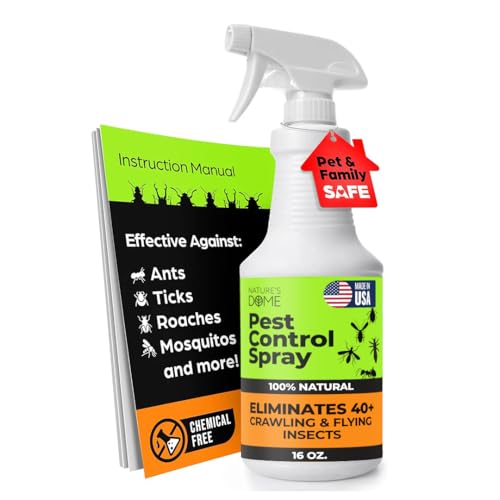
Geraniol, cinnamon and cottonseed oil — no synthetic pyrethroids and no chemical smell.
Nature’s Dome takes the plant-oil route to a similar end. The three actives are geraniol, cinnamon oil and cottonseed oil, and the label notes it avoids synthetic pyrethroids entirely — those are the man-made compounds used in most conventional bug sprays, including the deltamethrin in the top pick. If you are deliberately avoiding that class of ingredient, this is the pick.
It kills on contact where sprayed — ants, roaches, spiders, fleas, flies, gnats and bed bugs — and for ticks and mosquitoes the wording is different: it helps repel them where applied. That distinction is worth holding onto. A repellent is not the same as a residual killer, and it means treated surfaces need refreshing rather than being a set-and-forget film. The 16 fluid ounce bottle is ready to use with an adjustable nozzle for broad coverage or cracks.
The label says it is safe around kids and pets, drying before use, and the smell is a mild herbal rather than a solvent. Buyers rate fire ants and cat households among the successes, and the non-staining claim holds on most fabrics with a spot test first. The weak point is the bottle: the sprayer top has been reported working loose from the body and spilling contents mid-job. Decant it into a sturdier sprayer if you plan to use the whole thing at once across a foundation.
Why it appeals: a geraniol and cinnamon formula that skips synthetic pyrethroids and leaves an herbal smell instead of a chemical one.
What to watch: the sprayer top has a habit of loosening, so treat the bottle gently or move the liquid elsewhere.
Reach for this if: avoiding synthetic pyrethroids matters more to you than maximum residual length.
Look elsewhere if: you need one treatment to hold a barrier for months.
8. Wondercide Ant & Roach Aerosol Spray, 10 oz 2-Pack

The only can here that names stink bugs outright on its label.
Most sprays in this category do not bother naming stink bugs. Wondercide does: the label claims it is proven to kill over 20 common household bugs, and stink bugs are on the list alongside spiders, fleas, carpet beetles, earwigs and silverfish. For an obvious reason, that makes it the easiest pick to justify if stink bugs are the specific problem and you want a quick can on the shelf.
It is a contact aerosol rather than a residual — point, spray to kill, and wipe the bug away. The formula is plant-powered, built on lemongrass essential oil and geraniol, with no artificial colours or fragrances, and it is formulated to be safe around pets and family when used as directed. Two 10-ounce cans come in the pack, which is the practical advantage: one lives under the kitchen sink, the other goes in the garage, so you are never hunting for a bottle mid-infestation.
Speed is the reason people keep buying it — ants and roaches going down in seconds. A long-time rural resident who has used many pesticides ranked it among the best they had bought after it cleared a large ant trail almost instantly. The honest catch is the aerosol format: nozzle clogging halfway through the can is a known frustration, and one buyer ended up recommending the hand-crank bottle instead. The oily residue on floors also means you spray the edges, not the middle of the walkway.
Where it earns its place
- Stink bugs are named on the label, alongside more than 20 other household pests.
- Lemongrass and geraniol formula with no artificial colours or fragrances.
- Two 10-ounce cans, so you can keep one on each floor.
- Knockdown is measured in seconds, not hours.
What to plan around
- Nozzles have clogged halfway through cans, leaving the second half unreachable.
- It leaves an oily residue, so keep it off walking paths.
- It is a contact killer, not a long-lasting barrier — repeat use is expected.
Suits you if: you want a can in reach for the stink bugs you actually see, and a formula that names the pest.
Not your pick if: you want a seasonal barrier — this is the spot-kill can, not the perimeter treatment.
9. Ortho Home Defense MAX 24-Ounce (2-Pack)

Stinkbugs are named in the product title itself, and the spray leaves no odour behind.
Ortho is one of very few brands here to put stink bugs in the name. The label lists ants, roaches, spiders, stinkbugs and centipedes as targets, and it creates a bug barrier that controls for up to 12 months against ants, roaches and spiders indoors on nonporous surfaces. The odour-free finish is the other selling point — a stink bug problem is already a smell problem, and adding a chemical fog on top of it is the last thing most homeowners want.
Two 24-ounce bottles per pack is generous, and the spray is non-staining. A buyer using it around windows, doors, screens and the base of doorways reports keeping bottles in the basement, garage and upstairs so a treatment is always one reach away. Another sprayed once and saw no ants for nearly a month, planning to reapply every three months. That fits the intended pattern: spot spray the entry points, then repeat quarterly as a maintenance habit.
The recurring limit is speed on contact. One buyer found a sprayed roach kept crawling for a while, and switched to a different brand for the fast kill. If you are aiming at stink bugs lined up on a window track, expect them to die a short time after they walk through the residue rather than dropping instantly in front of you. For a slow, quiet, odour-free barrier on the frames, that trade is fine.
Plain-speak read: a named stinkbug killer that leaves no smell, works as a non-staining barrier indoors, and comes two bottles to a pack.
The honest trade: not a fast contact kill — sprayed bugs may crawl a while before dying.
Pick this if: a chemical smell inside the house is the deal-breaker, and you want a quiet residue on the window frames.
Pass if: you want to watch the bug die the second you spray it.
10. Trifecta Ready-to-Use Outdoor Pest Control Spray, 32 oz

A 32-ounce bottle aimed at the yard and patio, not the window frame.
Stink bugs come in off the yard, the shrubs and the flower beds before they come in the house. Trifecta treats that approach: the label lists stink bugs among the outdoor pests it kills on contact, alongside spiders, mosquitoes, ants, fleas, ticks, gnats and mites. It is built on cedarwood, citronella, geraniol and thyme oils, and it is described as safe around kids, pets, lawn, patio and flower beds.
The coverage number is the stand-out: a single bottle reaches up to 5,000 sq. ft. That makes it a treatment for the whole yard rather than a spot spray, and it is billed for weekend gatherings and barbecues to keep the outdoor space clear. The catch on duration is real, though. One reviewer noted the effect lasting only about a day, and the label-implied routine of reapplying every couple of weeks tells you this is not a season-long barrier.
Where it genuinely delivers is on stink bugs specifically. A buyer whose previous favourite product was discontinued said this one killed stink bugs on contact and repelled them, working as well or better, and directed applications around the yard, house, windows, doors and foundation. Plan for the scent and the cost per treatment: coverage is large but the bottle is small for repeated use, and reviewers are not entirely favourable on value.
Why it earns a mention: a plant-oil blend that lists stink bugs outright and covers a stated up-to-5,000 sq. ft. of yard from a 32-ounce bottle.
The honest limit: a short-lived effect — one buyer mentioned it working for about a day, so this is a repeat-application yard spray.
Best for: clearing the patio, shrub line and foundation approach before stink bug season starts.
Consider something else if: you want one application to last a season.
11. Ortho Home Defense Indoor & Perimeter2 1.1 gal. (2-Pack)

Two large jugs with battery-powered wands — the setup for a whole two-storey perimeter.
Reaching the second-storey siding with a hand trigger is the job that breaks most weekend treatments. This bundle solves it: two 1.1 gal. containers and two Comfort Wand sprayers, which deliver a continuous spray via a battery-powered pump. You point, hold the trigger and the wand keeps misting without you pumping — a real difference on a long wall.
The active ingredients are bifenthrin and zeta-cypermethrin, both synthetic pyrethroids. The label claims up to 12 month protection against ants, roaches and spiders indoors on non-porous surfaces, and lists fleas, ticks, scorpions, earwigs and silverfish as targets. Use it indoors around kitchens and bathrooms, and outdoors on foundations, patios, decks and garages. Two large containers mean you can run a full house treatment without stopping to refill.
Shoppers say the barrier working visibly — a dead-insect zone around the house, no roaches outside after spraying, and black widows at the home’s base curling up. The honest caution is the hardware, not the liquid: the sprayer can be fussy, and the recurring negative is durability of the spray mechanism rather than the formula. One buyer also found a large hobo spider survived repeated spraying, which is the reminder that no formula catches every species. Store the jugs somewhere cool and flat so they do not tip.
What the kit gives you
- Two battery-powered Comfort Wand sprayers, so you are not pumping by hand on tall siding.
- Two 1.1 gal. containers — a full house treatment without a refill break.
- Stated up to 12 month control indoors on non-porous surfaces against ants, roaches and spiders.
- Bifenthrin and zeta-cypermethrin formula with a broad listed target range.
Before you order
- The spray mechanisms draw the most complaints — treat the wands with care.
- Two large jugs take up garage or shed space.
- No formula catches every insect; a stubborn spider can walk away from a double dose.
Choose this if: you have a big exterior wall, want a battery-assisted wand, and expect to treat more than once.
Choose smaller if: you are treating a couple of windows, not a two-jug job.
Know the Specs
Active ingredient class
The two main families here are synthetic pyrethroids — deltamethrin, bifenthrin and zeta-cypermethrin — and plant oils such as peppermint, geraniol and cinnamon. Pyrethroids are man-made versions of compounds found in chrysanthemum flowers. They tend to deliver longer residues; plant oils tend to be gentler around pets and family and are often labelled for repeated use.
Residual duration
Residual means the spray keeps killing after it dries, rather than only hitting the bug you aimed at. A stated residual of a year or more usually comes with a narrow condition — for example indoors, on a non-porous surface, against a specific insect. That footnote is where the real deal sits. Plant oils are typically labelled for reapplication every few days or every couple of weeks.
Concentrate vs ready-to-use
A concentrate is a small bottle of active ingredient you dilute with water and load into your own sprayer, which buys you far more mixed liquid per bottle but demands measuring and a sprayer you own. A ready-to-use formula arrives premixed in a trigger bottle or aerosol — no mixing, no equipment, but a heavier container and less coverage per ounce of product.
Volume and coverage
Volume is listed as fluid ounces, gallons or litres depending on the brand, and it tells you how far one purchase goes. A 16 fluid ounce concentrate that you dilute goes considerably further than 16 fluid ounces of ready-to-use spray. Match the volume to the job: a bottle for a few window tracks, a gallon or a two-jug kit for a full foundation and perimeter.
Surfaces and staining
Most labels specify non-porous surfaces for the longest claims, and several here state non-staining or clear formulas. Stink bugs cluster on painted siding, aluminium frames and glass, so a spray that stains those surfaces costs you more than the bugs did. Spot-test any fabric before treating curtains, and keep oily aerosols off walking paths.
Delivery format
A trigger bottle suits aiming at a window track. An aerosol gives a fine mist and fast knockdown but can clog. A battery-powered wand delivers a continuous spray for tall siding and long foundations. A pump or backpack sprayer is what a concentrate needs, and it is the format that lets you cover the most ground in one session.
Common Questions
What actually kills stink bugs rather than just repelling them?
Do I need to spray the inside of my house or just the outside?
How long does a stink bug barrier actually last?
Is a concentrate better than a ready-to-use spray for stink bugs?
Will these sprays stain my siding or window frames?
Can I use a peppermint or clove oil spray around my dog or cat?
Why do my stink bugs keep coming back after I spray?
Does a battery-powered wand sprayer really help on tall siding?
Is it safe to spray where my kids play in the yard?
What is the difference between a contact killer and a residual barrier?
The Bottom Line
For most households, the stink bug spray worth buying is the Bugg Insecticide Concentrate. A 16 fluid ounce concentrate you dilute yourself covers the whole exterior, dries odourless and non-staining on siding you would rather keep clean, and stays put through rain. It rewards a little planning — you need your own sprayer and the kill takes days rather than seconds — but it turns one treatment into a season-long barrier at the entry points stink bugs actually use.
If you cannot face mixing, the BioAdvanced Complete Insect Killer buys you a ready-to-spray gallon and a stated 12 months of indoor protection. The Raid MAX Perimeter Protection carries the longest label claim here at up to 18 months and leaves no stain or odour for a window-track job. For the ones already inside and crawling across the baseboard, keep the Wondercide aerosol on hand — it is the one that names stink bugs outright and knocks them down where they sit.
The honest nudge: treat early, treat the outside face first, and treat wider than you think you need. The bugs are coming from the siding and the shrub line, and a barrier that stops at the front door lets the next wave walk straight past it. Match the formula to the surface and the schedule to the label, and the annual stink bug march turns into a short stop at the wall.
How we choose
We do not accept paid placement. Every pick is matched to a real buyer and a real use-case; we do not hands-on test units.
Sources
Specifications: manufacturer listings and product documentation. Review insights: verified customer reviews, as of October 2026. Pricing: not shown on this page (it changes often); check the current price via the retailer link.
As an Amazon Associate, Aappliancez earns from qualifying purchases. This does not affect which products we feature.