Disclosure: Some links in this post are affiliate links. As an Amazon Associate I earn from qualifying purchases, at no extra cost to you. Learn more
Specs are compiled from manufacturer listings and verified buyer reviews and can change over time — please confirm the key details on the product page before buying.
Boxelder bugs show up in waves — hundreds on the south wall one afternoon, then a line of them squeezing under your door frame. The spray that actually ends that cycle is a residual one: a liquid that leaves dried insecticide on your siding, foundation, and windowsills so the bugs die after they land on it, not just when you hit them directly. That is the single biggest thing separating a spray that works from one that wastes your weekend. Every pick below was chosen on that basis, plus how long the label says it keeps working and whether it leaves stains or a smell behind.
This guide is built by comparing the manufacturers’ published specifications and the patterns across verified customer reviews, so you get each pick’s real strengths and trade-offs instead of marketing spin.
A good boxelder treatment plan starts with the right bottle, then the right mixing and timing. The picks below cover concentrates, ready-to-use aerosols, and a plant-based option, so you can match the product to how bad your infestation is. Here is what separates the spray for boxelder bugs that works from the one that just wets your siding.
Top Picks
How To Choose The Best Spray for Boxelder Bugs
Boxelder bugs are not like ants that march to a bait. They warm up on your south- and west-facing siding in the fall, then work their way into wall voids to sit out the winter. A spray that only kills on contact leaves the next wave untouched, which is why the formula and the form matter as much as the brand name.
Residual versus knock-down
A knock-down spray kills the bug you hit. That helps right now, but the ones you missed keep coming. A residual spray dries onto the surface and keeps killing for weeks or months, so every bug that crosses your foundation gets dosed. Read the label for the residual window — some list months of control on nonporous surfaces, others measure it in weeks.
Concentrate or ready-to-use
A concentrate is a bottle of active ingredient you mix with water in your own sprayer. One small bottle makes multiple gallons, which is why it covers a whole house perimeter. A ready-to-use bottle or aerosol is pre-mixed — no measuring, no sprayer, but you go through it faster. If you are treating a single door frame, ready-to-use is simpler. If you are doing all four sides of a house, a concentrate stretches much further.
Where you spray matters more than the bottle
Boxelder bugs enter low and climb. Aim at the foundation line, the bottom corners of windows, door thresholds, and any gap around utility pipes. Treating the sunny wall where they cluster is fine, but the entry points are what keep them out of the house. A missing band of coverage at one doorway undoes a whole afternoon of spraying.
Side-by-Side Comparison
| Model | Best For | Form | Volume | Active Ingredient | Amazon |
|---|---|---|---|---|---|
| BUGGSLAYER Insecticide Concentrate★ Best Overall | Whole-house perimeter barrier | Concentrate | 16 fl oz | Deltamethrin | Amazon |
| BASF PT 221LPro Favorite | Crack and crevice spot treatment | Pressurized aerosol | 14 fl oz | Cyhalothrin 0.05% | Amazon |
| Mighty Mint Peppermint Oil Spray | Pet-safe households and patios | Ready-to-use spray | 16 oz | Peppermint oil | Amazon |
| Ortho Home Defense MAX | Indoor perimeter and doorway control | Ready-to-use spray | 24 fl oz (2-pack) | — | Amazon |
| Atticus Devito CS | Long-residual yard and perimeter control | Liquid concentrate | 8 fl oz | lambda-cyhalothrin | Amazon |
Detailed Reviews
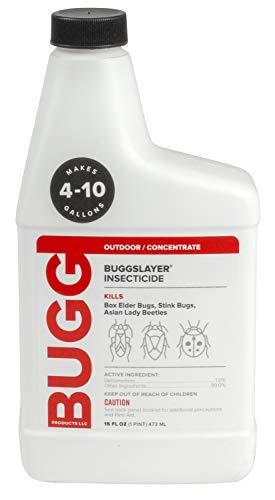
1. BUGGSLAYER Insecticide Concentrate 16 oz
Our pick — 4.5+★ from 950+ verified ratings; the strongest balance of quality and price.
The 16-ounce concentrate that turns one bottle into a full-house boxelder barrier.
If you are treating the whole outside of a house rather than one doorway, this is where most people land — 4.5+ stars from 900+ owners. It is a concentrate, which means you mix it with water as directed and fill your own pump or backpack sprayer. Because one 16-ounce bottle dilutes into multiple gallons, a single bottle can cover the entire perimeter: foundation, windows, doors, and every spot where a boxelder bug can slip inside. That bottle size edges the BASF PT 221L aerosol, which carries 14 fluid ounces and cannot be stretched with water at all.
The active ingredient is deltamethrin, a synthetic insecticide that works as a residual — it settles on the surface and stays there. Say it plainly: this is not a spray-and-watch-them-drop product. Bugs have to land on the treated siding and absorb it, which is why an overnight kill is normal but an instant one is not. The payoff is that weather does not wipe it out. Owners tell a remarkably consistent story: one treatment on the south-facing wall knocked the population back overnight, and the barrier held for months, including through rain. In fact, one reviewer noted the bugs stayed gone even after 3.5 inches of rain fell on the treated surface.
Two things are worth knowing before you buy. First, the label calls it odorless and non-staining, and it dries essentially invisible — though the same buyer who loved it noted a faint residue lingering on glass, which a quick wipe handles. Second, the coverage math is the whole value story here: this is a small bottle, and it only looks like money well spent once you see how many gallons of working solution it makes. If you are going to spray four walls anyway, this is the smartest way to do it.
What earns it the top spot
- 16-ounce concentrate dilutes with water, so one bottle covers a full house perimeter
- Deltamethrin residual keeps killing through rain and holds for months of control
- Water-based, odorless, and non-staining on siding and trim
- Works on boxelder bugs, stink bugs, and Asian ladybugs alike
Where it asks you to plan ahead
- It is a residual, not a knock-down — expect dead bugs by morning, not on contact
- You must own a sprayer and mix it yourself
- Treating glass can leave a faint film you will want to wipe
Made for the full-perimeter job: buy this if you are spraying a house, a garage, or a boundary line and want one bottle to do the whole job.
Not the one for you: if you only need to treat a single door frame and want something ready to grab, a pre-mixed spray is the easier call.
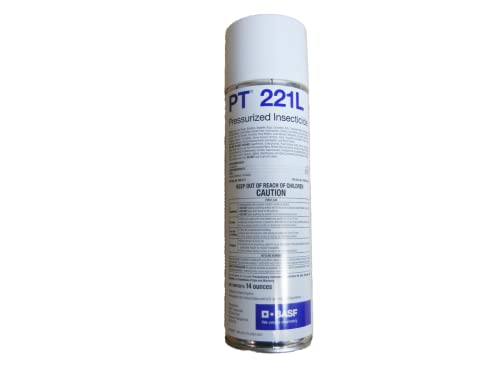
2. BASF PT 221L Insecticide Aerosol Spray 14 Ounce
The press-and-go aerosol pest crews keep in the truck for gaps and crevices.
Boxelder bugs do not always stop at your wall — they tuck into window frames, behind siding panels, and into the weep holes along the foundation. That is precisely the territory this aerosol was built for. The 0.05% cyhalothrin formula is a non-repellent, meaning bugs do not smell it and steer away; they walk right through it and take it back to wherever they are hiding. Being non-repellent is the quiet advantage over a purely repellent scent spray, because you are not just pushing the colony to the neighbor’s fence.
It is pressurized and ready to use, so there is no mixing and no sprayer to dig out of the garage. The extension of its reach is in the application pattern: hard-to-reach voids, under sinks, behind appliances, along door frames, and around windows and doors. For boxelder bugs, that means a targeted hit on the exact cracks they use to get in during the fall migration, when the weather turns cold and they look for a warm gap. The label lists reapplication every 21 days in food-handling settings and at 7-day intervals for bed bugs, so in a home you have real flexibility on repeat timing.
The catch is mechanical, not chemical — the nozzle. A buyer who otherwise liked the product said plainly that the nozzle was poor and hard to cover ground evenly. On a 14-fluid-ounce can, that means you notice the limitation quickly. The upside of dealing with that: nothing to mix, nothing to clean, and the residual keeps working in a void long after you spray. For spot work in tight gaps, it does what a bulky pump sprayer simply cannot.
Where it shines brightest: tight voids and crack-and-crevice work — window frames, weep holes, behind appliances, and around door edges, all with a trigger and no mixing bowl.
Keep in mind: the spray pattern depends on a nozzle that some owners find awkward for wide coverage. And because it is a fixed 14-fluid-ounce can, you cannot dilute it to stretch across a whole perimeter the way the BUGGSLAYER concentrate can.
Grab this if: you have identified the exact cracks boxelder bugs are funneling through and want to dose them directly.
Consider the concentrate instead if: your priority is broad coverage over a large exterior wall.
3. Mighty Mint Peppermint Oil Insect Repellent Spray, 16 oz

The peppermint bottle for households that would rather not use synthetic insecticide at all.
Some people cannot or will not spray a synthetic insecticide around their pets or their kids, and that is the entire reason this bottle exists. It is a 16-ounce ready-to-use spray built on extra-concentrated peppermint oil, designed as a deterrent for spiders, ants, roaches, and other crawling insects. You spray baseboards, entryways, patios, and the places boxelder bugs gather and hope they turn around. There is no mixing and no dilution math — you point and spray. The one bottle-size note is that it matches the BUGGSLAYER at 16 fluid ounces, but because this is premixed rather than a concentrate, it does not dilute into extra gallons.
What owners talk about more than anything is the smell. It is a genuine peppermint aroma, free of synthetic fragrance, and it lingers — so much so that overdoing it can overwhelm a room. That smell is the mechanism as much as the side effect, so plan for it rather than fight it.
Here is the honest fit check. This is a plant-based deterrent, not a residual barrier that keeps killing for months. If boxelder bugs are streaming through a window frame in volume, a peppermint spray is unlikely to close that gap — that job calls for a residual. Where this earns its place is a patio, a doorway, or a kitchen where you want a low-fragrance-chemical option and will reapply regularly. In those spots it does exactly what it claims, and the scent is pleasant enough to be a feature rather than a nuisance.
Reach for this if: you are treating a patio or a doorway and want a plant-based option for a household with pets.
Look elsewhere if: you are dealing with a heavy indoor invasion and need a long-lasting residual instead.
4. Ortho Home Defense MAX Insect Killer Spray 24-Ounce 2Pack

Ready-to-spray perimeter protection that the label says keeps working for up to a year.
Two 24-ounce ready-to-use bottles whose label claims up to 12 months of control on nonporous indoor surfaces. For boxelder bugs, the draw is that you can spray a band along your baseboards, door thresholds, and window sills and not worry about mixing anything. For a fall migration, that indoor perimeter is exactly the line you want to draw. The consistency of the spray matters, though — one owner reported that spraying a single roach did not stop it instantly, so treat this as a barrier that works as bugs cross it, not a one-spray-one-kill bottle.
The two features that keep showing up separately in what people value are that it is effective on the listed pests and that it is odor-free. An odor-free spray is a real advantage indoors, because you can treat a doorway or a basement corner without the whole floor smelling like a chemical works. Owners who use it keep it handy in multiple spots around the house — a bottle in the basement, one in the garage, one upstairs by the screens and doors. It is also non-staining, which takes the worry out of a baseboard or trim that you cannot easily replace.
So what is the catch? Two pack sizes and a fixed ready-to-use formula mean you will re-buy more often than a concentrate user would. The Ortho gives you the convenience of no mixing plus the long lasting claim, while the BASF PT 221L gives you a different shape of control because it is an aerosol engineered for cracks. If you want to cover point after point around a doorway without hauling out a sprayer, though, this is the bottle to keep within reach.
First impression: two ready-to-use bottles and a manufacturer-stated 12-month control window on nonporous indoor surfaces is a lot of low-effort coverage from the start.
The trade-off: this is a barrier product, not a contact killer. Bugs have to cross the treated surface to be affected, so the instant knockdown some people expect is not what the label promises.
Point this at: indoor thresholds, baseboards, and window sills where you want an odor-free barrier and no mixing.
Go another route if: you are covering a large exterior and would rather buy one concentrate than keep buying ready-to-use bottles.
5. Atticus Devito CS Insecticide 8oz
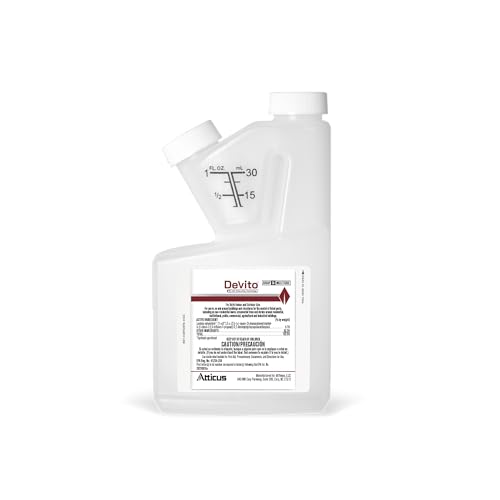
Time-released capsules that keep dosing boxelder bugs for up to three months.
What sets this one apart is the delivery system, not just the active ingredient. Devito pairs 9.7% lambda-cyhalothrin with EnduraCap Technology, which holds quick-release and slow-release capsules in one formula, so you get an immediate hit plus control the label says lasts up to 90 days. For boxelder bugs, that slow-release side is the key part — it means the treated surface keeps working long after you put the sprayer away. It is EPA-registered for indoor and outdoor use on landscapes, building perimeters, and kitchens.
The label covers more than 70 pests, including ants, roaches, bedbugs, spiders, and fleas, and buyers report it killing boxelder bugs. The 8-fluid-ounce bottle is a concentrate you mix yourself — owners commonly mix around one ounce per gallon — and it stretches across a yard or a full perimeter. It can cause skin tingling or burning during mixing, so wear gloves and eye protection; treated surfaces are safe once dry. It is also not sold in every state, so it is worth checking availability for yours.
Compare it to the BUGGSLAYER and the picture sharpens. Both are concentrates, but Devito packages less liquid — 8 fluid ounces versus 16 — and charges more per bottle because of the encapsulated formula. What you are paying that premium for is the stated 90-day residual window in a single application, which can mean fewer treatments over a season. If you want the strongest stamina and do not mind the mixing gear, this is the pick that delivers it.
For the homeowner who wants the longest stretch between applications: the encapsulated formula is built to hold up for up to 90 days on treated surfaces.
Think twice if: you need it shipped to California, Connecticut, New Hampshire, New York, or Vermont, where it is not available for sale.
Know the Specs
Concentrate versus ready-to-use
A concentrate is a bottle of active ingredient you measure and mix with water in your own sprayer. That lets one small bottle make multiple gallons of working solution, which is what lets it cover a whole house perimeter. A ready-to-use product is pre-mixed — you skip the measuring, but you use up the bottle faster. Neither is better in the abstract; a concentrate suits a big exterior, a ready-to-use bottle suits a single doorway or a patio.
Residual and how it kills
Residual sprays do not repel bugs or knock them down instantly. They dry onto a surface and stay active on it, so a bug that walks across the treated area picks up the insecticide and dies afterward. That is why timing matters: treat before the fall migration, not after the bugs are already inside. The label’s residual window — the time it stays effective — is the number that decides how often you reapply.
Common Questions
What kind of spray actually kills boxelder bugs?
Do I need to mix a concentrate with water?
How long does a boxelder bug spray keep working?
Will these sprays keep the bugs from coming back next fall?
Can I spray the outside of the whole house or just the walls?
Is it safe to use a boxelder bug spray around pets and kids?
Do I have to use one of these indoors and something else outdoors?
Why did my friend’s spray smell so much and mine does not?
How often should I reapply a residual during boxelder season?
Will a peppermint spray kill boxelder bugs outright?
The Bottom Line
For most people treating a whole house, the spray for boxelder bugs winner is the BUGGSLAYER Insecticide Concentrate, because one 16-ounce bottle dilutes into enough solution to band the entire perimeter and the residual keeps working through rain and for months after. If you want the longest stretch between applications, grab the Atticus Devito CS with its stated up-to-90-day residual. And for crack-and-crevice work around windows and weep holes, the BASF PT 221L is the one to reach for. The BUGGSLAYER carries the highest owner rating at 4.5+ stars, and with nearly a thousand owners behind it, the pattern of a clean overnight knockdown and a lasting barrier is worth trusting for the fall season ahead.
How we choose
We do not accept paid placement. Every pick is matched to a real buyer and a real use-case; we do not hands-on test units.
Sources
Specifications: manufacturer listings and product documentation. Review insights: verified customer reviews, as of October 2026. Pricing: not shown on this page (it changes often); check the current price via the retailer link.
As an Amazon Associate, Aappliancez earns from qualifying purchases. This does not affect which products we feature.