Disclosure: Some links in this post are affiliate links. As an Amazon Associate I earn from qualifying purchases, at no extra cost to you. Learn more
Specs are compiled from manufacturer listings and verified buyer reviews and can change over time — please confirm the key details on the product page before buying.
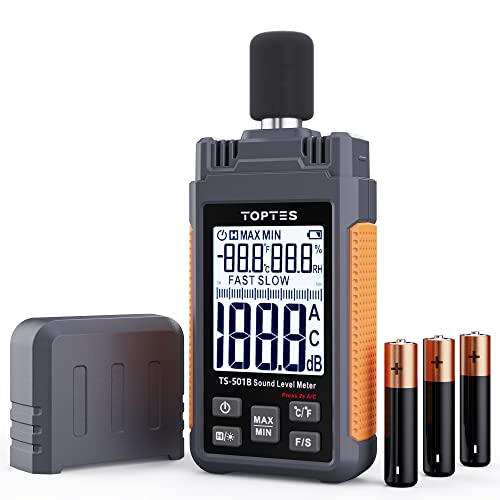
You need a number, not an opinion. A neighbor’s bass, a workshop saw, a home theater speaker — “too loud” arguments end fast when a meter shows the reading. The quickest answer for most people is the TopTes TS-501B: it displays 30 to 130 dB with ±1.5 dB accuracy, comes factory calibrated, and runs on three included AAA batteries, so you can open the box and start measuring in a minute. Below are seven meters that each suit a different job, from handheld noise checks to rack-mounted studio displays.
This guide is built by comparing the manufacturers’ published specifications and the patterns across verified customer reviews, so you get each pick’s real strengths and trade-offs instead of marketing spin.
Some meters are built for a pocket and a quick reading, while others are designed to sit on a wall or in a rack and be glanced at all day. The trick is matching the tool to the job — a dB range and an A/C weighting switch are meaningless if the display is unreadable from where you stand. This guide to the best spl meter covers what each model actually measures and who it fits.
Top Picks

How To Choose The Best SPL Meter
A sound pressure level meter turns “that’s too loud” into a number you can write down and act on. Sorting out four things before you buy saves you from paying for functions you will never touch.
Start with the range and the accuracy figure
Most household meters cover 30 to 130 dB, which reaches from a quiet bedroom up to a chainsaw. The accuracy number — usually written as ±1.5 dB — tells you how close the reading sits to the true level. A meter rated ±1.5 dB is a good fit for noise complaints, speaker setup, and shop checks. For lab-grade or legal work you want a certified instrument, and that is a different class of tool.
Decide between A-weighting and C-weighting
A-weighting follows how the human ear hears quieter sounds, so it suits environmental noise and neighbor complaints. C-weighting keeps the low-frequency energy in the reading, which is what you want when measuring machinery, motors, or gunfire. A meter with both modes switches between the two, and that flexibility is worth having.
Think about where the meter will live
A handheld unit with a backlit screen goes into a pocket or a carry case. A wall-hanging meter with a large red display stays put and shows the level across the room at a glance. A rack unit trades portability for a permanent spot in your audio stack. Pick the format that matches how often you will actually use it, because a meter that stays in a drawer measures nothing.
Side-by-Side Comparison
| Model | Best For | Range | Accuracy | Weight | Amazon |
|---|---|---|---|---|---|
| TopTes TS-501B★ Best Overall | Everyday handheld noise checks | 30–130 dB | ±1.5 dB | 5.3 ounces | Amazon |
| Technical Pro DB30Best Display | Rack light show plus power outlets | 5–140 dB | — | 2.1 lbs | Amazon |
| SQECH SL720C | Colour-screen and SONE readings | 30–130 dB | ±1.5 dB | 242 g | Amazon |
| Tadeto TE017 | Calibratable field measurement | 30–130 dB | ±1.5 dB | 11.7 ounces | Amazon |
| Pyle PSPL25 | Basic A/C metering on a budget | 60–130 dBA | ±1.5 dBA | 9.6 ounces | Amazon |
| Nobsound AK2515 | Visual spectrum display | 20Hz–20kHz sweep | — | — | Amazon |
| TestHelper SW-525A | Wall-hung room display | 30–130 dB | — | 0.6 kg | Amazon |
Detailed Reviews
1. Decibel Meter, TopTes TS-501B Sound Level Meter
Our pick — 4.5+★ from 2,500+ verified ratings; the strongest balance of quality and price.
The do-everything handheld that turns a shouting match into a number you can read.
At 5.3 ounces this meter disappears into a shirt pocket, which is why it ends up on so many kitchen tables and workbenches. It covers 30 to 130 dB with an accuracy of ±1.5 dB and a frequency response of 30 to 8000 Hz, and it ships factory calibrated with three AAA batteries in the box. The 2.25-inch LCD has a backlight you switch on with a long press, so you can read it in a dark venue without fumbling for a light.
The practical magic is in the dual weighting. A-weighting mimics how your ear hears soft sounds, which suits neighbor-noise and home-theater work. C-weighting keeps the deep low-frequency energy in the reading, so it tells you what a subwoofer or an airgun is really putting out. Switch to SLOW response for a steady room reading and the number settles; FAST shows the peaks as they happen. MAX/MIN and data hold let you freeze the loudest moment of a burst you might otherwise miss.
Where it earns its keep is real calibration work. Buyers report it landing within 1-2 dB of a second meter on A-weighting, and within 0.2 dB of a calibrator at 1kHz at both 94 and 114 dB. That is a believable, honest read for a home-use instrument. The catch to know going in: the hygrometer and thermometer it also shows are not its strong suit, so treat the dB reading as the reason to buy this and the temperature gauge as a nice extra. It also checks silent-room levels closer to 33 dBA than a textbook 30, which is normal behavior for real-world rooms with HVAC running.
What earns the top spot
- 30 to 130 dB range with ±1.5 dB accuracy handles noise complaints, speaker setup, and shop checks.
- 2.25-inch backlit LCD stays readable in dark venues and dim rooms.
- A and C weighting plus FAST/SLOW response cover both ear-matched and machine-level measuring.
- Factory calibrated and runs on three included AAA batteries with auto power-off.
Where it stops short
- The temperature and humidity readings are secondary; the dB figure is the real feature.
- FAST mode wanders by a few dB on wildly fluctuating sounds, so SLOW gives a steadier average.
- Not a substitute for a certified professional instrument in a legal or lab setting.
The everyday default: If you want one meter that covers home theater setup, neighbor noise, airgun testing, and workshop checks without a learning curve, this is the one.
Look past it: skip it if you need a certified reading for a legal dispute or professional acoustic survey.
2. Technical Pro DB30 1U Rack Mount dB Decibel Meter Display
The rack unit that turns your audio levels into a light show while it powers your whole stack.
This is not a pocket meter; it is a 1U rack panel that slides into a standard audio rack at 19 inches long and shows you the dB level in real time. The rear panel puts eight grounded outlets and a 5V USB charging port in the same box, so it earns its rack space twice over. Range runs from 5 dB to 140 dB, and the display switches between dot and bar modes with sensitivity adjusters on both left and right channels. Input and output are RCA, and it runs on 110 or 220 volts.
What wins people over is the display itself, backed by the practical bonus of the outlets on the back. The LED patterns draw your eye without distracting, and the finish reads as solid metal rather than a plastic shell. For a home hi-fi or rack setup it functions as an active visual centerpiece you’ll glance at all evening.
Here is the honest frame: this meter is configured for pro-level audio, which means a standard home AV receiver may not drive enough signal to light the display fully. The fix is a line-level booster inline between the pre-amp outs and the unit’s RCA inputs, so plan for that extra piece if your gear is consumer-tier. Once it’s wired correctly and in place, it becomes a fixture of the rack that just keeps working.
The sound-vs-show trade-off: The DB30 is a visual instrument first and a precision acoustic tool second. Its accuracy is not what buyers rave about — the display and the outlet convenience are. If you want a calibrated handheld reading, the TopTes in the top spot is the better fit.
Wiring note: With a modern receiver you may need a line-level booster to get full deflection on the display; it is spec’d for pro audio levels, not consumer line out.
Built for the rack: Pick this if you have a hi-fi or studio rack and want a dB display plus eight outlets in one 1U space.
Skip the detour: pass on it if you need an accurate handheld meter for noise documentation rather than an on-rack visual.
3. SQECH Decibel Meter SL720C Digital Sound Level Meter

A colour screen and SONE readings that make acoustic work feel less like a science project.
The SL720C covers 30 to 130 dB with an accuracy of ±1.5 dB and a frequency response of 31.5Hz to 8KHz, and it runs on a condenser microphone protected by a metal shell. That metal housing makes it drop-friendly, and the included windproof ball cuts wind noise when you measure outdoors. The real talking point is the screen: a colour backlit display with a three-colour analog bar that shows you at a glance whether the level is safe, improve, or too loud.
Beyond the usual A/C weighting and FAST/SLOW response, this one adds a SONE mode. SONE measures perceived loudness rather than raw sound intensity, which is useful if you are balancing a room for how it feels rather than how it meters. It comes with three AAA batteries, a screwdriver, a cloth bag, and a windbreak ball in the box. The 242-gram body sits well in the hand for handheld measuring trips.
Two honest caveats come straight from how it is built. The battery cover needs the included screwdriver, so plan where you keep that little tool. And there is no stand thread — the base stands upright but not with total confidence, so a flat surface and a steady hand matter. A few buyers also note it can struggle with very deep, bass-heavy rumbles like HVAC brown noise, which is a job for a C-weighted meter with strong low-end pickup. For everything from traffic checks to live-show levels, it measures cleanly and reads clearly.
Why the screen wins
- Three-colour analog bar shows safe versus loud at a glance without squinting at numbers.
- SONE unit mode measures perceived loudness, not just raw intensity.
- Metal-protected condenser mic and included windproof ball stand up to outdoor use.
- 31.5Hz–8KHz response covers speech, music, and engine noise.
What to plan around
- Battery cover needs the supplied screwdriver, so keep it handy.
- No tripod thread means it is trickier to mount for a fixed reading.
- Deep, bass-heavy brown noise can fall outside what it picks up cleanly.
Screen-first pick: Choose this if a bright colour readout and SONE loudness matter more to you than a pocketable shell.
Not your tool: Reach elsewhere if you plan to log very low-frequency rumble or need tripod mounting.
4. Tadeto TE017 Digital Sound Level Meter

The field meter with five switchable ranges and alarms that shout when the room gets too loud.
What sets the TE017 apart is the shifting function: five adjustable measurement ranges across 30 to 130 dB, so you can narrow the band and get a more detailed read on a specific zone. Accuracy holds at ±1.5 dB. The A-weighted mode follows how the ear hears soft ambient noise, while C-weighting brings out the low-end punch of machine motors. FAST catches fluctuating traffic and shifting sounds; SLOW gives you a steady average on constant noise.
The features that make it feel pro-grade are the ones you won’t use every day but will want when you need them. Audible and visual alarms trigger when levels cross a threshold you set, so you can leave it monitoring a room without staring at a screen. The backlight keeps the large LCD readable in dim spots, and a low-voltage icon warns you before the battery quits. The 11.7-ounce body means it feels substantial rather than fragile.
Here is the catch to weigh. Some owners mention the auto-off kicks in after a few minutes to save battery, which can interrupt a long monitoring session — just know to wake it back up. And the calibration function, while welcome, is what moves it into pro territory: the unit can be recalibrated if it drifts, which is a feature most pocket meters lack. For setup work on a home theater or a workshop noise check, it does the job with a little more control than the budget tier offers.
The calibratable edge: The main reason to pick this over the others is the calibration option — it lets you or a shop trim the reading back if drift creeps in over time. Five switchable ranges give you finer resolution on any single band.
Bedtiming note: Auto-off dims the screen after a few minutes to conserve battery; you have to give it a nudge to resume a long monitoring run.
For the detail-obsessed: Grab this if you want to zero in on one dB band, set threshold alarms, and have the option to recalibrate over the years.
Simplicity wins for some: If you want a meter that just reads the level and stays on, the top pick is less to think about.
5. Pyle PSPL25 Digital Handheld Sound Level Meter

A no-nonsense dBA meter that runs for up to 30 hours on one 9V battery.
If all you need is a reliable dBA reading for the room, the PSPL25 keeps it simple. It measures from 60 to 130 dBA with ±1.5 dBA accuracy and a resolution of 0.1 dBA, sampling twice per second. Readings display on a large backlit screen with MAX/MIN hold, so you can catch the loudest and quietest moments of a noise burst. A single 9V battery powers it for up to 30 hours of continuous use, and the auto power-off — which you can disable — keeps the battery from dying in a drawer.
The weighting story is where this differs from the top pick. The PSPL25 is an A-weighted-only meter, meaning it follows how your ear hears quieter sounds rather than capturing the deep low-frequency energy that C-weighting targets. That makes it great for neighbor noise, office noise, speech therapy, and general environmental checks. It is not the tool for measuring a subwoofer’s rumble or a machine’s lowest frequencies. It is also heavier than the top pick at 9.6 ounces versus 5.3 ounces — noticeable in a pocket but reassuring in the hand.
One practical note: this meter has no calibration option, and a few buyers have reported readings that drifted well off from a calibrated reference. Most owners find it consistent and useful for comparing noise before and after a fix — like measuring a car’s cabin before and after installing sound deadening. Treat it as a comparison tool for relative differences, and it delivers well for the budget tier.
Budget-friendly strengths
- 60–130 dBA range with ±1.5 dBA accuracy and 0.1 dBA resolution fits most household jobs.
- Up to 30 hours of continuous use on a single 9V battery.
- Large backlit display with MAX/MIN hold shows peaks and quiet moments at a glance.
- Simple to teach someone else to use in under a minute.
Where it trades off
- A-weighted only, so it misses the deep low-frequency energy that C-weighting captures.
- No calibration option, so a rare drifting unit cannot be trimmed back.
- 60 dBA floor means it cannot read very quiet rooms below that level.
Great value for simple checks: Ideal if you want dBA readings for neighbor noise, room checks, or before-and-after comparisons without spending much.
Not for deep bass work: Look to the top pick or the Tadeto if you need C-weighting for subwoofers or machinery.
6. Nobsound AK2515 Pro Audio Spectrum Analyzer

A spectrum analyzer that turns your music into a moving VFD light show with a clock in the corner.
This is a different animal from a handheld SPL meter. Instead of a single number, the AK2515 shows you which frequencies are firing across a 20Hz–20kHz sweep on a 25×15 VFD display. The 3.5mm AUX and MIC inputs let you feed it from a phone, a mixer, or a laptop, and the built-in SD3078 crystal oscillator clock runs within ±3.8ppm for a monthly error within 10 seconds. That combination makes it part audio tool, part desk ornament.
The customization is where this product earns its fans. You can switch between five gain settings from -10 to 0 dB, choose from three display modes, and adjust brightness, main light-column falling speed, and peak-holding behaviour. It also has five music spectrum modes, three level modes, five clock modes, and four font types — with a power-off memory function that saves your favourite setup. Hooked up to an equalizer in a laptop chain, it ran through hundreds of hours of daily use without a hitch.
The honest catch is the setup. It is not plug-and-play; expect 15 to 20 minutes of assembly, and the supplied instruction booklet is thick with typos that make the first configuration a puzzle. The mic is a little sensitive, and low frequencies tend to register faster than high notes on a live mic feed, so a direct wired connection gives a cleaner read. There is no stand or case in the box, and a right-angle cable helps it sit cleanly in a shelf or under a TV. Once it is dialled in, it looks and feels like a premium audio display.
The visual draw: Most buyers are here for the look, and it delivers — a crisp VFD spectrum that syncs to your music and flips to a clock when the music stops. The broad customizability means you can set up exactly the display you want.
Setup reality: The instructions are poorly edited, so the first setup takes patience. Budget the time and you will be rewarded; expect a bare unit with no stand, so plan a shelf or a custom mount.
Audio enthusiasts and tinkerers: This is the pick if you want a beautiful spectrum display that reacts to music and don’t mind a setup session to get it right.
Not a handheld meter: If you need a calibrated dB reading for noise documentation, this is the wrong tool for the job.
7. TestHelper SW-525A Sound Level Meter
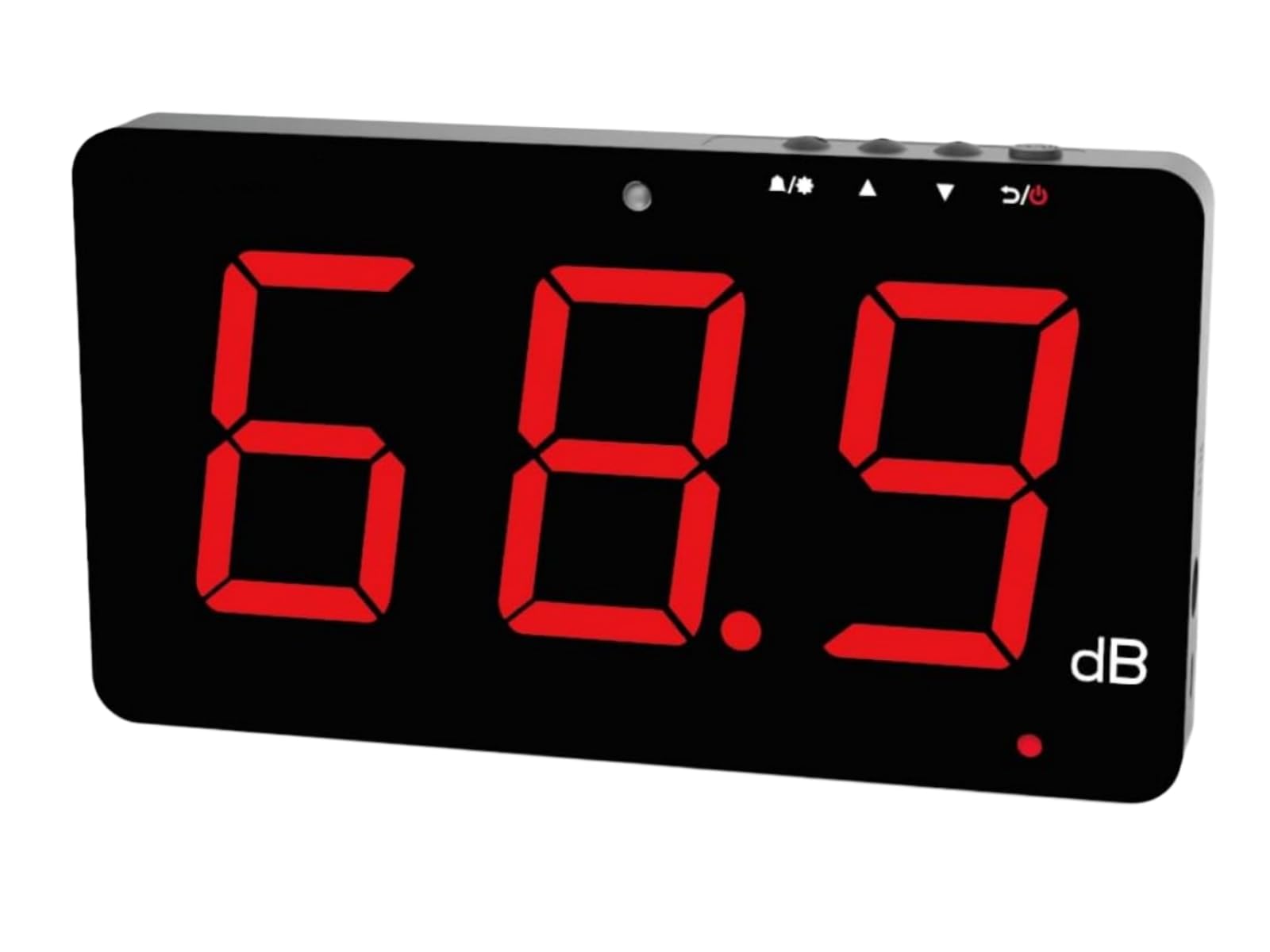
A big red wall display that shows how loud the room is from across the floor.
The SW-525A is built to hang on a wall and be read from across the room, not to live in a pocket. Its large red LCD display measures 8.98 by 4.92 inches overall and covers a 30 to 130 dB range. It updates roughly once per second, which is slow enough to read but fast enough to catch a sudden noise. The body is plastic and acrylic, and it weighs 0.6 kg, which is light enough for a couple of wall screws or a bracket. A USB-C port takes power from an included cable, and the unit has a built-in alarm that sounds when noise crosses a level you set.
The best use case is at home with a noise-sensitive household. It works well in a woodshop where you want a heads-up display of the noise level, and it suits a studio where you want a visible meter without looking at a screen. The accuracy holds up at loud levels where cheaper handhelds fall short. The alarm feature also makes it a useful teaching tool — set it to trigger when kids get too loud during work-from-home calls, and it gets the message across.
Two practical notes before you mount it. The alarm at full volume is still fairly quiet, so do not expect it to cut through a noisy room by sound alone. And the power cord is short for some wall positions, with no AC adapter in the box, so measure your outlet run before you commit to a spot. It has no optional stand — it is a wall-mount design, so plan its permanent location. For a fixed display, those are small adjustments to make.
The wall-display advantage
- Large red LCD reads clearly from 20+ feet away, so the whole room can see the level.
- 30–130 dB range holds accuracy at loud levels.
- Built-in alarm triggers when noise crosses your set threshold.
- USB-C powered with included cable and updates roughly every second.
Mounting realities
- No stand — wall-mount only, so pick a permanent spot.
- Power cord is on the short side, and no AC adapter is included.
- The built-in alarm is quiet at full volume, so it is a visual cue more than an audio one.
For the wall: Ideal if you want a visible room-level display for a workshop, studio, or family home that everyone can read from across the room.
Grab a handheld instead: it’s not for you if you need something you can carry to different spots or read at close range.
Know the Specs
dB Range and Accuracy
The dB range tells you the loudest and quietest sounds a meter can register. A 30–130 dB span covers a quiet bedroom up to a chainsaw. The accuracy figure — typically ±1.5 dB — shows how close the reading sits to the true level. For noise complaints, speaker setup, and general checks, a ±1.5 dB meter does the job. Certified lab instruments cost far more and are not needed for home use.
A-Weighting and C-Weighting
A-weighting follows how the human ear hears softer sounds, so it is the mode for neighbor noise, offices, and environmental checks. C-weighting keeps the deep low-frequency energy in the reading, making it the right choice for subwoofers, motors, and machinery. A meter with both modes is more versatile than one locked to A-weighting alone.
FAST and SLOW Response
FAST response uses a 0.125s time constant and suits sounds that change quickly, like traffic or voices. SLOW uses a 1s time constant and gives a steadier average on constant noise like a fan or HVAC hum. Switching to SLOW can make a reading settle enough to write down and compare later.
Display and Mounting Format
A handheld meter lives in your pocket and gets carried to the noise. A wall-hung display stays in one spot and shows the level to the room. A rack unit fits your audio stack and doubles as a visual centerpiece. Pick the format that matches how often and where you will actually use the meter.
Common Questions
Will a handheld SPL meter work for measuring neighbor noise?
What is the difference between A-weighting and C-weighting?
Can a decibel meter tell me if my home theater speakers are set up right?
How accurate is a ±1.5 dB meter compared with a professional one?
Why does my meter read 33 dB in a silent room instead of 30 dB?
Can I mount an SPL meter on a tripod or wall?
Does a decibel meter need calibration before I use it?
What is the difference between FAST and SLOW response on a decibel meter?
Will a phone sound meter app do the same job?
Which SPL meter is best for measuring machinery or subwoofer bass?
The Bottom Line
For most buyers, the spl meter worth reaching for first is the TopTes TS-501B, because it covers the widest everyday ground — A and C weighting, 30–130 dB with ±1.5 dB accuracy, a backlit 2.25-inch screen, and factory calibration in a 5.3-ounce body. If you need to calibrate and set threshold alarms, step up to the Tadeto TE017. For a permanent wall display everyone can read, the TestHelper SW-525A is the one to mount.
One honest nudge: seven models made the shortlist because each handles its own job well, and the top pick holds up under comparison with a calibrator. Match the meter to the job and you’ll stop arguing about noise and start fixing it.
How we choose
We do not accept paid placement. Every pick is matched to a real buyer and a real use-case; we do not hands-on test units.
Sources
Specifications: manufacturer listings and product documentation. Review insights: verified customer reviews, as of October 2026. Pricing: not shown on this page (it changes often); check the current price via the retailer link.
As an Amazon Associate, Aappliancez earns from qualifying purchases. This does not affect which products we feature.