Disclosure: Some links in this post are affiliate links. As an Amazon Associate I earn from qualifying purchases, at no extra cost to you. Learn more
Specs are compiled from manufacturer listings and verified buyer reviews and can change over time — please confirm the key details on the product page before buying.
You cough, you feel tight, and you want something at home that actually helps. So the first thing to settle is what you are trying to do: move mucus out, or measure your numbers? A flutter valve helps you clear your airways. A peak flow meter tells you how much air you can push out in one breath. Most people start with the wrong one.
This guide is built by comparing the manufacturers’ published specifications and the patterns across verified customer reviews, so you get each pick’s real strengths and trade-offs instead of marketing spin.
Below you will find seven devices split into movers and measurers. The strongest all-rounders sit first. By the end you will know which spirometer for home use fits your routine.
Top Picks

How To Choose The Best Spirometer for Home Use
Two very different machines share this shelf, and picking the wrong type is the only decision here that really costs you money. First-time buyers treat them as the same thing. They are not.
Clearing Mucus Versus Measuring Airflow
A flutter valve (a mucus clearance device — you breathe through it to loosen and shift mucus in your airways) gives you relief, not a number. You breathe in and out, and the vibration helps you cough the mucus up. That is the whole job.
A peak flow meter or digital spirometer is the opposite. You blow into it as hard and fast as you can, and the screen shows a reading you can write down. It does nothing for mucus.
If you want a daily routine for a head cold or congestion, the flutter valve wins. If you want to track a lung condition week to week, you want the meter. Some households end up owning one of each, which is why this list includes both.
Reading the Numbers You Will Actually Use
Peak expiratory flow, usually shortened to PEF, is your fastest blast of air. A peak flow meter is built to capture that one number, and most asthma action plans are based on it.
FEV1 (forced expiratory volume in one second — the amount of air you can force out in that first second) is the number a lung specialist cares about most. It is why a digital meter that reports both PEF and FEV1 is worth a look over a plain mechanical tube.
A device that tracks one and not the other still has value — it just tells a narrower story. Check which of the two your own care routine already uses before you buy.
Resistance Settings and Comfort
On the flutter-valve side, resistance decides how hard your breathing workout feels. Devices with three weighted steel balls or a numbered dial let you make it easier when you are tired and harder when you want a challenge.
Adjustability matters more than raw resistance. A device stuck on one hard setting gets abandoned in a drawer after a week. One you can dial down gets used daily.
Cleaning matters just as much. Anything you breathe into repeatedly needs to come apart easily or have a rinse-friendly airflow path. Otherwise hygiene turns into a chore and the device gets shelved.
Side-by-Side Comparison
| Model | Best For | Device Type | Resistance / Range | Data Output | Amazon |
|---|---|---|---|---|---|
| Flutter Valve Breathing Exercise Device★ Best Overall | Daily mucus clearance | Flutter valve | 3 steel balls | None (visual airflow) | Amazon |
| Nascool Peak Flow MeterBest Value | Family asthma tracking | Digital peak flow meter | Auto-ranging | PEF + FEV1 | Amazon |
| Tilcare Breathing Exercise Device | Seated muscle training | Resistance trainer | 6-level dial | None (manual mode) | Amazon |
| Sonmol Digital Peak Flow Meter | Glanceable risk zones | Digital peak flow meter | Auto-ranging | PEF + FEV1 with color zones | Amazon |
| Sonmol Digital Breathing Exercise Device | Tracked strength training | Digital resistance trainer | 6 levels inhale + 6 exhale | MIP + MEP with app sync | Amazon |
| MIR Smart One | Shareable reports | App-based digital spirometer | Auto-ranging | PEF + FEV1 with PDF export | Amazon |
Detailed Reviews
1. Flutter Valve Breathing Exercise Device
Our pick — 4.0+★ from 400+ verified ratings; the strongest balance of quality and price.
Three steel balls and zero batteries clear the mucus nobody else on this list touches
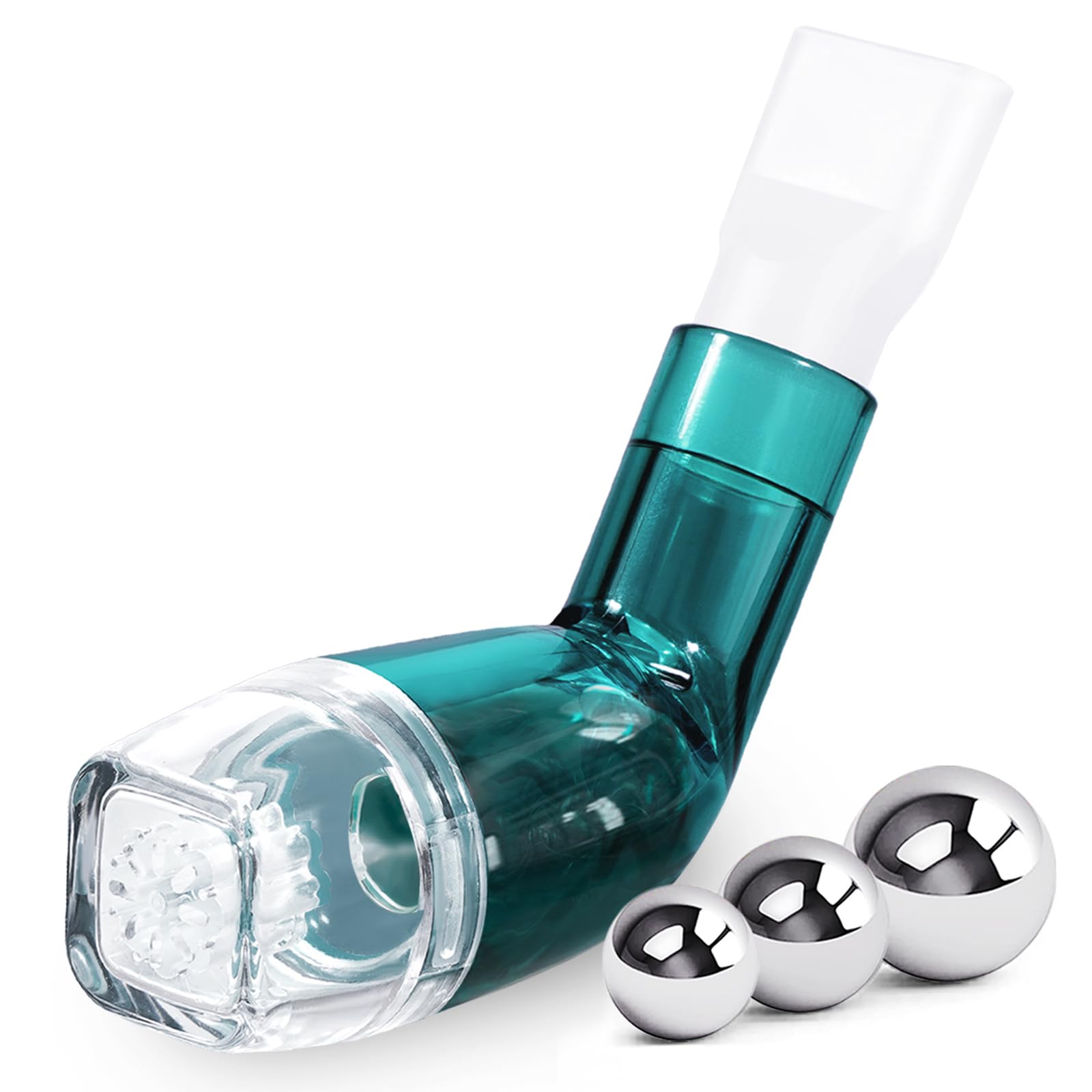
Three different-sized steel balls inside let you change how hard the workout feels — swap the ball to go lighter or tougher. That is the single reason this one sits first: a beginner and a long-time user can share the same unit. You breathe into it, the ball vibrates, and that flutter effect loosens mucus so you can cough it up.
The transparent body shows you the flutter as you exhale, and the shell is made from medical-grade PC (polycarbonate — a shatter-resistant plastic that stands up to regular cleaning). There is nothing to charge and nothing to sync.
Where it beats the meters is portability and ruggedness. It measures 4.3 x 1.7 x 3.3 inches and weighs 5.29 ounces — a 2.1x-larger footprint than the Nascool peak flow meter, and 6% heavier at 5.29 ounces versus 4.97 ounces. Worth knowing if you plan to carry it in a jacket pocket rather than a bag.
mucus clearing valve
- Three steel balls give you three resistance levels, so a beginner and a long-time user can share one unit
- Runs on nothing — no batteries, no app, no charging cable to lose
- Cleaning is quick, which matters for something you breathe into daily
- Transparent body lets you watch the flutter as you exhale
requires daily effort
- No numbers, no readings — this clears airways, it never tells you how your lungs are doing
- Larger and heavier than the compact pocket meters on this list
- Fine mucus work takes a few minutes of steady breathing, not one big puff
beside the tissue box: this is for anyone whose priority is clearing airways day to day, especially through cold season.
not your tool: if you need a doctor-ready number after every blow, a meter belongs in your cart instead.
2. Nascool Peak Flow Meter for Adults & Kids
The household meter a respiratory therapist picked for her own kitchen counter
A respiratory therapist who has handled plenty of peak flow meters called this one “amazing and great for home use” and singled out its lack of moving parts. With no moving parts to wear out, the accuracy holds up over months of daily blowing instead of drifting like a mechanical gauge can.
One blow gives you both PEF (your fastest blast of air) and FEV1 (the air you force out in the first second), and it arrives pre-calibrated so there is nothing to adjust before your first test. What it lacks is Bluetooth — you read the screen and write the number down yourself.
That is the one thing that divides opinion here. skip it if you want automatic logging. Buy it if you want every reading to be something you looked at with your own eyes.
adult and kid range: a family tracking one or two people’s asthma at home, including kids above 6, and anyone doing virtual follow-ups where the doctor wants numbers from between visits. It also comes with a paper asthma diary, so the low-tech approach works straight from the start.
bluetooth pairing quirks: the readings never sync to a phone, so you are the logging system. For some buyers that is the point — one owner put it plainly: “who needs another smart device in their life?” For others chasing a trend chart, it is a deal-shape mismatch, not a defect.
grab it if: you want an accurate, calibration-free meter with a readable screen and you are happy to jot readings in the included diary.
look past it if: automatic phone syncing is a must-have for you.
3. Tilcare Breathing Exercise Device

A pocket-sized trainer that fits a five-minute breathing session into your TV time
Six resistance levels on one dial, so you start easy and turn it up as your lungs get stronger. That dial is the point: it trains breathing muscles rather than clearing mucus, and it is aimed at swimmers, singers, athletes and older users who want stamina, not measurements.
The honest picture here is more mixed than most of this list. Quality earns the most discussion of any trait on this device, and the talk splits both ways — plenty of people get great use out of it and plenty find it flimsy. The most common real-world use is seated: breathing reps while watching TV, once or twice a week, with a noticeable difference reported over time. It is not built for running or workouts where you cannot hold the mouthpiece in place.
Where the dial design pays off is pacing — you adjust resistance mid-session without stopping, which keeps the reps flowing. Where it can let you down is the dial itself. If the resistance control sticks, the whole point of six levels disappears, so check it early and treat the mechanism gently. The body is BPA-free (made without bisphenol A, a plastic additive many buyers prefer to avoid in a mouthpiece).
fits best: a seated, low-intensity routine at home, especially for older users or anyone training breathing strength at a desk or armchair.
think twice if: you need a device that stands up to vigorous daily abuse or you want resistance clearly tougher than the tools a clinic hands out.
4. Sonmol Digital Peak Flow Meter
Green, yellow, red — the meter that turns your breathing number into a traffic light
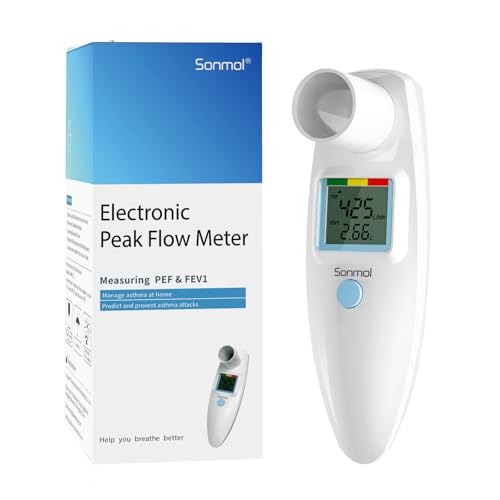
An arrow points at a green, yellow or red bar the moment you finish blowing, so you know at a glance whether today looks normal for you. That color verdict is why this one stands out from the meters above. The Nascool gives you the raw numbers, but you still have to know what your personal range is. This one shows you the answer.
You set your personal expected value once by scanning the QR code and entering your age, gender, height and weight. From then on every test is compared against your own baseline rather than a generic chart. One blow reads both PEF (your fastest blast of air) and FEV1 (the air you force out in the first second), using a differential-pressure sensor (a sensor that reads the pressure change your breath creates).
The airflow path is a straight open pipe you rinse under the tap — no fiddly disassembly before you can put it away. Two AAA batteries are quoted at up to a year of daily use, so battery anxiety is not part of the routine.
On accuracy, buyers are honest that it tracks consistency better than absolute truth. As owners put it: “just as accurate as the one I got from transplant doctors both show 2.30 when clinic has 2.97.” Read that as a device that tells you reliably whether today is better or worse than yesterday, not one that replaces a lab. It also suits children from age 5 with adult guidance.
color coded readings: you have to complete the personal setup before the indicator arrow activates, and the readings stay on the device unless you write them down — there is no syncing here.
reach for this if: you want to know instantly whether a reading is in your safe zone without memorizing your own numbers, and you want a meter a child of 5 can use.
better elsewhere if: you need automatic logging to an app across months.
5. Sonmol Digital Breathing Exercise Device
Two separate dials, a manometer and a whale game make lung training feel like a hobby
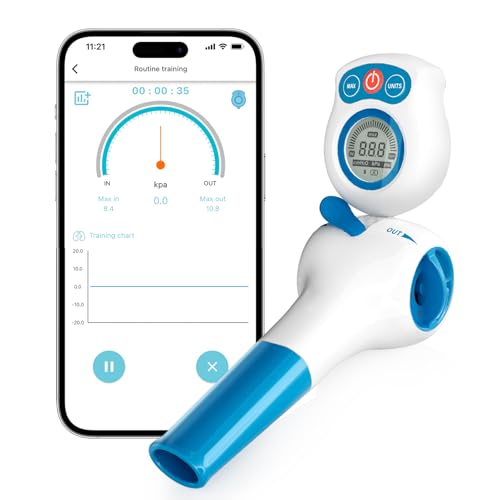
Separate resistance dials for inhaling and exhaling — six levels each — mean you can train the weaker direction harder. That is genuinely more adjustability than the Tilcare’s single six-level dial, and it is why this one earns its spot. It also measures MIP and MEP (the maximum pressure you can pull in and push out), which the manufacturer suggests re-testing roughly every four weeks to see the trend.
Your training data, MIP and MEP readings all sync automatically to the eRMT app, which builds improvement charts without you logging anything. A manometer (a gauge that shows the pressure you generate) sits in the kit alongside the resistance attachments.
It comes with a travel case that holds every attachment, and an owner with unlimited sessions on their hands called the full kit a bargain given how many times it can be reused. The trade-off is setup patience. The app needs some manual attention to get going on a phone, one owner found the whole thing too complicated to master, and another noted the iOS app needs screen-resizing work. Buy it for the data, not for a frictionless first five minutes.
combined meter and trainer: it is the only pick here that both strengthens breathing muscles and records the strength numbers over time, which suits anyone recovering who wants proof of progress rather than a feeling.
higher price tag: you are paying for a measuring tool, and that means dealing with a phone app. If you want pick-up-and-breathe with nothing to configure, the simpler trainers and valves above and below this entry suit you better.
solid choice for: anyone who wants to watch MIP and MEP strength improve week over week without keeping a paper log.
not the fit if: app setup friction will make you stop using it.
6. Bluetooth Peak Flow Meter
The meter that writes your asthma diary for you, six months deep and counting
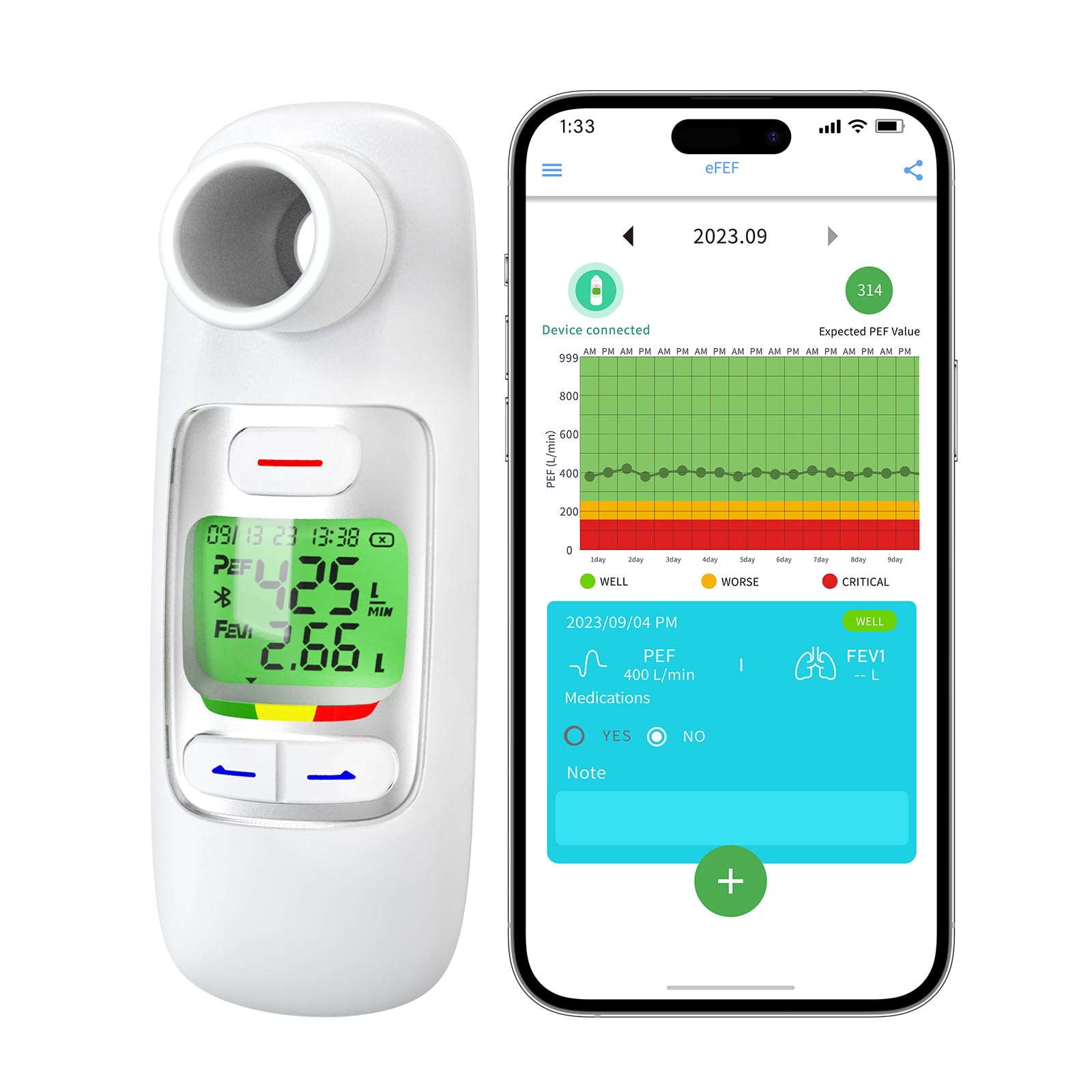
It holds 300 readings on the device and syncs them to your phone over Bluetooth in real time, so a month of blowing turns into a trend line without you entering a single value by hand. That automatic diary is why it earns a place here. Where the Nascool leaves you holding a pen, this one handles the paperwork.
The screen shows large PEF (your fastest blast of air) and FEV1 (the air you force out in the first second) figures with a green backlight, and readings come through in about one second. After each blow it displays green, yellow or red zones. The app lets you log triggers, symptoms and medications to build an action plan with ACT values (asthma control test scores) for both children and adults.
It recharges rather than eating disposable batteries, and it ships with two washable mouthpieces, which matters when you are blowing into the same device twice a day. It suits ages 4 and up with adult supervision.
Accuracy is the part buyers question most. It is fair to say the experience is not unanimous — a few would not recommend it. The functionality side is stronger: it works, it stores months of history without wiping, and the allergist-recommended use case of keeping tabs on a child’s asthma is exactly what it was built for.
choose this if: you monitor asthma regularly and you want the diary, the zones and the history generated for you instead of logged by hand.
consider the nascool instead i: you would rather read a screen and trust your own eyes than depend on an app that some find rough around the edges.
7. MIR Smart One
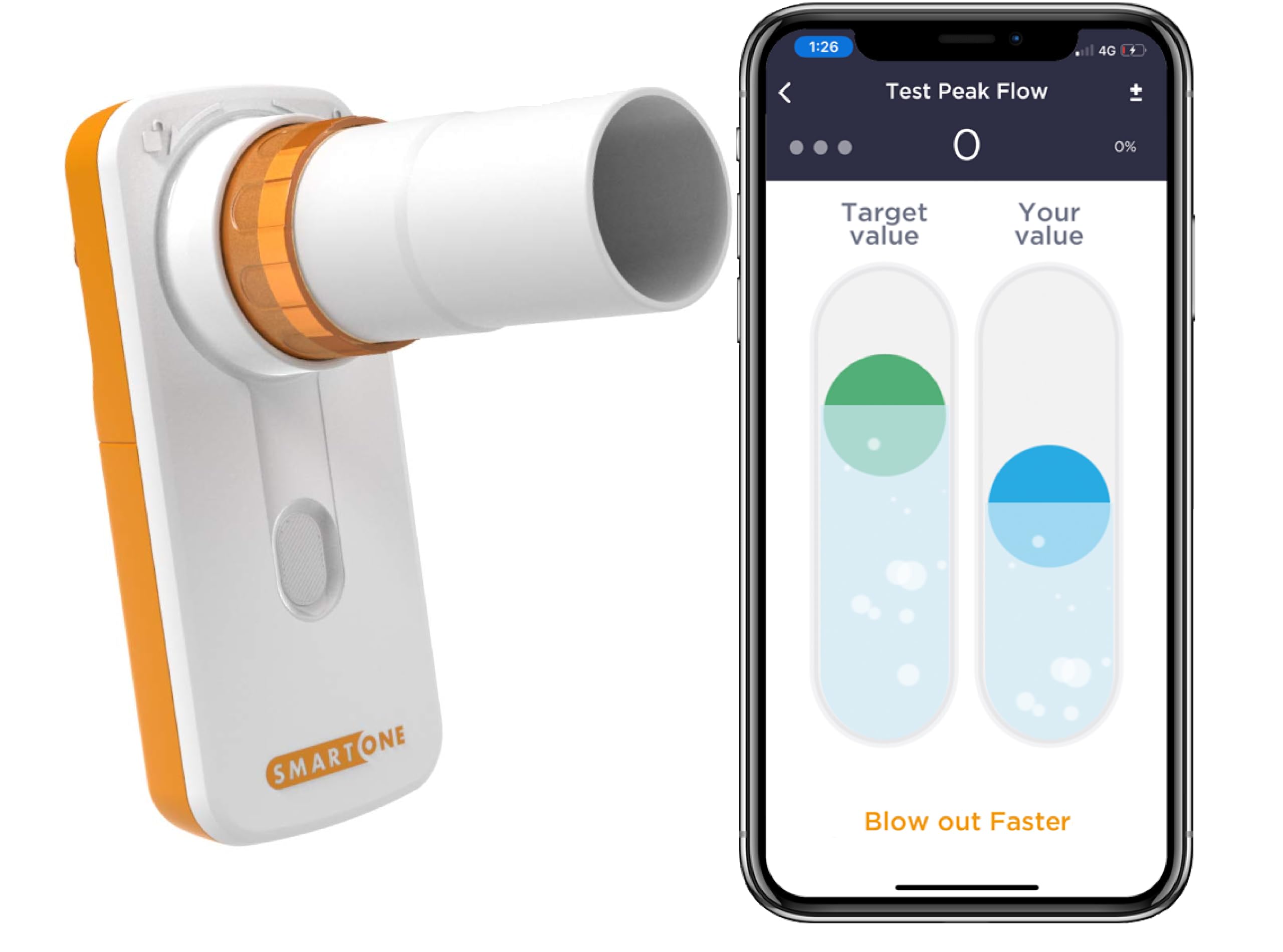
The one that hands your lung specialist a shareable PDF instead of a sticky note
Every test produces PEF (your fastest blast of air) and FEV1 (the air you force out in the first second) figures, and the app builds shareable PDF charts you can send to your healthcare provider. No prescription is required to buy one, and a single reading takes under a minute. That shareable report is why it closes the list.
Designed in Italy by MIR, it is the smallest thing here at 2.14 ounces with a pocket-slim shape, and it runs on a single AA battery. Buyers report FEV1 matching professional spirometry exactly, and one notes it is a precise, affordable stand-in for FEV1 between appointments even though it does not measure everything a full lab test does. It also guides your exhale speed while you blow, so technique on a bad day does not wreck the reading as easily as it can on a cheap tube meter.
Two cautions worth knowing. The mouthpiece does not collapse the way some buyers assumed it would, so packing it is slightly bulkier than the barrel alone suggests. And the companion app draws mixed feelings for polish even though the iPhone connection itself is described as flawless.
for the diligent tracker: pick this if your readings go to a doctor, you want shareable charts, and you value a device your specialist can trust to be consistent.
skip the premium if: a straightforward on-device reading and a paper diary cover everything you need.
Know the Specs
PEF and FEV1 Explained in Plain Words
PEF (peak expiratory flow) is the fastest speed you can force air out of your lungs — a single number from one hard blow. FEV1 (the air you push out in the first second) is the figure a lung clinic usually tracks. A meter that reports both tells a fuller story than one that reports PEF alone, which is why the digital units on this list list both. Neither number is meaningful on its own — what matters is today’s reading against your own usual range.
Resistance Levels on a Muscle Trainer
On a breathing trainer or flutter valve, resistance is how hard the device pushes back against your breath. More resistance means a tougher workout; less means you can keep going when you are tired. What matters is whether you can change it easily mid-session and whether it starts gently enough for a beginner. A device with a fixed, hard setting tends to get abandoned, no matter how good its numbers look on paper.
App Syncing and Manual Logging
Some meters push every reading to a phone automatically, and some show you a number and leave you to write it down. Automatic logging suits anyone tracking a child’s asthma or building a long trend for a doctor. Manual logging suits anyone who does not want another app, another account and another battery to manage. Decide which camp you are in before you choose, because this single feature separates the meters on this list more than accuracy does.
Mouthpieces and Cleaning
You are putting your mouth on this device daily, so how it cleans matters. Look for a mouthpiece that comes off for washing, or a straight airflow tube you can rinse directly. Replaceable or washable mouthpieces are a plus if more than one person in the house uses the device. A covered, sealable mouthpiece is worth having if the device lives in a bag or a drawer between uses.
Common Questions
What is the difference between a peak flow meter and a spirometer?
Should I get a flutter valve or a peak flow meter for home use?
Do I need a prescription to buy a home lung monitor?
Can children use these devices at home?
How often should I test my peak flow at home?
Do I need to calibrate a digital peak flow meter?
Which is better, a meter with Bluetooth or a manual log?
Can multiple people in one household share the same device?
How do I clean the mouthpiece between uses?
How long does the battery last on a digital meter?
The Bottom Line
For most homes, the spirometer for home use that earns its spot on the shelf is the Flutter Valve Breathing Exercise Device, because it delivers what most people actually need day to day — bronchial clearance with three adjustable resistance balls and nothing to charge. If a number is the point, grab the Nascool Peak Flow Meter; it is the meter a respiratory therapist chose for her own home. And for readings that travel to a doctor as a clean, shareable chart, the MIR Smart One is the one to reach for.
How we choose
We do not accept paid placement. Every pick is matched to a real buyer and a real use-case; we do not hands-on test units.
Sources
Specifications: manufacturer listings and product documentation. Review insights: verified customer reviews, as of October 2026. Pricing: not shown on this page (it changes often); check the current price via the retailer link.
As an Amazon Associate, Aappliancez earns from qualifying purchases. This does not affect which products we feature.