Disclosure: Some links in this post are affiliate links. As an Amazon Associate I earn from qualifying purchases, at no extra cost to you. Learn more
Specs are compiled from manufacturer listings and verified buyer reviews and can change over time — please confirm the key details on the product page before buying.
You keep finding spiders in the corners, under the bed, or along the baseboards — and a glue board is the cheapest way to find out where they come from and stop them there. The board itself matters less than where you put it. Pick one with enough sticky surface to hold a spider that fights hard, in a shape that fits the dark gap you need to cover. This guide breaks down five picks by catch area, pack count, and how long the adhesive keeps working.
This guide is built by comparing the manufacturers’ published specifications and the patterns across verified customer reviews, so you get each pick’s real strengths and trade-offs instead of marketing spin.
A spider walking a baseboard will cross anything you lay flat. So the board you choose matters less than where you put it and how much sticky surface it gives you. That is the whole game with spider traps.
Top Picks


How To Choose The Best Spider Traps
Start with where the spiders actually walk. A glue board works on contact, so a spider never has to be lured anywhere — it only has to step onto the sticky face. That means your two biggest decisions are how much sticky surface you get per board and how many boards you can lay down at once.
Catch Area and Board Size
Bigger sticky faces catch more, plain and simple. A board with around 30 square inches of glue (the sticky face itself) gives a spider far more room to be caught than a narrow strip. A wide face is also harder for a large spider to walk around. Size decides where the trap can go, too: a smaller board slips into a tight gap behind a sofa, while a larger one covers more baseboard in a single placement. A board that measures roughly 8.5 inches by 5.25 inches is easy to tuck along a wall line. Boards with a fold-down tunnel shape (a cover that hides the glue behind cardstock) can sit in dusty or exposed spots without getting stepped on.
Pack Count and Coverage
Spiders rarely travel alone, so one board in one corner usually is not enough. A large multi-pack lets you place traps at every doorway, behind each piece of furniture, and along the full run of a baseboard at the same time. That is how you find the real entry points instead of guessing. Count matters for cost per placement too: a 72-board box spreads across a whole home, while a 12-pack suits a single room or a car. If you only lay two traps, you learn almost nothing about where the spiders are coming from.
Fold Shape and Placement
Flat boards work along floors and shelves. Folded traps do things flat ones cannot. A tunnel fold hides the glue so pets and vacuum cleaners are less likely to catch on it. A triangle fold tucks into a corner behind a toilet or under a sink. Perforated boards (dashed edges you tear by hand) are the third option — you tear the board into sections and press the glue right against the baseboard. That stops a caught spider from dragging the trap away. Think about your rooms first, then pick the fold that fits them.
Side-by-Side Comparison
| Model | Best For | Pack Count | Board Size | Target Species | Amazon |
|---|---|---|---|---|---|
| Catchmaster 72MB Glue Boards★ Best Overall | Whole-home coverage | 72 boards | 8.5″ x 5.25″ | Roach, flea, mouse, spider | Amazon |
| Shieldeck Roach Traps IndoorBest for Pets | Pet-safe rooms and cars | 12 traps | 8″ x 4″ x 1″ | Spider | Amazon |
| Catchmaster 288i Insect & Spider Trap | Tight dark gaps | 36 boards | 9.88″ x 7.5″ | Spider | Amazon |
| BugMD Indoor Roach Trap | Car and garage | 12 traps | — | Cockroach, waterbug, palmetto bug, spider, cricket | Amazon |
Detailed Reviews
1. Catchmaster 72MB Mouse & Insect Glue Boards
Our pick — 4.5+★ from 600+ verified ratings; the strongest balance of quality and price.
Seventy-two boards with a 30-square-inch glue face each, ready to line every wall you own.
This box wins the top spot on raw coverage: 72 boards, each measuring 8.5 inches by 5.25 inches with a 30-square-inch catching surface. That is enough glue that a spider has to cross it rather than skirt around the edge. The perforated design matters most in daily use — you tear a board off and press the adhesive directly against the baseboard, so a caught spider cannot drag the trap out of position before you find it. Boards also fold into a tunnel shape, which keeps the glue out of sight in dusty areas or spots where someone might step.
The coverage math is where this pick beats the Shieldeck pack below. You get 72 boards against Shieldeck’s 12 — 6x the placements from one purchase. That changes how you work. Instead of two or three traps and a long wait, you can cover the kitchen, the bathroom, both bedrooms, and the garage on day one and see where the catches actually happen. The printed IPM chart (a placement guide for integrated pest management) on the back of the board even walks you through setup, which helps if you have never run a glue board program before.
What owners keep coming back to is how well these simply work. The adhesive holds a spider even after a household insecticide spray, and a board left out for weeks still catches. The peanut butter scent splits owners: some barely notice it, others find it strong. The glue holds anything that touches it, so keep boards away from curious cats and dogs. Buyers report the boards caught roaches of every size, including juveniles and egg-bearing females.
What earns its keep
- 30 sq. in. of glue per board across 72 boards, so every baseboard and doorway gets its own trap
- Perforated edges tear off by hand and press flat against baseboards to stop drag-offs
- Folds into a tunnel for dusty or high-traffic spots
- Peanut-butter baited surface, no mixing or extra attractant needed
What to plan around
- Cleanup on a full board is unpleasant work — you are handling a loaded trap
- The glue grips anything that touches it, pets included, so placement needs thought
- The peanut butter smell is a love-it-or-hate-it detail
Built for: anyone who wants one purchase to cover a whole house and find out exactly where the spiders are entering.
Think twice if: you only need a couple of traps under one sink — a large box will leave you storing boards for months.
2. Shieldeck Roach Traps Indoor (12 Pack)
A food-baited board you can pick up without touching it, built for homes with kids and dogs underfoot.
A pick-up knob is the reason this trap earns its spot: when the board fills, you lift it out and drop it in the trash without your fingers ever going near the glue. That matters in a house with a dog, a toddler, or both. Shieldeck builds these around a food-based, non-toxic attractant rather than harsh chemicals. The cardstock fold measures 8 inches long by 4 inches wide by 1 inch tall — small enough to slide under a sink or behind a toilet. Twelve traps per box, each stated to last up to 3 months, so one box covers a couple of rooms for a season.
Against the 72-board Catchmaster above, this is the opposite trade. You get 12 traps instead of 72, but each one is pre-folded and pre-baited. What wins people over here is safety — the bait is designed around families, and buyers with older dogs have run these without concern. Setup earns praise once the fold clicks, though the folding instructions themselves trip a few people up on the first trap. Catches taper too: a trap that fills in the first day or two slows by around day five as the local population thins.
The honest catch is the smell. The bait has a noticeable odor one buyer called “pretty bad,” and it lingers when several traps sit in a closed cabinet. Placement is also a real skill — a trap tucked into a sink with extra bait still relies on a roach walking onto the sticky face, and a roaming spider will skip a well-fed, low-traffic spot entirely. Put these where the spiders already run, replace when full, and they do their job. It knocks down an infestation without toxic chemicals, which is the point in a home with pets.
Where the value sits: a 12-trap box with a 3-month coverage claim and a no-touch disposal handle, sized for a single room or a car rather than a whole house.
The trade you accept: baited traps work best when placed directly on a travel path, and the bait odor is strong enough that a closed cabinet will hold it for a while.
Reach for this if you want a non-toxic, handle-in, handle-out trap for a home with pets and kids.
Look elsewhere if you want bare boards in bulk — the 72-board pick above gives you far more placements for the same job.
3. Stingmon 24 Pack Roach Traps Indoor

Twenty-four baited traps with openings on every side, so a spider has no wrong door to walk through.
Entrances on multiple sides are why this pack takes the value slot: when you are not sure which direction the spiders travel from, a trap they can walk into from almost any angle does more work. Each of the 24 traps ships with its own bait pellet — the manufacturer builds the attractant in rather than asking you to add anything. The folded trap measures 7.48 inches long by 3.54 inches wide by 1.45 inches tall. Tuck them in the kitchen, the bathroom, the storage room, behind the garbage can, or along any garage wall. A handle on each trap means you lift it out and bin it whole, no scraping glue off a floor.
Owner results on this pack lean toward fast. Placements seeded under a sink and around a pantry have pulled in catches on the first night and then gone quiet for a week, which is what a working trap program looks like: a burst, then a plateau. The adhesive is genuinely strong, and the multi-entrance fold means a roach or a spider has to stumble onto sticky surface from almost any approach angle. If you are choosing between this and the Catchmaster 288i further down, the Stingmon wins on pack-to-placement math — 24 baited traps ready to go versus 36 bare boards you fold yourself.
The trade-off is the smell. Bait pellets carry a potent, non-chemical odor when you first unwrap them, and it takes a few hours to fade. Unwrapping each pellet also takes more care than a plain board — one owner described the process as a learning curve. The traps work best on a clean surface with repeat placements, since debris and crowding cut into the glue. Then there is the count: 24 traps means replacing a used trap eats into your coverage, so heavy infestations should buy a second box. For a normal household with a handful of spiders, one box does a full season.
Why it earns the spot
- 24 baited traps with a built-in handle on each, so disposal is one clean lift
- Multiple entry openings catch pests approaching from any direction
- Folds into a compact box that slips behind appliances and under sinks
- Paper-and-glue construction with a kid- and pet-safe placement claim
Where it nags
- Bait pellets have a strong odor right out of the wrapper before it fades
- Unwrapping each pellet is fiddly compared to a pre-baited board
- The fold involves a slight learning curve on the first trap or two
For the spider hunter who: wants a baited, multi-door trap that works on the first night without any mixing or spraying.
Skip if: the smell of fresh bait in a closed cabinet would bother you more than the spiders do.
4. Catchmaster 288i Insect & Spider Trap (36 Glue Boards)

Bare boards with nothing to smell and nothing to attract pets — just glue, folded to sit where spiders hide.
No bait and no added scent are the reasons this trap takes the top performer label: 36 glue boards, listed at 9.88 inches by 7.5 inches, with nothing edible on them for a pet to find. Each trap folds into a rectangle or a triangle, and each trap equals 3 monitors in Catchmaster’s own count. The extra glue on the unused bottom edge is a genuine bonus for anyone running a wide placement — one board covers more floor than a single-strip trap. Slide them under beds, behind sofas, and into any dark gap where you have seen a spider disappear. The bait-free design is also a working method on its own: a board that has already caught a couple of insects becomes attractive to hunting spiders as they investigate, so a successful trap keeps drawing more.
For hard-to-reach spots this beats the larger Catchmaster 72MB above on one count — at 9.88 inches by 7.5 inches it still fits where the full-width board will not, and in a house fighting brown recluse spiders you need many traps in many locations rather than a few big ones. Owners describe the adhesive as lasting a long time, which matters when you leave a board down for weeks behind a piece of furniture. There is also a bulk-cost angle here versus buying the same size at a hardware store.
Be honest about what a bare board can and cannot do. It catches what walks onto it — someone running these for a few days and seeing nothing should not assume they failed. Trials where the traps caught nothing for days turned productive after a mist insecticide was added, catching spiders that tried to flee and crossed the glue on their way out. If you have zero bait in the mix, patience and volume are part of the plan. Some buyers also mention the adhesive underside is unused until you fold the board a certain way, so read the fold before you place it. For sheer catchability per board, this is the strongest spider-specific option on the list.
Where it stands out: 36 bait-free glue boards with a triangle fold, sized to fit narrow gaps where a full-width board cannot go.
The one catch to know: no bait means placement and patience do the work, and boards laid in the walking path of a fleeing spider earn their keep best after other control steps are already running.
Best for: people running a spider-specific trap program who want many small boards across many dark spots, with no added scent or bait.
Not the pick if: you want a trap that starts working the moment it hits the floor without extra help.
5. BugMD Indoor Cockroach Killer & Roach Trap (12 Pack)
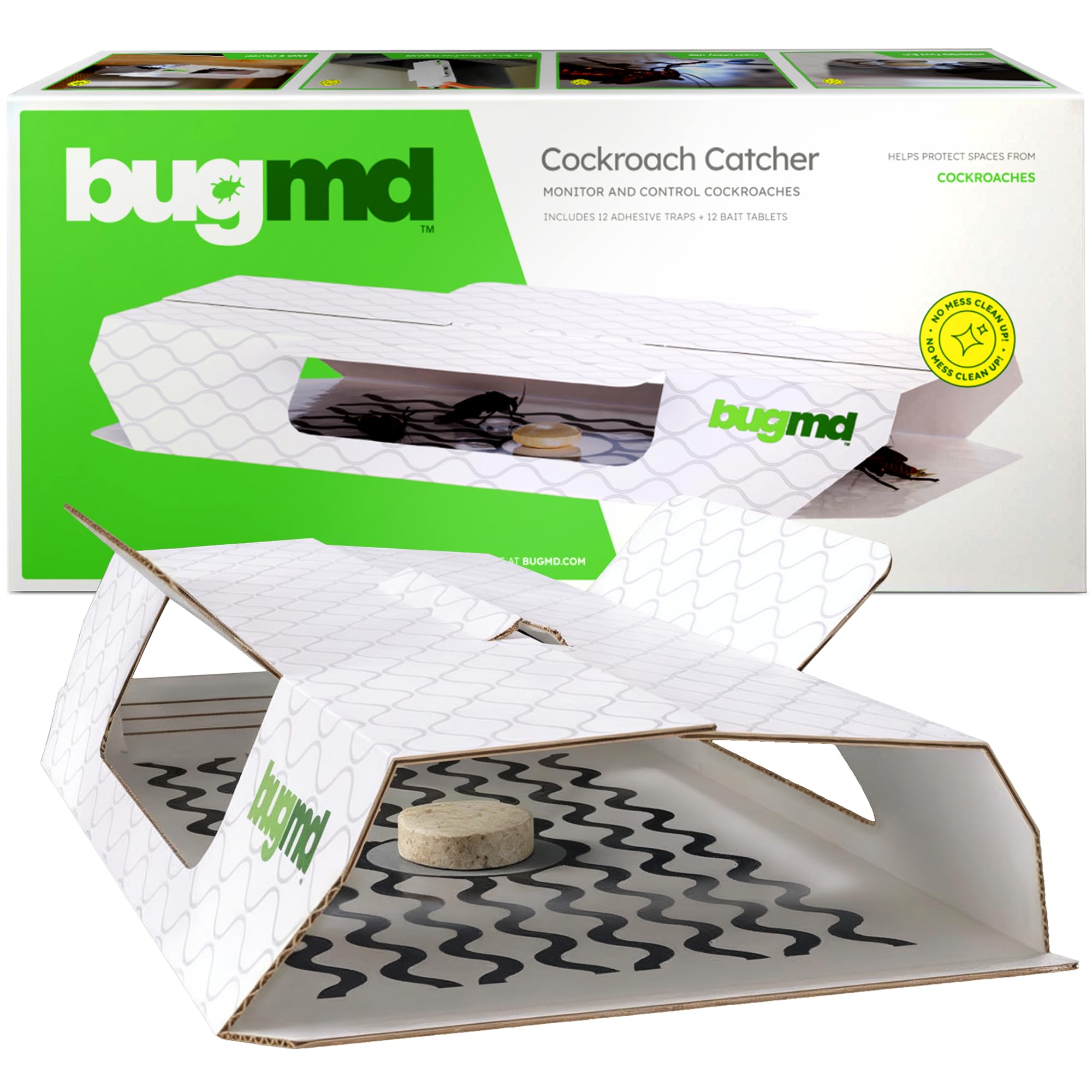
A pre-folded trap with a shrimp-and-sugar bait tablet that turns a car floor mat into a pest-free zone.
Under a car seat, on a garage shelf, in the back of a cabinet — these are spots a flat board cannot handle, and that flexibility is why this trap makes the list. Each of the 12 traps arrives pre-folded, and setup is stated at under a minute: peel the adhesive cover, drop in the bait tablet, fold it closed, and set it down. The bait is a food blend of shrimp powder, dried meat, starch, and brown sugar — an actual food lure rather than a chemical. Once anything steps onto the PermaGlue pad it stays there, and the whole trap goes straight into the trash when full. No harsh chemicals, and the company states its pest products are people- and pet-friendly.
The target list here runs wider than a spider-only board: cockroaches, waterbugs, palmetto bugs, spiders, and crickets. It is genuinely the most flexible of the five for that reason — one product that can sit in a kitchen corner by night and a garage shelf by day. Owners have used these successfully in cars, on garage floors, and near trash cans. If your spider problem overlaps with any other crawling pest in the same room, one box covers all of it.
What to weigh honestly: this is a baited trap, so the food-based lure has some scent and the trap needs to sit where pests actually travel. The pack count is 12, the same as the Shieldeck above, so it suits a couple of rooms or a vehicle, not a whole-house program — for that, the 72-board Catchmaster is still the volume leader. On direct contact it kills quickly; the residual effect on a treated surface is what tends to fade over time, and owners mention that populations drop without disappearing entirely. Used as a monitor and a catch point, it does exactly what you ask of it, and customers note “the trap caught all of them” when placed under car seats.
what separates it: pre-folded traps with a food bait tablet and stated under-a-minute setup, so you can drop one anywhere without assembly.
The practical limit: 12 traps covers a small area well, and the bait scent means you place these where pests already walk rather than wherever you like.
Pick this when you need a trap that works in a car, a garage, or a closed cabinet with almost no setup.
Pass if you want maximum trap count per purchase to cover every baseboard in the house.
Know the Specs
Catch Surface Area
The glue face is where a spider actually gets held, so this number tells you far more than the pack size. A board with around 30 square inches of adhesive gives a spider room to be caught the moment it steps on, and a wider face is harder to walk around than a narrow strip. Boards that also use the underside — like the Catchmaster 288i, which has usable adhesive on the bottom edge — effectively give you more sticky surface per piece. If you are covering wide gaps or a long baseboard run, size up; if you are fitting traps into tight slots, size down and buy more.
Fold Shape and Placement Style
Three main shapes dominate. Flat boards lie on floors and shelves and cover the most ground for the least fuss. Tunnel and box folds hide the glue behind a wall of cardstock, which keeps dust off the adhesive and stops footsteps from landing on it. Triangle folds sit into corners — a good fit behind a toilet or in a cabinet. Perforated boards are the fourth variation: you tear them into sections and press the adhesive against a baseboard, which stops a struggling spider from dragging the whole trap out of position. Match the fold to the room and you will place more traps correctly.
Common Questions
Do spider glue traps work on large spiders or only small ones?
How long do spider traps stay sticky?
Are spider traps safe around pets and children?
Where should I place a trap to catch spiders in a bedroom?
Is a baited trap better than a plain glue board for spiders?
Can I cut a glue board to fit a narrow gap?
How many traps do I need to cover a house?
What do I do if a pet or a child touches the sticky pad?
Do I need to add extra bait to a plain trap?
How often should I check and replace a glue trap?
The Bottom Line
For most homes, the spider traps winner is the Catchmaster 72MB Glue Boards — 72 perforated boards with a 30-square-inch catch surface each gives a whole house its own trap line in one purchase, and the tear-off baseboard placement stops spiders from dragging a catch away. If you need something non-toxic you can leave out with pets around, reach for the Shieldeck 12-Pack, which pairs a food-based bait with a touch-free disposal knob. And for a spider-specific program in tight dark gaps where a full board will not fit, the Catchmaster 288i — 36 boards that fold into a triangle — is the one to lay down under beds and behind sofas.
How we choose
We do not accept paid placement. Every pick is matched to a real buyer and a real use-case; we do not hands-on test units.
Sources
Specifications: manufacturer listings and product documentation. Review insights: verified customer reviews, as of October 2026. Pricing: not shown on this page (it changes often); check the current price via the retailer link.
As an Amazon Associate, Aappliancez earns from qualifying purchases. This does not affect which products we feature.