Disclosure: Some links in this post are affiliate links. As an Amazon Associate I earn from qualifying purchases, at no extra cost to you. Learn more
Specs are compiled from manufacturer listings and verified buyer reviews and can change over time — please confirm the key details on the product page before buying.
If you want the short answer: the Nama M1 is the one worth buying. It makes 3-4 cups of genuinely creamy plant milk in about 2 minutes and leaves you with dry pulp instead of a soaking-wet bag to wring out. Everything else on this list is a different compromise — bigger batches, lower cost, or a stainless chamber that heats and grinds in one go. The trick is matching the machine to how much milk you actually drink in a week.
This guide is built by comparing the manufacturers’ published specifications and the patterns across verified customer reviews, so you get each pick’s real strengths and trade-offs instead of marketing spin.
A good soy milk maker and a frustrating one usually differ in three ways: how it separates the pulp, how long a batch takes, and whether the chamber is stainless or nonstick. Below you get eleven machines sorted by what they do best, with the honest catch on each. My aim is simple — help you pick the right soy milk maker machine for your counter and your morning routine.
Top Picks


How To Choose The Best Soy Milk Maker Machine
Buying a soy milk maker is really a decision about one question: how much hands-on work do you want to do per batch? Every machine here heats, grinds, and finishes a drink on its own. Where they split is the step after — separating the ground solids (the okara, the fine meal left behind) from the milk. Some machines push pulp out dry on their own. Others hand you a mesh screen or a nut milk bag and expect you to strain.
Pulp separation is the whole ballgame
A machine with a filter funnel or pulp-extraction design collects the solids inside the chamber while the milk flows out. That means no bag, no sieve, and no burnt fingers on hot okara. Machines without one still make good milk, but you will be pouring hot liquid through a screen every single time you use it. If you plan to make soy milk three or four mornings a week, this is the single feature worth paying more for.
Match batch size to your fridge, not your ambition
A 1.6-liter chamber sounds generous until you learn that the yield is often quoted in quarts — one SoyaJoy owner reports 1.25 to 1.5 qt per run after straining. Small 10 oz batches suit a single coffee drinker who wants one fresh latte. A 35 oz or 40 oz machine suits a family that goes through half a gallon a week. Buy for the size you will actually finish before it spoils, because fresh plant milk without preservatives has a short fridge life.
Stainless versus nonstick inside
Stainless steel interiors rinse out and do not hold onto soy smells, but residue hardens if you walk away. Nonstick interiors claim easier release, and they generally deliver — as long as you add water right after pouring. Whichever you pick, cleaning immediately after the batch is the habit that decides whether you love the machine or resent it.
Side-by-Side Comparison
| Model | Best For | Capacity | Claimed Batch Time | Pulp Handling | Amazon |
|---|---|---|---|---|---|
| Nama M1★ Best Overall | Creamiest milk, least mess | 3-4 cups per batch | About 2 minutes | Pulp extraction, dry pulp out | Amazon |
| SoyaJoy G5Dry Bean Ready | Dry or soaked beans, 8 functions | 1.6 L stainless chamber | 36-minute automatic cycle | Precision Grinding Funnel plus sieve | Amazon |
| Soyapower G4Compact Build | Simple one-button soy milk | 1.3 L | About 20 minutes in soaked mode | Filter-free design, strain the okara | Amazon |
| IAGREEA Nut Milk Maker | Budget heater that also cooks | 35 oz | A few minutes for oat, longer for almond | Stainless jug plus straining sleeve | Amazon |
| Arcmira 6 in 1 | Small kitchens, small batches | 20 oz (600 ml) | Minutes; about 20 for hot soy | Nut milk bag included | Amazon |
| KIDISLE 8-in-1 | Milk plus soup and smoothies | 32 oz | About 8 minutes for almond milk | Fine mesh strainer plus nut milk bag | Amazon |
| AlfaBot N2 | Family-size batches, 5 modes | 1000 ml / 35 oz | About 15 minutes | Filter funnel plus 2 filter bags | Amazon |
| Tribest Soyabella SB-130 | Grinding and multi-use | 1.3 L | 15 minutes heated, raw in 30 seconds | Milk screen and rice paste screen | Amazon |
| Joyoung DJ12U-A903SG | One-button, no rinsing needed | 1.2 L | 25-30 minutes | Fine pulp, no straining needed | Amazon |
| MioMat 8-in-1 | Quiet, insulated, big batches | 1.3 L (37-43 oz) | About 20-30 minutes | Strainer plus optional nut bag | Amazon |
| ChefWave Milkmade | Six presets, small fresh batches | 10 oz or 20 oz batches | About 8-12 minutes | Patented extraction technology | Amazon |
Detailed Reviews
1. Nama M1 Plant-Milk Maker
Our pick — 4.5+★ from 250+ verified ratings; the strongest balance of quality and price.
Dry pulp comes out, not a dripping bag
The Nama M1 earns the top spot because it solves the step everyone else makes you do by hand. Its patent-pending system blends the ingredients and gently separates the solids, so the leftover pulp drops out dry and reusable instead of soaking wet in a strainer. You skip the overnight soak for almonds and coconuts entirely. Buyers who timed the whole job report 3-4 cups of milk in roughly 2 minutes, with about 5 minutes for prep, making and cleanup combined.
That speed matters more than any spec on the box. A two-step process (blend, then strain through a bag) is the reason most people stop making nut milk after a month. The M1 removes that barrier — as owners describe it, you add ingredients, press a button, and the machine handles the rest. Recipes run from almond to oat to cashew, and the yield beats what you would get wringing pulp by hand.
What wins people over is the taste, and it is the thing this machine is praised most for. Owners describe rich, creamy milk with no grittiness that beats store-bought cartons, with fine control over thickness and flavor. One long-running theme is the cashew creamer — thick enough for coffee in about a minute. Soy milk works too, with a soak-and-simmer routine, and the machine also handles coffee creamers and even blended fruit juice.
The obvious catch is size and heft. At 22.7 pounds it is a permanent counter resident, not something you stow in a cabinet between batches. It is also the priciest way to get into this category, and owners are upfront that the cost stings. For a household drinking plant milk daily, that math turns quickly; for someone making a batch twice a month, it will not.
The Everyday Wins
- Pulp comes out dry — no straining bag, no wringing, no burnt fingers
- No pre-soaking needed for almond or coconut milk
- 3-4 cups in about 2 minutes, cleanup included
- Comes with a pitcher with lid, pulp pouch and cleaning brush, backed by a 15-year warranty
What To Weigh Before Buying
- 22.7 pounds — you are giving it permanent counter space
- The most substantial outlay on this list; best value only if you make milk often
- Soy milk still needs a soak-and-simmer step
Reach for this if: you drink nut milk daily and want the mess gone — this is the machine that removes straining from the routine.
Think twice if: your counter is short on space and you only make milk occasionally.
2. SoyaJoy G5 8in1 Milk Maker
A stainless pot that takes beans straight from the jar
Here is the contrast that matters against the Nama M1: this one weighs 7.1 pounds, so it lifts off the counter without a fight. It also skips the soaking question in the other direction — dry beans go straight in. The 1.6-liter stainless steel cooking chamber heats and grinds in a single 36-minute automatic cycle, beeps when it finishes, then holds the batch warm for an hour.
What buyers value most here is raw build quality and function count — it is a true eight-in-one, covering soy, almond, quinoa, oat and cashew milk plus soups, porridges and hot cocoa. A patented Precision Grinding Funnel pulls ingredients toward the blades for a superfine grind, and the internal temperature sensor runs each program at its own heat profile. Soybeans specifically get 15+ minutes above 190 F to break down enzyme inhibitors.
The sieve, measuring cup and recipe book come in the box, and the warranty upgrades from one year to two with an email registration.
The recurring gripe is the strainer. The included mesh leaves a grittier result than a nut milk bag, and some owners switch to one for a silkier pour. Reliability is the other watch point — a handful of machines have thrown an E8 error and stopped finishing the cook cycle, though plenty run near-daily for well over a year without trouble.
Tasting notes from owners: the soy milk comes out creamy and nutty, without the bitter bean edge a stovetop pot leaves. Fine okara comes out reusable — good for crackers or fritters rather than the bin.
Noise reality check: moderate grinding noise, loud enough that owners would not take a work call next to it. It is a 36-minute process, so plan around it rather than hover over it.
Who it beats: anyone with a bag of dry soybeans and no patience for overnight soaking.
The honest limit: budget for a nut milk bag if you want silk-smooth texture — the stock sieve runs a little coarse.
3. Soyapower G4 Soy Milk Maker
Thermos-sized, six pounds, stainless from blade to rim
The number that sells this one is six pounds — light enough to move around, small enough that owners describe it as thermos-sized on the counter. Inside, the 1.3-liter grinding and cooking chamber is all stainless steel with a stain-resistant, leach-proof plastic outer layer that insulates and keeps the outside cooler. Eight automatic one-button functions cover fully cooked soup and beverages plus raw milks from beans, grains and nuts.
Soy milk from soaked beans runs about 20 minutes in the machine, and hands-on time is under 15. Buyers report frothy, creamy milk with good flavor, and the included fine mesh strainer and plastic jug handle the okara without a nut milk bag. Unsoaked beans work too, using hot water on a dedicated mode. A fourth-generation filter-free internal design is what makes the cleanup simple — the trade-off is that you strain the pulp yourself afterward.
Functionality is the quality this machine is praised most for, and the pattern backs it up: it assembles and runs correctly from the first batch, then keeps delivering. Cashew and almond milk come out close to store-bought at a fraction of the ingredient cost, and the stainless interior just rinses and dries.
Two things to know. First, residue hardens if you leave it — wash the jug before the bean paste dries or you will be scrubbing. Second, the top and handle carry the electrical connection, so you cannot dunk the whole thing under the tap; owners cover the connection with a thumb while rinsing.
Best-fit buyer: a single person or couple making one 36 oz batch at a time, who wants stainless construction without a large footprint.
Second-batch patience: there is a wait between batches, and the machine supervises itself through its stages — stay within earshot rather than leaving the house.
Yes if: you want a light, stainless, genuinely simple soy milk maker that does one job without ceremony.
Not quite if: you want pulp handled inside the machine — here it is your sieve and your five minutes.
4. IAGREEA Nut Milk Maker Machine
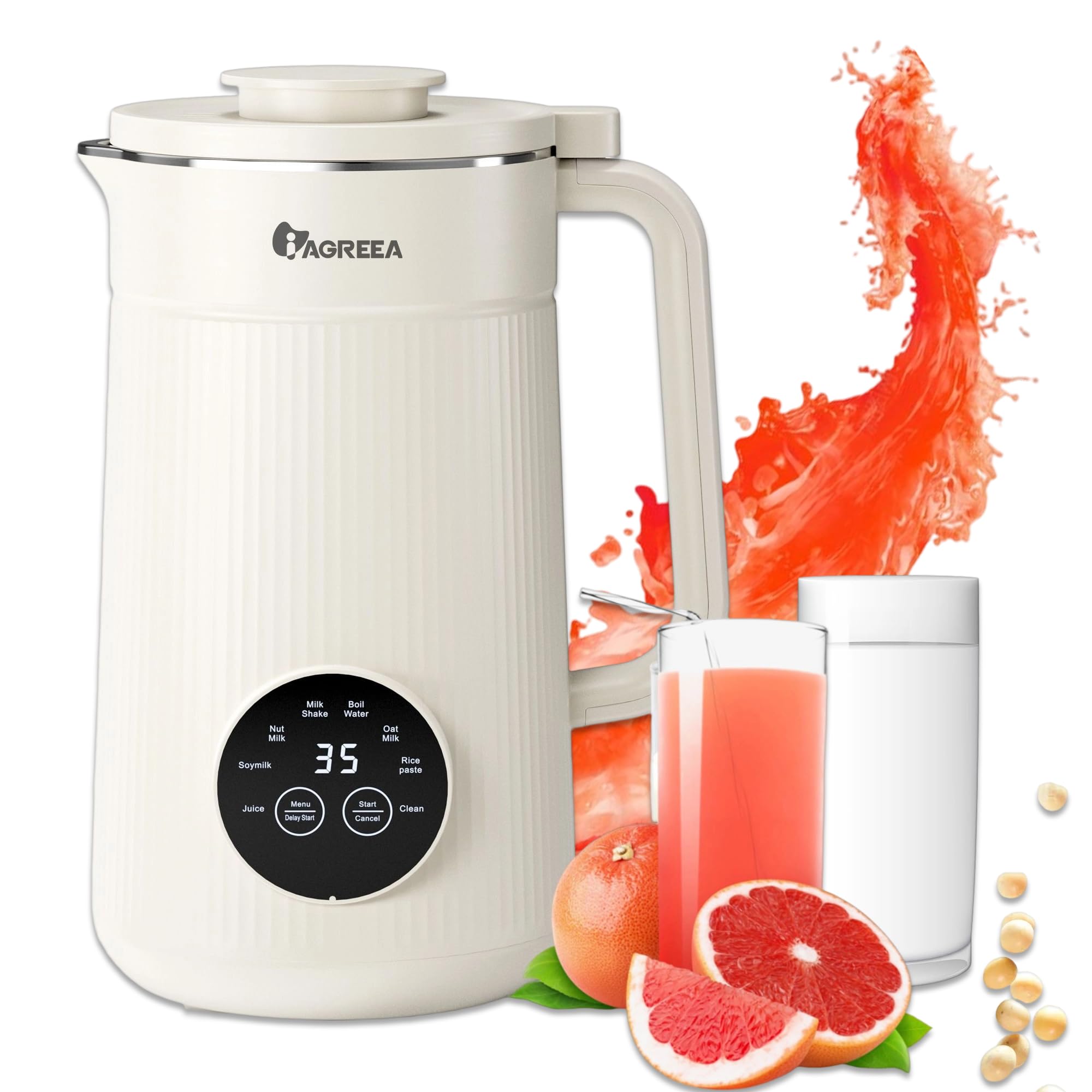
Half-gallon batches, eight presets, and a self-clean rinse
Thirty-five ounces per batch is the headline: this makes enough plant milk for a family without running the machine twice. The stainless steel jug has a nonstick interior so residue releases instead of baking on, and the 11-minute rinse cycle handles the worst of the cleanup if you add water right after pouring. Eight one-touch programs cover juice, soy milk, almond milk, milkshake, boiled water, oat milk, rice paste and self-clean.
Speed splits by ingredient. Oat milk comes together in about 2 minutes, almond milk in about 8, and a full half-gallon of strained oat milk takes roughly 10 minutes start to finish. A delay setting pushes the start up to 12 hours ahead, so milk is ready when you wake up. Some programs hold heat for 2 hours afterward, which suits anyone who wants a warm drink waiting rather than cold.
The blade geometry is the quiet hero — owners say the pulp it leaves is easy to strain, without the fine residue a high-powered countertop blender smears around the jug. A double-layered lid lets you open the small top cap to add sweetener or flavoring mid-batch, though that cap should stay shut during heated programs. A cleaning brush, measuring cup and scrub sponge come in the box.
Two honest notes. Juice is not this machine’s strength — carrots have come out untouched, so treat the juice preset as a bonus rather than a reason to buy. And overflow is real if you overfill: keep solids to around 60 g and you stay clear, which the recipe book spells out.
Why It Earns Its Place
- 35 oz batches suit a family without double runs
- Heats as well as blends — soy milk, rice paste and boiled water all covered
- Self-clean cycle plus a brush and sponge in the box
- Delay start up to 12 hours for morning-ready milk
Set Your Expectations Here
- The juice preset struggles with hard vegetables like carrots
- Overfilling causes overflow — stick near 60 g of solids
- Long-term durability is unproven on a newer model
Best match: a household that wants big batches of heated soy or oat milk on a modest budget.
Skip the juice dream: buy it for milk, water boiling and rice paste — not for pressing carrots.
5. Arcmira 6 in 1 Nut Milk Maker

A 1.3-pound counterweight for one or two people
At 1.3 pounds and 20 oz (600 ml) per batch, this is the machine for a small kitchen and a small appetite. It is the lightest unit on this list by a wide margin, and it skips the soaking step entirely. Six blades — two shaped as shark blades for nutrient extraction — plus a built-in quadrilateral stirring column keep ingredients colliding so the texture comes out smooth rather than chunky.
The temperature options are unusually specific for the size: room temperature for chilled almond milk, warm at 140 F for warm drinks, and hot at 212 F for soy and rice milk. Keep Warm runs up to 6 hours and Delay Start up to 18 hours, so you can set beans the night before. A 60-second self-clean rinse handles the bulk of the washing, and a nut milk bag, cleaning brush, measuring spoons and recipe come with it.
Where it shines is the everyday reality of a two-person household. One batch yields about 2 cups, which owners mention as roughly 3 lattes — enough for the morning without a half gallon going sour in the fridge. Speed is genuinely quick for hot soy milk at around 20 minutes.
The catch is capacity pressure. Fill it with too much bean and water on a hot setting and it can foam or boil over, and there is a record of one unit leaking at the lid handle until the seller replaced it. Keep batches modest and you avoid both. Some owners also hit a “green” note in unsoaked soy, which an overnight soak cures.
The learning curve: the instruction booklet is organized oddly and the menu button needs repeated presses to cycle settings — five minutes of practice solves it.
Filtration note: the included filter bag carries a plastic smell at first; a 1:3 vinegar soak overnight clears it, though the bag wears quickly.
Made for: one or two people who want fresh milk in minutes without giving up counter space.
Look elsewhere if: you need more than 20 oz at a time — this is not a family machine.
6. KIDISLE 8 in 1 Nut Milk Maker

Almond milk in eight minutes, tomato soup in the same jug
The stainless steel interior is the reason this one earns a slot beyond nut milk. It grinds soy, almond, oat and cashew milk, then pivots to fresh juice, rice paste and even boiled water. Owners push it further into tomato soup and papaya smoothies and come away impressed by how smooth the output is — one described the texture as industrial-quality for a countertop machine.
Almond milk takes roughly 8 minutes, and cleanup with the self-clean circulation runs around 15 minutes if you start it right after pouring. The exterior just needs a wipe; no disassembly. A measuring cup, cleaning brush, fine mesh strainer, nut milk bag, recipe book and warranty card all come with it, which is more in the box than most rivals at this level.
Cashew milk is the easy win here — creamy with minimal straining if you buy cheaper cashew pieces. Almond milk needs blanched nuts and a pass through the bag, and soy milk wants a cooking step. Owners also flag that most parts go in the dishwasher, which is rare in this category.
Two genuine trade-offs. It is loud — owners compare it to a stationary blender that does not move, but the volume is real, and there is a plastic smell during back-to-back batches. Durability is the bigger question, with failures reported around the 1.5-month mark on some units, so buy it understanding the risk and register the warranty.
Where It Delivers
- 32 oz stainless jug that handles milk, juice, rice paste and boiling
- Almond milk in about 8 minutes, smooth without grittiness
- Dishwasher-safe parts, plus a strainer and nut bag included
- Self-cleaning cycle keeps the interior tidy
Where It Asks For Patience
- Loud during grinding — not a quiet-morning machine
- A plastic smell shows up when you run batches back to back
- Under-blade cleaning is awkward; a brush is required
Worth it for: a kitchen that wants one machine doing milk, soup and smoothies rather than three appliances.
Think twice if: quiet operation tops your list, or you want a machine with a longer reliability record.
7. AlfaBot N2 Nut Milk Maker

Five cups a run, ten blades, and a 12-hour delay clock
Ten stainless steel blades and a 1000 ml / 35 oz jug are the core pitch, and that volume translates to about 5 cups per run — enough for a family breakfast without a second batch. The filter funnel and two filter bags strain the pulp so the milk pours clean. Five modes split the work: Nut, Beans, Yogurt, Juice and Grains.
Almond milk is the showcase. Half a cup of raw almonds, two dates, a pinch of salt and water to the max line produces a batch in about 15 minutes, with mostly quiet running except a brief blade burst. The base is hot when it finishes, so give it a few minutes to cool before straining. Cleanup is limited to the jug and lid, and the self-clean function plus delay setting make it practical for a working morning.
The yogurt mode is the sleeper feature. Customers note reliable soy yogurt from probiotics or a live culture, though other yogurt bases take some experimentation. The 12-hour delay lets you load it at night so a fresh batch is ready by breakfast — the kind of feature that turns a gadget into a habit.
Two honest flags. It is noisy, especially when grinding soy, and there is a burning plastic smell on some units that owners find off-putting. One unit also arrived with a US plug where an EU plug was expected. Capacity reads as mixed across the range of reports, with some batches coming in at 24 to 32 oz rather than the full 35 oz.
The value story: the base ingredients cost about the same as a carton, but owners say the flavor is dramatically fresher and free of gums and preservatives.
Longevity check: reviewers point out steady use over six months and even returns after two years to confirm it is still running.
Pick this when: you are feeding a family and want a fresh batch on a schedule.
The catch to accept: noise and the occasional plastic odor — ventilate the kitchen and you will be fine.
8. Tribest Soyabella SB-130

Heated soy milk in fifteen minutes, raw nut milk in thirty seconds
Two numbers define the Soyabella: 15 minutes for heated soy milk and 30 seconds for unheated raw plant milk. That raw speed is unique on this list — the MILL button runs short grinding cycles you repeat, so almond milk comes together in a handful of bursts. The MILK button handles the heated multi-step soy program. A 1.3-liter stainless carafe with screens and a BPA-free motorhead keeps your drink out of contact with plastic.
The helical, serrated blade does more than milk. It grinds coffee beans, flax seeds and spices to a smooth consistency, which is why owners call it the multi-use pick rather than a one-trick soy machine. There is no exposed heating coil, so the chamber wipes and rinses easily. Dedicated milk and rice paste screens, a grinding cup, measuring cup, cleaning pad and brush all come included.
Performance is what it is praised most for, and the long-run record backs that up — owners describe units still working years after purchase, including one that survived accidental water exposure. Built-in safety features guard against overflow, dry heating and overheating, and the machine stays quiet and free of plastic smell while running.
The honest trade-offs are real but manageable. Vibration can walk the machine across the counter, so place it securely. The MILK and MILL buttons are easy to confuse, and the manual’s almond instructions are inaccurate — follow the soy steps and adapt. Replacement screens come only from the manufacturer, and a few units have died young, so register the warranty the day it arrives.
Best for: a buyer who wants milk and a spice grinder in one stainless unit and does not mind a smaller batch of roughly half a gallon.
Cleaning trick: let the screen sit overnight before scrubbing — it softens the residue and saves your wrists.
Choose it for: the raw 30-second milk cycle and the bonus grinding function.
Hold off if: you want a pointer-style digital display and precise preset programs — this is buttons and patience.
9. Joyoung DJ12U-A903SG Soy Milk Maker

Throw in dry beans and walk away for thirty minutes
The pitch here is almost absurdly simple: raw beans, water, one button. No soaking, no rinsing, no watching. A 30-minute cycle yields a full batch of creamy soy milk, and the pulp comes out fine enough that you do not need to strain — a rare convenience in a 1.2-liter machine. Owners put total hands-on effort at around 3 minutes including cleanup.
The 304 food-grade stainless steel head and cup lining is a smooth design with no dirt traps, so cleaning is easier. The double-layered cup insulates and keeps grinding noise down. Intelligent temperature control simmers gently so the milk does not burn or stick to the bottom. Eight functions cover soy milk, rice paste, juice, porridge and more, all one-touch.
Quality is what buyers praise most, and the everyday reports are glowing — the milk foams nicely for coffee, handles frozen pre-soaked beans without complaint, and tastes close to the traditional stovetop method. Owners who mix yellow and black soybeans report especially good soy milk.
Durability is the honest caveat. There is a documented pattern of motors burning out under heavy use — one owner running it every other day lost the motor after about 18 months. It is also loud during grinding, compared to a high-powered blender with a bad bearing. Use it as intended, not as a daily workhorse, and it holds up well.
What Buyers Praise
- Dry beans go straight in — no soak, no rinse, no fuss
- Fine pulp means no straining bag required
- smooth 304 stainless lining wipes clean easily
- Insulated double-wall cup keeps things quiet and safe to touch
What To Watch
- Loud grinding, especially on the soy cycle
- Motor burnout reported under every-other-day use
- Occasional spill on the grains setting
Suits you if: convenience is king and you want soy milk from dry beans with almost no effort.
Not for you if: you plan to run it daily and need long-term motor durability.
10. MioMat 8in1 Plant Based Milk Maker

Insulated walls that keep the noise in and the outside cool
Double-layer insulated walls do two jobs here: quieter operation than a regular blender and a body that stays safe to touch while making hot soy milk or soup. The whole interior is food-grade 304 stainless steel. The chamber holds 1.3 liters, and the yield lands between 37 and 43 oz — five to six cups from half a cup of raw ingredients, with room to push denser if you want thicker milk.
Heating is ingredient-aware. Nuts and seeds get gentle heat to soften them for grinding while keeping nutrients intact; grains and legumes get cooked for easier digestion. Each milk type has its own program, and the efficient grinding system does the rest. A recipe book walks you through the first batches, and the 2-year warranty is standard rather than an upsell.
Owners single out how quiet it is — many compare it favorably to a high-powered blender — and are surprised by the smooth, creamy output. Soy milk foams beautifully for lattes, and coconut milk works well enough that owners use it in sweet potato soup. Most use it almost daily for milks, smoothies, soups and porridges.
The catch is minimum batch size. The included strainer also needs a few passes, so a nut milk bag helps. Let the motor cool fully between batches to avoid burnout.
Compact note: for a machine that makes this much milk, the footprint is modest at 7 x 9 x 12 inches — it fits a corner counter without hogging it.
Cleaning truth: the cleaning cycle is more of a rinse; rinse immediately, especially after soy, or the residue takes effort.
The right buyer: someone who makes milk in quantity and values a quiet, insulated machine with a real warranty.
The sticking point: if you live alone, that 1.3-liter minimum will feel wasteful.
11. ChefWave Milkmade Plant-Based Milk Maker

Six milks, two batch sizes, one glass pitcher to the fridge
The preset count is what sets the Milkmade apart: almond, soy, cashew, oat, macadamia and coconut, each available hot or cold. You choose 10 oz for a single drink or 20 oz for a couple of servings, which suits a coffee drinker who wants one fresh latte rather than a jug. A glass pitcher with a lid comes included, so the finished milk goes straight into the fridge without decanting.
The patented extraction technology pulverizes and filters without overnight soaking or a nut milk bag, and the delay start schedules a batch around your routine. Setup per batch is a few minutes, and the self-cleaning function is the single most appreciated feature — owners call it the main reason the machine stays in rotation rather than collecting dust on the counter.
Effectiveness is what it is praised most for, and the everyday reports match: owners run it two or three times a week and report reliability well past the one-year mark, with some past two years. The milk tastes nuttier and fresher than cartons, with no additives you did not add yourself. Extra glass pitchers can be ordered from the company for expanding your rotation.
The honest limits are size and support. Twenty ounces is the ceiling, so a family will run it repeatedly, and each batch takes around half an hour. The self-clean cycle does not fully reach the blade area, needing a manual scrub weekly. And replacement parts depend on the manufacturer, so a broken steam cap has meant a full-machine replacement rather than a cheap fix.
Cold-milk planning: the machine uses hot water, so chilled milk requires planning ahead rather than an instant pour.
Sediment reality: soy milk has sediment that needs a shake before drinking — fine for oatmeal, less ideal in coffee. Cashew milk pours creamier.
Best for: the single coffee drinker who wants one fresh 10 oz batch with minimal fuss and a pitcher ready to store.
Not the one if: you need bulk batches or want a machine with off-the-shelf replacement parts.
Know the Specs
Capacity in liters and ounces
Manufacturers quote chamber size, but the yield you actually pour is smaller — some of the volume stays behind as pulp. A 1.6-liter chamber can produce 1.25 to 1.5 qt after straining, and a 35 oz jug yields around 5 cups. Translate that into what your household drinks before it spoils, since homemade milk without preservatives has a short fridge life.
Soaking versus dry beans
Soaking beans overnight softens them and often reduces the beany edge in soy milk. Some machines skip it, taking dry beans straight into the chamber. Both work, but if you want the mildest flavor, presoaking plus a quick blanch is the habit owners settle into.
Pulp separation methods
A filter funnel or pulp-extraction design collects solids inside the chamber, so the milk comes out strained. A mesh screen or nut milk bag means you strain by hand afterward. The first is faster and cleaner; the second is simpler to build and often lighter on the wallet.
Stainless versus nonstick interiors
Stainless resists smells and stainsand wipes clean, but residue hardens if left. Nonstick interiors release pulp more easily but can wear over time. Either way, rinse the chamber immediately after pouring — that habit decides how much you enjoy the machine.
Heating and cook cycles
A heated cycle cooks the milk so it is safe to drink straight from the jug, and soybeans in particular need sustained heat to break down enzyme inhibitors. A 36-minute automatic cycle or a 30-minute soy program does this unattended. Raw cycles are faster but require you to cook the milk yourself afterward.
Self-clean, delay and keep-warm
A self-clean rinse cuts the worst of the scrubbing but rarely reaches the blade area fully, so a brush still matters. Delay start schedules a batch for the morning, and keep-warm holds it hot for a set window. Both are convenience features that make daily use realistic.
Common Questions
Do I really need to soak soybeans before making soy milk?
Can a soy milk maker also make almond, oat and cashew milk?
Why is my homemade soy milk gritty even after straining?
How long does fresh homemade plant milk last in the fridge?
Is a stainless steel chamber better than a nonstick one?
How loud is a soy milk maker during grinding?
Can I put the chamber parts in the dishwasher?
What batch size should I buy for one person?
Do these machines cook the soy milk or just blend it?
How do I stop plant milk from boiling over inside the machine?
The Bottom Line
For most people, the soy milk maker machine winner is the Nama M1 because it removes the step that stops most households from making plant milk at all — the straining. Dry pulp out, no bag to wring, 3-4 cups in about 2 minutes, and a 15-year warranty behind it. If you want dry beans straight from the jar and a stainless pot that grinds and heats in one 36-minute cycle, the SoyaJoy G5 is the pick. And for a light, thermos-sized stainless machine that pours 36 oz of soy milk in about 20 minutes, reach for the Soyapower G4. Whichever you choose, the machine you will actually keep using is the one whose cleanup you do not dread.
How we choose
We do not accept paid placement. Every pick is matched to a real buyer and a real use-case; we do not hands-on test units.
Sources
Specifications: manufacturer listings and product documentation. Review insights: verified customer reviews, as of July 2026. Pricing: not shown on this page (it changes often); check the current price via the retailer link.
As an Amazon Associate, Aappliancez earns from qualifying purchases. This does not affect which products we feature.