Disclosure: Some links in this post are affiliate links. As an Amazon Associate I earn from qualifying purchases, at no extra cost to you. Learn more
Specs are compiled from manufacturer listings and verified buyer reviews and can change over time — please confirm the key details on the product page before buying.
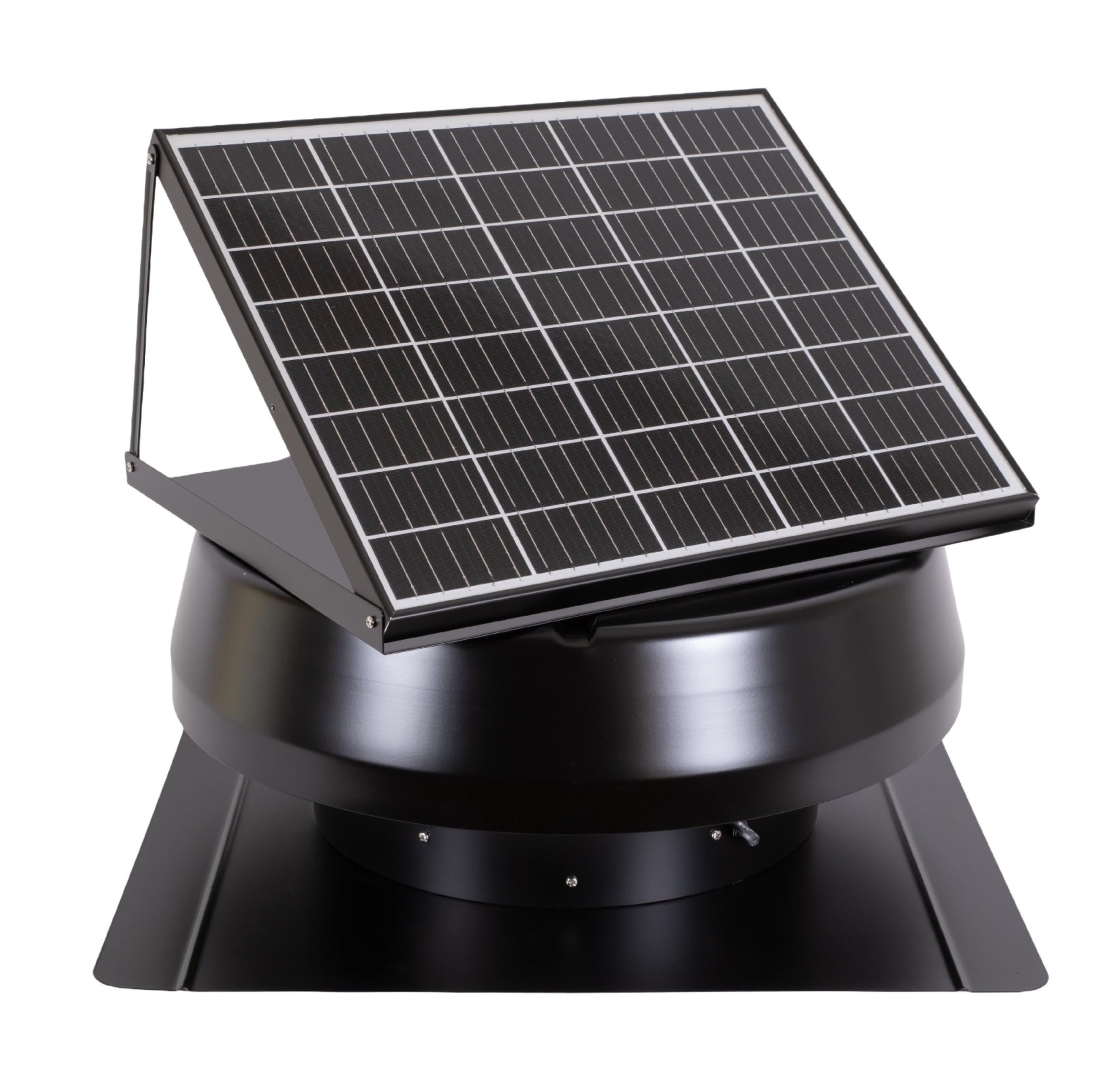
If your upstairs rooms turn into an oven every afternoon, the fix is not another window unit — it is getting the trapped heat out of the attic before it soaks through your ceiling. That is what a solar-powered roof vent does. It runs on daylight, turns itself on when the attic gets hot, and never touches your breaker box. The single most important number to check is airflow, measured in CFM (cubic feet per minute — how much air the fan pushes out every 60 seconds), because a rooftop vent that moves too little air for your attic size will spin all day and change nothing.
This guide is built by comparing the manufacturers’ published specifications and the patterns across verified customer reviews, so you get each pick’s real strengths and trade-offs instead of marketing spin.
Below you will find airflow, coverage and control differences broken down side by side, plus honest notes on what owners love and where these units fall short. This breakdown of the best solar powered roof vent options covers sizes from small sheds to full attics above 2,800 square feet.
Top Picks


How To Choose The Best Solar Powered Roof Vent
Buying a solar roof vent depends on three numbers that have to line up with your house: how much air the fan moves, how big your attic actually is, and how many hours of real sun that rooftop gets. Get those three right and the rest — remote controls, humidity triggers, warranties — is preference. Get them wrong and even a well-built fan underperforms.
Match CFM airflow to your attic size
CFM (cubic feet per minute) is the volume of air the fan pushes out in one minute. A vent rated for 2,900 square feet moves far more air than one built for a 1,400 square foot space. If your attic is large and you buy a small-capacity fan, hot air lingers at the rafters no matter how long it runs. Measure your attic footprint first, then pick a fan whose stated coverage meets or beats it.
Understand what solar wattage really buys you
The panel wattage tells you how much electricity the fan can harvest from daylight. A 32W panel and a 50W panel behave very differently on a cloudy afternoon — the higher-wattage panel keeps the motor spinning when the sky grays over. If your roof gets long shade periods, look for a hybrid model that also accepts an AC adapter so the fan keeps working after sundown.
Decide how you want the fan to switch on
Some fans simply run whenever the sun hits the panel. Others add a thermostat that starts the fan only above a temperature you set, plus humidity triggers for damp climates. A thermostat means the fan works on demand instead of only on brightness, which matters in regions where mornings are cool but afternoons are brutal. Remote control panels let you mount the brains inside the house instead of crawling into the attic.
Side-by-Side Comparison
| Model | Best For | Airflow (CFM) | Coverage Area | Mount / Control | Amazon |
|---|---|---|---|---|---|
| iLIVING HYBRID 14″ Solar Roof Attic Fan★ Best Overall | Whole-attic cooling with thermostat control | 1150 cfm | Up to 2900 sq. ft. | Roof mount / Smart thermostat | Amazon |
| Criditpid 16″ Gable Mount Vent Attic FanTop Performer | High-volume gable ventilation for sheds and garages | 2065 cfm | Up to 1850 sq. ft. | Gable / wall mount / Adjustable thermostat | Amazon |
| iLIVING 12″ Wall Mounted Shutter Exhaust FanBest Value | Garage and workshop ventilation on a budget | 960 cfm | Up to 1400 sq. ft. | Wall mount / Digital temp & humidity control | Amazon |
| InoKraft 12″ Shutter Exhaust Fan | Remote-controlled shop and attic exhaust | 1500 cfm | Up to 1400 sq. ft. | Wall mount / Wireless remote | Amazon |
| DC HOUSE 32W Solar Attic Fan | Wiring-free solar exhaust for sheds and sunrooms | 2500 cfm | Up to 3000 sq. ft. | Fixed roof mount / Solar control | Amazon |
| Moonshan Hybrid Solar Attic Fan 40W | Remote speed and timer control with AC backup | 880–1470 cfm | Not stated | Roof mount / Remote control | Amazon |
| OmniPV Smart Hybrid Solar Attic Exhaust Fan Pro | Large attics needing day-and-night airflow | 2850 cfm | Up to 4000 sq. ft. | Roof mount / Wall switch + 12V AC adapter | Amazon |
| Natural Light Solar Attic Fan 32W | Quiet, simple rooftop exhaust on doublewide homes | 1560 cfm | Not stated | Roof mount / Optional thermostat | Amazon |
| Natural Light Solar Attic Fan 48W | Big attics wanting a commercial-grade solar unit | 1881 cfm | Up to 2825 sq. ft. | Roof mount / Solar remote control | Amazon |
Detailed Reviews
1. iLIVING HYBRID Smart Thermostat Solar Roof Attic Exhaust Fan, 14″
Our pick — 4.0+★ from 1,500+ verified ratings; the strongest balance of quality and price.
The attic workhorse that quietly shaves degrees off the house without a single wire run.
The iLIVING HYBRID is the one most buyers end up with, and the numbers explain why. Its 14-inch blades push 1150 CFM (cubic feet per minute — the volume of air it moves every minute) and it covers up to 2,900 square feet of attic, which is the largest coverage area in this whole lineup. That reach comes from a 40W solar panel you can angle at 0°, 15°, 30°, or 45° to chase the sun across your roofline. The thermostat is where it earns its place, though: you set any temperature between 50°F and 122°F, and the fan only wakes up when your attic actually crosses that line — so it is not simply spinning from sunrise to sunset.
What buyers report again and again is real relief. As the review pages put it: “Kept house cooler: max temp dropped from 100°F to 88°F.” Install is described as straightforward even for a first-timer, with standard romex 12-2-2 wiring and a 3-prong male head; one owner simply detached the included housing and bolted the new motor onto a 15-year-old fan’s existing support poles. Blades sit on a nylon-fiber-aluminum hub, the motor carries an IP68 waterproof rating (sealed well enough to run through rain and humid attic air) and a 15-year warranty. For a 2,900-square-foot coverage rating at 1150 CFM, there is nothing here that moves more air for the size.
The catch is in the naming. “Hybrid” means it can run day and night — but the AC/DC adapter kit that lets it work after dark is sold separately, so the fan is solar-only until you add it. A few owners also hit a startup hiccup where the thermostat needed a reset (setting the temp to 95–100°F, powering down for a few hours, then reconnecting) before it cycled correctly. It is a quick fix, not a repair.
What Earns It First Place
- Biggest coverage in the lineup at up to 2,900 sq. ft. from 1150 CFM of airflow
- Adjustable solar panel you can angle at 0°, 15°, 30°, or 45° for better sun catch
- Settable thermostat span of 50°F to 122°F, so the fan runs on heat, not just daylight
- IP68 waterproof brushless motor backed by a 15-year warranty
The Honest Trade-Offs
- Night-time running needs the AC/DC adapter kit, which is not included
- You need basic electrical knowledge or a handyman for the hardwired install
- Newer buyers may need a thermostat reset to get it cycling properly
Reach for this if: you have a full-size attic above roughly 2,000 square feet and want the widest coverage with a thermostat that does the thinking for you.
Look elsewhere if: you need a fan that runs past sunset from the start — the AC adapter is a separate purchase.
2. Criditpid 16″ Gable Mount Vent Attic Fan
Raw airflow muscle for sheds and garages that runs on wall power, not sunlight.
Before we go further: the Criditpid is a gable-mount exhaust fan that runs on AC power — a 115V household supply — so it is not itself a solar roof vent. It belongs on this list because owners of solar setups frequently pair a powered gable fan with one for backup ventilation, and for that job it is the most powerful unit here. Its three large alloy blades move 2065 CFM at 1480 RPM, and that airflow is well clear of the iLIVING 12″ wall fan at 960 CFM — more than double the moving capacity from the same 16-inch frame class. The pure copper stator winding drives a fully enclosed motor with thermal protection.
Buyers praise the heft. The frame is all metal with a thick powder-coated finish and three heavy-gauge steel blades, and the bearings arrive permanently lubricated so there is no oiling to remember. As one satisfied owner put it: “Moves lots of air, quiet, ~60W confirmed by amp meter.” That ~60W draw is unusually low for 2065 CFM, so you can run it for hours without watching the meter. Install is described as bolt-and-go from the start, with a 72-inch extended power cord saving you from running new wiring to the gable opening. Coverage runs to 1,850 square feet, and there is a one-year warranty.
Here is the caveat worth knowing before you buy: the included thermostat has a mixed reputation. The unit itself holds up; it is the bundled thermostat that lets the package down.
Quiet crowd-pleaser: For a fan that moves 2065 CFM, owners consistently describe it as quiet — a rare pairing, and the reason it makes a strong backup companion to any solar roof vent.
The gable-mount catch: Because it mounts to a gable opening rather than the roof plane itself, you need an existing gable vent or the willingness to cut one — this is not a drop-in roof replacement.
Your pick if: you have a large shed, garage, or workshop and want maximum CFM per dollar with a motor built to run hot and humid without complaint.
Pair it with something else if: you need solar-only operation — this one wants a wall outlet.
3. iLIVING 12″ Wall Mounted Shutter Exhaust Fan
The garage defender — plug-and-play, smart-controlled, and built for years of daily duty.
If your problem is a stifling garage or workshop rather than a whole attic, the iLIVING 12″ wall fan is the smart buy here. It moves 960 CFM through 12-inch aluminum blades with a deep pitch angle, enough to exchange the air in spaces up to 1,400 square feet. Compare that to the Criditpid 16″ gable fan at 2065 CFM and it is clearly the smaller-airflow unit — but it runs on a standard plug with a 5.6 ft cord, so there is no electrician, no hardwiring and no ladder work beyond mounting the frame.
What clinches it is the digital controller. You get temperature and humidity triggers across a 50°F to 99°F range, up to 12 adjustable speeds, and a 24-hour timer. As one long-term user wrote: “Been on for several months almost straight, great value, keeps air in the garage flowing, max volume is still very quiet.” That sentiment — months of near-continuous running with no trouble — is the kind of durability that stops you thinking about the fan at all. The EC motor carries ETL certification, and the galvanized steel frame with aluminum shutters shrugs off damp conditions. The controller can even be extended into the house with a USB Type A cable, though that cable is not included.
The trade-off most buyers discover is power interruptions. After an outage, the fan reverts to its default state and drops out of your setpoints, so if you keep it running around the clock unattended, it is best paired with a battery backup — as one owner put it, once plugged into a computer backup system there are no more issues. Also budget for a custom frame if your existing vent is rectangular; the square fan does not drop into every opening.
Smart Control You Actually Use
- Temperature and humidity triggers across a 50°F to 99°F range
- Up to 12 adjustable speeds plus a 24-hour timer
- 960 CFM covers spaces up to 1,400 sq. ft.
- Runs for months nearly continuously with minimal wear
- Plug-and-play with a 5.6 ft cord — no electrician needed
Where It Needs a Hand
- Loses its setpoints after a power interruption unless it is on a backup
- The square frame may need a custom surround for rectangular vents
- USB control-extension cable is not in the box
Best for: garages, workshops and grow spaces where you want hands-off temperature and humidity control with zero wiring.
Skip if: you need a whole-attic solution — 960 CFM is tuned for a single enclosed room.
4. InoKraft 12 in Shutter Exhaust Fan
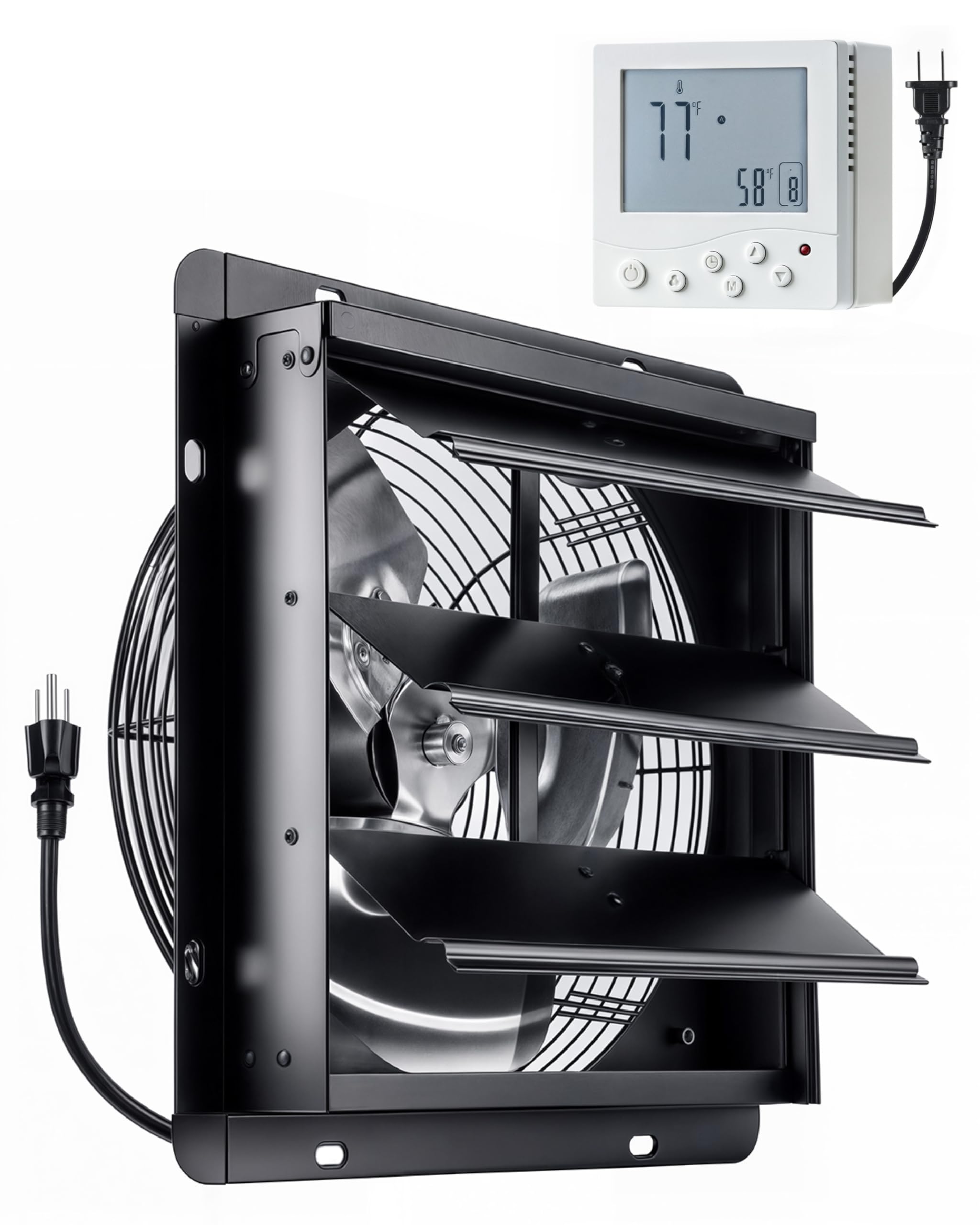
Remote control and serious airflow make this the workshop tinkerer’s pick.
The InoKraft packs 1500 CFM into a 12-inch frame — so it moves noticeably more air than the similarly sized iLIVING 12″ at 960 CFM, while covering the same 1,400 square foot footprint. It runs on a 120V ETL-certified EC motor and holds a 65 dB top-end noise level (65 decibels — roughly the volume of a normal conversation), which is quiet enough to keep working beside it. what separates it is the wireless remote control panel: you can mount it up to 33 feet away, on a bench or hallway wall, and dial in airflow, speed and temperature without walking to the fan. Engineering-wise, the whole package is designed for DIYers, with a wall-cutting template and a video guide included, so there’s no guess-the-measurement anxiety.
The remote is a genuine convenience most owners lean on. The shutter seals tight when the fan is off, so bugs and drafts stay out on cooler days, and the thermostat ramps fan speed up smoothly as the temperature crosses your set level rather than slamming on full blast. It is built for hot, humid, dusty spaces, with heavy-duty steel frames and coated aluminum shutters plus weather-sealed strips. Whether you are clearing welding fumes from a 500-square-foot garage or pulling heat from an attic, the airflow is up to the job.
There is one honest limitation that catches remote-mounters: the temperature sensor lives inside the control panel, so if you mount the panel in a hallway away from the fan, the thermostat is reading the wrong room. As one careful owner noted, “It’s good, but could use remote temp sensor” — you may simply have to run it in manual mode. Also note the auto-restart behavior after a power cut: the fan jumps to High Speed and stays there until you manually reset its mode.
Where it leads: 1500 CFM from a compact 12-inch wall unit is head-and-shoulders above what most 12-inch fans in this class deliver — good news if you want real exhaust without a big cutout.
Pick this if: you want maximum airflow for a workshop or enclosed space and value being able to adjust it from across the room.
Think twice if: you plan to mount the control panel far from the fan and rely on its thermostat — the sensor reads wherever the panel sits.
5. DC HOUSE 32 Watt Solar Attic Fan

A true solar roof vent — zero wiring, big airflow, real compromises.
This is the most affordable way to get a genuinely self-powered roof vent. It runs entirely on its own solar panel — no outlet, no wiring, no electrician — and it pushes 2500 CFM across up to 3,000 square feet of attic, which beats the iLIVING HYBRID’s 1,150 CFM airflow and its 2,900 sq. ft. coverage on both fronts. The 9-inch aluminum blades turn inside a high-strength metal shell rated to resist hail and weather, and the housing is built to handle rough climates. That combination of capacity and no-wiring install is why it earns its spot.
What wins owners over is simplicity. Ten-minute installs are common — one reviewer noted it pulled hot attic air immediately and cut indoor temps by about 5°F, and another refused to let theirs go during a shingle replacement because it had survived hail without a mark. Cloudy days still produce some airflow, and the unit shuts off on its own at night. For a workshop, sunroom or farm shed where you want ventilation without touching a breaker panel, the plug-and-forget appeal is real.
The honest catch is durability consistency. A portion of owners mention the motor making noise or seizing after a year or two, and there is a mismatch worth flagging: the listing describes the motor as brushless, while some users found it was actually a brush-type motor that wears out faster. Shade is also a practical limit — even a hand passing over the panel sharply drops fan speed, so this needs a genuinely unshaded roof position. Treat it as a value pick for a secondary building, not a forever unit.
Why It Wins the Budget Crown
- 2500 CFM and up to 3,000 sq. ft. coverage — the highest capacity of any solar-only fan here
- Completely solar-powered with no wiring or outlet required
- Hail- and weather-resistant metal housing for harsh climates
- Fast, tool-light install — some customers note around ten minutes
What to Watch
- Motor durability is inconsistent — some units slow or fail after a year or two
- Some reviewers point out the delivered motor was brush-type rather than brushless
- Performance falls off sharply in any panel shade
Best for: sheds, workshops and secondary buildings where you want big solar airflow without spending premium money or running power.
Not for you if: you need a set-and-seal heat-control system for a main living attic — the temperature control here is basic.
6. Moonshan Hybrid Solar Attic Fan, 40 Watt

A hybrid solar fan with a genuinely useful remote and a 3mm tempered glass panel.
Moonshan’s hybrid runs on solar during the day and accepts a plug-in supplement when the sun fades, so it can keep moving air on gray afternoons and at night. It delivers 880–1470 CFM through 11.8-inch aluminum alloy blades — that top figure is close to the DC HOUSE’s 2500 CFM? No; it sits well below that at just over half the peak airflow, which is fair for its 40W panel class. The standout component is the panel itself: a 3mm-high-efficiency monocrystalline silicon sheet behind transparent tempered glass, which the maker says holds a more uniform light density than polycrystalline panels. A lightning-protection and rain-resistant steel-and-aluminum body with UV-resistant epoxy coating rounds it out.
The remote is what separates it from the crowd. You get on/off at any temperature regardless of the default setting, four speed levels and four timing settings, plus an 18ft auxiliary power cord so you never have to climb back into the attic to plug or unplug. Owners running it day and night report measurable relief, with one noting the hybrid setup lowered indoor temperatures. Customer service is a repeated bright spot — most buyers describe responsive help and fast replacement parts when something does come up.
The one thing to plan for is the mounting. The remote also has its quirks, with no on/off indicator light to confirm state at a glance. It is a well-built fan that rewards a patient, careful installation.
Control you can reach: The 18ft auxiliary adapter and 4-speed, 4-timer remote turn this into the most adjustable hybrid here — you set schedules from the ground, not the rafters.
Install patience required: Sealing the flashing properly is the make-or-break step, and it is the most common frustration owners mention with this model.
Reach for this if: you want remote speed and timing control plus night-time AC backup on a hybrid solar fan.
skip it if: you’re not comfortable sealing roof flashing — a leak under the dome is a real risk if installation is rushed.
7. OmniPV Smart Hybrid Solar Attic Exhaust Fan Pro

The heavy hitter for vast attics — 2850 CFM, 4000 square feet, runs around the clock.
If you are cooling a genuinely large space and want the most airflow a solar roof vent can deliver, the OmniPV Pro tops the list at 2850 CFM and 4,000 square feet of coverage. That coverage is well beyond the iLIVING HYBRID’s 2,900 sq. ft. and the Criditpid’s 1,850 sq. ft., and it is exactly what you want over a big attic, barn, or warehouse. The engine behind it is a rare earth permanent magnet brushless DC motor that, per the maker, can run on as little as 1W of solar power — meaning it keeps turning even on partially cloudy days. A 50W panel drives the 20.6″D x 22″W x 8.1″H frame, and the panel adjusts from -45° to +45° horizontally and 0° to 60° vertically to chase peak sun wherever it sits.
Then there is the “Pro” part: a 12V 2A AC adapter is included, so this unit genuinely runs day and night without an extra purchase — a step up from hybrids that make you buy the adapter separately. The 50–104°F thermostat lets you set when it kicks in or run it continuously, and the rust-proof aluminum alloy housing is rated for 10+ years of rooftop exposure. Owners describe the build as durable and premium, and the support team as responsive. For the biggest job, the biggest airflow is the right starting point.
Weigh the trade-offs honestly, though. A 1mm aluminum mounting plate needs to be bent to fit wavy or square metal roofing, and one buyer found the screw-hole access fiddly enough to remove rivets and lift the top before mounting. There are also reports of an occasional unit failing under load, with a blade cracking and taking the assembly with it — rare, but worth knowing before you commit to the higher price. This is a fan that deserves a careful, patient install.
Big Job, Big Airflow
- 2850 CFM and up to 4,000 sq. ft. — the highest capacity here
- 12V 2A AC adapter included for true 24/7 day-and-night operation
- Adjustable panel from -45° to +45° horizontal and 0° to 60° vertical
- Rust-proof aluminum alloy body built for 10+ years on a roof
What to Keep in Mind
- 1mm mounting plate needs bending to fit wavy or square roof profiles
- Occasional unit failures are reported under load
- Premium build calls for a careful, unhurried install
Choose it when: your attic is oversized and nothing smaller will circulate enough air, and you want day-and-night running without buying a separate adapter.
Consider another option if: you have a straightforward small attic — this fan is overkill for the job.
8. Natural Light Solar Attic Fan 32-Watt

An American-made rooftop vent that earned its reputation on silence and simplicity.
Natural Light has been making this fan long enough that owners often buy it twice — and the design philosophy is deliberately stripped down. It moves 1560 CFM, it runs on solar with no wiring, and it carries an industry-leading lifetime limited warranty on the whole unit. It is made in the USA with heavy-gauge materials, and a roofer can install it in about an hour. There is no bloat here: no app, no fancy controller unless you add the optional thermostat.
Silence is the headline. Owners who run this describe it as essentially inaudible — one couldn’t tell whether it was running at all — and it survived 3/4-inch hail and 50mph winds without damage. In real heat, it works: shoppers say cooler attics and faster evening cooldown once trapped heat is exhausted, with several noting years of rust-free service. The straightforward no-wiring install is a genuine plus for a homeowner who does not want to think about electrical work.
The honest limitation is sunlight dependence. Because it runs purely on the panel, airflow drops the instant a cloud passes and stops entirely in full shade, so performance swings with the weather. Confirmed reviews of that behavior show owners often keep a backup electric fan with a thermostat for cloudy stretches. The larger versions in this family are also louder than the older small ones, and the panel is fixed rather than adjustable, so you cannot tilt it to chase low-angle sun.
Built to disappear: For a rooftop fan, being inaudible and maintenance-free for years is the whole point — this one nails that brief and backs it with a lifetime limited warranty.
The cloud catch: With no AC backup, this fan’s output tracks the sky second by second. If your roof gets long shade windows, plan for that.
For the set-and-forget buyer: someone with good sun who wants a proven, whisper-quiet American roof vent and never wants to touch a control panel.
Look elsewhere if: your roof spends much of the day shaded and you need steady airflow regardless of conditions.
9. Natural Light Solar Attic Fan – 48 Watts

The big-panel Natural Light built for enormous attics and no-nonsense durability.
This is the largest and most powerful of the Natural Light solar fans, pairing a 48W panel with 1881 CFM of airflow and coverage up to 2825 square feet. If your attic footprint is dominant and you already know the smaller 32W version leaves you wanting, this step up delivers meaningfully more capacity. It is powder-coated heavy-gauge aluminum throughout — commercial-grade build quality — and carries a lifetime manufacturer’s warranty on the solar panel, fan motor and housing. There is no wiring to run, and it qualifies for federal solar tax credits.
Like its smaller sibling, this one is built for a roofer to install in about an hour using the included mounting hardware, and it is made in the USA. The panel, motor and housing are all covered for life, which is an unusually strong commitment for a rooftop unit exposed to weather year-round. For a large home where heat build-up in the attic is persistent and the last thing you want is to replace the fan in five years, that coverage is the real value proposition.
The trade-off is straightforward: this is the top of the size range, so it is the biggest physical unit here and not the right match for a smaller attic looking for a compact vent. It is also solar-dependent in the same way as its sibling, so on heavily shaded or cloud-heavy roofs it will not perform to its capacity without added management. For the big, sunny attic, though, it is a serious, permanent solution.
Coverage that lasts: A 48W panel driving 1881 CFM with a lifetime warranty on the panel, motor and housing — this is the long-haul pick for a large attic.
The right call for: a large, sunny roof where you want maximum capacity backed by a lifetime warranty and zero wiring.
Not the fit for: a small attic or a roof that spends its days in deep shade, where you will not realize its full airflow.
Know the Specs
CFM airflow and what it moves
CFM stands for cubic feet per minute — the volume of air the fan pushes out in one minute. A fan rated at 960 CFM moves roughly a room’s worth of air every minute in a small garage, while a 2850 CFM unit clears a large attic far faster. Match CFM to your space: an oversized fan for a tiny shed wastes capacity, and an undersized fan for a big attic spins all day without clearing heat.
Solar wattage and cloudy-day behavior
The panel wattage is how much power the fan can harvest from sunlight. A 32W panel and a 50W panel both run in full sun, but the higher wattage keeps the motor spinning longer as clouds roll in. If your roof is shaded part of the day, a hybrid model with an AC adapter — or the OmniPV Pro that runs on as little as 1W — keeps air moving when a solar-only fan would stall.
Common Questions
How do I know what size solar roof vent my attic needs?
Do solar attic fans run at night or in cloudy weather?
Can I install a solar roof vent myself or do I need a roofer?
What is the difference between a solar attic fan and a gable mount fan?
Do these solar fans need a thermostat to work well?
How much airflow do I need to cool an attic in a hot climate?
Will a solar attic fan reduce my air conditioning use?
How long should a solar roof vent last?
Will shade from trees affect my solar roof vent’s performance?
Is a hybrid solar fan better than a plain solar roof vent?
The Bottom Line
The best solar powered roof vent winner is the iLIVING HYBRID 14″ Solar Roof Attic Fan, because it pairs the largest coverage area in this lineup — up to 2,900 square feet — with 1150 CFM of airflow and a thermostat you can set from 50°F to 122°F. Owners mention attic temps falling from 100°F to the high 80s, and the brushless motor carries a 15-year warranty. If raw airflow for a shed or workshop is your priority, the Criditpid 16″ Gable Mount Fan moves 2065 CFM on a wall outlet. And for a genuinely oversized attic that needs day-and-night circulation, the OmniPV Pro delivers 2850 CFM across up to 4,000 square feet with an included AC adapter. Match the CFM to your attic size, confirm your sun exposure, and the right one for your roof becomes obvious.
How we choose
We do not accept paid placement. Every pick is matched to a real buyer and a real use-case; we do not hands-on test units.
Sources
Specifications: manufacturer listings and product documentation. Review insights: verified customer reviews, as of October 2026. Pricing: not shown on this page (it changes often); check the current price via the retailer link.
As an Amazon Associate, Aappliancez earns from qualifying purchases. This does not affect which products we feature.