Disclosure: Some links in this post are affiliate links. As an Amazon Associate I earn from qualifying purchases, at no extra cost to you. Learn more
Specs are compiled from manufacturer listings and verified buyer reviews and can change over time — please confirm the key details on the product page before buying.
You want a light that clicks on the moment something moves across your driveway — and you want it to run itself without an electrician, a wire run, or a single kilowatt on your bill. The hard part is that solar motion lights look near-identical in photos. The real differences hide in three places: how many lumens actually hit the ground, how wide and how far the motion sensor reaches, and whether the panel survives a second winter. This guide sorts those three things out for you, picks by pick.
This guide is built by comparing the manufacturers’ published specifications and the patterns across verified customer reviews, so you get each pick’s real strengths and trade-offs instead of marketing spin.
Brightness is only half the story here — a light that fires wide but dim, or bright but narrow, will still leave your porch dark. Below you’ll find the models that balance raw lumen output against sensor range and honest weatherproofing, so you can pick the right solar motion lights for your yard, gate, or garage on the first try.
Top Picks

How To Choose The Best Solar Motion Lights
Most buyers assume a bigger lumen number means a better security light. It doesn’t. A 6000-lumen fixture with a weak panel will burn through its stored charge in a few hours and sit dark by midnight. What you actually want is a balanced light: enough lumens to see a face or a licence plate, a sensor that reaches the edge of your driveway, and a panel big enough to refill the battery before the next night.
Match the sensor to the distance you need covered
A PIR motion sensor (a passive infrared eye that reacts to body heat moving across its view) is what triggers the light. The two specs that matter are its detection angle and its range. A wide angle like 180° catches movement across a broad sweep — handy on a corner or gate. A narrower 120° angle concentrates the trigger on a path. Range is the distance it senses at: models here run from 16 feet up to 32 feet, so measure the gap from your mounting spot to the point where you want the light to fire.
Check where the solar panel can actually sit
A solar panel in shade charges slowly or not at all. If you’re mounting under a porch roof or an eave, look for a light with a detached panel and a cable so the panel can sit in direct sun while the lamp stays where you need it. If the panel is built into the top of the lamp head, that spot needs direct sunlight for most of the day. Panel type matters too — monocrystalline and single-crystal panels are noted in the specs here as working on cloudy days, while a polycrystalline panel is described as durable and corrosion-resistant.
Read the runtime claims with the modes in mind
Most of these lights offer several modes: motion-only, a dim glow that jumps to full brightness on movement, or a constant dim all night. Runtime figures usually refer to the dim setting. A light that stays on motion-only overnight sips far less power than one holding a constant glow. Decide which behaviour you want before you compare hours.
Side-by-Side Comparison
| Model | Best For | Brightness | Detection Range | Weather Rating | Amazon |
|---|---|---|---|---|---|
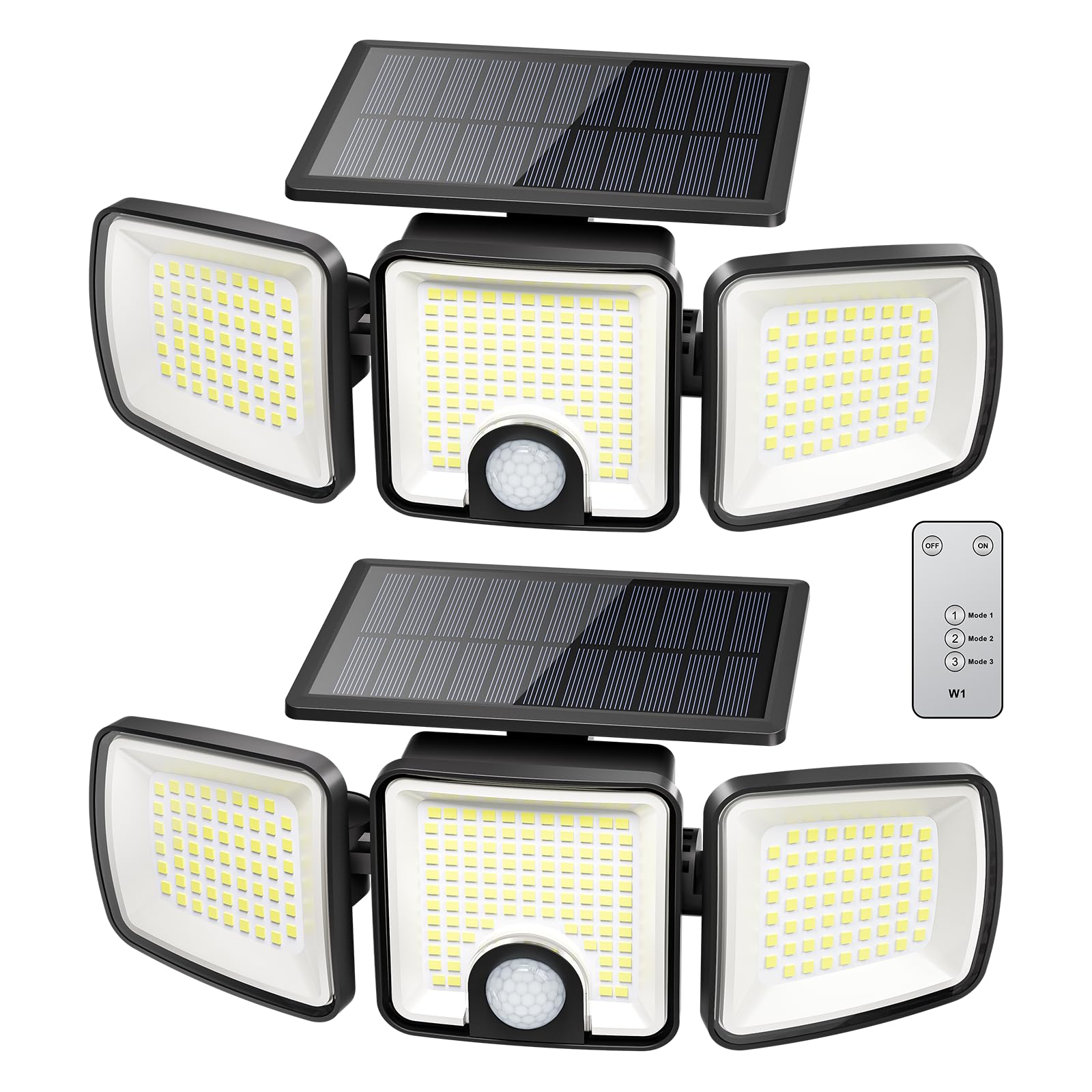
| Brightever 388-LED 2-Pack★ Best Overall | Wide yard coverage | 4000 lm | 16 ft / 120° | IP65 | Amazon |
| Brightown 2-Pack FloodBest Sensor Reach | Remote-controlled brightness | 2500 lm | 26 ft / 180° | IP65 | Amazon |
| MDCMDCM 3-Head Security | Widest detection sweep | 3000 lm | 32 ft / 180° | IP65 | Amazon |
| AURAXY Wall Light | Tight spots and porches | 260 lm | 120° | — | Amazon |
| Philips Solar Security Light | Under-deck and shaded installs | 800 lm | 26.25 ft / 120° | IP65 | Amazon |
| ropelux Dual-Panel Flood | Maximum raw brightness | 6000 lm | 26 ft / 120° | IP65 | Amazon |
| WaitScher Camera-Style 2-Pack | Deterrent look plus light | 1800 lm | 26 ft | IP67 | Amazon |
Detailed Reviews
1. Brightever Solar Outdoor Lights 2-Pack
Our pick — 4.5+★ from 950+ verified ratings; the strongest balance of quality and price.
The brightest LED count in this lineup, wrapped in a two-pack that lights a whole yard.
Start with the number that decides most of it: 4000 lumens. That’s the highest output here apart from the ropelux flood, and it comes from 388 LED beads spread across a 270° wide-angle head. What that means for you is coverage — the light fans out around the fixture instead of throwing one hotspot, so a fence line or a garage side gets lit edge to edge rather than in a single bright circle.
The head-to-head that surprises people: this Brightever carries 388 LEDs against the Brightown flood’s 223, and it pushes 4000 lumens against that model’s 2500. The trade flips on sensing — Brightown reaches 26 feet where this one reaches 16 feet at 120°. So the Brightever throws more light once triggered, but you need to mount it closer to the path you’re watching. For a wall over a driveway you cross within a few steps, that’s an easy call.
Where owners land is brightness and lighting quality, both the things the review pages dwell on most. The reliability story is the real headline: buyers report, “We’ve had these for three years and they’re still working great.” Three lighting modes cover the bases — a stay-on night setting, a dim glow that jumps to full brightness for 15 seconds on motion, and a motion-only mode that stays dark until something moves. Monocrystalline cells rated at up to 20.5% conversion give up to 8-10 hours of night light after a decent charge, provided the panel sees direct sun. The honest catch sits in the waterproofing — the spec sheet lists IP65, and the recurring gripe is that condensation, not leaks, is what eventually retires a unit. Mount it where water drains off rather than pools, and you’ll get the long service most buyers describe.
What earns the top spot
- 4000 lumens from 388 LEDs — the widest, brightest spread in this lineup
- Three modes including a dim-then-full motion setting
- Up to 8-10 hours of night run time from monocrystalline cells
- Mounts on wood or chain-link with the included hardware or zip ties
Where it asks more of you
- 16-foot motion range at 120° is tighter than the Brightown and MDCMDCM sensors
- IP65 sealing is the weak point long-term — internal condensation retires some units
- No remote, so mode changes mean reaching the button
Reach for this if: you have a wall or fence you can mount within 16 feet of the traffic you want lit, and you want maximum spread for the money.
Look elsewhere if: your driveway approach is longer than that 16-foot reach — the Brightown or MDCMDCM sensor covers more ground.
2. Brightown Solar Flood Outdoor Lights 2 Pack
A remote in your hand and a sensor that sees 26 feet out — convenience over raw lumens.
If setting modes means climbing a ladder in the dark, you’ll stop changing modes. That’s the case for this Brightown two-pack: a wireless remote lets you pick your mode from the ground. It carries three — a motion-only setting, a dim glow that jumps to full brightness on movement, and a constant dim all night — so you can shift from security-watch to ambient-glow without touching the fixture.
The numbers: 223 LEDs, 2500 lumens, 6500K. That’s a cooler, whiter light than the Brightever’s 6000K, and it’s a step down in raw output — 2500 against 4000. Where it claws that back is sensing. The 180° sensor reaches 26 feet, against the Brightever’s 16 feet at 120°, so it catches you earlier as you walk up. Three adjustable heads let you aim coverage at a porch corner, a back door, and a walkway from one mount. It’s built for a 6.5–8 ft install height, above head level but below the panel’s sun line.
What buyers talk about most is build quality first, brightness second, and the install being painless — the two-pack mounting with the included screws and no wiring. Battery life earns consistent praise, with owners noting it holds a charge well and runs long after dark. The honest part is reliability: a share of units arrive weak, and one detailed review called out several lights failing from the start after long sun exposure, with flickering and unreliable motion pickup. Treat that as the fit note — this is a light where checking each unit works before you mount it up high saves you a second trip. The remote is genuinely useful day to day, but several owners mention they lost it and found the light still worked fine without it.
The sensor case: 180° at 26 feet is the widest-reach combo in this lineup outside the MDCMDCM, and for a walkway approach it’s the difference between the light meeting you and the light greeting your shadow.
Test-before-mount caveat: reliability is the uneven edge here — power each unit on the ground, confirm it triggers and holds a charge, then mount.
Best for: anyone who wants to change brightness from the porch without a ladder, and who has a 26-foot approach to cover.
Skip the remote if: you’d rather set it once — the fixture itself still runs off its own button.
3. MDCMDCM Solar Motion Sensor Outdoor Lights, 3000LM 3 Modes
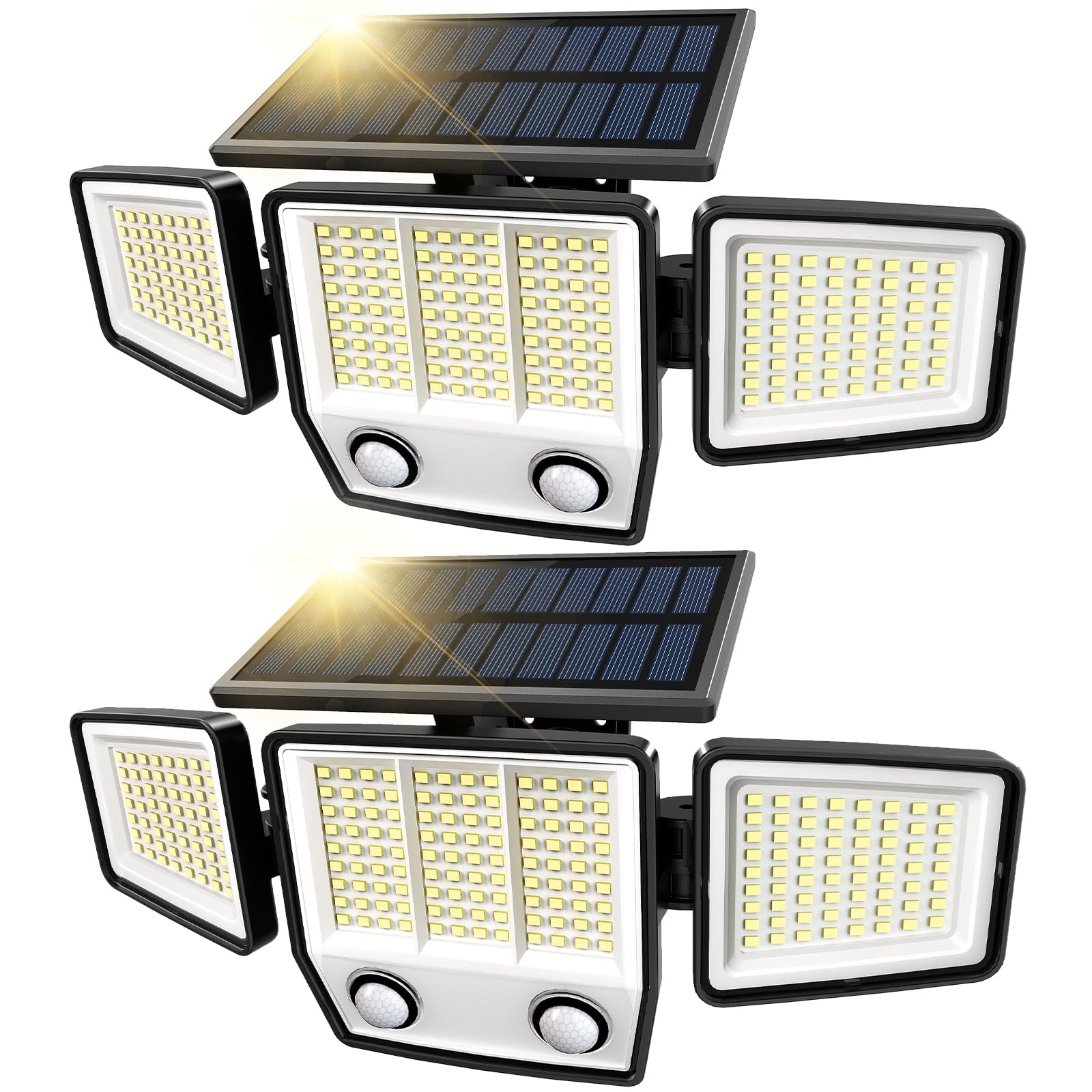
Two sensors instead of one, so the light catches you coming and going.
The spec that does the work here: a dual PIR setup rated for 180° detection out to 32 feet — the longest reach in this lineup. Two sensors scan across the front of the fixture instead of one, which is why it covers more ground and leaves tighter blind spots. For a corner mount or a gate where people approach from either side, that’s a real advantage over a single-sensor light.
Output is 3000 lumens from 236 LEDs spread across three adjustable heads, at a 7000K cool white — the coolest tint here, and the company rates it as covering up to 1600 square feet. Set against the Brightever, its detection angle is the standout: 180° against 120°, a much wider sweep. The Brightever still wins on raw LED count at 388 versus 236. So this is the pick when catching movement matters more than flooding the yard in light.
The three modes give you flexibility: motion-only at full brightness, a constant 30% glow all night, or a 10% baseline that jumps to 100% on motion. Buyers consistently point to brightness and build quality as the reasons they’re happy, with the light reliably covering most of a yard and holding power longer than other units they’ve owned. The catch appears in the adjustability — the heads and the solar panel turn, but a few buyers found them stiffer to angle than rival models, and one found the panel less adjustable than hoped. If you need a precise aim, set it before you commit; if a broad sweep works, you’re set. A single unit occasionally fires with nothing moving, and that’s the trade of a sensitive dual sensor.
Detection-first design: 180° dual sensors at 32 feet beat the Brightever’s 120° at 16 feet outright, and the 236 LEDs throw a clean 3000-lumen wash across three aimable heads.
Set the aim before mounting: heads and panel adjust but run stiff, so get your angles right on the ground.
Pick this if: you’re lighting a corner, gate, or wide approach where people arrive from more than one direction.
Know before you buy: it runs on its own button and touch control — there’s no remote in the box.
4. AURAXY Solar Motion Sensor Security Lights

A soft, low-glare pool of light for a doorway — not a floodlight, and honest about it.
Here’s the number that sets expectations: 260 lumens. That’s a fraction of the floods in this lineup, and it’s the whole point. This AURAXY is a wall light meant to wash a doorway, a stair, or a walkway in gentle light rather than blast a yard. The defining touch is the optical lens across the front, which spreads the beam evenly instead of throwing a harsh hotspot — so you get a soft, downward glow you can walk through without being blinded.
The reason it suits porches and overhangs: the solar panel sits angled on the fixture, which is what makes it work where a top-facing panel would sit in shade. It carries a 120° PIR sensor on a 4000K warm-ish tint — noticeably warmer than the 6500K cool whites elsewhere here. Three modes cover motion-only, a dim glow that brightens for about 20 seconds on movement, and a backlight that stays on from dusk to dawn. It’s light too, listed at 6.56 ounces, so mounting on a fence post or a porch wall is a quick job with the included kit.
Durability is what owners come back to rave about — units still working perfectly several years out, holding up through snowy winters and desert heat. The light reads as calm rather than glaring, and it fades on gracefully instead of snapping bright. Two honest notes: the included double-sided tape gave out in high heat for at least one buyer, who switched to a stronger tape, and the small three-position switch sits under a rubber cover that’s fiddly to set. Some buyers also found the motion pickup occasionally misses — a trade of the softer, lower-power design. Power each unit on and set the switch before it goes up.
Why it earns a place
- Optical lens spreads light evenly with no harsh glare
- Angled panel works on shaded overhangs and under eaves
- Three modes including dusk-to-dawn backlight
- 6.56 ounces — simple to mount on posts and walls
The trade-offs to weigh
- 260 lumens is a doorway glow, not yard coverage
- Included tape can fail in high heat — plan a screw or heavier-tape mount
- The mode switch under its rubber cover is fiddly to set
Right for: shaded porches, stairs, side doors, and walkway points where you want soft light, not a flood.
Not for: a large yard or a driveway you need to light from 30 feet — the low lumen count won’t reach.
5. Philips Solar Security Light Outdoor LED
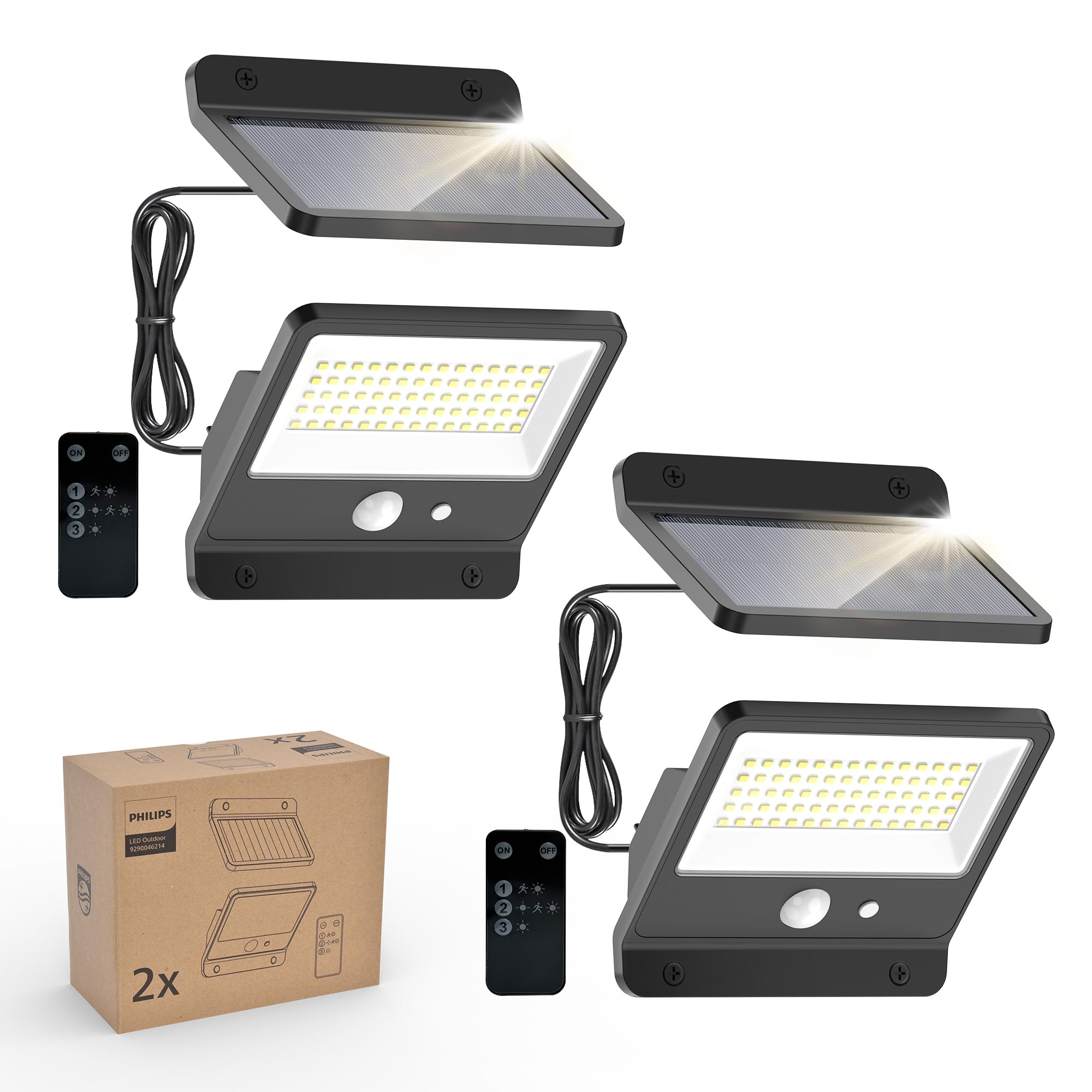
The separate panel and its 16-foot cable solve the one problem that kills most solar lights: shade.
If your mounting spot never sees the sun, this is the pick built for you. The Philips runs its solar panel on a 16-foot cable, so the panel can sit out in the open while the lamp stays under a deck, an eave, or a dark overhang. That single design choice is why owners use it for under-deck lighting and shaded porch corners where a top-mounted panel would starve.
The light itself is 800 lumens at 6500K, with a 2000 mAh battery, a PIR sensor rated 26.25 feet at 120°, and a remote so you never climb to switch modes. That’s bright enough to light a stairwell or a deck underside clearly, but well below the 2500–6000-lumen floods here — this is purposeful, targeted light, not a yard flood. The three modes are specific: motion-only at 100% for 20 seconds; a 2% baseline that jumps to full on motion and reverts to motion-only after 6 hours; and a 10% constant glow for 4 hours before switching to motion-only.
What buyers prize most is that brightness and the simple setup, and the smooth panel does its job — owners note it stays bright even when the panel sits in shade most of the day. The recurring honest note is runtime: on a full constant-on setting it won’t hold all night, though the motion-only mode runs cleanly. One owner put it plainly — “I use it as an all night porch light and patio light, but it doesn’t last all night with a full charge.” Lean on the motion and low-glow modes and the 2000 mAh battery stretches comfortably; run it at full constant output and you’ll see the floor of its capacity. For an under-deck install there’s little else here that does the job this cleanly.
Shade solved: a 16-foot panel cable and a 2000 mAh battery are the answer to shaded overhangs, paired with 800 lumens of cool 6500K light and a 26.25-foot sensor.
The runtime reality: full constant-on won’t run all night on one charge — the low and motion modes are where this light lives comfortably.
Choose it if: your install spot is shaded and you need the panel out on a cable, with mode changes handled by remote.
Look elsewhere if: you want a full-brightness all-night flood — the constant setting drains before dawn.
6. ropelux Solar Flood Lights Outdoor

Two big panels and 6000 lumens — the most raw light on this list by a wide margin.
When you want a yard lit like it’s plugged in, start here. The ropelux pushes 6000 lumens at 6500K — the highest output in this lineup, more than triple the Brightown’s 2500 and well past the Brightever’s 4000. It feeds that appetite with two solar panels measuring 82 square inches total at up to 22% conversion, an area the company notes is what lets it store more energy and stay brighter longer into gray days. Two panels totaling 82 square inches are what let it store enough charge to sustain 6000 lumens.
The adjustable arm runs 180° with a 7.6-inch extension so the panel clears a roof eave from sunrise to sunset — a real fix for the panel-in-shadow problem. The PIR sensor reaches 26 feet at 120°, and the light is rated for 8-12 feet mounting height. Five modes give more control than most here: smart dimming that fades after 15 seconds, a security mode that cuts off after 15 seconds, a dusk-to-dawn 15% glow, a one-hour full-on timer, and an auto mode that holds 70% brightness until the pack hits 50% and then drops to motion-only.
Brightness and build quality are what buyers praise most, with the light proving more than enough for a 15×30 area at medium. The honest sticking point is the sensor range in practice — while rated to 26 feet, at least one buyer found the trigger only engaged within about 5 feet, narrower than expected. Mode-setting is also fiddly, since you count flashes to know which mode you’re in. On the battery side, the reports split: some units stay charged and run all night, others fall short. Set the mode on the ground and test the sensor range at your mount height before trusting the rating.
The brightness ceiling: 6000 lumens and two 82-square-inch panels are class-leading here, with a 7.6-inch arm that lifts the panel clear of a roof line.
Sensor and battery variance: real-world trigger distance can fall short of the 26-foot rating, and runtime is uneven unit to unit.
Built for: big spaces — driveways, side yards, open lots — where you need the brightest possible throw.
Think twice if: a shaded or low mount is all you have and you can’t test the sensor first.
7. WaitScher Solar Motion Lights Outdoor Spotlight

It looks like a security camera, blinks red, and lights the spot — a two-part deterrent.
The clever part isn’t the lumens, it’s the shape. This WaitScher is molded to look like a bullet surveillance camera, complete with a small flashing red indicator light at night — so it reads as a camera to anyone glancing up, while the 1800-lumen light does the actual illuminating. For a dark back corner, a gate, or a spot where you’d like the look of a watchful eye, that double duty is the reason to pick it.
The maker rates it for 5°F to 120°F year-round, and it runs on a higher-efficiency single-crystal panel that’s noted to keep charging on cloudy and rainy days. A 6-8 hour charge is described as enough for up to three days of light. You get two in the box with stakes and mounting hardware for wall or ground.
What wins buyers over is reliability — the lights simply keep working in extreme heat, with owners running several of them and noting they trigger at all hours even in partial sun. The camera look is convincing enough that it draws comment, and it’s a comfort on a dark walk. The honest note is durability over the long haul, which is the one category that lands mixed: a couple of customers note early failures, so treat the two-pack as your spares cushion. Setup is easy — one buyer notes you don’t adjust any settings, just angle it. No settings to adjust — you just angle it and go.
Why it stands out
- Camera-style body with a flashing red indicator doubles as a visual deterrent
- IP67 rating — the strongest water seal in this lineup
- Rated to run in 5°F to 120°F year-round
- Single-crystal panel charges through cloudy and rainy days
What to keep in mind
- 1800 lumens lights a corner, not a whole driveway
- Long-term durability is the one uneven area — the second unit covers you
- The 30-second hold is fixed, so you can’t extend the on-time
Made for: a front gate, dark side yard, or back corner where you want the look of a camera plus a real motion light.
skip it if: you need to flood a wide driveway — 1800 lumens reaches a spot, not a sprawl.
Know the Specs
Lumens and LED count
Lumens measure how much visible light a fixture puts out — think of it as the real brightness number, not the wattage. A higher lumen count (say 4000 versus 800) means a stronger wash of light, but only if the battery and panel can feed it all night. LED count is a rough partner to lumens: more beads usually mean wider spread rather than a single hotspot. Look at both together — a light with many LEDs and a big lumen number throws broad, even coverage.
PIR range and angle
A PIR sensor is the motion eye, and it’s defined by two numbers. Angle is how wide a sweep it watches — 120° covers a path, 180° covers a corner. Range is how far out it senses, measured in feet. A wide angle with short range catches a lot side to side but not far ahead; a long range with a narrow angle watches straight down a driveway. Match the pair to how people actually approach your space.
IP ratings explained
IP65 and IP67 are weather-seal codes. The first digit is dust, the second is water — a higher second digit means better water resistance. IP65 handles rain and spray from most directions; IP67 is rated to survive more water exposure. Neither guarantees years of trouble-free service: condensation forming inside a sealed unit is a common end-of-life cause regardless of rating, so mount where water drains away rather than sits.
Panel type and placement
The solar panel is the fuel line. Monocrystalline and single-crystal panels are noted for charging even on cloudier days; a polycrystalline panel is described as durable and corrosion-resistant. Placement matters as much as type: a panel in direct sun for most of the day charges fastest. Where the mount is shaded, a detached panel on a cable lets the panel sit in the open while the lamp stays where you need it.
Common Questions
How many lumens do I really need for a driveway or porch?
Will a solar motion light work if the panel is always in shade?
What is the difference between 120° and 180° motion detection?
Do these lights run all night on one charge?
Is IP65 or IP67 better for outdoor use?
Can I mount a solar motion light under a porch roof or deck?
How high should I mount one of these lights?
Do solar motion lights need wiring or an electrician?
Why does my solar light sometimes turn on when nothing is moving?
What is the difference between these and a standard floodlight?
The Bottom Line
For most yards, the winner is the Brightever 388-LED 2-Pack — it pairs the biggest LED spread on this list (388 beads, 4000 lumens, 270° wide angle) with a price that makes lighting a whole property realistic. The one thing to check first is your mount distance: its 16-foot, 120° sensor wants a closer install than the wider-reaching models. If your approach is long and you want to change modes from the porch, the Brightown 2-Pack with its remote and 26-foot, 180° sensor is the better pickup. And if you’re mounting under a shaded deck or eaves, reach for the Philips — its 16-foot panel cable is the fix nothing else here offers. Measure the distance from your mount to where people approach, then pick a sensor range that reaches it.
How we choose
We do not accept paid placement. Every pick is matched to a real buyer and a real use-case; we do not hands-on test units.
Sources
Specifications: manufacturer listings and product documentation. Review insights: verified customer reviews, as of October 2026. Pricing: not shown on this page (it changes often); check the current price via the retailer link.
As an Amazon Associate, Aappliancez earns from qualifying purchases. This does not affect which products we feature.