Disclosure: Some links in this post are affiliate links. As an Amazon Associate I earn from qualifying purchases, at no extra cost to you. Learn more
Specs are compiled from manufacturer listings and verified buyer reviews and can change over time — please confirm the key details on the product page before buying.
If your lawn feels like a parking lot when you walk on it, the fix is not more seed or fertilizer — it is the soil underneath. Water beads up, roots cannot push down, and grass goes thin in the same spots every summer. The picks below are products that change the soil structure itself, from liquid aerators you mix in a watering can to bagged worm castings you rake into beds. One correction up front: no soil conditioner is a sprinkle-once-and-forget job. Every one of these needs the right application rate and, in most cases, repeat doses.
This guide is built by comparing the manufacturers’ published specifications and the patterns across verified customer reviews, so you get each pick’s real strengths and trade-offs instead of marketing spin.
Hard, cracked clay and thin, patchy grass usually point to the same problem: your soil needs structure and life, not just another bag of fertilizer. Gypsum (a soft mineral that loosens tight clay) is one fix. A 4,000-species microbial liquid (a bottled mix of 4,000+ soil microbes) is a different tool from a bag of worm castings (worm manure that feeds soil life). Each one earns its place in a different part of your yard, and this breakdown of the best soil conditioner for lawns shows where.
Top Picks


How To Choose The Best Soil Conditioner for Lawns
Choose format before brand: liquid concentrate or granular bag. A liquid concentrate mixes into water and soaks down to where roots live. A granular bag gets spread on the surface and worked in by rain or watering. Liquids reach depth faster on tight clay; granules are simpler to broadcast over a big yard. Match the format to the size of your problem before you compare anything else.
Figure out your coverage need before anything else
Every product here quotes coverage differently — square feet, gallons of mixed solution, or a bottle that dilutes to a set number of gallons. Soft Soil’s gallon jug claims 16,000 square feet at its stated mix rate. FoliarTech’s one-liter bottle claims a quarter acre. Write down your lawn’s square footage first, then check the label math, because sticker size tells you almost nothing on its own.
Know if you need minerals, microbes, or aeration
Hard, crusty clay that sheds water needs something that physically breaks the structure apart — gypsum or a liquid aerator. Soil that has gone lifeless and grey needs biology — worm castings or a microbial inoculant. Lawns that stay pale despite feeding often sit on locked-up nutrients, which is where a humic and fulvic acid blend comes in. Buying the wrong category for your soil is the most common wasted purchase in this aisle.
Plan for repeat applications, not one dose
Compacted soil took years to build and it does not reset in a week. Liquid aerators are typically reapplied every few weeks through the growing season. Granular programs are usually run twice a year. Budget your time and product for a season of treatments, and you will judge these products on realistic results instead of a single disappointing pass.
Side-by-Side Comparison
| Model | Best For | Form | Stated Coverage | Container Size | Amazon |
|---|---|---|---|---|---|
| 97% Pure Gypsum Powder★ Best Overall | Loosening heavy clay and fixing salt buildup | Powder | — | 10 pounds | Amazon |
| Jonathan Green Love Your SoilFull-Lawn Program | Full-lawn program on hard, compacted ground | Granules | 5,000 sq ft | 15.5 pounds | Amazon |
| Fish Head Farms Organic Liquid | Small beds, pots, and targeted root-zone help | Liquid concentrate | 20 | 120 ml | Amazon |
| FoliarTech Humic Acid Blend | open up nutrients and greening a half-acre | Liquid concentrate | 0.25 acre | 1 liter | Amazon |
| TeraGanix TCM Microbial Inoculant | Rebuilding biology and killing odors | Liquid concentrate | Dilutes to 16 gallons | 16 ounces | Amazon |
| Wiggle Worm Worm Castings | Feeding beds and containers organically | Granules | — | 40 pounds | Amazon |
| Soft Soil Liquid Aerator | Breaking up compacted lawn without a machine | Liquid concentrate | 16,000 sq ft | 128 fl oz | Amazon |
Detailed Reviews
1. Gypsum Powder
Our pick — 4.5+★ from 700+ verified ratings; the strongest balance of quality and price.
A straight mineral powder that pulls tight clay apart — no biology, no bottles, no mixing math.
Gypsum is the plainest fix in this whole list, and the numbers back its reputation. The powder is 97% calcium sulfate dihydrate — a calcium-and-sulfur mineral that loosens hard, sodium-heavy clay and supplies two plant nutrients at the same time. Anyone with crusty ground that sheds water will feel the difference as water starts sinking in rather than running off. Its crowd of buyers sits at 4.5+ stars across 700+ ratings, and what wins people over is the purity of the material itself.
You will see results beyond the lawn. Buyers report on the review pages that avocado trees which had gone brown from salt buildup pushed out new green growth after the powder went into the topsoil. A pond owner summed up their own experiment: “Works great. I just poured all 5lbs into my little muddy pond and it cleared up the top few inches and did not appear to hurt my gold fish.” That is the same calcium doing its job in water — a reminder that this is a mineral, not a plant food.
The catch is that gypsum is not a fertilizer and it will not fix a lawn starved of nitrogen. It works on soil structure and calcium levels, and that is it. Nor is it cheap per pound compared to a granular program. And it is a fine powder packed in a sealed enclosure, so expect dust when you open the bag and treat it as a broadcast-and-water product rather than something you measure spoon by spoon.
Where the gypsum earns its rank
- 97% calcium sulfate dihydrate — a single, clean mineral rather than a blended mix
- High solubility so it dissolves into water and moves down into the root zone
- Handles both clay loosening and calcium-and-sulfur feeding in one pass
- Ten-pound bag covers a real yard without needing a spreader calibration ritual
The honest limits to plan around
- Not a fertilizer — it will not green up a lawn low on nitrogen
- Fine powder means dust when you open and broadcast it
- Needs watering in to do its work; a dry application sits on top
Grab this if: you have heavy clay, salt-damaged soil, or hard ground that refuses to absorb water.
Look elsewhere if: your lawn is thin from lack of feeding rather than soil structure — you want a granular program instead.
2. Jonathan Green Love Your Soil – Lawn Food for Hard Soil
Built for the whole yard, not a flower bed — granulated so you can walk it on with a spreader.
At 15.5 pounds per bag with a 5,000 square foot coverage claim, this granular product is built for a whole lawn, not a patch. It is granulated, which means it drops from a spreader and gets carried into the soil by rain or watering. The bag is rated for spring, summer, or fall, so you can slot it into a yearly program without timing gymnastics. What it does on the ground is break up clay and loosen compacted soil so air and water can move again, while stimulating the microbes that recycle organic matter into a humus layer.
At 15.5 pounds it is a bulkier package than the liquid concentrates here, so plan on a real spreader session rather than a quick mix. If you want to skip the spreader entirely, the Soft Soil liquid claims 16,000 square feet from one gallon.
Here is where the coverage claim needs attention. This is the most-discussed honest gripe in the whole category — the number on the bag is a maximum, and the spreader setting decides whether you hit it. Owners mention that the recommended setting 6 on a Scotts rotary spreader came up well short on a stated 11,000 square foot lawn, and the company advised dropping to setting 4. Translation: set it lower and slower than the bag suggests and you get the stated coverage. The rest of the crowd is happy — effectiveness is what gets praised most, and the lawn turning from bright lime green to a deeper blue-green is the visual people describe.
Why it holds the middle ground: this is the pick for anyone running a full seasonal lawn program who wants granules that spread evenly and work with a spreader they already own. Trees, roses, shrubs, vegetables, and hanging baskets are all listed uses too, so one bag covers odd jobs.
The one thing to get right: calibrate your spreader to a lower setting than the bag prints, and expect to run it two or three times before the ground gives. Customers note the lawn looking best-ever after a single early-May application in Virginia, staying green into late July — that is what a well-set spreader buys you.
Best for: a half-to-full acre lawn on hard, compacted ground where you want a granular, spreader-friendly routine.
Think twice if: your yard is small — the 15.5-pound bag is built for area, not for a few beds.
3. Fish Head Farms Organic Liquid Soil Conditioner, 120ml
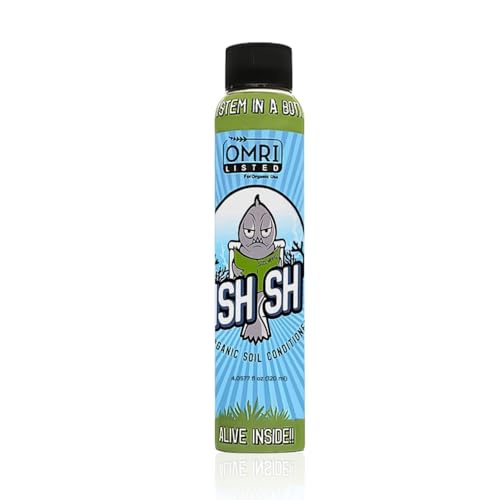
A concentrated dose of living biology — over 4,000 microbial species in a small bottle that dilutes for yards.
This is not a mineral powder or a bag of castings. It is a microbial liquid — billions of active microbes across more than 4,000 species — designed to wake up the soil food web so existing nutrients become available to roots again. That is a different job than gypsum. Where calcium sulfate fixes structure, this one fixes the biology that mineralizes nutrients. The mixing ratio is easy to live with: 2 teaspoons per gallon, shaken well, then watered in with your normal watering.
What the results look like in real yards: buyers describe seedlings that took off after feeding, including acacia and mimosa trees that exploded with growth. The label carries real credentials for a small bottle — 100% organic, OMRI-listed, USDA BioPreferred-certified, and the maker states it is safe for children, pets, wells, and waterways with no offensive odor.
The genuine trade-off is concentration versus volume. At 120 ml you are getting a small bottle, and the listing shows a coverage figure of 20 — narrow, not a whole-acre solution. The recurring mixed note is value for the size; the biology is real, but you are buying a bottle sized for focused use.
The case in one line: if you want to rebuild soil life without buying a 40-pound bag, a 120 ml bottle with 4,000+ species and an OMRI listing (Organic Materials Review Institute — a certification for organic use) is a small, clean way to test whether biology is your missing piece.
Worth knowing: it works with organic or synthetic fertilizer programs, so you do not have to pick a camp — it just helps what is already in the soil become usable.
Reach for this if: you garden in beds, pots, or a focused lawn edge and want living biology rather than a bulk material.
Skip the rebuy if: you are treating a large lawn — 120 ml is a small bottle for an area-wide program.
4. FoliarTech Humic Acid

One liter of humic concentrate that spreads across a quarter acre and open up nutrients already in the soil.
The spec that matters most here is coverage: one liter treats a quarter acre, or roughly 10,800 square feet by the label’s own spray math. That makes it the widest-reach liquid in this list for the bottle size — a real advantage when you are treating a big lawn without hauling gallons. It is 100% water soluble, so it does not clog sprayers, and it works equally well in a hose-end sprayer or a hydroponic setup. The active ingredient is humic and fulvic acid sourced from Humalite in Alberta, Canada.
The biology here is about nutrient accessibility rather than structure. Humic acid regulates pH and breaks up the lockout that keeps nutrients bound to soil particles and unavailable to roots. If your grass is fed but stays dull, that is the failure this blend targets. Buyers describe lawns staying very green, and one flowable benefit is that it mixes into other additives and water without clogging. It can be used directly or combined with what you are already spraying.
The limits are the flip side of concentration. A 1-liter bottle at quarter-acre coverage means you go through it fast if you have a bigger property. The mixing ratio is printed on the label rather than stated here, so you need to read the bottle carefully to hit the right dilution. And a humic blend will not replace a structural fix on genuinely compacted clay — pair it with a gypsum or a liquid aerator if the ground itself is hard.
What makes it a fit
- 0.25 acre coverage from a single liter — the widest liquid reach per bottle here
- 100% water soluble and non-clogging for sprayers and hydroponic lines alike
- OMRI-certified with a stated child-and-pet-safe formula
- Works on lawns, trees, shrubs, ornamentals, vegetables, and crops
Where it falls short
- 1 liter drains quickly on a large property
- Mixing ratio is supply-dependent — you must read the bottle label
- Nutrient open up, not a structural fix, so hard clay still needs a mineral
Pick it for: a fed-but-dull lawn where you suspect nutrient lockout and want wide, sprayer-friendly coverage.
Pair it with: a gypsum or liquid aerator if your soil is physically compacted rather than chemically locked.
5. TeraGanix TCM Soil Conditioner
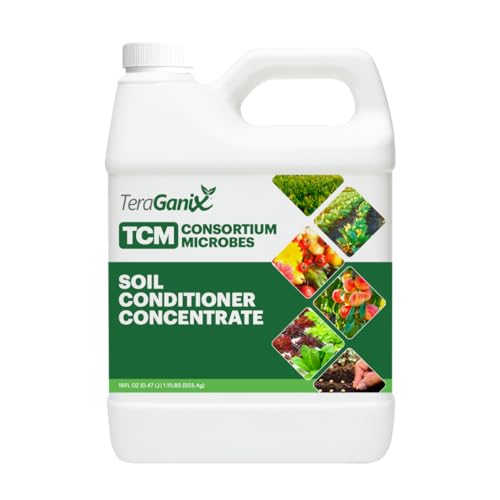
A 16-ounce concentrate that stretches to 16 gallons and doubles as an odor killer around the yard.
The headline spec is dilution: one 16-ounce bottle makes 16 gallons of working solution. That is a wide spread of coverage for the bottle size, and it is why this TeraGanix bottle appeals to people who treat lawns, compost, and animal areas with the same mix. It carries 1 million colony-forming units of lactic acid bacteria per the label — living microorganisms that condition soil and, in ponds and aquariums, improve water quality. It is non-GMO and non-toxic, and it works alongside a normal feeding program.
The odor angle is what surprises most people. Buyers describe spraying diluted TeraGanix on chicken coop bedding and having the smell drop within about two weeks, and clearing a drain smell that had hung around for days. The same biology that digests organic matter in soil does the same job on organic odor sources. On the plant side, the reports are perky plants and a measurable reduction in how much fertilizer was needed.
One honest catch: this is a living product, so shelf life matters. Store it out of sunlight, keep it from freezing, and keep it sealed, and it stays viable as long as the pH stays below 3.6 on the maker’s stated threshold. The recurring mixed note is durability — one tank is guaranteed for a year from production, so buy it when you intend to use it rather than stockpiling. And the price draws the occasional grumble, though the dilution ratio softens that once you divide out the 16 gallons.
Why it earns a slot: the combination of soil conditioning and odor control from one bottle is genuinely unusual, and a 16-gallon working batch means one container goes a long way.
Handle with a little care: treat the date on the bottle as real, store it cool and sealed, and do not let it freeze.
Best if: you want one concentrate that conditions soil, helps compost, and tackles tough smells around the yard.
Hold off if: you will not use it within the guarantee window — this is a living product with a shelf life.
6. Wiggle Worm Worm Castings 40lb
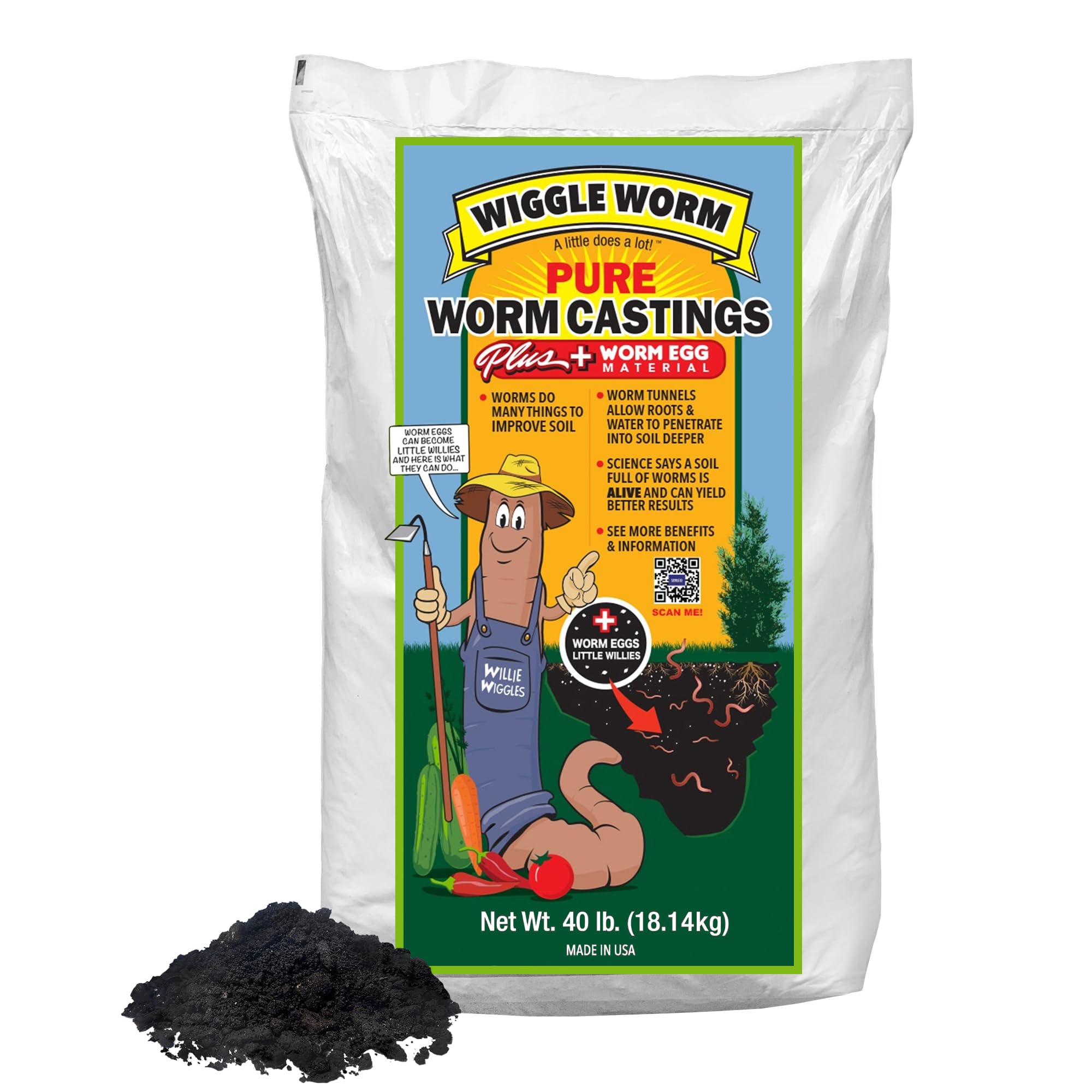
Forty pounds of pure castings with live egg material mixed in — the organic feed for living soil.
If your goal is feeding plants rather than restructuring clay, this is the heavy hitter. It is 100% pure worm castings blended with worm egg material — the cocoons the worms lay — which boosts microbial activity while it aerates and adds nutrients. Granulated and odor-free, drawn from a single 40-pound bag, it is aimed at beds, containers, and living-soil setups rather than broadcast lawn work. The crowd is large and happy: 4.5+ stars across 1,000+ ratings, and quality is what gets praised most by a wide margin.
Reviewers point out clean, finely textured castings with no trash or undecomposed clumps — real castings, not filler-heavy compost. It mixes easily into pots and garden beds, and the plants respond with healthier color and steady growth at no burn risk. A grower summed up the ceiling: “From growing a seedling to a 6-ft plant in 5 months;-) wink, there is no need to add any other supplements.” Strong words, but it speaks to how complete a feed true castings can be.
The mixed notes are worth knowing before you buy. Value and worm content are the two areas that split opinions — some bags come loaded with visible eggs and live worms, others show fewer than expected. The listing itself warns that some debris including small rocks may make it through the sifting process. Neither is a defect in most cases; it is the reality of a farmed, bagged material. For heavy-feeding or large beds you will also go through a 40-pound bag fast.
Strengths worth paying for
- 100% pure castings plus worm egg material — no filler-heavy blend
- Odor-free and finely textured, easy to mix into containers and beds
- Aerates soil and feeds it at the same time; no burn risk
- 40 pounds goes a long way across beds and raised garden boxes
Set your expectations
- Worm egg content varies from bag to bag
- Small rocks can slip through the sifting
- Not the pick for broadcasting a full lawn — it is a bed material
Choose this when: you are feeding raised beds, containers, or a living-soil grow and want pure castings with biology built in.
Look elsewhere when: you need to cover thousands of square feet of lawn — you want a granular lawn product instead.
7. Soft Soil Liquid Soil Aerator & Lawn Treatment, 1 Gallon

Skip the spiked shoes and the rented machine — one gallon of concentrate covers 16,000 square feet of lawn.
The headline number here is 16,000 square feet of coverage from a single gallon. That is the biggest stated reach in this list for a lawn-scale product, and it makes a liquid aerator an attractive alternative to mechanical core aeration for anyone with a sprawling yard and bad knees. Mix four ounces into a gallon of water and spray; a hose-end sprayer is the maker’s recommendation for larger areas. It is organic, safe on any grass type, and works on established lawns, new seed, sod, and plugs alike.
What it does to the soil is break apart the compaction that causes standing water. When clay hardens, water cannot permeate down to the roots; the lawn dries out even after rain and grass goes thin. Soft Soil loosens that crust so air and water reach the root zone. Buyers describe it softening stubborn clay near landscape beds so roots can travel, and lawns greening faster after treatment. It is safe around family and pets per the listing.
The honest limits are significant enough to plan for. The most-discussed gripes are value and application frequency — shoppers say needing to reapply every few weeks through summer to hold results, and the smell is a real complaint from some. Some find the mixed rate means multiple bottles for a big lawn, which pushes the cost up past what mechanical aeration or a lower-cost concentrate would cost. That 16,000 square feet assumes four ounces per gallon at 500 square feet per mixed gallon, so measure carefully to hit it.
Why the no-machine route works
- 16,000 square feet from one gallon — the widest liquid lawn coverage here
- No mechanical aeration tools needed
- Safe on any grass type, including new seed, sod, and plugs
- Organic formula the listing states is safe for family and pets
Where it costs you patience
- Needs repeated applications through summer to hold results
- Some find the smell unpleasant when applying
- The mix rate means the full coverage figure takes careful measuring
Right for: a compacted lawn owner who cannot run a core aerator and wants a spray-on way to break the surface crust.
Ready for the upkeep: buy into it planning several summer applications — one pass rarely finishes the job.
Know the Specs
Coverage in square feet vs gallons of solution
Coverage numbers confuse people because they describe two different things. A liquid concentrate may state how many gallons of mixed solution it makes, or the square footage the maker says one bottle treats. Granular bags state square footage at a stated spreader setting. Always convert to what you will actually spray or spread before comparing, because a bottle that dilutes to many gallons and a bag that covers a fixed area are not measured the same way.
Mixing ratios and why they matter
Some labels give a clear mix like 2 teaspoons per gallon, others like 4 ounces to a gallon, and still others leave the ratio to the bottle. The ratio is what decides how far a bottle really goes, so read it before you buy for a large yard. Over-mixing wastes product; under-mixing means you get a weaker dose than the maker intended.
Minerals versus microbes
Calcium sulfate (gypsum) and humic acid are minerals that change soil chemistry and structure. Worm castings and microbial concentrates are living biology that build up the soil ecosystem. Neither replaces the other — a hard clay problem needs a mineral, and lifeless soil needs biology. Getting the category right is more than half the decision.
Storage and shelf life
Living products carry real expiry dates. Liquid microbes need to stay out of sunlight, off freezing temperatures, and sealed between uses. Dry minerals and castings last far longer. If you buy during a sale, store living products cool and check the date before you stockpile.
Common Questions
Can I use gypsum and a liquid aerator at the same time?
How do I know if my lawn actually has compacted soil?
Will worm castings burn my lawn if I apply too much?
How long does a bottle of liquid microbial inoculant last?
Why didn’t my granular lawn product cover the square footage on the bag?
Is gypsum safe for lawns, pets, and goldfish?
Can I spray a liquid conditioner through a hose-end sprayer?
Do I need to apply a lawn soil conditioner more than once?
How is worm casting material different from compost?
The Bottom Line
For most people fighting hardened, water-repelling clay, the soil conditioner for lawns that earns first place is the 97% Pure Gypsum Powder — a clean, soluble calcium sulfate that loosens the structure and feeds the soil at once. If you want a granular routine you can spread across a full yard, reach for the Jonathan Green Love Your Soil, just set your spreader low. And for rebuilding the biology beneath beds and containers, the Wiggle Worm Worm Castings is where organic gardeners should start.
One last note on why the gypsum holds the top slot even though a bagged program gets more discussion: the crowd is smaller than some other picks but it carries the higher score across its ratings, and the 97% calcium sulfate figure tells you exactly what is in the bag — no guesswork, no filler.
How we choose
We do not accept paid placement. Every pick is matched to a real buyer and a real use-case; we do not hands-on test units.
Sources
Specifications: manufacturer listings and product documentation. Review insights: verified customer reviews, as of October 2026. Pricing: not shown on this page (it changes often); check the current price via the retailer link.
As an Amazon Associate, Aappliancez earns from qualifying purchases. This does not affect which products we feature.