Disclosure: Some links in this post are affiliate links. As an Amazon Associate I earn from qualifying purchases, at no extra cost to you. Learn more
Specs are compiled from manufacturer listings and verified buyer reviews and can change over time — please confirm the key details on the product page before buying.
Buying a swim watch is mostly a question of two numbers: how deep it can go, and how long it runs between charges. A 5ATM watch handles splashes and pool laps but is not built for diving. A 10ATM or 100m-rated watch covers open-water swims and pool sessions alike. Once depth rating and GPS-mode battery life clear your needs, stroke detection and screen brightness become preferences rather than requirements.
This guide is built by comparing the manufacturers’ published specifications and the patterns across verified customer reviews, so you get each pick’s real strengths and trade-offs instead of marketing spin.
Below you’ll find the watch that actually holds up to chlorine, open water, and daily wear, plus the specs that tell you which is which. This shortlist of the best smartwatches for swimming spans pool lap counters to 200-meter dive-rated tools, with each pick’s trade-offs spelled out.
Top Picks

How To Choose The Best Smartwatches for Swimming
The number that decides whether a swim watch belongs in the water at all is its water rating. A watch rated to 5ATM (meaning it can resist pressure equivalent to a 50-metre depth) handles pool laps and showering. A watch rated to 10ATM or 100m handles open-water swims and diving without a second thought. If you swim in the ocean, a lake, or a triathlon, aim for 10ATM or 100m at minimum.
Water Rating: 5ATM vs 10ATM vs 100m
A 5ATM rating is the floor for lap swimming: pressure equivalent to 50 metres of depth for short periods. A 10ATM rating doubles that to 100 metres, enough for open-water swims, snorkelling, and diving. A watch that lists “100m water resistance” in its specs is generally telling you the same thing. But water rating alone does not tell you whether the watch has a swimming mode, stroke detection, or lap counting — you need to check for those features separately.
Swim Tracking: What the Watch Measures In The Pool
A dedicated pool mode does the counting for you: it counts laps, detects your stroke type (freestyle, breaststroke, backstroke, butterfly), and tracks distance and pace. Swim outdoors and open-water mode uses GPS (satellite positioning) to track your route and distance without lane lines. Swim in a pool and pool mode is the feature you’ll use most. Swim outdoors and GPS accuracy matters more than stroke detection. Not every watch in this guide has both — check the spec list for each pick to see exactly what you get.
Battery Life In GPS Mode vs Smartwatch Mode
Battery life figures come in two flavours: everyday smartwatch mode (display, notifications, heart rate) and GPS mode (tracking a workout). The GPS number is always shorter because GPS chips draw more power. A watch that claims 15 days in smartwatch mode might last only 26 hours in GPS mode. If you swim with GPS frequently, look at the GPS figure, not the headline battery claim. If you mostly swim in a pool without GPS, the everyday figure is what matters.
Side-by-Side Comparison
| Model | Best For | Water Rating | Battery Life | Swim Features | Amazon |
|---|---|---|---|---|---|
| Apple Watch Ultra 3★ Best Overall | Open-water and multisport training | 100m | 42 hours normal / 72 hours Low Power | Swimming workouts, multisport | Amazon |
| Fitbit Versa 2 Special EditionBudget Swimmer | Budget pool laps with swim tracking | — | 4-5 days with All-Day Sync on, AOD off | Swim tracking | Amazon |
| CARBINOX Edge MilitaryRugged Pick | Rugged outdoor and swim training | 5ATM + IP69K | Up to 25 days basic watch mode | Swimming mode, 160 sport modes | Amazon |
| Amazfit Active Max | Long battery with map support | — | Up to 25 days | 170+ workout modes including swim | Amazon |
| Fitbit Versa 4 | Senior fitness tracking with swim modes | 50 meters | 6+ days | 40+ exercise modes, water resistant to 50m | Amazon |
| Samsung Galaxy Watch Ultra | Ocean swimming with titanium build | Ocean swimming mentioned | 60 hours / ~2 days | Heart rate tracking, fitness tracker | Amazon |
| Casio G-Shock GBD-H2000 | Rugged swim and multisport | 200-meter | Solar-assisted charging | Swim, run, bike, gym modes | Amazon |
| Garmin Instinct 3 Solar | Open-water and outdoor GPS | 10ATM | Up to 40 days smartwatch mode | GPS multi-band, multisport | Amazon |
| Garmin Forerunner 970 | Triathlon and serious swim training | — | 15 days smartwatch / 26 hours GPS | Multisport auto-transition, swim/bike/run | Amazon |
Detailed Reviews
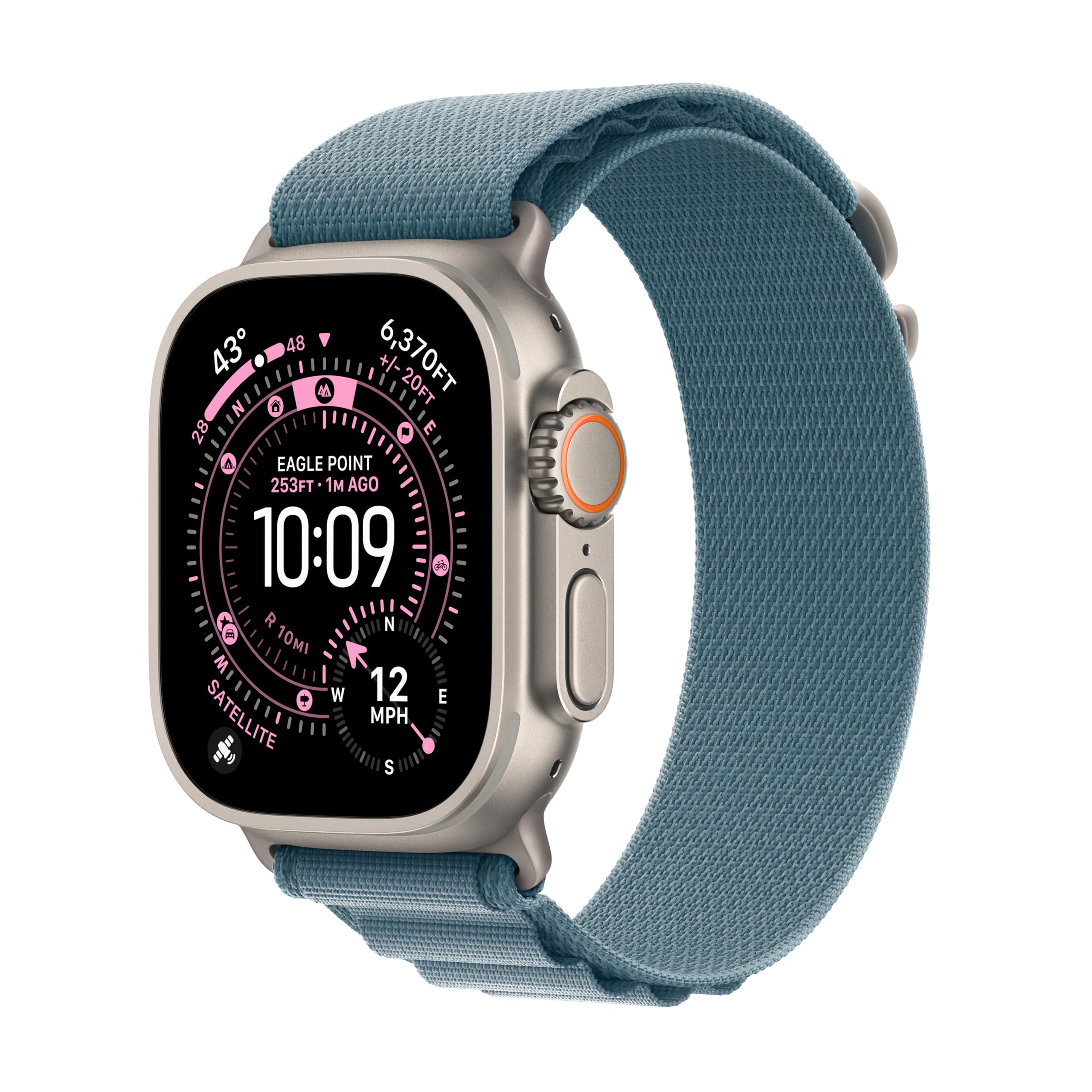
1. Apple Watch Ultra 3 [GPS + Cellular 49mm]
Our pick — 4.5+★ from 1,000+ verified ratings; the strongest balance of quality and price.
The open-water swim watch that also runs your whole day.
Water resistant up to 100m — that’s a depth rating that covers open-water swims, pool laps, and diving without you babying it. The Ultra 3 pairs that with a titanium case and sapphire crystal display, which is a glass that resists scratches far better than the standard glass on most watches. For a swim watch you wear daily into chlorinated water, that combination of a tough case and a scratch-proof screen is exactly what you want.
You’ll go over a week between charges here, which matters more than on any other smartwatch in this guide. Apple states up to 42 hours of normal use and up to 72 hours in Low Power Mode. In workout terms, that means up to 20 hours of GPS and heart rate tracking in Low Power Mode. Log a 45-minute session three times a week and that’s over a week between charges even with GPS running — a meaningful step up from the daily-charge routine of older Apple Watches.
You can read it at a glance from the pool deck: the display is larger than the standard Apple Watch, and Apple says it emits more light at wider angles. A customizable Action Button also gives you one physical press to start a workout or turn on the flashlight — useful with wet fingers. Cellular is built in, so you can stream music or take a call without your iPhone nearby. The catch is that the 2.24-ounce weight is the heaviest in this guide, and the titanium build that makes it tough also makes it something you’ll notice on your wrist during long sessions.
What makes it the overall pick
- 100m water resistance covers pool laps, open-water swims, and diving
- Sapphire crystal display resists scratches from pool tiles and gym equipment
- Up to 42 hours normal use and 72 hours in Low Power Mode — over a week of weekly swim sessions between charges
- Cellular built in, so you can swim without your phone and still stream music
- Customizable Action Button starts a workout with one press, even with wet hands
The trade-offs to know
- At 2.24 ounces it’s the heaviest watch here — you’ll notice it on long sessions
- Titanium and sapphire build commands a premium-tier price
Worth it for: swimmers who want one watch for the pool, the trail, and the office, and who value a 100m rating and a scratch-proof screen over saving weight.
Size up first: the 2.24-ounce weight is real — try one on before committing if you’re used to lighter watches.
2. Fitbit Versa 2 Special Edition
The entry-level pick that still logs your laps and your sleep.
Swim tracking is the headline here, and it’s the reason the Versa 2 makes this list at all. It counts your laps and your time in the water without asking you to reach for a phone. Sleep tracking is the other strong suit — the watch builds a nightly sleep score from your heart rate, time asleep, and restlessness, and breaks that into light, deep, and REM stages. For a swimmer who wants to see how pool sessions affect recovery, that’s a genuinely useful pairing of data.
Battery life runs 4-5 days with All-Day Sync on and the always-on display off. Turn the always-on display on and you cut that by 30-50%, which is the single biggest thing to know about this watch. The always-on display itself requires more frequent charging, per Fitbit’s own spec, so most owners keep it off and wake the screen with a tap. At 0.16 ounces, the watch is extraordinarily light — it’s the opposite end of the spectrum from the 2.24-ounce Apple Watch Ultra 3 above, and you’ll barely feel it during a swim set.
The recurring honesty note is reliability over the long haul. Some units develop charging faults after months of use, and the sync can occasionally need a restart to reconnect. The warranty picture is one area where buyer experiences have been mixed. That’s a fair caution to weigh against the low entry price, but it doesn’t change the fact that this is a capable swim tracker for someone who wants the basics without the premium outlay. Connectivity is Bluetooth-only, so there’s no built-in GPS — a phone in a dry bag or pool bag fills that gap.
What works: swim tracking, a genuinely useful sleep score, and a 0.16-ounce weight that disappears on your wrist — at a budget-tier price that leaves room for a decent pair of goggles.
Plan for: the all-day sync plus always-on display combination eats battery fast; keep the display off and you’ll get the stated 4-5 days.
Reach for this if: you want lap counting and sleep data without paying for a premium sports watch, and you’re comfortable with a Bluetooth connection to your phone.
Look elsewhere if: you need built-in GPS for open-water routes — this watch relies on your phone for that.
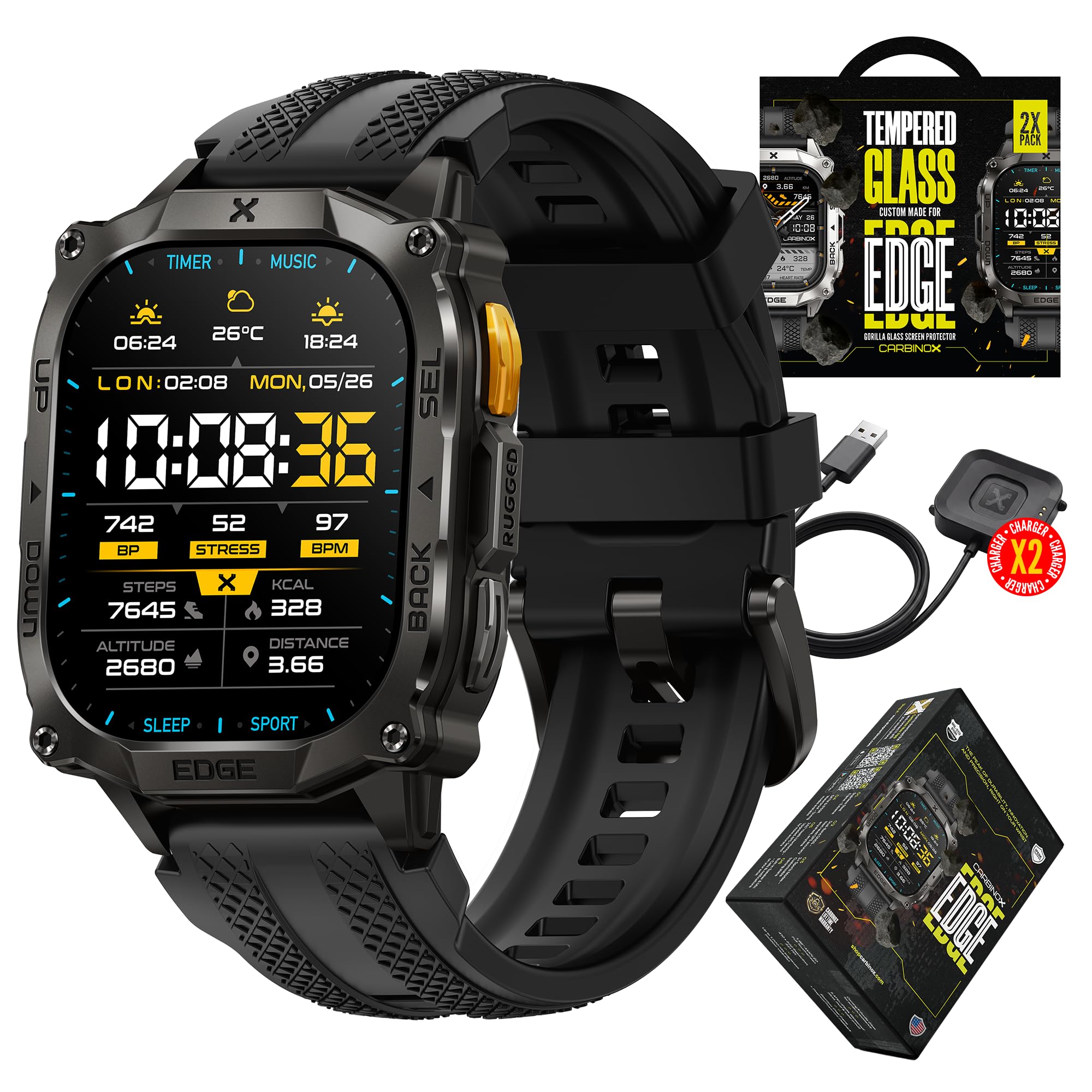
3. CARBINOX Edge Military Smart Watch
A pool-to-jobsite watch that takes a hit and keeps counting laps.
Two water ratings tell the story better than any marketing line. The 5ATM rating covers pool laps and showering. The IP69K rating is one step beyond — it means the watch survives high-pressure water jets, which is the kind of abuse a pool deck or a jobsite throws at a watch. The stainless steel bezel and Corning Gorilla Glass add drop and dust protection, and the whole package is tested to MIL-STD-810H, a military durability standard. For a swim watch that lives in a gear bag between sessions, that combination is reassuring.
The battery is the other standout. CARBINOX lists up to 25 days in basic watch mode, and a full recharge takes about 2 hours on the magnetic charger. The 1.96-inch AMOLED display is rated at 1000 nits, which is bright enough to read in direct sun. Dual-frequency GPS (L1+L5) with six satellite systems is a serious navigation setup for a watch at this tier — it’s the kind of spec that usually appears on premium outdoor watches. There are 160 sport modes including swimming, and a 22mm quick-release silicone strap you can swap without tools.
The honest catch is connectivity. The Bluetooth link to your phone can drop out, and that shows up as missed notifications or a delayed sync. The weather app is also not the most accurate. Neither issue affects the swim tracking itself, which runs on the watch’s own sensors and GPS. The 15-day battery average life figure is the realistic everyday number, with the 25-day claim applying to basic watch mode only.
Where it earns its place: 5ATM plus IP69K is the widest water-resistance combination on this list, and MIL-STD-810H testing means the case and screen are built for real abuse.
What to know: Bluetooth dropouts and a so-so weather app are the recurring notes — swim tracking and GPS are unaffected.
Best for: swimmers who also work outdoors, hike, or need a watch that can take a hit between sessions.
Not the one if: you need rock-solid phone notifications all day — the Bluetooth link is the weak point.
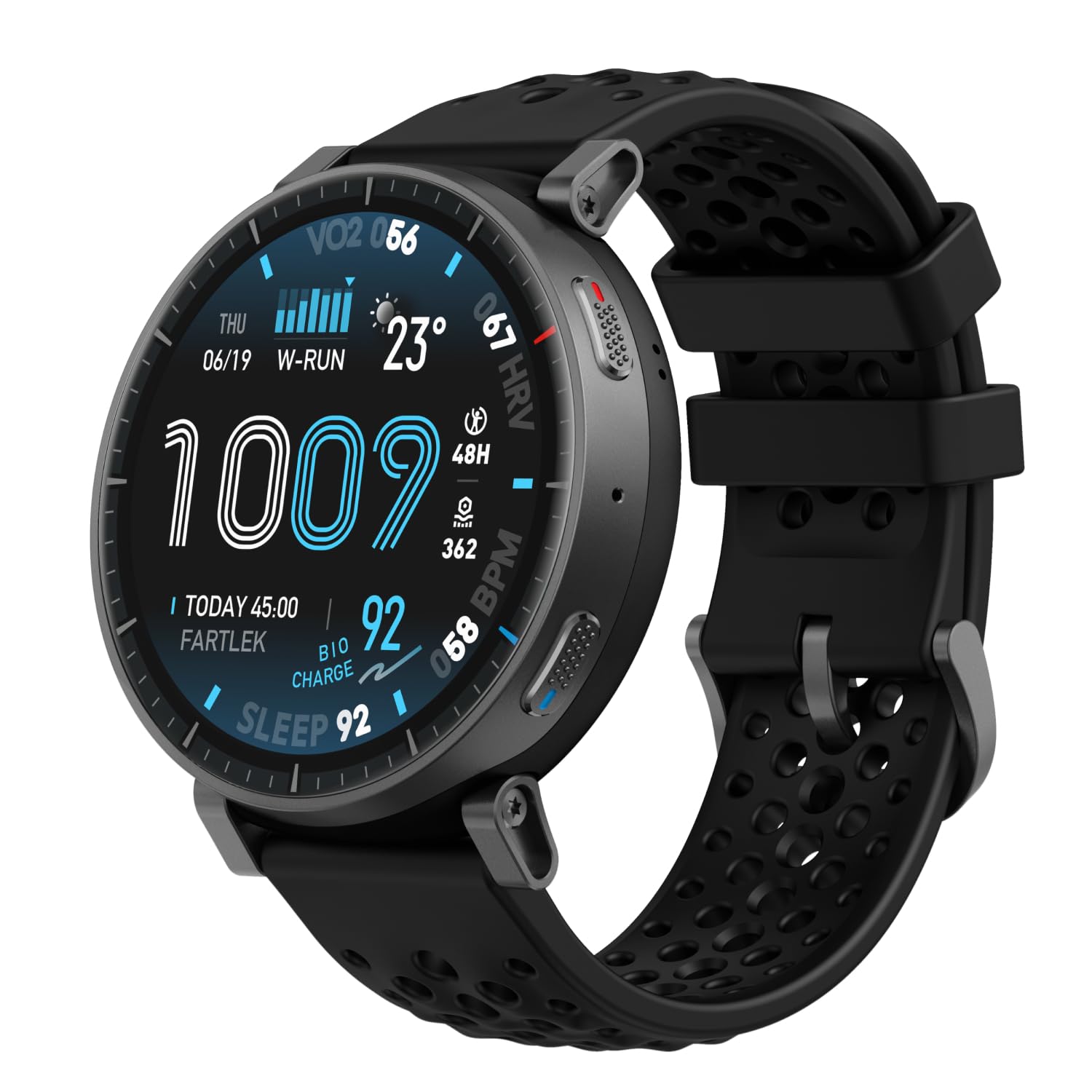
4. Amazfit Active Max Smart Watch
The brightest screen in this guide, paired with a battery that lasts weeks.
A 3,000-nit display is the number to lead with. That’s a measure of screen brightness, and 3,000 nits is bright enough to read clearly on a pool deck in full sun, which is where most swim watches fail the readability test. The 1.5-inch AMOLED panel sits behind it, and AMOLED means each pixel lights itself, so blacks stay deep and the screen stays legible at an angle. For a swim watch you glance at between sets, that brightness matters more than resolution specs.
The battery is the other headline: up to 25 days. That’s a realistic claim based on owner experience — one reviewer noted the battery at 70% after five days of GPS walks, elliptical workouts, and nightly sleep tracking. The Active Max also has 4GB of onboard storage for music and downloadable terrain and ski maps, plus five satellite systems for GPS tracking. There are 170+ workout modes, and swimming is among them.
The trade-off is the app ecosystem. Amazfit’s Zepp app is well-organized but carries fewer third-party apps than Garmin or Apple, and some advanced health metrics can read inaccurately during intense workouts. The 200 mAh battery capacity is smaller in raw terms than several picks here, but the low-power display and efficient chipset stretch it far. Note also that the charger is a magnetic base only — no USB-C cable in the box — so pack accordingly if you travel.
Why swimmers will like it
- 3,000-nit AMOLED display stays readable on a sunny pool deck
- Up to 25 days of battery — weeks between charges, not days
- 4GB storage for music and offline maps
- Five satellite systems for GPS tracking
- 170+ workout modes including swimming
What you give up
- Smaller app ecosystem than Garmin or Apple
- Some advanced health metrics read inaccurately during hard workouts
- Magnetic charging base only — no USB-C cable included
The pick for: swimmers who train outdoors and want a screen they can actually read in sunlight, plus weeks of battery.
Know before you buy: the app store is limited — if you depend on third-party swim apps, this isn’t the watch for you.
5. Fitbit Versa 4 Fitness Smartwatch

Six-day battery and a 50-metre rating for the swim-and-gym crowd.
The 50-metre water resistance rating puts this squarely in lap-swimming territory — it handles pool water and showering without issue. The 40+ exercise modes include swimming, and the watch tracks Active Zone Minutes and all-day activity alongside them. Built-in GPS means you can track an outdoor swim route without your phone, which is a step up from the Versa 2 above. Battery life is rated at 6 days, and a full charge takes about 2 hours, so a Sunday-night top-up keeps it running all week.
The daily readiness score is the feature that separates this from a basic step counter. It reads your sleep, activity, and heart rate trends and tells you whether to push or recover. For a swimmer balancing pool sessions with the rest of life, that’s a useful nudge. The watch also handles on-wrist Bluetooth calls and texts, plus Alexa built in, so it pulls double duty as an everyday smartwatch.
The honest caveat is that heart rate tracking during exercise is the recurring weak spot in owner experience. Some buyers find readings unreliable during intense workouts, and a few report sync glitches that clear up with a restart. The screen also washes out in bright sun, which matters if you swim outdoors at midday. None of that changes the fact that this is a solid all-rounder for the price — it’s just not the precision training tool that the Garmin picks below are.
The value case: 6-day battery, 50-metre water resistance, built-in GPS, and a daily readiness score at a mid-range price — a lot of watch for pool swimmers who also want texts and Alexa on their wrist.
Where it stumbles: heart rate during hard efforts and screen visibility in direct sun are the two recurring gripes.
Pick this if: you swim laps a few times a week and want a watch that also handles calls, texts, and sleep tracking without charging every night.
skip it if: you need lab-grade heart rate accuracy during interval training — the Garmin picks below are stronger there.
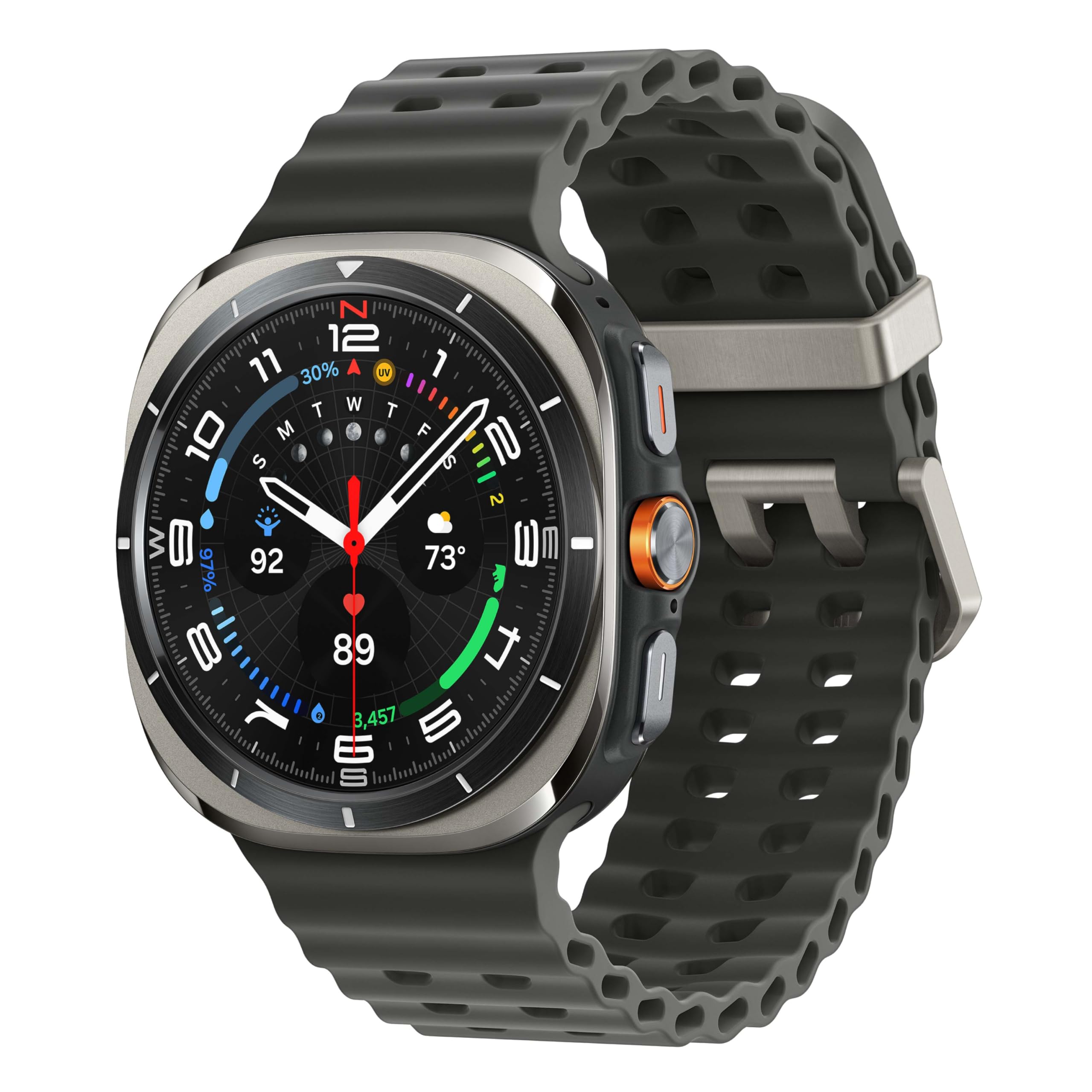
6. Samsung Galaxy Watch Ultra
Titanium toughness built for ocean swims and dusty trails alike.
The titanium case is the defining feature. Samsung describes it as their toughest build yet, rated to stand up to rainy and dusty conditions — and the product listing specifically names ocean swimming as a use case. That’s the kind of explicit water-use language you want on a swim watch, rather than a vague “water resistant” line. The 590 mAh battery is rated at 60 hours of average life, and a full charge takes about 2 hours.
Where this watch pulls ahead of the Fitbits above is the training intelligence. Energy Score uses Galaxy AI to calculate a physical readiness number from yesterday’s sleep, heart rate, and steps. Heart Rate Tracking with Galaxy AI filters out body movement during workouts, which is exactly the problem that plagues wrist sensors in the pool. Wellness Tips then turns that data into daily suggestions analyzed on your phone. For a swimmer who wants their watch to tell them something useful, that’s a deeper layer than a simple lap counter.
The honest limit is battery life. Sixty hours is roughly two and a half days, which is shorter than the Garmin and Amazfit picks in this guide. You’ll charge it every couple of days, not every couple of weeks. It’s also a bulky watch — the titanium build and the 47mm case make it a presence on the wrist. Neither is a dealbreaker for a swim watch, but both are worth knowing before you commit to the premium tier.
what separates it
- Titanium case rated for ocean swimming, rain, and dust
- Energy Score turns sleep, heart rate, and steps into a daily readiness number
- Heart Rate Tracking with Galaxy AI filters out body movement during workouts
- LTE built in for calls and texts without your phone
What to weigh
- 60-hour battery means charging every two to three days
- Bulky 47mm titanium case is noticeable on smaller wrists
Right for: ocean swimmers and open-water athletes who want a titanium watch with AI-driven training feedback and LTE on the wrist.
Think twice if: battery life is your top priority — the Garmin Instinct 3 below runs for weeks, not days.
7. Casio G-Shock GBD-H2000

The 200-meter rating that leaves every other watch here behind.
No other watch on this list comes close on water depth. The GBD-H2000 is rated to 200 meters, which is double the 100m rating of the Apple Watch Ultra 3 and four times the 50-metre rating of the Fitbit Versa 4. For open-water swimmers, divers, and anyone who wants the watch to be the least of their worries in the water, that’s the headline. The shock-resistant build is a G-Shock signature, and the watch is designed for running, walking, cycling, swimming, gym workouts, and everyday activity tracking.
The training setup is solid: GPS tracking for distance and pace, optical wrist heart rate, step counting, and sensors for elevation and other activity data. Training and recovery data push to the CASIO WATCHES smartphone app for a fuller view. The solar-assisted charging is a nice touch — in normal use it tops up the battery, though Casio is clear that solar alone cannot fully charge the battery to the HIGH level. USB charging via the supplied cable takes about 3.2 hours from blank, and Casio specifies charging between 41°F and 95°F.
The honest part: this is a purpose-built sports watch, not a polished smartwatch. Heart rate readings can lag and then jump — one buyer watched it show 60s and then register 128 bpm moments later. There’s no touchscreen-first interface, and the app ecosystem is minimal. If you want a swim watch that’s tough, water-rated deeper than anything else here, and simple to operate, that’s the trade you’re making.
The case for it: you get the deepest water rating in this guide by a wide margin — a 200-meter rating — plus a shock-resistant G-Shock build and multisport GPS in one watch.
Know the limits: heart rate can lag and jump, and the smartwatch features are basic compared to the Apple and Samsung picks.
Go for this if: you dive, swim open water, or need a watch that can handle real depth and real abuse.
Not the pick for: anyone who wants a rich app store or polished smartwatch interface — this is a sports tool first.
8. Garmin Instinct 3 Solar

Weeks of battery and a 10ATM rating in a watch that almost never needs a charger.
The 10ATM water rating is the swim number that matters. It means the watch handles pressure equivalent to 100 meters — open-water swims, snorkelling, and diving all fall inside its comfort zone. The 50mm fiber-reinforced polymer case with a metal-reinforced bezel is built to MIL-STD-810 for thermal and shock resistance, so a pool-deck drop is not the end of the story. Garmin also includes a built-in LED flashlight with variable intensities and strobe modes, which is a genuinely useful extra for early-morning or late-night swims.
Battery life is the other headline. Garmin rates it at up to 40 days in smartwatch mode, with solar charging extending that in good light. In practice, one owner reported roughly 40 days per charge on standard settings. The solar lens is a 1.1-inch display, and the watch uses multi-band GPS with SatIQ technology to tune positioning without draining the battery. The catch with solar is real: heavy GPS or flashlight use will pull the battery down faster than the solar can top it up.
What you’re buying here is a tool, not a lifestyle watch. The display is practical rather than pretty, and the button interface takes adjustment if you’re coming from a touchscreen. But for a swimmer who wants a watch that is water-rated to 10ATM, lasts weeks, and tracks every session without fuss, this is about as dependable as it gets. It’s also note that Garmin Pay contactless payments are supported here, so you can leave your wallet in the locker.
What owners value: the 10ATM rating, the weeks-long battery, and the solar charging that extends time between charges in good light — a swim watch that stays off the charger.
The honest catch: the display is practical, not flashy, and the button-heavy interface takes getting used to after a touchscreen.
Best for: open-water swimmers and outdoor athletes who want weeks of battery, a 10ATM rating, and a watch that works without fuss.
Look elsewhere if: you want a bright touchscreen and app ecosystem — the Apple and Samsung picks are stronger on that front.
9. Garmin Forerunner 970

The triathlon watch that tracks swim, bike, and run without you pressing a button.
Multisport auto-transition is the feature that justifies this watch for swimmers who race. It detects sport changes between swim, bike, and run automatically, so you can focus on the race and let the watch record the splits. That matters for triathletes because fumbling with a watch in transition costs time. The 560 mAh battery is rated at up to 15 days in smartwatch mode and up to 26 hours in GPS mode — enough for a full Ironman-distance race with battery to spare.
The build is premium: a lightweight titanium bezel, a sapphire lens that resists scratches, and the brightest AMOLED touchscreen Garmin has put on a Forerunner. There’s a built-in LED flashlight for early-morning and late-night swims, plus button controls that work with wet fingers — a real advantage over touchscreen-only watches on the pool deck. Full-color built-in maps and multi-band GPS handle open-water navigation, and dynamic round-trip routing can reroute you if you break off your planned swim path.
The honest trade-off is learning curve and price. This is a serious training tool, and the depth of metrics means it takes time to learn the interface — especially coming from an Apple Watch. Training readiness, running economy, and step speed loss are powerful numbers, but some of those features require a separate HRM 600 monitor that is sold separately. If you want a swim watch that does the thinking for you, this one expects you to meet it halfway.
Why triathletes choose it
- Multisport auto-transition detects swim-to-bike-to-run changes automatically
- Up to 15 days smartwatch mode and 26 hours GPS mode
- Titanium bezel and sapphire lens resist scratches and knocks
- Button controls work with wet fingers on the pool deck
- Full-color maps and multi-band GPS for open-water routes
What to factor in
- Steep learning curve with a deep metrics interface
- Some advanced running metrics require a separate HRM 600 monitor
The one for: triathletes and serious swimmers who want automatic sport transitions, sapphire durability, and weeks of battery on the wrist.
Consider the trade: this is a training tool with a learning curve — if you want plug-and-play, the Apple Watch Ultra 3 is simpler.
Know the Specs
Water Resistance Ratings Explained
A water resistance rating states the water pressure a watch is built to withstand. A 5ATM rating means the watch can survive pressure equivalent to being 50 meters underwater for short periods — good for pool laps and showering. A 10ATM rating doubles that to 100 meters and covers open-water swims, snorkelling, and diving. Some watches list “100m water resistance” or “50 meters” instead of ATM figures, but they mean the same thing. The G-Shock here goes even further at 200 meters. Pair a high water rating with a screw-down or sealed case design, and you have a watch you can trust in the water without babying it.
Battery Life: Smartwatch Mode vs GPS Mode
Every watch in this guide states battery life in two different modes, and knowing which one applies to you saves a surprise. Smartwatch mode is everyday use — display on, notifications coming in, heart rate tracking. GPS mode is when the watch is actively tracking a workout with satellite positioning. The GPS figure is always shorter because GPS draws much more power. A watch rated at 15 days in smartwatch mode might last 26 hours in GPS mode. Swim with GPS frequently — open water, not pool laps — and look at the GPS figure. Mostly swim laps in a pool and the smartwatch figure is what you’ll experience day to day. Solar-assisted watches add a third variable: how much sunlight you get, which can extend time between charges but won’t fully charge the battery on its own.
Common Questions
Can I swim in a watch rated 5ATM?
Does a swimming watch need built-in GPS?
What is the difference between 5ATM and IP69K water resistance?
How long does a swimming watch battery last?
Do I need a multisport watch for swimming?
Will I be able to use my swimming watch in the ocean?
Can I track my stroke type with these watches?
Is a titanium case better for a swimming watch?
Does a solar charging feature work if I swim indoors in a pool?
What is the best swimming watch for triathletes?
The Bottom Line
For most swimmers, the winner is the Apple Watch Ultra 3 — one watch you can wear from the pool to the office, with a 100m water rating, a scratch-resistant sapphire crystal display, and up to 42 hours of normal use. Want open-water GPS and weeks of battery instead of days? Reach for the Garmin Instinct 3 Solar, with a 10ATM rating and up to 40 days in smartwatch mode. And for triathlon training where the watch has to track swim, bike, and run without you pressing anything, the Garmin Forerunner 970 handles the auto-transition automatically.
How we choose
We do not accept paid placement. Every pick is matched to a real buyer and a real use-case; we do not hands-on test units.
Sources
Specifications: manufacturer listings and product documentation. Review insights: verified customer reviews, as of October 2026. Pricing: not shown on this page (it changes often); check the current price via the retailer link.
As an Amazon Associate, Aappliancez earns from qualifying purchases. This does not affect which products we feature.