Disclosure: Some links in this post are affiliate links. As an Amazon Associate I earn from qualifying purchases, at no extra cost to you. Learn more
Specs are compiled from manufacturer listings and verified buyer reviews and can change over time — please confirm the key details on the product page before buying.
You want a watch that reads your heart rhythm and your blood oxygen, and you want one that will still be on your wrist at bedtime. Those two demands pull against each other: the more health sensors a watch runs, the faster the battery falls. The picks below resolve that tension in different ways, from a titanium sports watch that goes nearly two days per charge to a hybrid with physical hands that runs for weeks.
This guide is built by comparing the manufacturers’ published specifications and the patterns across verified customer reviews, so you get each pick’s real strengths and trade-offs instead of marketing spin.
The biggest fork in the road is phone loyalty: Apple’s ECG and blood-oxygen apps only pair with an iPhone, while Samsung and Garmin open up to Android. That single compatibility question decides more buyers than any sensor spec, and it shapes every pick on this list of the smartwatch with oxygen sensor and ecg.
Top Picks

How To Choose The Best Smartwatch With Oxygen Sensor and ECG
Start with your phone, not the watch. An ECG app (a feature that records the electrical signal of your heartbeat through the wrist and produces a rhythm strip) is gated by software, and the software is gated by your phone’s operating system. Get that wrong and the sensor you paid for sits idle.
Match the health app to your phone
Apple’s ECG and blood-oxygen readings require an iPhone. Samsung’s blood pressure calibration and health suite work through Android and the Samsung Health Monitor app. Garmin’s ECG app is listed as not available in all countries, so check your region before assuming it will switch on. A watch that fits your phone will give you a clean trend over months; one that fights it will give you setup headaches.
Decide how often you want to charge
Every health sensor draws power. A watch running continuous heart-rate monitoring and overnight SpO2 will drain far faster than the headline figure suggests. Smartwatch mode hours and GPS mode hours are two very different numbers — a Garmin quoted at up to 15 days in smartwatch mode drops to up to 26 hours once GPS is locked on. Be honest about whether you will charge nightly or want to forget the cable for weeks.
Check what the ECG reading actually needs from you
Most wrist ECGs ask you to rest your opposite finger on a crown or button for a stretch of time. That contact is what completes the circuit. If your hands shake, if the strap is loose, or if you are mid-workout, the strip can come back inconclusive. A watch that makes this easy — a clear prompt, a comfortable resting position — is worth more than one with an extra sensor you never use.
Weigh water rating against your real routine
Water ratings on this list run from IPX6 (protected against strong water jets, not immersion) to 10ATM and 100m swim-ready. If you swim laps or dive, that gap matters more than any other spec. If you sweat through a gym session and rinse the band, IPX6 can be plenty.
Side-by-Side Comparison
| Model | Best For | Battery (claimed) | Water Rating | Phone Pairing | Amazon |
|---|---|---|---|---|---|
| Apple Watch Ultra 3★ Best Overall | Multisport and backcountry | Up to 42 hrs normal use | 100m | iPhone | Amazon |
| Garmin Forerunner 970Top Performer | Triathlon training | Up to 15 days smartwatch mode | — | Android and iPhone | Amazon |
| Samsung Galaxy Watch UltraBest for Android | Android adventure use | 590 mAh cell | 10ATM | Android | Amazon |
| Apple Watch Series 9 | Everyday iPhone health tracking | — | 50m, IP6X dust | iPhone | Amazon |
| Garmin fēnix 8 | Expedition and diving | Up to 16 days smartwatch mode | 40m dive rating | Android and iPhone | Amazon |
| Withings Scanwatch Nova | Hybrid looks with SpO2 | Up to 30 days | — | Android and iPhone | Amazon |
| Citizen CZ Smart PQ2 | Dressy Wear OS | 24+ hrs, 40-min charge | IPX6 | Android and iPhone | Amazon |
| Withings Scanwatch Light | Weeks per charge, analog hands | Up to 30 days | — | Android and iPhone | Amazon |
| Fitbit Sense 2 | Stress and sleep focus | 6+ days | 50m | Android and iPhone | Amazon |
Detailed Reviews
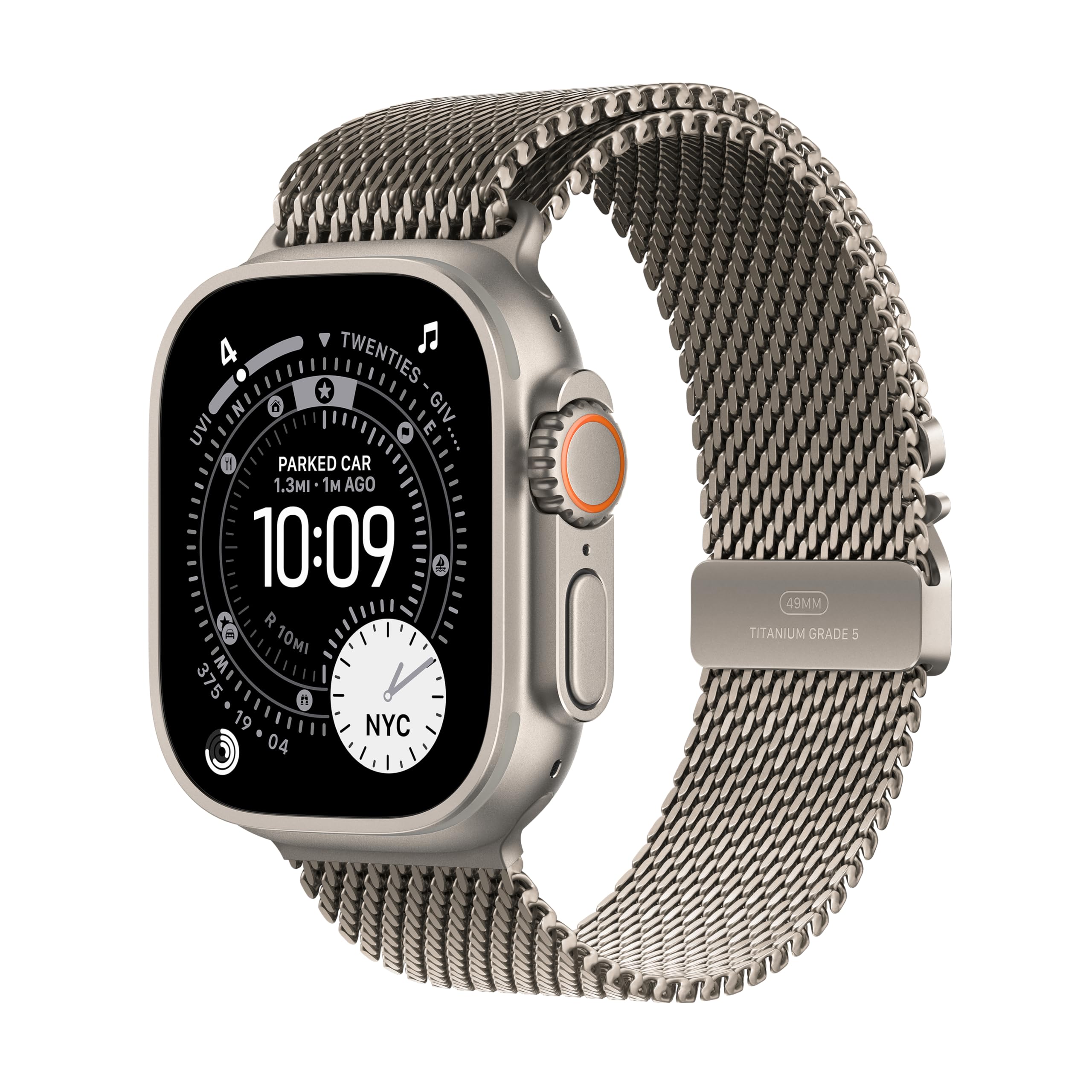
1. Apple Watch Ultra 3 49mm
Our pick — 4.5+★ from 1,000+ verified ratings; the strongest balance of quality and price.
Titanium, sapphire, and nearly two days between charges — the adventure watch that keeps its sensors on.
For a runner, triathlete, or backcountry hiker who wants the health sensors working all day rather than in bursts, this is the watch that makes the trade-offs look easy. It reads an ECG (a one-lead heart rhythm trace you take by resting a finger on the crown) and measures blood oxygen right from the wrist. The body is an extremely tough titanium case under a strong sapphire crystal display, water resistant up to 100m — so it handles pool laps and open-water swims without a second thought.
The battery is the real story here, and it is what wins people over. You get up to 42 hours of normal use, or up to 72 hours in Low Power Mode, and up to 20 hours of a tracked workout with full GPS and heart-rate monitoring when Low Power Mode is on. As buyers report: “One buyer reports getting nearly two days from a single charge.” Pair that with a screen that emits more light at wider angles, and mid-run glances get genuinely easy. There is also a customizable Action Button for one-press control over things like starting a workout or firing the flashlight.
What earns its place at the top is how the pieces connect on the health side. The watch can take an ECG and check heart rhythm for signs of AFib, and it alerts you to a possible irregular rhythm or an unusually high or low heart rate. It logs overnight metrics in the Vitals app and takes blood-oxygen readings. The catch is the ecosystem: the ECG and blood-oxygen features lean on an Apple-designed pipeline, and this model is built around iPhone pairing. That weight buys the titanium and the multiday battery, but it is the honest reason some people hand it back.
What holds up under real use
- Up to 42 hours of normal use, or 72 hours in Low Power Mode, so overnight SpO2 and ECG sessions do not wipe the charge.
- 100m water resistance plus a titanium case and sapphire crystal — built for swimmers and divers.
- ECG plus heart-rhythm AFib checks, Vitals overnight metrics, and on-demand blood oxygen in one place.
- Dual-frequency GPS and a customizable Action Button for one-press workout and flashlight control.
Where it asks something of you
- At 2.24 ounces it is 75% more than the 1.28-ounce Fitbit Sense 2 — noticeable on a small wrist.
- Health features are tied to iPhone, so Android owners should look elsewhere.
- The screen-size feedback is mixed, and some find the feature depth takes a guide to learn.
Reach for this if: you train outdoors and want ECG, SpO2, and dual-frequency GPS in a titanium package that survives water and impacts.
Think twice if: you have a small wrist or an Android phone — the weight and the pairing both work against you.
2. Garmin Forerunner® 970, 47mm, Soft Gold Titanium
Fifteen days in smartwatch mode and an ECG app — the training watch that refuses to be a nightly charger.
If you are training for a triathlon or a marathon and you are tired of plugging your watch in every night, the Forerunner 970 was built for you. It runs up to 15 days of battery life in smartwatch mode and up to 26 hours in GPS mode — two numbers that tell you whether it survives a long race weekend. The ECG app can record your heart rhythm and check for signs of atrial fibrillation, though Garmin notes it is not available in all countries and is meant for people 22 years or older.
The display is the part that hits first. It is Garmin’s brightest AMOLED touchscreen display with button controls, set in a lightweight titanium bezel under a sapphire lens. There is also a built-in LED flashlight for early morning or late-night runs. Multisport auto-transition detects the change between swim, bike, and run, so you focus on the race and the watch handles the splits. Training readiness pulls together sleep quality, recovery, training load, and HRV status (heart-rate variability, the small beat-to-beat differences that hint at recovery).
Where this one asks for patience is the learning curve. The data depth is enormous — running economy, step speed loss, wrist-based running power — and none of it is obvious on day one. Its titanium-and-sapphire design draws more praise than any single spec, but mixed value feedback keeps it off the top step. Compare it directly to the Apple Watch Ultra 3: the Forerunner 970 claims up to 15 days in smartwatch mode where the Ultra 3 claims up to 42 hours of normal use. If battery freedom is your deciding factor, that gap is the whole argument.
The battery argument: up to 15 days in smartwatch mode is the number that changes your routine — you stop planning around a charger.
The honest cost: the feature set is deep enough that the first week feels like homework, and it is priced in the premium tier accordingly.
The one to beat for endurance athletes: triathletes and long-distance runners who want an AMOLED map display, multisport transitions, and two-week battery.
Not your watch: if you want a watch that explains itself on day one, or you only train casually indoors.
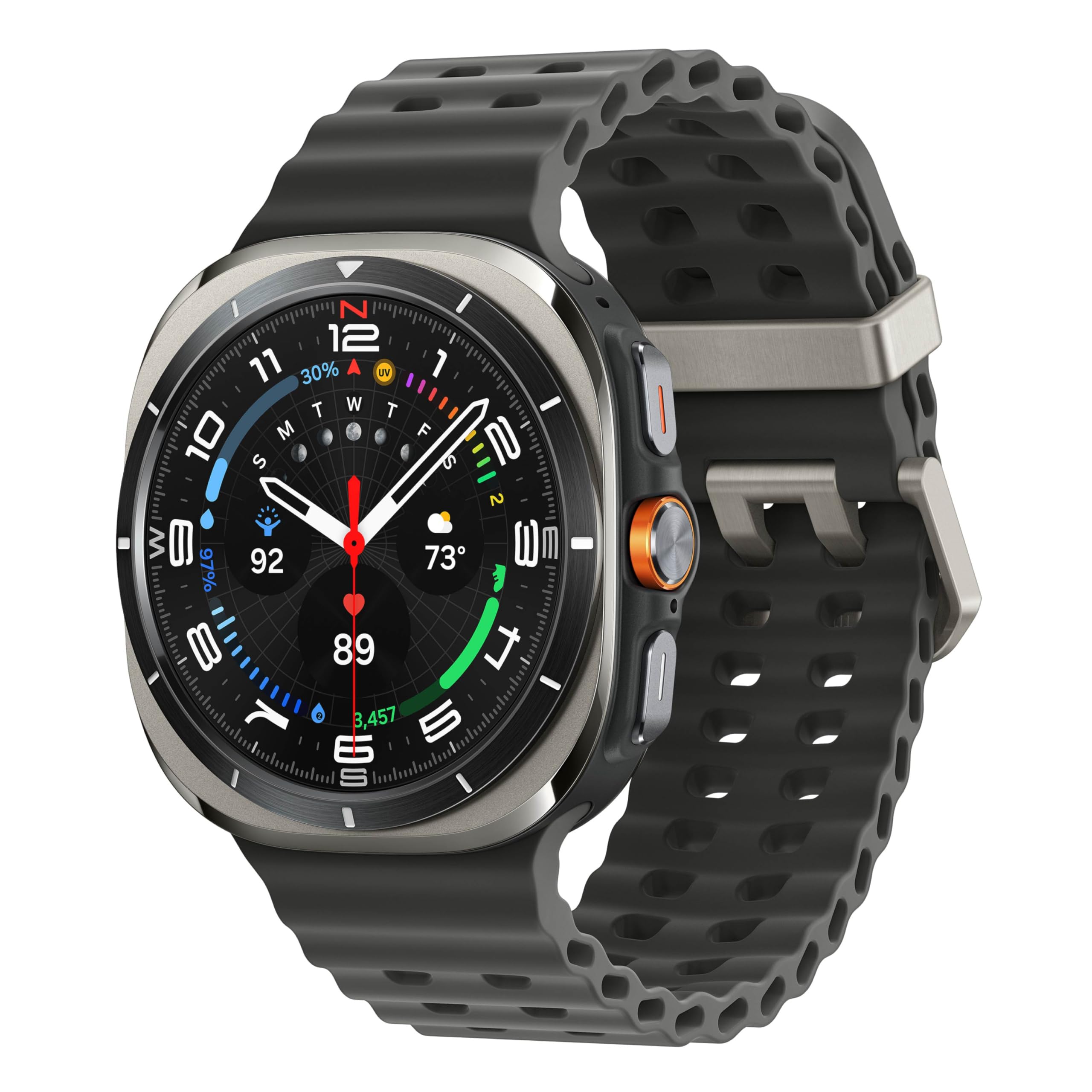
3. Samsung Galaxy Watch Ultra, Titanium Silver, 47mm LTE
A rugged titanium Android watch that checks blood pressure and tracks sleep like a coach.
Android owners who want an adventure-grade watch with serious health tools have a clear answer here. The case is durable titanium with 10ATM water resistance — a rating that covers ocean swimming and rainy, dusty conditions. Inside sits a 590 mAh battery cell, and the strap is silicone with a buckle closure. The cellular radio means LTE calling without your phone in reach.
The health layer goes further than most. You can check blood pressure by calibrating the watch against a blood pressure cuff (sold separately), then read systolic and diastolic numbers in the Samsung Health Monitor app. Advanced Sleep Coaching works on your nights, and Running Coach analyses factors like your age, weight, oxygen levels, and heart rate to guide a run. An Energy Score with Galaxy AI summarizes yesterday’s sleep, activity, and heart rate several times a day. Buyers notice the titanium case first, and appearance feedback dominates the conversation.
The honest friction is battery expectation versus reality. Owner reports on runtime are split, with some seeing two days and others less, so treat a charge every couple of days as the plan. There is also a plasticky stock band and a short attached charging cable that owners regularly swap out. And the pairing story is Android-only — Samsung phones are the natural fit, though other Android phones work with the Galaxy Wearable and Samsung Health apps.
Where it earns its keep: blood pressure calibration, Advanced Sleep Coaching, and 10ATM titanium make this the most complete Android adventure watch on the list.
Where to temper expectations: the 590 mAh cell does not translate to a week-long charge in real use, and the stock strap is the first thing most people replace.
Made for Android adventurers: you want LTE calling, titanium toughness, and sleep-plus-blood-pressure coaching from a Samsung phone.
Look past it if: you own an iPhone or expect a multi-day charge without compromise.
4. Apple Watch Series 9 45mm

The stainless-and-sapphire everyday watch that keeps an ECG and blood-oxygen app on your wrist.
This is the pick for the iPhone owner who wants the health basics done well without the bulk of an adventure watch. The blood-oxygen app keeps an eye on your oxygen level, and you can take an ECG anytime. It notifies you if you have an irregular heart rhythm. Sleep stages show how much time you spent in REM, Core, or Deep sleep, and temperature sensing feeds into cycle tracking. The stainless steel case with sapphire crystal handles daily knocks, and the watch is IP6X dust resistant and swimproof with 50m water resistance.
The S9 chip drives a superbright display and a new way to interact without touching the screen. Cellular connectivity means you can text, call, and stream music without your iPhone nearby, and Family Setup lets you manage a watch for someone who does not have their own iPhone. Fall Detection and Crash Detection can connect you with emergency services, and Emergency SOS calls for help with a button press. Buyers praise the stainless finish and the Milanese Loop more than any other feature.
Be clear about two things before you buy. First, this watch requires an iPhone XS or later with the latest iOS version — no exceptions. Second, value feedback runs mixed. Compared with the Apple Watch Ultra 3 above, you are trading the 42-hour battery and titanium toughness for a lighter stainless case and a more everyday profile. The Series 9 still takes the same ECG and SpO2 readings, so if those two features are the whole point, this one does the job in a dressier package.
Why it fits an iPhone routine
- Blood oxygen app plus anytime ECG and irregular-rhythm notifications.
- IP6X dust resistance and 50m water resistance in a stainless steel case with sapphire crystal.
- Cellular calling and texting without the phone, plus Fall and Crash Detection.
What you give up
- Requires an iPhone XS or later on the latest iOS version.
- No titanium case and a shorter runtime than the Ultra 3.
- Value-for-money opinion splits, so weigh it as an everyday pick rather than an adventure one.
Best everyday iPhone health watch: you want ECG, blood oxygen, and sleep stages in a stainless-and-sapphire case you can wear to dinner.
Skip the upgrade if: you already own a recent Apple Watch or you need multisport battery life.
5. Garmin fēnix® 8, 47mm, Black

Dive to 40 meters, then track your sleep score — the expedition watch for people who go off-grid.
For the scuba diver or backcountry adventurer who still wants Pulse Ox and an ECG app on their wrist, this is the extreme end of the list. It carries a 40-meter dive rating with leakproof metal buttons and supports scuba and apnea dive activities. The 1.4-inch AMOLED display sits behind a stainless steel bezel, with a built-in LED flashlight for after-dark visibility. Battery runs up to 16 days in smartwatch mode, or up to 47 hours in GPS mode.
Navigation is where it pulls ahead: multi-band GPS with SatIQ technology, plus a 3-axis compass, gyroscope, and barometric altimeter. Dynamic round-trip routing lets you set a target distance and get turn-by-turn directions that bring you back to your start on schedule. A built-in speaker and mic let you take calls from the wrist when paired to your phone, and an off-grid voice command feature works even without a smartphone connection. Build quality wins people over, with watch-quality feedback leading the board.
Two honest notes. The ECG app is not available in all regions and is for people 22 years or older, and Pulse Ox is not available in all countries either. And this is a genuinely premium purchase with a steep learning curve. Compared with the Forerunner 970, the fēnix 8 adds the 40-meter dive rating and multi-band GPS with SatIQ, while the Forerunner 970 claims up to 15 days versus this watch’s up to 16 days — a small edge that matters if you are counting every day off the charger.
The build is the headline: a 1.4-inch AMOLED behind stainless steel with a 40-meter dive rating is the rugged combination most watches on this list cannot match.
The caveat worth knowing: adventure-grade features come with an adventure-grade learning curve and a premium price tier.
For divers and expedition runners: you need a 40-meter dive rating, multi-band GPS with SatIQ, and a flashlight for night navigation.
Overkill for most: a city runner or casual walker will pay for dive certification they never use.
6. WITHINGS Scanwatch Nova

Physical hands and a 30-day battery, with SpO2 and temperature tracking hiding underneath.
Some people want the readings without the glowing rectangle on their wrist. This hybrid keeps real hands on a stainless steel case and buckle strap, then adds on-demand blood oxygen (SpO2) readings and overnight tracking for breathing disturbances. A breakthrough TempTech24/7 module reads baseline body temperature and its fluctuations, with temperature variation zones for workouts. That is a sensor package you rarely find on a watch that looks like this.
Heart tracking runs 24/7 with notifications if your heart rate goes too high or too low, plus overnight heart-rate variability to chart heart health over months. Sleep tracking covers duration, light and deep sleep, interruptions, regularity, and a Sleep Quality Score. Activity support spans 40+ auto-recognized activities with heart-rate zones, VO2 max estimation, and connected GPS. And the charge interval is the headline: battery average life is listed at 30 days, with a 2-hour charge time. Buyers praise the stainless steel build most, with the look close behind.
The honest catch is software polish. App feedback, sleep-tracking feedback, and notification feedback all read as mixed, and one thing buyers clearly miss is an on-watch alarm — the app’s time wheel is clunky by comparison. The battery is charged by cable rather than replaced, so plan for that. Still, if your priority is a traditional-looking watch that measures oxygen and temperature while running for weeks between charges, this is the one that does the most while looking the least like a gadget.
Sensor set worth the case
- On-demand SpO2 plus overnight breathing-disturbance tracking.
- TempTech24/7 temperature baseline and fluctuation tracking.
- Up to 30 days of battery with a 2-hour charge time.
Where the software lags
- No on-watch alarm — the app’s time wheel is clunky.
- App, sleep, and notification feedback all run mixed.
- The battery cannot be replaced by the user.
A hybrid for watch purists: you want visible hands, a stainless case, 30-day battery, and SpO2 plus temperature running in the background.
Not for app-first users: if you expect deep sleep analytics and easy notifications, the software will frustrate you.
7. Citizen CZ Smart PQ2 44MM Sport Smartwatch

A great-looking watch under a NASA-inspired alert app — with software that needs patience.
This is the pick for someone who wants a traditional-looking smartwatch and is willing to trade some polish for the style. The CZ Smart YouQ app uses NASA research and IBM Watson AI to identify your chronotype — whether you are a morning go-getter or a high-energy hustler — and build a 24-hour forecast of alertness. It computes heart rate, SP02, fitness activity, and sleep into an hourly Power Score, with Power Fixes to counter fatigue. The sensor list includes gyroscope, altimeter, barometer, accelerometer, heart rate sensor, SP02, and an ambient light sensor.
The build is what carries it. Stainless steel case and band, a 44mm case, a bright auto-brightness display with Always On, and a full touchscreen that owners describe as crisp and detailed. It runs Wear OS by Google, so you get Google Fit, Strava, Spotify, YouTube Music, and Amazon Alexa from the Play Store. Connections include Bluetooth, Wi-Fi, GPS, and NFC. Battery is listed at 24+ hours with a full charge in just 40 minutes, and the Qualcomm 4100+ chipset drives the software.
The honest limitation is that this one has the lowest rating on the list, and the mixed feedback is worth reading carefully. The recurring complaint is software — freezing, lag, and a battery that can drop to battery-saver in a working day for some. It is also IPX6 rated, which protects against water jets but not immersion, so it is not the lap-swimming watch of this group. If you love the Citizen look and can accept that trade-off, the design and display deliver; if you want reliability first, look up the list.
The look does the selling: stainless steel, a 44mm case, and a bright Always-On face put it well ahead of plastic watches on style.
The honest trade: at IPX6 it handles splashes but not swims, and the software divides opinion more than any other pick here.
Buy it for the look: you want a Wear OS watch with NASA-derived alert scoring and a stainless finish for the office.
Look up the list instead if: you swim laps or you need the software to feel smooth on day one.
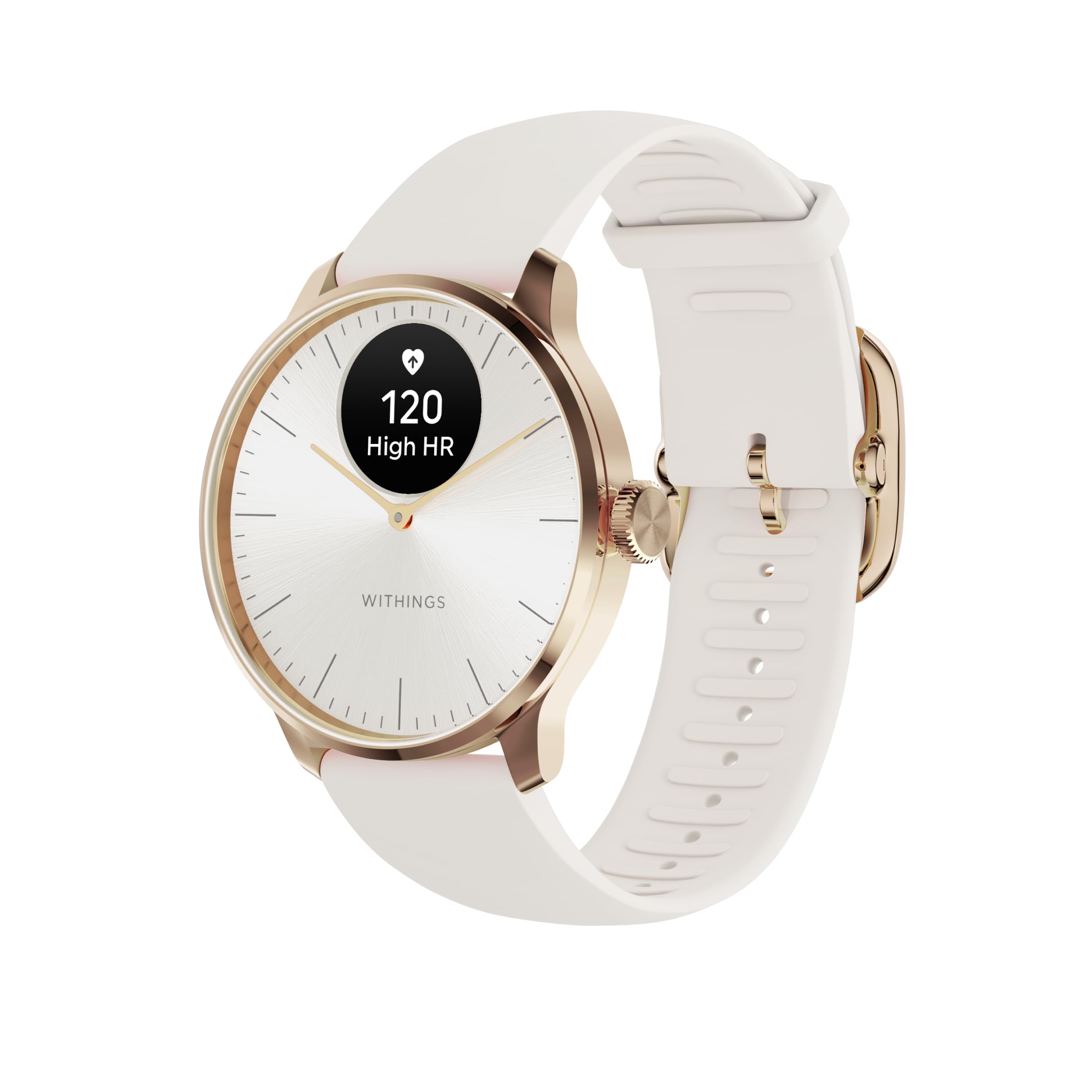
8. WITHINGS Scanwatch Light
Charges monthly, looks like a normal watch, and still tracks blood oxygen overnight.
If your ideal smartwatch is one you set on your wrist and forget for a month, this is it. Battery average life is listed at 30 days, and the case is stainless steel with an FKM wristband and a stainless steel buckle. The display sits behind a flat crystal that keeps glare down. Bluetooth Low Energy handles pairing with the free Withings App on Android and iPhone. Buyers respond most to the look — most read it as a regular watch, not a fitness tracker.
The health side covers heart rate tracking with high and low alerts, overnight heart-rate variability, and a Sleep Quality Score built from light sleep, deep sleep, duration, disturbances, and regularity. You also get blood oxygen tracking and a menstrual cycle guide for logging phases, period duration, symptoms, flow, and moods over time. The upgraded HealthSense OS runs on-device machine learning so metrics land on the watch itself. Activity support spans 40+ recognized activities with heart-rate zones, VO2 max, and connected GPS.
The trade-offs are durability and step accuracy, and both are documented. The case scratches more easily than you would like, so a screen protector is a sensible first purchase. Step counting can under-count — the watch has recorded roughly three quarters of what a dedicated tracker counted on the same walk. And there is no touchscreen here, which is a design choice that some love and some do not.
The case for it: 30 days of battery, a stainless steel hybrid body, and blood-oxygen plus heart-rate tracking with on-device HealthSense OS.
The thing to accept: step counts can run low and the crystal scratches, so treat it as a wellness watch rather than a training instrument.
A month between charges, no glowing screen: you want a classic-looking watch that quietly tracks heart rate, sleep, and oxygen.
Not for step counters: if precise daily step totals matter to you, a dedicated fitness tracker will serve you better.
9. Fitbit Sense 2 Health and Fitness Smartwatch
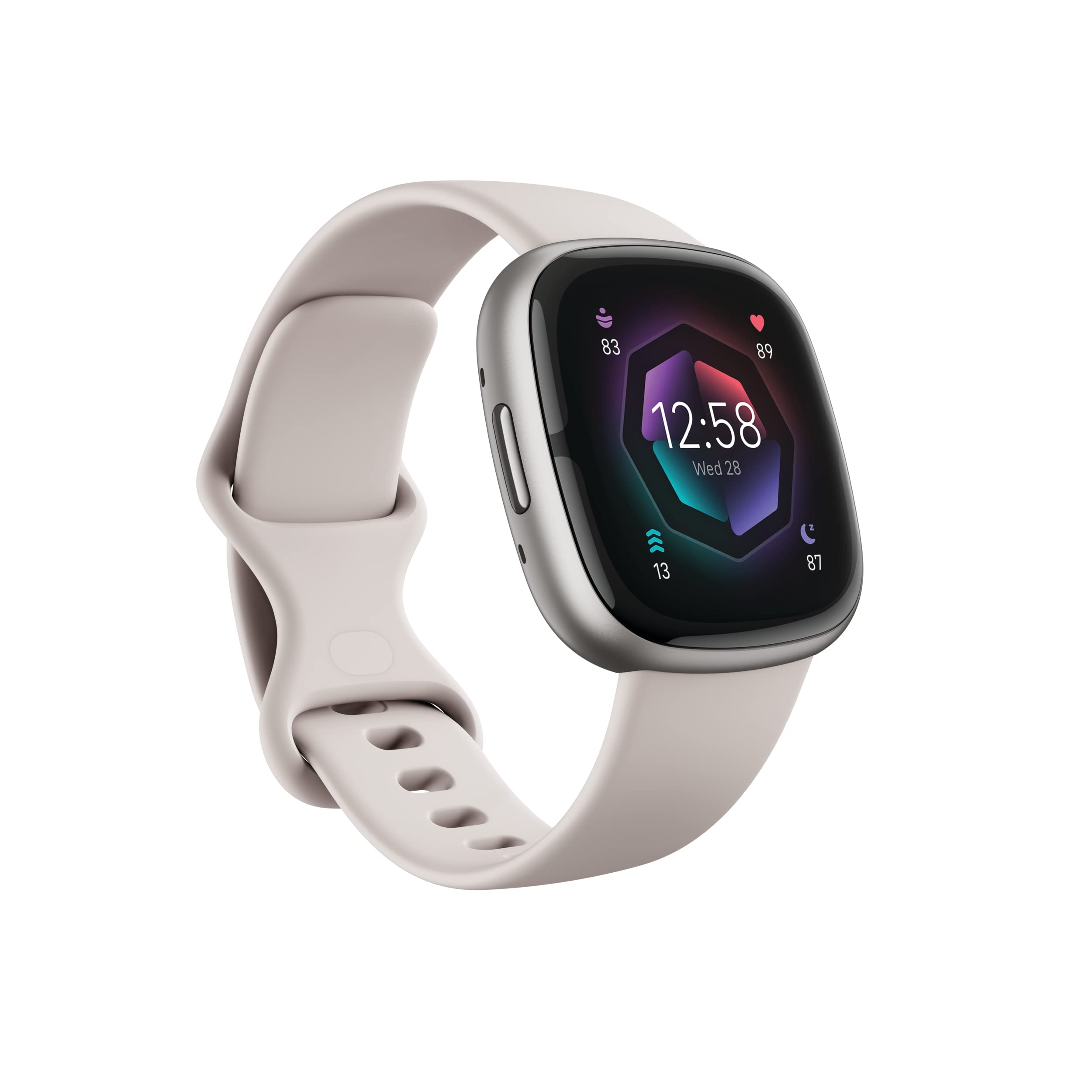
The lightest watch here, built around stress signals and a 1.28-ounce body.
For someone whose main concern is stress and sleep rather than lap splits, this is the most focused pick on the list. It reads all-day stress through a cEDA sensor (continuous electrodermal activity — a small electrical measurement of skin changes tied to stress) and turns it into a daily Stress Management Score. There is an ECG app for atrial fibrillation assessment, irregular heart rhythm notifications, SpO2, and a health metrics dashboard with mindfulness content. The battery is listed at 6+ days, and the body is 1.28 ounces — light enough to wear overnight without a thought.
Sleep is where it earns its place. Daily sleep stages, a Sleep Score, a smart wake alarm, and do-not-disturb mode all live here. Activity tracking covers built-in GPS, a workout intensity map, a Daily Readiness Score, Active Zone Minutes, all-day activity, 24/7 heart rate, and 40+ exercise modes with automatic exercise tracking. Water resistance is 50 meters, and on-wrist Bluetooth calls, texts, and Alexa are included. The price-to-feature ratio is the reason most people try it.
The honest gaps are real and worth weighing. The ECG reading is finicky — finger placement on the sensor is tricky and results can come back inconclusive, so if AFib tracking is your whole reason for buying, this is not the watch to build that around. Battery beats its rated 6+ days less often than you would hope; owners mention a stretch of roughly five days at first, settling to three or four with activity. Still, for the price of an entry-level smartwatch, it packs ECG, SpO2, stress, and sleep into a body lighter than almost anything else here.
Where it shines: cEDA stress detection, a Sleep Score, and Daily Readiness make it a wellbeing watch first and a sports watch second.
Where it asks patience: the ECG reading is finicky about finger placement, and battery settles to three or four days in real use.
Best entry into ECG and SpO2: you care about stress, sleep, and a light wrist, and you want those sensors without a premium price.
Choose it cautiously if: a reliable AFib reading is your one non-negotiable — the ECG here is fussy about finger contact.
Know the Specs
What an ECG app actually measures
An ECG app records the electrical signal that runs through your heart with each beat and turns it into a rhythm strip. On a wrist watch, you usually complete the circuit by touching a crown or button with your other hand and holding still. The reading depends on stable skin contact, so a loose strap or a shaky hand can produce an inconclusive result. That is why some watches on this list are easier to use for ECG than others.
Blood oxygen (SpO2) and overnight tracking
SpO2 is an estimate of how much oxygen your red blood cells are carrying, read through the skin with light sensors. Some watches take it on demand when you ask; others track it overnight while you sleep. Neither replaces a medical measurement, and the readings are best read as a trend over weeks. A watch that tracks overnight needs to stay on your wrist and keep enough charge to run the sensor all night.
Battery claims come in different modes
Smartwatch mode and GPS mode are not the same thing. A watch quoted at up to 15 days in smartwatch mode may drop to up to 26 hours once GPS is locked on for a long run. Continuous heart-rate monitoring and overnight SpO2 also draw power. When you compare two watches, make sure both numbers are the same mode — Garmin and Apple state both, while a hybrid may just say 30 days for its lighter sensor set.
Water ratings from IPX6 to dive depth
IPX6 means the watch survives strong water jets but is not rated for immersion. 50m, 100m, and 10ATM ratings cover swimming and water sports, while a 40-meter dive rating covers scuba and apnea activities. If you swim laps or dive, choose on this spec before anything else, because no sensor package matters if the watch cannot go where you go.
Common Questions
Will an Apple Watch take an ECG if I use an Android phone?
How long does the battery really last with blood oxygen and heart rate running?
Do I need to touch the watch to take an ECG reading?
What is the difference between SpO2 on demand and overnight tracking?
Can I swim with these watches?
Is the Withings Scanwatch Nova better for sleep than a full smartwatch?
Does the Samsung Galaxy Watch Ultra really measure blood pressure?
Which watch works with both iPhone and Android?
How long does a watch with ECG and SpO2 take to charge?
Is a hybrid watch as accurate as a full smartwatch for heart rate?
The Bottom Line
The smartwatch with oxygen sensor and ecg that wins for most people is the Apple Watch Ultra 3, because it pairs an ECG, overnight Vitals metrics, and blood-oxygen readings with a titanium case, 100m water resistance, and up to 42 hours of normal use. If you train for triathlons and want to forget the charger, grab the Garmin Forerunner 970 and its up-to-15-day battery. And for a classic-looking hybrid that tracks SpO2 and temperature without a glowing screen, the Withings Scanwatch Nova is the one to reach for.
If you are upgrading from a recent Apple Watch, the Ultra 3 is the upgrade that changes your daily routine, not just your watch face. If you are already carrying an iPhone, the Apple Watch Series 9 does the same ECG and blood-oxygen work in a lighter stainless case for less. Android owners should start with the Samsung Galaxy Watch Ultra and its blood-pressure calibration. Whatever you pick, buy the one whose phone pairing matches what is already in your pocket — a sensor you cannot switch on is a sensor you paid for and never used.
How we choose
We do not accept paid placement. Every pick is matched to a real buyer and a real use-case; we do not hands-on test units.
Sources
Specifications: manufacturer listings and product documentation. Review insights: verified customer reviews, as of October 2026. Pricing: not shown on this page (it changes often); check the current price via the retailer link.
As an Amazon Associate, Aappliancez earns from qualifying purchases. This does not affect which products we feature.