Disclosure: Some links in this post are affiliate links. As an Amazon Associate I earn from qualifying purchases, at no extra cost to you. Learn more
Specs are compiled from manufacturer listings and verified buyer reviews and can change over time — please confirm the key details on the product page before buying.
You do not need every sensor on the spec sheet. You need one that survives a two-hour match, keeps a readable screen in direct sun, and does not die mid-third-set because you left the always-on display running. Those three things are the whole job. Sleep scores, stress tracking and app stores are bonus. Below are six watches that actually hold up on court, sorted by what they do best so you can pick the right one without wading through spec sheets.
This guide is built by comparing the manufacturers’ published specifications and the patterns across verified customer reviews, so you get each pick’s real strengths and trade-offs instead of marketing spin.
Most tennis players overpay for features they will never touch and underpay attention to the two things that matter: battery endurance and GPS accuracy on a moving court. Here is the honest breakdown of the smartwatch for tennis that earns its place on your wrist.
Top Picks

How To Choose The Best Smartwatch for Tennis
Tennis is a stop-start sport with short explosive bursts and long rest intervals. A watch that tracks a steady marathon pace will still record a match, but the data it gives you back may be thin. The watches that genuinely help a tennis player are the ones that handle interval bursts, keep GPS locked when you move laterally across a court, and survive a full match plus the walk home without a charge.
Battery life in GPS mode — the number most listings bury
Smartwatch-mode battery life (the big “up to X days” figure) tells you how long the watch lasts with GPS off. Tennis uses GPS. Look for the GPS-mode number instead. A watch rated for 20 hours in GPS mode will handle a three-set match with plenty of headroom. A watch that only quotes smartwatch-mode days may drain much faster once you start tracking a session.
GPS accuracy on a court — why multi-band matters
A tennis court is roughly 24 meters long and 11 meters wide for singles. That is a small area for GPS to resolve. A watch with multi-band GNSS (a receiver that locks onto more satellite frequencies at once) holds position better on a small court than a single-band unit. If you care about distance-run and court-coverage maps, multi-band is worth paying for.
Screen readability in sunlight
You will glance at your wrist mid-changeover, often in bright afternoon light. An AMOLED screen (a display type that lights each pixel individually) stays readable in direct sun where older LCD panels wash out. The trade-off is that a brighter screen and an always-on setting both drain the battery faster. Most tennis players are better served by a bright AMOLED screen with always-on turned off during matches.
Weight and band comfort during play
A watch that feels fine at your desk can become annoying after 90 minutes of gripping a racket. Silicone bands are common because they resist sweat and do not absorb water. Fiber-reinforced polymer cases keep the watch light. If you have a smaller wrist, check the case size — a 47mm case on a narrow wrist will catch on your backhand follow-through.
Side-by-Side Comparison
| Model | Best For | Battery (Smartwatch Mode) | Case Size | Display Type | Amazon |
|---|---|---|---|---|---|
| Garmin Forerunner 265★ Best Overall | All-round tennis and fitness tracking | Up to 13 days | 46mm | AMOLED | Amazon |
| Fitbit Sense 2Best Value | Health-focused players on a budget | 6+ days | — | — | Amazon |
| Apple Watch SE (2nd Gen) | iPhone users who want cellular freedom | All-day (per owner reports) | 44mm | Retina | Amazon |
| Garmin Venu 3 | Premium fitness tracking with phone calls | Up to 14 days | 45mm | AMOLED | Amazon |
| Apple Watch Series 9 | Advanced health sensors and always-on display | — | 45mm | Always-On Retina | Amazon |
| Samsung Galaxy Watch 6 Classic | Android users who want a rotating bezel | — | 47mm | — | Amazon |
Detailed Reviews
1. Garmin Forerunner 265
Our pick — 4.5+★ from 3,000+ verified ratings; the strongest balance of quality and price.
A multi-band GPS running watch with a bright AMOLED screen and up to 20 hours of GPS battery — enough for a full tournament week.
The Forerunner 265 is a running watch by design, but the combination of multi-band GNSS (a GPS receiver that locks onto more satellite signals at once) and a bright AMOLED touchscreen makes it a serious tennis companion. It tracks your court movement accurately, and the 46mm case with a silicone band stays comfortable through a long match. Garmin rates it at up to 13 days in smartwatch mode and up to 20 hours in GPS mode — enough for several matches before you need to charge. The 30+ built-in activity profiles include more than just running, so you can log a tennis session without resorting to a generic workout mode.
What wins people over is the look and the battery in equal measure. The AMOLED screen is readable in direct sunlight, which is the only kind of light you will be playing in. Owners consistently report getting 7-10 days of real use with five or six workouts per week, and one buyer clocked 10 days with daily workouts and a weekly four-mile hike while running sleep-only SpO2 and no always-on display. That is a buyer’s own test, not a lab number, and it lines up with Garmin’s 13-day rating once you account for GPS use. The touchscreen plus physical buttons means you can start a session with a button press even if your fingers are sweaty and the screen is not responding cleanly.
The Forerunner 265 also carries Garmin’s training readiness score, which pulls together sleep quality, recovery, training load and HRV status (heart-rate variability, a measure of how recovered your body is) to tell you whether you are primed to go hard. For a tennis player that is genuinely useful — it will tell you when a heavy week of matches has left you flat. You also get daily suggested workouts that adapt after every run, and a race widget if you are training for a tournament. The catch is that this is not a full smartwatch in the Apple sense: there is no tap-to-pay, no texting from the wrist, and no on-wrist calls. If those matter to you, look further down this list.
What earns it the top spot
- Up to 13 days in smartwatch mode and up to 20 hours in GPS mode — enough for a full tournament week
- Multi-band GNSS with SatIQ keeps position locked on a small court while managing battery draw
- 30+ activity profiles including running, cycling, and open-water swimming
- AMOLED touchscreen readable in direct sun, with physical buttons for sweaty hands
- Training readiness score pulls sleep, recovery, training load and HRV into one number
What you give up
- No tap-to-pay, no on-wrist texting, no calls — it is a fitness watch first
- Sleep-stage alarm is missing, which some owners noticed after switching from other brands
- No metal casing option — the fiber-reinforced polymer case looks more sporty than dressy
Reach for this if: you want the most complete fitness-tracking package for tennis and do not need a phone on your wrist.
Think twice if: you rely on contactless payments or on-wrist messaging during the day.
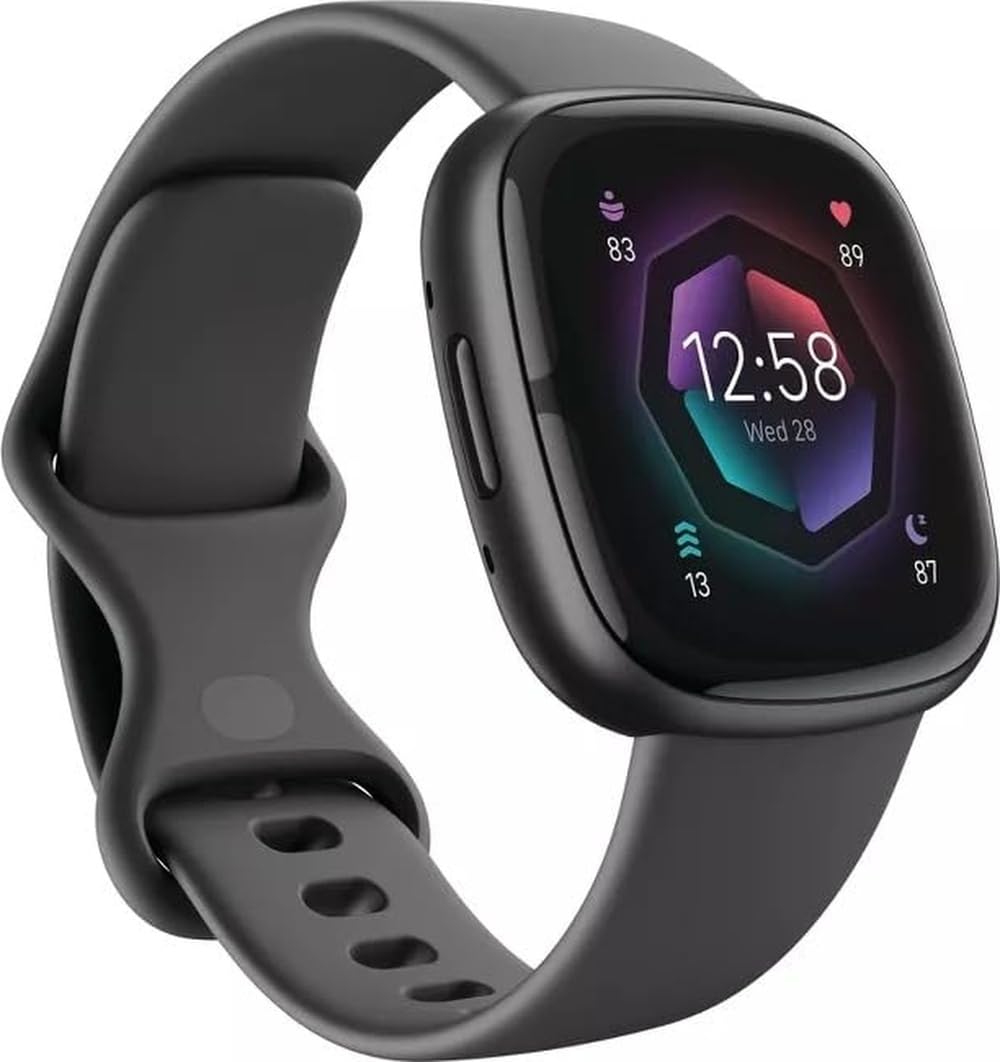
2. Fitbit Sense 2
The health-first pick that costs less and still tracks your court time.
The Sense 2 is the most affordable watch on this list, and it is the only one that puts stress detection at the center of its pitch. It uses a cEDA sensor (a skin-conductance sensor that reads sweat response) alongside a daily Stress Management Score, plus an ECG app for atrial fibrillation assessment and SpO2 readings. For a tennis player, the useful part is the Daily Readiness Score, which factors in activity, sleep and heart-rate variability to tell you whether to push or back off. It has built-in GPS and 40+ exercise modes, and it is water resistant to 50 meters — so sweat and rain are not a concern.
Where the Sense 2 earns its place is the price-to-feature ratio. Buyers report the battery holding around 5 days early on, settling to 3-4 days with heavier activity, and one long-term buyer said it keeps above 20% without drama. It pairs with both iPhone and Android, and the full charge takes roughly half an hour according to owner reports. On court, the 50-meter water resistance means you can wear it in the pool for cross-training without thinking twice.
The honest trade-off is reliability at the edges. Heart-rate tracking has drawn criticism for lagging during fast intervals, and the step count is less accurate in water-based workouts. The app is also described as not intuitive by some users, and the readiness rating has been called into question by at least one buyer. For tennis specifically, the built-in GPS handles court movement fine, but if you want precise split times and serious training analytics, the Garmin options do more. This is the pick for a recreational player who wants health insight and GPS without spending premium money.
Where the money goes: cEDA stress sensing, ECG, SpO2 and a Daily Readiness Score at the entry price — the health feature set punches above its tier.
The honest limit: heart-rate accuracy during fast intervals is the recurring gripe, and the app takes some learning. Treat it as a wellness watch that plays tennis, not a tennis-first training tool.
Best for: the casual club player who wants GPS, stress tracking and sleep insight without a premium spend.
Look elsewhere if: you need pinpoint heart-rate splits during sprint intervals or a polished app experience.
3. Apple Watch SE (2nd Gen)

Leave the phone in the bag and still take the call between sets.
If you carry an iPhone, the Watch SE is the easiest watch to live with. The 44mm Midnight Aluminum case with a Midnight Sport Band S/M is swimproof to 50 meters, so sweat and a post-match shower are fine. Cellular connectivity means you can send a text, make a call or stream music without your iPhone nearby — useful if you leave your phone in a locker during a match. The Workout app covers a range of training types with advanced metrics, and the watch includes Fall Detection, Crash Detection and Emergency SOS, plus Check In to notify someone when you arrive. It also works with Apple Fitness+ (three months free included).
Owners describe it as easy to set up and easy to read, with a large face and a screen that holds up to daily banging around. One reviewer noted the watch stays charged and charges quickly, and another said it still had about 50% battery at bedtime. The fitness tracking is the part that matters for tennis: the Workout app gives you distance, pace and heart-rate data, and it can verbally announce pace at intervals during a run — a feature that translates well to training drills. The 9.1-ounce package weight includes the watch and band, and the aluminum case keeps it light on the wrist during play.
What you should know before buying is that the SE is the entry Apple Watch, not the flagship. It gives you the essentials — fitness tracking, safety features, cellular — but not the always-on display or the advanced health sensors you get on the Series 9. Battery is the other point to plan around: owners mention it lasts all day but generally needs a nightly charge, so a heavy match day is fine but a weekend tournament without a charger is not. If you want the bigger health suite, the Series 9 below is the step up.
Why iPhone owners gravitate here
- Cellular lets you call, text and stream music without your iPhone nearby
- Workout app with advanced metrics and pace announcements during runs
- Safety features including Fall Detection, Crash Detection, Emergency SOS and Check In
- 50-meter water resistance handles sweat, rain and a post-match shower
- Light aluminum case at a 44mm size that suits most wrists
The fine print
- Needs a nightly charge — not a multi-day watch like the Garmin picks
- No always-on display and no advanced health sensors like ECG or blood oxygen
- Cellular requires a plan from your carrier, which is a separate ongoing cost
Your match if: you are on iPhone and want cellular freedom, safety features and simple fitness tracking in one familiar package.
Keep looking if: you want a watch that survives a multi-day tournament without a charger.
4. Garmin Venu 3

Garmin’s fitness brain with a phone on your wrist — the balanced upgrade.
The Venu 3 is what you get when you want the Forerunner’s training depth plus the convenience of taking calls and responding to texts from your wrist. Garmin rates it at up to 14 days in smartwatch mode, and the 45mm fiber-reinforced polymer case with a silicone band keeps it light enough for long matches. It has more than 30 built-in indoor and GPS sports apps, including walking, running, cycling, HIIT, swimming and golf. The AMOLED display is bright and colorful, and the 300 mAh battery (a measure of stored charge) delivers the multi-day endurance Garmin is known for. It pairs with both iPhone and Android via the Garmin Connect app.
Owners consistently say the Venu 3 beats the Apple Watch on battery life and fitness accuracy. One detailed comparison noted the step count matched an iPhone, heart rate matched a blood-pressure cuff, and calorie tracking lined up exactly with actual weight loss. Another user reported about 92% battery left after a full day and 45% by day five — enough to get through a week-long vacation without a charger. The sleep tracking gets specific praise for monitoring minute-by-minute sleep duration, and the Body Battery energy monitor uses sleep, naps, stress and workouts to tell you when to rest. For tennis, the GPS accuracy and the range of workout profiles mean you can log a match or a training session without fuss.
The honest catch with the Venu 3 is that it sits in an awkward spot between the Forerunner 265 and the Apple Watch Series 9. Some owners also find the interface takes a little learning, and the app list is not as rich as the Apple or Samsung stores. If you want Garmin accuracy with on-wrist calling and do not need race-day coaching, this is the best balance in the lineup.
The defining strength: up to 14 days of smartwatch battery with on-wrist calls and text replies — a combination the Apple and Samsung picks here cannot match on endurance.
Worth knowing: it is priced above the Forerunner 265 but lacks its race-adaptive training plans, so the extra money buys smartwatch convenience rather than more coaching depth.
Pick this if: you want Garmin’s fitness accuracy plus wrist calls and texts, and multi-day battery is non-negotiable.
skip it if: race-day coaching tools matter more to you than smartwatch conveniences.
5. Apple Watch Series 9

The brightest screen and the deepest health suite Apple puts on a wrist.
The Series 9 is the premium Apple option, and it brings features the SE does not: an Always-On Retina display, ECG and blood oxygen apps, sleep-stage tracking (REM, Core, Deep) and temperature sensing. The S9 chip drives a superbright display and a new way to interact without touching the screen. Cellular connectivity lets you text, call and stream music without your iPhone nearby, and it is IP6X-certified dust resistant and swimproof with 50-meter water resistance. For a tennis player, the Always-On display is the standout — you can glance at your heart rate mid-changeover without raising your wrist sharply.
The advanced fitness features are the reason to pay more here. The Workout app gives you a range of training modes with advanced metrics, and the heart monitoring drew specific praise from buyers who bought the Series 9 for exactly that. One buyer picked up two 45mm models for himself and his wife, citing heart monitoring and exercise tracking as the deciding features. The always-on screen is bright enough to read in direct sun, and the Midnight Aluminum case with a Sport Band M/L keeps the watch light on the wrist during play. If you already live in the Apple ecosystem, the integration is the smoothest of any watch on this list — open up your Mac, finding your iPhone, paying with Apple Pay.
Battery is where the Series 9 asks for patience. Customers note short battery life compared with the multi-day Garmin picks, and it needs a daily charge — the same rhythm as the SE rather than the week-long endurance of the Forerunner or Venu. That is the trade-off for the bigger display and the advanced sensors. It is also an iPhone-only watch, so Android users should look at the Galaxy Watch below. If battery endurance is the single most important thing to you, the Garmin picks hold up longer; if you want the best display and health suite Apple offers, this is it.
What you are paying for: the Always-On Retina display and the full Apple health suite — ECG, blood oxygen, sleep stages and temperature sensing — plus the S9 chip’s superbright screen.
If a nightly charge does not fit your routine, pick a Garmin instead.
Choose it for: the best Apple display and health sensor suite, plus always-on readability on court.
Not your pick if: you want multi-day battery or run an Android phone.
6. Samsung Galaxy Watch 6 Classic 47mm

A stainless-steel classic with a physical bezel you can actually feel click.
The Galaxy Watch 6 Classic 47mm is the pick for Android users who want a watch that looks like a watch. The stainless-steel case and band with a rotating bezel give it a traditional feel, and the bezel itself is a real navigation tool — the most-discussed design element on this watch is how good it looks, by a wide margin. It tracks over 90 exercises, recognizes activities from running to swimming, and provides personalized heart-rate zones based on your health data. The BIA sensor (a body-composition sensor) reads body fat, skeletal muscle, body water and BMI. It has Advanced Sleep Coaching with snoring detection, and an always-on heart monitor that scans for irregular rhythm.
Owners gravitate to the bezel navigation and the sleep tracking. One buyer called the rotating bezel the easiest way to move through Wear OS apps, and another said the sleep monitor gave useful insight into apnea. The 425 mAh battery delivers roughly a day and a half with always-on display off and limited GPS use, according to owners, and the fast charger included in the box makes topping up less painful. The 47mm case is on the large side — one buyer mentioned it is slightly large but not obstructive, and another said the 43mm version fits smaller wrists better. The crystal glass holds up to daily bumps, and the band swap system takes one click.
The trade-off with the Classic is battery and phone compatibility. It needs a charge roughly every day to day and a half, which is far short of the 13-14 day Garmin picks. GPS is also slightly less accurate than a phone in some owners’ experience, and the full health suite, including ECG, only works with Samsung phones — a real limit if you are on another Android brand. It is heavier and thicker than the other watches here, though owners say it becomes unnoticeable after a few hours. For a Samsung phone owner who wants a classic look and a physical bezel, this is the natural match.
Why the classic look wins: the stainless-steel case and rotating bezel are the most-praised design details on this watch, and the bezel doubles as a navigation tool that works even with sweaty fingers.
The compatibility catch: ECG and some health features are tied to Samsung phones, and battery runs roughly a day to a day and a half — plan on a nightly charge.
Made for: Samsung phone owners who want a classic stainless-steel watch with a physical bezel and a deep health sensor set.
Look away if: you use a non-Samsung Android phone or want battery that lasts more than a day and a half.
Know the Specs
Battery life in GPS mode vs smartwatch mode
The headline battery figure on most listings is the smartwatch-mode number — the watch sitting on your wrist with GPS off. Tennis uses GPS, and GPS drains the battery faster. The Forerunner 265 quotes up to 13 days in smartwatch mode and up to 20 hours in GPS mode; that 20-hour figure is the one that matters on court. A three-set match plus warm-up is unlikely to run past three hours, so 20 hours of GPS is plenty. But if you also record practice sessions and runs, the GPS figure decides how often you charge. Always look for both numbers on the spec sheet and weigh the GPS one more heavily.
Multi-band GNSS and court accuracy
GNSS stands for global navigation satellite system — the satellite network your watch uses to place you on a map. A single-band receiver listens to one frequency; a multi-band receiver listens to more than one, which helps it hold a position in tight spaces and under trees. On a tennis court, which is a small area, multi-band GNSS keeps your distance and court-coverage maps cleaner. The Forerunner 265 uses multi-band GNSS with SatIQ technology, which switches between satellite modes to balance accuracy and battery. If you care about tracking where you move on court, multi-band is the spec to check.
AMOLED vs Retina vs always-on displays
AMOLED is a screen type where each pixel lights itself, so it can show deep blacks and stay bright in sunlight. The Garmin Forerunner 265 and Venu 3 both use AMOLED, and owners note the screens are readable in direct sun. Apple’s Retina display on the SE is also bright but not always-on; the Series 9 adds an Always-On Retina display, meaning the screen dims but keeps showing the time and data without a wrist raise. Always-on costs battery. If you glance at your watch mid-match, always-on saves you a gesture; if you want maximum battery, an AMOLED screen with always-on off is the better trade.
Health sensors: ECG, SpO2, HRV and BIA
ECG (electrocardiogram) reads your heart’s electrical rhythm and can flag an irregular rhythm. SpO2 measures blood oxygen saturation. HRV (heart-rate variability) tracks the variation between heartbeats and feeds recovery scores like Garmin’s training readiness. BIA (bioelectrical impedance analysis) estimates body composition — body fat, muscle and water — by sending a small current through your body. These sensors range from genuinely useful for recovery (HRV, readiness scores) to niche (BIA on a watch). The Fitbit Sense 2 and Apple Watch Series 9 both offer ECG and SpO2; the Samsung adds BIA. For a tennis player, the recovery scores built on HRV are the most actionable.
Common Questions
Will a running watch like the Garmin Forerunner 265 work for tennis?
Does the Fitbit Sense 2 track GPS without a phone?
Can I take a call on the Apple Watch SE without my iPhone?
How long does the Garmin Venu 3 battery actually last?
Is the Apple Watch Series 9 better than the SE for tennis?
Does the Samsung Galaxy Watch 6 Classic work with a non-Samsung Android phone?
Which watch has the longest battery for a weekend tournament?
Can I wear these watches in the shower after a match?
Why do tennis players need multi-band GPS instead of regular GPS?
Are AMOLED screens readable in direct sunlight on a court?
The Bottom Line
For most tennis players, the smartwatch for tennis winner is the Garmin Forerunner 265 because it combines multi-band GNSS, 30+ activity profiles, a bright AMOLED screen and up to 13 days of battery in one package — and the training readiness score actually helps you manage a busy match schedule. If you want Garmin fitness accuracy with on-wrist calls and texts, grab the Garmin Venu 3; its up to 14-day battery and phone-call support make it the better daily wearer. And for iPhone users who want the best display and health suite Apple offers, the Apple Watch Series 9 is the one to reach for, as long as you can live with a nightly charge. It is rated 4.5+ stars across 300+ ratings — so if you are undecided, start there.
How we choose
We do not accept paid placement. Every pick is matched to a real buyer and a real use-case; we do not hands-on test units.
Sources
Specifications: manufacturer listings and product documentation. Review insights: verified customer reviews, as of October 2026. Pricing: not shown on this page (it changes often); check the current price via the retailer link.
As an Amazon Associate, Aappliancez earns from qualifying purchases. This does not affect which products we feature.