Disclosure: Some links in this post are affiliate links. As an Amazon Associate I earn from qualifying purchases, at no extra cost to you. Learn more
Specs are compiled from manufacturer listings and verified buyer reviews and can change over time — please confirm the key details on the product page before buying.
You want one machine that handles squats, bench, cable work, and pull-ups without turning your garage into a commercial gym floor. The trick is knowing which cages actually hold steady under a loaded barbell and which ones wobble the moment you rack the bar. Below you will find eleven real machines ranked by build quality, pulley smoothness, and the honest gripes that show up after months of use — so the specs you compare here are the ones that decide how the machine holds up after a year of use.
This guide is built by comparing the manufacturers’ published specifications and the patterns across verified customer reviews, so you get each pick’s real strengths and trade-offs instead of marketing spin.
Everything here is sorted by how the machine actually behaves in a low-ceiling basement or a spare bedroom. Each pick below is sized against a real room, so you can match footprint and ceiling height before you order.
Top Picks
How To Choose The Best Smart Home Gyms
Your first decision is not the brand. It is the type: a cage you load with plates, a machine with a built-in weight stack, or a hybrid that does both. Each type fits a different amount of floor space and a different set of joints.
Weight capacity tells you how the frame was built
A high weight rating — 1,200 or 1,500 pounds of supported load — usually signals thicker steel uprights and more reinforcing tabs. That matters because a rack that flexes under a heavy squat feels unstable at the exact moment you need confidence. A lower rating is not automatically bad; it just tells you the machine is built for moderate loads rather than max attempts.
Pulley ratio changes the weight you actually lift
Cable systems with a 2:1 ratio halve the resistance you feel, so a plate loaded with 45 pounds pulls like roughly half that on the handle. A 1:1 stack gives you the full number. Neither ratio is better — just confirm which one your machine uses before you buy plates.
Footprint and ceiling height decide what fits
Measure your floor space and your ceiling before anything else. A true power cage needs enough internal depth for a bench inside the frame. A Smith machine needs overhead clearance for the bar path. A cage that does not clear your ceiling or fit a bench inside the frame is a cage you stop using.
Weight stack versus plate-loaded
A stack machine lets you change resistance by moving a pin, which is faster for drop sets and supersets. A plate-loaded cage costs less to buy but needs plates, and those plates cost real money on top. Decide whether you are paying for convenience or for expandability.
Side-by-Side Comparison
| Model | Best For | Max Weight Rating | Machine Weight | Footprint (D x W x H) | Amazon |
|---|---|---|---|---|---|
| Mikolo K6 Power Cage★ Best Overall | All-around cage with cables | 1500 lbs | 220 lbs | 67.5″ x 56.5″ x 86.4″ | Amazon |
| OPPSDECOR Lat Pulldown MachineBest for Tight Rooms | Tight-space full body | — | 58.3 kg | 65″ x 39.7″ x 79.1″ | Amazon |
| SPORTSROYALS RK2 Power CageBest for First Racks | Budget-friendly full cage | 1200 lbs | 150 lbs | 59.6″ x 59.6″ x 82.6″ | Amazon |
| Marcy Pro PM-5108 Cage | Bench-included starter | 300 lbs | 148.7 lbs | 68.25″ x 44.33″ x 83.75″ | Amazon |
| Body-Solid Best Fitness Trainer | Cable crossover on a budget | — | 102 lbs | 39″ x 112″ x 82″ | Amazon |
| Mikolo HGS Pro Station | Small-space weight stack | 300 lbs | 300 lbs | 75″ x 36.3″ x 80″ | Amazon |
| SunHome SH-999 Smith Machine | Solo lifting safety | 800 lbs | 440 lbs | 72″ x 60″ x 90″ | Amazon |
| MAJOR FITNESS F22 Rack | Dual-pulley circuits | 1600 lbs | 243 lbs | 68.9″ x 55.5″ x 82.5″ | Amazon |
| pooboo P43 Power Cage | Highest load rating | 2000 lbs | 417 lbs | 62.9″ x 43.3″ x 82.6″ | Amazon |
| Marcy SM-7409 Smith Machine | Multi-station variety | 300 lbs | — | 86″ x 70″ x 84″ | Amazon |
| Body-Solid PFT100 Crossover | Dual weight stacks | — | 476 lbs | 42.3″ x 62.6″ x 83″ | Amazon |
Detailed Reviews
1. Mikolo Power Cage with Cable Crossover System (K6)
Our pick — 4.5+★ from 200+ verified ratings; the strongest balance of quality and price.
Eight stations in one frame, and the steel is heavier than the price suggests.
The number worth starting with is 220 pounds — that is the machine’s own weight, and it is the reason this cage sits still while you squat. A heavier frame resists tipping and walking across the floor, which is the thing that scares most first-time cage buyers. The 1500-pound maximum weight recommendation backs that up with real steel capacity rather than a decorative sticker.
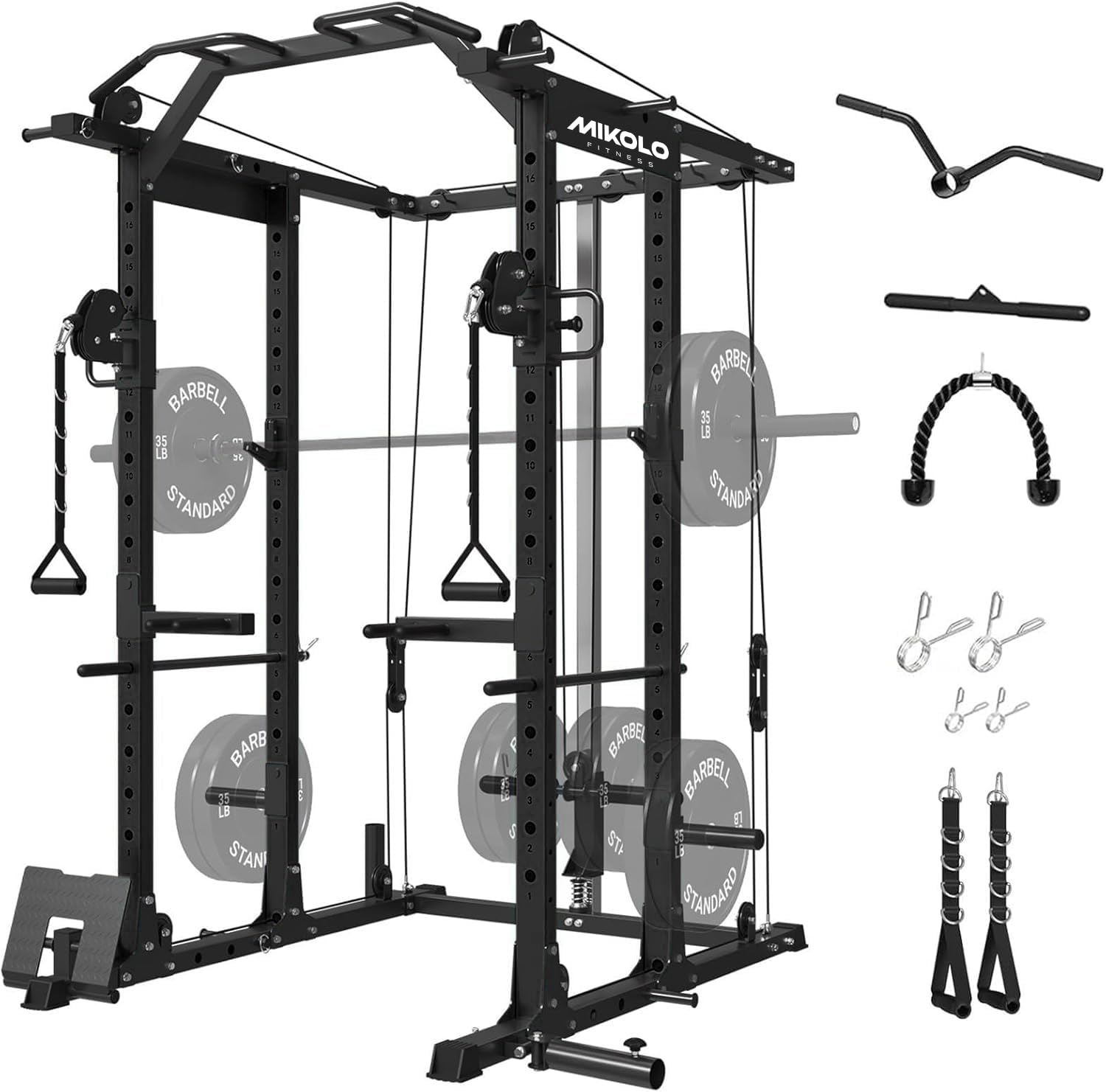
You get a lot packed into that footprint: a power rack, a cable crossover, a lat pulldown station, a 2:1 ratio low row station with a footplate, a chin-up station, a dip station, a core trainer, and a resistance station. The 2:1 ratio means the plate you load pulls at half the resistance on the handle (load 100 lb, feel about 50 lb) — smooth for cable work, but you feel less of every pound. Inside, 41 inches by 60 inches is deep enough for almost all weight benches, so you can bench inside the cage with the safety arms in place. Before you order, check that your space clears the 56.5-inch width and 86.4-inch height.
Build quality is what wins people over here, and it shows in the small parts — the upgraded pulley system runs on four white rollers that glide along the riser instead of grinding it. The included kit is unusually complete: T-bar, lat pulldown bar, tricep rope, cable bar, two cable handles, two weight storage pins, two J-hooks, two dip bars, a detachable landmine, a footboard, and spring clamps. The catch is the trolley. Buyers report the advertised 1,500 lb capacity hits a real limit, because roughly 8 inches of sleeve per side will not fit enough plates for serious pulling. And the 2:1 pulley means about 135 lb of actual resistance with six 45 lb bumper plates. If you pull heavy, plan on slim cast iron plates or accept that ceiling.
Where the K6 earns its keep
- 220-pound frame with eight reinforcing tabs holds steady during in-cage squats and bench presses
- Eight stations replace a rack, crossover, lat tower, dip stand, and landmine in one footprint
- Four-roller pulley sleeves protect the riser from wear and keep cable travel smooth
- Complete attachment kit means no surprise add-on purchases after delivery
What to weigh before you buy
- Short plate sleeves on the trolley cap heavy cable pulling well below the rated number
- The 2:1 pulley ratio halves felt resistance, so lighter plates feel even lighter
- Assembly runs about three hours and the boxes are heavy enough to need a second pair of hands
Reach for this if: you want one frame that covers barbell lifts and cable work without buying three machines.
Think twice if: your cable work lives above 150 pounds — the trolley sleeve length will frustrate you.
2. OPPSDECOR Home Gym Machine with Lat Pulldown
At 39.7 inches wide, this is the machine that actually fits a spare bedroom.
Look at the width first: 39.7 inches is narrower than most power cages by a wide margin, and that is the whole point of this machine. The 65-inch depth and 79.1-inch height keep it under a standard basement ceiling too, so it slots into rooms where a full cage would not survive a tape measure. Compare it to the Mikolo K6 above at 67.5 inches deep and 56.5 inches wide — the OPPSDECOR takes up meaningfully less floor on both axes, which is the trade you make for a lighter 58.3 kg frame.
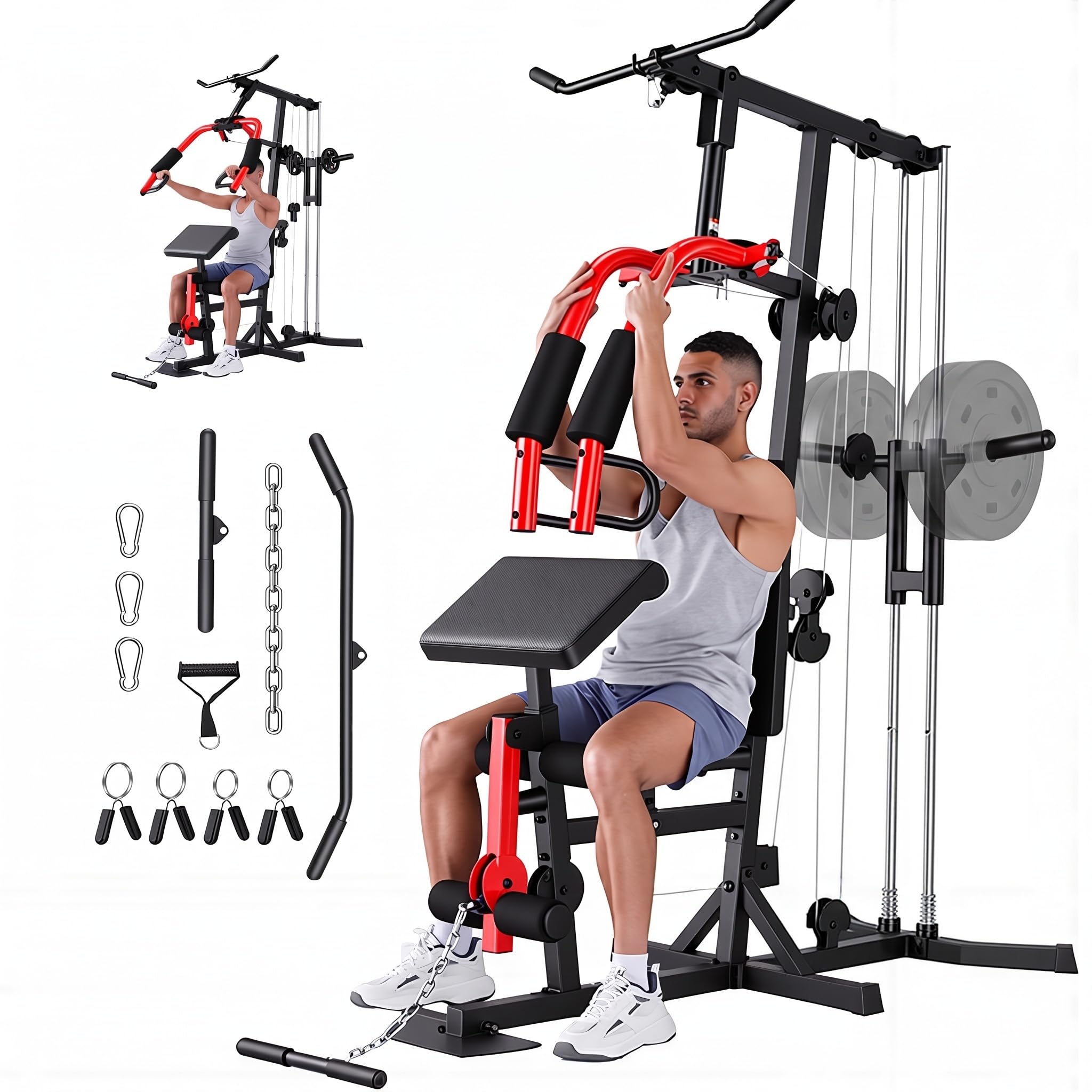
What you get for that footprint is a dual-function arm that switches between chest press and butterfly fly with a pin, plus lat pulldown, preacher curl, leg extension, and rowing stations. The seat, backrest, and preacher curl pad are each 3-position adjustable, and the curl pad detaches so it stops getting in the way. The 2-in-1 weight carrier is a genuinely clever touch — it accepts both 1-inch standard plates and 2-inch Olympic plates by attaching or removing a sleeve, so you are not locked into one plate type. Build quality carries the most weight in the owner feedback, with value for money close behind.
Assembly is the honest dividing line. Threading 13 pulleys across 3 cables is slow work, and the instructions leave gaps — the machine ships in two heavy boxes that may arrive on different days, and setting it up solo is tedious. Do it with a helper and budget several hours. One unit arrived with a lower leg cable that would barely move under light load, a frustrating one-off rather than the norm. What it does deliver is press, fly, curl, and row stations in a 39.7-inch-wide footprint.
Compact-frame payoff: 39.7 inches of width and a detachable preacher pad mean you can shift between stations without rearranging the room.
The assembly tax: 13 pulleys and 3 cables take real time to route correctly, and the manual does not always spell out the path.
Best match: a small room, a low ceiling, and a lifter who wants press, fly, curl, and row from one narrow machine.
Not your machine if: you want a true safety cage for heavy barbell squats — this is a station, not a rack.
3. SPORTSROYALS Power Cage with Pulley System (RK2)
Fourteen adjustment levels and a 500-pound cable, built for the lifter moving up from dumbbells.
The 50 by 50 mm steel square frame at 1.5 mm thickness carries a 1200-pound maximum weight recommendation, and the rack itself weighs 150 pounds with two reinforcing tabs. That is a lighter frame than the Mikolo K6’s 220 pounds, and you feel it in one specific way: the rack can walk slightly when you re-rack a loaded bar. Owners describe this as a minor quirk rather than a safety problem, and the price reflects the lighter steel.
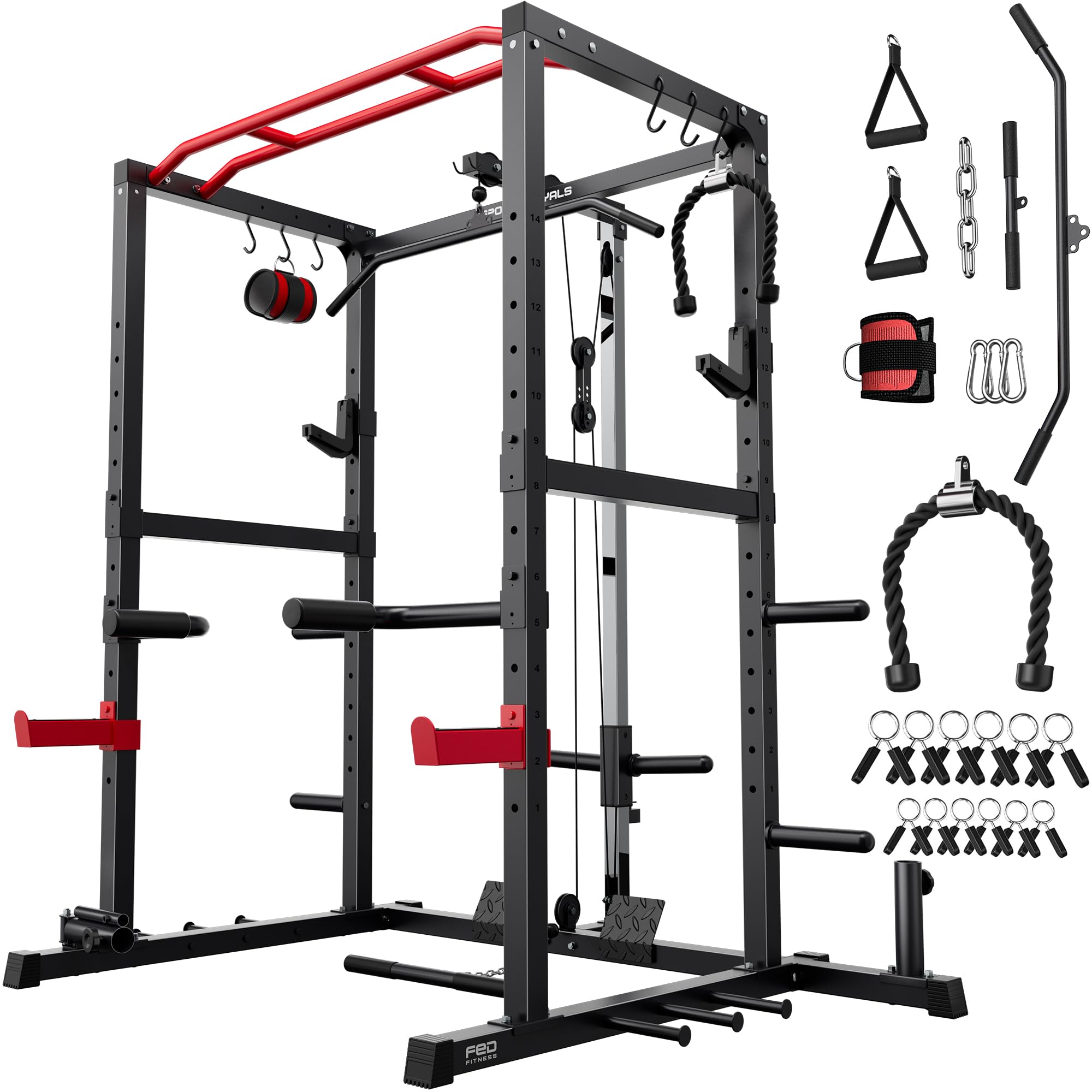
The pulley system is the standout. Precision bearing pulleys pair with fully electroplated telescopic poles, and the PU-coated steel cable (a plastic-coated cable) holds up to 500 pounds. That coating matters because bare cable frays and grabs; a coated cable keeps the pull smooth over thousands of reps. You get upper and lower pulldown stations, a squat rack, a power tower, dip bars, and a long attachment list: a rowing bar, four weight plate storage holders, six band pegs, a lat pulldown bar, an ankle strap, a 360-degree landmine, and a wide/narrow pull-up frame. The weight storage fits both 2-inch Olympic and 1-inch standard plates.
Cable feel is where the honest split shows up — the cables feel best above 70 pounds, the lowering phase (eccentric control) is not as refined as a dedicated cable machine, and the squat pulley sits close to your face on some setups. Tall users also find the inside of the cage tight for squats. With a 61.6-inch length, 56-inch width, and 82.6-inch height, measure before you commit. Its real strength is letting one person bench or use the landmine while another works the cables on the same frame.
The cable and the cage both earn their spot: a 500-pound rated PU-coated cable is a serious component for this tier, and 14 height positions let you dial in safety arms for squats and bench alike.
Frame weight is the tell: at 150 pounds against the 220-pound K6, expect a little movement when you re-rack.
Pick it when: you are building your first real rack and want cable work, a landmine, and dip bars without stretching the budget.
Choose a heavier frame instead if: you regularly squat near 500 pounds and want zero movement on re-rack.
4. Marcy Pro Deluxe Cage System PM-5108

One of the few picks that ships with the bench already in the box.
Most cages leave you to buy a bench separately, which adds cost and one more decision. This one bundles a multi-position utility bench that adjusts to incline, flat, and decline, so chest work is ready the day it arrives. The cage is built from oversized 14-gauge square tubing with a powder coat finish, sized at 68.25 inches deep, 44.33 inches wide, and 83.75 inches tall. It weighs 148.7 pounds.
The bench doubles as the squat station — the cage itself takes a 6- or 7-foot Olympic barbell with adjustable bar and safety catches. The high pulley lat tower and low pulley station cover the cable work, and the removable bench clears the floor when you want the cage open for squats. The leg developer and sliding weight post round out the lower-body side.
See this limit before you order: the maximum weight recommendation is 300 pounds, the bar catch is rated for 300 lbs, the leg developer for 100 lbs, and the sliding weight post for 100 lbs. That is a beginner and intermediate ceiling, not a heavy-lifting one. Assembly feedback splits down the middle — some find it straightforward, others hit picture-only instructions and part labels that read backwards for left and right. Marcy posts a downloadable manual online, so grab that first. A handful of builders mention the bench tipping under heavy leg work and bar-rest holes set too far apart for a tight setup.
The bundled bench changes the math: incline, flat, and decline positions come included, and the bench lifts out so squats get the full cage floor.
Know your ceiling number: 300 pounds on the bar catch defines who this is for — moderate lifters, not max-attempt squatters.
Right call for: a beginner or intermediate lifter who wants a bench and cage together and does not need a 1,000-pound frame.
Better elsewhere if: you already own a bench, or you plan to squat well past 300 pounds.
5. Body-Solid Best Fitness Functional Trainer

The cheapest way into a real cable crossover — and the 190 lb stack is already in the frame.
If your training lives on cables, buying a stack machine beats loading plates by hand every set. This one carries a 190 lb weight stack, so switching resistance is a pin move rather than a plate hunt. The frame measures 39 inches deep, 112 inches wide, and 82 inches tall, and the 112-inch width is what gives you a proper crossover stretch from arm to arm. It weighs 102 pounds on its own, so it is lighter than it looks.
The mechanical side is where Body-Solid earns its reputation: patented nylon bushing technology pairs with eight sealed ball bearing, high resin pulleys, and the top and bottom pulleys swivel through more than 180 degrees. That wide arc lets your hands travel in a natural path instead of a fixed groove. Exercise range covers pec fly, bench, incline, crossover, upright row, deltoid raise, shoulder press, lat pullup and pulldown, seated row, ab crunch, tricep press down, reverse fly, glute kickback, and more. The frame carries a 10-year manufacturer warranty and the parts carry one year.
Two things to plan for. First, pulleys with sealed bearings still need a little silicone spray on the vertical frames before the weight carriage will slide freely — skip that and it sticks. Second, the pulley system eats some resistance, so the number on the stack is not perfectly what you feel at the handle. Add D-handles and a lat bar to your order; the included handles are basic and most owners upgrade them fast.
Why cable purists like it
- 190 lb weight stack included means no plate shopping to get started
- Eight sealed ball bearing pulleys and over 180° of swivel give a natural hand path
- 112-inch width delivers a genuine crossover stretch, not a narrow imitation
- 10-year frame warranty and one-year parts coverage back the build
The small print
- Silicone spray on the vertical frames is required before the carriage glides properly
- Pulley friction trims the felt resistance below the stack number
- Included handles are basic — plan on adding D-handles and a lat bar
Good fit for: a garage or basement where cable work is the main event and you want a stack instead of loose plates.
Look elsewhere if: your lifting is barbell-first — this machine does not squat or spot you.
6. Mikolo HGS Pro Home Gym Station
Thirty-six inches wide with a built-in stack — this is the one for a bedroom corner.
Width is the headline: 36.3 inches is narrow enough to live along a wall, and the 80-inch height clears most low ceilings. The 75-inch depth is the dimension to check against your room, because that is the reach you need in front of the machine. It weighs 300 pounds, and that mass is why it stays put during lat pulldowns and rows instead of sliding.
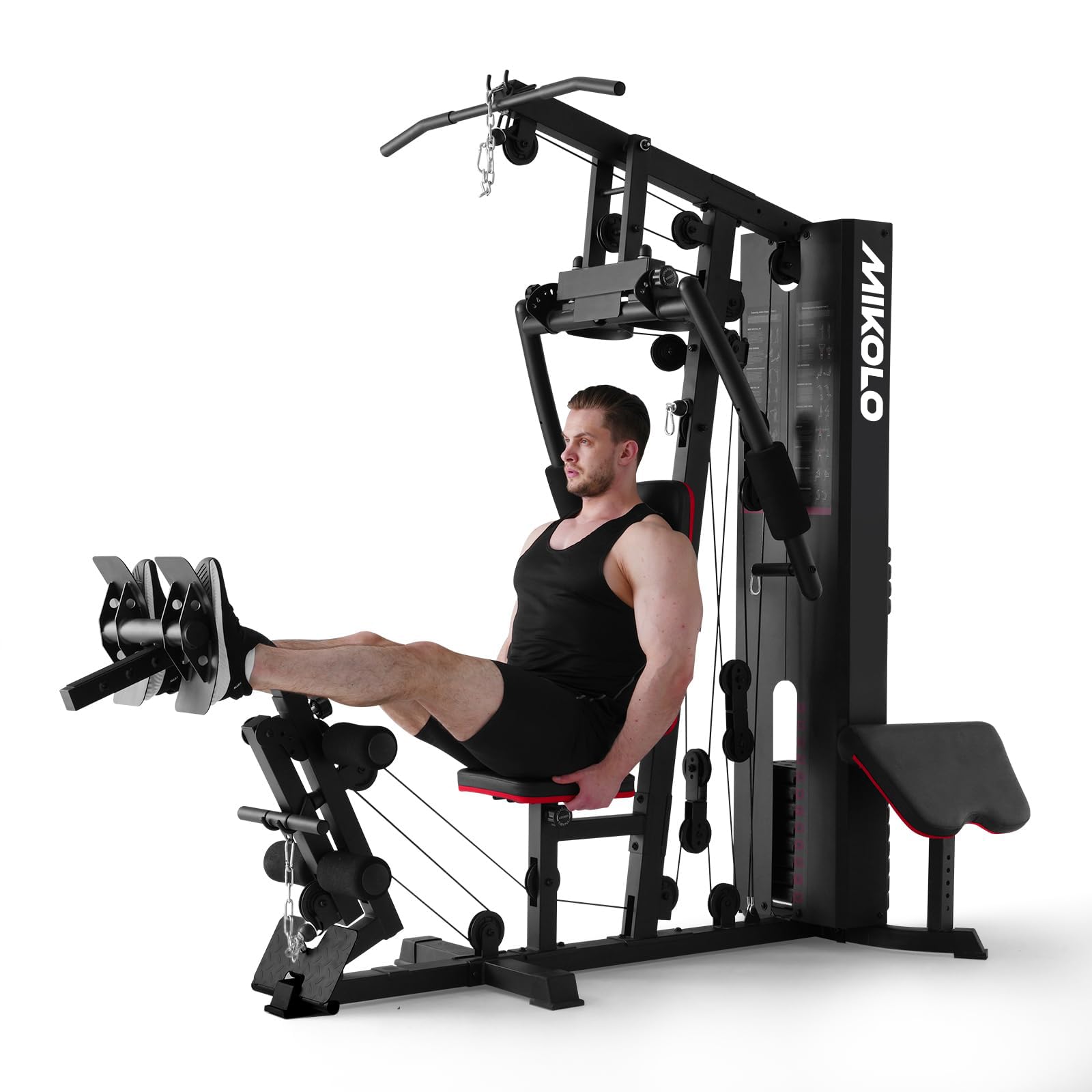
Inside that frame you get pec fly, lat pulldown, low row, chest press, leg extension, leg press, preacher curl, core trainer, calf training, seated row, and mid row — the maker lists support for over 90 exercise variations. The weight stack solves the plate problem entirely: you move a pin instead of loading plates, which is a real convenience in a small room where plates pile up. The stack runs from 10 to 154 lb in 12 lb increments, which covers most accessory and isolation work comfortably. The 14-gauge steel frame wraps the counterweight block in a protective steel sheet.
Height is the one caveat that keeps coming up. A 5’11” user fits fine, but a 6’2″ user cannot get full range of motion on most exercises — if you are tall, this machine will frustrate you on lat pulldowns and rows. Seat adjustment only moves up and down, not forward and back, which a shorter user found limiting. Assembly takes roughly four to five hours and the cable routing guide is thin, so plan to redo a pulley or two. Customer support handles the rest well: replacement bushings and a dented cover panel both arrived quickly.
Footprint discipline: 36.3 inches of width and a 150 lb stack turn a corner into a full cable station with no plate storage needed.
The height ceiling: taller lifters lose range of motion, and the seat only adjusts vertically.
Built for: a small room, a low ceiling, and a lifter who wants pin-select resistance without buying plates.
Skip the fit if: you stand 6’2″ or taller — your range of motion will be short on most movements.
7. SunHome Smith Machine SH-999

Fail a heavy bench alone and the bar locks where you left it.
Training without a spotter is the reason Smith machines exist, and this one takes it seriously with auto-lock safety hooks that catch the bar at any point along the track. The frame is built from commercial steel square tubing at 2 mm thickness, and the machine weighs 440 pounds — that weight is what keeps the bar path true when you push hard. The maker rates the cage for 2000 lbs and lists a footprint of 72 inches deep, 60 inches wide, and 90 inches tall.
The 3-in-1 layout adds a patented butterfly chest station to the Smith bar and pulldown system, which lets you superset squats with flyes without moving equipment. Storage is handled with 6 weight plate posts, 1 barbell post, and accessory hooks, so the floor stays clear. The pulley system uses a rolling bearing design rather than a sliding one — the rolling action runs smoother, quiets down the cable travel, and wears the parts less over time. A rowing cable is included for seated rows.
Quibbles center on assembly. The instructions are pictures and numbers with no words, and the parts are not numbered or lettered, so matching hardware to the diagram takes patience. One owner describes it as “honestly horrible putting it together with the instructions,” then adds that it has “exceeded my expectations for a cheap at home machine” after a month of use. Budget most of a day, especially solo. The 90-inch height is also the tallest pick in this group and needs real overhead clearance.
What sold owners on it
- Auto-lock safety hooks catch a failed rep at any angle with no spotter present
- 440-pound frame and 2 mm commercial steel keep the Smith bar path straight
- Rolling bearing pulleys run quieter and wear less than sliding designs
- Six plate storage posts and a barbell holder keep a garage floor clear
Before you order
- Picture-only instructions with unlabeled parts stretch assembly into most of a day
- 90-inch height needs generous ceiling clearance in a basement or garage
- Reracking the Smith bar takes some getting used to
Ideal owner: a solo lifter who wants to push heavy bench and squat without a training partner in the room.
Measure twice if: your ceiling sits near the 90-inch mark — this is the tallest frame here.
8. MAJOR FITNESS F22 Power Rack
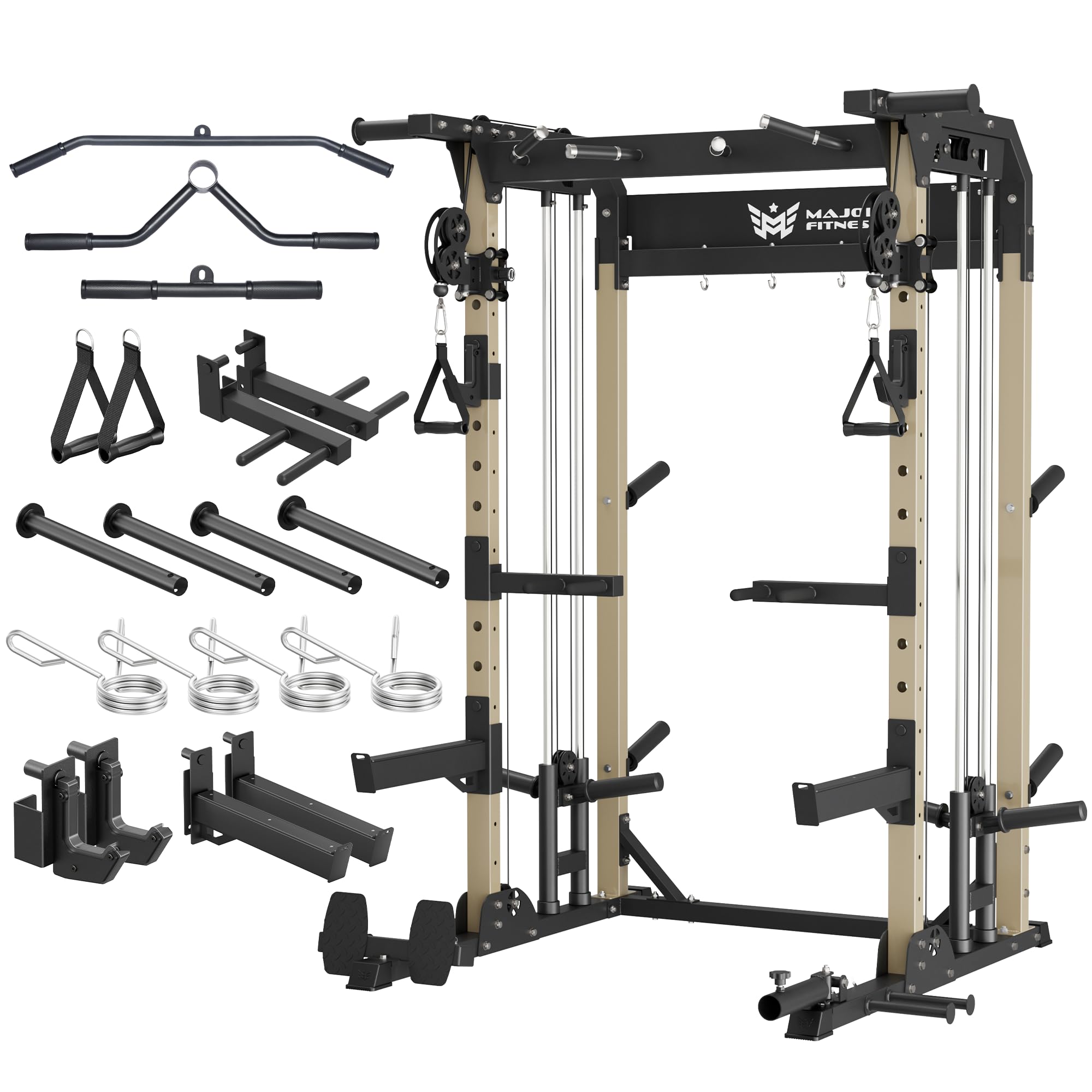
Two pulleys that run independent of each other, so two people can train at once.
Most cable racks share one cable path, which means one lifter at a time. The F22 splits it: an independent dual-pulley system at a 2:1 ratio means you and a partner can work without cable interference, and you can run circuits with a different weight on each side. That 2:1 ratio gives smoother cable travel and finer resistance steps, which is why quick drop sets feel more controlled here than on a single-pulley rack.
The frame is 2 by 3 inch commercial-grade 14-gauge steel at 0.08 inch thick, rated for a 1600 lb static weight capacity, and the machine weighs 243 pounds. The dual-triangle base spreads contact across more floor, which is the reason it holds steady during weighted pull-ups without bolting down. Dimensions run 68.9 inches deep, 55.5 inches wide, and 82.5 inches tall. Sturdiness is the trait that gets the most praise from owners, with functionality close behind.
Two things to know. The pulley system asks for circular plates, which makes mid-workout weight changes slower than a pin stack — if you like fast transitions, that is a real annoyance. And a few units have arrived with bent parts in transit, so inspect the boxes before you sign. Assembly itself runs roughly three hours and owners describe it as straightforward. The included attachment set covers J-hooks, safety arms, foot pedals, landmine, T-bar, dip bars, lat pulldown, cable bars, and band pegs.
The independent-pulley advantage: separate trolleys let two lifters train simultaneously and allow a different load on each side for circuits.
Plate style matters: circular plates are required, so a fast plate swap is not happening mid-set.
Worth it for: a couple or a partner-training household where two people share one rack.
Not the pick if: you want instant resistance changes — a weight stack serves that better.
9. pooboo P43 Power Cage Smith Machine
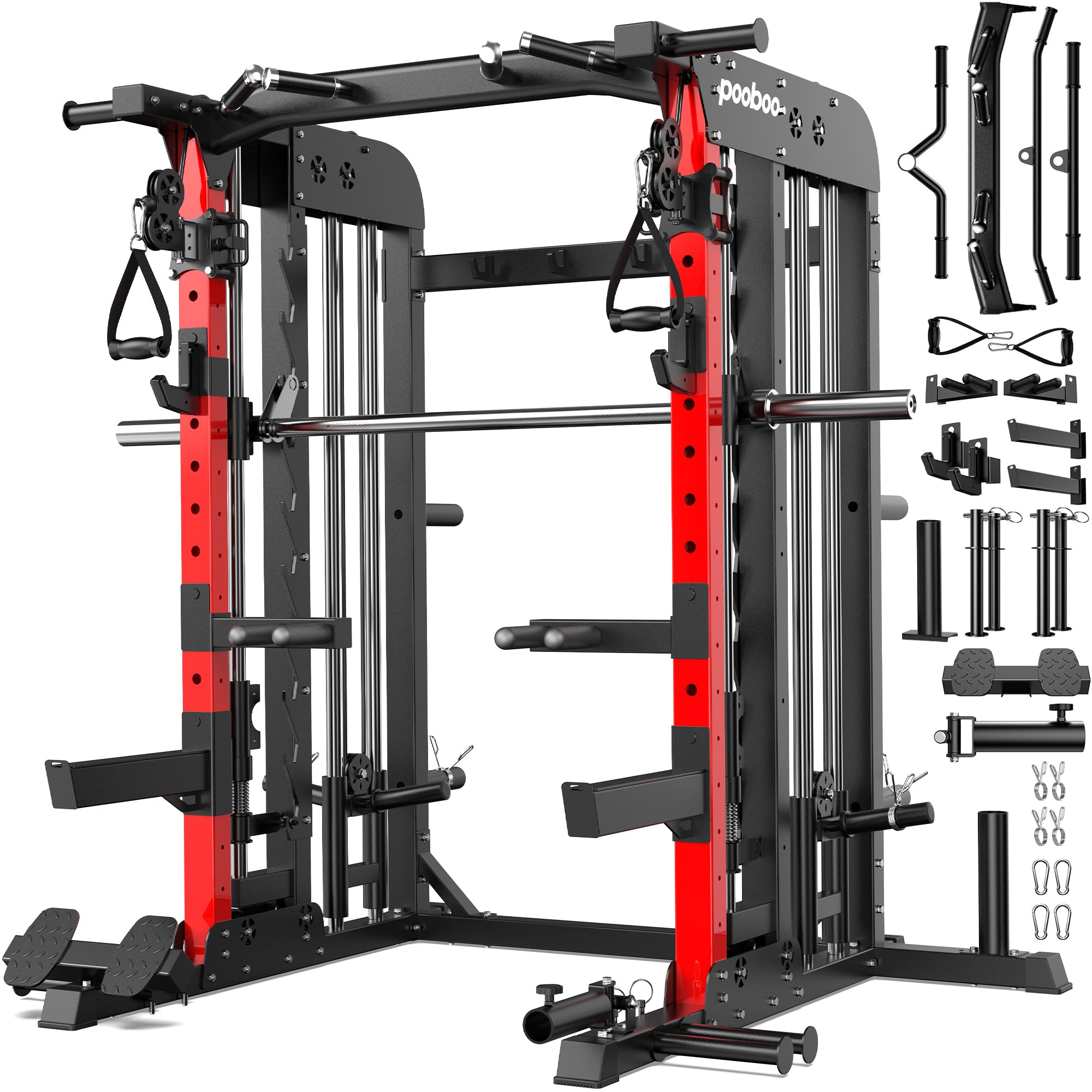
Twenty-plus attachments and a 2,000-pound rating in a frame under 63 inches deep.
Start with the load number, because it is the highest on this list: 2,000 pounds of supported weight on heavy-duty steel. The machine weighs 417 pounds, which is the mass that makes that rating mean something during a loaded Smith bar path. Footprint runs 62.9 inches deep, 43.3 inches wide, and 82.6 inches tall — the 43.3-inch width is narrow for a cage with a Smith bar and dual pulleys, so measure your wall clearance carefully.
The kit is the real draw here. Over 20 free attachments ship with it: 2 J hooks, 2 safety spotter arms, 2 dip bars, 2 cable grip handles, a lat pulldown bar, a row bar, a row low foot board, a 360-degree landmine, 4 plate storage pins, 4 weight holders, and 4 band pegs. That covers cable flys, lat pulldowns, landmine movements, rows, squats, bench presses, deadlifts, curls, tricep extensions, pull-ups, and chin-ups without another order. Owners rate quality highest, with value for money close behind.
Assembly is orderly but long. Parts come in multiple boxes, the manual has clear pictures, and one builder spent roughly three days across ten hours with a child helping. Two notes from use: grease the slide bars, because they squeak after a couple of weeks, and plan for a second person on the pull-up cross-member. The P43-Pro version adds a free Olympic bar, lat training handles, a barbell pad, a triceps rope, and an ankle strap if you want the fuller kit. A one-year warranty covers the frame and accessories.
Attachment depth: 20-plus pieces including a landmine, spotter arms, and four weight holders means you can train a full split from day one.
Grease the slides: the slide bars squeak within a couple of weeks without lubrication.
Made for: a lifter who wants the highest rated frame here and a complete attachment kit in a single order.
Give it a second thought if: your room is narrow — 43.3 inches of width leaves little margin beside a Smith bar.
10. Marcy Smith Machine Cage System SM-7409

Smith bar, dual height pulleys, low-pull cable, and a pec deck in one steel frame.
This is the multi-station route: a Smith machine with safety catches, dual height-adjustable pulleys, a low-pull cable, and a pec deck, all on a durable steel frame measuring 86 inches deep, 70 inches wide, and 84 inches tall. The maximum user weight is 300 lbs. If you want to move between chest, back, and squats in a single session without leaving the platform, this layout is built for exactly that.
What it solves is ceiling and space efficiency in reverse — this machine occupies real floor, but it covers more training stations than a plain cage. The Smith machine handles incline bench and squats with the safety catches set and no spotter. The dual pulleys cover high and low cable angles, and the pec deck adds a chest station you would otherwise buy separately. Owners describe the machine as sturdy and massive once assembled, with smooth operation on the cables and pulleys.
Assembly is the part nobody enjoys. Parts arrive in five boxes packed out of assembly order, so you open everything to identify hardware first. One builder logged 177 parts and spent two hours just labeling them. Plan on several sessions with a ratcheting wrench and a helper for the overhead pieces. Two functional gaps worth knowing: there is no lat pulldown attachment included, and the bench sits high for some users. A weight trolley that sticks under load has also been reported, and lubricating the guides is the first thing to try.
Station count wins: Smith bar, dual pulleys, low cable, and pec deck under one frame cover most of a push-pull-legs split.
No lat pulldown included: plan to add a pulldown attachment if vertical pulling matters to you.
Fits the plan if: you want a Smith machine plus pec deck plus cables and have the floor to place an 86-inch-deep frame.
Check first if: lat pulldowns are central to your training — that attachment is not in the box.
11. Body-Solid Powerline PFT100 Cable Crossover

Two independent 160 lb stacks that let each arm work on its own terms.
True isolateral training needs two separate weight sources, and this machine delivers with dual independent 160 lb weight stacks at a 1/2:1 weight ratio. That means each arm pulls from its own stack, so you can even out a weaker side instead of hiding it behind a shared cable. The extra-wide mainframe measures 42.3 inches deep, 62.6 inches wide, and 83 inches tall, and the machine weighs 476 lbs — the heaviest pick on this list, and the reason it stays planted.
Exercise range spans cable crossovers, shoulder presses, pull-ups, leg kickbacks, pec fly, incline, upright row, deltoid raise, seated row, ab crunch, tricep press down, reverse fly, and glute kickback — essentially the full high and low pulley book. The electrostatically applied powder coat finish resists scratching, and the frame carries a 10-year manufacturer warranty with one year on parts. Durability and smooth operation both come up consistently in owner experience, with the glide described as silky.
The real limit is the stack size. At 160 lb per side, advanced lifters will run out of resistance on heavier movements — one experienced user bought this and immediately wished for the larger stack. Order the bigger version if you pull heavy. Assembly runs a couple of hours with two people, and the instructions are vague in spots, with one undocumented part showing up mid-build. No spare hardware ships in the box, so keep your own bolts handy.
Why the dual stack matters
- Two independent 160 lb stacks deliver true isolateral resistance for each arm
- 476-pound frame with an extra-wide mainframe stays planted under heavy crossover work
- 10-year frame warranty with one year on parts backs the build
- High and low pulleys cover nearly every cable movement in one footprint
Where it caps out
- 160 lb per stack leaves advanced lifters wanting more resistance
- Instructions are vague in places and no spare hardware is included
- 62.6-inch width needs a dedicated wall or garage bay
Right shopper: a cable-focused lifter who wants matching resistance on each side and a frame that never shifts.
Pick the larger stack instead if: your working sets go heavy — 160 lb per side will not hold you long.
Know the Specs
Maximum weight recommendation
This is the load the maker says the frame can handle, and it tells you what kind of steel sits under the powder coat. A 2,000-pound rating points to a heavier gauge frame and thicker uprights, while a 300-pound rating is honest about being a beginner and intermediate machine. Match the number to your actual training, not to the biggest weight you might one day lift.
Pulley ratio (2:1 vs 1/2:1)
A ratio describes how much of the loaded plate reaches your hand. At 2:1, the resistance on the handle is roughly half the load, which makes each cable pull smoother and gives you finer weight steps. At 1/2:1 on a stack machine, you feel more of the stack. Neither ratio is superior — the number tells you how much plate to load to feel a given resistance.
Machine weight and stability
The weight of the frame itself acts as ballast. A 440-pound machine resists walking and tipping far better than a 150-pound one, especially when you re-rack a loaded barbell or pull a heavy cable. If your floor is slick or the rack sits on a mat, a heavier frame is the difference between a planted feel and constant repositioning.
Footprint and ceiling clearance
Depth, width, and height work together to decide whether a machine belongs in your room. A true cage needs internal depth so a bench fits inside the frame, a Smith machine needs bar-path clearance overhead, and a crossover needs width for a full stretch. Check all three numbers against your room before you buy anything.
Weight stack versus plate-loaded
A stack machine moves resistance with a pin, which suits drop sets and quick transitions. A plate-loaded cage costs less upfront but needs plates, and plates are a real purchase on their own. Stack machines also cap the available resistance, so a 160-pound stack suits most accessory work but not heavy compound pulling.
Steel gauge and tube thickness
Gauge and thickness are the quiet specs that decide how a rack feels years down the line. Fourteen-gauge square tubing at 2 mm or 1.5 mm thickness with reinforcing tabs resists flex during squats and rack pulls. Thin steel may hold your current loads but can flex as you get stronger, so buy a little above your present ceiling.
Common Questions
How much floor space does a power cage really need?
What does a 2:1 pulley ratio actually mean for my lifts?
Will a Smith machine fit under a basement ceiling?
Is a weight stack better than loading plates by hand?
How long does assembly take on a full home gym machine?
Do I need to bolt a power cage to the floor?
Can two people use the same home gym at once?
What height of lifter does a compact machine suit?
Do cable machines come with the plates or the weights included?
The Bottom Line
For most people building a home gym, the smart home gyms winner is the Mikolo K6 Power Cage. It puts a stable 220-pound cage, a cable crossover, a lat tower, and a landmine in one frame that fits a garage bay. If cables are your main training and you want resistance that changes with a pin, grab the Body-Solid Best Fitness Functional Trainer and its 190 lb stack. And for the solo lifter who needs to fail a heavy bench without a spotter, the SunHome SH-999 Smith Machine is the one to reach for.
One last thing worth acting on: the pooboo P43 carries the highest load rating in this whole group at 2,000 pounds and ships with more than 20 attachments. If you want the highest-rated frame here with the fullest attachment kit, put it on your shortlist.
How we choose
We do not accept paid placement. Every pick is matched to a real buyer and a real use-case; we do not hands-on test units.
Sources
Specifications: manufacturer listings and product documentation. Review insights: verified customer reviews, as of October 2026. Pricing: not shown on this page (it changes often); check the current price via the retailer link.
As an Amazon Associate, Aappliancez earns from qualifying purchases. This does not affect which products we feature.