Disclosure: Some links in this post are affiliate links. As an Amazon Associate I earn from qualifying purchases, at no extra cost to you. Learn more
Specs are compiled from manufacturer listings and verified buyer reviews and can change over time — please confirm the key details on the product page before buying.
If you want the smallest video camera that still delivers usable 4K footage, the answer depends on where you plan to wear it. For smooth, gimbal-stabilized clips you can shoot hand-held or on a mini tripod, the Xtra Muse is the strongest all-round pick. For hands-free chest or cap mounting, a thumb-sized body cam makes more sense. This guide compares seven compact video cameras on the specs that actually decide how they feel in daily use: sensor size, stabilization, battery run time, and weight.
This guide is built by comparing the manufacturers’ published specifications and the patterns across verified customer reviews, so you get each pick’s real strengths and trade-offs instead of marketing spin.
Each pick gets its strengths, its trade-offs, and the form factor it suits: gimbal for vlogging, body cam for POV, action cam for travel. By the end, the right smallest video camera for your pocket or mount should be obvious.
Top Picks

How To Choose The Best Smallest Video Camera
A palm-sized camera is only useful if the footage stays steady and the battery outlasts the shoot. Your choice depends on three things: how you plan to mount it, how steady your hands are, and how long you need to record.
Stabilization: gimbal vs electronic
A gimbal is a motorized arm that physically holds the lens level, so walking and hand-holding produce smooth motion. Electronic image stabilization (EIS) crops and shifts the frame in software instead. A gimbal generally wins for hand-held vlogging, while EIS is lighter and smaller for action mounts. Some tiny body cams skip stabilization entirely, which shows up as shaky footage when you move fast.
Sensor size and low light
A 1-inch sensor gathers more light than the tiny sensor inside a thumb cam, so indoor and evening footage holds up better. If most of your shooting is outdoors in daylight, a smaller sensor is fine and keeps the camera pocketable. If you film indoors or at dusk, lean toward the larger sensor.
Mounting and form factor
Gimbal cameras (cameras with a motorized stabilizer that keeps the shot steady) sit on a handle or tripod and point where you aim them. Body cams clip to a shirt, stick to metal with a magnet, or hang from a pendant so your hands stay free. Pick cinematic framing or a first-person view first — that single choice eliminates half the list before you compare specs.
Side-by-Side Comparison
| Model | Best For | Display | Video Resolution | Battery | Amazon |
|---|---|---|---|---|---|
| Xtra Muse★ Best Overall | Hand-held vlogging with smooth gimbal footage | 2-inch touch screen | 4K at 120fps | 161 minutes | Amazon |
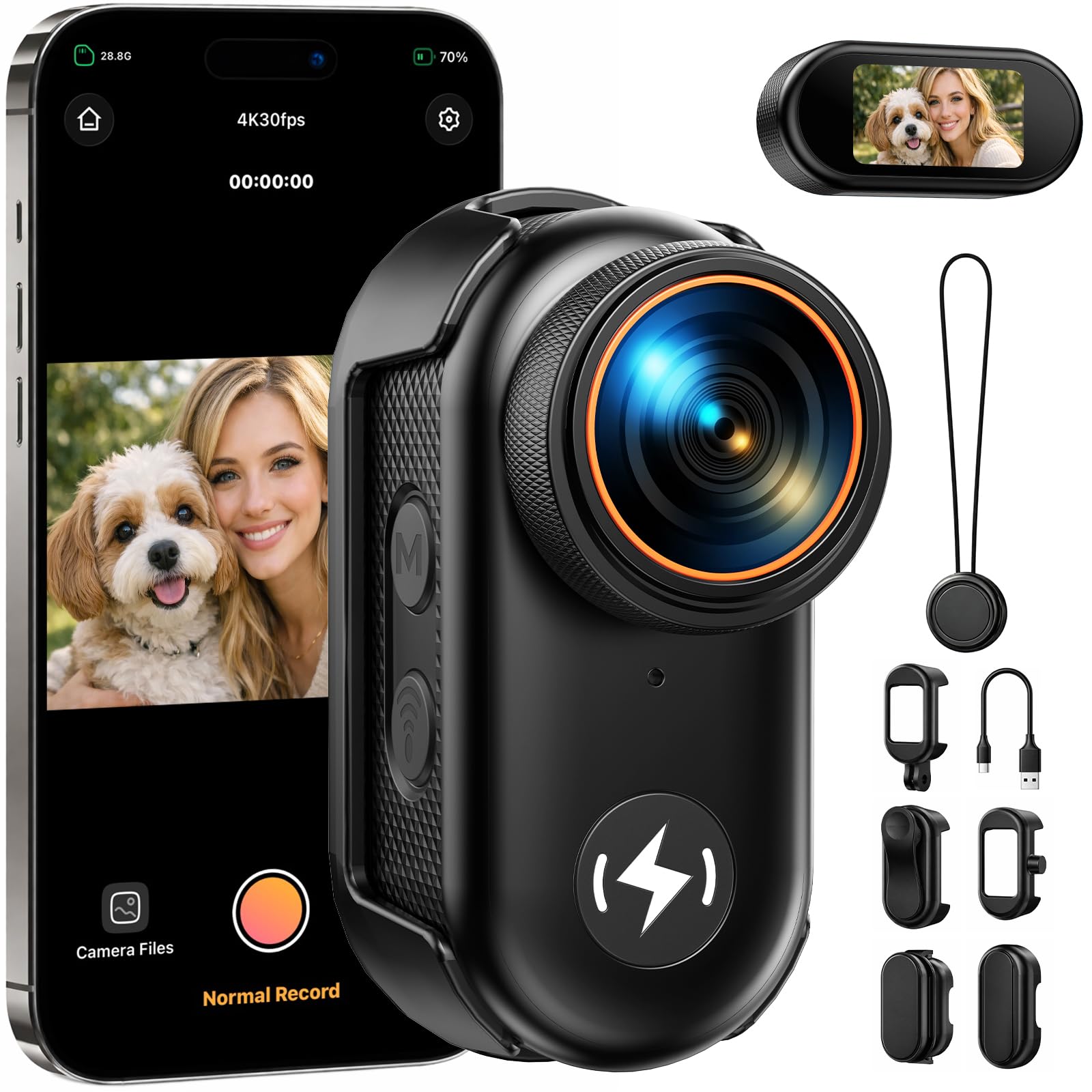
| CAMWORLD 4K Mini Body CameraBest POV Pick | Hands-free POV and safety recording | 1.47-inch HD screen | 4K at 30fps | — | Amazon |
| ZYDIIE 4K Camcorder | Beginners who want batteries and a card included | 3-inch touchscreen, 270° rotation | 4K, 64MP photos | Two batteries included | Amazon |
| FlyFrost 8K Camcorder | Budget buyers chasing an 8K label and a mic | 3-inch touchscreen, 270° rotation | 8K at 15fps | Two batteries included | Amazon |
| SJCAM C400 | Long-shoot travel and action POV | — | 4K Ultra HD | 7 hours (460 minutes) | Amazon |
| Canon PowerShot V10 | Pocket vlogging with a large sensor and stand | Retractable front-facing screen | 4K at 30fps | 2 hours | Amazon |
| Insta360 GO Ultra | Wearable 4K for cycling, running, and travel | Action Pod dock | 4K at 60fps | 200 minutes | Amazon |
Detailed Reviews
1. Xtra Muse Vlogging Camera
Our pick — 4.0+★ from 450+ verified ratings; the strongest balance of quality and price.
A gimbal camera that fights the shake so your walking vlog looks like it was shot on rails.
The Xtra Muse puts a 1-inch CMOS sensor (the large light-gathering chip that decides low-light quality) into a pocket gimbal body, and records 4K video at up to 120fps. That high frame rate lets you slow footage down in editing without it turning to mush. A 3-axis gimbal stabilizer physically holds the lens level, so dancing, running, or hiking stays smooth instead of shaky. This is the crowd favorite here — 4.0+ stars across 400+ owners.
What wins people over is sheer image quality: it is the most-praised attribute by a wide margin, and the footage is repeatedly described as rivaling gear that costs far more. A 25-year pro bought it for a run-and-gun job and found the footage held up against far pricier gear. Buyers report it also ran 131.86 minutes of 4K30FPS recording to 0% with no overheating once the screen was off. The 2-inch touch screen flips between horizontal and vertical shooting, and true 10-bit X-Log color grading gives editors up to one billion colors to work with for sunrises and sunsets.
The honest catch is battery life and app polish. Some owners mention the battery drains quickly and suggest an attachment for long shoots, so a full-day event may need a top-up. The companion XTRA app is less sturdy than the big-name competition, and wireless mic pairing needs a firmware update to pair without a receiver. For a compact gimbal camera that keeps footage steady, that is a fair trade — the stabilization is the reason you buy it.
What earns the top spot
- 1-inch CMOS sensor with 4K at 120fps for slow-motion detail
- 3-axis gimbal keeps running and dancing footage smooth
- 161-minute battery run time on paper for long sessions
- 10-bit X-Log color for flexible post-production grading
Where it asks patience
- Battery can die fast on heavy shoot days — pack a top-up
- XTRA app trails the bigger-name apps in polish
- Struggles in genuinely challenging lighting
Grab this if: you vlog hand-held and want gimbal-smooth footage from a camera that fits in a pocket.
Think twice if: you need all-day battery without a spare — a run-and-gun day will need a top-up.
2. CAMWORLD 4K Mini Body Camera
Clip it to your shirt and forget it is there — a 44g first-person recorder.
At 44g this is the lightest camera in the group, and its 150° ultra-wide-angle lens grabs a first-person point of view without you aiming anything. It records 4K at 30fps, and a built-in microphone captures audio. A magnetic mount lets you stick it to metal, a backpack, or a helmet for hands-free recording on bikes and motorcycles. Note that it has no EIS or mechanical image stabilization, so the footage is only as steady as your mount.
Buyers praise the build quality most, and for good reason: the 64GB card is included so you can record from the start, and the 1.47″ HD screen lets you preview and replay clips without grabbing your phone. A security guard’s family found the strong magnet held through a shirt, the one-button recording simple, and the video sharp despite sweat and heat. The native 16:9 and 9:16 vertical modes mean TikTok-ready clips need no cropping. Weigh that against the lack of stabilization: one Manhattan buyer returned it because moving footage came out shaky.
Battery life is the real constraint — a full day of continuous use will outlast it, so plan on short bursts or a top-up. For a discreet commute, ride, or safety-recording cam, 44g and a 150° lens cover a lot of ground.
The size angle: 44g and a thumb profile make it genuinely forgettable to wear — a big deal for commuting and travel.
The honest limit: no stabilization means you should mount it firmly; walking-heavy footage will wobble.
Reach for this when: you want hands-free POV on a ride, a commute, or a trail without a bulky rig.
Look elsewhere if: smooth walking footage matters — the missing stabilization shows up on the move.
3. ZYDIIE 4K Video Camera Camcorder
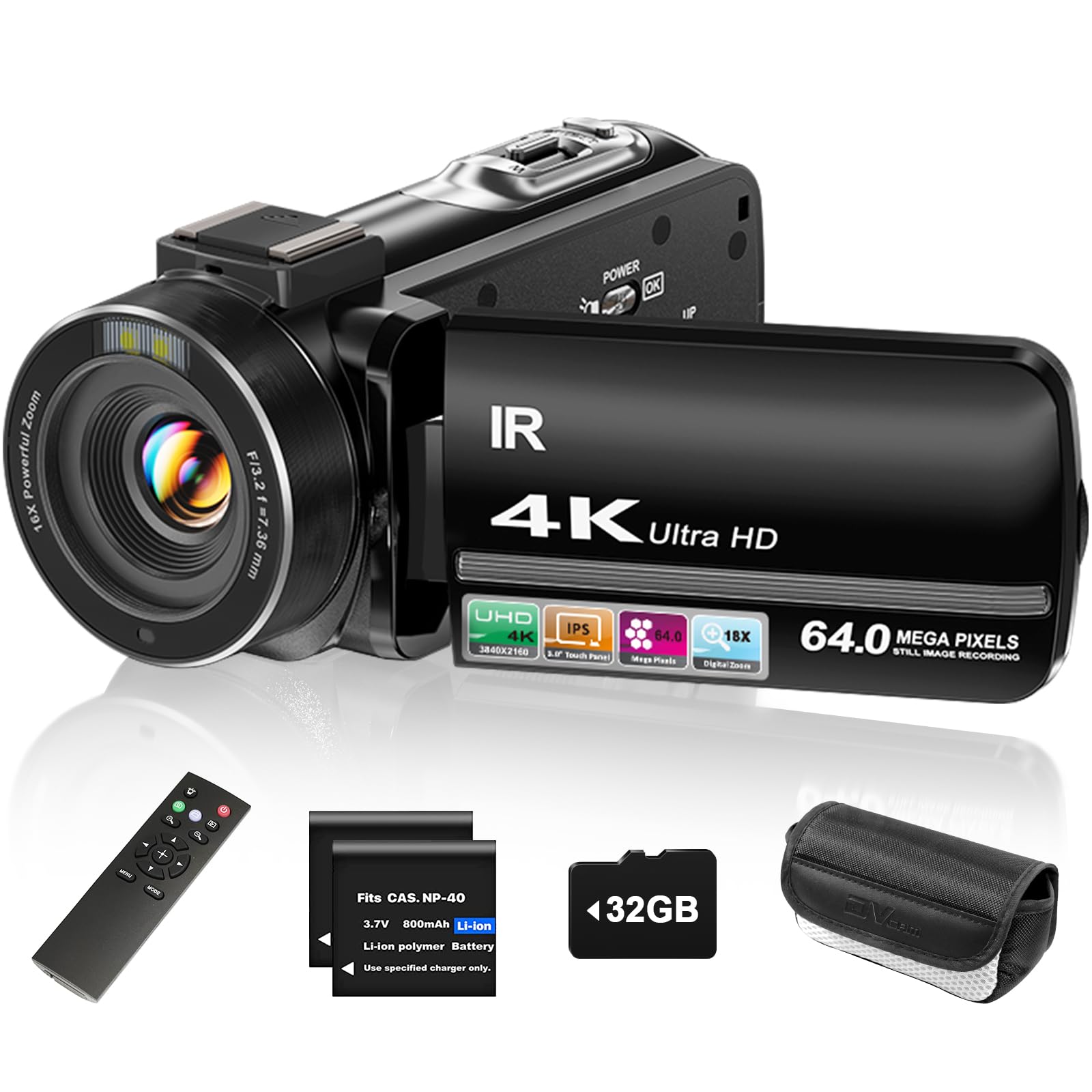
The complete starter kit — two batteries, a card, and a 270° screen in one box.
Where the pocket cams ask you to buy accessories, this one ships with a 32GB card, two high-capacity batteries, a remote control, and a charging cable. It records 4K Ultra HD video and 64MP photos through a high-sensitivity CMOS sensor. The 3-inch touchscreen rotates a full 270°, so you can frame yourself for solo shots or angle the screen overhead and still see it. Its 18x digital zoom pulls distant subjects closer, and an IR cut filter switches the camera into black-and-white night vision in total darkness.
The quality is what earns it a place: it is the most-praised attribute with over 220 mentions, and video quality follows close behind. That tracks with the flat feel of the reviews — it quietly does the basics well for beginners, family events, and travel, and the rotating screen makes self-recording painless. A wireless remote starts and stops recording without touching the body, and plugging in a single USB cable turns it into a webcam for livestreams. At 4.0+ stars across 900+ owners, it has one of the largest review bases in this list, and it is the most affordable pick here.
Two things to know. The remote can turn the camera off but not on, so you still power up by hand, and the auto power-off timer means you restart and refocus for stationary wildlife shots. Neither is a dealbreaker for run-and-gun vlogging — but if you shoot waiting shots on a tripod, budget time for the manual wake-up.
Why beginners grade it high
- Two batteries plus 32GB card and remote in the box
- 270° rotating touchscreen for self-recording
- IR night vision for dark-room footage
- Doubles as a plug-and-play USB webcam
The trade you should weigh
- Remote cannot power the camera on — manual start only
- Auto power-off needs a manual restart for stationary shots
Solid choice for: first-time creators who want everything included and a screen that flips to face them.
The one caveat: if you film long stationary setups, the manual power-on and auto-off timer will slow you down.
4. FlyFrost 8K Video Camera Camcorder

An 8K headline and a full accessory bag — read the fine print on frame rate first.
This one records video at up to 8K resolution at 15fps and captures 88MP photos, backed by a 6-axis gyroscope autofocus. The 3-inch touchscreen rotates 270° and supports 18x digital zoom. It connects over Wi-Fi to the iSmart DV2 app for wireless transfer and remote control, and pressing “OK” switches on IR night vision for black-and-white footage in dark rooms. The package includes an external microphone to cut wind and background noise, a handheld stabilizer, a lens hood, a remote, two batteries, and a 32GB card.
Here is the honest read. Quality is the most-discussed attribute, and Amazon’s own summary marks it mixed — some owners are impressed, others find the picture pixelated. The 8K figure also hides a low 15fps, and one buyer wished the frame rates sat higher across the board since 1080 offers 60. On the upside, the flip screen suits vlogging and selfies, the included mic lifts the audio noticeably, and Wi-Fi transfer saves pulling the card. Treat it as a budget camcorder with a big label rather than a true cinema tool.
For true sharp, stable 8K, look elsewhere — but as a beginner kit with mic, stabilizer, and two batteries, the accessory bundle is generous for the tier.
The accessory story: a mic, stabilizer, two batteries, and a card in the box means you shoot day one without extras.
Read the fine print: 8K runs at 15fps, and quality divides owners — check it against what you actually need.
Best for: buyers who want the biggest feature list and accessories up front on a tight tier.
Look past it if: you need smooth high-frame-rate 4K or consistent image output — go for a proven small sensor or gimbal instead.
5. SJCAM C400 Vlogging Camera
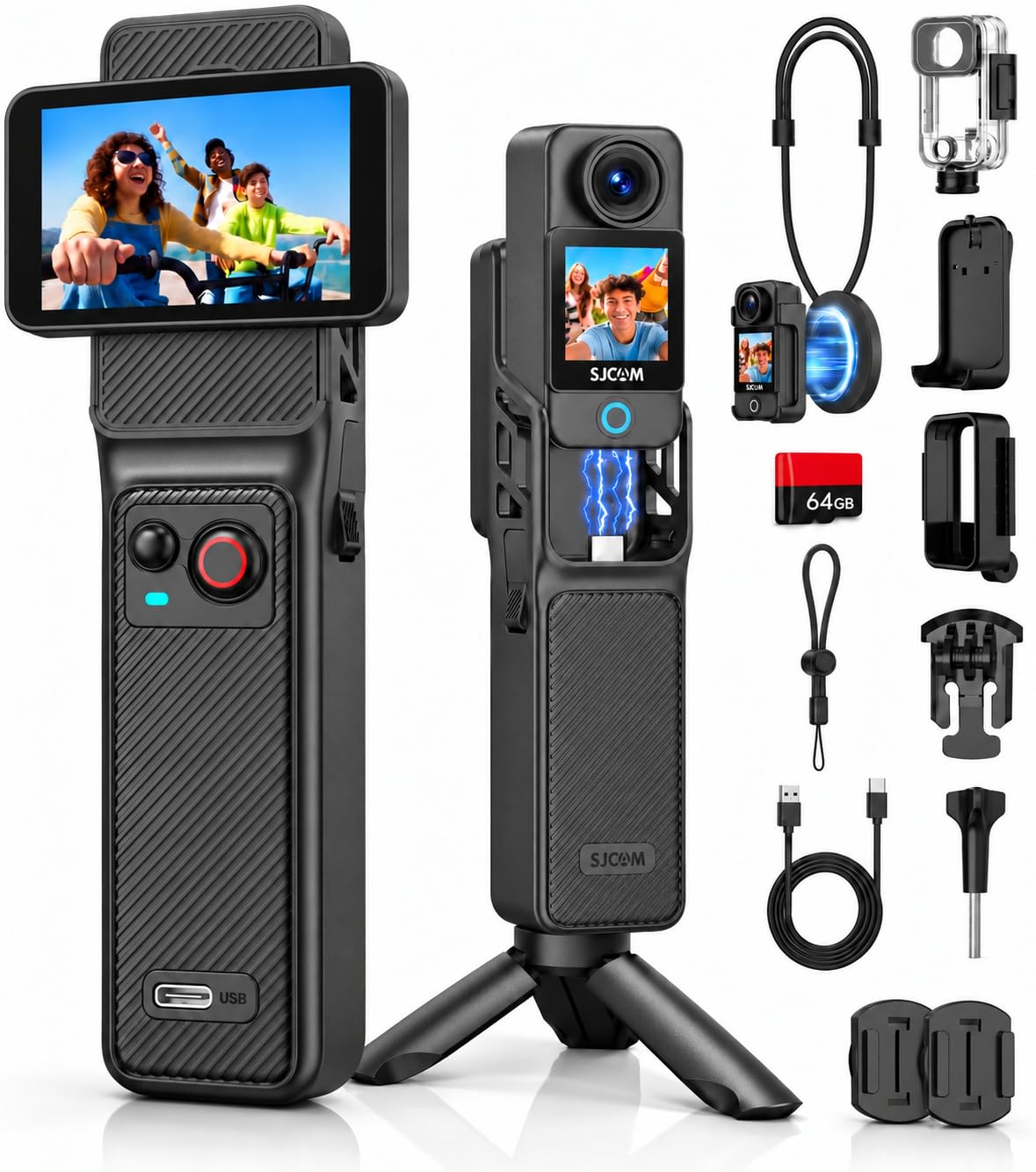
Seven hours of battery and a detachable controller — built for the long shoot day.
The big number here is run time: the SJCAM C400 is rated at 7 hours (460 minutes) of continuous shooting, so a sunrise-to-sunset shoot does not need a spare. It records 4K Ultra HD through a 154° distortion-free wide-angle lens with an f/2.0 aperture, which helps in lower light and gives a pleasing shallow depth of field. A 6-axis Electronic Image Stabilization with horizon correction keeps action footage level, and the 5G Wi-Fi module moves large 4K files to your phone fast. It is waterproof up to 30M with a full kit — waterproof housing, handlebar mount, and helmet base included — and ships with a 64GB card.
Camera quality is the thing owners praise most, and the package matches it: one rider records a lot of horse footage and rates the picture and video above the big-name competition. The detachable handheld controller lets you preview and change settings from a distance, which is welcome on a handlebar or helmet. Video quality, though, splits opinion — a few find the 4K at 30fps softer than expected, and low light is the weak spot. Sound is good in normal conditions.
Think of it as an action camera that happens to vlog well. For riders, skiers, and long shoot days that need a waterproof housing, the 7-hour rating fits. If you film indoors at night, add a light — the camera’s own low-light ceiling is real.
What the long-day shooters get
- 7-hour (460-minute) battery rating for full-day use
- 30M waterproof with housing and mounts included
- 6-axis EIS with horizon correction for action footage
- Detachable controller for distant preview and settings
What to plan around
- Low light is the weak spot — add a ring light indoors
- Some find 4K at 30fps softer than they expected
Made for: riders, skiers, and travel shooters who need runtime and water resistance over cinematic low light.
Not the one if: your filming is mostly night interiors — this needs extra light to shine.
6. Canon PowerShot V10 Compact Vlogging Camera

A 1-inch sensor and a folding stand in a body small enough for a fanny pack.
The Canon PowerShot V10 pairs a 15.2-megapixel 1-inch back-illuminated CMOS sensor with a fixed 19mm wide-angle lens (35mm equivalent) — wide enough for tight interiors but not so wide that faces distort at the edges. It captures 8-bit 4K video at up to 30fps and Full HD at up to 60fps, with 14 movie color filters to set the mood. A retractable front-facing screen lets you see yourself while filming, and the built-in stand folds front or back for hands-free angles anywhere. Three microphones — a stereo pair plus a center one to cut background noise — handle audio, with a micro-HDMI output and external mic port for expansion.
Compactness is the most-praised trait, and the portability is the pitch: it slips into a pocket or bag and powers on ready to shoot. The video holds up in sunlight and low light, and for beginner point-and-shoot use the setup is quick enough to go from pocket to filming in seconds. A crocheted case came out of one owner’s worry about the missing lens cover — a small accessory gap, not a fault. The real watch-outs are battery and longevity: the battery life is short and is the most-discussed downside, and the camera overheats quickly in some longer takes.
For travel vlogs, product clips, and quick social posts, the 1-inch sensor and pocketable body do the heavy lifting. Just carry a spare battery and do not expect long unbroken takes on a hot day.
The sensor advantage: a 1-inch back-illuminated sensor means stronger low-light footage than a tiny action-cam chip.
The real caveat: short battery life and quick overheating limit long continuous takes — pack a spare and shoot in clips.
Reach for this if: you want big-sensor image quality from a camera that vanishes into a pocket.
Look elsewhere if: you need hours of unbroken recording — this one prefers short, punchy takes.
7. Insta360 GO Ultra Creator Bundle
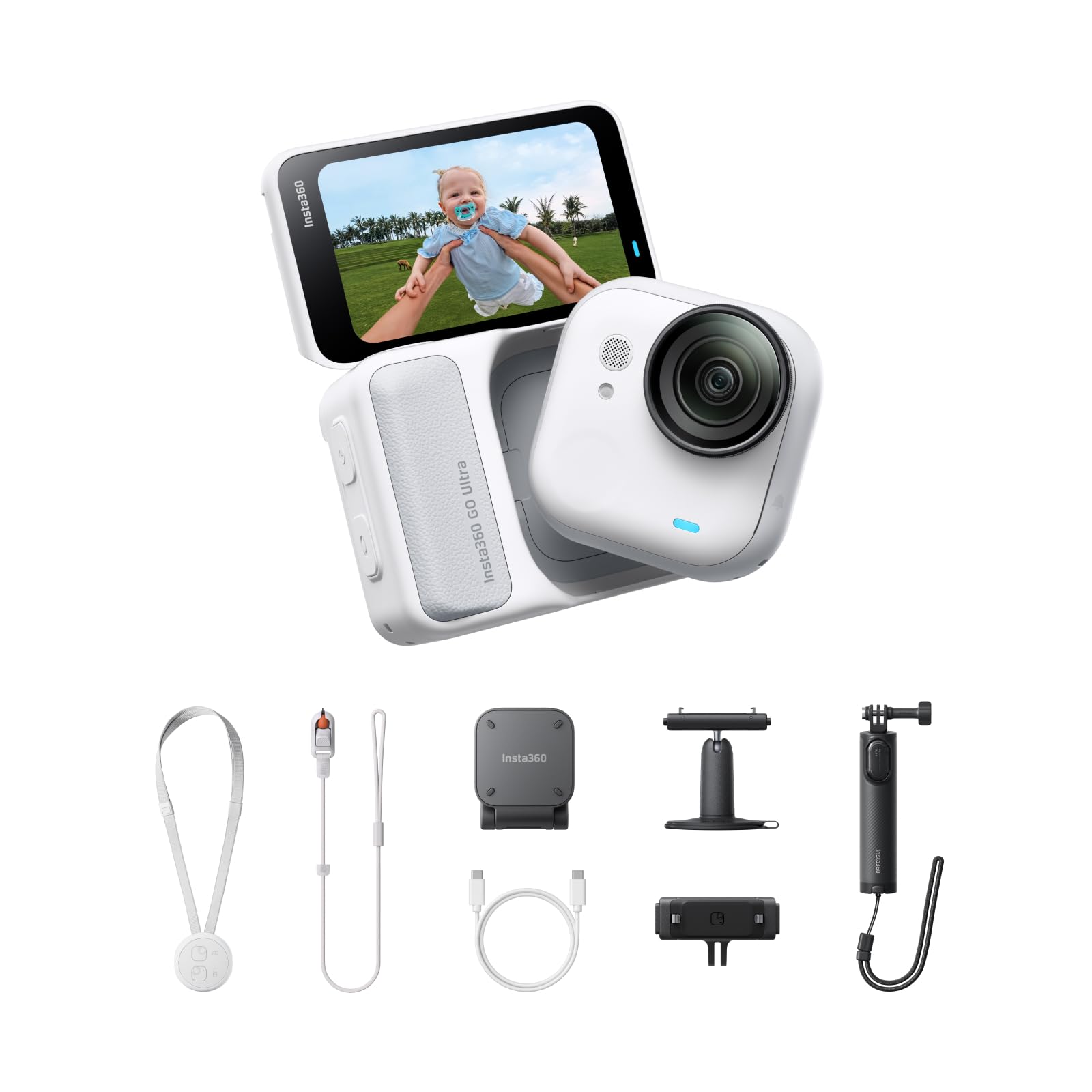
Watch-sized and magnet-mounted, so the camera goes where your hands cannot.
At 53g and the size of a watch, the GO Ultra clips to a cap or hangs from a magnet pendant for a true hands-free point of view. It records 4K at 60fps with 4K Active HDR, so floodlit and outdoor shots stay balanced. A 1/1.28″ sensor and 5nm AI chip with a PureVideo Mode push low-light performance. For steadiness it uses three levels of FlowState Stabilization plus 360 Horizon Lock, and it is IPX8 waterproof to 33ft (10m) on its own — the Dive Case takes it to 197ft (60m). Its 200-minute run time splits into 70 minutes standalone and 3 hours in the Action Pod, with a fast charge from 0–80% in 12 minutes.
What buyers talk about most is the 4K quality, and the smooth, natural look holds up. Popping it on a pendant for travel is the obvious win — compact, light, and quick to start with one button. It even doubles as a dashcam and helmet cam with better footage than a dedicated unit. The trade-offs are honest: the battery has some phantom drain when idle, and it runs warm after about ten minutes of use. It also costs a premium over the pack, which is worth flagging as a splurge rather than a first camera.
For hands-free cycling, running, or diving footage, this 53g wearable is the most refined option here. Expect to keep it charged and accept the warmth in long takes.
Why the wearable crowd loves it
- 53g watch-sized body, magnet-mount hands-free
- 4K at 60fps with 4K Active HDR
- IPX8 waterproof to 33ft (10m), Dive Case to 197ft (60m)
- 0–80% fast charge in 12 minutes
Where to keep expectations in check
- Battery can drain when idle in the dock
- Runs warm after about ten minutes
- Premium tier — a splurge over the pack
Made for: cyclists, runners, and travelers who want a hands-free 4K POV camera on their cap or pendant.
Not the first buy if: you are just starting out — the smaller body cams cover the basics for less.
Know the Specs
Sensor size and low light
The sensor is the chip that turns light into an image. A 1-inch sensor gathers more light than the tiny chip in a thumb cam, so indoor and evening footage looks cleaner. If you mostly shoot daylight outdoors, a smaller sensor keeps the camera pocketable without much loss.
Resolution and frame rate
4K means 3840 pixels across and gives sharper detail than 1080p. Frame rate (fps) is how many images per second the camera captures — a higher number smooths motion and allows slow-motion in editing. Watch both together: an 8K label at 15fps is a very different tool from 4K at 60fps.
Stabilization types
A gimbal is a motorized arm that physically holds the lens level, so hand-held footage stays smooth. Electronic image stabilization crops and shifts the frame in software to dampen shake. A gimbal generally suits walking and vlogging, while EIS fits light action cameras. Some tiny cams have neither, so mount them firmly.
Battery run time
Run time tells you how long the camera records per charge. A short run time suits quick bursts, while a long one supports all-day shoots. Pack a spare or a fast charger if your shooting runs long, and remember that high resolution and bright screens both drain quicker.
Common Questions
Is a 1-inch sensor camera really better than a thumb-sized body cam?
Do I need a gimbal or is electronic stabilization enough?
What does 4K at 120fps actually get me?
How much battery do I need for a full day of filming?
Can these small cameras replace my phone for vlogging?
Are the small cameras waterproof for pool or sea use?
What memory card do these cameras use?
Will a tiny body cam overheat during long recordings?
How do I move footage from the camera to my phone?
Do I need an external microphone on a small camera?
The Bottom Line
For most vloggers, the smallest video camera to buy is the Xtra Muse — its 1-inch sensor and 3-axis gimbal deliver smooth, sharp hand-held footage that rivals pricier gear. If hands-free POV is your aim, grab the CAMWORLD 4K Mini Body Camera at 44g. And for all-day action with a waterproof housing, the SJCAM C400 is the one to reach for. The Muse has the highest rating and the most praise of the group, so if you are unsure, start there.
How we choose
We do not accept paid placement. Every pick is matched to a real buyer and a real use-case; we do not hands-on test units.
Sources
Specifications: manufacturer listings and product documentation. Review insights: verified customer reviews, as of October 2026. Pricing: not shown on this page (it changes often); check the current price via the retailer link.
As an Amazon Associate, Aappliancez earns from qualifying purchases. This does not affect which products we feature.