Disclosure: Some links in this post are affiliate links. As an Amazon Associate I earn from qualifying purchases, at no extra cost to you. Learn more
Specs are compiled from manufacturer listings and verified buyer reviews and can change over time — please confirm the key details on the product page before buying.
A small kayak solves one problem above all others: getting it to the water without a roof rack, a trailer, or a second pair of hands. The picks below all run about 10 feet or shorter, and most of them will slide into a hatchback, a minivan, or the trunk of a small car. Some are rigid plastic hulls that shrug off rocks; others fold or inflate into a bag you can carry on your shoulder. Which one fits you depends on three things: the water you paddle, how you get the boat to it, and whether a second paddler ever comes along.
This guide is built by comparing the manufacturers’ published specifications and the patterns across verified customer reviews, so you get each pick’s real strengths and trade-offs instead of marketing spin.
You will see which hull shape keeps you steady on choppy water, which seats you can sit in for hours, and where each boat honestly falls short. The result is a direct pick for the best small kayak for your water, your car, and your carry routine.
Top Picks


How To Choose The Best Small Kayak
Start with the load, not the label. A kayak that sits too high in the water feels twitchy, and one that sits too low takes on water over the bow. Match the stated weight capacity to your body weight plus whatever gear and cooler you plan to bring, and leave some headroom. Then think about how you will move the boat from storage to shoreline, because the carry weight decides whether a kayak gets used every weekend or sits in the garage.
Hull shape and how stable it feels
A multi-chine hull has several angled panels running front to back instead of one smooth curve, and those panels add surface contact with the water so the boat resists tipping. Wider beams around 30 to 36 inches give you more secondary stability, which is the resistance you feel once the boat starts to lean. A flat or shallow-V bottom tracks straighter across open water, while a rounded bottom turns faster in tight river bends. Flat and shallow-V bottoms suit open water; rounded bottoms suit tight bends, so choose for your home water.
Sit-inside versus sit-on-top
A sit-inside cockpit surrounds your legs and keeps splashes off you, which makes cold mornings and windy lakes more pleasant. A sit-on-top puts you on a molded deck with self-bailing scupper holes, which are small drains that let water fall out the bottom instead of pooling around your seat. Sit-on-tops are easier to climb back onto after a swim, while sit-insides stay drier and often paddle a little faster for the same effort.
Inflatable and folding hulls: space versus setup
An inflatable or folding kayak breaks down into a bag that fits in an apartment closet or a car trunk, so you never need a rack. The trade is time and pressure. An inflatable needs a pump and a few minutes of work before every launch, and the material asks for care around sharp rocks. A folding hull sets up in minutes once you have practiced the sequence, but the panels and seals want regular inspection. If you launch at the same local lake every week, a rigid hull skips that pump-and-assemble routine entirely.
Side-by-Side Comparison
| Model | Best For | Length | Weight | Seating Capacity | Amazon |
|---|---|---|---|---|---|
| Pelican Argo 100X★ Best Overall | First-timers and easy solo loading | 120 in | 36 lbs | 1 | Amazon |
| Perception JoyrideDry Storage Pick | Comfort and dry storage on day trips | 120 in | 42 lbs | — | Amazon |
| Advanced Elements AdvancedFrame ConvertibleTandem Space Saver | Two paddlers who must fit a car trunk | 180 in | 52 lbs | 2 | Amazon |
| Lifetime Lotus | Fishing and easy reboarding | 96 in | 39 lbs | 1 | Amazon |
| OCEANBROAD Inflatable | Tandem trips with a full kit included | 165.6 in | 51.7 lbs | 2 | Amazon |
| Lifetime Kokanee | Families who want one boat for two | 126 in | 76 lbs | 2 | Amazon |
| Pelican Argo 100XR | Long days with lots of gear | 120 in | 43 lbs | 1 | Amazon |
| Perception Tribe 9.5 | Big paddlers wanting a high seat | 113 in | 46 lbs | 1 | Amazon |
| Oru Kayak Inlet | Apartment storage and trunk transport | 9’8″ unfolded | 20 lbs | 1 | Amazon |
| Wilderness Systems Pungo 105 | Efficient paddling on flat water | 126 in | 47 lbs | 1 | Amazon |
| Sea Eagle 380x Explorer | Rough water and heavy loads | 150 in | 40 lbs | 3 | Amazon |
Detailed Reviews
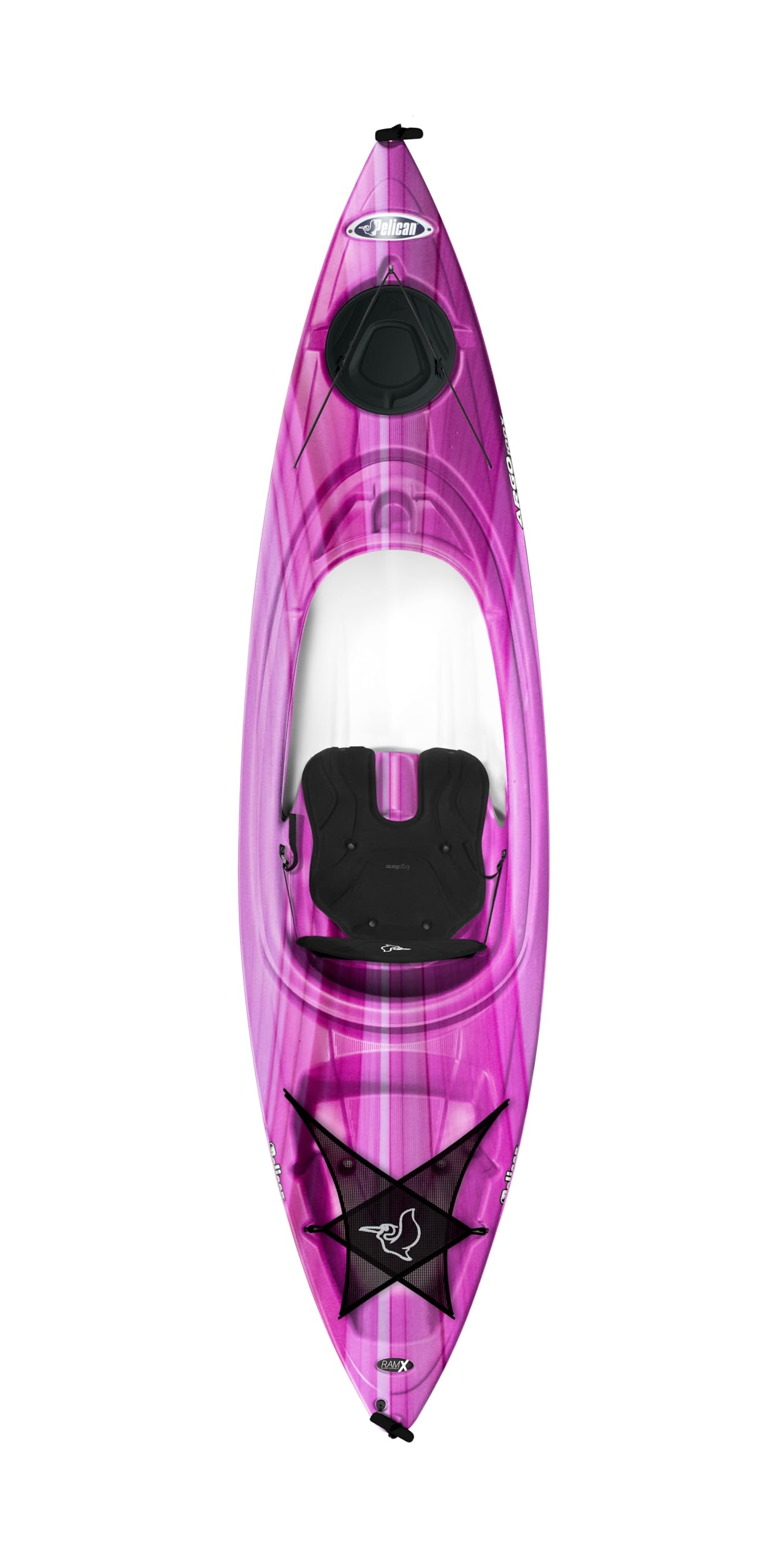
1. Pelican Argo 100X Kayak
Our pick — 4.5+★ from 500+ verified ratings; the strongest balance of quality and price.
The ten-footer you can lift off the car alone and still feel steady in.
At 36 pounds, the Argo 100X is the lightest rigid sit-inside on this list, and that number does the heavy lifting for you. Getting it off a car top or carrying it down a launch ramp becomes a one-person job, which is why so many owners describe it as easy to portage. It runs 120 inches long and 28 inches wide, so it carves a narrow line in the water but still leaves room in the cockpit for your legs.
The hull is Pelican’s twin-arched multi-chine design, which is several angled panels that broaden the boat’s contact patch with the water. In practice that reads as a hull that resists tipping when you shift your weight to reach a water bottle. The Ergoform seat gives you an adjustable backrest and a cushioned pad that sits flat on the hull, and the molded footrests let shorter and taller paddlers find a brace point without a separate part to adjust.
What consistently wins owners over is the build: the hull, hatches, and hardware feel a class above the price. There is a front glovebox and a rear bungee net, enough for a phone, a snack, and a dry bag. The honest limit is the edge of the plastic: a few buyers report wear showing over time, so treat the hull to a rinse and don’t drag it across concrete. It is the crowd favorite on this list, and a 4.5+ star score across 500+ ratings backs that up.
Where the Argo 100X earns it
- 36-pound hull that a smaller paddler can carry and car-top without help
- Twin-arched multi-chine bottom adds water contact for a non-tippy feel
- Adjustable Ergoform backrest and molded footrests fit a range of leg lengths
- Front glovebox plus rear bungee net for phone, snacks, and a dry bag
The catch to weigh
- Polyethylene hull will scuff when dragged over pavement, so carry it
- 28-inch beam is narrower than the tandem boats, so it leans sooner in chop
- No bulkhead or sealed compartment for overnight gear
Grab this one if: you load and unload solo and want a rigid hull that feels planted under you.
skip it if: you need sealed dry storage or a second seat for a paddling partner.
2. Perception Joyride Kayak
The cockpit that keeps your gear bone dry and your phone in camera range.
The Joyride’s headline feature is a sealed bulkhead, which is a solid wall inside the hull that turns the rear compartment into a genuine dry bin. Toss a towel, a water shoe, a dog vest, and your lunch back there and they come out dry. Length runs 120 inches and width 29.5 inches.
That extra height costs a little weight. At 42 pounds the Joyride is 6 pounds heavier than the Pelican Argo 100X, and a handful of owners find it bulky to move alone. The payoff is a hull that tracks cleanly without a skeg — that is a fin under the stern, which this boat does not have — and one long-time paddler in the review pages reports it handled windy, choppy water without wandering. The built-in selfie slot lets you mount a camera pointing back at you, which is genuinely useful if you paddle solo and want photos.
What puts this near the top is the seat and the layout: an adjustable backrest, adjustable footrests, and a front dashboard that holds a phone, bottle, and speaker within reach. Owners praise the build first and the seat comfort second, and both come through in their first-season reviews. The recurring gripe is the lack of a drain plug, so emptying water after a capsize means a towel or a sponge. Plan on buying the aftermarket plug.
The storage story: A sealed bulkhead plus front hatch and rear tankwell means multi-day gear or a dry bag has a home, which is rare on a ten-foot sit-inside.
Set your expectation on drain: There is no factory drain plug. Several owners installed their own, and you should budget for that small job.
The right call for: day trippers who carry cameras, towels, and a change of clothes and hate soggy gear.
Look elsewhere for: a boat you can easily empty out after a swim, since there is no scupper or drain plug.
3. Advanced Elements AdvancedFrame Convertible Kayak
Two seats and three layers of skin that still fold down to a car-boot package.
This is the one tandem on the list that packs away, and it does it with seats for two. It stretches 180 inches long and 32 inches wide — 50 percent more length and 14 percent more width than the 120-inch Pelican Argo 100X, which is what gives two adults room to paddle without knocking elbows.
The build is what earns it a slot here. Three layers of material give it real puncture resistance, and built-in aluminum ribs define the bow and stern so the boat holds a line instead of flexing. What wins people over most is trackability — the ability to run straight without constant corrective strokes — with sturdiness close behind.
Here is where honesty matters. Air retention gets mixed feedback, and the included hand pump sits low to the ground and can tire your back over its full inflation run. The three seat positions let you paddle solo or tandem, and a pressure relief valve helps you find the right firmness. Budget for patience and maybe a spare pump, and this becomes a two-person boat that lives in a closet.
Why a two-person pick still travels light
- 180-inch length and 32-inch beam give two paddlers real cockpit space
- Three seat positions let it run solo or tandem as the crew changes
- Aluminum ribs at bow and stern hold a straight line in calm water
- Folds into the included bag for cars without a roof rack
Where it asks for patience
- 52-pound bag is a two-person lift for most people
- Hand pump sits low and can strain your back over a full fill
- Air retention gets mixed feedback, so check seams before each trip
Pick it for: couples and parents who want one boat that seats two and disappears into a closet afterward.
Know this first: you will inflate it by hand before every launch, so bring patience or a better pump.
4. Lifetime Lotus Sit-On-Top Kayak with Paddle

An eight-footer small enough to sit in a hatchback and light enough for one arm.
At 96 inches long, the Lotus is the shortest rigid hull in this roundup, and that compact footprint is its whole argument. Owners mention it sliding into the back of a Ford Escape with the seat reclined, and into a Honda CRV trunk. The 39-pound weight and front and rear T-handles plus a center carry handle mean you can walk it from the parking lot without a cart.
What it is not is fast. The short hull trades straight-line speed for maneuverability in tight spaces, and the same paddlers who love it in narrow backwaters admit it wanders on open water. A sit-on-top deck means you sit above the waterline with self-bailing scupper holes — small drains that let splashed water fall back out instead of pooling under you. That design makes it easy to reboard in deep water, which matters if you ever flip. The wider deck also gives you a place to set a cooler or a dry bag.
What owners praise most is the size and the flexibility that comes with it, and stability runs second. The quick-release seat back and multiple footrest positions adjust for different paddlers. Be practical about its ceiling: it is a leisure boat for calm water and river current, and heavier adults should mind the load. The recurrences of shipping damage are worth checking for on arrival, and one 62-year-old owner specifically called out how easy it was to load and carry.
Best in tight water: The short 96-inch hull turns on a dime where a longer boat runs out of room, which suits narrow creeks and bayous.
Fair-weather friend: The trade is tracking. It wants your paddle corrections on open water, and it doesn’t have the speed of a longer sit-inside.
Made for: anglers and casual paddlers who work tight creeks and want the easiest possible car-to-water loop.
The honest limit: it tracks loose and runs slow, so open-lake crossings are not what it was built for.
5. OCEANBROAD Inflatable Sit-in Kayak

A full two-person kit in one bag, floor stiff enough to stand on.
The engineering story here is the drop-stitch floor. Drop-stitch is a construction where thousands of threads stitch two fabric layers together, and when you inflate it the floor goes rigid like a board instead of sagging like a pool toy. At 2.95 inches of inflated floor height, it gives you a flat, firm platform to sit on and push against. Length runs 165.6 inches and width 35.4 inches — wider than the Pelican Argo 100X at 28 inches and the Advanced Elements at 32 inches.
Included in the box is a considerable kit: two 86-inch paddles, two seats, two footrests, a directional fin, a repair kit, a hand pump, and a duffel bag. That means no extra shopping before your first launch. Setup takes a few minutes with the hand pump, and customers note the 3-chamber construction holds pressure well thanks to the Halkey-Roberts valves, which are one-way valves designed to hold air under pressure. The removable fin sharpens tracking, and the drain hole clears splash water.
What wins people over is the look of the thing and how stable it sits on the water, with value close behind. Where it asks for care: performance and durability get mixed feedback, including a report of a seat-back zipper failing, and a swamped cockpit drained slowly through the small scupper holes. Know that going in and you get a surprisingly complete package. The 51.7-pound carry weight is manageable with the duffel, but treat it as a load for one strong adult or two people.
Best fit for: first-time tandem paddlers who want paddles, seats, pump, and bag in one purchase.
One thing to expect: the seat backs are the weak link over time, so a padded vest or an aftermarket seat back will keep you comfortable.
6. Lifetime Kokanee Sit-On-Top Kayak, Lime, 10’6″

One wide hull, two quick-release seats, and room for the whole crew.
The Kokanee is the widest boat here at 36 inches, and that width is the whole point. It seats two, or one adult plus a child, and the two adjustable quick-release seat backs let both paddlers lean back at their own angle. Length is 126 inches and weight is 76 pounds, which makes it the heaviest pick on the list — two people should carry it, or you should plan a cart.
High-density polyethylene gives the hull UV protection and a hard shell that shrugs off docks and gravel ramps. The sit-on-top deck has one 6-inch storage hatch, a bungee storage area, and front and rear toggle handles. Because the beam is so broad, it feels steady with a bigger paddler aboard — one larger owner describes it as very steady and stable with him on it. That breadth is a family virtue: kids can shift around without tipping the boat.
What people praise most is the quality and the stability, and the value shows up too. Honest trade-offs: it is not quick, and at 76 pounds it is not fun for one person to move alone. Storage holes on the deck have been called useless by some because gear slides around, and the seat backs lack butt padding for long sessions. A foam pad fixes that cheaply. It is a family boat first, a workout boat never.
Room for two and then some: The 36-inch beam and dual seat backs make this the easiest tandem to share with a child or a friend.
The weight tax: 76 pounds means a cart or a second set of hands at the launch, and the short paddling speed is the trade for that stability.
Worth it for: families who want one boat both adults and kids can grab a seat in.
Not for: solo paddlers who need to car-top without help.
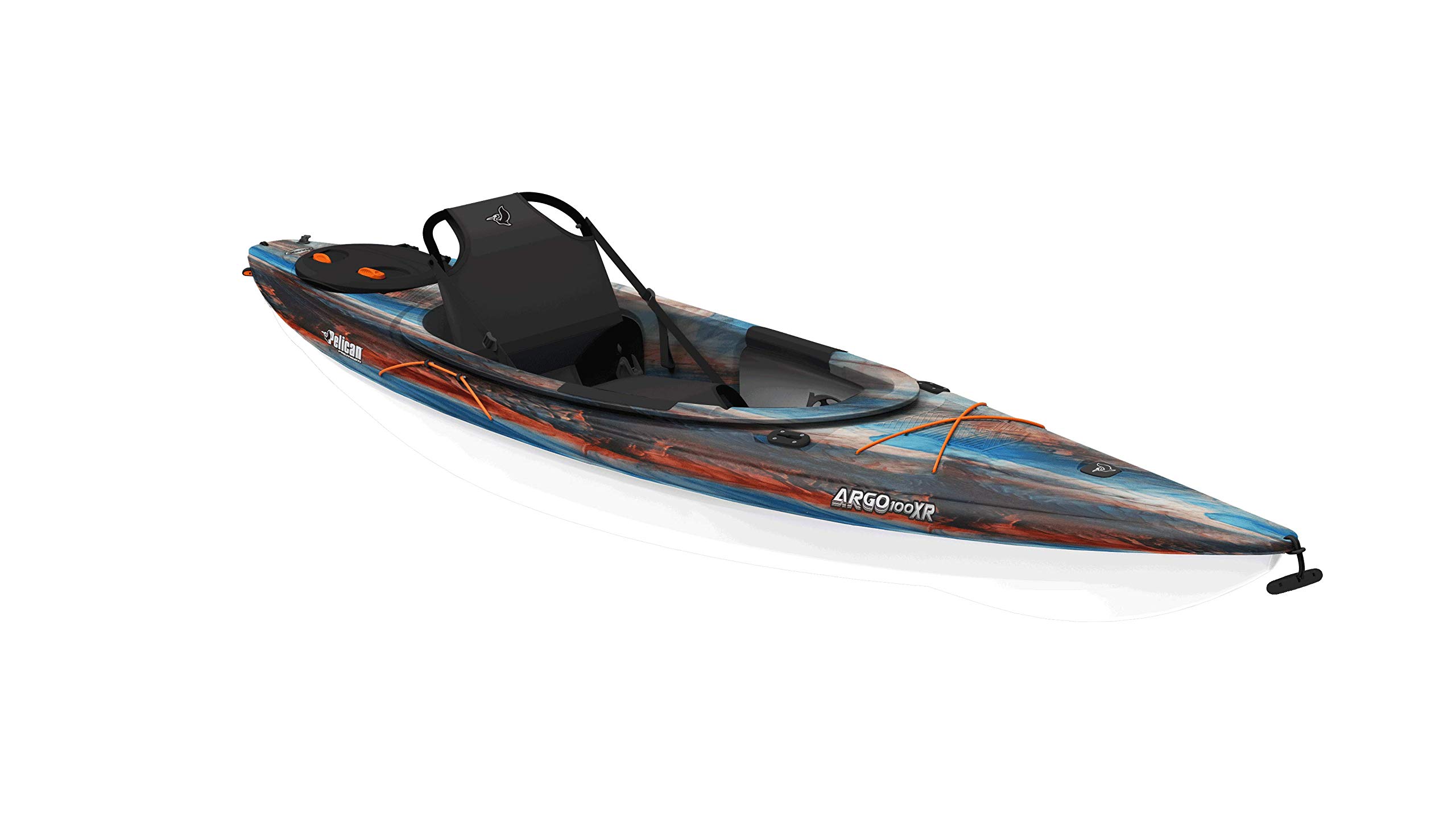
7. Pelican Argo 100XR Kayak
The loaded version of a proven hull, with a seat that doubles as a camp chair.
Same 120-inch length and 29-inch beam as the Argo 100X, but the 100XR answers the question of where you put your stuff. There is a back quick-lock hatch with a storage bag, a forward storage platform with bungee cords, a bottle cage, a secondary bottle holder, and premium knee pads. Weight climbs to 43 pounds from the 100X’s 36, so the extra gear capacity costs you a few pounds of carry weight.
The Ergocoast seat comes out of the boat entirely, which turns it into a beach chair at camp — that is a real comfort win when you are eating lunch on shore. Floating blocks on each side of the hull add a safety margin, and the flattened hull shape holds a maximum capacity of 300 pounds. Twin-arched multi-chine geometry keeps it steady, and the two 1-inch rigging tracks let you bolt on Pelican accessories without drilling the hull.
Build quality is what owners praise above all, with comfort close behind, and they describe it as easy to load and unload without tipping. The honest caveat is the plastic itself: a few owners found the hull scratches and dents more easily than they expected, with one specifically calling out a pushed-in stern that got replaced. That is a check-on-arrival issue, not a design flaw. Inspect the boat before the delivery driver leaves, and you sidestep the common frustration.
The extras that actually get used
- Removable Ergocoast seat turns into a shore chair when you stop for lunch
- Quick-lock hatch with a storage bag plus a bungee storage platform
- 300-pound maximum capacity gives bigger paddlers headroom
- Two 1-inch rigging tracks mount accessories without drilling
What to watch on arrival
- 43 pounds is heavier than the base Argo 100X’s 36 pounds
- Hull dents and scratches have shown up in shipping
- Not built for Class 3 water, which is real moving whitewater
Choose it when: you want a sit-inside that holds camera gear, a cooler, and a bottle without extra bags.
Worth noting: the plastic is softer than some rivals, so inspect the stern before you accept delivery.
8. Perception Tribe 9.5 Kayak

A high-backed frame seat and 300-pound capacity in a nine-and-a-half footer.
The Tribe 9.5 measures 113 inches long and 31.5 inches wide, and it carries up to 300 pounds — that is the spec that sells it to bigger paddlers. The seat is a high-back frame seat with adjustable recline, which lifts you off the deck and gives real lower-back support instead of a molded ridge. For anyone who has winced after two hours in a cheap seat, that change matters more than any hull tweak.
Owners who have had knee replacements report getting in and out in shallow water easily, which is the sit-on-top advantage: you swing your legs over the side instead of folding into a cockpit. The hull tracks well in calm water and takes mild chop in stride, and a rear tankwell with tie-downs holds a cooler or a gear crate. At 46 pounds it is lighter than the 76-pound Lifetime Kokanee, though a few paddlers still find it too heavy to lift onto a rack alone.
What earns the most praise is the quality of construction, with stability a close second, and the boat feels substantial under you. Be realistic about the trade: the higher seat raises your center of gravity, so leaning far to one side will tip it. Paddlers who sit centered and paddle steadily get a comfortable, dry ride. Add wheels to your kit and the launch routine becomes a two-minute job.
Built around the seat: The high-back frame and recline adjust sit you up off the deck, which is the comfort feature that sells this boat to bigger paddlers.
Lean carefully: That raised seating position means the boat tips if you lean far, so it rewards an even, centered paddle stroke.
Right for: larger paddlers, or anyone with knees that need an easy side-entry into a sit-on-top.
Keep in mind: plan a cart or a helper for loading, and keep your weight centered on the water.
9. Oru Kayak Inlet

Twenty pounds of origami that folds into a box and lives in a closet.
The Inlet weighs 20 pounds — roughly half what a comparable rigid hull carries — and folds from a 9’8″ by 31″ boat into a 42″ x 10″ x 18″ box. That box fits in the trunk of a small car and in an apartment hallway, which is the entire reason this boat exists. The skin is 5 mm double-layered polypropylene, an extruded plastic sheet that resists punctures and abrasion, and the panels crease along factory-set fold lines so it goes together without tools.
What owners praise most is how quickly the assembly clicks after a few tries, with portability a close second, and one 35-year-old kayaker in the review pages describes folding it down in about 5 minutes and getting it into a Corolla trunk. It paddles well enough to keep pace with hard-shell boats on calm lakes and rivers. The cockpit is 23 by 44 inches, the maximum paddler height is 6’2″, and the capacity tops out at 275 pounds.
The honest trade is durability and stability. Both get mixed feedback, with some paddlers finding the panels sturdy and others reporting sections slipping out of place when wet. Seat comfort runs thin — the cushion is minimal and the back is flimsy, so plan on adding a pad. A paddle is not included. Buy it for the storage and transport freedom, not for whitewater.
The storage breakthrough
- Folds to a 42 x 10 x 18 inch box for trunks and apartment closets
- 20 pounds is light enough to backpack to a remote launch
- Polypropylene skin resists punctures and abrasion
- Tracks and paddles close to a hard-shell on calm water
The setup and comfort trade
- Panels can slip when wet, and stability gets mixed feedback
- Seat cushion and back are thin, so budget a pad
- No paddle included in the box
Made for: city dwellers, apartment paddlers, and backpackers with no room for a roof rack.
Before you buy: add a seat pad and a paddle, because neither comes ready to use.
10. Wilderness Systems Pungo 105 Kayak

The efficient hull for paddlers who count strokes and cover distance.
The Pungo 105 is a 126-inch sit-inside built around speed, and the manufacturer calls it the most efficient kayak in its class. That is a claim, but the hull shape backs up the intent: it cuts a narrow line and tracks straight on flat water. It weighs 47 pounds and sits 30 inches wide, so it is stable enough for new paddlers while still slipping along easily for experienced ones.
The Phase 3 Airpro seat is fully adjustable and uses mesh-covered honeycomb-vented foam, which lets air move through the cushion so you stay cooler on warm days. Adjustable footrests and thigh pads let you dial in the fit so your legs lock against the hull. What owners praise most is the overall quality of the boat, and one paddler who has spent years on the water describes it as very stable and confidence-inspiring in rapids, staying dry and handling Class III with ease and Class IV with a spray skirt.
Sturdiness gets mixed feedback, with some owners reporting durability issues over time and others finding it rock solid. The likely reason is that this is a performance-oriented hull and it wants care — treat it like a precision tool, not a bumper. There is also a shipping risk worth noting: at least one boat arrived damaged, so inspect before accepting. Pick it if paddling efficiency is what you chase.
Ride quality that earns the price: A vented, adjustable Phase 3 Airpro seat plus thigh pads make long flat-water sessions feel far easier on the body.
The catch is sturdiness: Durability feedback varies, so this is a hull to handle with care and inspect the moment it arrives.
For you if: flat-water distance and paddling efficiency matter more than rough-water durability.
Think twice if: you plan to bounce it off docks and rocks, or you need a boat that shrugs off rough landings.
11. Sea Eagle 380x Explorer Inflatable Tandem Kayak Packages

An inflatable rated for real rapids, with a floor stiff enough to stand on.
Most inflatables ask you to stay on calm water. This one is rated up to Class IV whitewater and carries 16 self-bailing drain valves — openings you pop open on wild rivers and close for dry touring. It supports up to 750 pounds across two or three adults, which is the highest capacity on this list by a wide margin, and the 12-foot-5-inch length gives a tandem crew real room. The removable drop-stitch floor inflates to 10 PSI and firms up like a hard deck.
The shell is 1000 Denier reinforced PVC with quadruple-overlapped glued seams, built to bounce off rocks and river debris rather than worry about them. The Pro package arrives complete: two tall-back seats, two heavy-duty paddles, a high-output pump, and an all-purpose backpack. A removable swept-back rear skeg keeps it tracking straight on open water. Setup takes roughly 8 minutes of inflation according to the maker, and the hand pump with gauge reaches pressure in a manageable number of strokes.
What earns the most praise is the build quality, with stability close behind — the drop-stitch floor is firm enough that owners stand in it without losing balance. The honest limits: it is slower than a hard shell of the same length, the foam footrests are hard to adjust, and the supplied pump rated below the floor’s 10 PSI requirement, which means a high-pressure pump is a smart add-on. It also wants a thorough freshwater rinse after saltwater use.
Why this one handles rough water
- Rated up to Class IV whitewater with 16 self-bailing drain valves
- 750-pound capacity for two or three adults plus gear
- Drop-stitch floor inflates to 10 PSI and feels rigid underfoot
- Pro kit includes two seats, two paddles, a pump, and a backpack
Where it asks extra care
- Slower than a hard-shell kayak of the same length
- The included pump rated below the floor’s 10-PSI target
- Foam footrests are hard to adjust to a comfortable position
Reach for it when: you want a boat that can run rivers and haul a heavy tandem load, then pack into a backpack.
The honest caveat: budget a high-pressure pump for the floor, and accept that speed is not this boat’s strong suit.
Know the Specs
Weight capacity
This is the total load the hull is rated to float. That includes your body weight, clothes, a cooler, and gear. Too much load pushes the boat low in the water, and a sit-inside can take water over the coaming, the raised lip around the cockpit. Compare the rating to your actual combined weight and leave room to spare. A 300-pound rating gives most adult paddlers headroom, while a 750-pound rating like the Sea Eagle 380x Explorer suits two or three adults with gear.
Length versus maneuverability
Shorter hulls turn quickly and fit in tight spaces, which is why an 8-foot boat like the Lifetime Lotus lives easily in a hatchback. Longer hulls track straighter and carry more momentum, so a 15-foot boat like the Advanced Elements convertible feels steadier across open water. The trade is real: a short hull needs more corrective strokes, and a long hull is harder to swing around in acreek. Choose length for your weekly water, not for one annual trip.
Hull weight and carry routine
The number on the spec sheet decides whether you launch alone. A 20-pound folding hull like the Oru Inlet can be shouldered and carried to a remote lake. A 76-pound sit-on-top like the Lifetime Kokanee needs a cart or a second person. Think about the whole loop — garage to car, car to ramp, ramp back to garage — and pick a weight you can handle at the end of a tired day, not just at the start.
Inflatable floor construction
An inflatable hull’s floor comes in two common styles. An I-beam floor uses internal fabric walls to hold air, and it can sag under weight. A drop-stitch floor uses thousands of threads between two fabric layers, so it inflates into a rigid board. The OCEANBROAD and Sea Eagle 380x Explorer both use drop-stitch, which is why owners describe standing on the floor without losing balance. A stiffer floor means less flex under your seat and more efficient paddling.
Common Questions
Will a 10-foot kayak fit inside a car rather than on a roof rack?
Is a sit-on-top or a sit-inside better for a beginner?
How much weight can a small kayak safely carry?
Do inflatable kayaks puncture easily on rivers?
How long does it take to inflate or assemble a portable kayak?
Can one person paddle a two-person kayak alone?
What is the difference between a skeg and a rudder on a small kayak?
Do I need a drain plug or scupper holes in a recreational kayak?
How should I store a kayak in an apartment or small garage?
Is a wider kayak always more stable for a beginner?
The Bottom Line
For most paddlers, the small kayak that gets out of the garage most often is the Pelican Argo 100X, because its 36-pound hull is light enough for one person to load and car-top without help, and its twin-arched multi-chine bottom keeps it steady on the water. If you want dry storage and a taller cockpit that is easier to slide into, the Perception Joyride answers that with a sealed bulkhead and a built-in selfie slot. And when you need two seats that still fold into a trunk, the Advanced Elements AdvancedFrame Convertible is the one to reach for.
One honest nudge before you decide: the Pelican Argo 100X holds the top score on this list at 4.5+ stars across 500+ ratings, and that combination of a light hull and a settled, non-tippy ride is hard to argue with for a first or only kayak. Match the hull to your usual water and your loading routine, and it becomes the boat that leaves the garage.
How we choose
We do not accept paid placement. Every pick is matched to a real buyer and a real use-case; we do not hands-on test units.
Sources
Specifications: manufacturer listings and product documentation. Review insights: verified customer reviews, as of October 2026. Pricing: not shown on this page (it changes often); check the current price via the retailer link.
As an Amazon Associate, Aappliancez earns from qualifying purchases. This does not affect which products we feature.