Disclosure: Some links in this post are affiliate links. As an Amazon Associate I earn from qualifying purchases, at no extra cost to you. Learn more
Specs are compiled from manufacturer listings and verified buyer reviews and can change over time — please confirm the key details on the product page before buying.
You do not need a garage-sized box to stop losing food to the back of your fridge. A small chest freezer gives you a second frozen zone in the footprint of a kitchen chair — and the picks below cover everything from a 2.0-cubic-foot corner unit to a 7-cubic-foot convertible that can switch between freezer and fridge. The trick is knowing which size, which door, and which defrost routine fits how you actually shop.
This guide is built by comparing the manufacturers’ published specifications and the patterns across verified customer reviews, so you get each pick’s real strengths and trade-offs instead of marketing spin.
Below you’ll find capacity, quietness, and defrost details explained in plain terms, plus the honest catch on each unit.
Top Picks


How To Choose The Best Small Chest Freezers
Start with the wall you plan to put it against, not with the capacity number. A chest freezer’s footprint is what decides whether it slides into a closet, under a counter, or beside a car in the garage — and that footprint is usually written as depth × width × height in inches.
Match cubic feet to how you shop, not to how much you wish you froze
A 2.0-cubic-foot unit suits one person buying meat weekly. A 3.5-cubic-foot box holds a bulk-shop run for two. Step to 5.0 or 7.0 cubic feet once you’re feeding a family or splitting a quarter cow with a neighbor. Oversizing means a mostly-empty box cycling cold air for nothing.
The lid hinge is a daily-use decision
A lid that hovers between 45 and 85 degrees lets you load with both hands. A lid that slams shut means one hand is always holding it up. Some hinges are also designed so the door doesn’t swing into the wall behind it — worth checking if the freezer sits against drywall.
Dial or digital? It changes how precisely you can set the cold
A mechanical dial with numbered settings (often 1 through 7) gives you broad steps. An electronic panel accurate to 1°F gives you a real number to work to. If you’re storing breast milk, game meat, or anything where a few degrees matters, the digital control is the more useful tool.
Plan for frost before you buy
Almost every compact chest freezer here uses manual defrost. That means a frost layer creeps up on the interior walls over months, and you’ll need to empty and thaw it. A built-in defrost drain turns that job into a bucket-and-hose task instead of a towel-and-shop-vac task.
Side-by-Side Comparison
| Model | Best For | Capacity | Noise Rating | Defrost / Drain | Amazon |
|---|---|---|---|---|---|
| EUHOMY 3.5 Cu.Ft★ Best Overall | Best Overall | 3.5 cubic feet | 38 dB | Drain port | Amazon |
| West Bend 5-Cu.FtMax Storage | Bulk buyers | 5 cubic feet | — | Defrost drain | Amazon |
| DEMULLER 4.0 Cu.FtBest Control | Digital control | 4 cubic feet | — | Defrost hole | Amazon |
| KRIB BLING 3.5 Cu.Ft | Tight budgets | 3.5 cubic feet | Under 40 dB | Frost scraper included | Amazon |
| Climate Choice 3.5 Cu.Ft | Small closets | 4.2 cubic feet | Below 40 dB | — | Amazon |
| DOGHLY 2.0 Cu.Ft | Smallest spaces | 2 cubic feet | Low noise (no figure stated) | Defrost drain | Amazon |
| LifePlus 3.5 Cu.Ft | Hinge-style door | 3.5 cubic feet | Quiet (no figure stated) | Drain hole | Amazon |
| DEMULLER 3.49 Cu.Ft | Overflow baskets | 3.49 cubic feet | 40 dB | Defrost hole | Amazon |
| BLACK+DECKER 2.7 Cu.Ft | Brand trust | 2.7 cubic feet | — | Manual defrost + drain | Amazon |
| Kismile 3.0 Cu.Ft | Long-term value | 3 cubic feet | Below 40 dB | — | Amazon |
| BODACIOUS 7.0 Cu.Ft | Family capacity | 7 cubic feet | Under 40 dB | Drain port | Amazon |
| ADT 2.1 Cu.Ft Display | Retail display | 2.1 cubic feet | Quiet (no figure stated) | — | Amazon |
| Midea 7.0 Cu.Ft | Convertible use | 7 cubic feet | Quiet (no figure stated) | — | Amazon |
| Frigidaire 7 Cu.Ft | Design + capacity | 7 cubic feet | Quiet (no figure stated) | Defrost drain | Amazon |
Detailed Reviews
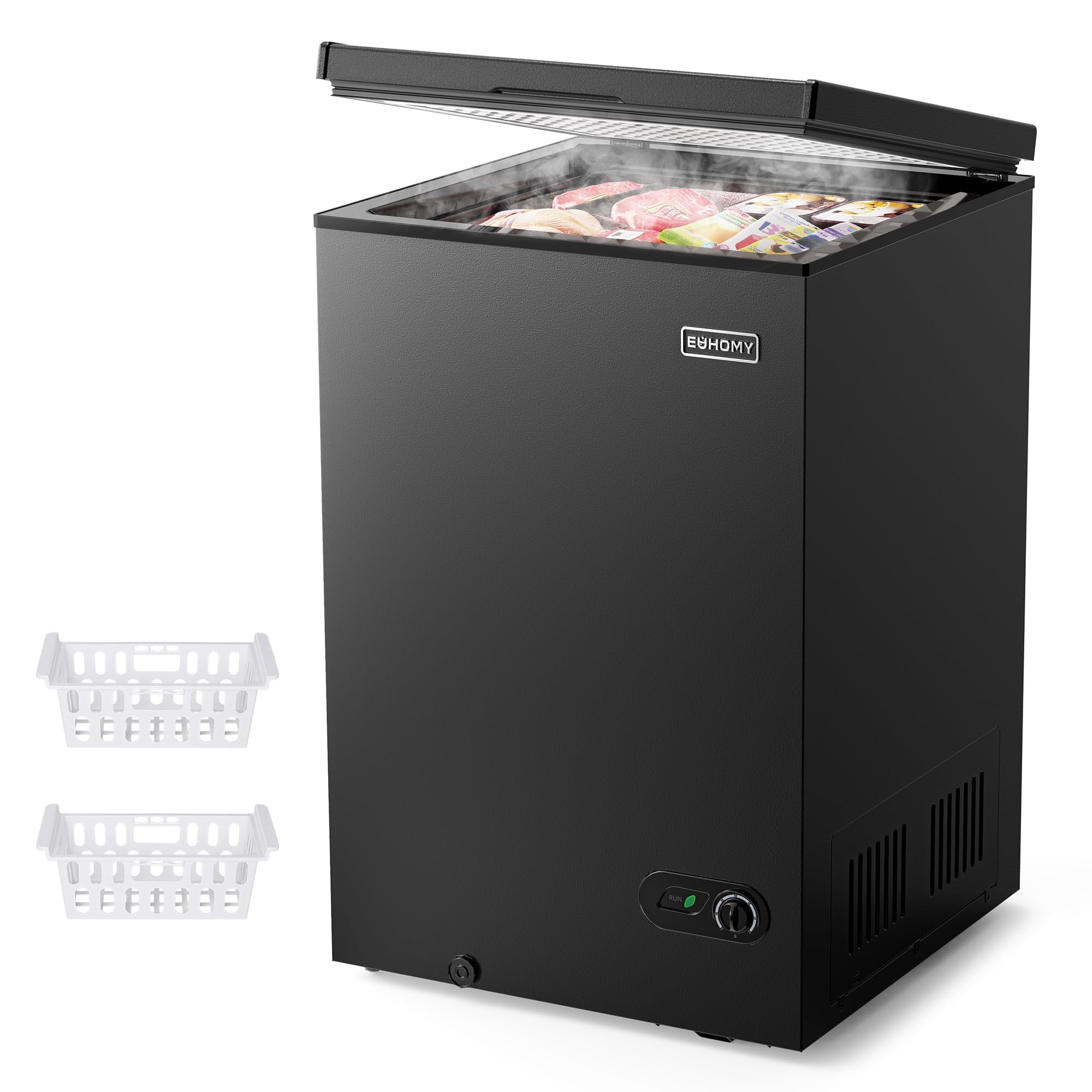
1. EUHOMY 3.5 Cu.Ft Chest Freezer, Deep Freezer Top Door, Black
Our pick — 4.5+★ from 650+ verified ratings; the strongest balance of quality and price.
The quiet corner box that holds a small household’s worth of meat for the price of a mid-range countertop gadget.
This is the pick that wins on the two numbers most small-freezer buyers care about at once. It takes up 3.2 square feet of floor and measures 21.2″ wide by 21.6″ deep by 30.9″ tall, so it slots under a counter or beside a washer without eating a room. Inside, 3.5 cubic feet swallows roughly 33 pounds of beef plus 48 pounds of fish, which is a serious weekly-shop buffer for two people.
What wins people over is how little you notice it. A 38 dB compressor is quieter than a library conversation, so a kitchen-adjacent or apartment placement doesn’t turn into a background drone. The seven-stage knob runs from “0” (off) through “7” (coldest), moving about 2°F per stage across a range from -7.6°F to 10°F. There’s a mesh basket for loose items, a bottom drain port for meltwater, and a lid that hovers between 45 and 85 degrees so you can load one-handed. Against the West Bend 5-cubic-foot unit this box gives up 1.5 cubic feet and 13 pounds of body weight, and at 44.1 pounds it stays movable for one adult.
The catch is durability. The compressor side holds up for the long haul in most reports, and it runs a 12-hour freezing capacity of 24 pounds, but the recurring gripe is the frost layer that builds up without an auto-defrost cycle. Budget a thaw-out session every few months, and use that drain port. As buyers put it, it “lasted 2 years strong” with frost build-up as the only ongoing issue.
Where It Earns Its Keep
- 38 dB running noise keeps it livable in apartments and open kitchens
- 3.2 ft² footprint and 21.2″ width fit under counters and in corners
- 7-stage thermostat plus hover-lid and drain port cover the daily annoyances
The Honest Trade-Off
- Manual defrost means periodic thawing; frost is the most-cited long-term annoyance
- 3.5 cubic feet tops out fast if you’re feeding four or more
Buy this if: you want a genuinely quiet 3.5-cubic-foot freezer that fits a corner and holds a two-person meat stock.
Look elsewhere if: you need auto-defrost convenience or family-scale volume.
2. West Bend Chest Freezer, 5-Cu.Ft, White
Five cubic feet and a hinge geometry that keeps the lid off your wall — the bulk-shop box.
If a quarter cow is your goal, this is the pick to check. The 5.0-cubic-foot (198 liter) flat-back interior is the largest in the mid-group here, and it’s the kind of volume that holds a full bulk-buy haul. At 57 pounds and 22.25″ deep by 25″ wide by 33.5″ tall, it wants a dedicated wall or garage corner rather than a closet. Compare it to the EUHOMY above: you gain 1.5 cubic feet of storage and 13 pounds of cabinet heft, and you lose the sub-40 dB quiet story.
The design details are the reason people stick with it. A single flip-up lid with an integrated handle opens one-handed and stays up as long as you need. Rear-mounted hinges mean the lid can’t knock the wall behind it and the seal stays tight when shut. A fast-freeze setting, a removable basket, a defrost drain, and a power indicator light round out the control panel, and the thermostat sits on the exterior so you don’t open the lid to make an adjustment.
The honest caveat is cosmetic, not functional: a few units show up with scuffs or dents from shipping, and one buyer’s delivery arrived with visible damage. Check the cabinet on arrival before you toss the packaging. Everything else — the freezing consistency, the quiet run, the sense that the interior is bigger than expected — is what keeps this one on the short list.
Why it stays on the list: a flat-back 5.0-cubic-foot interior, rear hinges that protect your wall, and an exterior thermostat add up to a fuss-free bulk box.
What to watch: manual defrost plus a shipping-damage lottery means inspect on delivery and plan a seasonal thaw.
The right call for: households buying meat in bulk or splitting a large freezer order with a neighbor.
Give it a pass if: your space is a narrow closet rather than a garage wall.
3. DEMULLER 4.0 Cu.Ft Deep Freezer with Electronic Control
A digital thermostat that reads to one degree, packed into a narrow 16.3-inch-wide shell built for a closet.
The standout here is control you can read. The electronic panel holds temperature accurate to 1°F across a range of -15°F to 41°F, which is a wider span than most dial-only competitors offer. That range lets you run it flirting with fridge territory if you want, then drop it cold for a meat load. Capacity is 4.0 cubic feet inside a body measuring 24.6″ deep by 16.3″ wide by 29.5″ tall. At 16.3 inches wide, this is one of the narrowest bodies on this list — the one that actually slots into a hall nook or beside a fridge.
Two hanging stainless steel baskets keep ice cream and small items off the floor of the box, and two adjustable feet help it sit level on uneven floors. A recessed door handle means the lid lifts cleanly one-handed. A high-efficiency R600 compressor does the cooling.
Functionality is where the box earns its keep — the day-in, day-out question is whether a compact box actually performs, and this one largely answers it. As one long-term buyer reports after nearly a year: “Been using for about 11 months. It still works well, no complaints.” Check the door seal on arrival; some units need that seal checked and pressed into place to hold their cold.
The case for digital: 1°F accuracy and a -15°F to 41°F range give you the finest control in this group without stepping up in size.
The narrow-body trade: 16.3″ wide fits tight spaces, but check that the 24.6″ depth clears your door swing.
Reach for this if: you want to set an exact temperature and your floor space is narrow rather than deep.
Consider a bigger box instead if: 4.0 cubic feet won’t cover a family’s weekly frozen load.
4. KRIB BLING Chest Freezer 3.5 Cu.Ft

Forty pounds, forty decibels, and a seven-gear dial — the cheapest way into a genuinely quiet 3.5-cubic-foot box.
At 40 pounds and 20.47″ deep by 16.73″ wide by 28.54″ tall, this is the lightest 3.5-cubic-foot unit here and one of the easiest to haul up stairs alone. The seven-gear temperature control covers deep freeze, refrigerate, and keep-fresh modes, and the whisper-quiet compressor runs under 40 dB. A ring-shaped condenser circulates cold air evenly, and multi-foaming in the compartment walls is designed to hold the cold longer during a power cut. There’s a removable basket and a frost scraper in the box.
Two of the recurring notes are the ones worth knowing. Shipping dents show up on the exterior while the internals stay fine — one buyer described a dented shell but a fully working unit. And a small number of units arrive not matching the promised capacity, so weigh how much you need against the listed 3.5 cubic feet before you commit.
The Cheap-Win Shortlist
- 40 pounds is the lightest 3.5-cubic-foot body in this comparison
- Under 40 dB quiet, 7 gears, and a frost scraper included
Before You Bite
- Dented shells from shipping are a recurring complaint
- Manual defrost with no drain plumbed to the outside
The budget entry: a light, quiet 3.5-cubic-foot box for a first apartment or a garage overflow.
Check on arrival: inspect the shell before discarding the packaging, and measure the gap you plan to fill.
5. Climate Choice 3.5 Cu.Ft Small Chest Freezer, Gray

The lightest pick on the list and the cheapest to run — a 37.2-pound box that sips 0.37 kWh a day.
If you want a second freezer that barely touches your bill, this one leads on efficiency. It draws 0.37 kWh per 24 hours and runs below 40 dB. Seven adjustable settings span -11.4°F to 10.2°F. And the body is light enough for one person to move empty. The manufacturer lists a 3.5-cubic-foot class while the spec sheet states 4.2 cubic feet of capacity — measure your true load against the 18.5″ deep by 22.4″ wide by 29.3″ tall body and confirm before you buy.
Buyers report it holds temperature steadily and runs quietly day after day, with no fuss. It’s a top-mounted door with a removable basket, so the access is the simple lift-and-reach kind. Use it in a utility closet, a dorm, or a home office — the gray finish doesn’t look out of place in a living space.
The honest gap is consistency. A few units have turned up with delivery dents on the cabinet while still cooling fine. And some report temperature-control oddities, so don’t fill it the day it arrives — give it a full day upright first and check the reading before you load it. Durability is the other soft spot: treat the compressor with care, keep it on a level surface, and it behaves.
The efficiency pick: 0.37 kWh a day and 37.2 pounds make it an easy addition to a small utility space.
Worth confirming first: the exact interior capacity you’ll get, since the listed figures vary.
6. DOGHLY 2.0 Cu.Ft Chest Freezer, White

Two cubic feet and 32.4 pounds — the freezer that fits beside an RV door or in a dorm closet.
This is the smallest unit here by a comfortable margin, and it’s built for that. The 2.0-cubic-foot interior sits in a 17″ deep by 20.5″ wide by 24″ tall body at 32.4 pounds. Picture it in a dorm room, an RV, or a studio where nothing else will shoehorn in. A single person or a small family can keep meat, seafood, and ice cream in rotation.
The details are scaled to the box: a seven-setting thermostat dial, an upward-hinged lid that stays open between 45 and 90 degrees so you don’t have to hold it, and a removable basket for small items. A front-accessible defrost drain handles meltwater during maintenance without tipping the unit. It’s marketed as garage-ready, and the easy-clean interior is a small mercy when something spills.
What you don’t get is bulk capacity. Two cubic feet is roughly a week’s worth of frozen goods for one, not a bulk-shopping buffer for four. The right buyer is someone in a dorm, RV, or studio who needs a week of frozen food for one and has no room for more.
Size-first pick: 32.4 pounds and a 24-inch height make it the easiest to place and move — ideal where every inch is spoken for.
The obvious limit: 2.0 cubic feet is a solo or couple’s freezer, not a bulk box.
For: a single person, a dorm, an RV, or a tiny studio that needs a second frozen zone without a second appliance footprint.
Not for: a family buying meat in bulk — step up to 5 or 7 cubic feet.
7. LifePlus Chest Freezer 3.5 Cu.Ft, Gray
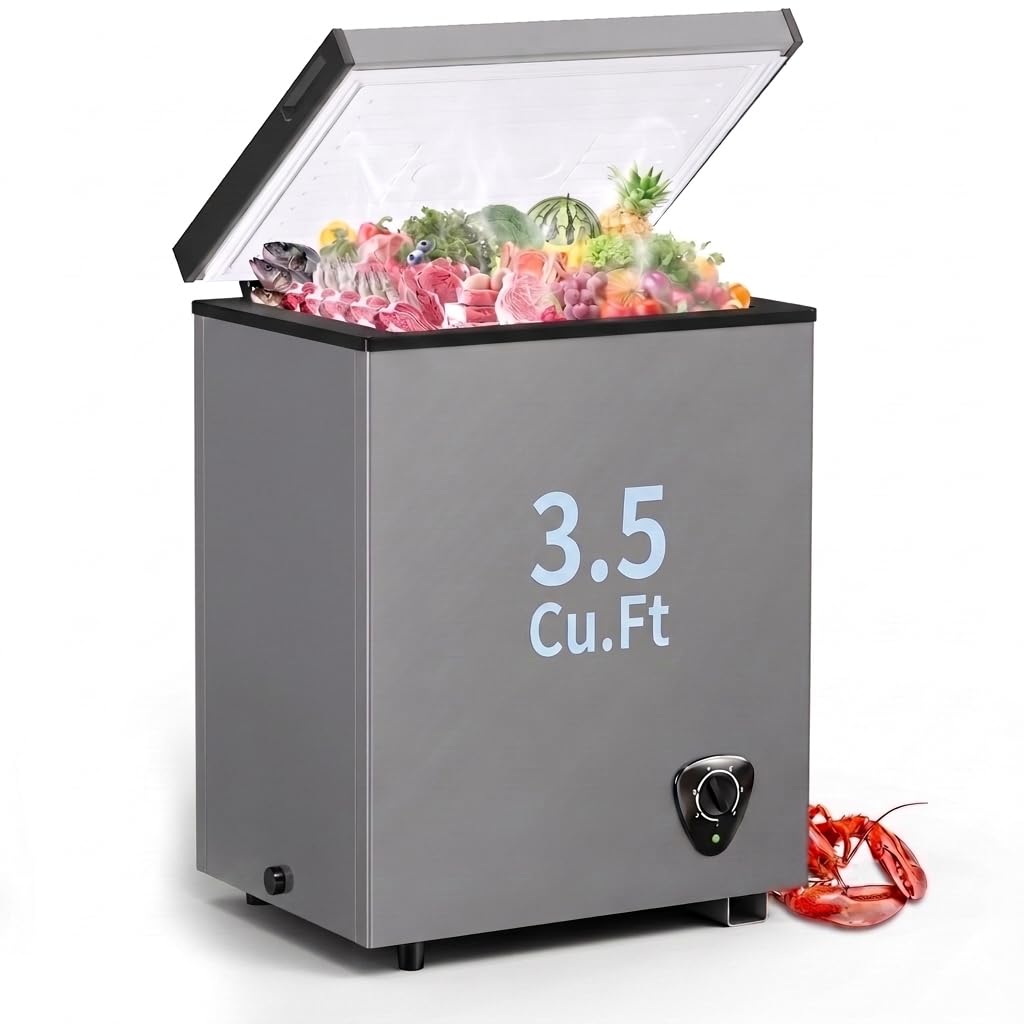
The hinge-led pick — a lid that holds at 70 to 90 degrees so both hands stay free while you dig.
Balanced metal hinges and recessed handles let this lid hover at multiple angles between 70 and 90 degrees, which means hands-free loading and no lid crashing toward your knuckles. It runs at a claimed 40 dB in one owner’s own measurement, and the R600a compressor sips 0.37 kWh per day. The 3.5-cubic-foot body measures 18.5″ deep by 22.4″ wide by 29.5″ tall — the same footprint family as the KRIB BLING above, but with a heavier-duty hinge assembly.
The thermostat dial spans seven settings from -7.6°F to 21.2°F, which will hold steady below zero. Reports describe it holding a constant 0°F at a normal setting, which is the range you want for long-term meat storage. Storage capacity is real: one owner fit 60 pounds of ground venison. Two small wheels help you shift it.
The criticism to weigh is the door-seal and frost angle. A few buyers have gotten units that don’t sit flat or that need the leveling feet adjusted before the seal behaves. Give it 24 hours upright before plugging in, set it, and let it settle — most of the cooling complaints trace back to skipping that step.
Hinge-Day Wins
- Lid holds at 70-90 degrees — load with both hands
- 0.37 kWh per day with an R600a compressor
- Holds a constant 0°F and takes 60 lbs of frozen meat
What To Know Going In
- Needs the 24-hour upright rest before first use
- Level the feet on uneven floors to protect the seal
Go here for: the best-balanced lid and low running draw in the 3.5-cubic-foot group.
skip it if: you want digital control — this one runs on a numbered dial.
8. DEMULLER Mini Chest Freezer, Electronic Control, Black

Two removable baskets and a one-degree electronic thermostat — the organizer’s 3.49-cubic-foot box.
If you hate digging through frozen lumps to find the good stuff, this is the one. Two removable wire baskets let you separate small items from the big cuts, and the electronic thermostat holds accurate to 1°F across a range of -11°F to 41°F. The 3.49-cubic-foot interior sits in a 20.6″ deep by 16.3″ wide by 29.5″ tall body at 35 pounds. That’s light for the volume, and the narrow width helps it tuck in.
The lid holds open at 45 and 75 degrees, so you can reach in with both hands. A defrost drain sits behind a removable side cover, which turns a thaw-out into a drain-and-bucket job rather than a towel-and-mop job. The compressor runs at 40 dB and sips 0.44 kWh per day, which puts it near the top of the efficiency group without the digital-panel price.
What could stop you? The control panel is electronic, so if it ever needs service, it’s not a dial you swap out yourself. And 3.49 cubic feet is compact — fine for a couple or an overflow box, tight for a large family. But for the size, the insulation and quiet setup are what buyers keep coming back to.
Organization-first: two removable baskets plus 1°F electronic control make it the neatest box in the compact group.
The trade: electronic control means fewer field fixes than a dial if something goes wrong.
A good match for: small households that want precise control and real organizational separation.
Look at the Kismile instead if: you’d rather have a mechanical dial and more capacity.
9. BLACK+DECKER BCFK276 Compact Chest Freezer

A 2.7-cubic-foot branded box rated to hold 94.5 pounds of frozen food — small footprint, real food volume.
Here’s the math that makes this one punch above its size: the 2.7-cubic-foot interior is rated to hold 94.5 lbs. of frozen food. That means it handles frozen dinners, ice cream, and a serious meat stock from a body measuring 17.3″ deep by 20.9″ wide by 33.26″ tall. At 44.8 pounds it sits heavier than the DOGHLY above on a smaller capacity, so it isn’t the one to haul up stairs monthly.
The controls are deliberately simple. A mechanical dial and indicator light sit on the outside, so you adjust temperature without lifting the lid. A removable basket handles the small-item problem. A manual defrost with an easy-access drain simplifies the maintenance side of ownership. The upside of a mechanical control is that there’s nothing electronic to fail.
The honest caveat is noise and the interior finish. Some units hum louder than expected in a quiet room, and a few note the interior dents or scratches easily if you drop something heavy. Give it the 72-hour wait before first plug-in that the manufacturer specifies, and it behaves.
The 94.5-Pound Argument
- Holds 94.5 lbs. of frozen food in a 17.3-inch-deep body
- External mechanical dial — no opening the lid to adjust
Plan Before You Plug In
- 72-hour settling period before first use is required
- Some units hum more than expected in quiet rooms
Reach for this if: you want a recognized brand, a mechanical dial, and near-100-pound food volume in a narrow column.
Think twice if: you’re very noise-sensitive and the unit will sit near a bedroom.
10. Kismile 3.0 Cubic Feet Chest Freezer, Black

The most-proven box on this list — the 3.0-cubic-foot freezer 2,000+ owners keep re-buying for apartments and travel trailers.
The strongest single number here isn’t a spec — it’s the crowd. A 4.5+ star average across 2,000+ owners makes it the safest bet if you want a 3.0-cubic-foot box with a long real-world track record. The interior fits 3.0 cubic feet inside a 17.12″ deep by 20.67″ wide by 31.89″ tall column at 43.7 pounds. A seven-grade thermostat covers 6.8°F down to -7.6°F, and a red power light plus green run light tell you at a glance whether it’s actually working. It’s rated under 40 dB and draws 0.6 kWh per day.
The details are practical: a lid that hinges between 45 and 90 degrees, two removable baskets, and adjustable leveling legs for uneven floors. Reviewers have pulled it into apartments, travel trailers, and dog-food duty without complaint. The warranty coverage is a 1-year term, which resolves the occasional early issue without drama.
Where the box asks for care is on a trailer or off-grid setup. If you’re running it off an inverter, measure your inverter’s peak capacity before you plug it in — a small unit may not handle the startup surge. For home use, that’s irrelevant.
Why it earns the trust: a huge installed base, 2,000+ owners, a 1-year warranty, and a 0.6 kWh daily draw make it a low-risk compact buy.
One thing to check: if you’re planning trailer or off-grid use, size your inverter to handle the startup surge.
The low-risk choice: a proven 3.0-cubic-foot freezer with wide real-world coverage across apartments, garages, and trailers.
Step up in size if: you consistently store more than a few weeks of frozen food for two.
11. BODACIOUS 7.0 Cu Ft Chest Freezer

Seven cubic feet in a 17.32-inch-wide body — the family box that somehow fits a narrow wall.
Family-scale frozen storage without a family-scale footprint is the whole point here. The 7.0-cubic-foot interior is packed into a body just 17.32″ wide by 21.57″ deep by 33.46″ tall, at 48.5 pounds. That narrow width is unusual for a 7-cubic-foot box, and it’s what lets this one sit in a gap that a wider unit would refuse. It runs under 40 dB and locks the cold behind a double-hinged door you can open at 45 to 85 degrees.
The control is a six-speed thermostat covering -0.4°F to 32°F, with an LED indicator on the front. A built-in drain port makes defrost drain simple, and stabilizer adjusters keep it level on uneven floors. One basket keeps the small items off the bottom. Given that it’s a 7-cubic-foot unit, the daily power draw is more about size than about saving — this is a freezer for someone who’s serious about food volume.
The honest note is on freezing performance over time. Some units freeze hard and steady; a few reports show a unit that stops working. That’s a small fraction of the field, but it’s why a 7-cubic-foot box is worth buying from a seller with clear service terms.
The Narrow Giant
- 7.0 cubic feet of capacity in a 17.32-inch-wide column
- Under 40 dB and fully loaded with leveling adjusters
Weigh Before You Commit
- Occasional units fail early — buy where service is clear
- 7.0 cubic feet is more box than a one- or two-person household needs
For your family: a 7-cubic-foot bulk box that still fits a narrow wall or a garage corner.
Too much box if: you’re shopping for one person — go compact instead.
12. ADT 2.1 Cu Ft Glass Door Display Freezer

The only upright glass-door freezer here — built to show off ice cream, frozen desserts, or premium spirits.
This isn’t a chest freezer and it doesn’t pretend to be. The 2.1-cubic-foot box stands upright with a three-layer glass door, so what’s inside is on display. A heated glass system reduces condensation on the outer pane, which means clear product visibility even in a humid room. A right-hinged door, two adjustable shelves, and a 21.5″ deep by 17.5″ wide by 25.4″ tall body make it the counter-adjacent piece in a café, bar, dessert shop, or home bar.
The temperature range spans -8°F to 14°F across seven settings. That’s cold enough for frozen desserts and freezer-friendly premium spirits without going deep-freeze cold. A durable compressor and copper tubing support continuous daily operation.
What it won’t do is store a week of meat. Two adjustable shelves give it display organization, not bulk storage. The right buyer is a café, bar, or home bar that needs frozen desserts and spirits visible and reachable — not someone storing 40 pounds of beef.
Display-first design: a heated three-layer glass door plus seven settings from -8°F to 14°F turn this into a retail-style case rather than a chest.
The obvious limit: 2.1 cubic feet is a display unit — good forspirits and desserts, not bulk food storage.
Made for: a bar, café, dessert counter, or home entertainment space that wants frozen goods visible and reachable.
Not the one if: you need to stash a bulk meat order — this box shows, it doesn’t store deep.
13. Midea 7.0 Cu.ft Chest Freezer, Convertible

Switches between freezer and fridge on demand — and holds its cold for up to 48 hours after the power goes.
The reason to pick this over a plain 7-cubic-foot box is flexibility. It converts between freezer mode and fridge mode, so a full freezer can become overflow refrigerator space when the holidays land. It’s garage-ready, designed and tested to run in non-climate-controlled spaces from 38°F to 110°F in fridge mode and 0°F to 110°F in freezer mode. That’s a real spec for a garage that bakes in summer and chills in winter.
The capacity is 7 cubic feet inside a 22″ deep by 30.3″ wide by 33.5″ tall body at 65.3 pounds. That width is wider than the BODACIOUS above, so check your wall gap. Power outage protection keeps items frozen for up to 48 hours after losing power — the reason to consider it for a garage that sees storms. Adjustable legs level it, and a removable plastic basket keeps items organized. An interior LED light makes the deep box readable without a flashlight.
The honest concern is build consistency on arrival. Some units arrive with dented shells or damaged hinges, so inspect before you discard packaging. Functionally it performs — cooling fast and running quietly — and the convertible range is the reason most people buy it. If freezer-only is all you need, a simpler box will do.
The Two-Mode Argument
- Converts between freezer and fridge as your storage needs shift
- 48-hour cold hold during a power outage
- Garage-ready across 0°F to 110°F in freezer mode
Sizing And Inspection Notes
- 30.3-inch width needs a wider wall gap than a narrow box
- Inspect for shipping dents and hinge damage on arrival
Best for: a garage or basement where the freezer may need to double as a fridge and the power isn’t always reliable.
Skip the convertible feature if: you only ever need deep freeze and want a simpler, narrower box.
14. Frigidaire Chest Deep Freezer, 7 Cu. Ft., Granita

Seven cubic feet with a textured Granita finish — the freezer you don’t have to hide in the corner.
The first thing you notice is the finish. The bespoke Granita textured surface is a real design choice, and it’s the reason this freezer can sit in a visible spot rather than a hidden one. Behind the looks sits 7 cubic feet of capacity in a 22.83″ deep by 33″ wide by 35.04″ tall body at 75 pounds — the heaviest and widest unit on this list, so plan the delivery path before it arrives.
The controls are on the outside: an adjustable exterior thermostat and a compressor-on indicator light let you tune the cold without opening the lid. A removable vinyl-coated wire basket keeps smaller items organized and protects them from the bottom of the box. An interior drain plug and a defrost drain mode simplify cleaning when frost finally builds.
The catch on this one is the interior walls, which are thin aluminum and can dent if something heavy knocks them during loading. Also, there’s no interior light, so a flashlight helps when you’re digging for the last bag at the bottom. Neither bothered the long-term owners who keep recommending it for restaurant and home use alike.
Looks and volume: a Granita-textured cabinet, 7 cubic feet of storage, and an exterior thermostat make this the pick that doesn’t look like a utility box.
Handle with intent: the aluminum interior dents easily, and there’s no light inside the lid.
The design-forward choice: for a family or a small business that wants 7 cubic feet without an ugly box on display.
Measure the doorway first: 33 inches wide and 75 pounds is the heaviest footprint here.
Know the Specs
Capacity in cubic feet
Cubic feet measures the interior volume of the box — how much frozen food fits inside. A 2.0-cubic-foot box suits one person’s weekly meat; a 5.0-cubic-foot box handles bulk-shop hauls for a family. A body listed as 3.5 cubic feet is not the same as one listed as 4.2 cubic feet, even when the exterior looks similar — always check the number in the spec sheet, not just the marketing.
Defrost drain and manual defrost
Almost every compact chest freezer uses manual defrost, which means frost builds on the interior walls over months and you’ll need to thaw it out. A defrost drain turns this into a drain-into-a-bucket task; without one, you’ll be toweling and mopping. Budget for a drain thaw session once or twice a year.
Decibels (dB) and where the unit can live
Decibels measure loudness. A freezer rated below 40 dB is roughly library-quiet — it can sit in a kitchen or an open-plan room without becoming a background drone. A freezer with no dB figure listed may run louder or softer — treat the number as your best comparison tool, and listen before you buy if the freezer will live near a bedroom.
Thermostat: dial vs. digital
A numbered dial (often 1 through 7) gives you broad steps of cold. An electronic panel accurate to 1°F gives you a real number to set. If you’re storing meat for months or anything where a few degrees matters, the digital control is more useful. A mechanical dial is simpler to fix if it ever fails.
R600a compressor and running cost
R600a is a refrigerant used in small freezers because it cools efficiently at low power. A unit drawing 0.37 kWh a day runs cheaper than one drawing 0.6 kWh. Multiply that daily draw by your local electricity rate to see the real running cost — but keep in mind that bigger boxes always cost more to run than compact ones, all else being equal.
Garage-ready rating
“Garage ready” means the freezer is designed and tested to operate in a non-climate-controlled space, often across a wide ambient range. A garage can bake in summer and freeze in winter, and a standard freezer may not hold temperature beyond normal room conditions. If your freezer will sit anywhere other than a climate-controlled room, check for that rating.
Common Questions
How long should a small chest freezer last before I need to replace it?
Do I need to wait before plugging in a new chest freezer?
How often do I have to defrost a manual chest freezer?
Can a small chest freezer live in a garage that gets very cold in winter?
What does the number of cubic feet actually tell me about how much food I can freeze?
How loud is a small chest freezer when it runs?
Will a small chest freezer fit under a kitchen counter or in a closet?
Can I use a small chest freezer as a fridge?
Does a chest freezer keep food frozen during a power outage?
What is the difference between a mechanical dial and an electronic thermostat?
The Bottom Line
The easiest way to pick a small chest freezers is to start with the size that matches your shopping and end with the quietness that matches your room. For a quiet, flexible 3.5-cubic-foot box, the EUHOMY 3.5 wins on its 38 dB run and hover-lid. If you’re feeding a family and want a bulk box that still fits a narrow wall, the BODACIOUS 7.0 Cu.Ft has the volume and the narrow footprint. And when you want the safest bet from a proven crowd, the Kismile 3.0 is the one with the most owners behind it.
Whichever you pick, plan the delivery path, give it the upright rest its manual asks for, and note the drain port — that’s the difference between a freezer that earns its keep and one you’re cleaning with a towel.
How we choose
We do not accept paid placement. Every pick is matched to a real buyer and a real use-case; we do not hands-on test units.
Sources
Specifications: manufacturer listings and product documentation. Review insights: verified customer reviews, as of October 2026. Pricing: not shown on this page (it changes often); check the current price via the retailer link.
As an Amazon Associate, Aappliancez earns from qualifying purchases. This does not affect which products we feature.