Disclosure: Some links in this post are affiliate links. As an Amazon Associate I earn from qualifying purchases, at no extra cost to you. Learn more
Specs are compiled from manufacturer listings and verified buyer reviews and can change over time — please confirm the key details on the product page before buying.
Fog arrives fast on small water, and the one thing that separates a calm run home from a blind one is whether your screen shows the other boat before you hear it. Here is the short answer: for most small-boat owners who want one screen that handles charting, sonar and radar on a compact boat, the Lowrance Elite FS 9 is the safest all-round buy. The rest of this page explains why, and where a dedicated radar dome earns its space on the rail instead.
This guide is built by comparing the manufacturers’ published specifications and the patterns across verified customer reviews, so you get each pick’s real strengths and trade-offs instead of marketing spin.
You will see how range in nautical miles, dome size and cooling all shape what fits a small helm, plus which units need a separate radar dome. My aim is simple: help you sort the real contenders in this small boat radar lineup before you commit.
Top Picks
How To Choose The Best Small Boat Radar
The first fork in the road is not brand, it is function. A multifunction display (MFD — the touchscreen that shows charts, sonar and radar in one place) tells you where you are and what is under you. A radar dome tells you what is out there in the dark and the fog. Most small boats need the display first and add the dome later.
Decide if you need a display or a dome
If you already own a compatible screen, a standalone dome is the smarter buy. It fires a radio pulse out and paints a picture of solid objects — other hulls, breakwaters, weather cells — on your existing screen. If you are starting from nothing, buy an MFD with radar capability built in, then add the dome when the budget allows.
Match the range to the water you actually run
Range is quoted in nautical miles (nm — one nm is about 1.15 land miles). A short-range dome is plenty for a bay or a lake. Long-range reaches let you pick out a coastline or a shipping lane from far off. Buy a few miles more range than your usual water demands and you gain margin for the one foggy evening that matters.
Check the mount and the wiring before you fall in love
A dome is a physical object bolted up high, and the cable has to travel from the masthead down to the helm. Check the dome diameter in inches against your radar arch or hardtop. Check the cable length in the box. And check the voltage the unit expects, because a small boat’s 12-volt system has to feed everything.
Side-by-Side Comparison
| Model | Best For | Screen | Radar Role | Core Strength | Amazon |
|---|---|---|---|---|---|
| Lowrance Elite FS 9★ Best Overall | One-screen all-rounder | 9 in | Live-sonar ready | Depth to 1000 ft | Amazon |
| Simrad GO9 (HDI package)Best Value | Budget-friendly radar base | 9 in | Radar capable | C-MAP Discover card | Amazon |
| Simrad GO9 XSE | Plug-and-play dome pairing | 9 in | Radar ready | HDI Med/High transducer | Amazon |
| Garmin ECHOMAP UHD2 93sv | Inland lake charting | 9 in | Radar add-on | 18,000+ lakes mapped | Amazon |
| Simrad HALO20+ | Collision avoidance | — | Dedicated dome | 36 nm pulse radar | Amazon |
| Furuno 1815 | Standalone offshore radar | 8.4 in | All-in-one dome | 4 kW transmitter | Amazon |
| Garmin GPSMAP 1243xsv | Big-screen helm upgrade | 12 in | Radar add-on | 12-inch WXGA display | Amazon |
Detailed Reviews
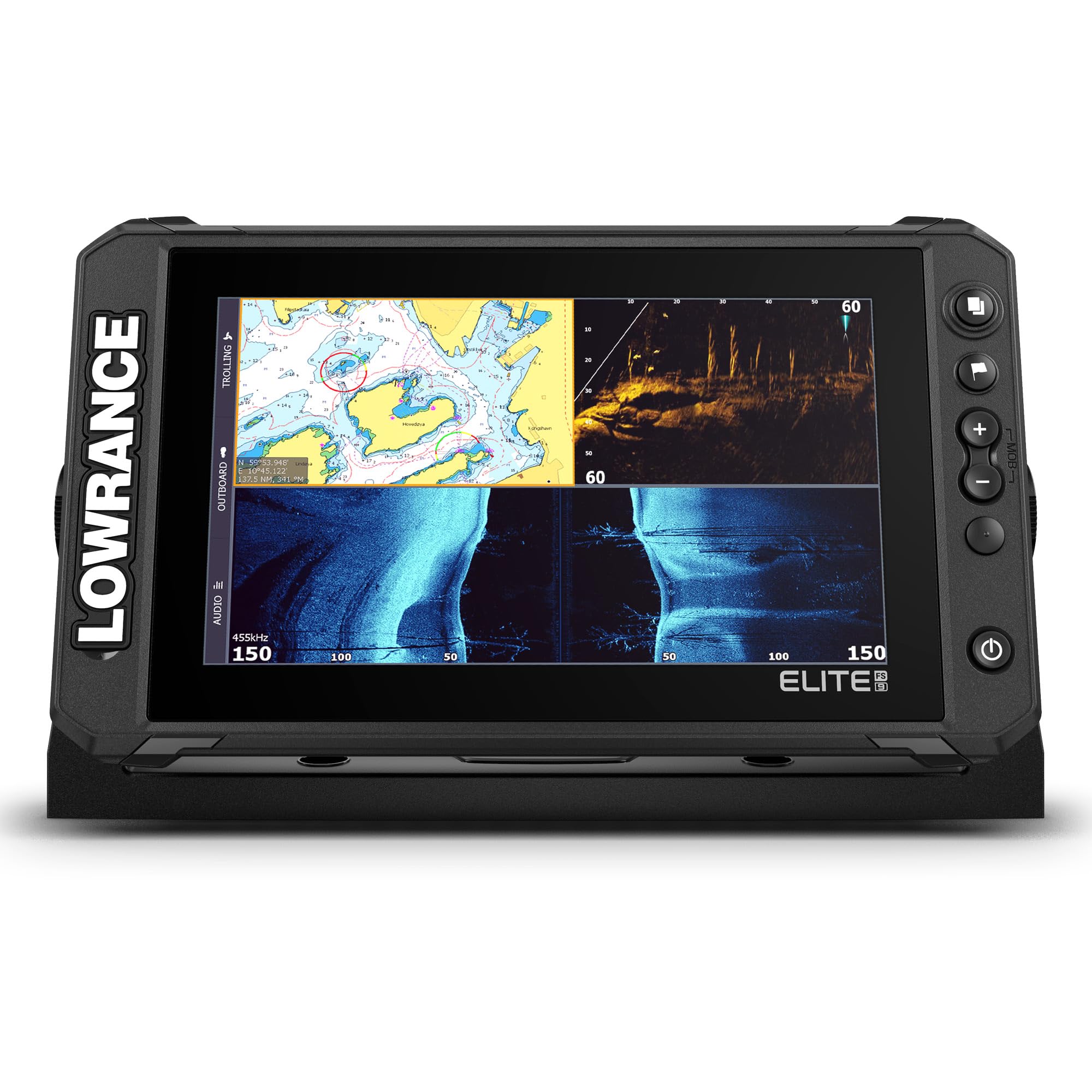
1. Lowrance Elite FS Fish Finder/Chartplotter
Our pick — 4.5+★ from 500+ verified ratings; the strongest balance of quality and price.
Nine inches of touchscreen that reads the bottom to 1000 feet and still leaves room for the charts.
This is the pick to start with if your small boat needs one screen that does the whole job. The 9-inch multi-touchscreen is high-resolution and runs flexible split-screen layouts, so you can put sonar beside the chart and keep both readable. Depth of view tops out at 1000 feet, which on a compact hull means you can follow a drop-off deep into the lake without the screen giving up on you.
You can launch the same day, because the box is complete: a 3-in-1 transducer (one puck that handles CHIRP sonar, SideScan and DownScan with FishReveal — three ways of seeing the bottom and to the sides at once), a suncover, mounting bracket and knobs, a fuse and holder, and the power cable. Nothing else to buy before you launch. C-MAP Discover charts come preloaded with detailed lake contours, so ledges, drop-offs and ditches show up before you drop a line.
Owners keep coming back to how much structure this thing reveals, and the preloaded maps are accurate enough to trust on a strange lake. One kayak angler runs it off a 20ah lithium battery that lasts a full day, weighing 6 lbs, with a Yak Hobby transducer mount on an Oldtown 120 PDL. Another owner notes the 9-inch body fits behind a Basstracker windshield with room left for a cup holder.
The catch is the money question, and owners split on it. Some call it worth every bit for the feature set, others find it steep for the size. The other honest note is the 9-inch screen — plentiful for split views, but not the panoramic spread a bigger unit gives you. If you want ActiveTarget live sonar later, the unit is ready for it, which softens the sticker question for anyone planning to grow the rig.
Where it pulls ahead
- Complete setup in the box — MFD, 3-in-1 transducer, suncover, bracket, fuse, power cable
- 1000-foot maximum measuring depth covers deep lake structure
- SideScan and DownScan with FishReveal in one transducer
- Mirror the display to a phone or tablet anywhere on board
Where it holds you back
- Owners are split on whether the price is fair for the screen size
- 9-inch display is tight if you want a wide three-panel split
Made for: the owner who wants charts, sonar and room to add live sonar on one compact screen, out of one box.
Think twice if: you want the widest possible display and expect to run three panels side by side every trip.
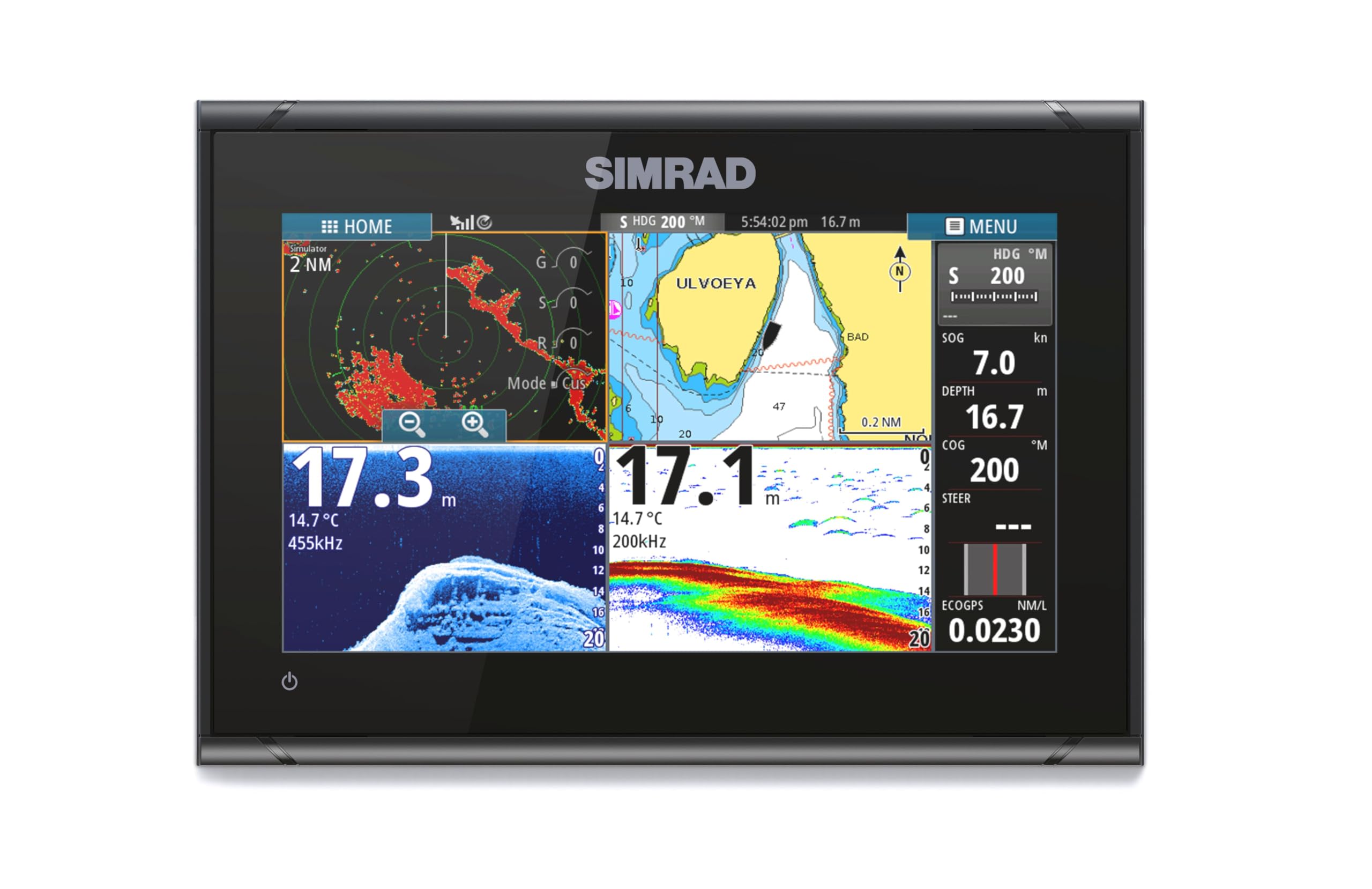
2. Simrad GO Chartplotter and Fish Finder, with Transducer and Radar Options, Preloaded C-MAP Discover Chart Card
The entry point that still gives you radar capability and a 9-inch touchscreen without the premium outlay.
If you are building toward radar on a budget, this is the base to build on. It is a 9-inch multifunction display that already handles GPS navigation, sonar support and radar capability — so the dome becomes the next purchase, not the first. The included 83/200 kHz HDI transducer (a dual-frequency puck) supports CHIRP sonar and DownScan Imaging, which is enough to see bottom structure and fish targets on the same screen you navigate with.
It fits a tighter dash slot than the Lowrance Elite FS 9: the Simrad’s footprint measures 10.35 by 3.54 by 7.24 inches, where the Lowrance spans 16 inches in length. It weighs 3 pounds against the Lowrance’s 2.7 pounds — a small difference on the rail. The C-MAP Discover card in the box brings full-featured vector charts, custom depth shading, tides and currents, high-resolution bathymetric contours and coverage across the US and Canada. Built-in GPS pairs with Wi-Fi and NMEA 2000 (a boat wiring standard that lets electronics share data) so the unit talks to other gear instead of sitting alone.
The functionality is where owners get won over, and the display gets consistent praise for staying viewable in real conditions. One owner upgrading from a smaller Go model calls the Go series intuitive and easy to interface with radar and other devices, and likes that the Simrad phone app adds value. A 32-foot Christ Craft Commander owner reports being amazed how it worked right from the start.
Reliability is the split verdict, and data availability draws mixed notes — some owners find their coverage complete, others discover missing waypoints and tracks. There is also the odd box that arrives short a card, so check the packaging before you mount anything. None of that changes what the unit is: a sensible radar-ready foundation at the most approachable end of this group.
What it really is: a radar-capable 9-inch MFD that trades the premium badge for the same core navigation and sonar workload.
Reach for this if: you want a full chartplotter now and plan to bolt a radar dome on later.
Look elsewhere if: you need guaranteed complete chart data on every trip and cannot tolerate a coverage gap.
3. Simrad GO Chartplotter and Fish Finder, with Transducer and Radar Options, Preloaded C-MAP Discover Chart Card

The sportsboat screen built to plug straight into a Simrad radar dome when you are ready to add eyes.
This GO9 XSE is the version built for radar pairing, where the value GO9 only gets you started. It is radar ready with plug-and-play connectivity to Simrad radar solutions for powerboats of all sizes — you add the dome, the display picks it up, and you gain safer cruising and more productive fishing without a compatibility hunt. The HDI Med/High/455/800kHz transducer (a sonar sender that pulses sound at those frequencies) is the step up here: Medium and High CHIRP plus DownScan Imaging, giving a picture-like view of the structures fish hold against.
It slots onto a center-console dash without eating the whole panel: it measures 11.3 by 3.5 by 6.55 inches, the compact end of the group and well under the 16-inch length of the Lowrance Elite FS 9. Wi-Fi and NMEA 2000 connectivity (a boat wiring standard that shares data between electronics) feed radar, charts and other functions across the boat, and mirroring to a smartphone or tablet means the helmsman and the bow have the same picture. The included C-MAP Discover card covers vector charts, custom depth shading, tides and currents and high-resolution contours across the US and Canada.
Installation stories run positive — transducer positioning is the usual challenge, but owners describe the instructions as simple and effective, the power-up and menu structure easy to navigate, and the modular design a good safety buy. Packaging let the unit down at least a couple of times, with the C-Map chip missing from the box, so unpack it fully and check the card before installing. Framing on the cover has been a weak point for a small number of owners, so ease the sun cover off gently rather than prying it.
Chart accuracy is the other split. The marketing claims coastal and inland coverage in high detail, and some owners dispute that for tricky shoal areas. If you run skinny water on an inland lake, cross-check the area you care about before you rely on it alone. If your plan is a Simrad dome and a tidy dash footprint, the plug-and-play pairing is the reason to pick this one.
Suits you when: a Simrad radar dome is on the list and you want the display to connect without drama.
Worth weighing: the compact frame and chart detail are the trade-off if your home water needs deep inland coverage.
4. Garmin ECHOMAP UHD2 93sv

Inland water gets its own map library here — 18,000-plus lakes with contours down to 1 foot.
Lake anglers should look hard at this one. The built-in Garmin Navionics+ inland maps with integrated Navionics data cover more than 18,000 lakes with contours down to 1 foot, which is the difference between guessing a hump is there and seeing it drawn. The GT56-TM transducer in the box adds Garmin traditional, ClearVü and SideVü scanning sonars — three looks at the bottom and out to the sides. The 9-inch touchscreen is bright and sunlight-readable, sized at 7.8 by 4.5 inches of actual display area within a 9.0-inch panel.
It is the heaviest of the 9-inch displays here at 8.1 pounds, so plan the mount for a solid dash surface rather than a thin bracket. Built-in Wi-Fi lets you share sonar, waypoints and routes with another ECHOMAP UHD2 chartplotter, and wireless pairing with a Force trolling motor lets you follow routes, run waypoints, control speed and check battery life from the screen. For a lake boat adding a radar later, this is the Garmin path into that ecosystem.
Functions win people over, and depth finding is the second strongest point. Owners who came over from another brand describe the graphics as a real step up, and there is a common thread of it being an easy upgrade from a previous unit. The one recurring honest note is ease of use — some find the interface natural, others mention a learning curve before it clicks. Give yourself an afternoon with the menus and it settles down.
Its place on this list is inland charting first, radar-capable second. If your water is a deep offshore run rather than a mapped lake, the range and chart coverage argue for one of the dedicated radar domes instead. If your weekends are spent on inland water, this is the most complete map-to-screen picture here.
Why lake anglers gravitate here
- Navionics+ inland maps across more than 18,000 lakes with up to 1-foot contours
- GT56-TM transducer adds traditional, ClearVü and SideVü sonar
- Wireless pairing with a Force trolling motor for route-follow and speed control
What to know before mounting
- Heavier than the other 9-inch units at 8.1 pounds
- The interface takes a learning curve for some owners
Pick this one for: inland lakes where contour detail and a full sonar suite decide whether you find the fish.
Pass on it for: blue-water runs where long-range radar range is the point of the purchase.
5. Simrad HALO20+ Pulse Compression Radar
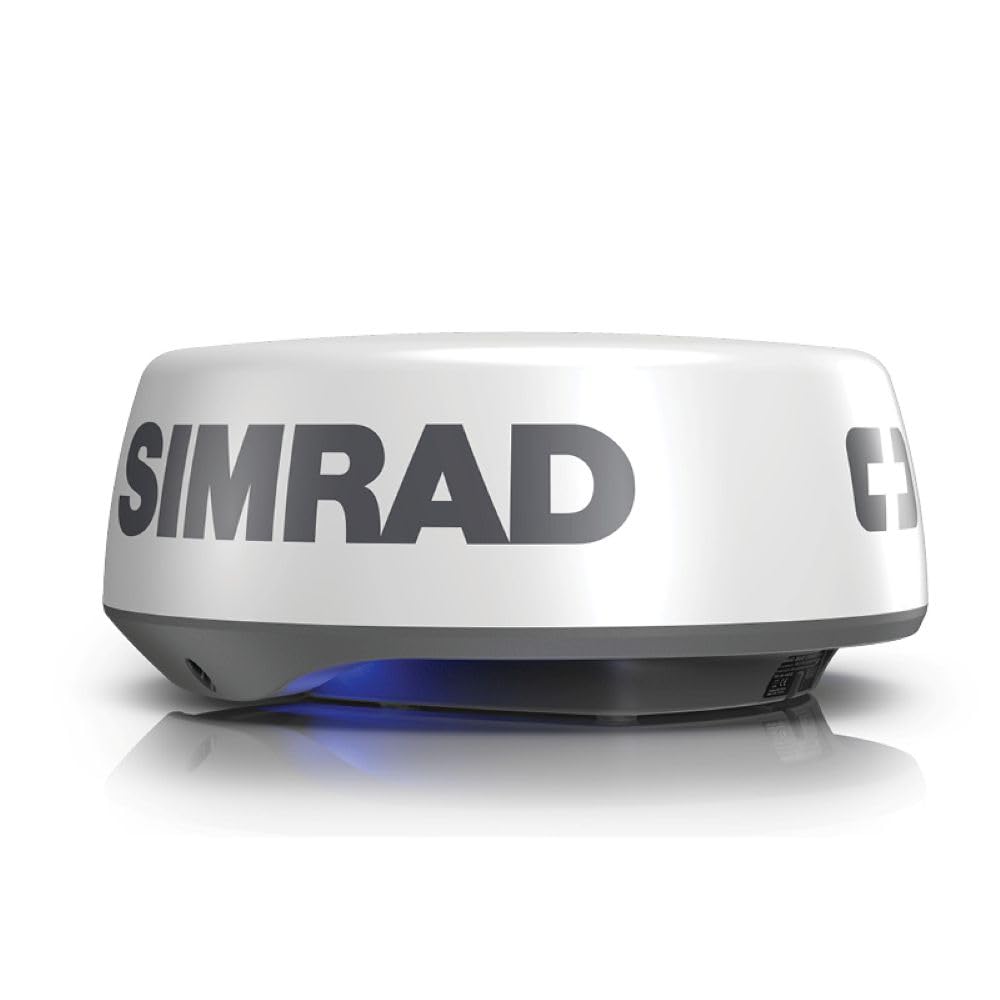
A 20-inch dome that spins at 60 RPM and paints targets out to 36 nautical miles.
You get range and speed at once, but only if you already run a compatible Simrad, Lowrance or B&G screen — this is a radar dome, not a display. Pulse compression technology with beam sharpening reaches up to 36 nautical miles (about 41 land miles), so far-off traffic shows up early. Dual-range operation shows near and far together, and 60 RPM rotation (a full sweep every second) keeps close targets refreshing almost in real time. VelocityTrack Doppler (a feature that spots motion toward or away from you) flags traffic closing on you, which is exactly the warning you want in a busy channel at dusk.
The dome measures 20 by 20 by 8.8 inches and weighs 22.1 pounds, and it runs on 24 volts of direct current — check that against your boat’s supply before you plan the install. Buyers report fitting it themselves quickly, working from the paper template in the box, and running the long cable to a 21-foot center console without fuss. Once wired, the power order matters: switch the radar on before the Simrad Go9, let it settle to standby, then transmit.
Range is the story owners keep telling. Targets have been reported well beyond 30 nautical miles, with Catalina Island and boats at 100 yards showing in the same view, and long-range returns near 50 miles on weather. Harbor mode tracks targets and flags collision threats, and bird mode finds bait offshore — turn trails on for bird detection, because returns fade fast. What you gain in awareness you pay for in a physical object on the hardtop, so confirm your arch can carry a 20-inch dome safely.
The honest read: the sharpest collision-avoidance tool in this group, provided you already own a compatible MFD and a mounting point that suits a 20-inch dome.
Best fit: boats running congested harbors or night passages who want near-real-time target tracking on a screen they already have.
The limitation: it is dome-only, so it adds nothing until it is paired with a compatible display.
6. Furuno 1815 8.4 Color Lcd Ra Radar 19 4kw Dome

Everything you need in one box — dome, screen and cable — with no extra purchase before launch.
Some boats do not want a network; they want a radar that works on its own. This Furuno pairs a 19-inch radome antenna with a built-in 8.4-inch color LCD screen and a 4 kW transmitter output — enough punch to hold a return in rough weather. Fast Target Tracking follows up to 10 targets manually or automatically and displays speed and course vectors in seconds. Adjustable display colors let you tune contrast to the light you are actually in, whether that is blinding afternoon sun or a dark bridge at night.
It is built for pleasure craft, workboats and small fishing boats, and it ships with a 10-meter cable. Owners like that the complete setup arrives in one order — no hunting for a display or a cable separately. Install reports describe the mount and wiring as straightforward, and the display readable once it is powered. For someone running a simple boat without an existing network, that self-contained design is a real practical advantage over a dome that needs a screen.
Offshore fishermen are the natural audience. Owners who run far out describe it as a tool you want aboard when the coastline disappears, with one report of a 100-mile offshore run on the same unit. The screen is the trade-off to size honestly: 8.4 inches is smaller than the 9-inch and 12-inch displays here, so you see less at once when the picture is busy. If a single self-contained radar suits your helm, that smaller screen is the price of the no-network simplicity.
Go with this if: you want a self-contained radar with its own screen and no separate MFD to buy.
Consider the bigger screens instead if: you want a wide panel for charts and sonar alongside the radar image.
7. Garmin 010-02367-61 GPSMAP 1243xsv SideVü

A 12-inch helm screen for the boat that reads charts from the back deck as well as the seat.
When you want the biggest display in the group, this is it. The 12-inch WXGA panel (a wide high-definition format) with improved display optics carries SideVü, ClearVü and Traditional CHIRP sonar plus preloaded Navionics mapping, and it supports Panoptix sonar for a live forward view you can add later. On a boat with room to mount it, the extra inches mean multi-view layouts — chart, sonar and radar panels — that you can still read without leaning in.
Owners like the readability first: a large screen, multi-view layouts, and the choice of deck mount or flush mount. External antenna placement is worth the effort — reports say it gives better accuracy than the internal option. Boot-up is the slow part, but once it starts, GPS and depth come up quickly. For interfacing with other gear, it displays Yamaha engine parameters the way a dedicated engine screen would, which tidy up a crowded dash.
The sizing caveat is real. This is not a direct swap for every older Garmin, and owners who tried to replace a 1242XSV found the footprint did not match, forcing extra modification of the cutout. Measure your existing opening and mount plan before you order. As a radar-capable MFD it sits down the Garmin radar path — add a compatible dome and the big screen carries the picture beautifully. For anyone who wants one large, bright screen doing navigation, sonar and eventually radar on a roomy console, this is the biggest canvas here.
What the big screen buys you
- 12-inch WXGA display with improved optics for multi-view layouts
- SideVü, ClearVü and Traditional CHIRP sonar with preloaded Navionics mapping
- Yamaha engine parameters shown on the same screen
Measure before you order
- Footprint differs from older models like the 1242XSV, so the cutout may need work
- Boot-up is slower than the rest of the operation
Right choice when: your console has space for a 12-inch panel and you want every view readable from across the deck.
Rule it out when: you are swapping into an existing cutout built for an older model.
Know the Specs
Range in nautical miles
Range is how far the radar pulse can pick out a solid target, measured in nautical miles (nm — roughly 1.15 land miles each). A 20-inch dome rated to 36 nm reaches coastline and shipping from far off, while shorter ranges suit a bay. Buy range for the foggiest visibility you expect, not the clearest day.
Dome diameter and rotation
A radar dome is the spinning antenna housing that sends and receives the pulse. Diameter in inches affects the physical footprint on your arch — a 19- or 20-inch dome needs a solid mount. Rotation speed in RPM (revolutions per minute — sweeps per minute) governs how often the picture refreshes; faster sweeps keep close targets current.
Display size and resolution
The screen in inches decides how many panels you can view at once. A 9-inch screen handles a chart plus sonar split; a 12-inch carries more. WXGA (a wide high-definition format) keeps detail legible on a bright day. Size the screen to your console space and to whether you plan to add a radar dome later.
Transducer frequency and sonar type
A transducer is the underwater sender that maps the bottom. Its frequency band — such as 83/200 kHz for deep and shallow coverage, or Med/High CHIRP for clearer separation — decides how well it tells fish from structure. Sonar types like ClearVü and SideVü add downward and side views so you see more of the water than a straight shot.
Power, voltage and wiring
Check the voltage the unit expects — some radar domes run on 24 volts of direct current, and a small boat’s 12-volt system has to match. Cable length in the box matters too: a 10-meter cable may be enough for one helm and short for another. Confirm both before you plan the run through the boat.
Chart cards and mapping
Preloaded chart cards like C-MAP Discover or Navionics+ carry contours, depth shading, tides and coverage. The differences show up in inland detail, so confirm your local water is covered with the contour resolution you want. Chart coverage is the spec most likely to disappoint quietly if the card covers the wrong region for your home lake.
Common Questions
Will a radar dome work with my existing chartplotter?
Do I need a separate display, or does the radar come with a screen?
What range do I actually need for a small boat?
How big a dome can a small boat carry?
What voltage does a radar dome need?
Is the chart card included, or do I buy it separately?
Why do some owners complain the charts are wrong for their water?
Does the radar need to be switched on in a certain order?
Which unit is best if I want a big visible screen on deck?
Can I track other vessels automatically?
The Bottom Line
For most small-boat owners, the smartest call in this small boat radar lineup is the Lowrance Elite FS 9, because it ships complete — screen, 3-in-1 transducer, charts and cable — and reads depth to 1000 feet while staying ready for live sonar later. If you already plan to add a radar dome and want the sharpest collision warning on a compact boat, reach for the Simrad HALO20+ and its 60 RPM, 36-nm reach. And if your weekends are on inland lakes, the Garmin ECHOMAP UHD2 93sv with more than 18,000 mapped lakes is the one to grab. The crowd has voted too — the Lowrance holds a 4.5+ star rating from a large, deep pool of owners, while the Furuno’s 4.8 sits on a much smaller base, so the Lowrance is the safer default. The single nudge here: match chart coverage and range to the water you actually run, not to the biggest spec sheet.
How we choose
We do not accept paid placement. Every pick is matched to a real buyer and a real use-case; we do not hands-on test units.
Sources
Specifications: manufacturer listings and product documentation. Review insights: verified customer reviews, as of October 2026. Pricing: not shown on this page (it changes often); check the current price via the retailer link.
As an Amazon Associate, Aappliancez earns from qualifying purchases. This does not affect which products we feature.