Disclosure: Some links in this post are affiliate links. As an Amazon Associate I earn from qualifying purchases, at no extra cost to you. Learn more
Specs are compiled from manufacturer listings and verified buyer reviews and can change over time — please confirm the key details on the product page before buying.
If you are shopping for an SLA printer or the resin that feeds it, the answer is simpler than the spec sheets make it look: match the resin to your machine’s wavelength and your own post-processing tolerance. Water-washable formulas remove the alcohol jug from your bench, standard 405nm resin gives you the crispest detail for miniature work, and a wash-and-cure station turns a messy two-hour chore into a push-button routine. This guide walks you through eleven picks — resins, a couple of FDM machines that keep showing up in the same shopping carts, and the wash-and-cure units that finish the job.
This guide is built by comparing the manufacturers’ published specifications and the patterns across verified customer reviews, so you get each pick’s real strengths and trade-offs instead of marketing spin.
Below you’ll find the resins that cure cleanly under 405nm light, the stations that wash and finish them without soaking your bench in IPA, and the honest trade-offs on each. Whether you are chasing sub-40mm miniatures or casting jewelry, here is what actually matters when comparing sla printers and the resin that runs in them.
Top Picks


How To Choose The Best SLA Printers Resin And Accessories
Most resin print failures trace back to a wavelength mismatch or resin that has gone off in storage, not to your printer’s resolution. Here is what to check before you buy.
Wavelength compatibility comes first
Your printer’s light source fires at a specific wavelength, and the resin has to be tuned to absorb it. Most modern LCD and DLP machines run at 405nm, while some older units use 365nm. A resin rated for the 365-405nm band covers both, so it works on either machine. If a resin lists only one wavelength and your printer runs the other, layers stay soft and sticky no matter how long you expose them.
Water washable versus alcohol cleanup
Water-washable resin contains hydrophilic groups — chemical hooks that let plain water lift uncured resin off the model. That removes isopropyl alcohol from your shopping list and the fumes from your workspace. The trade-off is that water-washable formulas can print slightly softer on fine detail than standard resin, so if you are chasing the sharpest possible miniature faces, standard resin still has the edge.
Shrinkage and elongation numbers
Shrinkage is how much the model pulls in as it cures under UV light, and a low number means your parts come out the size you designed. Elongation is how far the cured plastic stretches before it cracks — a higher figure means more flexible, longer-lasting prints. For thin jewelry or engineering parts, both numbers matter more than the printer’s resolution spec.
Side-by-Side Comparison
| Model | Best For | Type | Wavelength / Cure | Weight | Amazon |
|---|---|---|---|---|---|
| HATCHBOX PLA Filament 1.75mm Black★ Best Overall | Reliable FDM printing for beginners | PLA filament, 1.75mm | 180-220°C nozzle | 1000 g | Amazon |
| ANYCUBIC 3D Printer Resin (Grey, 1kg)Best Detail | Miniature detail work | Standard UV resin | 405nm | 2 pounds | Amazon |
| ANYCUBIC Water Washable Resin 2.0Best Alcohol-Free | Alcohol-free cleanup | Water washable resin | 365-405nm | 2.2 pounds | Amazon |
| SUNLU 2kg Water Washable Resin | Bulk water-washable printing | Water washable resin | 395-405nm | 4.4 pounds | Amazon |
| Siraya Tech Cast Resin (True Blue) | Jewelry and metal casting | Castable wax-based resin | UV cure, wax burnout | 2.2 pounds | Amazon |
| ELEGOO Mercury Plus 2.0 | Compact wash & cure | Wash & cure station | 16 x 405nm LED | 10 pounds | Amazon |
| ANYCUBIC Wash & Cure Plus 3.0 | Larger build plates | Wash & cure station | Flexicure gooseneck LEDs | 6.71 pounds | Amazon |
| Creality Ender 3 V3 SE | Fast FDM entry point | FDM printer | 250mm/s max speed | 15.66 pounds | Amazon |
| ANYCUBIC Wash and Cure Max 3 | Large-format resin post-processing | Wash & cure station | 25000 μW/cm² curing | 39.5 pounds | Amazon |
| ELEGOO Saturn 4 Ultra 16K | High-detail large resin prints | Resin printer | 16K LCD, 14 x 19 μm | 35.4 pounds | Amazon |
| Creality K2 Combo | Multicolor large-format printing | FDM printer with CFS | 600mm/s, up to 16 colors | 39.7 pounds | Amazon |
Detailed Reviews
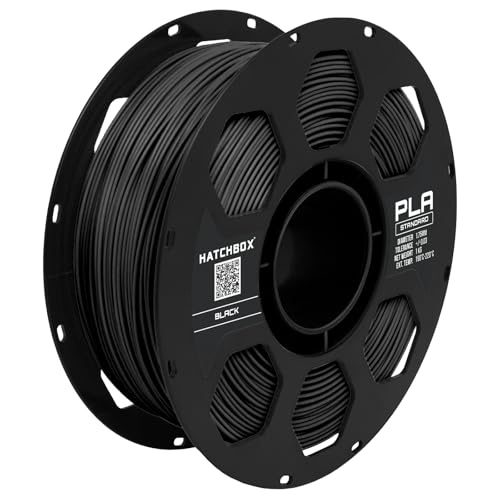
1. HATCHBOX PLA Filament 1.75mm Black, 1KG Spool
Our pick — 4.5+★ from 40,500+ verified ratings; the strongest balance of quality and price.
The dimensional-accuracy benchmark that keeps beginners printing instead of troubleshooting.
Anyone running an FDM printer alongside their resin setup eventually lands on this spool, and it earns the crowd-favorite title — 4.5+ stars across 40,000+ owners. The headline reason is the tolerances: ±0.03mm dimensional accuracy means the filament’s thickness stays consistent enough that your extruder feeds it evenly, so walls come out smooth instead of lumpy. At 1 kg per spool you get a full 2.20 pounds of material to burn through before reordering.
What wins people over is the quality consistency — 4.4K owners single it out, with print quality right behind. The glossy finish on completed parts and the dimensional accuracy hold up whether you are running a 0.4mm nozzle or pushing toward a 1mm nozzle for fast, chunky prints. The recommended nozzle window of 180-220°C gives you room to dial in surface finish, and it runs on most FDM machines without needing a heated bed, which is why it shows up in so many first-printer setups. Buyers report an even 0.05mm deviation across workflows when the setup is dialed in.
Here is the trade-off an experienced buyer will notice. Reliability and bed adhesion both carry mixed signals — some setups run flawlessly, others need attention. Legacy non-PTFE hot ends generated six clogs on prints over two hours, and one spool developed binding at the quarter-roll mark. A PTFE-lined hot end and a re-rolled spool solved both, but this filament is best kept dry and paired with modern hardware. Thermal sensitivity also means black takes some dialing in.
Why it earns the top slot
- ±0.03mm dimensional accuracy keeps walls even across nozzles and printer brands
- 1 kg spool (2.20 pounds) with a 180-220°C window that runs on most FDM machines
- No heated bed needed and low warp — friendly to beginners on budget hardware
Where it asks a little of you
- Older non-PTFE hot ends can clog on long prints — pair with a PTFE-lined upgrade
- Spool binding can appear around the quarter-roll mark; a re-roll fixes it
Buy it if: you want an FDM workhorse filament that holds tolerance across printers and needs almost no learning curve.
Think twice if: your hot end is an older non-PTFE design or you print in a very humid space.
2. ANYCUBIC 3D Printer Resin Grey 1kg
Crisp miniature detail at a 2540 dpi resolution rating, without the alcohol-free trade-offs.
If detail is the whole point — tabletop minis, character faces, fine engine parts — this is the bottle that keeps coming back. The 2540 dpi maximum print resolution spec is the headline, and reliability is what owners praise most, with resin quality running close behind. Low shrinkage during the photocuring process keeps parts dimensionally true, and the combination of rigidity and toughness makes supports pop off cleanly without chipping the model underneath.
Color holds up too — the grey keeps its tone through curing, which matters when you are batch-painting a squad and want consistent primer coverage. The universal compatibility is the other big draw: it runs on all DLP/LCD 3D printers, though the maker tunes it best for their own LCD machines. A full shake before pouring is not optional — do it and the color paste mixes evenly, skip it and you get patchy pigment across the layer stack.
The recurring gripe is odor. It carries mixed signals there, and color is similarly split — some lots read truer than others. Brittleness is the honest one to plan for: prints come out rigid rather than flexible, so drop-prone pieces benefit from a thicker cross-section. The bubble-wrapped bottle with the tight-fitting air bag means the odds of a leaking shipment are low.
What’s worth knowing: print quality in the miniature-work category is what this resin is tuned for, and the low-shrinkage formula is what keeps those fine details locked in after the cure.
Reach for this if: miniature fidelity is your priority and you do not mind resin odor during a print run.
Look elsewhere if: you want a flexible, drop-resistant part or your workspace is tightly sealed.
3. ANYCUBIC Water Washable 3D Printer Resin 2.0 Grey 1000g
Skip the IPA jug entirely — this one rinses under the tap and stays flexible.
Water washable is the switch that gets resin printing out of the garage and onto the kitchen counter. This 2.0 formula contains hydrophilic groups with good water solubility, so plain water lifts uncured resin off the model instead of isopropyl alcohol. It also works in the brand’s own Wash and Cure Machine or an ultrasonic cleaner, so you are not locked to a sink-only workflow. Buyers consistently report a lot less odor and easy water cleanup as the two things that sold them.
The upgraded formula is also anti-yellowing — models keep vibrant color after prolonged exposure, which is a real problem for clear and white resins under UV. Precision runs up to 0.15mm, enough to meet the demands of miniature detail work. Elongation sits at 16.62%, and that number is the one that matters when you are worried about cracked, brittle prints: it means cured parts flex a little instead of shattering, and last longer under handling. It works across a wide range of LCD and DLP machines in the 365-405nm band, so it slots into most printers already on your bench.
Detail is where it splits from the standard formula, and it is worth naming plainly. Some prints come out soft and sticky even after bumping exposure from 3 seconds to 4 seconds, and detail gets lost. That is not universal — most prints hold detail well, including transparent models like windows and lab equipment, though clear prints cure frosted and need a gloss coat for real glass clarity. The 2.2-pound bottle is 10% heavier than the standard ANYCUBIC 1kg resin, so you get a little more material for the same bottle size.
What makes it different
- Cleans with plain water — no IPA budget, no alcohol fumes in the workspace
- 16.62% elongation keeps parts flexible and less prone to cracking
- 365-405nm compatibility covers most LCD and DLP machines already on the market
The honest caveat
- Fine detail can come out soft on some setups, especially at lower exposure times
- Clear prints cure frosted and need a gloss coat for real glass clarity
The right call for: anyone who wants resin printing without hauling IPA home by the gallon.
Better options exist if: razor-sharp miniature faces are non-negotiable and exposure tuning is not your thing.
4. SUNLU 2kg Water Washable 3D Printer Resin (2000g Grey)

A 2kg bottle that prints down to paper-thin detail without the alcohol soak.
Two kilograms in one bottle changes the workflow math — fewer reorders, fewer mid-project interruptions. The 395-405nm cure window covers most 2K, 4K, and 8K resin printers across LCD, DLP, and SLA, so the question is not whether your machine is compatible. Thin, paper-weight detail is where it shines: owners mention successful prints as thin as roughly 0.010 inches, about the thickness of three sheets of paper, running on a Saturn 2. Low shrinkage and high precision come from SUNLU’s R&D focus on reducing volume shrink during curing.
The water-washable chemistry lets you clean with plain water instead of IPA, which is the whole reason this formula exists. And the washability aspect is what keeps coming up as the standout — owners celebrate that the print quality holds up alongside the cleanup savings. Compatibility is high enough that even multi-printer households consolidate on it, with low odor that dissipates quickly after printing. The leak-proof bottle design and strict packing process reduce the odds of a shipment arriving damaged.
The honest trade-off is brittleness, which is mixed in the feedback. Small items can arrive cracked if handled roughly, and occasionally a print pops off the plate with more force than you want. Minor adhesion issues cleared up with an 80-grit sanding on the plate, and best results come from a 3-5 minute UV cure window. Large surfaces print slightly rougher than premium brands, so if smooth, uniform large-format output is the goal, this is not the pick.
Where it lands: perfect for volume printers running miniatures or props where water-wash convenience matters more than a flawless mirror finish on large flat surfaces.
Worth the shelf space if: you print a lot, want water cleanup, and can live with a slightly rougher surface on large parts.
Skip the switch if: you need premium surface uniformity on big flat models.
5. Siraya Tech Cast 3D Printer Castable Resin (True Blue, 1kg)

The castable formula that burns out clean for thick bracelets and metal parts.
If you print patterns that become metal, ash residue is your enemy. This castable resin contains wax, so it burns out more easily than non-wax casting resins and leaves much less ash behind — that means cleaner molds and fewer casting defects on thicker designs like bracelets, big pendants, medals, and coins. The result is a formula suited to both new users and experienced casting benches, since it does not demand a bone-dry environment or special additive to print and burn well.
Where the prints themselves stand out is high resolution with real surface gloss. The bright true blue color makes the gloss obvious, which helps you see detail while you are checking your supports. It is softer than the brand’s own cast purple, and that softness translates to complex features and ultra-fine structures being captured more reliably. It runs in most LCD, DLP, and SLA printers, so you are not shopping for a dedicated casting machine.
The learning curve is the honest bar to clear. Casting performance is not the same as plug-and-play resin printing — this one needs specific temperature and exposure tuning before it behaves. And curing is the aspect that trips people up most. The blue also cannot print crisp details as easily as the purple on its own, which is why the mixed-50/50 blue-plus-purple approach keeps showing up: better prints than either alone. Customers note the payoff — prints surviving drops, easy tooling, and use in a 260°F rubber vulcanizer without glue or coating.
Where it shines
- Wax-based formula burns out clean with less ash — ideal for thick designs and metal parts
- True blue surface gloss makes detail visible while you check supports
- Softer than cast purple, which captures ultra-fine structures like bracelet filigree
Plan around this
- Steep learning curve — expect to tune exposure and temperature before it behaves
- Blue alone cannot print crisp details as easily as purple; mixing helps
Made for: jewelry casters and metal-part makers who need a clean-burning pattern resin and will invest the time to dial it in.
Not the first bottle if: you want a forgiving all-purpose resin for hobby miniatures.
6. ELEGOO Mercury Plus 2.0 Wash and Cure Station
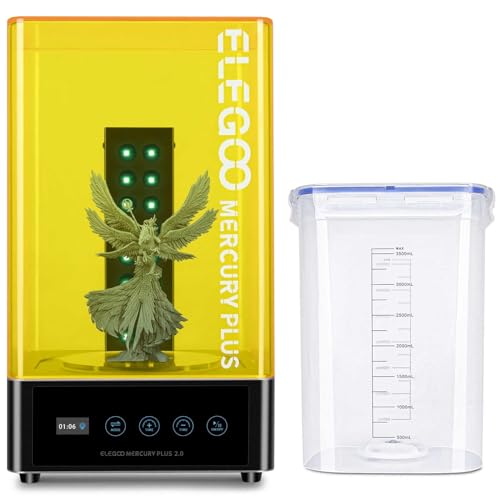
The compact wash-and-cure station that retires your jar of IPA and homemade curebox.
For anyone running a Mars-sized resin printer, this is the accessory that upgrades the whole workflow. The 16 built-in 405nm UV LEDs paired with a 360-degree rotating turntable mean every angle of the model gets the same UV dose — no more rotating parts by hand and hoping the underside cured. The anti-UV lid blocks 99.95% of ultraviolet rays, so you can run a cure cycle without staring into UV light, and the sealed wash mode keeps alcohol from evaporating into your workspace between prints.
What wins people over is quality — the most-discussed aspect, at 133 counted mentions — with ease of use right behind at 86. The front TFT screen shows the set time and remaining time directly, so you can glance and walk away. You can either drop models into the cleaning basket for a separate wash, or mount the build plate with models still attached and wash everything together without touching uncured resin. The height of the platform bracket adjusts to fit your bucket’s liquid level, so a full Mars build plate drops straight in.
Noise is the recurring gripe, and it is a mixed bag. Startup brings a high-pitched fan whine, and the mode buttons beep at a volume you cannot disable. The basket holes are too large for small miniatures — a mesh liner solves it. A few structural quirks surface over time: the wash bin bearing can gum up if cured resin gets in, the lid feels flimsier than the rest of the machine, and replacement buckets have been hard to find on Amazon. One owner notes the wash cycle works well with 70-90% IPA or denatured alcohol, and the results beat shaking by hand.
Buy it if: you print on a Mars-sized machine and want one box that washes and cures without juggling jars.
Steer around it if: you run a Saturn-class build plate (too big for the wash tank) or you print with water-washable resin.
7. ANYCUBIC Wash & Cure Plus 3.0, 7.6L Basket

Bigger tank, brighter gooseneck, and the widest build-plate compatibility in the lineup.
If you moved up from a compact resin printer to a 10.6-inch LCD machine, this is the station sized for you. That means the whole build plate drops in without tilting or removing models first. Meanwhile the lightweight 6.71-pound body makes moving it between bench and shelf far easier than a larger unit.
The Flexicure gooseneck lights are the standout spec. They add 30,000 μW/cm² (microwatts per square centimeter, a measure of light intensity) over a 1-3 cm irradiation range, aimed right at the tricky top surfaces and figure details that flat LED arrays miss. The re-arranged lamb beads combined with a lens light source deliver 20% more curing uniformity than the previous generation, so surfaces come out consistently tack-free instead of partly under-cured. Cleaning and curing times adjust from 1 to 30 minutes, and the platform mode has two adjustable heights of 150mm and 250mm, letting the plate sit between 6.6 and 10.3 inches — which trims how much IPA you pour per cycle.
The honest friction point is durability of the physical hardware. The wash container’s seal can pop out and refuse to seat back properly, and the tabs holding the top lid on have a reputation for snapping off if you are rough with them. A few owners also find the default wash and cure times run short and dial them up. Buyers do report the station runs quietly and sturdily, and the large tank plus fast washing earn consistent praise for post-processing throughput.
The case for it: covers all the sizes the Mercury Plus cannot, with a small footprint for a station this capable.
Suits you if: you run a 10.6-inch or smaller LCD resin printer and want the widest plate support without a giant footprint.
Not your pick if: you want a station you can bang around — the lid tabs and seal want gentle handling.
8. Creality Ender 3 V3 SE 3D Printer, 250mm/s

The 20-minute setup that gets a first-time FDM user printing without the hardware fight.
This is the FDM printer for someone who wants to learn the craft rather than fight the machine. Preassembly gets you three steps from unboxing to first print, and 20 minutes is realistic from unpacking to a completed test model. The CR Touch sensor handles auto leveling and a strain sensor handles auto Z-offset, so the bed-height ritual that used to eat afternoons is quietly handled in the background. The 250mm/s max speed and 2500mm/s² acceleration make it faster than typical entry machines.
The extruder is the bigger story. The Sprite full-metal dual-gear direct extruder pushes filament with more force than a Bowden setup, which means smooth feeding and no slipping — a real difference on flexible materials like TPU. It handles PLA, PETG, and TPU without switching hardware, and this extruder design has shipped on over 500,000 units worldwide, so it is not untested. Dual Z-axis lead screws cut Z wobbling, and the Y-axis runs on two 8mm steel linear shafts for stability over long-term use.
The honest limits sit in the reputation picture. Reliability, durability, and bed adhesion all carry negative signals in the feedback mix, and the printer arrives calibrated but not always dialed in — firmware updates, a belt-tension check, and one round of bed leveling solve most of the out-of-box friction. Cloud functions and the companion app want a paid accessory and some basic features sit behind paywall prompts, so plan on running the free slicer routes if you print offline. Auto filament loading and unloading works with a tap on the screen, which makes material swaps noticeably faster than manual feeding.
Where it earns its place
- 250mm/s max speed and 2500mm/s² acceleration beat typical entry-tier FDM printers
- CR Touch auto leveling plus strain-sensor auto Z-offset removes manual bed-leveling rituals
- Sprite dual-gear direct extruder handles PLA, PETG, and TPU without swaps
What to expect
- Arrives calibrated but not fully dialed — budget an hour for firmware, belt tension, and one bed leveling pass
- Some cloud and app features sit behind paid or gated options
Right for: beginners who want a fast, easy-to-set-up FDM printer to learn on without constant hardware troubleshooting.
Look past it if: you want cloud functions open up from day one or expect zero tuning from the start.
9. ANYCUBIC Wash and Cure Max 3 Station
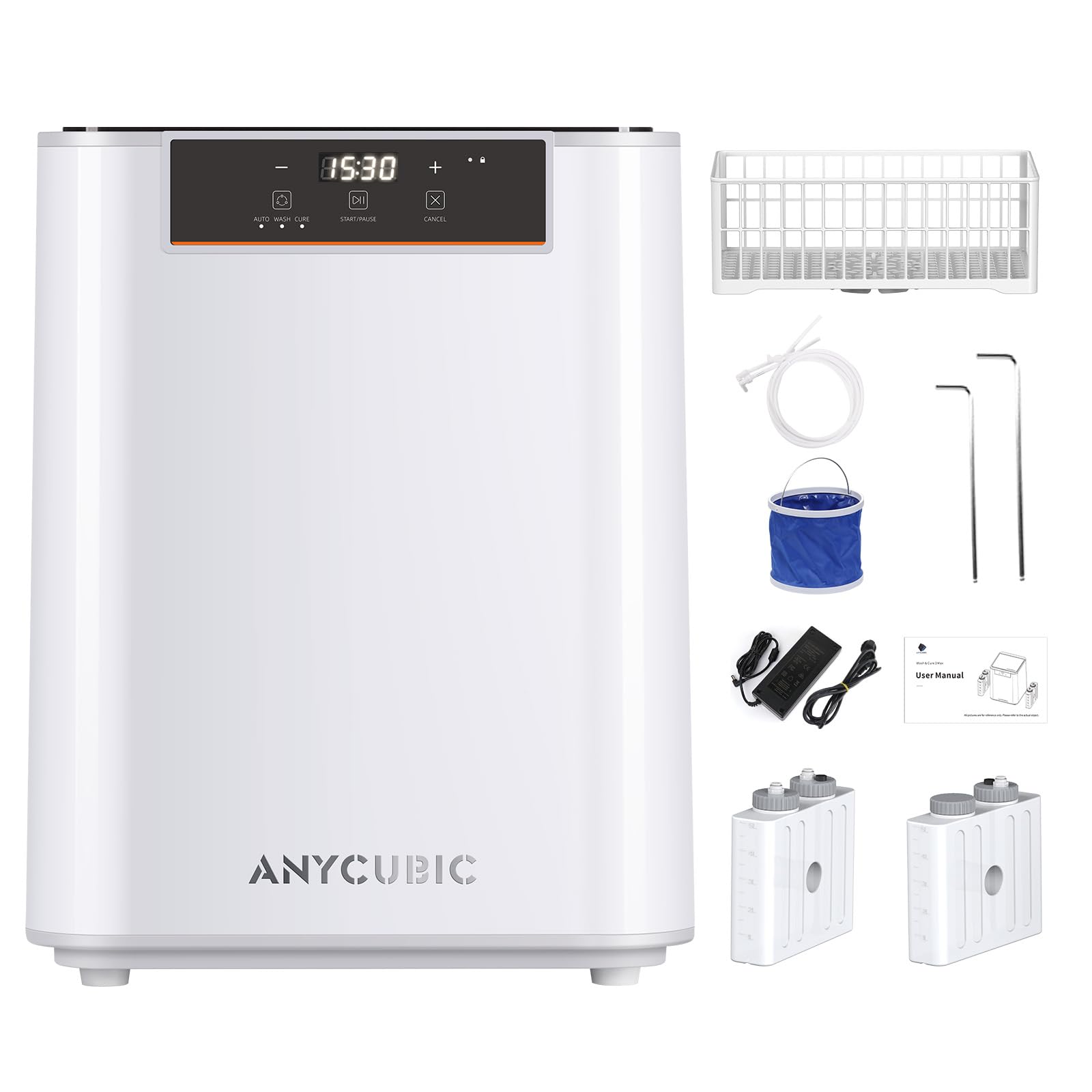
The station built for monster prints — and the workflow quirks that make it a specific-buy.
Anyone printing helmets, terrain, or full-size props on a large-format resin printer knows the post-processing problem: the standard wash-and-cure station is not big enough. This one is. The wash chamber measures 305 x 165 x 300mm and fits any resin 3D printer with a build volume of 13.6 inches or smaller — genuine room for scale that most benchtop stations cannot touch. The rotating wash basket handles up to 3KG, and the high-load transmission keeps the basket spinning evenly even with a full load.
The IPA-saving math is the other big argument. The dual cleaning mode (spray rinsing plus bottom immersion washing) covers the model from 360 degrees, and the whole cycle needs only about 4 liters to wash a 25cm print — compared to the 8.5 liters traditional immersion machines pull for the same job. The curing platform rotates for 360-degree coverage with a curing energy value of 25000 μW/cm² (microwatts per square centimeter, a measure of light intensity) at an 18cm irradiation distance, giving full-volume exposure. Intelligent monitoring alerts you to faults during operation so you know when something needs attention.
The honest trade-off here is that this is a machine with real workflow friction. There is no wash-only cycle — pressing the button auto-advances into cure, which several owners say leaves wet prints especially with black resin. The turntable and basket can hop or stall once a few ounces are loaded, regardless of balance, and fine hollow prints can come out still sticky and needing a manual scrub. On top of that it weighs 39.5 pounds and needs a drain bucket and discharge setup most buyers are not expecting. Many reviewers point out they ended up not using it after a handful of cycles.
Buy it knowing: this is the largest-format station in the ANYCUBIC lineup, and the only reason to pick it is the size — nothing else it does rivals the smaller Plus 3.0.
Only for you if: you genuinely need 305 x 165 x 300mm of wash volume and can live with the auto-advance quirk and manual follow-up scrubs.
Look at the Plus 3.0 instead if: you want a smaller, smoother post-processing workflow that just works the first time.
10. ELEGOO Saturn 4 Ultra 16K Resin 3D Printer

The 16K panel that captures detector-grade detail in an 8-inch build area.
When a resin printer’s screen resolution climbs to 16K, layer lines become almost invisible at normal viewing distance. The XY resolution of 15120 x 6230 pixels translates to 14 x 19 μm per pixel — meaning the smallest detail the LCD can produce is roughly one-sixth the width of a human hair. That matters for model makers who need fine rivets on a tank hull or hair-thin filigree on a jewelry pattern. Print volume is a generous 8.33 x 4.66 x 8.66 inches, so larger figures or multi-part kits fit in one go.
The heated resin tank solves a specific problem. Resin gets thick and unpredictable in a cold garage, which drops print success rates. The tank detects when the temperature drops below 25°C and activates heating to bring it back into the working window — so you can run a batch in a cold shop without warming your resin separately. The AI camera with an integrated light lets you check on a run at any time, catch a spaghetti failure, and correct it before you waste a full print. It handles time-lapse recording, which owners use to share workflows with other makers.
Speed is honest here too: the tilted release technology and 25% higher light energy get it to 150mm/h without needing ACF release films. Auto-leveling, power-on resume, Wi-Fi transfer, and one-click self-check on startup strip shelf most of the setup friction. The trade-off is reliability — some units work perfectly straight from the start while others arrive with a dead power brick and need a warranty replacement. The resin smell is unavoidable, the stock release film is a consumable you will eventually replace, and one owner notes the machine is light enough to wish it were bigger.
What sets it above
- 16K LCD with 15120 x 6230 px (14 x 19 μm) resolution captures detector-grade detail
- Auto-heated tank activates below 25°C, so cold workspaces do not kill print success
- 150mm/h print speed without needing ACF release films
The honest bit
- Some units arrive with a failed power brick — Elegoo support replaces them but it is a delay
- Stock release film is a consumable; budget for a replacement early
Ideal for: modelers and makers who want 16K detail in an 8-inch class build volume and value auto-heating for cold workspaces.
Would not choose this if: you want an absolute-zero-defects arrival experience or a fully closed machine ecosystem.
11. Official Creality K2 Combo 3D Printer with CFS

Multicolor prints up to 16 colors in one run, at speeds that finish full models in a single sitting.
Multicolor FDM printing used to mean swapping spools by hand and pausing the print. This bundle does it automatically. Bundled with the CFS multi-filament system, it can run up to 16 colors together in one print, which means painting is optional instead of required. The system manages multiple filaments intelligently, so switching colors between layers happens without you hovering over the machine — a workflow shift that shows up in the model detail right away.
The speed story is real. Industry-grade three step-servo motors located in the extruder and on the X/Y axis work together for extrusion consistency and printing accuracy, and the printer reaches 600mm/s with 20000mm/s³ acceleration. Shoppers say full prints completing in about 80 minutes at top speed. The 10.24 x 10.24 x 10.24 inch build volume fits a helmet or many small pieces in a single run — no more splitting models across multiple prints.
What supports all that speed is the foundation. A rigid exoskeleton built from die-cast aerospace aluminum alloy stiffens the XYZ axis so the printer does not wobble at high acceleration. The 40mm³/s high-flow hotend runs on an 80W powerful heater, with ABS flow reaching 40mm³/s at 280°C — and the nozzle reaches 300°C with a hardened steel tip built for abrasive engineering filaments. Adaptive mesh leveling probes only where your model sits, so the first layer lands in much less time than a full bed probe.
Why buyers pick it up: the combination of 16-color printing, 600mm/s speed, and a 10.24-inch build volume covers hobbyist and small-shop workflow gaps that were previously split across multiple machines.
For you if: you want multicolor prints without manual spool swaps, in a large-format FDM machine that can run several models at once.
Maybe not if: you only print single-color functional parts and would never use the CFS system.
Know the Specs
Wavelength (365nm vs 405nm)
The wavelength is the color of the UV light your printer fires, measured in nanometers. A resin absorbs light best at the wavelength it was tuned for. Standard consumer machines run at 405nm, while some older or specialty machines use 365nm. If you have not checked yours, look at the light source spec on the printer. A resin rated for the 365-405nm band covers both, which makes it the safe pick for most machines. A mismatched wavelength is the most common silent cause of sticky, undercured layers.
Water Washable vs Standard Resin
Standard resin cleans with isopropyl alcohol, which means buying IPA by the gallon and dealing with fumes. Water-washable resin contains hydrophilic groups that let plain water do the same job, which removes both costs from your bench. The trade-off is that water-washable formulas can print slightly softer on very fine detail, so resin-only modelers chasing the sharpest miniature faces still reach for standard resin. Both formulas cure identically under your printer’s UV light.
Common Questions
What is the difference between SLA and DLP resin printers?
Can I use water-washable resin in any resin 3D printer?
How do I know which wavelength my printer uses?
Why does my resin print come out brittle and crack easily?
How long do I need to cure resin prints after washing?
Is a wash-and-cure station worth buying or can I do it manually?
Do I need a heated resin tank for printing in a cold workshop?
How much resin do I need for a typical miniature?
Can I mix two different resin formulas in the same bottle?
What causes resin prints to stick to the build plate or fall off mid-print?
The Bottom Line
For most people getting into resin and FDM printing, the sla printers winner in this batch is the HATCHBOX PLA Filament — the crowd favorite with 4.5+ stars across 40,000+ owners, thanks to its ±0.03mm accuracy and 180-220°C window that runs on most FDM machines without a heated bed. If you want the alcohol-free cleanup workflow, the ANYCUBIC Water Washable Resin 2.0 rinses clean under a tap with a 365-405nm rating that covers most machines. And if your priority is 16K layer detail in an 8-inch class build volume, the ELEGOO Saturn 4 Ultra 16K with its auto-heated resin tank is the one to reach for.
How we choose
We do not accept paid placement. Every pick is matched to a real buyer and a real use-case; we do not hands-on test units.
Sources
Specifications: manufacturer listings and product documentation. Review insights: verified customer reviews, as of October 2026. Pricing: not shown on this page (it changes often); check the current price via the retailer link.
As an Amazon Associate, Aappliancez earns from qualifying purchases. This does not affect which products we feature.