Disclosure: Some links in this post are affiliate links. As an Amazon Associate I earn from qualifying purchases, at no extra cost to you. Learn more
Specs are compiled from manufacturer listings and verified buyer reviews and can change over time — please confirm the key details on the product page before buying.
Buying side scan sonar is really about one thing: whether the picture on your screen is sharp enough to tell a sunken tree from a rockpile before you cast. Get the frequency, the beam coverage and the head-unit compatibility right, and you can read a whole stretch of bank in a single pass. Get them wrong, and you own a transducer that shows mush, or worse — one that will not even plug into the fish finder already bolted to your console. This guide covers the eleven units worth your attention, what each one actually does for you on the water, and which one fits your boat, your budget tier and your fishing style.
This guide is built by comparing the manufacturers’ published specifications and the patterns across verified customer reviews, so you get each pick’s real strengths and trade-offs instead of marketing spin.
Side imaging works by firing thin sonar slices out to the sides of your hull, so the screen shows a strip of bottom and anything sitting on it. The catch is that no two units here fit the same head unit, and connector pin counts and adapter cables matter as much as the beams themselves. Below you will find the full breakdown of the side scan sonar options that actually earn a spot on the transom.
Top Picks


How To Choose Side Scan Sonar
The first decision has nothing to do with the transducer at all. It is the box on your dash. Every side imaging unit here is built for a specific family of displays, and the plug on the end of the cable is the detail that quietly decides whether your new purchase works or sits in a box. Work backwards from your head unit, confirm the connector, then shop the beams.
Fit the display before you fit the beam
A transducer is a dumb part in the best way — it sends and receives sound, and the display does the thinking. That means the display has to recognise it. Some units here use a 9-pin connector and call for an adapter cable; others run a proprietary plug built for one brand’s fish finders. Write down your head unit’s model number first. Then match it to the compatibility list, because a wide-coverage beam you cannot plug in is worth nothing on the water.
Frequency and what it buys you
Side scan runs at set frequencies, and they trade off against each other. Higher frequencies like 800 kHz return a sharper, tighter picture but cover less ground per pass. Lower settings such as 455 kHz reach further out to the sides of the boat. CHIRP sonar, which sweeps a range of frequencies rather than one fixed tone, improves target separation so fish arches and structure read more cleanly. Serious buyers check the listed frequency range and the maximum measuring depth before anything else.
Coverage, mounting and the long cable run
A transom-mounted unit bolts to the back of the hull and skims just under the waterline. Trolling motor mounts and nosecone setups put the beam where your boat is already headed, which keeps the picture steady in wind. Cable length matters more than most first-time buyers expect — you are running it from the transom up to the console, and a short run leaves you coiling excess in the wrong place. Check the stated cable length against your own hull before you commit.
Side-by-Side Comparison
| Model | Best For | Max Measuring Depth | Mount Type | Weight | Amazon |
|---|---|---|---|---|---|
| Humminbird XHS 9 HDSI 180 T★ Best Overall | Replacing an ageing Humminbird side imaging transducer | — | Transom Mount | 14.08 ounces | Amazon |
| Lowrance Active Imaging 3-in-1 (6′ Cable)Most Versatile | HDS LIVE, Carbon and Elite Ti2 owners | 91 meters | Transom, Flush step, Jackplate | 2 pounds | Amazon |
| Lowrance TripleShot SkimmerBudget Champion | HOOK Reveal and HOOK2 displays | 300 feet | Transom Mount | 1.5 pounds | Amazon |
| Lowrance Active Imaging 3-in-1 Nosecone | Ghost trolling motor owners | 91 meters | Trolling motor mount | — | Amazon |
| Humminbird XM-14-HW-MSI-T | SOLIX displays needing MEGA imaging | 1200 feet | Transom | 1.7 pounds | Amazon |
| Garmin STRIKER Plus 7sv | Inshore boats wanting a complete 7-inch setup | — | Transom Mount | — | Amazon |
| Garmin STRIKER Vivid 7sv | Easy first side imaging display | — | Panel Mount, Dashboard Mount | 5.4 pounds | Amazon |
| Garmin STRIKER Plus 9SV | Pontoon and open-boat owners wanting a big screen | — | Surface Mount | 2.4 pounds | Amazon |
| Garmin STRIKER Vivid 9sv | Anglers who fish in bright sun | — | Thru-Hull Mount | 6.4 pounds | Amazon |
| Humminbird Helix 7 G4 | MEGA side imaging on a 7-inch head unit | 125 feet | Gimbal and In-Dash Mounting Kit | 2.1 pounds | Amazon |
| Garmin ECHOMAP UHD2 93sv | Chartplotter mapping plus side scan | — | Dashboard Mount | 8.1 pounds | Amazon |
Detailed Reviews
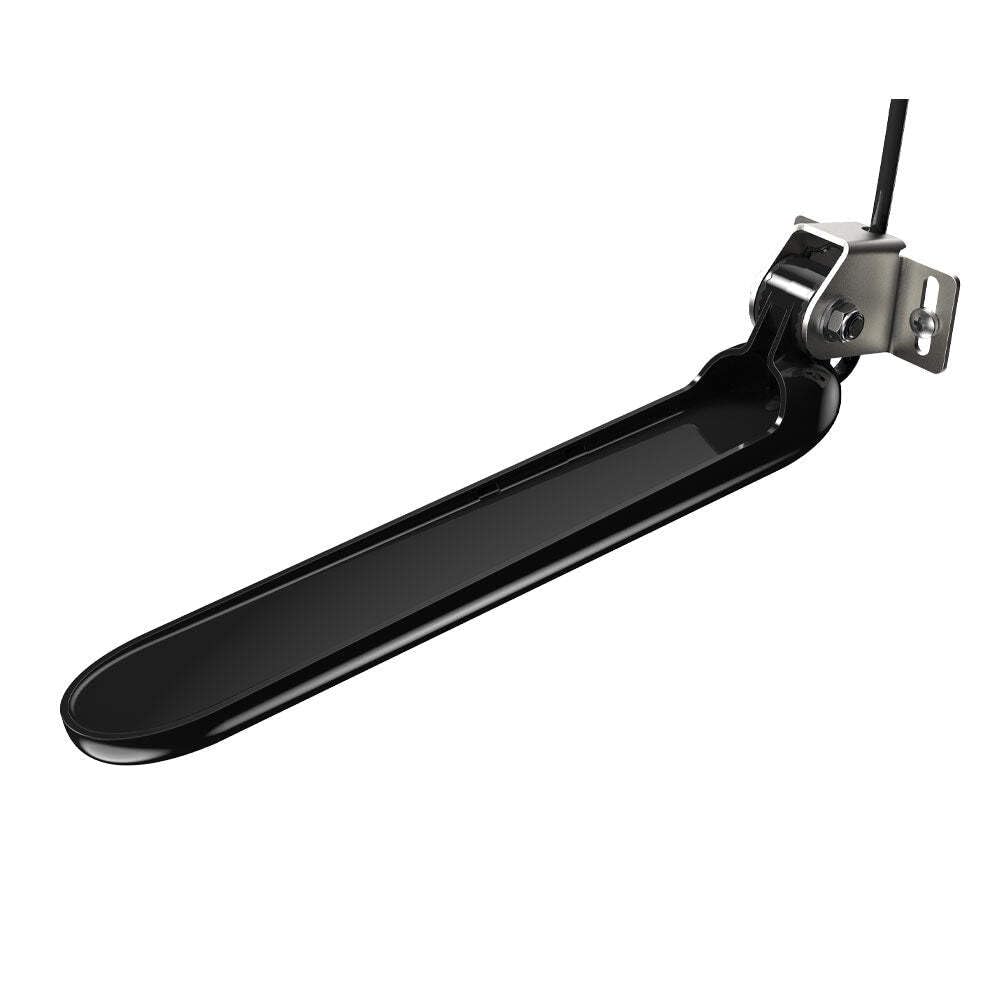
1. Humminbird Transom Transducer – XHS 9 HDSI 180 T
Our pick — 4.5+★ from 350+ verified ratings; the strongest balance of quality and price.
A 180-degree side-to-side sweep that turns a tired Humminbird into a fresh pair of eyes.
This is the pick that makes the most sense for the biggest group of buyers — the ones running a Humminbird side imaging unit that has seen a few seasons and started to blur. The headline number is that 180-degree sweep: it throws the side beam right out to each side of the hull, so a single pass lays down a full width strip of structure on the screen. Combine that with a DualBeam PLUS setup that runs a 20-degree and a 60-degree beam together, and you get one tight beam for detail plus one wide beam for ground coverage in the same pass.
What keeps showing up in the review pages is the picture clarity versus the stock transducer. As owners put it, “This one is better than the one that came with the unit. Clearer images, great definition.” The practical read is straightforward: if your current side imaging looks washed out, this 180-degree transducer is a genuine step up rather than a sideways swap. It also carries a built-in temperature sensor, which means you get surface water temperature on the display without adding another gadget to the transom — useful when you are trying to learn which temperature band the fish are sitting in.
Fitting is the part to think through. The revised design sits more securely and is less prone to kicking up at speed, and the running angle has been improved, which matters if you run long distances between spots. The cable runs 20 feet, so there is plenty of slack to get from the transom up to a console-mounted display. Remember it is a transducer only — no screen in this box. Check the compatibility list carefully, because select HELIX Side Imaging models work while a set of specific HELIX 7 CHIRP MSI variants is called out as excluded.
What Lands With Owners
- Full 180-degree side imaging sweep gives you both banks in one run
- Dual 20- and 60-degree beams pair fine detail with wide coverage
- Built-in temperature sensor saves a separate gauge on the transom
- 20-foot cable gives plenty of reach to a console display
Where It Asks For Care
- Transducer only — you need a compatible Humminbird display already on board
- A specific group of HELIX 7 CHIRP MSI models is excluded, so verify yours
- Physically heavier than a compact skimmer at 14.08 ounces
Best matched to: Humminbird side imaging owners chasing a clearer picture and a true 180-degree sweep without swapping the whole dash setup.
Think it over if: your head unit is one of the excluded HELIX 7 CHIRP MSI variants, or you are not running a Humminbird display at all.
2. Lowrance Active Imaging 3-in-1 Transducer
Three views from one transom mount, and a weight figure that keeps the bracket happy.
For anyone running an HDS LIVE, HDS Carbon or Elite Ti2, this is the transducer that does side, down and traditional CHIRP sonar from a single bracket — three jobs, one bolt-on. It covers Medium, High, CHIRP, SideScan and DownScan frequencies, which means you can drop down to a lower frequency for reach or push up for a crisper, tighter read of cover. Maximum measuring depth is listed at 91 meters, and because it handles flush step and jackplate mounting as well as plain transom, it suits more hull shapes than a bare skimmer does.
One number worth flagging honestly: this one weighs 2 pounds, while the Lowrance TripleShot Skimmer in this list comes in at 1.5 pounds. Neither is a problem to hang, but if you are chasing the lightest possible setup on a small transom, the gap is real. The practical trade is that this unit adds DownScan and CHIRP side imaging in the same housing, which is exactly the coverage many HDS owners are missing.
The thing to plan around is the connector. It uses a 9-pin plug and requires an adapter cable for some installs, so confirm what your display takes before you order. There is also a cable-length caveat worth knowing: buyers report “The cable that comes on this product is only about 4 1/2 feet, NOT 6′ as advertised.” On a short run from transom to a nearby display that is fine. On a longer hull it means planning an extension, so measure the run first.
Where the value lands: one bracket carries your side, down and CHIRP views, and the transom, flush step and jackplate mounting options widen the boats it will fit.
The one to measure first: that shorter-than-listed cable run and the 9-pin adapter requirement are the two things that catch people out.
Reach for this if: you already run HDS LIVE, Carbon or Elite Ti2 and want all three imaging views from one housing.
Look elsewhere if: your console sits far from the transom and you would need to add a cable extension.
3. Lowrance TripleShot Skimmer Transducer
The entry point into side and down imaging for HOOK2 owners who want the views without the spend.
If your display is a HOOK² 5, 7, 9 or 12 TripleShot model, this skimmer is built to plug straight in and give you High CHIRP, SideScan and DownScan from one transom bracket. The imaging frequencies are 455 and 800 kHz — the lower setting reaches further out to the sides, the higher one sharpens the detail on structure and fish. Maximum measuring depth is listed at 300 feet, which covers a lot of inland and inshore water. A built-in temperature sensor handles the seasonal side of things so you can follow water temperature rather than guess at it.
What makes it a sensible budget-tier pick is that a tired old transducer is often the real reason a display looks bad. Owners mention “My previous transducer was 12 years old and they just degrade over time,” and swapping one out brought a breaking-up, pausing screen back to life. That is the honest case for this skimmer: a cheap fix that restores SideScan and DownScan on your HOOK2 or HOOK Reveal display, without buying a new head unit.
The trade-off is build. The housing is described as flimsy in places, and one weak spot on the body can crack, so treat it gently on the bracket and avoid knocking it on the ramp. That is a fair caveat, not a reason to walk away — the install itself is simple and the imaging reads clean when it is set right. Just confirm your head unit is a supported HOOK Reveal or HOOK² model before ordering.
The right call for: HOOK² and HOOK Reveal owners who want side and down imaging back on screen for a modest outlay.
Worth noting: the housing has a weaker spot, so this is one to mount carefully and not bang around at the ramp.
4. Lowrance Active Imaging 3-in-1 Nosecone Transducer

Puts the imaging where your boat is already pointing, so the picture stays steady in wind.
This one is for a specific buyer: the Ghost trolling motor owner who wants side, down and CHIRP imaging without a transom bracket fighting the chop. It slots onto the nosecone of a Ghost 47-inch, 52-inch or 60-inch trolling motor and reads 83/200/455/800 kHz frequencies. Maximum measuring depth is listed at 91 meters. Because the motor is doing the steering, the beam tracks where you point it — a steadier picture than a transom unit bobbing at the back of the boat.
Accuracy is what earns this unit its place on the list. The imaging reads true to what is under and beside the hull, which is exactly what you need when you are working a weed edge or a drop-off and want to know whether that mark on screen is worth a cast. The install is genuinely quick — the nosecone goes on in minutes, and because it replaces a blank nose piece you are not drilling the hull. It carries a 2-year warranty, which is longer coverage than most transducers here list.
There is a cost-of-entry reality to flag: this is a premium-tier part, and it only makes sense if you already own a Ghost trolling motor. If you do, the pitch is simple — it turns the front of your boat into a live imaging platform rather than an add-on bracket. If you do not, it does not apply to you, and a transom unit is the right route.
Why it reads clean: Steady, boat-pointing imaging on a Ghost trolling motor, with a 2-year warranty on the part.
Who it excludes: It is a premium part built for Ghost motors only, so it is not a fit for any other setup.
Suits you when: you run a Ghost 47-inch, 52-inch or 60-inch trolling motor and want imaging that follows the bow.
Not for you if: you do not own a Ghost motor — this part will not mount anywhere else.
5. Humminbird XM-14-HW-MSI-T Transducer

Built for SOLIX owners who want MEGA imaging and a stated depth reach of 1200 feet.
Start with the number that matters on big water: maximum measuring depth is listed at 1200 feet. That is the kind of headroom that lets you image deep structure without the transducer running out of range, and it is why this unit suits the SOLIX crowd rather than a small inland rig. The side imaging runs on MEGA frequencies in the 455 kHz range, with a stated side-to-side reach up to 800 feet and MEGA Down Imaging reaching 400 feet (122 meters) at that same range. Dual Spectrum CHIRP covers a full 150-220 kHz band and a narrow 180-240 kHz band.
For the SOLIX 10, 12 or 15 CHIRP MEGA SI+ GPS G2 displays, this is a straight replacement rather than a rerig, and the install is a standard transom job. That MEGA frequency range is the reason serious deep-water anglers look at it — the sharper resolution of the higher imaging frequencies helps separate a fish from a branch lying on the same piece of structure. It also carries a built-in temperature sensor and a 20-foot cable, so the run from transom to console is covered.
Compared with the Humminbird XHS 9 HDSI 180 T above, this unit trades the 180-degree legacy sweep for MEGA imaging and a far deeper stated reach — 1200 feet against no stated depth on the XHS. The catch is compatibility: it is built for SOLIX G2 displays, and it needs that head unit to be worth buying. At 1.7 pounds it hangs comfortably on a transom bracket, and the warranty is the maker’s standard coverage as listed.
Reasons Anglers Want It
- Stated 1200-foot maximum measuring depth for deep structure work
- MEGA side imaging reach stated up to 800 feet side-to-side
- Dual Spectrum CHIRP across a 150-220 kHz full band
- Built-in temperature sensor and a 20-foot cable run
Fitting Notes
- Made for SOLIX G2 displays — check your head unit first
- Transom mount only, so it is not a nosecone or thru-hull swap
Matches up with: SOLIX 10, 12 or 15 CHIRP MEGA SI+ GPS G2 owners who fish deep water and want real imaging reach.
Before you buy: confirm your SOLIX is a G2 model, since this transducer is built around that display family.
6. Garmin STRIKER Plus 7sv

The full kit — display, transducer and cover — for inshore boats that want side scan in one box.
Coming at this from the other direction: if you have no head unit at all yet, buying a transducer alone leaves you with a part you cannot use. This package solves that in one order. You get the 7-inch sunlight-readable display, the CV52HW-TM transducer for Garmin CHIRP traditional sonar plus CHIRP ClearVü scanning sonar, and a protective cover. The screen size is the one buyers point to for inshore work — big enough to read structure clearly, small enough to fit a modest console.
What the display adds beyond imaging is where this earns its spot. There is built-in Quickdraw Contours mapping, which records 1-foot contours across up to 2 million acres as you idle, so every trip slowly builds your own map of the water. Built-in GPS marks waypoints, creates routes and shows boat speed. Wi-Fi connects to the ActiveCaptain app for waypoint transfers and software update notifications. For a boat that has no chartplotter yet, that is a lot of capability riding along with the side scan.
The honest caveat is the GPS. It is present and works, but it draws mixed feelings in the reviews, and this is not a full chartplotter — there is no built-in map library here. If you want factory charts from the start, you need a different class of unit. For side scan and structure finding with basic navigation, this does the job, and the setup is simple enough for a self-install. The reverse: no charts, no fuss, and a clear picture where it counts.
The headline number: a 7-inch sunlight-readable display paired with ClearVü and traditional CHIRP sonar, all in one package with a cover included.
Beyond the beam: Quickdraw Contours records 1-foot contours for up to 2 million acres, so your own lake gets mapped trip by trip.
Pick this when: you are starting from scratch and want a display, transducer and cover in one order.
Understand first: there is no built-in chart library, so factory maps are simply not part of this purchase.
7. Garmin STRIKER Vivid 7sv

Bright colour palettes that make fish and structure pop, wrapped in a display you can run without a manual.
Simplicity is this unit’s whole pitch. The Vivid scanning sonar color palettes let you recolour the return so fish and structure stand out from the bottom, and that is the feature that makes the screen readable to a first-timer. It supports Garmin CHIRP traditional sonar plus CHIRP ClearVü and CHIRP SideVü scanning sonars, and the package includes the GT52HW-TM transducer, so side scan is ready from the start. High-sensitivity GPS marks waypoints and shows boat speed, and built-in Quickdraw Contours records depth contours as you go.
Wi-Fi ties it to the ActiveCaptain app for waypoint transfers, smart notifications and access to the Garmin Quickdraw Community — which means other anglers’ 1-foot contour maps can come down to your screen. For a mid-range unit, that community sharing adds real value: you are not starting from an empty map, you are pulling in contour coverage for water you fish.
What you give up is factory maps. There are no pre-loaded charts, and points of interest only appear if you waypoint them yourself. The mapping that you get comes from Quickdraw, which builds contour charts from your own passes and from the community library. If you want a chartplotter with manufacturer maps, look at the higher picks. If you want easy side scan and fish ID with a live contour feed, this one delivers and it is genuinely simple to run.
What Sells It
- Vivid color palettes make fish and structure easier to tell apart
- GT52HW-TM transducer included, so SideVü works from day one
- Quickdraw Contours plus Quickdraw Community map sharing via app
- High-sensitivity GPS for waypoints, routes and speed
What It Leaves Out
- No factory maps pre-loaded — your charts come from Quickdraw
- Points of interest have to be waypointed manually
- App notifications can be intrusive if you keep them switched on
Great fit for: anglers who want side scan made simple, with colour palettes doing the heavy lifting on readability.
Skip if: you expect pre-loaded manufacturer charts, which this unit does not carry.
8. Garmin Striker Plus 9SV

A 9-inch screen that stays legible in direct sun, built for open boats and pontoons.
The size is the reason to look here. That 9-inch WVGA display is bright enough to read in full sun, which matters on a pontoon where the screen sits in the open. It runs Garmin CHIRP traditional sonar plus CHIRP ClearVü and CHIRP SideVü scanning sonars from the included CV52HW-TM transducer, set up for either transom or trolling motor mounting. Built-in GPS handles waypoints, routes and speed, and Wi-Fi connects to ActiveCaptain for waypoint transfers and the Quickdraw Community.
Be clear on what this is: the Striker series is a fishfinder, not a chartplotter. It does not accept any mapping software and ships with no map library. If you want to run a chart card, you are looking at the wrong family — the ECHOMAP UHD2 93sv further down is built for exactly that. What the 9SV does is give you a large, sunlight-readable sonar picture and the tools to mark spots, without the mapping layer.
There is a reliability caveat to flag in proportion: most units run fine and set up quickly, but a small number of owners have hit a transducer failing after about a week of use. That is not the norm, but it is worth keeping the warranty route in mind if something is off early. At 2.4 pounds the head unit mounts easily, and the three-question setup gets traditional sonar running fast.
The defining spec: a 9-inch WVGA display that stays readable in direct sunlight, paired with ClearVü and SideVü imaging.
The honest caveat: a few units have seen a transducer fail early on, so test the sonar thoroughly in the first week on the water.
Worth it for: pontoon and open-boat owners who want a big, sun-friendly screen and no mapping complexity.
Change direction if: you want to run chart cards or mapping software, which the Striker series does not accept.
9. Garmin STRIKER Vivid 4cv
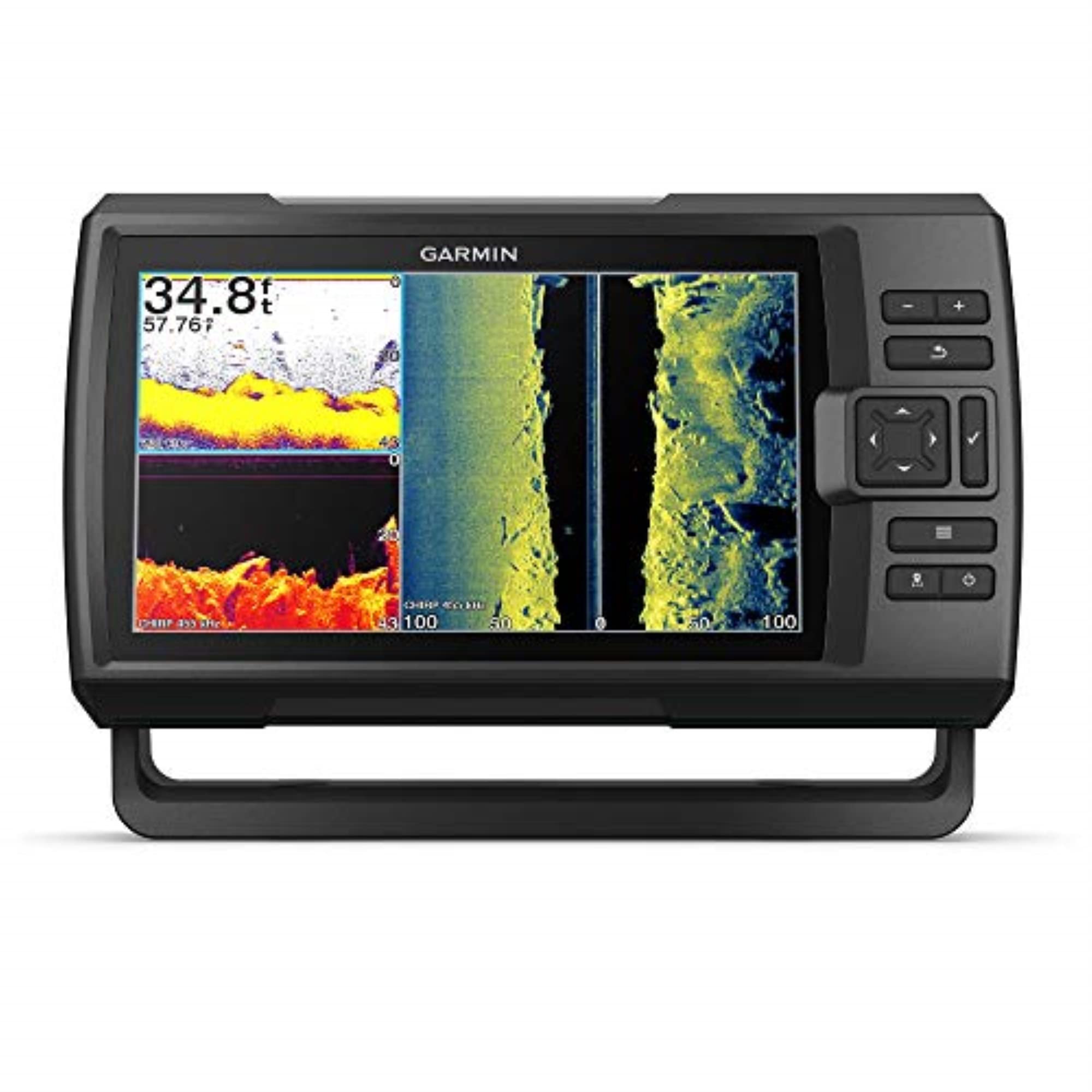
A 9-inch Vivid screen that anglers set up once and rave about for the view in bright light.
This is the large-screen Vivid of the range, and the 9-inch display is the reason people reach for it. The Vivid color palettes let you recolour the sonar return so fish and structure pop against the bottom, and the extra inches mean the split-screen views stay readable without you squinting. It supports Garmin CHIRP traditional sonar plus CHIRP ClearVü and CHIRP SideVü scanning sonars with the included GT52HW-TM transducer, and the included components list is complete — power cable, adapter cable, tilt mount and hardware all in the box.
Built-in Quickdraw Contours handles the mapping, recording your own depth contours as you run, and Wi-Fi connects to the ActiveCaptain app for waypoint transfers and the Garmin Quickdraw Community. High-sensitivity GPS marks waypoints and shows speed. That mix — big screen, colour palettes you can tune, and a live contour feed — is exactly why anglers like it. The easiest units to live with are the ones you do not have to fight in bright light, and this 9-inch Vivid screen is built for exactly that.
The caveat is glare. On some boats the screen picks up reflections that a smaller unit did not, so mounting angle matters — tilt it to kill the sun rather than fighting it. There are also no pre-loaded maps, so your charts come from Quickdraw and the community rather than from the factory. Neither is a dealbreaker for a sonar-first boat. If you want factory mapping built in, that is the ECHOMAP UHD2 93sv’s job, not this one’s.
Why People low-maintenance
- 9-inch Vivid display with tunable colour palettes
- GT52HW-TM transducer included for SideVü from day one
- Quickdraw Contours plus Quickdraw Community mapping
- High-sensitivity GPS for waypoints and speed
Know Before You Mount
- Screen glare can show up depending on mounting angle
- No factory maps pre-loaded
- One of the heavier head units here at 6.4 pounds
Best for: anglers who fish in bright light and want a big Vivid screen that reads easily in the sun.
Mount it thoughtfully if: glare is a risk on your console — a tilted angle solves most of it.
10. Humminbird Helix 7 G4 GPS Fish Finder
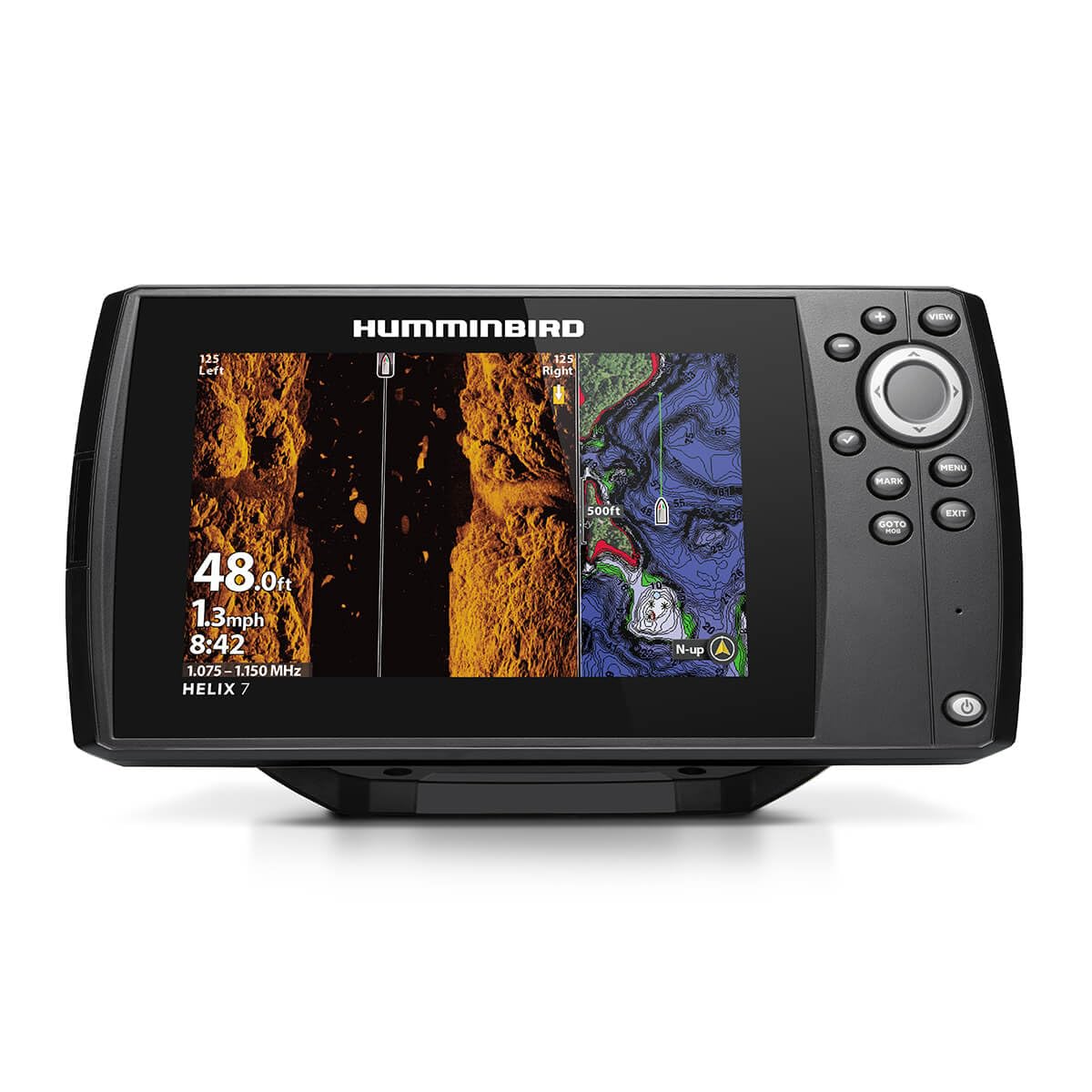
MEGA imaging that reads 125 feet to each side and 125 feet straight down in one pass.
The numbers here are concrete. MEGA Side and Down Imaging show fish, structure and contours out to 125 feet on either side of the boat and 125 feet directly beneath it, with the maker stating 3x more detail than standard imaging sonar. Maximum measuring depth is listed at 125 feet to match. Dual Spectrum CHIRP runs Wide Mode for coverage and Narrow Mode for fine scanning, with a Low-Q transducer pushing precise 2D target separation. A transducer is included, so this is a complete imaging package on a 7-inch color display.
Mapping is where the 7 G4 punches above its size. Humminbird Basemap covers 10,000+ lakes and continental U.S. coastlines, and it accepts premium LakeMaster, CoastMaster and Navionics charts. AutoChart Live records depth contours, bottom hardness and vegetation in real time with eight hours of built-in recording, and takes AutoChart Zero Line SD cards for more capacity. For an angler who wants to map a spot as they fish it, that is a strong feature set in a 7-inch footprint.
The one thing to weigh is reliability. Most units run solidly and the screen reads bright and clear, but a rare report has a display failing after a short run. That is not the pattern, but it is worth testing your unit on the water early and keeping the warranty route handy. At 2.1 pounds the head unit is easy to gimbal or in-dash mount.
The standout number: MEGA imaging out to 125 feet each side and 125 feet below, with a stated 3x detail edge over standard imaging sonar.
Mapping upside: AutoChart Live records contours, bottom hardness and vegetation in real time, eight hours at a stretch.
Go for this if: you want MEGA side imaging and live AutoChart mapping on a compact 7-inch head unit.
Try before you trust: run the display early to confirm all is well, since a rare unit has failed shortly after install.
11. Garmin ECHOMAP UHD2 93sv

The full chartplotter that pairs side scan with built-in NAVionics+ maps of 18,000 lakes.
For the buyer who wants everything on one screen, this is the answer. It is a 9-inch chartplotter with a bright, sunlight-readable touchscreen, and the display itself measures 7.8 by 4.5 inches at a 9.0-inch diagonal — enough that a split view of side scan and chart both stay usable. The included GT56-TM transducer runs Garmin traditional, ClearVü and SideVü scanning sonars, so side scan is covered. Built-in Garmin Navionics+ inland maps with integrated Navionics data cover more than 18,000 lakes with up to 1-foot contours.
The extras are what separate it from a sonar-only unit. Wi-Fi connects wirelessly to a second ECHOMAP UHD2 chartplotter, so sonar, waypoints and routes can be shared across two screens — a real advantage at the console plus a forward station. It also connects wirelessly to a Force trolling motor to create and follow routes, navigate to waypoints, control speed and check battery life from the display. That integration is where the premium tier earns back its cost: the chart, the sonar and the motor control all talk to each other.
The one thing to plan around is the learning curve. A nine-inch touchscreen packed with mapping, sonar and motor control is a lot of interface, and a first-time user will spend a few trips getting comfortable. The upside is that functionality is what wins people over once they have it dialled in, and built-in chart coverage with 1-foot contours means you are not starting from a blank map. At 8.1 pounds, the head unit is the heaviest here, so mount it solidly.
Where The Tier Earns It
- Built-in Navionics+ inland maps covering more than 18,000 lakes with up to 1-foot contours
- GT56-TM transducer included for traditional, ClearVü and SideVü sonar
- Wireless sharing of sonar, waypoints and routes to a second ECHOMAP UHD2
- Links to a Force trolling motor for route-following, speed and battery checks
What To Expect Going In
- A learning curve on a packed 9-inch touchscreen interface
- Heaviest head unit here at 8.1 pounds, so it needs a solid mount
- Premium tier, so it is the biggest commitment on this list
The one to own if: you want side scan, built-in lake charts and trolling motor control all on one 9-inch touchscreen.
Give yourself time: this interface rewards a few trips of learning before it feels second nature.
Know the Specs
Frequency in kHz and What It Changes
Side scan sonar fires at set frequencies, and the number you see — 455 kHz, 800 kHz, or a CHIRP band like 150-220 kHz — decides how the return looks on screen. Lower settings such as 455 kHz reach further out to the sides of the hull, so you cover more ground per pass. Higher settings, often around 800 kHz, return a sharper, tighter picture that separates a fish from the branch beside it. CHIRP sonar sweeps a range of frequencies instead of one fixed tone, which sharpens target separation. If you fish wide, open banks, lean toward the lower frequency range. If you pick apart tight structure, the higher setting earns its keep.
Maximum Measuring Depth and Real Reach
This is the deepest the unit is rated to read, listed in feet or meters depending on the maker. A unit rated to 300 feet covers most inland and inshore water, while a model rated to 1200 feet is built for deep structure work. Match the depth rating to the water you actually fish — a 300-foot unit covers inland and inshore water, while a 1200-foot rating is built for deep structure work. Check that the side imaging reach and the down imaging depth are both stated, since they are often different figures.
Beam Angle and Coverage Area
The beam angle is the spread of the sonar cone, measured in degrees. A wide beam, such as a 60-degree cone or a 180-degree side sweep, puts more bottom on screen at once but shows each target a little softer. A narrow beam, like a 20-degree cone, gives you a tighter, more detailed look at fewer targets. Units that run both — a wide beam for searching and a narrow beam for confirming — let you sweep for structure and then zoom in without changing transducers. That two-beam approach is why DualBeam and similar setups are popular with anglers who cover a lot of water.
Connector, Cable and Head-Unit Fit
The plug on the end of the cable has to match your display, and this is where most buying mistakes happen. Pin counts vary — a 9-pin connector is common on some brands, and others use a proprietary plug built for one family of fish finders. Some units also require an adapter cable to bridge the two. Cable length is the second part of the fit: you are running from the transom up to the console, and a short run can leave you needing an extension. Always confirm the head-unit compatibility list and the stated cable length against your own hull before ordering.
Common Questions
Will a side scan transducer work with my existing fish finder?
What is the difference between 455 kHz and 800 kHz side imaging?
Do I need a separate transducer for side scan and down scan?
How long should the transducer cable be for my boat?
Will a transom mount work, or do I need a trolling motor or nosecone setup?
Do I need a head unit with a built-in temperature sensor, or does the transducer handle it?
Is a chartplotter better than a fish finder for side scan?
Can I add a side scan transducer to a boat that already has an older unit?
What does AutoChart Live or Quickdraw Contours actually do?
How wide can side imaging reach to each side of the boat?
The Bottom Line
The strongest call across this whole list is the Humminbird XHS 9 HDSI 180 T — it holds 4.5+ stars from 300+ owners, and that 180-degree side sweep with 20- and 60-degree DualBeam coverage delivers a full width strip of structure in one pass. The crowd favourite across the widest group of buyers, it earns the top spot on both rating and reach. If you would rather have three imaging views in one housing, the Lowrance Active Imaging 3-in-1 runs side, down and CHIRP from a single transom bracket. And for a complete chartplotter package with built-in lake maps, the Garmin ECHOMAP UHD2 93sv puts side scan, Navionics+ charts and trolling motor control on one 9-inch touchscreen.
One honest nudge: transducer designs change slowly, so a unit that matches your head unit today will still fit it next season. Buy the one your display recognises, then spend the saved effort learning to read the side imaging returns — that is where the fish actually show up.
How we choose
We do not accept paid placement. Every pick is matched to a real buyer and a real use-case; we do not hands-on test units.
Sources
Specifications: manufacturer listings and product documentation. Review insights: verified customer reviews, as of October 2026. Pricing: not shown on this page (it changes often); check the current price via the retailer link.
As an Amazon Associate, Aappliancez earns from qualifying purchases. This does not affect which products we feature.