Disclosure: Some links in this post are affiliate links. As an Amazon Associate I earn from qualifying purchases, at no extra cost to you. Learn more
Specs are compiled from manufacturer listings and verified buyer reviews and can change over time — please confirm the key details on the product page before buying.
If your kitchen knife smears a tomato instead of slicing it, you do not need a new knife — you need one stone with the right grit and a base that will not slide while you work. This guide separates the stones that actually raise a burr and hold a flat surface from the ones that dish out after a few sessions. Every pick below is matched to a real job: a first whetstone, a polishing stone for a cherished Japanese blade, a guided kit for someone who wants the angle handled for them.
This guide is built by comparing the manufacturers’ published specifications and the patterns across verified customer reviews, so you get each pick’s real strengths and trade-offs instead of marketing spin.
Grit ratings, base stability, and soaking needs are the three things that decide whether a stone earns its place on your counter, so each pick here is checked against those.
Whether you are fixing a chipped paring knife or polishing a sushi blade, this breakdown of the sharpening stones for knives matches each stone’s grit and base to the job.
Top Picks


How To Choose The Best Sharpening Stones for Knives
You can narrow the whole shelf down to three choices. First, pick your grit (the abrasive grade that sets how fast a stone cuts versus how smooth it finishes). Second, decide if you want to soak a stone in water or wipe a diamond plate (a steel plate coated in diamond grit that cuts without soaking). Third, check how stable the base is when your hands move a blade across it. Get those right and the brand matters far less than the numbers on the box.
Grit: the number that decides the job
Grit is the size of the abrasive particles — a lower number like 400 is coarser and grinds faster, while a higher number like 6000 is finer and leaves a polished edge. A dull everyday knife usually wants a 400 side to reset the edge and a 1000 side to finish it. A stone that starts at 3000 is a maintenance tool for a blade that is already sharp, not a rescue tool for one that has gone blunt.
Water stones versus diamond plates
A water stone is a porous ceramic or corundum block that you soak first, and it sheds a fine slurry as you grind — that is what gives the smooth feel many cooks prefer. A diamond plate is a steel plate electroplated with tiny diamond crystals, and it needs no soaking and stays flat because the diamonds sit on the surface. If you want the fastest possible edge repair on a badly damaged blade, the diamond plate is the harder-working option.
Base stability and angle control
A stone that slides mid-stroke is the single most common reason a beginner ruins an edge. Look for a rubber or silicone pad underneath, or a bamboo base built to hold the stone in place. If you cannot hold a consistent angle freehand, an angle guide that clamps to the blade — or a full guided system — removes that variable entirely.
Side-by-Side Comparison
| Model | Best For | Grit | Stone Type | Base | Amazon |
|---|---|---|---|---|---|
| Shapton K0702 Blade #1000★ Best Overall | Serious home cooks | #1000 | Whetstone | Plastic case | Amazon |
| DMT DuoSharp 8-InchTop Performer | Fast edge repair on any blade | 600/325 | Diamond plate | Standard base | Amazon |
| HiramWare 400/1000 WhetstoneBest Value | First-time freehand sharpening | 400/1000 | Corundum water stone | Non-slip silicone | Amazon |
| Whetstone Cutlery Dual 400/1000 | Budget workshop sharpening | 400/1000 | Silicon carbide | None included | Amazon |
| S SATC Diamond Plate 400/1000 | Flattening and plain-steel edges | 400/1000 | Diamond plate | None included | Amazon |
| HMPLL 4-Side Whetstone Set | Complete starter kit | 400/1000 & 3000/8000 | Corundum water stone | Bamboo + silicone holder | Amazon |
| KING KW65 Combination | All-round kitchen maintenance | 1000/6000 | Ceramic water stone | Plastic base | Amazon |
| MITSUMOTO SAKARI 1000/3000 | Japanese-style honing | 1000/3000 | White corundum | Non-slip bamboo | Amazon |
| Sharp Pebble 1000/6000 | Beginners who want a guide | 1000/6000 | Corundum water stone | Bamboo + angle guide | Amazon |
| Lansky Deluxe 5-Stone | Guided angle sharpening | Extra coarse to ultra fine | Alumina oxide + ceramic | Clamp and rod system | Amazon |
| Work Sharp Benchstone | Hunting and camp knives | 400/800 diamond + ceramic | Diamond + ceramic | Pivot-response base | Amazon |
| Arkansas Stone Set 10-Inch | Traditional oil-stone feel | Coarse, fine, extra-fine | Arkansas stone | Wood mount | Amazon |
| Shun Combination Whetstone | Polishing Japanese knives | 3000/6000 | Stone | Rubber tray | Amazon |
| SHARPAL 202H System | Precision angle work | 220–6000 plus strop | Diamond + whetstone + leather | Anti-slip metal base | Amazon |
Detailed Reviews
1. Shapton K0702 Blade #1000 Whetstone
Our pick — 4.5+★ from 4,500+ verified ratings; the strongest balance of quality and price.
A single #1000 stone that cuts fast, needs no soak, and lives in its own case.
The number that matters here is #1000 — a medium grit that takes a working kitchen knife from dull to paper-slicing without flipping a two-sided block. Shapton’s following is the reason this sits at the top: it is the crowd favourite, 4.5+ stars across 4,500+ owners, and the praise concentrates on one thing — the sheer quality of the abrasive. What wins people over is how cleanly and quickly it removes steel, then leaves an edge that keeps its bite for longer than a bargain stone manages.
Two practical details make it easy to live with. First, it does not need soaking — a splash of water on the surface is enough, so you are sharpening within a minute of pulling it off the shelf. Second, the plastic case it ships in flips over and works as a stone holder, which is a neat way to skip buying a separate base. The stone itself is light at 45 g, so it travels well in a knife roll or a drawer.
The honest limit is grit coverage. One #1000 stone is a fantastic daily driver, but it will not repair a badly chipped edge — for that you need a coarser side, and this stone does not have one. If your knives are regularly abused, pair it with a coarse plate or step up to a two-grit block. If your knives only need a working edge refreshed, this one stone covers it.
What earns it the top spot
- #1000 grit cuts fast enough to refresh a dull edge in a short session
- No soaking required — a splash of water and you start
- Plastic case doubles as a stone holder
- Light at 45 g, so it stores or travels anywhere
Where it stops short
- No coarse side, so chipped edges need a second stone
- Honing and polishing beyond a working edge is out of its range
Reach for this if: you cook daily and want one reliable stone that gets a working edge back without a soaking ritual.
Look elsewhere if: your blades arrive chipped or you want a single stone to cover coarse repair and fine polish together.
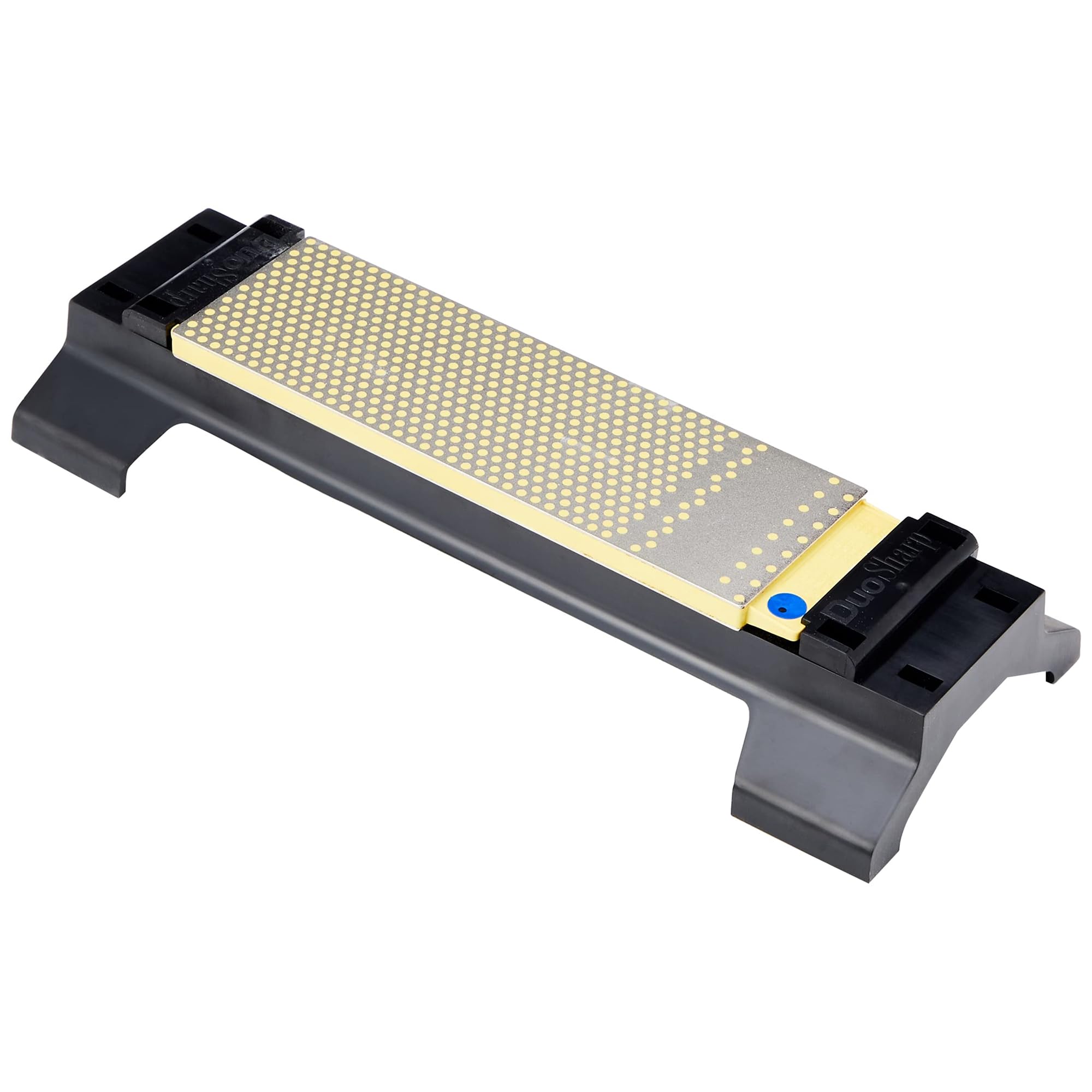
2. DMT DuoSharp Double-Sided Diamond Whetstone 600/325
Two diamond surfaces that bring a dead edge back to factory sharpness without a drop of oil.
This is the outlier of the group in every physical sense. It measures 13.25 inches in length and 13.25 inches in width against the 7-inch, 2.3-inch HiramWare block — a genuinely different footprint, and one that gives you a large work surface. At 516 g it is also far heavier than the 45 g Shapton, and that mass is exactly why it sits still on a bench instead of skating.
The two grits are 325 on the coarse side for restoring a damaged edge and 600 on the fine side for honing it sharp. Both are micronized monocrystalline diamond, which is the hardest abrasive here and does not need soaking — you can pick it up and work. The interrupted “polka-dot” surface traps the metal dust in its little wells, so the cutting surface stays clean and the edge keeps constant contact.
Durability is the one caveat worth knowing, and it is a fair one: a diamond plate is not a lifetime stone, and heavy use wears the crystal layer down. For kitchen knives, scissors, chisels, and carving tools used in normal rotation, it holds up well. It earned its effectiveness reputation honestly — this is the pick that rescues a blade nothing else will touch.
Why it leads on repair: the 325 side restores a rolled or chipped edge faster than any water stone here, and the 600 side finishes it clean.
Set your expectations: diamond is an abrasive coating, not solid stone, so it wears with heavy volume — treat it as a tool with a long but finite life.
Best matched to: a garage bench or workshop where knives, chisels, and scissors all need fast attention.
Think twice if: you want the smooth slurry feel of a water stone on a Japanese blade — this is a hard metal surface.
3. HiramWare 400/1000 Grit Whetstone with Non-Slip Base
The starter stone that covers repair and finish in one block and will not slide across your counter.
Use the 400 side to bring a dull edge back into shape, then flip to 1000 to polish it smooth. The material is white corundum — a hard, dense abrasive that holds its shape well over repeated sessions — and the block is 7 inches long, a comfortable length for a chef’s knife.
The detail that separates it from cheaper blocks is the silicone base. A stone that stays put lets you focus on holding your angle instead of chasing the block around the counter. That silicone base is what keeps a first attempt from turning into a chase around the counter.
There is no oil to buy either; water is all it takes, and cleanup is a rinse. The recurring note in the feedback is durability — this is a stone people expect to keep for years. Just be aware a 1000-grit finish is a working edge, not a mirror polish, so if you want that final gleam you will eventually add a finer stone.
The beginner payoff: 400 handles the damage, 1000 finishes the edge, and the silicone base keeps the whole thing steady while you learn.
The long game: a 1000-grit ceiling leaves a toothy working edge — great for kitchen prep, short of a showroom polish.
Pick this when: you have never sharpened on a stone and want to learn without fighting a sliding block.
Pass if: you already own a coarse stone and need only a high-grit polisher.
4. Whetstone Cutlery Dual 400/1000 Grit Wet Block

A workhorse dual-grit block that has been turning blunt knives sharp for years.
This one earns its spot on sheer endurance: 6,000+ ratings back it, making it one of the longest-running names in the budget tier. Buyers report that value keeps them loyal — the money-to-result ratio is the thing most talked about in its reviews. It is made from silicon carbide (a hard, fast-cutting abrasive), with a 400 side for sharpening and a 1000 side for smoothing and polishing, so you can bring a dull edge back and then refine it on one stone.
The process is old-fashioned and honest: soak it in water for 5 to 10 minutes, then work the blade. It takes oil out of the equation entirely. At 7 inches long and 2.25 inches wide, it is a compact block that handles kitchen cutlery, pocket knives, scissors, and even hatchets and garden tools without complaint. For a shop or a shed, that versatility is the whole point.
The trade-off is softness. Silicon carbide is a fast-cutting but relatively soft abrasive, so it dishes — develops a hollow in the middle — with steady use, and it will need flattening. That is normal for this class of stone and not a defect, just maintenance you should plan for.
What keeps it relevant: 400 and 1000 grits on one block, soaking in plain water, and a price that lets you buy a second one for the garage.
Budget-tier reality: the stone is soft and will hollow out over time, so budget for a flattening stone alongside it.
Suits: the shed and workshop crowd who sharpen everything from kitchen knives to hatchets and do not mind a soak.
Not the one if: you want a stone that holds a perfectly flat surface with no upkeep.
5. S SATC Diamond Sharpening Plate 400/1000

A flat steel plate with real diamond grit that never needs soaking or flattening.
Here is a stone that sidesteps the two biggest chores of water-stone ownership. It is a steel plate electroplated with monocrystalline diamonds, which means it cannot crater like a soft whetstone and never needs to be flattened. At 9.05 inches long and 0.3 inches thick, it is thin enough to store upright and long enough for a full chef’s knife stroke. For anyone who sharpens chisels and plane blades as well as knives, that permanent flatness is worth more than any polish.
The 400 side tackles coarse work, and the 1000 side finishes. It is heavy enough at 1.9 pounds to stay planted without a clamp, which turns a countertop into a stable honing station in seconds. It handles straight-edged tools — chisels, planer blades, kitchen knives — with the same direct feel.
The point to weigh is grit accuracy. A plated diamond surface is not as precise about grit size as a ceramic stone, and reports of variation are the main reason to go in with sensible expectations. On plain carbon and stainless steel it performs beautifully; on some high-vanadium super steels, the diamonds do the heavy lifting. Either way, this is the plate that gets a dull blade usable again with almost no setup.
The convenience argument: no soaking, no flattening, no dishing — a truly flat surface you can trust stroke after stroke.
The fine print: plated diamond grit can vary in consistency, so expect a slightly toothier finish than a ceramic stone at the same number.
Fits best: the woodworker or home cook who wants a permanently flat plate for knives and chisels with zero prep.
Skip if: your priority is a mirror-polished edge from a traditional water stone.
6. HMPLL Knife Sharpening Stone Set, 4-Side Grit
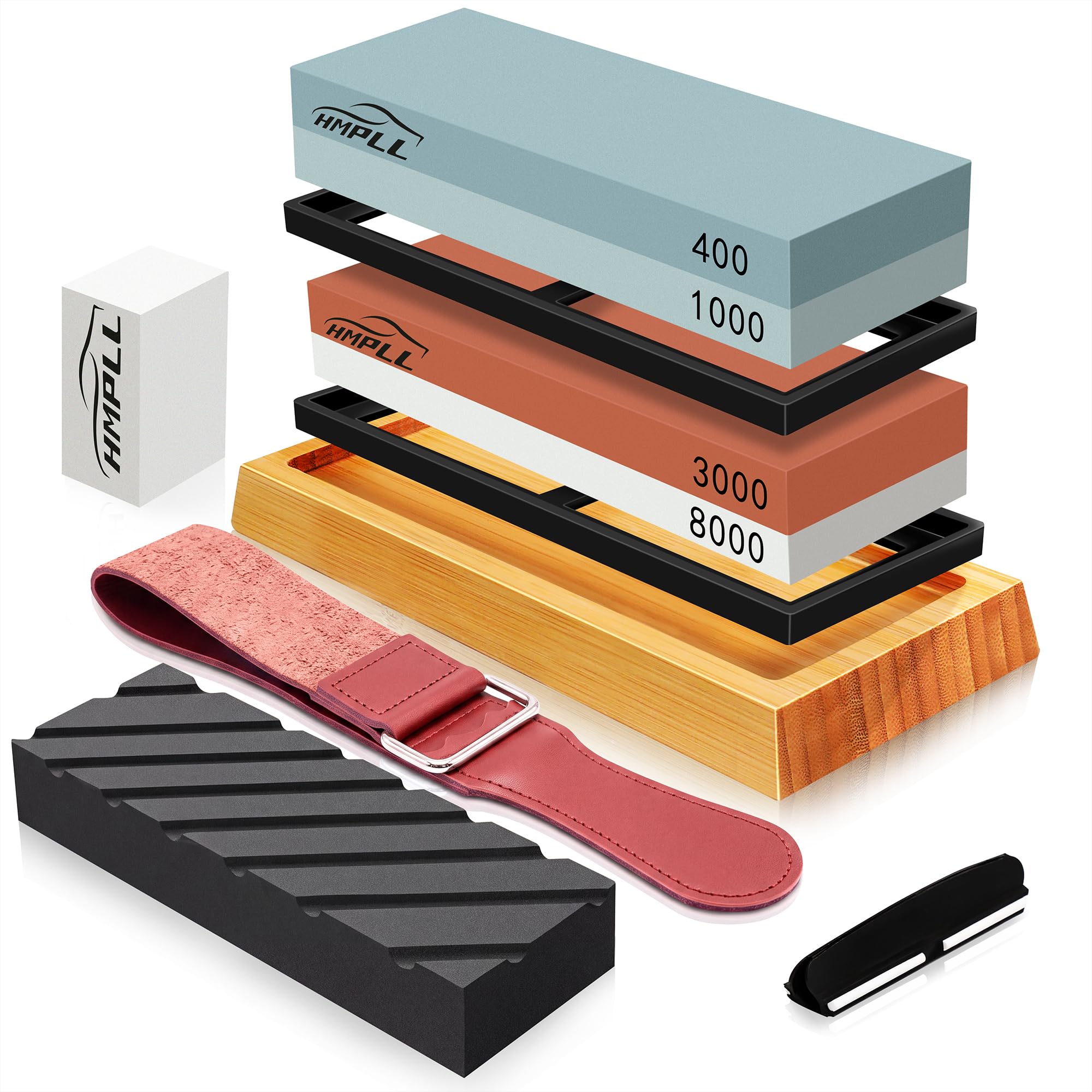
Four grits, a bamboo base, a flattening stone, and a strop in one box.
If you want to skip buying stones one at a time, this set covers the whole arc of sharpening. Two stones give you 400/1000 for repairing and sharpening, then 3000/8000 for refining and polishing. That range means you can take a chipped blade all the way to a mirror finish with the same kit — a journey the single-grit Shapton cannot make without a second purchase.
The extras turn it into a complete system, which saves a beginner several separate orders. You get a bamboo base with a rubber backing to keep everything steady, a silicone holder to grip the stone, an angle guide (a wedge that holds your stroke at a consistent angle), a flattening stone (a coarse stone that re-levels a dished surface), and a leather strop (a leather strip for the final polish). The stones are white corundum, a hard and dense abrasive that cuts steadily.
One thing to plan for: these are water stones and they want a 10- to 15-minute soak before each session. That is a minor ritual, but it is a ritual. The other consideration is that a four-grit kit is more stone than a casual cook strictly needs — but if you enjoy the process, it is a generous place to start.
Why the kit makes sense
- 400/1000 and 3000/8000 grits cover repair through polish
- Flattening stone, angle guide, and leather strop included
- Bamboo base with rubber backing holds the stone steady
Before you commit
- Stones need a 10- to 15-minute soak before use
- More grits than a casual cook will use day to day
Best for: the buyer who wants every grit and accessory in a single order.
Weigh this: the soaking step and the four-grit range are more than a light user needs.
7. KING KW65 1000/6000 Combination Whetstone

The classic two-grit ceramic that has been the home-kitchen default for years.
King’s name carries weight in this category, and this stone is why. The 1000 side sharpens, the 6000 side polishes, and the pairing covers almost every knife that lives in a home kitchen. At 8 inches long, 2.5 inches wide, and 1 inch thick, it has real heft to it, and it comes with a sturdy plastic base so it is ready to work straight from the box. The material is ceramic, which grinds steadily and rewards a patient, consistent angle.
What makes it the default recommendation is the range. A 1000-to-6000 jump is the balance: coarse enough to bring a working edge back, fine enough to leave a clean polish. It handles kitchen prep, hunting blades, and everyday carry knives with equal comfort. Owners mention it is especially friendly for freehand sharpeners (people who hold the blade at an angle by hand), which is where most people end up after a little practice.
The honest note is durability. Ceramic stones are hard, but reports of chips and cracks appear alongside praise from people who have kept one for years — treat it with care, do not drop it, and it will serve you well. No other single stone here spans 1000 to 6000 grit for the price.
The everyday logic: a 1000/6000 ceramic stone is the natural choice for a home kitchen that needs one tool to do it all.
Handle with care: ceramic can chip if dropped or knocked, so store it somewhere it will not take a fall.
Go for this if: you want one widely trusted ceramic stone that handles kitchen, hunting, and pocket knives.
Consider an alternative if: you need a coarse grit for serious edge repair.
8. MITSUMOTO SAKARI 1000/3000 Japanese Whetstone

A sintered corundum stone built for the smooth feedback a Japanese blade wants.
With a 1000 side for repairing worn edges and a 3000 side for honing a fine, clean finish, this is a two-step stone aimed at people who care about feel. The white corundum is high-temperature sintered, which makes for uniform abrasion without shedding excessive grit — the stone stays consistent from the first stroke to the last. It measures 7.09 inches long and sits at 772 g, enough weight to feel planted.
The design choice that matters most is water absorption. The pore structure is tuned so the stone takes on water predictably and builds a steady slurry, which is what gives Japanese-style sharpening its smooth, controlled feel. There is no oil involved. Underneath, a non-slip bamboo base with a pad keeps it from sliding, so you can hold a steady 15° to 20° angle — the working range for most kitchen knives.
Two small notes. The stone ships in a kraft box that suits gifting, but the value depends on what you need — the feedback splits between buyers who found it excellent and those who wanted more stone for the money. And a 1000/3000 combo will not fix a badly chipped blade; it is a maintenance stone for edges already in decent shape.
The texture story: a sintered corundum surface that absorbs water predictably and gives the smooth, steady feedback that Japanese-style sharpeners want.
The value question: buyers split on whether the stone justifies its tier — it is a fine tool for a blade you care about, not a value play.
Made for: someone maintaining a Japanese chef’s knife who wants a smooth, controlled honing feel.
Look past it if: you are starting from a blunt, damaged blade and need a coarser grip on the steel.
9. Sharp Pebble 1000/6000 Whetstone Knife Sharpener

The angle guide is the whole point: it removes the guesswork that puts most beginners off.
Holding a steady angle is the hardest part of freehand sharpening, and this kit solves it directly. The included angle guide locks the blade at the right position so your first stroke already works, and the bamboo base underneath is designed not to slip. Combined, those two pieces take the frustration out of the learning curve. The stone itself measures 7.25 inches long and weighs 2.1 pounds, a solid, substantial block.
The grit pairing is 1000 and 6000 — the 1000 side repairs a dull or damaged edge, and the 6000 side polishes it to a clean finish. That two-grit range is the one most kitchens actually need, which keeps things simple. There is a support layer too: an instruction manual, a tips guide, and a sharpening expert you can reach out to. For a first-timer, the manual, tips guide, and reachable sharpening expert add real support.
The caveat is the flip side of its range. A 1000 starting point means this stone is not built for heavy repair work on chipped or damaged blades — you would need a coarser stone for that. But as a starter kit that handles everyday dullness with guidance built in, it is hard to argue with.
What it does well: a clamping angle guide and a bamboo base so beginners achieve usable results on the first session.
The boundary: starting at 1000 grit leaves chipped edges to a coarser stone — this kit is for maintenance, not repair.
The right first buy for: anyone who has never sharpened freehand and wants guidance on the very first stroke.
Not the fix for: a heavily damaged blade that needs a coarse grit before it can be refined.
10. Lansky Deluxe 5-Stone Knife Sharpening System

A clamped, rod-guided kit that takes the guesswork out of keeping a consistent angle.
This is a different approach from a flat stone. You clamp the blade into a precision-engineered holder, and the stones ride on guide rods that hold the angle for you. That means a beginner can produce an even bevel without ever having to judge an angle by eye. The kit includes five stones — extra-coarse, coarse, medium, fine alumina oxide, and an extra-fine ceramic hone — so you can run a knife from repair all the way through to a polished edge in one session.
The details show where the thought went. Each stone has a colour-coded finger-grooved holder to keep your fingers clear of the moving edge, and the kit comes with specially formulated honing oil plus a custom-moulded case for storage. Everything packs down together, so it travels well and cannot spread across a bench.
The honest note is the learning curve. The clamp-and-rod setup takes a little fiddling to get used to, especially on a longer blade, and that is the trade-off for the precision it offers. For large knives it shines, keeping the angle exact over the full length of the edge.
The core value: a clamped blade plus guide rods means a consistent angle on every stroke, even on a long chef’s knife.
The trade-off: clamping takes practice to get comfortable with, so budget a little setup time.
Choose this if: you want guided precision and a complete grit range without learning to hold an angle freehand.
Think twice if: you prefer the simple, unclamped feel of a flat stone.
11. Work Sharp Benchstone Knife Sharpener

Three abrasives and a pivoting head that follows the curve of a hunting blade.
The signature here is what Work Sharp calls Pivot Response: the abrasive surface tilts to follow the curve of the blade, keeping contact as you sweep along the edge. On a hunting or camp knife with a curved belly, that means an even result instead of a flattened spot. The system carries three abrasives — 400-grit diamond for edge repair, 800-grit diamond for sharpening, and a fine ceramic stone for a keen finish — so you can work through all three on one base.
Angle guides are part of the design. They set you to 20° or 25° for consistency, and they come off entirely if you prefer freehand sharpening. For a camping knife used on game, rope, and wood, that dual-angle option covers both kitchen-style and heavier work. It also carries a 3-year warranty and is built by a family-owned American company that has been making sharpening tools in Oregon for years.
The main thing to know is the focus. This benchstone is built around consistent, curved-blade sharpening, so the guides are an advantage for outdoors knives and a minor extra step if you only ever sharpen flat chef knives. For a hunting pack, the pivoting head and 20°/25° guides are well matched to curved blades.
Best feature for its job: a pivoting abrasive head that stays in contact with a curved hunting blade through the whole stroke.
Keep it in perspective: the 20° and 25° guides are a field-knife advantage, not something a standard kitchen knife needs.
Suits: hunters and campers who need a portable, three-grit stone for curved and longer blades.
Not the obvious pick for: a home cook who only ever sharpens straight kitchen knives.
12. Arkansas Sharpening Stone Set, Wood Mounted 10-Inch
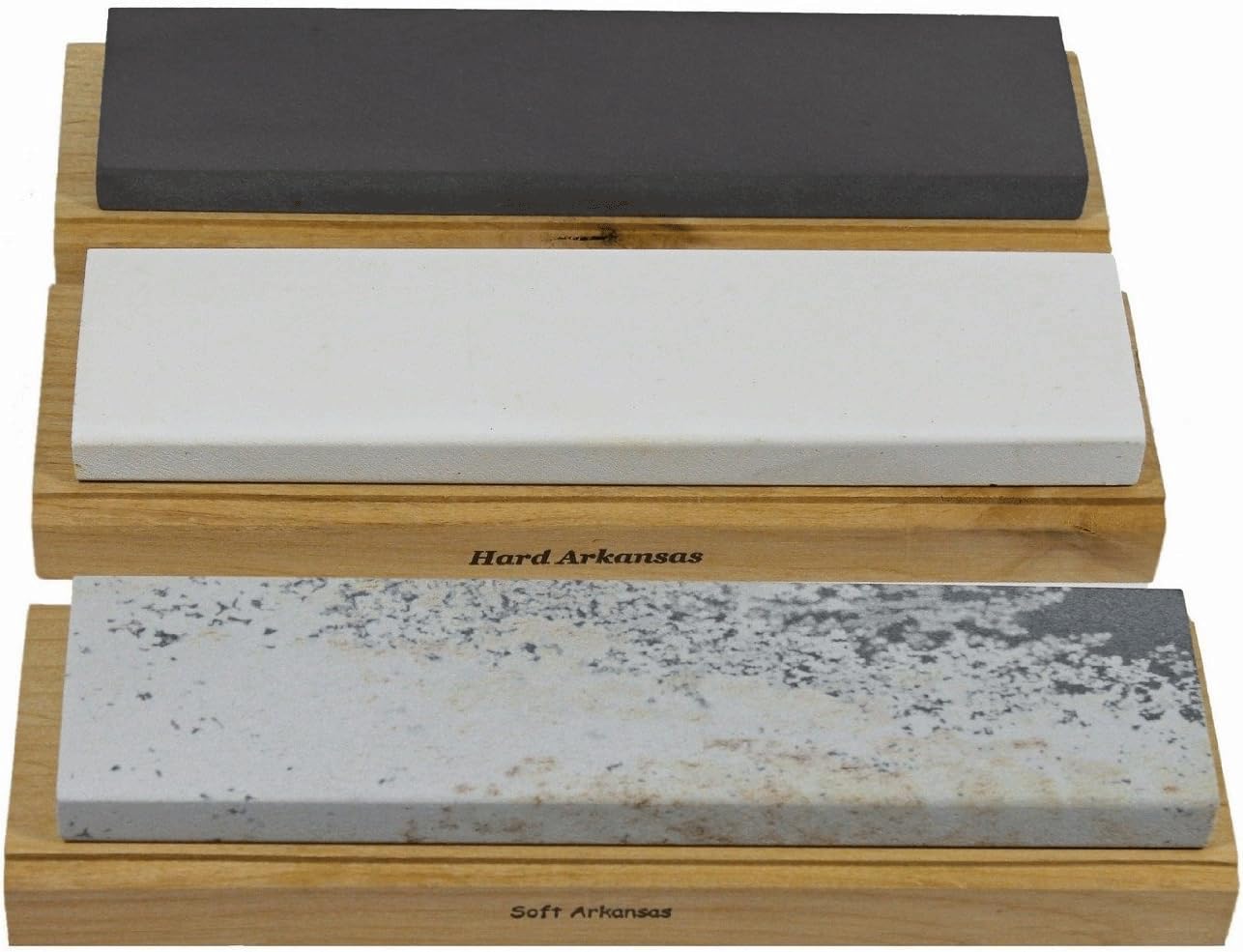
Three natural Arkansas stones in one wood-mounted set, from coarse through black extra-fine.
This is the traditionalist’s choice. You get three genuine Arkansas stones — soft, hard, and black — which map to coarse, fine, and extra-fine grits. That is a full progression in one set, letting you take a knife from blunt through to a refined edge across three separate stones. They come mounted in a wood base that holds them steady as a bench stone, and the set can be lifted out and used handheld if you prefer.
The natural stone angle is what sells it. Arkansas stones are dense and slow-wearing, and the feedback here centres on quality that holds up over time. Each stone is 10 inches in this version, a generous length for a full stroke across a chef’s knife or a Bob Kramer blade. It is made in the USA and backed by a lifetime guarantee, which for a set you will keep for decades is a meaningful promise.
The reality of natural stone is that it is not perfectly uniform. Reports occasionally note cracks or an uneven surface, so inspect yours on arrival. And a three-stone set rewards someone willing to learn the progression — it is overkill if all you want is a quick touch-up.
The artisan appeal: three natural Arkansas stones — soft, hard, and black — mounted in wood, made in the USA with a lifetime guarantee.
The natural-stone reality: each piece is its own stone, so an occasional crack or uneven face is possible — give it a careful once-over when it arrives.
For the patient sharpener: someone who loves the feel of natural stone and wants a coarse-to-extra-fine progression in one set.
Not ideal if: you want a single simple to use stone and have no interest in a three-step routine — this kit asks you to work through its stages.
13. Shun Combination Whetstone, 3000 & 6000 Grit

A high-grit finisher for Japanese knives — this one polishes, it does not repair.
The numbers tellyou exactly what this stone does: a 3000 side to restore a dulled edge and a 6000 side to refresh and polish the blade. There is no coarse grit here at all, which is deliberate — Shun built this for owners of Shun knives keeping an already good edge in pristine condition. Soak it in water before use, work the 3000 side, then move to the 6000 side for the final polish.
Stability is handled with an included rubber tray that holds the whetstone firmly in place, so the stone stays put while you draw the blade across it. The stone measures 7.5 inches long, 3 inches wide, and 1.5 inches thick. It ships as a combination piece with both grits permanently bonded into one block, and Shun backs it with a limited lifetime warranty.
Be clear-eyed about the fit. This is a maintenance and polishing tool for fine Japanese steel, and it will not touch a chipped or badly dulled Western blade — for that you need a coarser stone before you ever reach for this. It is also a niche purchase aimed at people already invested in Japanese knives. For a Shun owner keeping an edge in condition, the 6000 side delivers the polish a high-grit stone is meant for.
What it is built to do: a 3000/6000 pairing that maintains and polishes an already decent edge on fine Japanese steel, with a rubber tray keeping it steady.
Where it will not help: a chipped or heavily dulled blade needs a coarse stone first — this one refinishes, it does not repair.
Reserve this for: Shun and other Japanese knife owners who want a dedicated polishing stone alongside a coarser one.
Look past it if: you need a single all-purpose stone that handles a blunted kitchen knife.
14. SHARPAL 202H Precision Knife Sharpening System

A fully guided system that dials the angle from 10° to 35° and holds it on both sides.
This is the most complete kit in the group, and the angle range is the headline. You can fine-tune the sharpening angle anywhere from 10° to 35°, so the same setup suits a thin Japanese sujihiki edge and a thick cleaver. The distance-based angle setting keeps the edge-to-clamp distance fixed regardless of how wide the blade is, which removes the width-variation error that plagues traditional guided systems.
The abrasive count is generous, giving you a full progression from damaged steel to a finished edge. You get monocrystalline diamond plates (steel plates coated in diamond grit) in 220, 325, 600, and 1000 grit for everything from edge repair to a fine edge. Whetstone plates in 3000 and 6000 grit handle polishing, and a leather strop with green polishing compound delivers the final mirror finish. Dual sliding clamps hold blades of any length, and the flip mechanism keeps the same angle on both sides so the bevel (the angled cutting edge) stays uniform.
Two practical advantages stand out for anyone sharpening a lot. The heavy-duty metal construction with an anti-slip base keeps the whole rig steady during long sessions, and the rigid carry case keeps every piece organised and protected. The trade-off is angle adjustment, which some users find takes getting used to; it is a precise instrument that rewards a careful first setup. Once dialled in, it holds the angle reliably.
Why it covers so much ground
- Adjustable 10°–35° angle covers thin pocket knives to wide cleavers
- Diamond 220–1000, whetstone 3000/6000, and a leather strop with compound
- Flip mechanism keeps the angle identical on both sides
- Anti-slip metal base and rigid carry case included
Before you invest
- Angle adjustment takes a careful first setup to dial in
- More system than a casual cook who only touches up one knife needs
Made for: the enthusiast or professional who wants exact angle control and every grit from repair to mirror polish.
Consider simpler options if: you sharpen one knife occasionally and do not want a clamped system.
Know the Specs
What grit numbers mean
Grit is the size of the abrasive particles in the stone, and lower numbers are coarser. A 400-grit side removes steel fast and is used to repair chips and reset a dull edge. A 1000-grit side sharpens a working edge. A 3000 or 6000 side is a polisher — it refines and smooths an edge that is already sharp. This is why a stone that starts at 3000 cannot rescue a blunt blade; you work coarse to fine in sequence, never the other way round.
Water stones versus diamond plates
A water stone is a porous block — corundum, ceramic, or silicon carbide — that you soak before use; the slurry it sheds gives a smooth, controlled feel. A diamond plate is a steel plate electroplated with diamond crystals, needs no soaking, and stays flat because the diamonds sit on the surface. Water stones are softer and can dish out in the middle over time, so they need flattening. Diamond plates wear more slowly on flatness but the crystal layer itself has a finite life with heavy use.
Why a stable base matters
A stone that moves while you sharpen is the fastest way to round over an edge, because your angle changes mid-stroke. A silicone, rubber, or bamboo base keeps the stone planted so you can concentrate on a steady stroke. If the stone ships without one, plan to set it on a damp towel or buy a separate holder before your first session.
Freehand versus guided systems
Freehand sharpening means holding the blade at an angle by eye — cheap, fast, and quick to learn but hard to keep perfectly consistent. A guided system clamps the blade and holds the angle with rods or a pivoting head, so even a beginner produces an even bevel. Guided kits cost more and take a little setup, but they remove the single biggest source of a poor result: an angle that drifts.
Common Questions
Do I need to soak a sharpening stone before every use?
What grit should I start with for a dull kitchen knife?
Can a sharpening stone fix a chipped knife blade?
Are diamond sharpening plates better than water stones?
How do I stop my stone from sliding while I sharpen?
How long does a sharpening stone last?
Can I use oil on a water stone?
Is a guided sharpening system easier than freehand?
How do I know the stone will suit a large kitchen knife?
What does an angle guide actually do?
The Bottom Line
For most people, the best sharpening stones for knives pick is the Shapton K0702 #1000. A single medium grit that needs no soak and ships with its own holder gets a working edge back with the least fuss. If you want the fastest edge repair on chipped or damaged blades, reach for the DMT DuoSharp and its 325 and 600 diamond surfaces. And if you have never held a blade to a stone before, the Sharp Pebble kit hands you the angle guide so your first stroke already works.
How we choose
We do not accept paid placement. Every pick is matched to a real buyer and a real use-case; we do not hands-on test units.
Sources
Specifications: manufacturer listings and product documentation. Review insights: verified customer reviews, as of October 2026. Pricing: not shown on this page (it changes often); check the current price via the retailer link.
As an Amazon Associate, Aappliancez earns from qualifying purchases. This does not affect which products we feature.