Disclosure: Some links in this post are affiliate links. As an Amazon Associate I earn from qualifying purchases, at no extra cost to you. Learn more
Specs are compiled from manufacturer listings and verified buyer reviews and can change over time — please confirm the key details on the product page before buying.
Your first sewing machine should let you thread it, wind a bobbin, and sew a straight seam without wanting to quit on day two. The 11 machines below all clear that bar but trade off differently: more stitches, a bigger throat space (the gap between the needle and the machine body), or a build quality you can feel for years. They are sorted by what they actually do best.
This guide is built by comparing the manufacturers’ published specifications and the patterns across verified customer reviews, so you get each pick’s real strengths and trade-offs instead of marketing spin.
I’ve grouped these by who each machine suits so you can scan straight to the one that fits your workbench, your budget, and your patience for learning. The real difference between them isn’t the price tag — it’s the threading system and the frame underneath, where a beginner machine either grows with you or frustrates you.
Top Picks


How To Choose The Best Sewing Machine for a Beginner
Most beginners spend too long comparing stitch counts and not long enough on the two things that decide whether you keep sewing: how the machine threads, and whether the frame feels stable under your hands. A machine with 200 stitches is worthless if threading it takes you ten minutes every time.
Start with the threading system, not the stitch count
An automatic needle threader (a small built-in arm that pushes the thread through the needle’s eye for you) removes the single most common beginner frustration. A drop-in top bobbin means you place the bobbin in from above and follow a printed path — no reaching under the machine and guessing. Both features appear at every price tier here, so treat them as the baseline, not a luxury.
Understand the two numbers on any stitch list
You’ll see two different numbers thrown around. “Built-in stitches” is the number of stitch patterns physically on the machine. “Stitch applications” (or “stitch functions”) counts every pattern plus every width and length variation of it — so a machine with 32 built-in stitches and 110 stitch applications isn’t contradicting itself. The longer number is marketing-friendly; the shorter one is what you’ll actually scroll through.
Weigh the machine, literally
A heavier machine moves less while the needle punches through fabric, which is why the sturdier beginner models here sit in the 12 to 15 pound range. If you plan to pack the machine to a class or a friend’s house, a lighter body matters more than the stitch list — but a very light plastic frame can walk across the table on thick seams.
Side-by-Side Comparison
| Model | Best For | Built-In Stitches | Weight | Threading | Amazon |
|---|---|---|---|---|---|
| Brother XM3700★ Best Overall | First-timers who want it all spelled out | 37 | 12.5 pounds | Automatic needle threader, drop-in bobbin | Amazon |
| Janome JW8100Quilter’s Head Start | Quilting-ready from the first day | 100 | 12 pounds | Built-in threader, jam-proof drop-in bobbin | Amazon |
| Portable Sewing Machine (Nexgenz)Travel Kit | Sewing on the go with a starter kit | 12 | 4.2 pounds | Clear printed threading instructions | Amazon |
| Husqvarna Viking Jade 20 | Room for bulky projects | 82 | 10.5 kg | Built-in needle threader | Amazon |
| FEIYUE FYe330 | Slow, controlled stitching on delicate work | 25 built-in (105 applications) | 13.6 pounds | One-touch automatic threader | Amazon |
| Brother SM3701 | A compact second machine for the family | 37 built-in (74 functions) | 12.9 pounds | Self-threading mechanism | Amazon |
| Janome 2212 | Dial-driven simplicity, no screens | 12 | 14.9 pounds | Front-loading bobbin | Amazon |
| SINGER 4432 | Denim and canvas on a first machine | 32 built-in (110 applications) | 14.6 pounds | Standard threading with built-in features | Amazon |
| PooLin EOC02 | Computerized stitch picking plus a wide table | 200 | 7.5 kg | Automatic needle threader | Amazon |
| SINGER C5980Q Patchwork Plus | Quilters who want letters and decorative work | 200 built-in (417 applications) | 7.6 pounds | Standard threading, LCD-guided | Amazon |
| Bernette 38 | High-end features for a long-term machine | — | — | Automatic thread cutter and tie-off | Amazon |
Detailed Reviews
1. Brother XM3700 Sewing Machine 37 Built-in Stitches
Our pick — 4.5+★ from 950+ verified ratings; the strongest balance of quality and price.
The machine that hands a total first-timer every tool the job needs, already in the box.
Brother built the XM3700 around 37 built-in stitches (the actual pattern count stitched into the machine) plus a one-step auto-size buttonhole, so a first garment and a first buttonhole don’t need two machines. What wins people over is how simply it’s framed: it’s a basic machine, and that’s the compliment here. You get one obvious way to do each thing, no menu to fall into.
Threading it is the part most beginners dread, and this machine removes most of it. An automatic needle threader pushes the thread through the eye, and a jam-resistant drop-in top bobbin means you drop the bobbin in from above instead of fishing underneath. That’s a meaningfully easier start than a front-loading machine, where you reach into the bobbin case and hope. The five included feet — zigzag, zipper, blind stitch, buttonhole, and button sewing — cover the four jobs most people actually do. The free arm lets you slip cuffs, sleeves, and baby clothes over the end, and there’s free technical support from Brother by chat or phone for the life of the machine.
At 12.5 pounds it’s light enough to lift one-handed and heavy enough to sit still, and it’s corded electric at 120 volts for US outlets only. The honest catch: durability is the split opinion here — this is a machine that rewards being looked after, and a few have failed far sooner than they should. Buy it as a learning machine you’ll care for, not a commercial workhorse. As owners put it: “my first sewing machine and it works great! i’m a beginner and it’s perfect for me.”
37 stitch options
- Automatic needle threader plus a jam-resistant drop-in top bobbin removes the two hardest first-week jobs.
- 37 stitches with a one-step auto-size buttonhole, so a garment buttonhole is on the machine from day one.
- Five presser feet, three needles, a twin needle, and four bobbins all in one pouch.
- Free arm takes cuffs, sleeves, and baby clothes without wrestling the fabric.
- 12.5 pounds is light enough to move off the table by yourself.
no speed control
- Durability is the one recurring split — this is a cared-for machine, not a rough-use one.
- Figuring out which foot goes with which job takes a bit of manual-reading at first.
- The on-machine threading print has been called confusing by more than one owner.
- 120 volts and US-only, so check your outlet before buying.
first machine pick: the absolute beginner who wants to open a box and start a first project that evening, with a foot for basically every job already in there.
skip for quilting: you’re planning heavy daily production work — this one is happiest as a cared-for learning machine.
2. Janome JW8100 Computerized Sewing Machine with 100 Stitches
One hundred stitches, seven buttonholes, and a quilting kit already in the box.
If you know you’ll wander into quilting within the first year, the JW8100 saves you buying that gear later. It ships with 100 built-in stitches and 7 one-step buttonholes — compared with the 37 on the Brother XM3700, that’s more than double the pattern library before you’ve touched a setting. More importantly, the extras that a quilter usually buys separately are already in there: an extra-wide extension table, an even feed foot, and a ¼” quilting foot. That’s a real head start, not a bullet point.
Under the hood, a 7-piece feed dog system (the metal teeth that pull fabric forward from underneath) moves your fabric evenly, which is the difference between a flat seam and one that puckers on knits and layered material. The LCD screen plus a speed control slider let you dial the pace down while you’re learning, and a start/stop button lets you sew without the foot pedal at all. A built-in threader, needle up/down control, and a jam-proof drop-in bobbin round out the convenience side. The front drawer comes off to reveal the free arm for sleeves and tight spaces.
The build quality is the reason people pick this over cheaper machines — it’s metal-bodied at 12 pounds and sits firmly. The recurring gripe is small: the light could be brighter for fine work. More experienced hands also note you’ll want to be deliberate with thread choice, since a fussy thread can undo an otherwise smooth run. For a first machine you plan to keep and grow into, this is the one that doesn’t run out of features on you.
100 stitches onboard: extension table, even feed foot, and ¼” quilting foot included — the three add-ons most beginners end up buying within a year.
large footprint: the work light is functional rather than generous, so a clip-on lamp is worth adding if you sew fine details in a dim room.
quilter starter: a beginner with quilting ambitions who wants the accessories solved on day one and a computerized screen that shows the stitch as you choose it.
short on space: you want the absolute simplest dial-only workflow and no screen to learn.
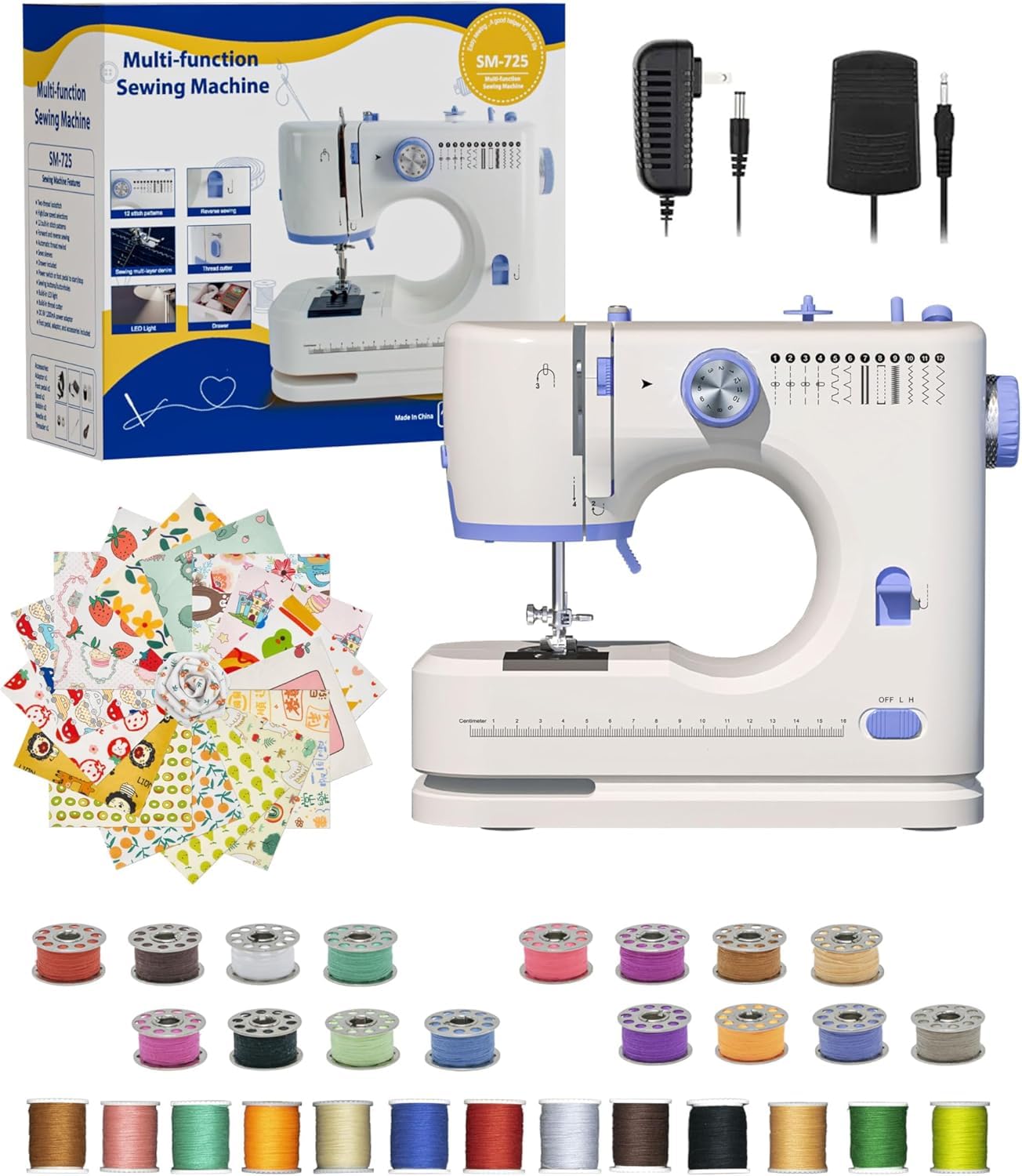
3. Portable Sewing Machine Beginner Kit with 12 Stitch Patterns
The machine you can carry to a class in one hand, with practice fabric already in the box.
At 4.2 pounds, this is the lightest thing in the lineup — the Brother XM3700 weighs 12.5 pounds by comparison, so this is the one that actually travels. It comes as a full starter kit: a 20-piece set of 7″ x 7″ practice fabrics in assorted patterns, plus a 32-piece thread kit. For someone who wants to learn on scraps before committing fabric, that’s a sensible package.
You get 12 stitch patterns including straight and decorative, plus reverse sewing to lock a seam. Power is flexible — a DC6V/1200mA input with either a foot pedal or a push-button switch, so you can sew hands-free or press-to-go. Threading instructions are printed clearly for a beginner, and the machine arrives with a bobbin and thread already set up. One useful quirk to know: with the switch set to “off” the foot pedal controls sewing, and “on” starts the machine sewing automatically — use the pedal while you’re learning for better control.
Set expectations honestly here. This is a mini plastic machine with 12 stitches and a 3.5+ star record over a small handful of early reviews — it’s for light practice, crafts, and quick repairs, not garment construction on heavy fabric. An occasional unit has arrived with a damaged box or missing pieces, so check the kit contents the moment it lands. Treat it as a training tool and travel companion, and it earns its place.
gift for newbies: you want a light practice machine to learn the motions, or you sew away from home and can’t haul a full-size body around.
heavy daily use: you plan to make real garments in medium or heavy fabric — step up to a full-size machine for that.
4. Husqvarna Viking Jade 20 Sewing Machine
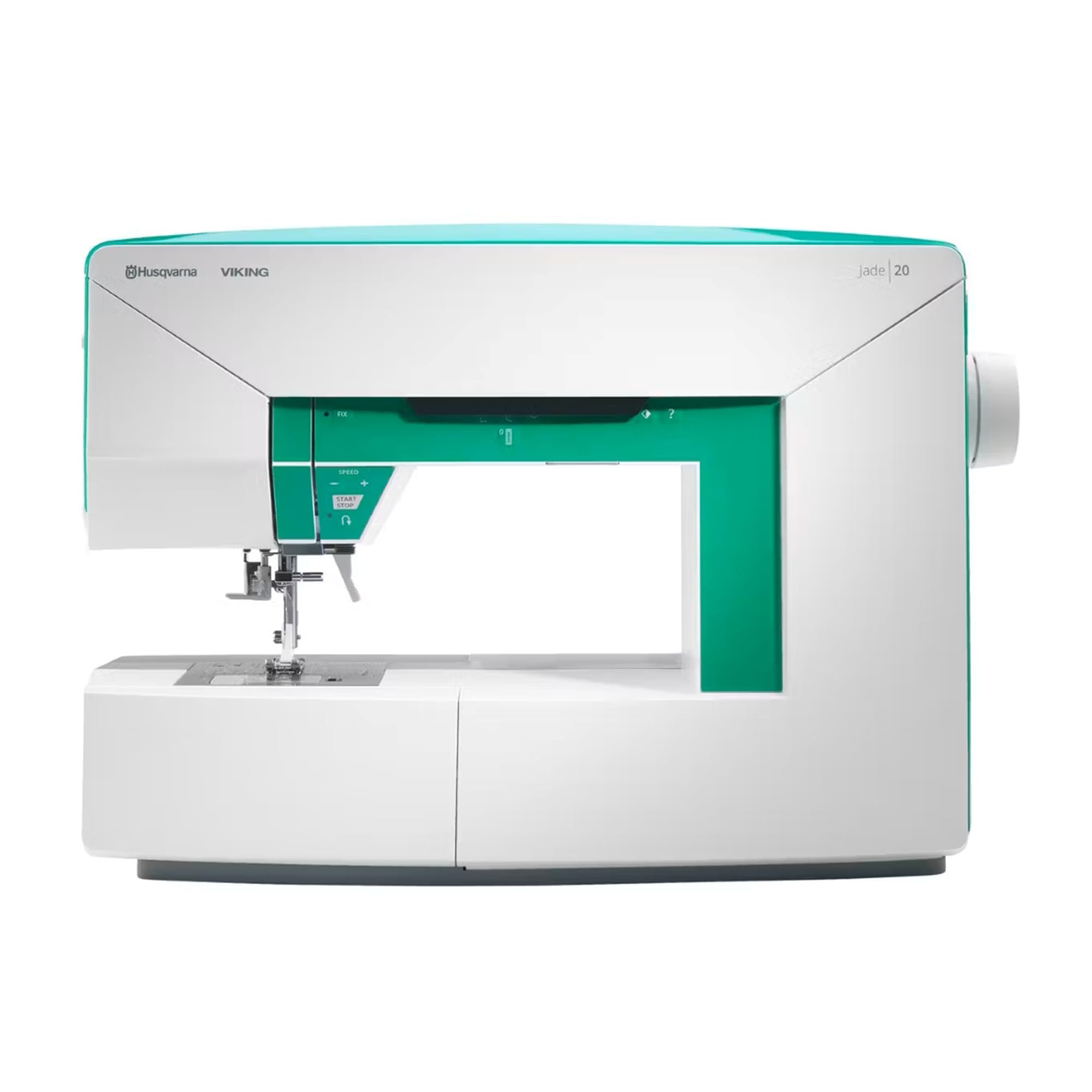
Eight inches of throat space and 82 wide stitches for anyone sewing bulky projects.
The number that matters here is 8 inches — that’s the sewing space to the right of the needle, the gap you feed fabric through. On a machine with a narrow throat, a quilt or a thick upholstery seam bunches up against the body; this one gives you room to push it through. Bright LED lighting sits over the needle so you can actually see the seam line, and 82 stitches at 7mm width give you broad decorative coverage.
Threading is a top-loading bobbin with a built-in needle threader, and there’s a start/stop function so you can sew without the foot control when you want a consistent speed through long seams or decorative runs. Extras include needle stop up/down, one-step buttonholes, drop feed teeth, mirror-image side-to-side, and 29 needle positions. Seven snap-on presser feet come with it, plus a dedicated accessory compartment.
Owner experience splits on one point: the machine itself is well regarded — quality is what people praise most — but needle insertion is the friction. Some find it very easy to use; others wrestle with swapping a needle, which needs a screwdriver and a clear view of a busy area. The reverse button also takes a deliberate press.
wide throat space: 8 inches of space right of the needle means a quilt sandwich or a thick seam has somewhere to go instead of bunching against the body.
pricey needles: needle changes take a screwdriver and a careful eye, and the reverse button needs a firm press — small frictions you’ll notice more in your first month than your second.
serious sewist: a beginner whose projects run bulky — upholstery, quilts, or thick seams — and who wants LED-lit visibility plus 82 stitches to grow into.
budget buyer: you want a machine you can thread and needle-swap blindfolded with zero fiddling.
5. FEIYUE FYe330 Home Sewing Machine with Foot Pedal

A servo motor built for ultra-low-speed control on delicate fabric and tight curves.
The FYe330 leads with its motor. A servo motor (one that holds its speed under load rather than running away) gives you real control at crawling pace — exactly what a beginner needs for curves and delicate fabrics. A reinforced metal frame and high-torque drive keep the stitch even when you slow things right down. There are 25 built-in stitches covering 105 stitch applications, and the one-touch automatic needle threader pushes the thread through for you.
The motor also has a smart-protection feature: on a thread jam or overload it pauses and flashes a warning so you can clear the jam before the needle takes damage. Six bobbins, three needles, and five presser feet are included, plus the foot pedal. It’s 13.6 pounds and corded electric at 120 volts.
The honest read is reliability. Owner opinion on quality is genuinely split, and a machine that won’t work properly has shown up more than once in the feedback. Some units have needed fixes for inconsistent stitch tension. A couple of owners also mention the auto-threader failing to catch or breaking thread, and one had the bobbin compartment come loose on arrival. This is a machine with a clever motor and a real feature set — just buy it knowing you may be relying on the return window if yours is a dud.
light mending: slow, controlled stitching on delicate fabric matters most to you, and the jam-protection pause sounds like the safety net you want.
thick fabrics: reliability is the recurring concern, so test it hard in the first weeks while you can still swap it.
6. Brother SM3701 37-Stitch Free Arm Sewing Machine

A small-footprint Brother with more features than its size suggests.
The SM3701 offers 37 built-in stitches and 74 stitch functions — the higher figure counts each pattern’s width and length variations. Five quick-change feet, a free arm for cuffs and sleeves, and a one-step auto-size buttonhole make it a genuinely complete package for a beginner. It’s 12.9 pounds in a compact 12″ wide frame, so it fits on a small table without eating your whole counter.
Where this machine shines is the physical layout. The larger top plate gives you a stable surface for flat work, and it lifts off to expose the free arm for hems, cuffs, and curves. The self-threading mechanism helps, though it’s best described as helpful rather than easy — the threader takes a bit of practice. Straight and decorative stitches switch with a turn of the knob, no scrolling through a screen.
One maintenance point a long-term owner raised: a heavy user found the machine seized after about ten months and needed an annual oiling to keep running smoothly. If you sew a couple of outfits a week, plan to oil it yourself — the procedure is documented on video and takes seven screws and a zoom-spout oiler. Treat that as routine care and the machine rewards you. The bobbin case cover also needs a small tool to open, which slows thread color changes slightly.
free arm access: a big flat top plate for everyday seams that pops off into a free arm for hems and cuffs — one body, two working setups.
needs oiling: heavy weekly sewing means an annual oiling to keep it running free, which is a small chore rather than a fault.
hem and cuff: a beginner with limited table space who wants real stitch variety and a removable free arm without a screen to learn.
maintenance averse: a bit of threading practice and routine oiling if you sew seriously — this machine likes being maintained.
7. Janome 2212 Sewing Machine

Twelve stitches, one dial, and a heavy metal-plastic frame that stays put.
The 2212 is a mechanical machine in the best sense: 12 built-in stitches and a four-step buttonhole on a dial pattern selector, with stitch width and length adjusted by hand. No screen, no menu, no learning curve beyond the dial. That’s the appeal if you want to spend your brainpower on fabric rather than on a manual. It’s 14.9 pounds, so it’s the heaviest thing in the middle of this list and it sits rock-still while you push fabric through.
Functionally it covers the beginner basics well. The free arm and drop feed handle a range of tasks, snap-on presser feet and a 5-piece feed dog keep fabric moving evenly, and there are two retractable vertical spool pins for efficient spooling. The front-loading vertical oscillating hook is the one part that takes getting used to — it’s a different bobbin routine than a drop-in machine, so read that section of the manual carefully. The push-pull bobbin winder and extra-high presser foot lift make the everyday routine easier.
This is a basic machine that simply works, and long-term owners back that up — the machine quality is what people praise most, with several running the 2212 for years without drama. The pedal is sensitive and coasts a few stitches after you lift your foot, so your first seams may run long until you learn the feel. Bobbin tension is the other split point: usually spot-on, occasionally too loose. Neither is a reason to avoid it — just plan a test seam before every real project.
simple repairs: you want a no-screen machine with a heavy frame, a dial for stitches, and the confidence of a long-running basic design.
stitch variety: front-loading the bobbin and a coasting pedal both take a first-day adjustment — budget an evening of practice before your first real seam.
8. SINGER 4432 Sewing Machine

A 1100-stitch-per-minute motor built to push denim and canvas through without stalling.
Most beginner machines treat thick fabric as an afterthought. The 4432 does the opposite — a high-performance motor the maker claims is 60% stronger than standard machines, running up to 1100 stitches per minute so denim, canvas, and multiple layers keep moving instead of stalling. You get 32 built-in stitches that expand into 110 stitch applications across basic, stretch, decorative, and repair work, plus a one-step buttonhole and a free arm. The included kit brings multiple presser feet, bobbins, needles, a seam ripper, a quilting guide, and a dust cover.
At 14.6 pounds it’s a substantial machine, and the feet are padded so it sits steady on a sewing table or a plain desk. It’s fine for a beginner who wants to learn directly on heavyweight material rather than upgrade later — that’s the trade you’re making. The one compatibility detail worth knowing before you buy: this machine wants SINGER needles, so your stash of other-brand needles for special fabrics may not fit.
Test your machine carefully in the first days. Buyers report a noisy, clunking unit where swapping the bobbin case and needle didn’t fix it, so sew a test seam and a buttonhole early and use it enough to know it’s healthy while returns are still open. The overall consensus, though, is a machine that takes multiple layers without complaint and runs smoothly across its speed range.
denim and canvas: a beginner whose real projects are denim, canvas, and layered work, and who wants speed plus a full accessory kit in one box.
delicate fabrics: check your needle stash — this one is happiest with SINGER needles, and run a test seam early to confirm yours is healthy.
9. PooLin EOC02 Computerized Sewing Machine with 200 Stitches
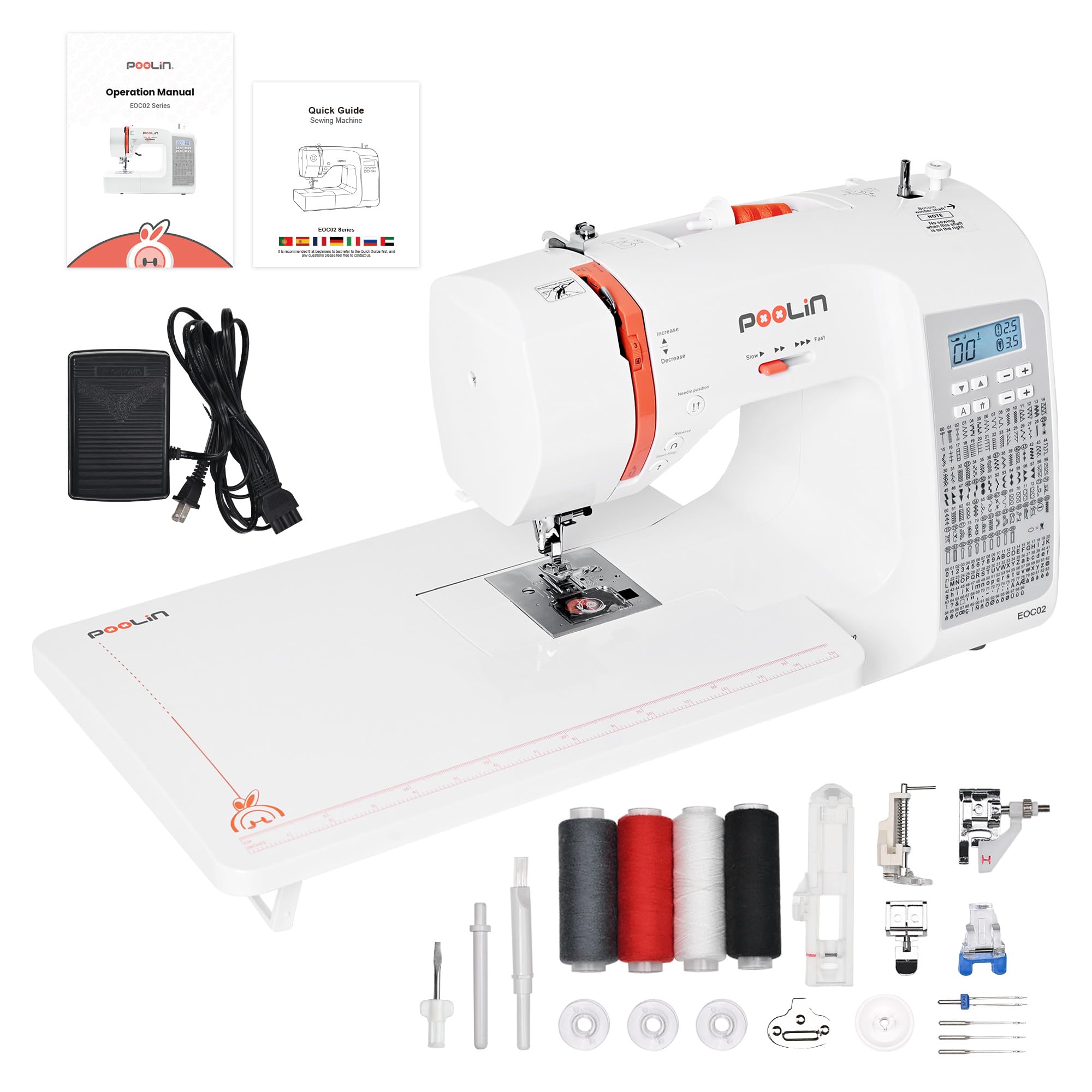
Two hundred stitches on an LCD screen, with a wide table for bigger projects.
The EOC02 is the machine to pick if the stitch list is what excites you. 200 built-in stitches — utility, decorative, and alphanumeric patterns — sit on an LCD screen, so you choose a stitch and the machine shows you the settings rather than making you decode a dial. Seven presser feet come with it, from basic straight stitching up through the specialized jobs, and a speed control slider lets you pace yourself.
The other practical win is the wide table. It gives you workspace for quilts and bulky material, and it detaches to reveal a free arm for cuffs, sleeves, and pant legs. Computerized conveniences include an automatic needle threader, a start/stop button for foot-free sewing, and a needle-position button that lifts the bobbin thread with one click. Different error prompts help you solve problems as they appear instead of guessing. It’s 7.5 kg, so it’s stable without being impossible to move.
Be clear about what this machine is and isn’t. It handles cotton, linen, denim, twill, and layered or quilted material up to 6mm thick, and stretch fabrics want a stabilizer for a clean stitch. But it is not a heavy-duty machine — it can struggle through three layers of dense fabric, and there are reports of zigzag stitches failing to advance. The good news is the support side: the maker offers step-by-step help through assembly, threading, and testing, and owners consistently call the customer service quick and thorough.
200 stitch library: 200 stitches on a clear LCD screen, seven feet, a wide table that detaches to a free arm, and one-click start/stop — a lot of machine to learn on.
screen menus: it handles up to 6mm of layered material and behaves on denim, but it’s not a heavy-duty machine for thick stacks.
tech minded: you want maximum stitch variety and a big work surface, and you’ll lean on the step-by-step support while you learn.
prefer dials: your projects are routinely thick multi-layer work — that’s the one place this machine runs out of headroom.
10. SINGER C5980Q Patchwork Plus Computerized Sewing Machine
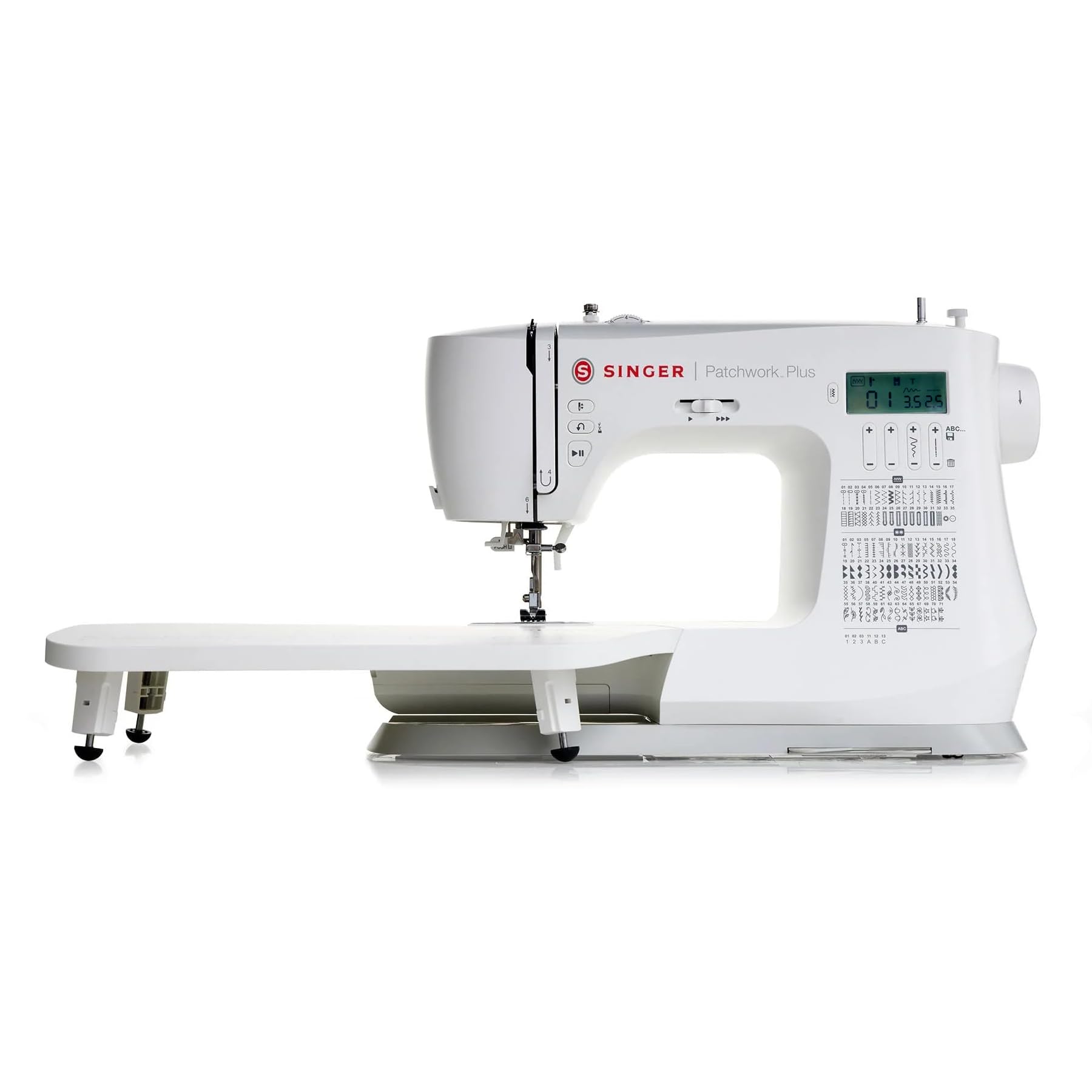
Letters, decorative work, and 417 stitch applications with a metal frame underneath.
The C5980Q is for the beginner who already knows they want to do decorative work — letters, monograms, quilting detail. It carries 200 stitches that expand into 417 stitch applications, which includes alphabets and fonts alongside the utility, decorative, and stretch stitches. An extension table is included for large quilts, and programmable needle up/down plus adjustable speed give you control for free-motion quilting and detailed stitching.
The frame is the quiet hero: a heavy-duty internal metal frame holds everything steady, and bright LED lighting illuminates the workspace so you can see the stitch line on any fabric. An LCD screen shows stitch selections and width and length settings. The accessory list is complete for starting out — all-purpose, zipper, buttonhole, and button-sewing feet, an edge/quilting guide, needles, bobbins, spool pins, a screwdriver, a seam ripper, and a soft dust cover.
Two small things to plan around. First, there’s no automatic tensioner — you’ll set tension yourself, which is a normal beginner skill but worth knowing. Second, the manual isn’t in the box; it lives on the maker’s site, and a downloadable version is now available through the Amazon product info, so take a minute to grab it before you sit down to sew. At 7.6 pounds it’s noticeably lighter than the metal-framed heavy-duty machines here, which makes it easier to move but slightly less planted on thick seams.
quilt blocks: the pattern-library machine — 417 stitch applications with fonts and a quilting table, for a beginner drawn to decorative projects.
quick fixes: no automatic tensioner and no printed manual in the box, so download the guide and learn tension control as part of the start-up routine.
11. Bernette 38 Swiss Design Computerized Sewing Machine

An automatic thread cutter and tie-off make this the machine that respects your time.
The feature that changes daily sewing on the Bernette 38 is the automatic thread cutter. Instead of pulling the work out and clipping every seam, the 38 snips the thread for you and the automatic tie-off locks the stitch — small conveniences that, done dozens of times a session, are the difference between a pleasant afternoon and a tedious one. Around that sit an intuitive LCD display, adjustable presser foot pressure (the downward force on the fabric) for adapting to different fabrics, and a basic serger stitch function (an overcasting stitch) for a professional finish.
This is the premium end of the list and it’s built like it. A metal body, an extension table for larger projects, a full accessory kit including needles, bobbins, spools, presser feet, and a foot hoop, and LED lighting that keeps the workspace bright. It takes on everything from delicate material to heavier textiles, and the machine quality is what people praise most. A long-term owner running several projects a week reports consistent, even stitches and a simple to use one-step buttonhole, with only periodic cleaning and oiling needed.
The trade-offs are real but specific. The foot lift is stiff and needs some arm strength, and the machine sits low enough that a tall sewer may hunch. It also uses plastic bobbins only — metal ones can damage it, so don’t mix your bobbin stash. This is a machine you buy to keep for years, and it rewards being read up on before you start; the manual genuinely matters here.
Swiss engineering: automatic thread cutting and tie-off on every seam, so you’re not clipping threads by hand all afternoon.
small buttons: a stiff presser-foot lift, a low working position, and a plastic-bobbins-only requirement — all manageable, none invisible.
design focused: you want a beginner-capable computerized model with the automatic thread cutter and build quality to last years, and you don’t mind learning it properly first.
tight budget: you want the simplest possible first machine with no manual reading — this one rewards a bit of study up front.
Know the Specs
Built-In Stitches vs Stitch Applications
“Built-in stitches” is the count of pattern designs physically on the machine — the Brother XM3700’s 37, the Janome JW8100’s 100. “Stitch applications” (or functions) counts those designs plus every width and length variation, which is how the SINGER 4432 reaches 110 from 32 built-ins. For a beginner, the built-in number is what you’ll scroll through on the dial or screen, so it matters more than the bigger inflated figure.
Needle Threading and Bobbin Loading
An automatic needle threader pushes the thread through the needle’s eye for you, and a drop-in top bobbin means you place the bobbin from above and follow a printed path. Both save the two tasks beginners find hardest. A front-loading machine like the Janome 2212 puts the bobbin in a case below the needle bed, which works fine but takes a little more practice. Either is fine — know what you’re getting so the first setup day doesn’t surprise you.
Common Questions
What stitch count should a true beginner start with?
Is an automatic needle threader worth insisting on for a first machine?
Drop-in top bobbin or front-loading bobbin for a beginner?
Can a beginner machine sew denim or canvas?
Do I need a foot pedal or does a start/stop button do the same job?
Will a heavy machine move less while I sew?
How often does a mechanical sewing machine need oiling?
Why do some machines list two different stitch numbers?
Can I use any brand of needle in a beginner sewing machine?
Does a computerized machine make learning to sew harder?
The Bottom Line
For most beginners, the sewing machine for a beginner that gets you sewing fastest is the Brother XM3700 — the automatic needle threader, jam-resistant drop-in bobbin, and 37 stitches with a one-step buttonhole mean a first project doesn’t stall on setup, and at 12.5 pounds it’s easy to lift onto the table. If you already know quilting is coming, the Janome JW8100 bundles the extension table, even feed foot, and ¼” quilting foot you’d otherwise buy separately. For heavyweight projects from day one, the SINGER 4432 runs denim and canvas at up to 1100 stitches per minute. And if you want to grow into a long-term machine, the Bernette 38 with its automatic thread cutter is the one to save for.
How we choose
We do not accept paid placement. Every pick is matched to a real buyer and a real use-case; we do not hands-on test units.
Sources
Specifications: manufacturer listings and product documentation. Review insights: verified customer reviews, as of October 2026. Pricing: not shown on this page (it changes often); check the current price via the retailer link.
As an Amazon Associate, Aappliancez earns from qualifying purchases. This does not affect which products we feature.