Disclosure: Some links in this post are affiliate links. As an Amazon Associate I earn from qualifying purchases, at no extra cost to you. Learn more
Specs are compiled from manufacturer listings and verified buyer reviews and can change over time — please confirm the key details on the product page before buying.
An exterior wood door takes more abuse than almost any other surface on your house. It faces driving rain, hours of direct sun, and constant swelling and shrinking as the seasons change. A penetrating sealer keeps water beading on the surface instead of soaking into the grain; a film finish that traps moisture leaves you sanding grey, peeling wood a year later. This guide covers the five sealers worth your time, sorted by what each one actually does best.
This guide is built by comparing the manufacturers’ published specifications and the patterns across verified customer reviews, so you get each pick’s real strengths and trade-offs instead of marketing spin.
You will see the difference between a film-building topcoat and a penetrating sealer, which one suits a south-facing door, and how much coverage a gallon really gives you. My goal is simple: help you pick the right sealant for exterior wood door on the first purchase.
Top Picks


How To Choose The Best Sealant for Exterior Wood Door
A door is a vertical surface, and that single fact changes what you should buy. Horizontal decks puddle water; doors shed it. Doors also sit in full sun on one face and deep shade on the other, so the coating has to flex as the wood moves. A sealer formulated for vertical exterior wood flexes with that movement and holds up for years between recoats.
Film-Building Finish or Penetrating Sealer
A film-building finish like polyurethane sits on top of the wood and forms a hard shell, which gives you a glossy, wipe-clean surface. A penetrating sealer soaks into the grain and shields the wood from the inside, so there is no shell to peel. Film finishes look sharper on a painted or stained door; penetrating sealers are far more forgiving on a door that already has some age to it.
How Much a Gallon Actually Covers
Coverage numbers assume smooth, prepped wood. A thirsty, sun-bleached door will pull far more product into the grain on the first pass, which is why experienced buyers buy enough for two coats. Treat the stated coverage per gallon as a best case for prepped wood, then buy enough for a second coat on a door that has not been sealed in years.
Clear Versus Tinted
A clear coat shows the wood exactly as it is, including every knot and grain line. A tinted sealer adds colour while still letting texture show through, and it also blocks more UV, which slows the grey. If you want the door’s grain and knots to show exactly as they are, go clear. If the boards are mismatched or sun-bleached patchy, a tint pulls them into one even tone.
Side-by-Side Comparison
| Model | Best For | Base | Finish | Stated Coverage | Amazon |
|---|---|---|---|---|---|
| Varathane Triple Thick Polyurethane Gloss★ Best Overall | Glossy hard shell on a prepared door | Water-based | Gloss | Up to 50 sq ft (quart) | Amazon |
| Thompson’s WaterSeal Transparent, Natural CedarBest Natural Look | Keeping the grain visible with a cedar tint | Water-based stain | Transparent | 150–400 ft²/gal | Amazon |
| Thompson’s WaterSeal Semi-Transparent, Chestnut Brown | Evening out a weathered or mismatched door | Water-based stain | Semi-Transparent | 150–400 ft²/gal | Amazon |
| Seal-Once Nano Clear Penetrating Sealer | Invisible protection that lets wood grey naturally | Water-based, polyurethane | Clear | — | Amazon |
| Ready Seal Stain & Sealer, Pecan | One-step stain and seal with no back-brushing | Oil-based | Oil | 125 sq ft per gallon | Amazon |
Detailed Reviews
1. Varathane Triple Thick Polyurethane Gloss Wood Finish
Our pick — 4.5+★ from 1,000+ verified ratings; the strongest balance of quality and price.
The one-coat shell that turns a tired door glossy and wipe-clean in an afternoon.
If your door is sound but dull, this is the pick that changes it fastest. The headline is one-coat coverage from a water-based formula, and that single pass gives you a thick, clear, high-gloss layer that resists scratches and stains. You get a film on top of the wood rather than a soak-in treatment, so the surface ends up smooth and easy to sponge down. A quart covers up to 50 sq ft, which is plenty for a standard door plus trim, and it dries to the touch in 2 hours — fast enough to get a second coat on the same day.
What wins people over is the finish quality. It self-levels as it goes down, so brush marks flatten out instead of setting in, and the gloss reads almost like a factory lacquer once cured. A buyer who ran it over an outdoor teak table found it “outperformed pricier products,” and the same reasoning applies to a front door that needs to look sharp from the street. This is also a genuinely water-based product, so clean-up is soap and water rather than solvent.
Here is the honest catch. Self-leveling results vary with technique, and the finish is only as even as your prep — sanding marks and old flaking layers will telegraph straight through a clear gloss. There is also a noticeable odour while it cures despite the water base, so plan to ventilate. And because this is a film, it is the least forgiving option if moisture ever gets behind it. On a door with existing rot or deep cracks, fix those first or skip this in favour of a penetrating sealer like the Seal-Once below.
What earns it the top spot
- One coat delivers a thick, clear gloss — no three-pass build-up
- Quick-drying enough to recoat in the same day
- Scratch and stain resistance on a high-traffic door face
- Up to 50 sq ft from a quart covers a door comfortably
Where it asks more of you
- Self-leveling is inconsistent without careful technique
- Strong odour during cure needs open windows
- Any existing rot or cracking should be fixed before coating
Best for: a sound, prepared wood door you want glossy and easy to clean.
Look elsewhere if: the wood is already weathered and grey — a penetrating sealer will serve you better.
2. Thompson’s WaterSeal Transparent Wood Stain and Sealer
A cedar-tinted waterproofing coat that lets texture show while it blocks the weather.
This one is for the door where you want to see wood, not lacquer. It is a transparent waterproofing stain and sealer in Natural Cedar, and the whole point is that it hides the grain lines but not the texture — so the wood still reads as wood. The coating uses fade-resistant polymers that resist UV damage, which is the part that matters on a door facing the sun all afternoon. Thompson’s states it meets ASTM D-4446, an industry standard for waterproofing wood, and a gallon covers 150 to 400 ft² depending on how thirsty the wood is.
You can apply it to damp or dry wood, so a rainy forecast won’t stall your project. A garden sprayer gives you an even coat over panel details. The brand’s water resistance has built a loyal following; one long-time buyer said, “I have used Thompson’s deck stain in light cedar for years.” Buyers repeatedly report a protective, water-shedding surface that holds up to weather.
The point to plan for is colour. “Natural Cedar” is not a wash of tint — it lands as a rich cedar tone, and on an already dark wood like mahogany it will shift the colour noticeably rather than barely touching it. If you want a truly invisible coat, this is not it; the Seal-Once below is the clear-minded alternative. Buyers also get the best result with a second coat on a sun-facing surface, so buy enough before you start.
The colour question: treat Natural Cedar as a real tint, not a whisper. It flatters lighter woods beautifully and darkens richer ones.
The trade-off: the transparent finish lets texture show through, which is exactly what you want on a wood door and exactly wrong if you were hoping to hide imperfections.
Reach for this if: you want a warm cedar tone with weather and UV protection on a wood door or its surrounding trim.
Think twice if: you need the wood’s exact colour unchanged — go with a clear penetrating sealer instead.
3. Thompson’s WaterSeal Semi-Transparent Wood Stain and Sealer

The even-out coat for a door that has gone patchy, grey, or mismatched over the years.
When a door has faded unevenly, a clear coat just highlights the mess. This Chestnut Brown semi-transparent finish covers the grain lines while letting texture through, so mismatched boards read as one deliberate colour. The polymers are fade-resistant and resist UV damage, and the gallon covers 150 to 400 ft² per coat. Like its Natural Cedar sibling, it clears ASTM D-4446 for waterproofing and will go on damp or dry wood, which gives you a wider working window.
Where this one really earns its place is on a rough or neglected surface. It soaks into grooves and evens out a weathered face instead of sitting on top of it. What the feedback keeps circling back to is how far a thin coat goes — this is a runny, stain-like consistency that rolls, brushes, or sprays on and cleans up with soap and water. For a door that has seen better days, apply it with a long-extension brush and you can reach the whole face without a ladder.
Two things to know before you open the can. First, the wet colour is not the dry colour — it dries several shades darker with a reddish cast, so test a hidden edge first. Second, a hot, sun-baked door often needs more than one pass to lock in full coverage; buyers who tried a single thin coat on an exposed deck found it drank the water back in after a season. This is the strongest argument for buying enough to do two coats on an exterior door.
What it fixes: patchy, sun-bleached wood looks intentional again under an even semi-transparent tint.
What to plan for: the colour shifts on drying, and a sun-facing door benefits from a second coat — budget the quantity up front.
A strong match for: weathered or mismatched wood that needs a consistent brown face.
Pass it over if: you love the raw grain of the door and want to keep every knot and board visible.
4. Seal-Once Nano Clear Penetrating Wood Sealer
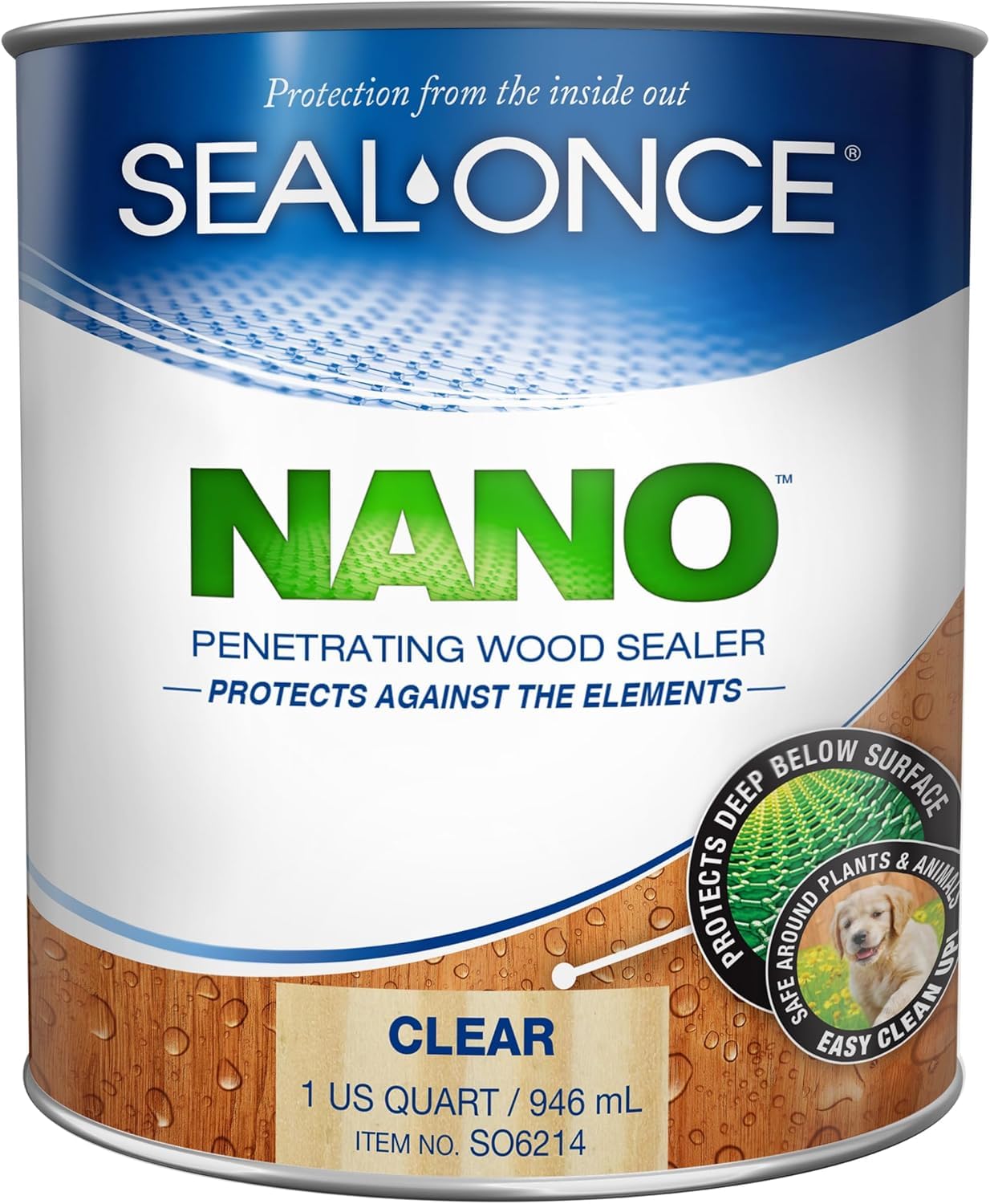
Clear protection that sinks into the grain instead of sitting on top of it.
This is the one to pick when you want the door to look untouched. Instead of forming a topcoat, the water-based formula penetrates below the surface to shield the wood from the inside, so there is no film to peel or flake. It is UV-stable and lets the wood grey naturally, which is the right move for someone who likes the weathered look but still wants to stop water damage. It is odorless, ultra-low VOC, and cleans up with soap and water.
The lack of a film is the real advantage on a door. A hard gloss shell can trap moisture if any gets behind it, while a breathable barrier lets the wood move. Buyers report water beading up after rain and running off the surface, and the wood tones coming through rather than being masked. If you ever plan to paint over the top, a buyer who sealed outdoor pine, waited a day, and then painted white house paint across it said it worked fine with a “good, clear, even layer.”
Because it soaks in rather than coating, how long it lasts depends heavily on the wood and exposure — the feedback runs the full range from several years of protection to wanting more for the money. This is not a colour product, so if your door is patchy, it will stay patchy. Set your expectations on coverage too; it is a premium quart, so measure the face before you start so you have enough for the second coat that penetrating sealers generally ask for.
Why it suits an older door
- Penetrates the grain instead of building a peelable film
- UV-stable clear finish lets wood grey on your terms
- Odorless and ultra-low VOC for easier indoor-adjacent work
- Soap-and-water clean-up keeps the job tidy
Where it demands patience
- No colour correction — patchy wood stays patchy
- Longevity depends on the wood and how much sun the door gets
- A premium quart, so plan for how many coats you need before you buy
Go this way if: you want the door to keep its natural look while gaining real water resistance.
Keep shopping if: you need to hide discolouration or want a film you can wipe clean — a tinted or gloss finish serves better.
5. Ready Seal Stain & Sealer for Wood, Pecan

Stain and seal in a single pass, with no priming, thinning, or back-brushing.
If the idea of a multi-step finishing job makes you put the door off for another year, this changes the maths. Ready Seal combines the stain and the sealer into one oil-based product, and the self-blending formula is designed to dry streak-free with no lap marks. UV and weather resistance are built in to guard against fading and water damage. One gallon covers 125 sq ft, which is enough for a door face plus a second coat if you are careful with quantity.
The Pecan tone gives you warmth without going too dark, so knots and grain still show where you expect them. A roller on a broom-handle extension lets you coat a door without a ladder, and the finish holds up under full-day sun. Buyers keep returning to how well it lasts in weather; one owner noted the deck was “very water-resistant initially and holds resistance well.” The oil base sinks in and weathers in place rather than flaking off.
The catch is colour variance. Oil-based stains pull differently on different wood, and a weeping knot or a board with high resin can throw an orange tone you were not expecting. Weathered wood also drinks the first coat fast, so the gallon may not stretch as far as the label suggests on an old door. Do a test patch on the door’s edge, and expect to spend more product on thirsty wood than the stated 125 sq ft implies.
The time-saver: stain and seal in one pass with no primer, thinning, or back-brushing — one product, one job, done.
The colour caveat: oil-based Pecan can pull orange on resinous or weathered boards, so test on a hidden edge before you commit to the full face.
Worth it if: you want a warmer stained tone and the weather protection in a single, no-fuss step.
Hold off if: you need an exact colour match or the door has wood that may pull orange — the tint is at the mercy of the grain.
Know the Specs
Penetrating Versus Film-Building
A penetrating sealer soaks into the grain and shields the wood from the inside, so there is no film to peel when a board swells and shrinks. A film-building finish like polyurethane sits on top and forms a hard, glossy layer, which wipes clean easily but is less forgiving if moisture gets behind it. On a door that swells and shrinks with the seasons, a penetrating sealer is the more flexible choice; on a freshly prepped door you want to look sharp, a film gives the cleaner finish.
What Coverage Per Gallon Really Means
Coverage figures such as 150 to 400 ft²/gal are measured on prepped wood in good condition. A dry, sun-bleached door soaks up far more product on the first pass, which is why the range is so wide and why buyers who do two coats often buy more than they expected. Treat the number as a best case for prepped wood, then add margin — especially if the door has not been sealed in several years.
Common Questions
Can I use a deck sealer on an exterior wood door?
How many coats does a front door need?
How long does an exterior wood door sealer last before you recoat?
Does a clear sealer stop the wood going grey?
Can I apply these sealers to damp wood?
What is the difference between transparent and semi-transparent?
Will a tinted stain change the colour of my wood door?
Do I need to sand the door before applying sealant?
How much sealer do I need for one door?
Is a gloss or a matte finish better on a front door?
The Bottom Line
For most doors, the best sealant for exterior wood door is the Varathane Triple Thick Polyurethane Gloss. One coat gives you a thick, clear, wipe-clean shell that resists scratches and stains on a sound door. If you want to keep the wood’s natural look, the Seal-Once Nano Clear Penetrating Sealer sinks into the grain and protects from the inside instead. And for a door that has gone patchy and needs an even tone, the Thompson’s WaterSeal Semi-Transparent Chestnut Brown does the job in a thin, weather-resistant coat.
How we choose
We do not accept paid placement. Every pick is matched to a real buyer and a real use-case; we do not hands-on test units.
Sources
Specifications: manufacturer listings and product documentation. Review insights: verified customer reviews, as of October 2026. Pricing: not shown on this page (it changes often); check the current price via the retailer link.
As an Amazon Associate, Aappliancez earns from qualifying purchases. This does not affect which products we feature.